







 Publish to Newswire
 Add an Event
No Nukes Action - In San Francisco June 10th, Interview with Umi Hagitani

Hear Umi Hagitani this Thursday from 2:00 pm to 3:00 pm on the Community Currency radio show on the Progressive Radio Network or join her this Friday from 3:30 pm to 5:30 pm at the Japanese Consulate in San Francisco, 50 Fremont Street (between Mission and Market). The rally will also march on to Bechtel (50 Beale St. San Francisco), to rally against Nuclear Power and in solidarity with the Japanese people. The San Francisco rally will be one of many taking place worldwide in response to an appeal from the people of Japan. (The rally held at 2 pm June 11th, 2011 in Japan will be streamed live on Labor Net TV.)
After the Fukushima disaster, people began raising their voices against nuclear energy and weapons in Japan and throughout the world. Germany and Switzerland responded with the announcement of the closure of their nuclear power plants. Following two major protests in April 10 and May 7, Japan requested the shutting down of one of the oldest and most dangerous nuclear plants – Hamaoka.
Umi Hagitani started working with Todos Somos Japan Collective, (A response to the global uprising and catastrophic situation in Japan whose intention is to translate, quote and analyze as much information as possible from Japanese into English, and translate encouragements, comments, suggestions, analysis, proposals and anything written in English into Japanese for the vantage point of the people struggling there and everywhere.) and No Nukes Action Committee which organized the June 7th rally at the Japanese Consulate in San Francisco and is organizing a June 10th Anti-Nukes Rally at the Consulate General of Japan, 3:30 pm - 5:30 p-m 50 Fremont Street, San Francisco, in solidarity with the Japanese people's call for actions worldwide, as well as a petition to End Japan's Nuclear-Military-Industrial Complex throughout the world.
Umi Hagitani was born in Tokyo and raised in Yokohama. She quit school at age 10 and personally experienced the violent attacks toward non-schoolers in early '90s. She began working for children and people's education outside of the school structure. After participating in the Feminist Queer Unit Against G8 in 2008, she began organizing against both institutional and interpersonal violence. She is a student at SF State majoring in Women and Gender Studies with a hint of Ethnic Studies, a comic writer, and a rape crisis counselor at San Francisco Women Against Rape. She also creates political art. No Nukes Art is being shared freely in solidarity with the global effort to halt the nuclear industry.
The No Nukes Action Committee's petition aims are broader than just shutting down nuclear power plants and calls for:
1. The closure of all nuclear plants in Japan, as Germany and Switzerland are preparing to do;
2. The full compensation of all workers and affected communities for their health and loss of employment due to this man-made catastrophe; 3. The criminal prosecution of all TEPCO and government officials who are shown to have engaged in a criminal cover-up of the explosions and leakage of nuclear material; 4. An end to the sale of nuclear power equipment and supplies in Japan, and support by the Japanese government for an end to nuclear power worldwide; 5. The formation of a citizens’/workers’ commission which will conduct an independent investigation of the causes of this accident, and investigate who is responsible for the systemic cover-ups by TEPCO and government officials which have prevented proper oversight and supervision of these plants and industry; 6. The widespread distribution of geiger counters,whole body counters and food radiation detectors; 7. The repeal of the 20mSv rule for children and the immediate evacuation of children and pregnant women from all affected areas; 8. Not using this disaster as an excuse to delay the removal of US forces from Okinawa, and an end of plans for the militarization and use of bases in Jeju Island in South Korea and Guam; 9. An end to uranium mining in the U.S. and abroad (India, Jabiluka in Australia); 10. An end to plans for nuclear waste dumping in Mongolia and the U.S.; 11. An end to the practice of the nuclear industry absorbing labor from marginalized communities (zainichi, baraku, indigenous people); and 12. A full accounting of all the economic costs of uranium mining and waste disposal globally. Community Currency radio show is hosted by Carol Brouillet, who edited The Invisible Nuclear War and more recently wrote Into Eternity - Nuclear Past, Present, and Future. This show will be archived at Progressive Radio Network.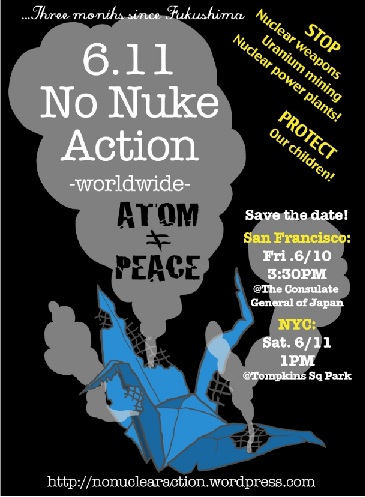
Donate

$95.00 donated
in the past month
Get Involved
If you'd like to help with maintaining or developing the website, contact us.
Publish
Publish your stories and upcoming events on Indybay.