







 Publish to Newswire
 Add an Event
Peak Minerals: Australian Report warns of Mineral Resource Depletion
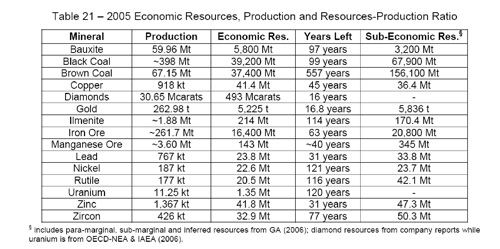
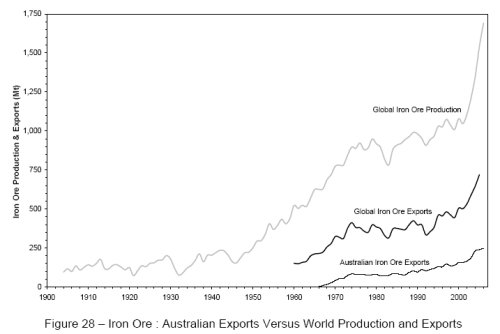
The report was presented at the Minerals Council of Australia Sustainable Development Conference in Cairns, 30 October to 2 November 2007, and is the first comprehensive analysis of Australian mineral production figures gathered since the beginning of the mining industry.
According to quantitative evidence gathered in the report on various mining trends:
- Ore grades continue to decline – meaning more rock needs to be mined to maintain production;
- Solid wastes are increasing exponentially – such as tailings and waste rock – which increases the environmental burden of metal and mineral production;
- Economic resources for many key strategic minerals appear to have plateaued (eg. coal, iron ore); some minerals have gradually increased (eg. gold, copper) over time but this is proving harder to maintain as ore grades decline and deposits move deeper.
Mining in future will involve a much larger environmental footprint including higher energy, waste, chemicals consumption and greenhouse emissions.
"We are extracting and exporting minerals faster than ever before, with plans to increase output," said Dr. Gavin Mudd, author of the report and lecturer and course director in environmental engineering at Monash University in Melbourne. "This trend is already placing a huge burden on the Australian environment – a burden which looks set to increase significantly. We can see the nation racing to the peak of economically available resources with little consideration of the consequences once this point is passed."
Dr Mudd said the statistics were alarming. "On average, 27 tonnes of greenhouse emissions are created to mine a tonne of uranium. That's equivalent to the annual emissions of nine family cars. To mine one kilogram of gold it takes 691,000 litres of water, and it takes 141 kilograms of cyanide to produce a single kilogram of gold.
"There is often talk about sustainable mining, but our latest body of research shows that minerals are being mined at an alarming rate, mining companies have to work harder to source it, and as a result the environmental costs of the process and clean-up are rising exponentially.
"If we were to project these key trends just 40 years into the future, we would find that to source the same amount of minerals would require a new Pilbara to be found or a new Mt Isa or Broken Hill - and that's unlikely.
"It takes a minimum of two million tonnes of solid waste to produce a single kilogram of gold. Copper produces around 250 tonnes of solid waste per tonne of copper while uranium produces about 2,400 tonnes of low-level radioactive waste per tonne of uranium oxide."
The report has been criticised by Queensland Resources Council (QRC) chief executive Michael Roche who told the ABC "What we're seeing around the state of Queensland, around Australia are many new projects coming online. World prices are holding up strongly because of demand," he said. "There's absolutely no shortage of demand for our product. What the study seems to be suggesting is that we're going to have a supply problem. It's simply nonsense."
But Dr Mudd criticised the lack of long term strategic assessment by national and international authorities to examine the real sustainability of material resources. "More than 50 per cent of land disturbed by mining has not yet been properly rehabilitated." he said.
The report has been published by the independent policy research thinktank, the Mineral Policy Institute, and is titled The Sustainability of Mining in Australia: Key Production Trends and Their Environmental Implications for the Future. (Download PDF). The Mineral Policy Institute is urging government and industry to take more seriously the long term implications of the increasingly rapid depletion of a range of once vast mineral resources that have underpinned Australia’s strength and economic security.
"Whether you look at it from an economic, strategic, social or environmental perspective, the unfettered expansion of mineral extraction in Australia is a development strategy that is fatally flawed," said James Courtney, researcher with the Mineral Policy Institute.
Sources:
- Mineral Policy Institute Media Release, November 1, 2007 - PEAK MINERALS: Ground breaking report warns of resource depletion
- Monash University Press Release October 30, 2007 - Warning: The mining boom is fading fast
- ABC Nov 6, 2007 - Resource Council rejects mining decline prediction
Donate

$95.00 donated
in the past month
Get Involved
If you'd like to help with maintaining or developing the website, contact us.
Publish
Publish your stories and upcoming events on Indybay.