







 Publish to Newswire
 Add an Event
From the Open-Publishing Calendar
From the Open-Publishing Newswire
Indybay Feature
Arctic ice melt to threaten Florida, scientists say
TORONTO - The pace of the Arctic ice melt is accelerating, proving climate change is occurring more rapidly than previously thought, scientists say.
Arctic ice melt to threaten Florida, scientists say
Last Updated Mon, 08 Nov 2004 21:33:22 EST
TORONTO - The pace of the Arctic ice melt is accelerating, proving climate change is occurring more rapidly than previously thought, scientists say.
The development threatens to raise global water levels and submerge low-lying regions around the world, including parts of Florida and already flood-prone Bangladesh.
This also throws in doubt the survival of numerous species of animals, and of the fragile cultures of northern aboriginal peoples around the world, says a new study.
The grim assessment is the conclusion of the Arctic Climate Impact Assessment, a study being published Tuesday at the International Scientific Symposium on Climate Change in Reykjavik, Iceland.
More than 300 scientists from 15 countries – including Canada – and six aboriginal groups have contributed to the four-year study measuring how fast the Arctic is warming up.
It suggests the Arctic is warming at twice the global average rate and temperatures there could be 4-7 degrees Celsius higher by 2100. Siberia and Alaska have already warmed by 2 to 3 degrees since 1950.
The report suggests summer sea ice around the North Pole may almost disappear by the end of the century. Ice around the pole has already receded by about 15 to 20 per cent over the last 30 years, and the ice melt, increasing rain and receding permafrost are likely to raise sea levels in future, according to the report.
Robert Correll, the American chair of the International Arctic Science Committee, says, "Assuming that the climate does warm at about three degrees centigrade, which is kind of in the middle of all the projections we have, we believe ... we're talking about the sea level rising at rate of about a metre every 50 years or so."
That's a much faster rate than previously thought. The problem, the report says, is everyday greenhouse gas emissions from industries and activities such as burning fossil fuels.
Foreign ministers of the eight-nation Arctic Council, which includes Canada and the United States, are due to meet to discuss the report on Nov. 24 in Reykjavik. But there are reports of deep divisions on the council on environmental issues and on treaties such as the Kyoto Protocol for cutting greenhouse gas emissions, which the U.S. has declined to support .
Scientists predict the marine environment is likely to change the most. The number of species dependent on sea ice, including seals and polar bears, could decline. Some could even become extinct.
Under the scenario described in the assessment, the polar bear is "unlikely" to survive, while land-based northern species including caribou, muskox and reindeer would find their habitats severely reduced.
Robert Correll
The report has already caught the attention of Inuit groups, who fear the rapidly melting ice will mean trouble for their way of life. The Inuit rely on a cold climate and the species who thrive in it for food, shelter and clothing.
"From my point of view the powerful message is that the Arctic is really impacted, and the people are really impacted — but this is a global phenomenon," Correll says. He argues the Arctic is the way to understand what is happening to the rest of the world.
Correll says the impact of rising water levels could be devastating.
"It will eliminate about the lower 15 or 20 per cent of Florida." An extra metre of water, he says, "will eliminate 40 per cent of the land mass of Bangladesh."
Inuit leaders say the global effort to battle Arctic climate change should start in Canada. They are calling for Ottawa to make changes, including cutting greenhouse gas emissions to below levels already agreed to under the Kyoto Protocol.
Written by CBC News Online staff
Last Updated Mon, 08 Nov 2004 21:33:22 EST
TORONTO - The pace of the Arctic ice melt is accelerating, proving climate change is occurring more rapidly than previously thought, scientists say.
The development threatens to raise global water levels and submerge low-lying regions around the world, including parts of Florida and already flood-prone Bangladesh.
This also throws in doubt the survival of numerous species of animals, and of the fragile cultures of northern aboriginal peoples around the world, says a new study.
The grim assessment is the conclusion of the Arctic Climate Impact Assessment, a study being published Tuesday at the International Scientific Symposium on Climate Change in Reykjavik, Iceland.
More than 300 scientists from 15 countries – including Canada – and six aboriginal groups have contributed to the four-year study measuring how fast the Arctic is warming up.
It suggests the Arctic is warming at twice the global average rate and temperatures there could be 4-7 degrees Celsius higher by 2100. Siberia and Alaska have already warmed by 2 to 3 degrees since 1950.
The report suggests summer sea ice around the North Pole may almost disappear by the end of the century. Ice around the pole has already receded by about 15 to 20 per cent over the last 30 years, and the ice melt, increasing rain and receding permafrost are likely to raise sea levels in future, according to the report.
Robert Correll, the American chair of the International Arctic Science Committee, says, "Assuming that the climate does warm at about three degrees centigrade, which is kind of in the middle of all the projections we have, we believe ... we're talking about the sea level rising at rate of about a metre every 50 years or so."
That's a much faster rate than previously thought. The problem, the report says, is everyday greenhouse gas emissions from industries and activities such as burning fossil fuels.
Foreign ministers of the eight-nation Arctic Council, which includes Canada and the United States, are due to meet to discuss the report on Nov. 24 in Reykjavik. But there are reports of deep divisions on the council on environmental issues and on treaties such as the Kyoto Protocol for cutting greenhouse gas emissions, which the U.S. has declined to support .
Scientists predict the marine environment is likely to change the most. The number of species dependent on sea ice, including seals and polar bears, could decline. Some could even become extinct.
Under the scenario described in the assessment, the polar bear is "unlikely" to survive, while land-based northern species including caribou, muskox and reindeer would find their habitats severely reduced.
Robert Correll
The report has already caught the attention of Inuit groups, who fear the rapidly melting ice will mean trouble for their way of life. The Inuit rely on a cold climate and the species who thrive in it for food, shelter and clothing.
"From my point of view the powerful message is that the Arctic is really impacted, and the people are really impacted — but this is a global phenomenon," Correll says. He argues the Arctic is the way to understand what is happening to the rest of the world.
Correll says the impact of rising water levels could be devastating.
"It will eliminate about the lower 15 or 20 per cent of Florida." An extra metre of water, he says, "will eliminate 40 per cent of the land mass of Bangladesh."
Inuit leaders say the global effort to battle Arctic climate change should start in Canada. They are calling for Ottawa to make changes, including cutting greenhouse gas emissions to below levels already agreed to under the Kyoto Protocol.
Written by CBC News Online staff
For more information:
http://www.agiweb.org/gap/legis108/climate...
Add Your Comments
Comments
(Hide Comments)
Testimony of Sheila Watt-Cloutier
Chair, Inuit Circumpolar Conference
Senate Committee on Commerce, Science and Transportation
Washington DC, September 15.
Good morning. My name is Sheila Watt-Cloutier. I am the elected Chair of the Inuit Circumpolar Conference which represents internationally the 155,000 Inuit who live in Alaska, Canada, Greenland and Chukotka, Russia. I want to thank the Chair, Senator McCain, and all members of the committee for the invitation to speak with you.
I provided written testimony to this Committee last spring, and I am here today, having made the trip to Washington DC from my home in Iqaluit, Nunavut, the new territory in the Canadian Arctic, because I believe that we find ourselves at the very cusp of a defining moment in the history of the planet. The earth is melting and we must all come together to do the right thing to address Climate Change.
While global warming is affecting the entire planet, there is a scientific consensus that it is impacting the Arctic much faster. Our elders having been experiencing these changes since the mid-1970's. The Inuit connection to the environment remains strong, and many of us still depend upon the land and sea to sustain our families. Our elders and hunters have intimate knowledge of the land, sea ice, and have observed disturbing changes to the Arctic Climate and environment, and to the wildlife. These changes include:
melting permafrost causing beach slumping and increased erosion and damaging infrastructure;
longer sea-ice free seasons;
new species of birds and fish-barn owls, robins, pin-tailed ducks and salmon invading the region;
invasion of mosquitos and blackflies;
unpredictable sea-ice conditions;
glaciers melting, creating torrents in place of streams.
Our observations are confirmed by western science in the Arctic Climate Impact Assessment (ACIA) which is to be presented to Ministers of Foreign Affairs of the eight Arctic states in November. Let me quote two key conclusions from the summary volume of the ACIA:
Marine species dependent on sea-ice including polar bears, ice living seals, walrus, and some marine birds are very likely to decline, with some facing extinction; and
For Inuit, warming is likely to disrupt or even destroy their hunting and food sharing culture as reduced sea-ice causes the animals on which they depend to decline, become less accessible or possibly go extinct.
I remind you that the ACIA is the most comprehensive regional Climate Change assessment ever undertaken. Over 300 Scientists and many indigenous peoples of the Arctic actively participated in this assessment. It states that our ancient connection to our hunting culture may well disappear, and within my grandson's lifetime.
My culture continues to see us through much tumultuous change. This change has resulted in confusion and despair--and all too often in early death for our young people from suicides and addiction.
Inuit face many challenges in finding our place in the new world order of globalization. A place that affords us self-respect and security, and in which we also contribute to the well-being of others. Notwithstanding our struggles and our limited numbers, we Inuit do have a significant role to play globally. Especially now with the threat of climate change to our entire way of life, we need to capture the world's attention and conscience. Climate change is happening first and fastest in the Arctic. My homeland-the Arctic-is the health barometer for the planet.
By looking at what is already happening in remote Inuit villages in Alaska, such as Shismaref and Kivalina, you can understand the future dangers for more populated areas of the world such as Florida, Louisiana or California. Shismaref is literally being battered to the point of falling into the sea.
If we can reverse the emission of climate change inducing greenhouse gases in time to save the Arctic from the most devastating impact of global warming, then we can spare untold suffering for hundreds of millions of people around the globe. Protect the Arctic and we Save the Planet. Use us in the Arctic as your early warning system.
In the 1940s, you, the Americans, set up a defense early warning system throughout the North American Arctic called the DEW line-short for Defense Early Warning. It is now time for another DEW line-Defense Environmental Warning--against climate change.
Global warming connects us all. Use what is happening in the Arctic-the Inuit Story-as a vehicle to re-connect us all, so that we may understand that the planet and its people are one. The Inuit hunter who falls through the depleting and unpredictable sea- ice is connected to the cars we drive, the industries we rely upon, and the disposable world we have become.
I ask you to look seriously at the Arctic for solutions to the global debate on Climate Change. More specifically I ask you to look at the role your Department of State is playing in the Arctic Council's Arctic Climate Impact Assessment process. This assessment has been largely paid for by the United States, which has also provided an assessment secretariat based at the University of Alaska at Fairbanks. Bob Corell of Harvard University and the World Meteorological Institute has done a superb job of Chairing the exercise.
The assessment is path-breaking and it is crucial that the world know and understand what it says. Yet the Department of State is minimizing and undermining the effectiveness of this assessment process by refusing to allow policy recommendations to be published in a stand alone form just like the assessment itself. Yet, this is what ministers of foreign affairs directed when, in Barrow Alaska in October 2000, they approved the assessment. I wrote to the Arctic Council chair last week about this, and have copies of this correspondence for the committee.
In closing, I grew up in the small community of Kuujjuaq in the Ungava Bay in northern Quebec and traveled by dog team for the first ten years of my life. Americans played a very important role in the history of my community. During the second world war many Inuit were starving, caught in a transition between a nomadic way of life and moving into a settled community. At that time, when most Inuit thought they had been totally forgotten, the Americans arrived to build airstrips, bringing with them jobs for the men, and supplies and food for the community. They came through for us during those challenging times in a very big way. Until her death two years ago, my mother always stated: "we would not have pulled through if it were not for the arrival of the Americans".
The Inuit once again need your help in these challenging times. The ACIA projects the end of Inuit as a hunting culture that has sustained us for millennia. Come back to help us. I have already said that what is happening in the Arctic is a snapshot of the future of the planet, and that, indeed, we are all connected. Climate change is a matter of the survival of humanity as whole. It is the most pressing global issue we face today. Protect the Arctic and we will save the planet.
Chair, Inuit Circumpolar Conference
Senate Committee on Commerce, Science and Transportation
Washington DC, September 15.
Good morning. My name is Sheila Watt-Cloutier. I am the elected Chair of the Inuit Circumpolar Conference which represents internationally the 155,000 Inuit who live in Alaska, Canada, Greenland and Chukotka, Russia. I want to thank the Chair, Senator McCain, and all members of the committee for the invitation to speak with you.
I provided written testimony to this Committee last spring, and I am here today, having made the trip to Washington DC from my home in Iqaluit, Nunavut, the new territory in the Canadian Arctic, because I believe that we find ourselves at the very cusp of a defining moment in the history of the planet. The earth is melting and we must all come together to do the right thing to address Climate Change.
While global warming is affecting the entire planet, there is a scientific consensus that it is impacting the Arctic much faster. Our elders having been experiencing these changes since the mid-1970's. The Inuit connection to the environment remains strong, and many of us still depend upon the land and sea to sustain our families. Our elders and hunters have intimate knowledge of the land, sea ice, and have observed disturbing changes to the Arctic Climate and environment, and to the wildlife. These changes include:
melting permafrost causing beach slumping and increased erosion and damaging infrastructure;
longer sea-ice free seasons;
new species of birds and fish-barn owls, robins, pin-tailed ducks and salmon invading the region;
invasion of mosquitos and blackflies;
unpredictable sea-ice conditions;
glaciers melting, creating torrents in place of streams.
Our observations are confirmed by western science in the Arctic Climate Impact Assessment (ACIA) which is to be presented to Ministers of Foreign Affairs of the eight Arctic states in November. Let me quote two key conclusions from the summary volume of the ACIA:
Marine species dependent on sea-ice including polar bears, ice living seals, walrus, and some marine birds are very likely to decline, with some facing extinction; and
For Inuit, warming is likely to disrupt or even destroy their hunting and food sharing culture as reduced sea-ice causes the animals on which they depend to decline, become less accessible or possibly go extinct.
I remind you that the ACIA is the most comprehensive regional Climate Change assessment ever undertaken. Over 300 Scientists and many indigenous peoples of the Arctic actively participated in this assessment. It states that our ancient connection to our hunting culture may well disappear, and within my grandson's lifetime.
My culture continues to see us through much tumultuous change. This change has resulted in confusion and despair--and all too often in early death for our young people from suicides and addiction.
Inuit face many challenges in finding our place in the new world order of globalization. A place that affords us self-respect and security, and in which we also contribute to the well-being of others. Notwithstanding our struggles and our limited numbers, we Inuit do have a significant role to play globally. Especially now with the threat of climate change to our entire way of life, we need to capture the world's attention and conscience. Climate change is happening first and fastest in the Arctic. My homeland-the Arctic-is the health barometer for the planet.
By looking at what is already happening in remote Inuit villages in Alaska, such as Shismaref and Kivalina, you can understand the future dangers for more populated areas of the world such as Florida, Louisiana or California. Shismaref is literally being battered to the point of falling into the sea.
If we can reverse the emission of climate change inducing greenhouse gases in time to save the Arctic from the most devastating impact of global warming, then we can spare untold suffering for hundreds of millions of people around the globe. Protect the Arctic and we Save the Planet. Use us in the Arctic as your early warning system.
In the 1940s, you, the Americans, set up a defense early warning system throughout the North American Arctic called the DEW line-short for Defense Early Warning. It is now time for another DEW line-Defense Environmental Warning--against climate change.
Global warming connects us all. Use what is happening in the Arctic-the Inuit Story-as a vehicle to re-connect us all, so that we may understand that the planet and its people are one. The Inuit hunter who falls through the depleting and unpredictable sea- ice is connected to the cars we drive, the industries we rely upon, and the disposable world we have become.
I ask you to look seriously at the Arctic for solutions to the global debate on Climate Change. More specifically I ask you to look at the role your Department of State is playing in the Arctic Council's Arctic Climate Impact Assessment process. This assessment has been largely paid for by the United States, which has also provided an assessment secretariat based at the University of Alaska at Fairbanks. Bob Corell of Harvard University and the World Meteorological Institute has done a superb job of Chairing the exercise.
The assessment is path-breaking and it is crucial that the world know and understand what it says. Yet the Department of State is minimizing and undermining the effectiveness of this assessment process by refusing to allow policy recommendations to be published in a stand alone form just like the assessment itself. Yet, this is what ministers of foreign affairs directed when, in Barrow Alaska in October 2000, they approved the assessment. I wrote to the Arctic Council chair last week about this, and have copies of this correspondence for the committee.
In closing, I grew up in the small community of Kuujjuaq in the Ungava Bay in northern Quebec and traveled by dog team for the first ten years of my life. Americans played a very important role in the history of my community. During the second world war many Inuit were starving, caught in a transition between a nomadic way of life and moving into a settled community. At that time, when most Inuit thought they had been totally forgotten, the Americans arrived to build airstrips, bringing with them jobs for the men, and supplies and food for the community. They came through for us during those challenging times in a very big way. Until her death two years ago, my mother always stated: "we would not have pulled through if it were not for the arrival of the Americans".
The Inuit once again need your help in these challenging times. The ACIA projects the end of Inuit as a hunting culture that has sustained us for millennia. Come back to help us. I have already said that what is happening in the Arctic is a snapshot of the future of the planet, and that, indeed, we are all connected. Climate change is a matter of the survival of humanity as whole. It is the most pressing global issue we face today. Protect the Arctic and we will save the planet.
For more information:
http://Support Clean Alternative Energy &a...
ACIA Arctic Climate Impact Assessment
ACIA Secretariat, University of Alaska Fairbanks, Fairbanks, Alaska, USA 99775-7740
http://www.acia.uaf.edu
Statement
by
Dr. Robert W. Corell, Chair
Arctic Climate Impact Assessment
Organized by the Arctic Council and the International Arctic Sciences Committee
and
Senior Fellow, American Meteorological Society
before
The Committee on Commerce, Science, and Transportation
United States Senate
March 3, 2004
Introduction:
Mr. Chairman, Members of the Committee, thank you for the opportunity to participate in today's Full Committee hearing on Climate Change Impacts. I am honored to testify before you today on behalf of an international team of 300 scientists, other experts, and elders and other insightful indigenous residents of the Arctic region who are preparing a comprehensive analysis of the impacts and consequences of climate variability and changes across the Arctic region, including the impacts induced by increases in UV radiation arising from depletion of stratospheric ozone in the region. I am Dr. Robert W. Corell, Chair of the Arctic Climate Impact Assessment (ACIA), which was established and charged to conduct the assessment by the Arctic Council1 and the International Arctic Sciences Committee 2. The Arctic Council is composed of senior officials from the eight Arctic countries (U.S. is represented by senior officials of the Department of State) and the leadership from six international indigenous peoples organizations of the Arctic region. The International Arctic Sciences Committee (IASC) was founded to encourage and facilitate cooperation in all aspects of Arctic research; the US is represented by an appointment made by the National Academy of Science.
Assessing the Impacts induced by Climate Change across the Arctic Region:
The Arctic Climate Impact Assessment (ACIA) is a four-year comprehensive scientific assessment that was established and charged at the Ministerial meeting of the Arctic Council in Barrow, Alaska in the fall of 2000. The ministers called for the ACIA to (i) evaluate and synthesize knowledge on the impacts and consequences of climate variability and change and increased ultraviolet radiation across the Arctic region, and (ii) support decision and policy making processes for the eight Arctic countries and their residents. ACIA is charged with assessing environmental, human health, social, cultural and economic impacts and consequences, including recommendations, by assessing how climate and UV radiation have been changing in the Arctic, how they are projected to change in the future, and the likely impacts of those changes. Most importantly, the assessment is charged with the responsibility of providing useful information to the governments, organizations, and peoples of the Arctic and the world to help them respond to the challenges and opportunities presented by climate change. Arctic Council sponsors ACIA through its Arctic Monitoring and Assessment Program (AMAP) and its Conservation of Arctic Flora and Fauna (CAFF) program and jointly sponsors the assessment with the International Arctic Sciences Committee (IASC). The ACIA teams of authors, including substantial expert contributions by indigenous and other residents of the Arctic, will submit their final reports, including their scientific and technical findings to the Arctic Council and the International Arctic Sciences Committee during the Ministerial meeting of the Arctic Council in Reykjavik, Iceland in November of this year. The Scientific Report, which is expected to total over 1800 pages is organized into 17 chapters of the Assessment and has already been revised after being subjected to a comprehensive external review by an independent group of over 225 international scientists and other experts from over a dozen countries. The Overview Report (about 100 pages) is in its final phases for preparation. It is designed for a broad non-scientific readership. It, too, will be externally reviewed. Because the Assessment is still in its final phases, my testimony will be in the form of a progress report that provides a preliminary "snapshot" of the knowledge and insights gleaned from the analysis, synthesis and documentation concerning the impacts and consequences of climate variability and change across the Arctic region.
Preliminary Findings Regarding the Key Impacts of Climate Change across the Arctic Region:
Click this image if you wish to see its larger versionThe IPCC's Third Assessment Report summarized the evidence that the Earth's, and more particularly the Arctic's, climate is changing more rapidly and persistently than at any time since the beginning of civilization. While some climate changes reflect natural variability, careful investigations of the strength and patterns of change indicate human influences are responsible for most of the changes since the mid-20 th century. As projected both by this Assessment and the IPCC 3, these climatic changes are the largest and are being experienced most intensely in the Arctic region. For example, over the past 50 years, the average temperatures across the Arctic have risen by nearly twice as much as the global average with some parts of the Arctic region experiencing much greater increases. That unusual changes are underway is indicated by increases in surface and oceanic temperatures, an overall increase in precipitation that is more evident in some sub-regions of the Arctic than in others, large reductions in sea ice and glacier volume, increases in river runoff and sea level, the thawing of permafrost, and shifts in the ranges of plant and animal species.
Overall, the Assessment details significant disruptive impacts while identifying a number of potential opportunities for indigenous and other residents, communities, economic sectors, and governments of the region. Because we are still in the final stages of completing the scientific and technical aspects of the assessment, I am only able to outline some of the most important findings that I believe are likely to be among those that will be included in the Assessment when we complete the process this fall.
The ACIA's reports have been prepared by teams of scientists and other experts who have conducted their work in the tradition of an independent process of research, analysis, and assessment based on published data and information. In addition, this assessment has undertaken substantial efforts to engage experts from indigenous and other resident communities across the Arctic region, drawing upon their insights as a companion to the scientific and technical findings. As an example of what is being experienced by those in the region, let me quote from an indigenous person's experiences.
"Nowadays snows melt earlier in the springtime. Lakes, rivers, and bogs freeze much later in the autumn. Reindeer herding becomes more difficult as the ice is weak and may give way... All sorts of unusual events have taken place. Nowadays the winters are much warmer than they used to be. Occasionally during winter time it rains. We never expected this; we could not be ready for this. It is very strange... The cycle of the yearly calendar has been disturbed greatly and this affects the reindeer herding negatively for sure..."
This 2002 observation by Larisa Avdeyeva, an elder from Lovozero, Russia, summarizes many of the insights emerging from both the scientific analyses and the insights of indigenous peoples across the Arctic. With this perspective as a backdrop, I would like to outline some of the findings that are likely to highlight the Assessment when it is released this fall:
Arctic Climate is Warming Rapidly and Much Larger Changes are Projected:
Records of increasing temperatures, melting glaciers, reductions in extent and thickness of sea ice, thawing permafrost, and rising sea level all provide strong evidence of recent warming in the Arctic (e.g., the plot below indicates the overall increase in Northern Hemisphere temperatures over the past 1000 years). There are regional variations due to circulation patterns in the atmosphere and oceans, with some areas experiencing more warming than others and a few areas even show a slight cooling; but for the Arctic as a whole, there is a clear warming trend. There are also patterns within this overall trend; for example, in most places, temperatures in winter are rising more rapidly than in summer. In Alaska and western Canada, the average winter temperatures have increased by as much as 3 to 4°C over the past 60 years, which is a significant increase given that the global average increase over the past 100 years has been only about 0.6±0.2°C. With respect to future changes, all of the models, regardless of the emissions scenario or computer model selected, project very significant warming for the Arctic over the next 100 years. Although these models do not agree on the regional and temporal details of the projected warming, there is little doubt that the world will warm significantly during the decades ahead and that the Arctic region will experience more warming than the rest of the world. On average, the models project that the Arctic is very likely to warm by more than twice the global average over the 21st century.
Click this image if you wish to see its larger version
One of the changes that is of particular importance is the rate at which Arctic sea ice is melting and the projection by models that there is likely to be an even more rapid reduction in the extent and seasonal duration of sea ice in the future. Not only will the melting back of the sea ice lead to seasonal opening of potentially important marine transportation routes, but the reduced sea ice extent and duration will lead to significant changes in the surface reflectivity, cloudiness, humidity, exchanges of heat and moisture, and ocean circulation, particularly along coastlines and near ice margins. Over the past 30 years, Arctic sea ice extent has decreased, on average, by about 10%, and this change has been 20% faster over the past two decades than over the past three decades. The average of the five ACIA model simulations project that there will be substantial reductions in summertime sea ice around the entire Arctic Basin, with one model projecting an ice free Arctic in the summer by the middle of this century (see graphic below). On average, the climate models project an acceleration of in sea ice retreat, with periods of extensive melting spreading progressively further into spring and fall.
Click this image if you wish to see its larger version
As a result of the sea ice melt back, there will be a longer navigation season in the Northern Sea Route that extends on the Asia side of the Arctic from the Atlantic to the Bering Straits. For purposes of our study, the navigation season is defined as the number of days per year in which there are easily navigable conditions, often defined as less than 50% sea ice concentration. The average of the five ACIA models projects that the current navigation season of 20-30 days per year will increase to 90-100 days by 2080, with one model indicating it is likely to open to this degree by mid-century. Passage is presently feasible for ice-breaking capable ships in seas with about 75% sea ice concentration, suggesting a navigation season for ice-breaking vessels of around 150 days a year by 2080. Opening new shipping routes and extending the navigation season could have very important economic implications because there will very likely be increased access to the region's oceanic and near coastal resources. However, potentially important issues regarding sovereignty, safety, and environmental preservation will also arise as more nations enter the region. While easing access to oceanic and coastal resources, the longer melt season on land may also make access to inland resources more difficult.
Warming Across the Arctic and its Consequences are likely to have Major Implications for the Entire World:
The likelihood of continued melting of glaciers including the Greenland Ice Sheet have significant implications for the entire planet as the total land-based ice in the Arctic has been estimated to be about 3,100,000 cubic kilometers which, if melted, would correspond to a sea-level equivalent of about 8 meters. The Greenland Ice Sheet dominates land ice in the Arctic. Over the past two decades, the melt area on the Greenland ice sheet has increased on average by about 0.7%/year (or about 16% from 1979 to 2002), with considerable variation from year to year (See graphic on the next page). The total area of surface melt on the Greenland Ice Sheet broke all past records in 2002. IPCC estimated that a sustained increase in Arctic temperatures of 3° C would lead to the melting of the Greenland Ice Sheet over a period of 1000 years -- the ACIA models suggest that regional warming will be much higher than this by the end of the 21 st century, putting us past the threshold for the long-term disintegration of that ice sheet. Recent studies of glaciers in Alaska already indicate an accelerated rate of melting. This rapid retreat of Alaskan glaciers represents about half of the estimated loss of mass by glaciers worldwide; the largest contribution by glacial melt to rising sea level identified for any region.
Click this image if you wish to see its larger version
The Arctic exerts a special influence over global climate. There are three major mechanisms by which Arctic processes can influence climate change on global scales. The first of these involves the snow and ice that reflect most of the incoming solar energy upward from the surface back into space. The melting back of snow and ice reveals the land and water surfaces beneath, which are much darker. These darker surfaces tend to absorb rather than reflect back the Sun's energy. This warms the surface further, causing faster melting, which in turn causes more warming, and so on, creating a self-reinforcing cycle, amplifying and accelerating warming trends.
A second mechanism by which Arctic processes can induce changes in global climate is through alterations in ocean circulation patterns. One of the ways the energy from the Sun absorbed by the oceans is transported from the equator toward the poles is through the globally interconnected circulation of ocean waters. As these oceanic waters move northward, the uniquely very cold, dense, and highly saline (salty) waters in the North Atlantic sink. This sinking drives an overturning process called the thermohaline circulation, the process that drives the global oceanic circulation (depicted in the graphic on the next page). However, as more fresh and less dense waters enter the North Atlantic as a result of the melting of sea ice and glaciers, and increased river outflows into the Arctic oceanic basin, this freshwater then mixes with the saltier water producing a less density sea water that weakens the sinking process and has the potential to weaken or even shut down thermohaline circulation. There is increasing scientific evidence derived from ocean sediments, ice cores, and oceanic current measurements that indicated that this weakening process has already begun and virtually of all the climate models indicate a continuation of the weakening during this century. It is not likely that there will be complete shutdown in this century, but as IPCC and studies from this Assessment indicate, this is a process which must be more fully understood as the consequences affect both the timing and magnitude of the warming trends, including the potential for local cooling in Europe even in a globally warming planet.
Click this image if you wish to see its larger version
A third way that Arctic warming could potentially amplify global change in the climate is by stimulating the release of greenhouse gases trapped in Arctic soils and coastal ocean sediments. For example, methane and CO2 are currently trapped in permafrost (frozen soil) that underlies much of the Arctic region. Permafrost is already thawing in many areas and thawing is expected to accelerate as warming intensifies. Such thawing has the potential for accelerating the release to the atmosphere of methane and CO2. In addition, the soils and vegetation of the boreal forests now serve as a major global storehouse for carbon. Boreal (northern) forests contain 40% of the world's reactive soil carbon, an amount similar to all the carbon that is stored in the atmosphere. Available studies do not yet indicate whether the net effect of the projected changes will be to take up or release more carbon overall as climate change proceeds, but recent studies suggest that over the Arctic as a whole, more productive vegetation will probably increase carbon storage in ecosystems over this century. There are other mechanisms that could lead to the release of methane, including the vast amounts of methane currently trapped at shallow depths in Arctic oceanic sediments (stored in a solid icy form called methane hydrates). If the temperature of the water at the seabed rises a few degrees, these hydrates could ultimately be released as methane and enter the atmosphere. Because each molecule of methane is about 30 times as potent (60 times as potent over a 100 year timeframe) at trapping heat in Earth's atmosphere as a molecule of CO2, it is essential that we advance our understanding of this long-term potential effect on global climatic processes.
Impacts from the Projected Shifts in Arctic Vegetation and Changes in the Biosphere:
Climate-induced changes in Arctic landscapes are important to people and animals in terms of habitat, food, fuel, and culture. The major Arctic vegetation zones include the polar deserts, tundra, and northern part of the boreal forest. Climate warming is projected to cause vegetation shifts because rising temperatures favor taller, denser vegetation, and will thus promote the expansion of forests into the Arctic tundra, and tundra into the polar deserts. This change, along with rising sea levels, is projected to shrink tundra area to its lowest extent in at least the past 21,000 years, potentially reducing the breeding area for many migratory bird species and the grazing areas for land animals that depend on the open landscape of tundra and polar desert habitats. Half the current tundra area is projected to disappear in this century.
Arctic agriculture is a relatively small industry in global terms. Agriculture in the north consists mostly of cool season forage crops, cool-season vegetables, small grains, and the raising of cattle, sheep, goats, pigs, and poultry, and reindeer. While agriculture in the Arctic is presently limited by climatic factors, especially in the cooler parts, it is also limited by the lack of infrastructure, the small population base, the remoteness from markets, and land ownership issues. Warming is projected to advance the potential for commercial crop production northward throughout this century, with some crops now suitable only for the warmer parts of the boreal region becoming suitable as far north as the Arctic Circle. Average annual yield potential will likely increase because of an increase in the suitability for higher yielding varieties and lowering the probabilities of low temperatures limiting growth. Longer and warmer growing seasons are thus very likely to increase the potential number of harvests and hence seasonal yields for perennial forage crops.
Animal Species' Diversity, Ranges, and Distribution are Likely to Change:
Arctic marine fisheries provide an important food source globally, and are a vital part of the economy of virtually every Arctic country. Because they are largely controlled by factors such as local weather conditions, ecosystem dynamics, and management decisions, projecting the impacts of climate change on marine fish stocks has been and will likely continue to be difficult. Based on available information, however, projected warming is likely to improve conditions for some important fish stocks such as cod and herring, because higher temperatures and reduced ice cover could possibly increase productivity of their prey and provide more extensive habitat. Although projected conditions are likely to benefit some species, they are likely to negatively affect others. For example, the extent of northern shrimp will probably contract, decreasing its abundance and reducing the large catch (about 100,000 tons a year) currently taken from Greenlandic waters. The total effect of climate change impacts, however, will likely be less important than decisions regarding fisheries management. While it is unlikely that climate change effects on fisheries will have long-term Arctic-wide social and economic impacts, certain areas of the region that are heavily dependent on fisheries may be dramatically affected, particularly indigenous communities and other residents of the region.
Climate also has a profound influence on marine mammals. Years with little or no ice in the Gulf of St. Lawrence (1967, 1981, 2000, 2001, 2002) resulted in years with almost zero production of seal pups, whereas in other years, these numbered in the hundreds of thousands. Polar bears are dependent on the presence of sea ice where they hunt ringed seals and other ice-associated seals, and use ice corridors to move from one area to another. Their seal hunting success, which depends on good spring ice conditions, is essential for their survival. Changes in ice extent and stability are thus of critical importance and similarly for many other species. The earliest impacts of warming are likely to occur near James and Hudson Bays, which are at the southern limits of the polar bears' range, and, such impacts have already been documented. As the loss of sea ice continues, the increasing loss of habitat for polar bear is likely to have significant and rapid consequences for their populations and for the indigenous people whose culture is tied to the polar bears and who depend on the polar bear for food, clothing, and other needs. Indigenous people are already reporting that the thinning and depletion of sea-ice in the Arctic will "push to extinction" key marine mammals, including polar bear, walrus, and some species of seal that are hunted by Inuit in Alaska, northern Canada, Greenland, and Chukotka in the Federation of Russia. As such, climate change in the Arctic is a human and cultural, as well as an environmental issue, which they report will in the long-term threaten the very existence of Inuit as a hunting culture.
Caribou (North American forms of Rangifer tarandus) and reindeer (Eurasian forms of the same species) are of primary importance to inland peoples throughout the Arctic for food, clothing, shelter, fuel, tools, and other cultural items. Caribou and reindeer herds depend on the availability of abundant tundra vegetation and good foraging conditions, especially during the calving season. Climate-induced changes to arctic tundra are projected to cause vegetation zones to shift significantly northward, reducing the area of tundra and the traditional pastures for these herds. Freeze-thaw cycles and freezing rain are also projected to increase. Further, data suggest that migrations of other animal species (moose, red deer, etc into Fennoscandia) into the traditional pasturelands of reindeer herders will have significant implications for the ability of the reindeer populations to forage for food and raise healthy calves. Much of the redistribution of species is climate induced, though it is important to note that the development of roadways, pipelines, and other civilian infrastructure also impact the abilities of herders to maintain their tradition ways of herding and, hence the culture that is endemic to these peoples. Future climate change could thus mean a potential decline in caribou and reindeer populations, threatening human nutrition and the cultural base of indigenous households and a way of life for those Arctic communities that have existed for as long as 9,000 years.
Thawing Ground Will Disrupt Transportation, Buildings, and other Infrastructure:
Much important transportation on land in the Arctic is over frozen tundra and across ice roads and bridges. Rising temperatures are already creating increasing challenges on these routes and the problems are projected to increase as temperatures continue to rise. In addition, the incidence of mud and rockslides and avalanches are sensitive to the kinds of changes in weather that are anticipated to accompany warming. The number of days per year in which travel on the tundra is approved by the Alaska Department of Natural Resources has dropped from over 200 to about 100 in the past 30 years, causing a 50% reduction in days that oil and gas exploration and extraction equipment can be used. Forestry is another industry that requires frozen ground and rivers. Higher temperatures mean a longer period during which the ground is thawed and thinner ice on rivers. This leads to a shortened period during which timber can be moved from forests to sawmills and increasing problems associated with transporting wood.
Permafrost, the foundation for these transportation pathways, is soil, rock, or sediment that has remained below 0°C for two or more years. Permafrost presently underlies most of the land surfaces in the Arctic region. "Continuous" permafrost thickness varies from a few meters to hundreds of meters. Permafrost temperatures over most of the sub-Arctic land areas have increased by from several tenths of a degree C up to 2°C during the past few decades, and the depth of the layer that thaws each year is increasing in many areas (see graphic below). Over the coming hundred years, these changes are projected to continue and their rate to increase, with permafrost degradation projected to occur over 10-20% of the present permafrost area, and the southern limit of permafrost is projected to shift northward by several hundred kilometers.
Click this image if you wish to see its larger version
Indigenous Peoples and other Residents of the Arctic are likely to Face Major Impacts Due To Climate and other Environmental Changes:
The Arctic is home to thousands of indigenous communities whose cultures and activities are shaped by the Arctic environment. They have interacted with their environment for many generations through careful observations and skillful adjustments in subsistence activities and lifestyles. Through ways of life closely linked to their surroundings, these peoples have developed uniquely insightful ways of observing, interpreting, and responding to the impacts of environmental changes. Indigenous observations and perspectives are therefore of special value in understanding the processes and impacts of Arctic climate change. There is a rich body of knowledge based on their careful observations of and interactions with the world. Holders of this knowledge will be able to use it to make decisions and set priorities. The ACIA has attempted to incorporate knowledge and insights from indigenous peoples with data from scientific research, bringing together these complementary perspectives on Arctic climate change.
Across the Arctic, indigenous peoples are already reporting the effects of climate change. In Canada's Nunavut Territory, Inuit hunters have noticed the thinning of sea ice, a reduction in ringed seals in some areas, and the appearance of insects and birds not usually found in their region. Inupiat hunters in Alaska report that ice cellars are too warm to keep food frozen. Inuvialuit in the western Canadian Arctic are observing an increase in thunderstorms and lightning, previously a very rare occurrence in the region. Athabascan people in Alaska and Canada have witnessed dramatic changes in weather, vegetation, and animal distribution patterns over the last half-century. S‡mi reindeer herders in Norway observe that prevailing winds relied on for navigation have shifted and that snow can no longer be relied on to travel over on trails that people have always used and considered safe. Indigenous peoples who are accustomed to the wide range of natural climate variations are now noticing changes that are unique in the long experience of their peoples.
Climate change will affect human health in the Arctic. The impacts will differ from place to place due to regional differences in climate change as well as variations in health status and adaptive capacity of different populations. Rural Arctic residents in small, isolated communities with a fragile system of support, little infrastructure, and marginal or non-existent public health systems appear to be most vulnerable. People who depend on subsistence hunting and fishing, especially those who rely on just a few species, will be vulnerable to changes that heavily impact those species (for example, reduced sea ice impacts on ringed seals and polar bears). Age, lifestyle, gender, access to resources, and other factors affect individual and collective adaptive capacity.
Climate in the Context of other Changes across the Arctic Region:
Climate change is occurring in the context of many other changes taking place in the Arctic. Environmental changes include chemical pollution, increased ultraviolet radiation, habitat destruction, and over-fishing. Social and economic changes include technological innovations, trade liberalization, urbanization, self-determination movements, and increasing tourism. All of these changes are interrelated and the consequences of these phenomena will depend largely on their interactions. Some of these changes will exacerbate impacts due to climate change while others alleviate impacts. Some changes will improve peoples' ability to adapt to climate change while others hinder adaptive capacity. The degree to which people are resilient or vulnerable to climate change depends on the cumulative stresses to which they are subjected as well as their capacity to adapt to these changes. Adaptive capacity is greatly affected by political, legal, economic, social, and other factors. Responses to environmental changes are multi-dimensional. They include adjustments in hunting, herding, and fishing practices as well as alterations in the political, cultural, and spiritual aspects of life. Adaptation can involve changes in knowledge and how it is used, for example, using new weather prediction techniques. Arctic people have historically altered their hunting and herding grounds and the species they pursue in response to changing conditions; however, they are increasingly indicating that the rapid rate of climate changes is limiting their capacities to adapt.
Concluding Thoughts
The ACIA represents the first effort to comprehensively examine climate change and its impacts in the Arctic region. As such, it represents the initiation of a process, rather than simply a set of reports. The ACIA brought together hundreds of scientists from around the world whose research focuses on the Arctic. It has also incorporated the insights of indigenous peoples who have a long history of gathering knowledge in this region. Linking these different perspectives is an exciting process for both the science community and the indigenous and other residents of the Arctic and it clearly has great potential to continue to improve our knowledge of climate change and its impacts. A great deal has been learned from this process and these interactions, though much remains to be studied and better understood. This Assessment is illustrating that climate change presents major and growing concerns to the Arctic region and the entire world. While these concerns are important now, they are even more important for the future generations that will inherit the legacy of our current stewardship. Climate change thus deserves and requires urgent attention by policymakers and the public worldwide. The assessment process should continue, and expand to more comprehensively include all issues of importance to Arctic residents as well as to the wider world.
Contact Information:
E-Mail Contacts for the Arctic Climate Impact Assessment:
Robert W. Corell, Chair (global [at] dmv.com)
Pål Prestrud, Vice Chair (pal.prestrud [at] cicero.uio.no)
Gunter Weller, Executive Director of the Secretariat (gunter [at] gi.alaska.edu)
Patricia Anderson, Deputy Executive Director of the Secretariat (patricia [at] iarc.uaf.edu)
Website:
http://www.acia.uaf.edu
ACIA International Scientific Symposium:
The ACIA in cooperation with the Environment and Food Agency of Iceland, the Icelandic Institute of Natural History, and the Icelandic Meteorological Office will host a scientific symposium November 9-12, 2004 in Reykjavik, Iceland. This Symposium will address a variety of issues connected to climate change in the circumpolar Arctic and its environmental and society consequences. In addition to an overview of the Assessment by the many of the authors of the Assessment, other potential authors of papers are invited to submit abstracts that extend the insights of the Assessment. Such submission should be sent by April 1, 2004 to the Program Committee Chair at Pål Prestrud (pal.prestrud [at] cicero.uio.no). Updates on the Symposium will be posted on http://www.acia.uaf.edu, http://www.amap.no, http://www.iasc.no, and http://www.caff.is.
--------------------------------------------------------------------------------
Footnotes
The Arctic Council was established on September 19th, 1996 in Ottawa, Canada. A high level intergovernmental forum, the Council provides a mechanism to address the common concerns and challenges faced by the Arctic governments and the people of the Arctic. The members of the Council are Canada, Denmark, Finland, Iceland, Norway, the Russian Federation, Sweden, and the United States of America. The Association of Indigenous Minorities of the North, Siberia and the Far East of the Russian Federation, the Inuit Circumpolar Conference, the Saami Council, the Aleutian International Association, Arctic Athabaskan Council and Gwich'in Council International are Permanent Participants in the Council. There is provision for non-arctic states, inter-governmental and inter-parliamentary organizations and non-governmental organizations to become involved as Official Observers. The Arctic Council is a high-level intergovernmental forum that provides a mechanism to address the common concerns and challenges faced by the Arctic governments and the people of the Arctic as a means of improving the economic, social and cultural well being of the north.
The International Arctic Sciences Committee was founded 28 August 1990 by national science organizations in all the arctic countries. It provides the major venue for national science organizations, mostly academies of science, to facilitate and foster cooperation in all fields of arctic research. It currently brings together scientists from Canada, China, Denmark, Finland, France, Germany, Iceland, Italy, Japan, The Netherlands, Norway, Poland, Republic of Korea, Russia, Sweden, Switzerland, United Kingdom, and the United States of America.
The IPCC Summary for Policymakers from the Third Assessment Report (2001) states, "Climate change in polar regions is expected to be among the largest and most rapid of any regions on the Earth, and will cause major physical, ecological, sociological, and economic impacts, especially in the Arctic, Antarctic Peninsula, and Southern Ocean".
ACIA Secretariat, University of Alaska Fairbanks, Fairbanks, Alaska, USA 99775-7740
http://www.acia.uaf.edu
Statement
by
Dr. Robert W. Corell, Chair
Arctic Climate Impact Assessment
Organized by the Arctic Council and the International Arctic Sciences Committee
and
Senior Fellow, American Meteorological Society
before
The Committee on Commerce, Science, and Transportation
United States Senate
March 3, 2004
Introduction:
Mr. Chairman, Members of the Committee, thank you for the opportunity to participate in today's Full Committee hearing on Climate Change Impacts. I am honored to testify before you today on behalf of an international team of 300 scientists, other experts, and elders and other insightful indigenous residents of the Arctic region who are preparing a comprehensive analysis of the impacts and consequences of climate variability and changes across the Arctic region, including the impacts induced by increases in UV radiation arising from depletion of stratospheric ozone in the region. I am Dr. Robert W. Corell, Chair of the Arctic Climate Impact Assessment (ACIA), which was established and charged to conduct the assessment by the Arctic Council1 and the International Arctic Sciences Committee 2. The Arctic Council is composed of senior officials from the eight Arctic countries (U.S. is represented by senior officials of the Department of State) and the leadership from six international indigenous peoples organizations of the Arctic region. The International Arctic Sciences Committee (IASC) was founded to encourage and facilitate cooperation in all aspects of Arctic research; the US is represented by an appointment made by the National Academy of Science.
Assessing the Impacts induced by Climate Change across the Arctic Region:
The Arctic Climate Impact Assessment (ACIA) is a four-year comprehensive scientific assessment that was established and charged at the Ministerial meeting of the Arctic Council in Barrow, Alaska in the fall of 2000. The ministers called for the ACIA to (i) evaluate and synthesize knowledge on the impacts and consequences of climate variability and change and increased ultraviolet radiation across the Arctic region, and (ii) support decision and policy making processes for the eight Arctic countries and their residents. ACIA is charged with assessing environmental, human health, social, cultural and economic impacts and consequences, including recommendations, by assessing how climate and UV radiation have been changing in the Arctic, how they are projected to change in the future, and the likely impacts of those changes. Most importantly, the assessment is charged with the responsibility of providing useful information to the governments, organizations, and peoples of the Arctic and the world to help them respond to the challenges and opportunities presented by climate change. Arctic Council sponsors ACIA through its Arctic Monitoring and Assessment Program (AMAP) and its Conservation of Arctic Flora and Fauna (CAFF) program and jointly sponsors the assessment with the International Arctic Sciences Committee (IASC). The ACIA teams of authors, including substantial expert contributions by indigenous and other residents of the Arctic, will submit their final reports, including their scientific and technical findings to the Arctic Council and the International Arctic Sciences Committee during the Ministerial meeting of the Arctic Council in Reykjavik, Iceland in November of this year. The Scientific Report, which is expected to total over 1800 pages is organized into 17 chapters of the Assessment and has already been revised after being subjected to a comprehensive external review by an independent group of over 225 international scientists and other experts from over a dozen countries. The Overview Report (about 100 pages) is in its final phases for preparation. It is designed for a broad non-scientific readership. It, too, will be externally reviewed. Because the Assessment is still in its final phases, my testimony will be in the form of a progress report that provides a preliminary "snapshot" of the knowledge and insights gleaned from the analysis, synthesis and documentation concerning the impacts and consequences of climate variability and change across the Arctic region.
Preliminary Findings Regarding the Key Impacts of Climate Change across the Arctic Region:
Click this image if you wish to see its larger versionThe IPCC's Third Assessment Report summarized the evidence that the Earth's, and more particularly the Arctic's, climate is changing more rapidly and persistently than at any time since the beginning of civilization. While some climate changes reflect natural variability, careful investigations of the strength and patterns of change indicate human influences are responsible for most of the changes since the mid-20 th century. As projected both by this Assessment and the IPCC 3, these climatic changes are the largest and are being experienced most intensely in the Arctic region. For example, over the past 50 years, the average temperatures across the Arctic have risen by nearly twice as much as the global average with some parts of the Arctic region experiencing much greater increases. That unusual changes are underway is indicated by increases in surface and oceanic temperatures, an overall increase in precipitation that is more evident in some sub-regions of the Arctic than in others, large reductions in sea ice and glacier volume, increases in river runoff and sea level, the thawing of permafrost, and shifts in the ranges of plant and animal species.
Overall, the Assessment details significant disruptive impacts while identifying a number of potential opportunities for indigenous and other residents, communities, economic sectors, and governments of the region. Because we are still in the final stages of completing the scientific and technical aspects of the assessment, I am only able to outline some of the most important findings that I believe are likely to be among those that will be included in the Assessment when we complete the process this fall.
The ACIA's reports have been prepared by teams of scientists and other experts who have conducted their work in the tradition of an independent process of research, analysis, and assessment based on published data and information. In addition, this assessment has undertaken substantial efforts to engage experts from indigenous and other resident communities across the Arctic region, drawing upon their insights as a companion to the scientific and technical findings. As an example of what is being experienced by those in the region, let me quote from an indigenous person's experiences.
"Nowadays snows melt earlier in the springtime. Lakes, rivers, and bogs freeze much later in the autumn. Reindeer herding becomes more difficult as the ice is weak and may give way... All sorts of unusual events have taken place. Nowadays the winters are much warmer than they used to be. Occasionally during winter time it rains. We never expected this; we could not be ready for this. It is very strange... The cycle of the yearly calendar has been disturbed greatly and this affects the reindeer herding negatively for sure..."
This 2002 observation by Larisa Avdeyeva, an elder from Lovozero, Russia, summarizes many of the insights emerging from both the scientific analyses and the insights of indigenous peoples across the Arctic. With this perspective as a backdrop, I would like to outline some of the findings that are likely to highlight the Assessment when it is released this fall:
Arctic Climate is Warming Rapidly and Much Larger Changes are Projected:
Records of increasing temperatures, melting glaciers, reductions in extent and thickness of sea ice, thawing permafrost, and rising sea level all provide strong evidence of recent warming in the Arctic (e.g., the plot below indicates the overall increase in Northern Hemisphere temperatures over the past 1000 years). There are regional variations due to circulation patterns in the atmosphere and oceans, with some areas experiencing more warming than others and a few areas even show a slight cooling; but for the Arctic as a whole, there is a clear warming trend. There are also patterns within this overall trend; for example, in most places, temperatures in winter are rising more rapidly than in summer. In Alaska and western Canada, the average winter temperatures have increased by as much as 3 to 4°C over the past 60 years, which is a significant increase given that the global average increase over the past 100 years has been only about 0.6±0.2°C. With respect to future changes, all of the models, regardless of the emissions scenario or computer model selected, project very significant warming for the Arctic over the next 100 years. Although these models do not agree on the regional and temporal details of the projected warming, there is little doubt that the world will warm significantly during the decades ahead and that the Arctic region will experience more warming than the rest of the world. On average, the models project that the Arctic is very likely to warm by more than twice the global average over the 21st century.
Click this image if you wish to see its larger version
One of the changes that is of particular importance is the rate at which Arctic sea ice is melting and the projection by models that there is likely to be an even more rapid reduction in the extent and seasonal duration of sea ice in the future. Not only will the melting back of the sea ice lead to seasonal opening of potentially important marine transportation routes, but the reduced sea ice extent and duration will lead to significant changes in the surface reflectivity, cloudiness, humidity, exchanges of heat and moisture, and ocean circulation, particularly along coastlines and near ice margins. Over the past 30 years, Arctic sea ice extent has decreased, on average, by about 10%, and this change has been 20% faster over the past two decades than over the past three decades. The average of the five ACIA model simulations project that there will be substantial reductions in summertime sea ice around the entire Arctic Basin, with one model projecting an ice free Arctic in the summer by the middle of this century (see graphic below). On average, the climate models project an acceleration of in sea ice retreat, with periods of extensive melting spreading progressively further into spring and fall.
Click this image if you wish to see its larger version
As a result of the sea ice melt back, there will be a longer navigation season in the Northern Sea Route that extends on the Asia side of the Arctic from the Atlantic to the Bering Straits. For purposes of our study, the navigation season is defined as the number of days per year in which there are easily navigable conditions, often defined as less than 50% sea ice concentration. The average of the five ACIA models projects that the current navigation season of 20-30 days per year will increase to 90-100 days by 2080, with one model indicating it is likely to open to this degree by mid-century. Passage is presently feasible for ice-breaking capable ships in seas with about 75% sea ice concentration, suggesting a navigation season for ice-breaking vessels of around 150 days a year by 2080. Opening new shipping routes and extending the navigation season could have very important economic implications because there will very likely be increased access to the region's oceanic and near coastal resources. However, potentially important issues regarding sovereignty, safety, and environmental preservation will also arise as more nations enter the region. While easing access to oceanic and coastal resources, the longer melt season on land may also make access to inland resources more difficult.
Warming Across the Arctic and its Consequences are likely to have Major Implications for the Entire World:
The likelihood of continued melting of glaciers including the Greenland Ice Sheet have significant implications for the entire planet as the total land-based ice in the Arctic has been estimated to be about 3,100,000 cubic kilometers which, if melted, would correspond to a sea-level equivalent of about 8 meters. The Greenland Ice Sheet dominates land ice in the Arctic. Over the past two decades, the melt area on the Greenland ice sheet has increased on average by about 0.7%/year (or about 16% from 1979 to 2002), with considerable variation from year to year (See graphic on the next page). The total area of surface melt on the Greenland Ice Sheet broke all past records in 2002. IPCC estimated that a sustained increase in Arctic temperatures of 3° C would lead to the melting of the Greenland Ice Sheet over a period of 1000 years -- the ACIA models suggest that regional warming will be much higher than this by the end of the 21 st century, putting us past the threshold for the long-term disintegration of that ice sheet. Recent studies of glaciers in Alaska already indicate an accelerated rate of melting. This rapid retreat of Alaskan glaciers represents about half of the estimated loss of mass by glaciers worldwide; the largest contribution by glacial melt to rising sea level identified for any region.
Click this image if you wish to see its larger version
The Arctic exerts a special influence over global climate. There are three major mechanisms by which Arctic processes can influence climate change on global scales. The first of these involves the snow and ice that reflect most of the incoming solar energy upward from the surface back into space. The melting back of snow and ice reveals the land and water surfaces beneath, which are much darker. These darker surfaces tend to absorb rather than reflect back the Sun's energy. This warms the surface further, causing faster melting, which in turn causes more warming, and so on, creating a self-reinforcing cycle, amplifying and accelerating warming trends.
A second mechanism by which Arctic processes can induce changes in global climate is through alterations in ocean circulation patterns. One of the ways the energy from the Sun absorbed by the oceans is transported from the equator toward the poles is through the globally interconnected circulation of ocean waters. As these oceanic waters move northward, the uniquely very cold, dense, and highly saline (salty) waters in the North Atlantic sink. This sinking drives an overturning process called the thermohaline circulation, the process that drives the global oceanic circulation (depicted in the graphic on the next page). However, as more fresh and less dense waters enter the North Atlantic as a result of the melting of sea ice and glaciers, and increased river outflows into the Arctic oceanic basin, this freshwater then mixes with the saltier water producing a less density sea water that weakens the sinking process and has the potential to weaken or even shut down thermohaline circulation. There is increasing scientific evidence derived from ocean sediments, ice cores, and oceanic current measurements that indicated that this weakening process has already begun and virtually of all the climate models indicate a continuation of the weakening during this century. It is not likely that there will be complete shutdown in this century, but as IPCC and studies from this Assessment indicate, this is a process which must be more fully understood as the consequences affect both the timing and magnitude of the warming trends, including the potential for local cooling in Europe even in a globally warming planet.
Click this image if you wish to see its larger version
A third way that Arctic warming could potentially amplify global change in the climate is by stimulating the release of greenhouse gases trapped in Arctic soils and coastal ocean sediments. For example, methane and CO2 are currently trapped in permafrost (frozen soil) that underlies much of the Arctic region. Permafrost is already thawing in many areas and thawing is expected to accelerate as warming intensifies. Such thawing has the potential for accelerating the release to the atmosphere of methane and CO2. In addition, the soils and vegetation of the boreal forests now serve as a major global storehouse for carbon. Boreal (northern) forests contain 40% of the world's reactive soil carbon, an amount similar to all the carbon that is stored in the atmosphere. Available studies do not yet indicate whether the net effect of the projected changes will be to take up or release more carbon overall as climate change proceeds, but recent studies suggest that over the Arctic as a whole, more productive vegetation will probably increase carbon storage in ecosystems over this century. There are other mechanisms that could lead to the release of methane, including the vast amounts of methane currently trapped at shallow depths in Arctic oceanic sediments (stored in a solid icy form called methane hydrates). If the temperature of the water at the seabed rises a few degrees, these hydrates could ultimately be released as methane and enter the atmosphere. Because each molecule of methane is about 30 times as potent (60 times as potent over a 100 year timeframe) at trapping heat in Earth's atmosphere as a molecule of CO2, it is essential that we advance our understanding of this long-term potential effect on global climatic processes.
Impacts from the Projected Shifts in Arctic Vegetation and Changes in the Biosphere:
Climate-induced changes in Arctic landscapes are important to people and animals in terms of habitat, food, fuel, and culture. The major Arctic vegetation zones include the polar deserts, tundra, and northern part of the boreal forest. Climate warming is projected to cause vegetation shifts because rising temperatures favor taller, denser vegetation, and will thus promote the expansion of forests into the Arctic tundra, and tundra into the polar deserts. This change, along with rising sea levels, is projected to shrink tundra area to its lowest extent in at least the past 21,000 years, potentially reducing the breeding area for many migratory bird species and the grazing areas for land animals that depend on the open landscape of tundra and polar desert habitats. Half the current tundra area is projected to disappear in this century.
Arctic agriculture is a relatively small industry in global terms. Agriculture in the north consists mostly of cool season forage crops, cool-season vegetables, small grains, and the raising of cattle, sheep, goats, pigs, and poultry, and reindeer. While agriculture in the Arctic is presently limited by climatic factors, especially in the cooler parts, it is also limited by the lack of infrastructure, the small population base, the remoteness from markets, and land ownership issues. Warming is projected to advance the potential for commercial crop production northward throughout this century, with some crops now suitable only for the warmer parts of the boreal region becoming suitable as far north as the Arctic Circle. Average annual yield potential will likely increase because of an increase in the suitability for higher yielding varieties and lowering the probabilities of low temperatures limiting growth. Longer and warmer growing seasons are thus very likely to increase the potential number of harvests and hence seasonal yields for perennial forage crops.
Animal Species' Diversity, Ranges, and Distribution are Likely to Change:
Arctic marine fisheries provide an important food source globally, and are a vital part of the economy of virtually every Arctic country. Because they are largely controlled by factors such as local weather conditions, ecosystem dynamics, and management decisions, projecting the impacts of climate change on marine fish stocks has been and will likely continue to be difficult. Based on available information, however, projected warming is likely to improve conditions for some important fish stocks such as cod and herring, because higher temperatures and reduced ice cover could possibly increase productivity of their prey and provide more extensive habitat. Although projected conditions are likely to benefit some species, they are likely to negatively affect others. For example, the extent of northern shrimp will probably contract, decreasing its abundance and reducing the large catch (about 100,000 tons a year) currently taken from Greenlandic waters. The total effect of climate change impacts, however, will likely be less important than decisions regarding fisheries management. While it is unlikely that climate change effects on fisheries will have long-term Arctic-wide social and economic impacts, certain areas of the region that are heavily dependent on fisheries may be dramatically affected, particularly indigenous communities and other residents of the region.
Climate also has a profound influence on marine mammals. Years with little or no ice in the Gulf of St. Lawrence (1967, 1981, 2000, 2001, 2002) resulted in years with almost zero production of seal pups, whereas in other years, these numbered in the hundreds of thousands. Polar bears are dependent on the presence of sea ice where they hunt ringed seals and other ice-associated seals, and use ice corridors to move from one area to another. Their seal hunting success, which depends on good spring ice conditions, is essential for their survival. Changes in ice extent and stability are thus of critical importance and similarly for many other species. The earliest impacts of warming are likely to occur near James and Hudson Bays, which are at the southern limits of the polar bears' range, and, such impacts have already been documented. As the loss of sea ice continues, the increasing loss of habitat for polar bear is likely to have significant and rapid consequences for their populations and for the indigenous people whose culture is tied to the polar bears and who depend on the polar bear for food, clothing, and other needs. Indigenous people are already reporting that the thinning and depletion of sea-ice in the Arctic will "push to extinction" key marine mammals, including polar bear, walrus, and some species of seal that are hunted by Inuit in Alaska, northern Canada, Greenland, and Chukotka in the Federation of Russia. As such, climate change in the Arctic is a human and cultural, as well as an environmental issue, which they report will in the long-term threaten the very existence of Inuit as a hunting culture.
Caribou (North American forms of Rangifer tarandus) and reindeer (Eurasian forms of the same species) are of primary importance to inland peoples throughout the Arctic for food, clothing, shelter, fuel, tools, and other cultural items. Caribou and reindeer herds depend on the availability of abundant tundra vegetation and good foraging conditions, especially during the calving season. Climate-induced changes to arctic tundra are projected to cause vegetation zones to shift significantly northward, reducing the area of tundra and the traditional pastures for these herds. Freeze-thaw cycles and freezing rain are also projected to increase. Further, data suggest that migrations of other animal species (moose, red deer, etc into Fennoscandia) into the traditional pasturelands of reindeer herders will have significant implications for the ability of the reindeer populations to forage for food and raise healthy calves. Much of the redistribution of species is climate induced, though it is important to note that the development of roadways, pipelines, and other civilian infrastructure also impact the abilities of herders to maintain their tradition ways of herding and, hence the culture that is endemic to these peoples. Future climate change could thus mean a potential decline in caribou and reindeer populations, threatening human nutrition and the cultural base of indigenous households and a way of life for those Arctic communities that have existed for as long as 9,000 years.
Thawing Ground Will Disrupt Transportation, Buildings, and other Infrastructure:
Much important transportation on land in the Arctic is over frozen tundra and across ice roads and bridges. Rising temperatures are already creating increasing challenges on these routes and the problems are projected to increase as temperatures continue to rise. In addition, the incidence of mud and rockslides and avalanches are sensitive to the kinds of changes in weather that are anticipated to accompany warming. The number of days per year in which travel on the tundra is approved by the Alaska Department of Natural Resources has dropped from over 200 to about 100 in the past 30 years, causing a 50% reduction in days that oil and gas exploration and extraction equipment can be used. Forestry is another industry that requires frozen ground and rivers. Higher temperatures mean a longer period during which the ground is thawed and thinner ice on rivers. This leads to a shortened period during which timber can be moved from forests to sawmills and increasing problems associated with transporting wood.
Permafrost, the foundation for these transportation pathways, is soil, rock, or sediment that has remained below 0°C for two or more years. Permafrost presently underlies most of the land surfaces in the Arctic region. "Continuous" permafrost thickness varies from a few meters to hundreds of meters. Permafrost temperatures over most of the sub-Arctic land areas have increased by from several tenths of a degree C up to 2°C during the past few decades, and the depth of the layer that thaws each year is increasing in many areas (see graphic below). Over the coming hundred years, these changes are projected to continue and their rate to increase, with permafrost degradation projected to occur over 10-20% of the present permafrost area, and the southern limit of permafrost is projected to shift northward by several hundred kilometers.
Click this image if you wish to see its larger version
Indigenous Peoples and other Residents of the Arctic are likely to Face Major Impacts Due To Climate and other Environmental Changes:
The Arctic is home to thousands of indigenous communities whose cultures and activities are shaped by the Arctic environment. They have interacted with their environment for many generations through careful observations and skillful adjustments in subsistence activities and lifestyles. Through ways of life closely linked to their surroundings, these peoples have developed uniquely insightful ways of observing, interpreting, and responding to the impacts of environmental changes. Indigenous observations and perspectives are therefore of special value in understanding the processes and impacts of Arctic climate change. There is a rich body of knowledge based on their careful observations of and interactions with the world. Holders of this knowledge will be able to use it to make decisions and set priorities. The ACIA has attempted to incorporate knowledge and insights from indigenous peoples with data from scientific research, bringing together these complementary perspectives on Arctic climate change.
Across the Arctic, indigenous peoples are already reporting the effects of climate change. In Canada's Nunavut Territory, Inuit hunters have noticed the thinning of sea ice, a reduction in ringed seals in some areas, and the appearance of insects and birds not usually found in their region. Inupiat hunters in Alaska report that ice cellars are too warm to keep food frozen. Inuvialuit in the western Canadian Arctic are observing an increase in thunderstorms and lightning, previously a very rare occurrence in the region. Athabascan people in Alaska and Canada have witnessed dramatic changes in weather, vegetation, and animal distribution patterns over the last half-century. S‡mi reindeer herders in Norway observe that prevailing winds relied on for navigation have shifted and that snow can no longer be relied on to travel over on trails that people have always used and considered safe. Indigenous peoples who are accustomed to the wide range of natural climate variations are now noticing changes that are unique in the long experience of their peoples.
Climate change will affect human health in the Arctic. The impacts will differ from place to place due to regional differences in climate change as well as variations in health status and adaptive capacity of different populations. Rural Arctic residents in small, isolated communities with a fragile system of support, little infrastructure, and marginal or non-existent public health systems appear to be most vulnerable. People who depend on subsistence hunting and fishing, especially those who rely on just a few species, will be vulnerable to changes that heavily impact those species (for example, reduced sea ice impacts on ringed seals and polar bears). Age, lifestyle, gender, access to resources, and other factors affect individual and collective adaptive capacity.
Climate in the Context of other Changes across the Arctic Region:
Climate change is occurring in the context of many other changes taking place in the Arctic. Environmental changes include chemical pollution, increased ultraviolet radiation, habitat destruction, and over-fishing. Social and economic changes include technological innovations, trade liberalization, urbanization, self-determination movements, and increasing tourism. All of these changes are interrelated and the consequences of these phenomena will depend largely on their interactions. Some of these changes will exacerbate impacts due to climate change while others alleviate impacts. Some changes will improve peoples' ability to adapt to climate change while others hinder adaptive capacity. The degree to which people are resilient or vulnerable to climate change depends on the cumulative stresses to which they are subjected as well as their capacity to adapt to these changes. Adaptive capacity is greatly affected by political, legal, economic, social, and other factors. Responses to environmental changes are multi-dimensional. They include adjustments in hunting, herding, and fishing practices as well as alterations in the political, cultural, and spiritual aspects of life. Adaptation can involve changes in knowledge and how it is used, for example, using new weather prediction techniques. Arctic people have historically altered their hunting and herding grounds and the species they pursue in response to changing conditions; however, they are increasingly indicating that the rapid rate of climate changes is limiting their capacities to adapt.
Concluding Thoughts
The ACIA represents the first effort to comprehensively examine climate change and its impacts in the Arctic region. As such, it represents the initiation of a process, rather than simply a set of reports. The ACIA brought together hundreds of scientists from around the world whose research focuses on the Arctic. It has also incorporated the insights of indigenous peoples who have a long history of gathering knowledge in this region. Linking these different perspectives is an exciting process for both the science community and the indigenous and other residents of the Arctic and it clearly has great potential to continue to improve our knowledge of climate change and its impacts. A great deal has been learned from this process and these interactions, though much remains to be studied and better understood. This Assessment is illustrating that climate change presents major and growing concerns to the Arctic region and the entire world. While these concerns are important now, they are even more important for the future generations that will inherit the legacy of our current stewardship. Climate change thus deserves and requires urgent attention by policymakers and the public worldwide. The assessment process should continue, and expand to more comprehensively include all issues of importance to Arctic residents as well as to the wider world.
Contact Information:
E-Mail Contacts for the Arctic Climate Impact Assessment:
Robert W. Corell, Chair (global [at] dmv.com)
Pål Prestrud, Vice Chair (pal.prestrud [at] cicero.uio.no)
Gunter Weller, Executive Director of the Secretariat (gunter [at] gi.alaska.edu)
Patricia Anderson, Deputy Executive Director of the Secretariat (patricia [at] iarc.uaf.edu)
Website:
http://www.acia.uaf.edu
ACIA International Scientific Symposium:
The ACIA in cooperation with the Environment and Food Agency of Iceland, the Icelandic Institute of Natural History, and the Icelandic Meteorological Office will host a scientific symposium November 9-12, 2004 in Reykjavik, Iceland. This Symposium will address a variety of issues connected to climate change in the circumpolar Arctic and its environmental and society consequences. In addition to an overview of the Assessment by the many of the authors of the Assessment, other potential authors of papers are invited to submit abstracts that extend the insights of the Assessment. Such submission should be sent by April 1, 2004 to the Program Committee Chair at Pål Prestrud (pal.prestrud [at] cicero.uio.no). Updates on the Symposium will be posted on http://www.acia.uaf.edu, http://www.amap.no, http://www.iasc.no, and http://www.caff.is.
--------------------------------------------------------------------------------
Footnotes
The Arctic Council was established on September 19th, 1996 in Ottawa, Canada. A high level intergovernmental forum, the Council provides a mechanism to address the common concerns and challenges faced by the Arctic governments and the people of the Arctic. The members of the Council are Canada, Denmark, Finland, Iceland, Norway, the Russian Federation, Sweden, and the United States of America. The Association of Indigenous Minorities of the North, Siberia and the Far East of the Russian Federation, the Inuit Circumpolar Conference, the Saami Council, the Aleutian International Association, Arctic Athabaskan Council and Gwich'in Council International are Permanent Participants in the Council. There is provision for non-arctic states, inter-governmental and inter-parliamentary organizations and non-governmental organizations to become involved as Official Observers. The Arctic Council is a high-level intergovernmental forum that provides a mechanism to address the common concerns and challenges faced by the Arctic governments and the people of the Arctic as a means of improving the economic, social and cultural well being of the north.
The International Arctic Sciences Committee was founded 28 August 1990 by national science organizations in all the arctic countries. It provides the major venue for national science organizations, mostly academies of science, to facilitate and foster cooperation in all fields of arctic research. It currently brings together scientists from Canada, China, Denmark, Finland, France, Germany, Iceland, Italy, Japan, The Netherlands, Norway, Poland, Republic of Korea, Russia, Sweden, Switzerland, United Kingdom, and the United States of America.
The IPCC Summary for Policymakers from the Third Assessment Report (2001) states, "Climate change in polar regions is expected to be among the largest and most rapid of any regions on the Earth, and will cause major physical, ecological, sociological, and economic impacts, especially in the Arctic, Antarctic Peninsula, and Southern Ocean".
For more information:
http://www.groundtruthinvestigations.com/d...
Ozone and Climate Change
Tango in the Atmosphere: Ozone and Climate Change
By Jeannie Allen, NASA Earth Observatory, February 2004
"Ozone chemistry is at the heart of atmospheric chemistry."
-- Bill Stockwell, Desert Research Institute
Ozone affects climate, and climate affects ozone. Temperature, humidity, winds, and the presence of other chemicals in the atmosphere influence ozone formation, and the presence of ozone, in turn, affects those atmospheric constituents.
Interactions between ozone and climate have been subjects of discussion ever since the early 1970s when scientists first suggested that human-produced chemicals could destroy our ozone shield in the upper atmosphere. The discussion intensified in 1985 when atmospheric scientists discovered an ozone “hole” in the upper atmosphere (stratosphere) over Antarctica. Today, some scientists are predicting the stratospheric ozone layer will recover to 1980 ozone levels by the year 2050. These scientists say we can expect recovery by that time because most nations have been abiding by international agreements to phase out production of ozone-depleting chemicals such as chlorofluorocarbons (CFCs) and halons. But the atmosphere continues to surprise us, and some atmospheric scientists recently demonstrated a new spin on the ozone recovery story that may change its ending. Well before the expected stratospheric ozone layer recovery date of 2050, ozone’s effects on climate may become the main driver of ozone loss in the stratosphere. As a result, ozone recovery may not be complete until 2060 or 2070.
Ozone’s impact on climate consists primarily of changes in temperature. The more ozone in a given parcel of air, the more heat it retains. Ozone generates heat in the stratosphere, both by absorbing the sun’s ultraviolet radiation and by absorbing upwelling infrared radiation from the lower atmosphere (troposphere). Consequently, decreased ozone in the stratosphere results in lower temperatures. Observations show that over recent decades, the mid to upper stratosphere (from 30 to 50 km above the Earth’s surface) has cooled by 1° to 6° C (2° to 11° F). This stratospheric cooling has taken place at the same time that greenhouse gas amounts in the lower atmosphere (troposphere) have risen. The two phenomena may be linked.
Says Dr. Drew Shindell of the NASA Goddard Institute for Space Studies (GISS), “I’ve long been aware that chemistry and climate influence one another strongly. I started to ask how cold the stratosphere might get because of increasing amounts of greenhouse gases. I was wondering whether or not the cooling in the stratosphere would be rapid enough that more ozone depletion would take place than we had previously calculated. Would the cooling be so fast that even more ozone depletion would occur before the impact of international agreements to limit ozone had time to take effect?”
This would create a possible feedback loop. The more ozone destruction in the stratosphere, the colder it would get just because there was less ozone. And the colder it would get, the more ozone depletion would occur.
The deepest ozone losses over both the Arctic and the Antarctic result from special conditions that occur in the winter and early spring. As winter arrives, a vortex of winds develops around the pole and isolates the polar stratosphere. When temperatures drop below -78°C (-109°F), thin clouds form of ice, nitric acid, and sulphuric acid mixtures. Chemical reactions on the surfaces of ice crystals in the clouds release active forms of CFCs. Ozone depletion begins, and the ozone “hole” appears. In spring, temperatures begin to rise, the ice evaporates, and the ozone layer starts to recover.
The graph above shows total ozone and stratospheric temperatures over the Arctic since 1979. Changes in ozone amounts are closely linked to temperature, with colder temperatures resulting in more polar stratospheric clouds and lower ozone levels. Atmospheric motions drive the year-to-year temperature changes. The Arctic stratosphere cooled slightly since 1979, but scientists are currently unsure of the cause. Future NASA missions, starting with the Aura satellite, will improve our understanding of the links between global climate change and ozone chemistry. (Graph based on data provided by Paul Newman, NASA GSFC)
Reflections on a Possible Delay
The concept that stratospheric cooling due to ozone loss may lead to a delay in recovery of the ozone layer has fallen on fertile ground. Scientists running different kinds of global models are finding similar results. “That gives us confidence,” says Dr. Venkatachalam Ramaswamy, at NOAA’s Geophysical Fluid Dynamic Laboratory. “We’re confident in our assessment, because the models can help us to understand the observed ozone and temperature changes on a global scale.”
Stratospheric cooling may have been taking place over recent decades for a number of reasons. One reason may be that the presence of ozone itself generates heat, and ozone depletion cools the stratosphere. Another contributing factor to the cooling may be that rising amounts of greenhouse gases in the lower atmosphere (troposphere) are retaining heat that would normally warm the stratosphere. However, scientists hold varying degrees of conviction about the nature of the link between tropospheric warming and stratospheric cooling. “The warming of the troposphere and its potential influence upon the stratospheric circulation is an important consideration,” points out Ramaswamy, “though the quantitative linkages are uncertain. It is possible that they may be interdependent only in a tenuous manner.”
“The problem is that we haven’t had adequate data,” Ramaswamy continues. “Observations have been primarily limited to only a very few locations in the stratosphere. We have only 20 years of full global coverage from satellites. Of course radiosonde goes back 40 years but that is not global coverage.”
Jim Hansen, of NASA’s Goddard Institute for Space Studies, agrees with Ramaswamy on the need for data. “Climate forcing by ozone is uncertain because ozone change as a function of altitude is not well measured. Especially at the tropopause (where the troposphere meets the stratosphere), we don’t know enough. The climate system is highly sensitive, especially to changes in the tropopause region. We need exact temperatures and ozone profiles at different altitudes and around the globe.” Hansen and others look forward to the launch of NASA’s Aura satellite in 2004. A vital part of NASA’s Earth Observing System, Aura will observe the composition, chemistry and dynamics of the Earth’s upper and lower atmosphere, including temperatures and ozone amounts. “What Aura will give us is quite exciting. There will be a suite of instruments measuring in regions not well measured before,” says Hansen.
In spite of large uncertainties that remain, scientists express a sense of accomplishment with their achievements so far. “I think one of the successes has to be the fact that we can now explain the observed temperature trends in the stratosphere reasonably well, states Ramaswamy. “There is actually a very strong indication that the observed changes in radiative and chemical species are responsible for globe-wide cooling of the stratosphere.”
The Variable Arctic
Although many global scale models agree with each other and with observations on the future of ozone recovery, most regional scale models do not agree. Atmospheric models show that the cooling influence of ozone depletion accounts very well for observed cooling winter-time temperature trends in the Antarctic, but not in the Arctic.
Differences among regions make predictions about complex atmospheric chemistry problematic. The Arctic and Antarctic regions, where low stratospheric ozone amounts are of great concern, differ in significant ways. The complex topography of the high latitude Northern Hemisphere, with its distribution of land masses and oceans, makes the Arctic atmosphere more dynamic and variable.
The Antarctic is colder than the Arctic. Antarctic winds form a relatively stable vortex for long periods of time, and the vortex allows temperatures of the air trapped within it to get extremely low. Shindell explains, "In the south, air masses just sit over the pole and get colder."
Such stability makes the Antarctic somewhat more predictable than the Arctic. Shindell says, "It's so variable in the Arctic that we have to have better data to figure out what we should believe and what we can have confidence in for the future."
These coastal mountains in southeast Alaska are representative of the rugged terrain of the Northern Hemisphere's high latitudes. High mountains and the contrast between large continental landmasses and open ocean in the Northern Hemisphere disturb the air over the Arctic, preventing the formation of a stable circulation pattern. In part, it is the lack of a stable "polar vortex" that prevents the Arctic from experiencing the extremely cold temperatures and dramatic ozone loss seen above Antarctica. In spite of this, large ozone losses occurred in the Arctic during the last several years. (Photograph courtesy NOAA Photo Library)
Although dramatic ozone depletion did not occur in the Arctic in the 1980s when it occurred in the Antarctic, times are changing. Very large ozone losses have occurred in the Arctic recently, especially in the late 1990s. Ozone chemistry is very sensitive to temperature changes. Since temperatures in the Arctic stratosphere often come within a few degrees of the threshold for forming polar stratospheric clouds, further cooling of the stratosphere could cause these clouds to form more frequently and increase the severity of ozone losses.
The Arctic may be changing in another way that differs from the Antarctic. With stratospheric cooling, the differences in temperature between the stratosphere and the troposphere are increasing. Differences in temperature creates winds, so stratospheric wind speeds have been increasing. (The Antarctic isn't affected by increasing greenhouse gases like the Arctic is because it's colder, and the polar wind circulation over the Antarctic is already very strong.)
Shindell says that from both observations and models, he has found increasing wind speeds not only at high altitudes but also near the surface. "That's a large effect on climate," he points out. "Changes in stratospheric ozone and winds affect the flow of energy at altitudes just below, which then affect the next lower altitudes, and so on all the way to the ground. That would be the most intriguing aspect of all this, though it's still controversial."
Ozone and Climate at the Surface
Interactions between ozone and climate naturally occur not only in the stratosphere, but also at the Earth's surface (troposphere). There are known chemical and physical aspects of ozone formation we can watch carefully as climate changes. Ozone forms in the troposphere by the action of sunlight on certain chemicals (photochemistry). Chemicals participating in ozone formation include two groups of compounds: nitrogen oxides (NOx) and volatile organic compounds (VOCs). In general, an increase in temperature accelerates photochemical reaction rates. Scientists find a strong correlation between higher ozone levels and warmer days. With higher temperatures, we can expect a larger number of "bad ozone" days, when exercising regularly outdoors harms the lungs. However, ozone levels do not always increase with increases in temperature, such as when the ratio of VOCs to NOx is low.
As the troposphere warms on a global scale, we can expect changes in ozone air quality. Generally speaking, warming temperatures will modify some but not all of the complex chemical reactions involved in ozone production in the troposphere (such as those involving methane). Because of the short-lived nature of these chemical constituents and variations across space and time, the uncertainty is too large to make predictions. Scientists can only speculate about specific kinds of change, about the direction of change in a particular location, or about the magnitude of change in ozone amounts that they can attribute to climate.
Some speculation involves VOC emissions from natural biological processes. Certain kinds of plants such as oak, citrus, cottonwood, and almost all fast-growing agriforest species emit significant quantities of VOCs. Higher temperatures of a warming climate encourage more plant growth, and therefore higher levels of VOCs in areas where VOC-emitting plants grow abundantly. Soil microbes also produce NOx. Soil microbial activity may also increase with warmer temperatures, leading to an increase in NOx emissions and a consequent increase in ozone amounts.
A warming climate can lead to more water vapor in the lower atmosphere, which would tend to produce more ozone. But cloud cover can also diminish chemical reaction rates because of reduced sunlight and therefore lower rates of ozone formation. Monitoring and analyzing such interactions is the best way we can improve our predictive capabilities. (Photograph courtesy Jeannie Allen, NASA GSFC/SSAI)
Another impact of climate on ozone pollution in the troposphere arises from the probability that higher temperatures will lead to greater demand for air conditioning and greater demand for electricity in summer. Most of our electric power plants emit NOx. As energy demand and production rises, we can expect amounts of NOx emissions to increase, and consequently levels of ozone pollution to rise as well.
Water vapor is also involved in climate change. A warmer atmosphere holds more water vapor, and more water vapor increases the potential for greater ozone formation. But more cloud cover, especially in the morning hours, could diminish reaction rates and thus lower rates of ozone formation.
Understanding the interactions between ozone and climate change, and predicting the consequences of change requires enormous computing power, reliable observations, and robust diagnostic abilities. The science community's capabilities have evolved rapidly over the last decades, yet some fundamental mechanisms at work in the atmosphere are still not clear. The success of future research depends on an integrated strategy, with more interactions between scientists' observations and mathematical models.
http://www.giss.nasa.gov/research/features/tango/
Data compiled from The British Antarctic Study, NASA, Environment
Canada, UNEP,EPA and other sources as stated and credited . Updated Daily.
The Ozone Hole Inc. is a 501(c)(3) nonprofit organization dedicated to preventing the destruction
of the Ozone Layer, preventing Global Warming and the preservation of Earth's Environment..
Please help us by making an online tax deductible donation today!
Just Click On The Button Below!
By Mail: Please send a check made payable to:
The Ozone Hole
P.O. Box 431
Pocono Pines, PA 18350
Tango in the Atmosphere: Ozone and Climate Change
By Jeannie Allen, NASA Earth Observatory, February 2004
"Ozone chemistry is at the heart of atmospheric chemistry."
-- Bill Stockwell, Desert Research Institute
Ozone affects climate, and climate affects ozone. Temperature, humidity, winds, and the presence of other chemicals in the atmosphere influence ozone formation, and the presence of ozone, in turn, affects those atmospheric constituents.
Interactions between ozone and climate have been subjects of discussion ever since the early 1970s when scientists first suggested that human-produced chemicals could destroy our ozone shield in the upper atmosphere. The discussion intensified in 1985 when atmospheric scientists discovered an ozone “hole” in the upper atmosphere (stratosphere) over Antarctica. Today, some scientists are predicting the stratospheric ozone layer will recover to 1980 ozone levels by the year 2050. These scientists say we can expect recovery by that time because most nations have been abiding by international agreements to phase out production of ozone-depleting chemicals such as chlorofluorocarbons (CFCs) and halons. But the atmosphere continues to surprise us, and some atmospheric scientists recently demonstrated a new spin on the ozone recovery story that may change its ending. Well before the expected stratospheric ozone layer recovery date of 2050, ozone’s effects on climate may become the main driver of ozone loss in the stratosphere. As a result, ozone recovery may not be complete until 2060 or 2070.
Ozone’s impact on climate consists primarily of changes in temperature. The more ozone in a given parcel of air, the more heat it retains. Ozone generates heat in the stratosphere, both by absorbing the sun’s ultraviolet radiation and by absorbing upwelling infrared radiation from the lower atmosphere (troposphere). Consequently, decreased ozone in the stratosphere results in lower temperatures. Observations show that over recent decades, the mid to upper stratosphere (from 30 to 50 km above the Earth’s surface) has cooled by 1° to 6° C (2° to 11° F). This stratospheric cooling has taken place at the same time that greenhouse gas amounts in the lower atmosphere (troposphere) have risen. The two phenomena may be linked.
Says Dr. Drew Shindell of the NASA Goddard Institute for Space Studies (GISS), “I’ve long been aware that chemistry and climate influence one another strongly. I started to ask how cold the stratosphere might get because of increasing amounts of greenhouse gases. I was wondering whether or not the cooling in the stratosphere would be rapid enough that more ozone depletion would take place than we had previously calculated. Would the cooling be so fast that even more ozone depletion would occur before the impact of international agreements to limit ozone had time to take effect?”
This would create a possible feedback loop. The more ozone destruction in the stratosphere, the colder it would get just because there was less ozone. And the colder it would get, the more ozone depletion would occur.
The deepest ozone losses over both the Arctic and the Antarctic result from special conditions that occur in the winter and early spring. As winter arrives, a vortex of winds develops around the pole and isolates the polar stratosphere. When temperatures drop below -78°C (-109°F), thin clouds form of ice, nitric acid, and sulphuric acid mixtures. Chemical reactions on the surfaces of ice crystals in the clouds release active forms of CFCs. Ozone depletion begins, and the ozone “hole” appears. In spring, temperatures begin to rise, the ice evaporates, and the ozone layer starts to recover.
The graph above shows total ozone and stratospheric temperatures over the Arctic since 1979. Changes in ozone amounts are closely linked to temperature, with colder temperatures resulting in more polar stratospheric clouds and lower ozone levels. Atmospheric motions drive the year-to-year temperature changes. The Arctic stratosphere cooled slightly since 1979, but scientists are currently unsure of the cause. Future NASA missions, starting with the Aura satellite, will improve our understanding of the links between global climate change and ozone chemistry. (Graph based on data provided by Paul Newman, NASA GSFC)
Reflections on a Possible Delay
The concept that stratospheric cooling due to ozone loss may lead to a delay in recovery of the ozone layer has fallen on fertile ground. Scientists running different kinds of global models are finding similar results. “That gives us confidence,” says Dr. Venkatachalam Ramaswamy, at NOAA’s Geophysical Fluid Dynamic Laboratory. “We’re confident in our assessment, because the models can help us to understand the observed ozone and temperature changes on a global scale.”
Stratospheric cooling may have been taking place over recent decades for a number of reasons. One reason may be that the presence of ozone itself generates heat, and ozone depletion cools the stratosphere. Another contributing factor to the cooling may be that rising amounts of greenhouse gases in the lower atmosphere (troposphere) are retaining heat that would normally warm the stratosphere. However, scientists hold varying degrees of conviction about the nature of the link between tropospheric warming and stratospheric cooling. “The warming of the troposphere and its potential influence upon the stratospheric circulation is an important consideration,” points out Ramaswamy, “though the quantitative linkages are uncertain. It is possible that they may be interdependent only in a tenuous manner.”
“The problem is that we haven’t had adequate data,” Ramaswamy continues. “Observations have been primarily limited to only a very few locations in the stratosphere. We have only 20 years of full global coverage from satellites. Of course radiosonde goes back 40 years but that is not global coverage.”
Jim Hansen, of NASA’s Goddard Institute for Space Studies, agrees with Ramaswamy on the need for data. “Climate forcing by ozone is uncertain because ozone change as a function of altitude is not well measured. Especially at the tropopause (where the troposphere meets the stratosphere), we don’t know enough. The climate system is highly sensitive, especially to changes in the tropopause region. We need exact temperatures and ozone profiles at different altitudes and around the globe.” Hansen and others look forward to the launch of NASA’s Aura satellite in 2004. A vital part of NASA’s Earth Observing System, Aura will observe the composition, chemistry and dynamics of the Earth’s upper and lower atmosphere, including temperatures and ozone amounts. “What Aura will give us is quite exciting. There will be a suite of instruments measuring in regions not well measured before,” says Hansen.
In spite of large uncertainties that remain, scientists express a sense of accomplishment with their achievements so far. “I think one of the successes has to be the fact that we can now explain the observed temperature trends in the stratosphere reasonably well, states Ramaswamy. “There is actually a very strong indication that the observed changes in radiative and chemical species are responsible for globe-wide cooling of the stratosphere.”
The Variable Arctic
Although many global scale models agree with each other and with observations on the future of ozone recovery, most regional scale models do not agree. Atmospheric models show that the cooling influence of ozone depletion accounts very well for observed cooling winter-time temperature trends in the Antarctic, but not in the Arctic.
Differences among regions make predictions about complex atmospheric chemistry problematic. The Arctic and Antarctic regions, where low stratospheric ozone amounts are of great concern, differ in significant ways. The complex topography of the high latitude Northern Hemisphere, with its distribution of land masses and oceans, makes the Arctic atmosphere more dynamic and variable.
The Antarctic is colder than the Arctic. Antarctic winds form a relatively stable vortex for long periods of time, and the vortex allows temperatures of the air trapped within it to get extremely low. Shindell explains, "In the south, air masses just sit over the pole and get colder."
Such stability makes the Antarctic somewhat more predictable than the Arctic. Shindell says, "It's so variable in the Arctic that we have to have better data to figure out what we should believe and what we can have confidence in for the future."
These coastal mountains in southeast Alaska are representative of the rugged terrain of the Northern Hemisphere's high latitudes. High mountains and the contrast between large continental landmasses and open ocean in the Northern Hemisphere disturb the air over the Arctic, preventing the formation of a stable circulation pattern. In part, it is the lack of a stable "polar vortex" that prevents the Arctic from experiencing the extremely cold temperatures and dramatic ozone loss seen above Antarctica. In spite of this, large ozone losses occurred in the Arctic during the last several years. (Photograph courtesy NOAA Photo Library)
Although dramatic ozone depletion did not occur in the Arctic in the 1980s when it occurred in the Antarctic, times are changing. Very large ozone losses have occurred in the Arctic recently, especially in the late 1990s. Ozone chemistry is very sensitive to temperature changes. Since temperatures in the Arctic stratosphere often come within a few degrees of the threshold for forming polar stratospheric clouds, further cooling of the stratosphere could cause these clouds to form more frequently and increase the severity of ozone losses.
The Arctic may be changing in another way that differs from the Antarctic. With stratospheric cooling, the differences in temperature between the stratosphere and the troposphere are increasing. Differences in temperature creates winds, so stratospheric wind speeds have been increasing. (The Antarctic isn't affected by increasing greenhouse gases like the Arctic is because it's colder, and the polar wind circulation over the Antarctic is already very strong.)
Shindell says that from both observations and models, he has found increasing wind speeds not only at high altitudes but also near the surface. "That's a large effect on climate," he points out. "Changes in stratospheric ozone and winds affect the flow of energy at altitudes just below, which then affect the next lower altitudes, and so on all the way to the ground. That would be the most intriguing aspect of all this, though it's still controversial."
Ozone and Climate at the Surface
Interactions between ozone and climate naturally occur not only in the stratosphere, but also at the Earth's surface (troposphere). There are known chemical and physical aspects of ozone formation we can watch carefully as climate changes. Ozone forms in the troposphere by the action of sunlight on certain chemicals (photochemistry). Chemicals participating in ozone formation include two groups of compounds: nitrogen oxides (NOx) and volatile organic compounds (VOCs). In general, an increase in temperature accelerates photochemical reaction rates. Scientists find a strong correlation between higher ozone levels and warmer days. With higher temperatures, we can expect a larger number of "bad ozone" days, when exercising regularly outdoors harms the lungs. However, ozone levels do not always increase with increases in temperature, such as when the ratio of VOCs to NOx is low.
As the troposphere warms on a global scale, we can expect changes in ozone air quality. Generally speaking, warming temperatures will modify some but not all of the complex chemical reactions involved in ozone production in the troposphere (such as those involving methane). Because of the short-lived nature of these chemical constituents and variations across space and time, the uncertainty is too large to make predictions. Scientists can only speculate about specific kinds of change, about the direction of change in a particular location, or about the magnitude of change in ozone amounts that they can attribute to climate.
Some speculation involves VOC emissions from natural biological processes. Certain kinds of plants such as oak, citrus, cottonwood, and almost all fast-growing agriforest species emit significant quantities of VOCs. Higher temperatures of a warming climate encourage more plant growth, and therefore higher levels of VOCs in areas where VOC-emitting plants grow abundantly. Soil microbes also produce NOx. Soil microbial activity may also increase with warmer temperatures, leading to an increase in NOx emissions and a consequent increase in ozone amounts.
A warming climate can lead to more water vapor in the lower atmosphere, which would tend to produce more ozone. But cloud cover can also diminish chemical reaction rates because of reduced sunlight and therefore lower rates of ozone formation. Monitoring and analyzing such interactions is the best way we can improve our predictive capabilities. (Photograph courtesy Jeannie Allen, NASA GSFC/SSAI)
Another impact of climate on ozone pollution in the troposphere arises from the probability that higher temperatures will lead to greater demand for air conditioning and greater demand for electricity in summer. Most of our electric power plants emit NOx. As energy demand and production rises, we can expect amounts of NOx emissions to increase, and consequently levels of ozone pollution to rise as well.
Water vapor is also involved in climate change. A warmer atmosphere holds more water vapor, and more water vapor increases the potential for greater ozone formation. But more cloud cover, especially in the morning hours, could diminish reaction rates and thus lower rates of ozone formation.
Understanding the interactions between ozone and climate change, and predicting the consequences of change requires enormous computing power, reliable observations, and robust diagnostic abilities. The science community's capabilities have evolved rapidly over the last decades, yet some fundamental mechanisms at work in the atmosphere are still not clear. The success of future research depends on an integrated strategy, with more interactions between scientists' observations and mathematical models.
http://www.giss.nasa.gov/research/features/tango/
Data compiled from The British Antarctic Study, NASA, Environment
Canada, UNEP,EPA and other sources as stated and credited . Updated Daily.
The Ozone Hole Inc. is a 501(c)(3) nonprofit organization dedicated to preventing the destruction
of the Ozone Layer, preventing Global Warming and the preservation of Earth's Environment..
Please help us by making an online tax deductible donation today!
Just Click On The Button Below!
By Mail: Please send a check made payable to:
The Ozone Hole
P.O. Box 431
Pocono Pines, PA 18350
For more information:
http://www.theozonehole.com/climate.htm
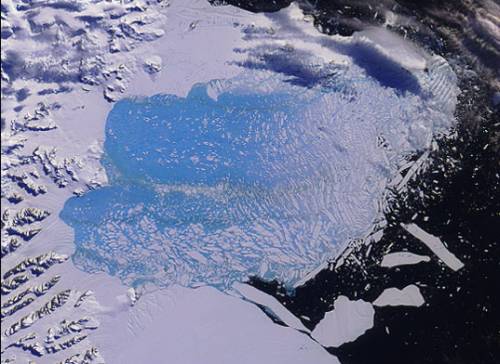
Polar Regions experiencing severe climate change
09 Nov 2004 09:10 GMT
Larsen B ice shelf breakup, Antarctic Peninsula, March 7, 2002
The Arctic and Antarctic are experiencing severe climate change. The Arctic ice cap is melting at an unprecedented rate due to human induced global warming, according to a new study conducted by 300 scientists and elders from native communities in the arctic, released 8 November. Over the last 30 years the ice cap has shrunk 15-20 per cent. In 2003 the Ward Hunt Ice Shelf, the largest in the Arctic, broke into two pieces. With the build up of greenhouse gases, primarily carbon dioxide, the trend is set to accelerate with forecasts that by the summer of 2070 there maybe no ice at all.
In Antarctica, while the interior of the continent is cooling, disappearin g sea ice and warmer temperatures around the Antarctic peninsula are causing an 80 percent drop in the numbers of Antarctic Krill. This is causing the food chain to crash affecting fish, penguins, sea birds, whales and other animals, as well as commercial Fisheries. The breakup of the Larsen B ice shelf in 2002 has also released several glaciers, increasing their speed up to eight fold, and dumping their loads into the Weddell Sea contributing to rising sea level.
[Melbourne IMC: Climate Change Features | Perth IMC: Warming in Antarctica | WWF: Arctic Climate Impact Assessment | Climate Solutions]
With the Russian Government giving the green light to the Kyoto Protocol, the treaty is set to become international law in 2005. On October 22 the Russian Duma (lower House) ratified the Kyoto treaty. It will become international law 90 days after Russian President Vladimir Putin signs the treaty.
The USA and Australia are the only two industrialised countries refusing to ratify the treaty which places quotas on carbon dioxide production, a major contributor to global warming. See article on the increase in atmospheric carbon dioxide. The Bush Administration Shuns Latest Global Warming Studies according to an article on Madison IMC.
In the USA some cities are taking unilateral action on climate change by acting to reduce emissions. The Arcata city council's August 2, 2000 proclamation called for a reduction in greenhouse gas emissions and adherence to the 1997 Kyoto protocol in response to the growing threat of global climate change and its potential consequences.
In 2002, the mayors of nearly 40 of the world's coastal cities, led by the mayor of Venice, sent a letter to U.S. President George W. Bush urging him to reconsider his rejection of the Kyoto global warming pact.
According to a BBC report on 4 November, 2004, Sir Crispin Tickell, a former diplomat and government adviser, told an audience in Cambridge that urgent action is needed because climate change is more serious even than terrorism. He identified six main threats he believes are pushing the environment to the edge: population increase; land degradation and waste; water pollution and supply; climate change; energy production and use; and the destruction of biodiversity.
He told the audience "Nothing is more difficult than learning to think differently. The problem... goes to the roots of how we run our society. It relates to our value system."
"In addition to the traditional costs of research, process, production and so on, prices should reflect the costs involved in replacing a resource or substituting for it; and the costs of the associated environmental problems." he said. "There have been some 30 urban civilisations before our own. All eventually crashed."
He called for urgent action on climate change, saying: "Sucking up to car drivers or calling for new airports does not suggest that all politicians have yet understood what is at stake."
To bring the necessary change about, he said, "we need three things: leadership from above; public pressure from below; and - usually - some instructive disasters to jerk us out of our inertia."
These comments by Sir Crispin Tickell follow on from UK Chief Scientist Sir David King saying that "Kyoto is not enough" that global warming is a bigger threat than terrorism, and that Washington is failing to tackle the problem.
According to the Green Consumer Guide November 8, 2004, an advisor to President Bush, Myron Ebell, from the Competitive Enterprise Institute (CEI), has debunked the notion of global warming, and attacked the UK's chief scientist as 'alarmist'.
He said the views of the UK's chief scientist, Sir David King, that 'US climate policy bigger threat to world than terrorism', was 'a ridiculous claim'. He also attacked the European Commission of targeting the American economy through efforts to develop an international climate change strategy.
Greenpeace UK organisation responded in a statement, "Global warming is a conspiracy against America", saying: "The world's best climate scientists agree the threat is real and growing. It is terrifying that this man is advising the White House on the gravest threat this planet faces. This kind of idiocy would be a mere distraction if it were not for the fact that Bush believes this nonsense. If Tony Blair really regards global warming as a huge threat, like he says he does, he needs to give the President a dose of straight talking the next time they meet."
Greenpeace also highlighted that Esso has provided funding of $1.5m since 1998 to the Competitive Enterprise Institute (CEI).
add a comment on this article
Reversing Global Warming
Aaron Vallejo 10.Nov.2004 13:22
Yes, you are right we are fighting for our Earth, our home and our lives.
I walked the streets of Seattle and the streets of Quebec with thousands of other citizens. I talked with them, protested with them, laughed with them and threw canisters with them.
We can talk about the problems of our present system and it's unacceptable situation. We all may boycott and protest, which are very important. But what I feel is needed is a plan - we need a new story, a new vision, a new place we want to go and arrive at in the future.
If I may, may I spark your imaginations?
We see a world that is infinitely connected, where our cities are forests, cleaning the air and being homes for many species.
Our homes create excess energy through ecological design architecture made of local materials. This anticipatory design science uses the abundant solar energy when it is cost-effective. Therefore perhaps some day paying for part of our home taxes by selling hydrogen back to the grid. This energy is created all the time by the way our homes are designed. Meaning by its very existence it creates energy (assets) for our economy.
When cities are built like these centralized power plants of today will not be needed.
Our food is all organic and safe, grown in huge neighbourhood farms using our biological excrement to create rich, black healthy soil where families of young and old citizens work together among their crops.
Political and economic power is in the individual citizens hands because they have control over energy, food and locate materials.
Clean fresh water, clean air, healthy soil and safe materials replace cancer, garbage, toxins, pollution, pesticides, herbicides and nuclear waste because everything we make and use are designed from the start to be totally safe for soil and biology (biological nutrients) or totally safe and perpetually up-cycled as products for industry (technical nutrients). This is where the molecules are designed to come apart and go back together again forever, therefore eliminating the concept of waste.
When this happens nothing goes to the landfills or incinerators and we stop mining the Earth’s lithosphere because we have an abundance of healthy and clean, perpetually up-cyclable materials for our culture’s use.
The tops of our factories, building and homes are native grasses and native bushes creating habitat for the children of the natural world.
The pollution from the factories is extinct because we have designed out the mercury, the cancer, the bio-accumulative substances, sulphur dioxide, nutrius oxide, carbon dioxide and the chlorine because the filters of the future will be in our heads not on the ends of pipes – intellectual filters.
Instead the factories are in residential areas because they delightfully nourish biology. This is where our factories produce oxygen, clean water, organic food, and healthy soil and they are also favorite places for children to play.
The factories use the abundance of solar and wind and geothermal energies. The solar collectors and the wind turbines are perpetually up-cycled after their 20-30 year life of collecting energy. They then are redeployed after being refurbished in cities. Each farmer could get one turbine so they can stay on their farms and produce another cash crop: hydrogen. This hydrogen is then sold to factories and the auto industry.
The farmers will grow hundreds of different organic crops making livelihoods far more secure instead of insecure monocultures. This is where we ask nature what it wants to grow here, instead of telling it what we want.
Humanity instead of trying to reduce global warming like the Kyoto Agreement is trying to do; humanity begins to be engaged in reversing global warming.
People come and relax in front of these huge 600 foot slow, silent wind turbines because they soothe and relax people like they were at the beach or coast.
This is where sustainability like politics is local and war is unheard of.
This is where global business and local business act together for mutual benefit, meaning global business supplies up-cyclable electronics and nutrious vehicles etc in locally run factories while local and family businesses supplies organic food and local materials.
This is where the 20th century business strategy of only measuring the bottom line or economics is thrown out the window and replaced with the triple top line business strategy where it measures health and fecundity in ecology, social equity and economy. This way when all of these cornerstones are optimized the multiplier effect is unbelievable.
This is where the question of capitalism is also replaced from being “how much can I get for how little I give?” to “how much can I give for all that I get?” therefore this is where capitalism is replaced by eco-effectiveness.
This is where instead of nature being resources for humanity’s use, humanity becomes resources for nature’s use.
We celebrate the fact that we are all different and we respect and celebrate those differences. We grow different cultures and rituals while continuing to question and love everything.
William McDonough’s work, eco-effectiveness is a unified philosophy that - in practical and demonstrable ways - is changing the design of the world. (Time Magazine 1999)
Books:
Silent Spring (1962), The Ecology of Commerce (1994), Natural Capitalism (1999),
Biomimcry: Innoviation Inspired by Nature (1999),
Cradle to Cradle: Remaking the Way We Make Things (2002)
Online Lectures:
http://wesley.stanford.edu/Multimedia/lectures/mcdonough.ram (Feb 2003)
http://wesley.stanford.edu/multimedia/Lectures/Benyus.ram (Jan 2003)
Audio:
http://talktotara.com/health_mind_body.php under Cradle to Cradle
http://evworld.com/view.cfm?section=article&storyid=378
http://www.savvytraveler.org/show/features/2002/20020628/interview1.shtml
http://wpr.org/webcasting/ideas_audioarchives.cfm?Code=hoe under McDonough
http://www.kpbx.org/news/poverty/mcdonough.htm
http://www.paulagordon.com/shows/mcdonough/
I feel it is time to engage and wage full-scale peace. What do you feel?
Peace and Opportunity
Undersea volcanos are a factor being overlooked
Geneva 11.Nov.2004 00:42
Satellite pics show a "hot spot" in the Arctic off the coast of Greenland and Iceland - which are known to have active volcanos. There are more volcanos underwater than on land, but it seems that to climatologists, out of sight = out of mind!
nos estamos matando
Lenn 13.Nov.2004 20:05
Bueno, como todos sabemos nos estamos matando, todos los días alteramos más a nuestra madre naturaleza.
Hemos vivido muy poco en la tierra y los daños que le provocamos son irremediables, y me inclyuo tanto a mi como a tí, ya que desde que optamos por subir a un colectivo o a un auto estamos dañando al medio.
Por eso creo que debemos transmitirle todo esto a los niños, y nosotros como adultos tomar conciencia y alguna medida para que el futuro de nuestros hijos no sea un infierno, pero creo que es muy dificil.
CUIDEMOS AL AMAZONAS!!!!
09 Nov 2004 09:10 GMT
Larsen B ice shelf breakup, Antarctic Peninsula, March 7, 2002
The Arctic and Antarctic are experiencing severe climate change. The Arctic ice cap is melting at an unprecedented rate due to human induced global warming, according to a new study conducted by 300 scientists and elders from native communities in the arctic, released 8 November. Over the last 30 years the ice cap has shrunk 15-20 per cent. In 2003 the Ward Hunt Ice Shelf, the largest in the Arctic, broke into two pieces. With the build up of greenhouse gases, primarily carbon dioxide, the trend is set to accelerate with forecasts that by the summer of 2070 there maybe no ice at all.
In Antarctica, while the interior of the continent is cooling, disappearin g sea ice and warmer temperatures around the Antarctic peninsula are causing an 80 percent drop in the numbers of Antarctic Krill. This is causing the food chain to crash affecting fish, penguins, sea birds, whales and other animals, as well as commercial Fisheries. The breakup of the Larsen B ice shelf in 2002 has also released several glaciers, increasing their speed up to eight fold, and dumping their loads into the Weddell Sea contributing to rising sea level.
[Melbourne IMC: Climate Change Features | Perth IMC: Warming in Antarctica | WWF: Arctic Climate Impact Assessment | Climate Solutions]
With the Russian Government giving the green light to the Kyoto Protocol, the treaty is set to become international law in 2005. On October 22 the Russian Duma (lower House) ratified the Kyoto treaty. It will become international law 90 days after Russian President Vladimir Putin signs the treaty.
The USA and Australia are the only two industrialised countries refusing to ratify the treaty which places quotas on carbon dioxide production, a major contributor to global warming. See article on the increase in atmospheric carbon dioxide. The Bush Administration Shuns Latest Global Warming Studies according to an article on Madison IMC.
In the USA some cities are taking unilateral action on climate change by acting to reduce emissions. The Arcata city council's August 2, 2000 proclamation called for a reduction in greenhouse gas emissions and adherence to the 1997 Kyoto protocol in response to the growing threat of global climate change and its potential consequences.
In 2002, the mayors of nearly 40 of the world's coastal cities, led by the mayor of Venice, sent a letter to U.S. President George W. Bush urging him to reconsider his rejection of the Kyoto global warming pact.
According to a BBC report on 4 November, 2004, Sir Crispin Tickell, a former diplomat and government adviser, told an audience in Cambridge that urgent action is needed because climate change is more serious even than terrorism. He identified six main threats he believes are pushing the environment to the edge: population increase; land degradation and waste; water pollution and supply; climate change; energy production and use; and the destruction of biodiversity.
He told the audience "Nothing is more difficult than learning to think differently. The problem... goes to the roots of how we run our society. It relates to our value system."
"In addition to the traditional costs of research, process, production and so on, prices should reflect the costs involved in replacing a resource or substituting for it; and the costs of the associated environmental problems." he said. "There have been some 30 urban civilisations before our own. All eventually crashed."
He called for urgent action on climate change, saying: "Sucking up to car drivers or calling for new airports does not suggest that all politicians have yet understood what is at stake."
To bring the necessary change about, he said, "we need three things: leadership from above; public pressure from below; and - usually - some instructive disasters to jerk us out of our inertia."
These comments by Sir Crispin Tickell follow on from UK Chief Scientist Sir David King saying that "Kyoto is not enough" that global warming is a bigger threat than terrorism, and that Washington is failing to tackle the problem.
According to the Green Consumer Guide November 8, 2004, an advisor to President Bush, Myron Ebell, from the Competitive Enterprise Institute (CEI), has debunked the notion of global warming, and attacked the UK's chief scientist as 'alarmist'.
He said the views of the UK's chief scientist, Sir David King, that 'US climate policy bigger threat to world than terrorism', was 'a ridiculous claim'. He also attacked the European Commission of targeting the American economy through efforts to develop an international climate change strategy.
Greenpeace UK organisation responded in a statement, "Global warming is a conspiracy against America", saying: "The world's best climate scientists agree the threat is real and growing. It is terrifying that this man is advising the White House on the gravest threat this planet faces. This kind of idiocy would be a mere distraction if it were not for the fact that Bush believes this nonsense. If Tony Blair really regards global warming as a huge threat, like he says he does, he needs to give the President a dose of straight talking the next time they meet."
Greenpeace also highlighted that Esso has provided funding of $1.5m since 1998 to the Competitive Enterprise Institute (CEI).
add a comment on this article
Reversing Global Warming
Aaron Vallejo 10.Nov.2004 13:22
Yes, you are right we are fighting for our Earth, our home and our lives.
I walked the streets of Seattle and the streets of Quebec with thousands of other citizens. I talked with them, protested with them, laughed with them and threw canisters with them.
We can talk about the problems of our present system and it's unacceptable situation. We all may boycott and protest, which are very important. But what I feel is needed is a plan - we need a new story, a new vision, a new place we want to go and arrive at in the future.
If I may, may I spark your imaginations?
We see a world that is infinitely connected, where our cities are forests, cleaning the air and being homes for many species.
Our homes create excess energy through ecological design architecture made of local materials. This anticipatory design science uses the abundant solar energy when it is cost-effective. Therefore perhaps some day paying for part of our home taxes by selling hydrogen back to the grid. This energy is created all the time by the way our homes are designed. Meaning by its very existence it creates energy (assets) for our economy.
When cities are built like these centralized power plants of today will not be needed.
Our food is all organic and safe, grown in huge neighbourhood farms using our biological excrement to create rich, black healthy soil where families of young and old citizens work together among their crops.
Political and economic power is in the individual citizens hands because they have control over energy, food and locate materials.
Clean fresh water, clean air, healthy soil and safe materials replace cancer, garbage, toxins, pollution, pesticides, herbicides and nuclear waste because everything we make and use are designed from the start to be totally safe for soil and biology (biological nutrients) or totally safe and perpetually up-cycled as products for industry (technical nutrients). This is where the molecules are designed to come apart and go back together again forever, therefore eliminating the concept of waste.
When this happens nothing goes to the landfills or incinerators and we stop mining the Earth’s lithosphere because we have an abundance of healthy and clean, perpetually up-cyclable materials for our culture’s use.
The tops of our factories, building and homes are native grasses and native bushes creating habitat for the children of the natural world.
The pollution from the factories is extinct because we have designed out the mercury, the cancer, the bio-accumulative substances, sulphur dioxide, nutrius oxide, carbon dioxide and the chlorine because the filters of the future will be in our heads not on the ends of pipes – intellectual filters.
Instead the factories are in residential areas because they delightfully nourish biology. This is where our factories produce oxygen, clean water, organic food, and healthy soil and they are also favorite places for children to play.
The factories use the abundance of solar and wind and geothermal energies. The solar collectors and the wind turbines are perpetually up-cycled after their 20-30 year life of collecting energy. They then are redeployed after being refurbished in cities. Each farmer could get one turbine so they can stay on their farms and produce another cash crop: hydrogen. This hydrogen is then sold to factories and the auto industry.
The farmers will grow hundreds of different organic crops making livelihoods far more secure instead of insecure monocultures. This is where we ask nature what it wants to grow here, instead of telling it what we want.
Humanity instead of trying to reduce global warming like the Kyoto Agreement is trying to do; humanity begins to be engaged in reversing global warming.
People come and relax in front of these huge 600 foot slow, silent wind turbines because they soothe and relax people like they were at the beach or coast.
This is where sustainability like politics is local and war is unheard of.
This is where global business and local business act together for mutual benefit, meaning global business supplies up-cyclable electronics and nutrious vehicles etc in locally run factories while local and family businesses supplies organic food and local materials.
This is where the 20th century business strategy of only measuring the bottom line or economics is thrown out the window and replaced with the triple top line business strategy where it measures health and fecundity in ecology, social equity and economy. This way when all of these cornerstones are optimized the multiplier effect is unbelievable.
This is where the question of capitalism is also replaced from being “how much can I get for how little I give?” to “how much can I give for all that I get?” therefore this is where capitalism is replaced by eco-effectiveness.
This is where instead of nature being resources for humanity’s use, humanity becomes resources for nature’s use.
We celebrate the fact that we are all different and we respect and celebrate those differences. We grow different cultures and rituals while continuing to question and love everything.
William McDonough’s work, eco-effectiveness is a unified philosophy that - in practical and demonstrable ways - is changing the design of the world. (Time Magazine 1999)
Books:
Silent Spring (1962), The Ecology of Commerce (1994), Natural Capitalism (1999),
Biomimcry: Innoviation Inspired by Nature (1999),
Cradle to Cradle: Remaking the Way We Make Things (2002)
Online Lectures:
http://wesley.stanford.edu/Multimedia/lectures/mcdonough.ram (Feb 2003)
http://wesley.stanford.edu/multimedia/Lectures/Benyus.ram (Jan 2003)
Audio:
http://talktotara.com/health_mind_body.php under Cradle to Cradle
http://evworld.com/view.cfm?section=article&storyid=378
http://www.savvytraveler.org/show/features/2002/20020628/interview1.shtml
http://wpr.org/webcasting/ideas_audioarchives.cfm?Code=hoe under McDonough
http://www.kpbx.org/news/poverty/mcdonough.htm
http://www.paulagordon.com/shows/mcdonough/
I feel it is time to engage and wage full-scale peace. What do you feel?
Peace and Opportunity
Undersea volcanos are a factor being overlooked
Geneva 11.Nov.2004 00:42
Satellite pics show a "hot spot" in the Arctic off the coast of Greenland and Iceland - which are known to have active volcanos. There are more volcanos underwater than on land, but it seems that to climatologists, out of sight = out of mind!
nos estamos matando
Lenn 13.Nov.2004 20:05
Bueno, como todos sabemos nos estamos matando, todos los días alteramos más a nuestra madre naturaleza.
Hemos vivido muy poco en la tierra y los daños que le provocamos son irremediables, y me inclyuo tanto a mi como a tí, ya que desde que optamos por subir a un colectivo o a un auto estamos dañando al medio.
Por eso creo que debemos transmitirle todo esto a los niños, y nosotros como adultos tomar conciencia y alguna medida para que el futuro de nuestros hijos no sea un infierno, pero creo que es muy dificil.
CUIDEMOS AL AMAZONAS!!!!
For more information:
http://www.indymedia.org/en/2004/11/112365...
More power plants in 94124 or a solar/wind community?
by Barbara George and Maurice Campbell
Pacific Chorus frogs can change color in as little as a minute, from green to brown to reddish color, to camouflage themselves. Frogs are considered an “indicator” species: when frogs can’t survive, the environment may not be safe for others either.
Photo: Jim McKissock
Just a week after the San Francisco Public Utilities Commission and PG&E finished their joint San Francisco Solar exhibition at the union-busting Hyatt Hotel, the City had a little surprise for Bay View Hunters Point. Thursday morning, the City Attorney’s Office summoned leaders of some groups involved in BVHP energy issues to City Hall to unveil a brand new plan. Was it 500 solar roofs for the sunny Southeast? Fifty whirring windmills for the windy Hill? Five thousand energy efficient LEDs (Light Emitting Diodes) to light up wintry nights?
No. Not yet, not here. The City has a little problem, the deputy city attorney said, because the Independent System Operator (ISO), which runs the electricity grid, proposes to delay the shutdown of the Hunters Point power plant until 2006 — or whenever PG&E completes eight (not seven) transmission projects, including its gold-plated Jefferson-Martin transmission line.
Last week’s lunar eclipse over the Hunters Point power plant, as seen from West Point Road. The ancients said eclipses are portents of change.
Photo: Barbara George
And oh, by the way, Mirant wants too much money for that little piece of land where the City planned to site its “peaker” power plants, and it’s all hung up in Mirant’s bankruptcy proceeding. Would it be ok with the community to set up those three new combustion turbines on the 94124 borderline, at Pier 80?
And ISO says the peakers need to run 4,000 hours a year - 11 hours a day - at full power so the Hyatt’s wealthy guests can primp and preen and pretend to plan solar projects with PG&E – enemy of solar, wind and energy efficiency for 50 years.
The Supervisor wasn’t at the meeting, though her aide was there. Later she said she didn’t know about the changes. She thought they’d need an Environmental Impact Report, and she didn’t know what the City was saying to Mirant.
Community groups were fuming. Every time the closure of the power plant seemed settled, somebody changed the deal. The Independent System Operator (ISO) demanded nearly twice as much transmission and power plant capacity as PG&E used to use to serve its customers up and down the Peninsula, although electricity demand in the area has grown very little since 2000.
The ISO unfairly kept increasing the requirements for shutting down Hunters Point, holding the carrot and stick in front of the community, not giving a damn about the health concerns. ISO claims environmental justice doesn’t apply to them. The City jumped on ISO’s bandwagon, supporting all the transmission upgrades and pushing its peaker plants in District 10 – ignoring the voters’ mandate to pursue renewable energy and energy efficiency instead.
Meanwhile, over at Pier 80
The news hit David Erickson very hard. He had met just the previous Saturday with men from Muni and the Port who informed him that their bulldozers would be massing on his doorstep in two weeks for an orgy of industrial carnage. A hundred yards from his bucolic art studio next to Islais Creek, the City plans to rip up the 6-foot sewer main, which is leaking once again, and re-lay its crushed transmission lines.
The Bay View reported the Thanksgiving 2001 disaster when Muni cracked the sewer main by carelessly digging underneath it to lay transmission lines across Islais Creek for Third Street Rail - and unnamed “other projects” that might include the afore-named peakers.
Eighty million gallons a day of secondary effluent (treated sewage) poured into the creek and out to San Francisco Bay. Three years later, the mackerel and herring have found their way back up to their time-immemorial home, but they are about to meet more sewage coming down, because the line is cracked again and city crews - who live everywhere but the city - are coming out to “fix” it once again.
That’s just for starters. David Beaupre, a tall fellow from the Port, stopped by David’s too, to mention that their “international” container facility needs a brand new railroad and a bridge across the creek, on top of Muni’s ill-starred transmission crossing. He delivered the stern message that the little Muwekma-Ohlone Park David and the other artists have been trying to rescue from Muni’s wreckage will be off-limits, blocked by a serious “homeland security” fence to keep out the terrorists. (Which side of the fence will they be on? He didn’t say …)
David had another visitor at the meeting that Saturday, Jim McKissock, who restores wildlife habitat in El Cerrito. Jim sought to soften the hearts of the city slickers from Muni and the Port with photos of frogs perfectly perched in the center of long, broad V-shaped reeds. Just give us a little time, and we can plant these California native species and save the last remaining San Francisco habitat of the Pacific Chorus frogs, he said. The frogs will soon be tuning up for their winter-spring mating songs that used to charm David’s evenings and sweeten the dreams of homeless people who habitate along the creek beside the frogs.
“Two weeks is all that we can give you,” said the important fellow from the Port, who has been announcing imminent condestruction in a similar time frame for lo these past five years. But he and Mr. Muni said they would donate a whole day of someone’s labor, and bring five big plastic troughs for a 15-foot garden for the frogs. They didn’t mention whether Muni would ever make up the $75,000 grants for fixing up the park that the artists lost because of Muni’s mess.
Meanwhile, the wheels of San Francisco’s celebrated election machinery cranked onward towards the fateful day, Nov. 2, when the country will decide whether we want to grab Iraq’s oil and gas all by ourselves, with the world in ruins, or join with other wealthy nations and carve that country up together in a more efficient way with lots more troops.
The polar bears are wondering, as they sit stranded on their shrinking scraps of ice, why the humans suddenly need this stuff so much when they lived without it for a hundred thousand years. They’re asking, “When our homes are gone, will you still have yours?”
There’s an old saying, “He who won’t hear, will feel.” As the price of gas goes up, fewer Americans can just fill up and drive away from the problem. As the price of natural gas goes up, the City’s peakers will sputter out along with the rest of the system, and we’ll all be sitting in cold dark rooms with cold canned food. Maybe then, even the Supervisor will ask why oh why didn’t we build the windmills and solar water heaters when we still had money in the bank?
Community Choice — the real clean energy alternative
Here at home, we soon will know if we have six Supervisors in the pockets of PG&E or six for solar and energy efficiency. Quietly, working amidst the din of so-called solar advocates, a plan is taking shape in Supervisor Ammiano’s office that could provide salvation for the long-suffering beings of Southeast San Francisco. It would finally resurrect the voter-approved solar bonds that seemed to sink beneath the waves along with public power in 2001.
That’s the election best remembered for the ballot-box lids bobbing in the bay a week after the week-long vote count ended 500 short of ending PG&E’s 100-year rule over City Hall. Not to be confused with the public power vote of 2002, when three weeks after the election PG&E’s campaign consultant “found” they’d raised and spent $800,000 more than the $2.2 million they reported. By the way, for that error, PG&E and its consultant, Jim Sutton, now face the biggest fine ever levied by the Ethics Commission: $100,000. Don’t ask why the corporation gets to keep the $800,000, or the election. Or how many minutes it takes for PG&E to make back the fine from the high rates it charges the community.
Ah, the community. That’s the ticket. When the community is paying for power, every month a few dollars each from all the residents and businesses, there’s a whole lot of money flowing through the electricity system. That’s the secret of “Community Choice,” the 2002 state law that forms Supervisor Tom Ammiano’s plan to put San Francisco in control of the electricity “revenue stream” — and use that money to pay off solar bonds. You can’t sell bonds if you don’t have a revenue stream to pay them off.
Community Choice is like public power, in that the community makes its own decisions about what kind of power to buy or build. But unlike public power, there’s no long drawn-out hassle to buy the transmission wires, so the community can make its choices and take action right away.
Our Supervisors voted unanimously this year to adopt Community Choice in San Francisco. They also declared Energy Independence: 360 megawatts of renewable energy - like solar and wind - combined with lots of energy efficiency in the next few years. That’s more than a third of San Francisco’s current needs. The implementation plan is being written now, with a vote set for January, just two months away.
With Community Choice, San Franciscans can wave goodbye to the peakers, close the old power plants, save the frogs, give the children of Bay View Hunters Point a bright new healthy start and show the rest of America the fastest way to a clean energy future that does not depend on killing other people’s children to steal their fossil fuel resources. It might mean cleaner elections, too, but that will take a little more work …
In the meantime, please let David Erickson know if you’d like to help build a garden for the frogs; call him at (415) 821-9300 or email zabudam [at] pacbell.net. He’s telling the City to chill out and give us more time, and the frogs might oblige with a few bars of the “Hallelujeh Chorus” … or “Down by the riverside … Ain’t gonna study war no more.”
For energy information and action, contact the authors: Barbara George, Women’s Energy Matters, (415) 330-9844, bgwem [at] igc.org; Maurice Campbell, Community First Coalition, (415) 468-9844, mecsoft [at] pacbell.net. http://www.mecresources.com http://www.womensenergymatters.com
by Barbara George and Maurice Campbell
Pacific Chorus frogs can change color in as little as a minute, from green to brown to reddish color, to camouflage themselves. Frogs are considered an “indicator” species: when frogs can’t survive, the environment may not be safe for others either.
Photo: Jim McKissock
Just a week after the San Francisco Public Utilities Commission and PG&E finished their joint San Francisco Solar exhibition at the union-busting Hyatt Hotel, the City had a little surprise for Bay View Hunters Point. Thursday morning, the City Attorney’s Office summoned leaders of some groups involved in BVHP energy issues to City Hall to unveil a brand new plan. Was it 500 solar roofs for the sunny Southeast? Fifty whirring windmills for the windy Hill? Five thousand energy efficient LEDs (Light Emitting Diodes) to light up wintry nights?
No. Not yet, not here. The City has a little problem, the deputy city attorney said, because the Independent System Operator (ISO), which runs the electricity grid, proposes to delay the shutdown of the Hunters Point power plant until 2006 — or whenever PG&E completes eight (not seven) transmission projects, including its gold-plated Jefferson-Martin transmission line.
Last week’s lunar eclipse over the Hunters Point power plant, as seen from West Point Road. The ancients said eclipses are portents of change.
Photo: Barbara George
And oh, by the way, Mirant wants too much money for that little piece of land where the City planned to site its “peaker” power plants, and it’s all hung up in Mirant’s bankruptcy proceeding. Would it be ok with the community to set up those three new combustion turbines on the 94124 borderline, at Pier 80?
And ISO says the peakers need to run 4,000 hours a year - 11 hours a day - at full power so the Hyatt’s wealthy guests can primp and preen and pretend to plan solar projects with PG&E – enemy of solar, wind and energy efficiency for 50 years.
The Supervisor wasn’t at the meeting, though her aide was there. Later she said she didn’t know about the changes. She thought they’d need an Environmental Impact Report, and she didn’t know what the City was saying to Mirant.
Community groups were fuming. Every time the closure of the power plant seemed settled, somebody changed the deal. The Independent System Operator (ISO) demanded nearly twice as much transmission and power plant capacity as PG&E used to use to serve its customers up and down the Peninsula, although electricity demand in the area has grown very little since 2000.
The ISO unfairly kept increasing the requirements for shutting down Hunters Point, holding the carrot and stick in front of the community, not giving a damn about the health concerns. ISO claims environmental justice doesn’t apply to them. The City jumped on ISO’s bandwagon, supporting all the transmission upgrades and pushing its peaker plants in District 10 – ignoring the voters’ mandate to pursue renewable energy and energy efficiency instead.
Meanwhile, over at Pier 80
The news hit David Erickson very hard. He had met just the previous Saturday with men from Muni and the Port who informed him that their bulldozers would be massing on his doorstep in two weeks for an orgy of industrial carnage. A hundred yards from his bucolic art studio next to Islais Creek, the City plans to rip up the 6-foot sewer main, which is leaking once again, and re-lay its crushed transmission lines.
The Bay View reported the Thanksgiving 2001 disaster when Muni cracked the sewer main by carelessly digging underneath it to lay transmission lines across Islais Creek for Third Street Rail - and unnamed “other projects” that might include the afore-named peakers.
Eighty million gallons a day of secondary effluent (treated sewage) poured into the creek and out to San Francisco Bay. Three years later, the mackerel and herring have found their way back up to their time-immemorial home, but they are about to meet more sewage coming down, because the line is cracked again and city crews - who live everywhere but the city - are coming out to “fix” it once again.
That’s just for starters. David Beaupre, a tall fellow from the Port, stopped by David’s too, to mention that their “international” container facility needs a brand new railroad and a bridge across the creek, on top of Muni’s ill-starred transmission crossing. He delivered the stern message that the little Muwekma-Ohlone Park David and the other artists have been trying to rescue from Muni’s wreckage will be off-limits, blocked by a serious “homeland security” fence to keep out the terrorists. (Which side of the fence will they be on? He didn’t say …)
David had another visitor at the meeting that Saturday, Jim McKissock, who restores wildlife habitat in El Cerrito. Jim sought to soften the hearts of the city slickers from Muni and the Port with photos of frogs perfectly perched in the center of long, broad V-shaped reeds. Just give us a little time, and we can plant these California native species and save the last remaining San Francisco habitat of the Pacific Chorus frogs, he said. The frogs will soon be tuning up for their winter-spring mating songs that used to charm David’s evenings and sweeten the dreams of homeless people who habitate along the creek beside the frogs.
“Two weeks is all that we can give you,” said the important fellow from the Port, who has been announcing imminent condestruction in a similar time frame for lo these past five years. But he and Mr. Muni said they would donate a whole day of someone’s labor, and bring five big plastic troughs for a 15-foot garden for the frogs. They didn’t mention whether Muni would ever make up the $75,000 grants for fixing up the park that the artists lost because of Muni’s mess.
Meanwhile, the wheels of San Francisco’s celebrated election machinery cranked onward towards the fateful day, Nov. 2, when the country will decide whether we want to grab Iraq’s oil and gas all by ourselves, with the world in ruins, or join with other wealthy nations and carve that country up together in a more efficient way with lots more troops.
The polar bears are wondering, as they sit stranded on their shrinking scraps of ice, why the humans suddenly need this stuff so much when they lived without it for a hundred thousand years. They’re asking, “When our homes are gone, will you still have yours?”
There’s an old saying, “He who won’t hear, will feel.” As the price of gas goes up, fewer Americans can just fill up and drive away from the problem. As the price of natural gas goes up, the City’s peakers will sputter out along with the rest of the system, and we’ll all be sitting in cold dark rooms with cold canned food. Maybe then, even the Supervisor will ask why oh why didn’t we build the windmills and solar water heaters when we still had money in the bank?
Community Choice — the real clean energy alternative
Here at home, we soon will know if we have six Supervisors in the pockets of PG&E or six for solar and energy efficiency. Quietly, working amidst the din of so-called solar advocates, a plan is taking shape in Supervisor Ammiano’s office that could provide salvation for the long-suffering beings of Southeast San Francisco. It would finally resurrect the voter-approved solar bonds that seemed to sink beneath the waves along with public power in 2001.
That’s the election best remembered for the ballot-box lids bobbing in the bay a week after the week-long vote count ended 500 short of ending PG&E’s 100-year rule over City Hall. Not to be confused with the public power vote of 2002, when three weeks after the election PG&E’s campaign consultant “found” they’d raised and spent $800,000 more than the $2.2 million they reported. By the way, for that error, PG&E and its consultant, Jim Sutton, now face the biggest fine ever levied by the Ethics Commission: $100,000. Don’t ask why the corporation gets to keep the $800,000, or the election. Or how many minutes it takes for PG&E to make back the fine from the high rates it charges the community.
Ah, the community. That’s the ticket. When the community is paying for power, every month a few dollars each from all the residents and businesses, there’s a whole lot of money flowing through the electricity system. That’s the secret of “Community Choice,” the 2002 state law that forms Supervisor Tom Ammiano’s plan to put San Francisco in control of the electricity “revenue stream” — and use that money to pay off solar bonds. You can’t sell bonds if you don’t have a revenue stream to pay them off.
Community Choice is like public power, in that the community makes its own decisions about what kind of power to buy or build. But unlike public power, there’s no long drawn-out hassle to buy the transmission wires, so the community can make its choices and take action right away.
Our Supervisors voted unanimously this year to adopt Community Choice in San Francisco. They also declared Energy Independence: 360 megawatts of renewable energy - like solar and wind - combined with lots of energy efficiency in the next few years. That’s more than a third of San Francisco’s current needs. The implementation plan is being written now, with a vote set for January, just two months away.
With Community Choice, San Franciscans can wave goodbye to the peakers, close the old power plants, save the frogs, give the children of Bay View Hunters Point a bright new healthy start and show the rest of America the fastest way to a clean energy future that does not depend on killing other people’s children to steal their fossil fuel resources. It might mean cleaner elections, too, but that will take a little more work …
In the meantime, please let David Erickson know if you’d like to help build a garden for the frogs; call him at (415) 821-9300 or email zabudam [at] pacbell.net. He’s telling the City to chill out and give us more time, and the frogs might oblige with a few bars of the “Hallelujeh Chorus” … or “Down by the riverside … Ain’t gonna study war no more.”
For energy information and action, contact the authors: Barbara George, Women’s Energy Matters, (415) 330-9844, bgwem [at] igc.org; Maurice Campbell, Community First Coalition, (415) 468-9844, mecsoft [at] pacbell.net. http://www.mecresources.com http://www.womensenergymatters.com
For more information:
http://www.sfbayview.com/110304/powerplant...
We need to protect our Environment and We as consumers need relief, from runaway energy cost, and practices. We need consumer driven energy policies.
Oil is over $54 a barrel, it is now being reflected in gas pump prices at over $2.38 a gallon locally. Natural gas prices have also gone up, and the first time we use our heaters when the weather changes we are all in for a shock. Expect the price of electricity to go up too. We need to join together and support Community Choice Aggregation, which is designed to quickly provide one-third of San Francisco’s energy needs from energy efficiency and renewables (Solar and Wind) and decrease costs for the masses (You and Me). The City’s current plan for Solar, Wind and (maybe) Wave Energy for mostly large industrial, commercial or government entities offers an improvement in the environmental impacts however it will not relieve the high bills that you and I the consumer will experience this year. Ask the hard questions what will lower our bill as consumers including the low income and people of color who can least afford it?
Why has Building Power Management not been incorporated into our commercial sector? Especially today with wireless networking so many buildings won't have to go through major rewiring to take advantage of this technology. Natural Resources Defense Council (NRDC) unveiled a study at the Commonwealth Club that said if the commercial sector took advantage of Building Power Management we would have a surplus of energy and wouldn’t need any more power plants. We agree with that statement, however NRDC should be supporting Community Choice Aggregation with the consumers in control, not utility companies. Why are so few of our current buildings taking advantage of automated power management? Stanford Research International has been taking advantage of this technology since 1974, why is there no write-up on their savings of both energy and the environment for over a quarter of a century? Why have we not deployed advanced Silicon technology like Light Emitting Diodes (LEDs) that use a fraction of the energy used by other lighting? They’re also more reliable and longer lasting, with a higher Mean Time Between Failure (MTBF) which saves money for you, the consumer in the long run. With Silicon Valley next door, where they know Silicon better than anyone else in the world?
We need to push for an award program for new technologies that save the consumer energy and make sure those technologies are widely deployed. Look at Space Ship One, a twenty million dollar solution and we spent billions to get to the same place. That ten million dollar reward was worth it. It is time for consumer-based solutions. Wind is being deployed throughout the world as inexpensive renewable energy for consumers and farmers. Why is it not being done here for the masses that need their bills reduced? Smaller windmill blades can be caged like house fans to protect the birds. Some people have converted their UPS (Uninterruptible Power Supplies) to take Solar or Wind input to keep critical systems running during an emergency. The masses need relief; we have been gouged by corrupt companies who hide behind agencies and nonprofits who sound concerned but don’t deliver the goods. The people need relief and protection of the environment
http://www.mecresources.com
http://www.womensenergymatters.org
add your comments
Harnessing Wind, Solar and Micro Hydro Power Makes Living in Remote Locations Possible!
by Renewable Energy! Tuesday, Oct. 12, 2004 at 11:15 AM
Save money and the environment
If you want to know how residential scale alternate energy systems work and how these systems can be used to live "off the grid", or to save on your utility power bills, you came to the right place.
--------------------------------------------------------------------------------
All About Renewable Energy!
Renewable Energy Systems
About Wind Energy
About Solar Photovoltaic Energy
About Solar Hot Water
About Micro Hydro
Putting It All Together: A renewable energy system for your home
About our company: Offshore Services
Recent Projects
Descriptions of over a dozen renewable energy projects installed by Offshore Services
Current Projects:
Halibut Point State Park, Rockport, Mass.
A renewable energy visitor center with wind, solar PV and solar hot water systems which we are building for the Commonwealth of Massachusetts
Roderich-Levins Residence, Island Falls, Maine
A residence built over a mile from the nearest power line to be powered by a Bergey 1.5 kw windturbine and a 4kW propane backup generator.
Links to Renewable Energy Sites on the Web
--------------------------------------------------------------------------------
This site was created by Henry duPont of Offshore Services, Ltd. a Block Island, RI based company specializing in the design and installation of small - medium scale alternate energy systems. For more information contact us at offshore [at] wind-power.com. ©1996, 1977Offshore Services Ltd. All Rights Reserved. Visitors to this page: 87734 Since 11/23/96
--------------------------------------------------------------------------------
Renewable energy systems
A renewable energy system converts the energy found in sunlight, wind, falling water, waves, geothermal heat, or biomass into a form we can use, such as heat or electricity. Historically, renewable energy was used exclusively as man's energy source until coal was first used in the 13th century, oil in the end of the 19th century and uranium in the middle of the 20th century.
Using renewable sources of energy promotes sustainable living and, except for burning biomass, is virtually pollution free. Renewable sources of energy are economically feasable in small scale applications in remote locations (off the grid homes) or in large scale applications in areas where the resource is abundant and can be harnessed by giant conversion systems such as the hydro projects of theTVA or the wind farms of California.
The focus of this site is small - medium scale renewable systems ranging from remote homes or facilities such as lighthouses to village scale power systems. To learn more about the individual components of a renewable energy system, read on!
--------------------------------------------------------------------------------
About Wind Energy
Harnessing wind energy was one of man's earliest achievements. Small windmills pumped water in ancient Syria and sailing ships used windpower to first circumnavigate the globe. The modern use of winturbines originated in the 17th Century where the Renaissance Dutch used wind power to recover hundreds of thousands of acres of land by draining the Rhine River delta.
The classic Dutch windmill design predominated for 300 years, pumping water, grinding grain and sawing wood until the multibladed American Farm Windmill was developed in the middle of the 19th century. These machines covered the continent, pumping water on every farm and in every town until rual electrifacation (and rust) brought about their demise in the middle of the 20th century.
Advances in the fields of aerodynamics and composite materials have made modern electric power generating wind turbines a reality. These machines range in size from a meter to a hundred meters in rotor diamater and from a hundred watts to a thousand kilowatts in power output. Wind turbines suitable for residential or village scale wind power range from 500 watts to 50 kilowatts. These machines fall into three categories:
Utility interconnected winturbines generate power which is syncronous with the grid and are used to reduce utility bills by displacing the utility power used in the household and by selling the excess power back to the electric company. These machines are economically attractive where there is a good wind resource and where the local power costs are in excess of 15 cents per kilowatt hour.
Wind turbines for remote homes (off the grid) generate DC current for battery charging.
Wind turbines for remote water pumping generate 3 phase AC current suitable for driving an electrical submersable pump directly.
For more information on residential or village scale wind turbines, visit Bergey Windpower Co. the leading manufacturer of small wind turbines
--------------------------------------------------------------------------------
About Solar Photovoltaic Energy
Solar cells are thin wafers of silicon which, when exposed to sunlight, produce DC electric current. These devices, which were developed for the space program in the 1950s, have a maximum conversion effeciency of about 15%. When a number of solar cells are mounted on a surface and are wired together in series, they become a solar module, the building block of a solar photovoltaic system. The solar photovoltaic module's relatively high initial cost (about $5/watt) is offset by a very long life and very low maintenance requirements.
Suitable applications for solar photovoltaic systems almost always involves their use in remote locations (whether spacecraft or remote homes) because their 20 year power cost of about 20 cents per kWh is not competitive with current utility power costs.
For more information on solar photovoltaic systems, visit the Siemens Solar Industries Web Site.
--------------------------------------------------------------------------------
About Solar Hot Water
Solar water heating is one of the most efficient and least expensive of the renewable energy technologies. These systems use the heat of the sun's rays to heat water for domestic use. Each system has two separate components:
the collector which converts the sun's energy to heat
an insulated storage tank to keep the water hot until ready for use.
The design of these systems varies according to the climate of the location of intended use. In tropical climates, these systems commonly employ thermal syphon pumping to circulate the hot water between the collector and the tank which must be placed above the collector. In colder climates, where freezing is a posibility, glycol is employed to transfer heat between the collector and the storage tank. A heat exchanger is used to keep the glycol from mixing with the domestic hot water.
Solar hot water systems give some of the best value compared to other solar energy technologies because of their reletive low cost and high collector efficiency.
--------------------------------------------------------------------------------
About Micro Hydro
The potential energy of falling water, captured and converted to mechanical energy by waterwheels, powered the start of the Industrial Revolution. Wherever sufficient head, or change in elevation, could be found, rivers and streams were dammed and mills were built. In the mid 1800's, the water wheel gave way to the water turbine. This device uses jets of water to spin the cup shaped blades of the turbine which drives an alternator, generating electricity.
In order to produce enough electricity to power a residence, a hydroelectric system requires a location with the following features:
Change in elevation or head: 20 feet @ 100 gal/min = 200 watts.
100 feet head @ 20 gal/min gives the same output.
The relationship between head and flow means that areas with low head need long runs of large diamiter pipe and are much more expensive...
Distance between the turbine and the residence: Distances of over a few hundred feet will require expensive cabling and be prohibitively costly.
Typical costs for a micro hydro system in a good location are between $2500-$5000. For more information on micro hydro systems, visit: Jade Mountain Micro Hydro Site.
--------------------------------------------------------------------------------
Putting It All Together: A Renewable Energy System For Your Home
The choice of equipment required to convert renewable energy sources into energy you can use in your home depends on whether or not there is already a connection to the electric utility. Utility interconnected systems are different by nature and are discussed in the next section
Remote (or off the grid) renewable energy systems used to generate electricty usually incoperate the following components.
Energy storage system a battery bank to store renewable energy until needed (cost $2,000 - $4,000)
Energy collection system the wind, solar PV, or micro-hydro power generating system (cost $3,000 - $10,000)
Energy conversion system an inverter to convert the DC battery current to 120 volt AC house current (cost $2,000 - $3,500)
Back up generator required for the times that the sun doesn't shine, the wind doesn't blow or the water doesn't flow (cost $1,500 - $5,000)
The cost of a remote renewable energy system sized for a modest home using up to 500 kWh per month will typically be from $15,000 to $25,000.
--------------------------------------------------------------------------------
Utility interconnected systems do not require a energy storage system or a backup generator because utility power is usually available during periods when the renewable source of energy is not available. These systems use an induction generator or a utility syncronized inverter to convert the power from the renewable source into AC power which in compatable in frequency and voltage with the utility source. The renewable energy generated will reduce utility bills by displacing electric power supplied by the utility and by selling excess power back to the utility.
--------------------------------------------------------------------------------
Links to other Renewable Energy Sites
Bergey Wind Power Company The manufacturer of reliable small scale wind turbines ranging from 850 watts to 10 kilowatts. Perfect for remote home or village power applications.
Solar Photovoltaic Power Resource Site This site coordinates and disseminates global information on photovoltaic technology.
Siemens Solar Industries The Premier Manufacturer of Solar Photovoltaic Modules in the world
Solar Electric SpecialtiesA leading distributor of Solar PV Products
National Renewable Energy Laboratory The Nations' Federal Laboratory for Renewable Energy Research
The American Wind Energy Association The Wind Energy Trade Association
http://www.wind-power.com/
add your comments
Energy savings up to 80%
by Intelligent lighting Tuesday, Oct. 12, 2004 at 11:22 AM
Long life (up to 100,000 hours) Help the Environment
With the introduction of Luxeon, Lumileds has delivered the benefits of LED technology to the lighting world. Luxeon is already impacting numerous lighting applications.
This is what Luxeon solid state lighting delivers to the lighting market:
Long life (up to 100,000 hours)
Energy savings up to 80%
Environment friendly (no waste, no mercury)
Intelligent lighting
Durability (no glass or filaments)
http://www.lumileds.com/solutions/solution.cfm?id=4
add your comments
Success Story: YWCA of White Plains, New York
by Johnson Controls Tuesday, Oct. 12, 2004 at 11:34 AM
Prevented 112,000 lbs. of pollution Save our environment Save Energy
Story: YWCA of White Plains, New York
Success Story: YWCA of White Plains, New York
Partner Information
Located in White Plains, New York
96,000 sq. ft.
Annual Cash Savings: $66,799
Prevented 112,000 lbs. of pollution
Service and Product Provider
Johnson Controls
"Not-for-profits that own buildings should have a current short- and long-term plan for energy use, equipment, and buildings. It is generally less expensive to fix things early rather than to wait until there is complete failure."
--Rita A. Brown
Chief Executive Officer
The Young Women's Christian Association (YWCA) of White Plains and Central Westchester in New York has been serving its community for 70 years. In 1966, it opened the Lila Wallace Activities Center in White Plains, a 96,000 sq. ft. facility that includes a swimming pool, gymnasium, meeting and activity rooms, dance studio, classrooms, and outdoor play areas. The aging building was wasting large amounts of energy and thereby diverting funds that could have gone into serving the community. Therefore, the YWCA embarked upon a comprehensive energy saving plan.
All Exits Lead to High Efficiency
All the lights in the building were replaced with high-efficiency lighting. Standard T-12 fluorescent lamps were replaced with T-8 lamps. All exit signs were replaced with energy efficient LED signs. In the pool area, metal halide fixtures were installed to dramatically improve light levels.
Pooling Efficient Resources
Two oil-fired boilers were installed to heat the water for the facility's swimming pool. These boilers operate independently of the building's main boilers, which provides savings in the summer since the main boilers don't have to be operating just to heat the pool.
In addition, the existing steam hot water heater was removed and replaced with a gas-fired unit with a 500-gallon storage tank.
New System Creates Cool Air, Cooler Savings
The current constant volume systems with terminal reheat were replaced with variable air volume systems, which provides improved heating and cooling control and greater efficiency. The building's nine major air-handling systems were refurbished with new coils, and six new variable speed drives were installed.
A new 250-ton McQuay water-cooled, dual compressor screw chiller was installed to replace an aging absorption unit.
Controlling Energy Costs
Much of the building's lighting, heating, and cooling are controlled from a new Johnson Controls Metasys Energy Management System (EMS). This new system allows instantaneous monitoring and control of all systems from an operator workstation. The EMS allows allows remote control through a modem.
More Opportunities
A number of smaller steps were also taken to make the facility as energy efficient as possible. Low-emissivity (low-e) glass, which has a special surface coating to reduce heat transfer, was installed in the pool area to limit solar heating. Low-e glass reflects 40% to 70% of the heat that is normally transmitted through clear glass, while allowing the full amount of light to pass through.
In addition, new pipe insulation was installed on pipes leading to the updated pool heaters, the domestic hot water tank, and the high-efficiency chiller.
A Contract for Great Performance
The YWCA of White Plains and Central Westchester entered into an energy performance contract (EPC) with Johnson Controls, Inc., the manufacturer of the EMS the facility had installed. Through the EPC, Johnson Controls, Inc., had all the energy efficiency measures in the facility installed at no charge to the YWCA. In addition, the YWCA was guaranteed annual savings of $66,799 for the next ten years. Now that is a good deal!
http://www.energystar.gov/index.cfm?c=sb_success.sb_successstories_ywca
add your comments
DOE studies estimate savings potential of LEDs
by DOE Tuesday, Oct. 12, 2004 at 11:42 AM
energy savings from solid-state lighting Save the Environment will represent billions of dollars of savings for consumers.
DOE studies estimate savings potential of LEDs
18 November 2003
Two new studies have been released by the US Department of Energy (DOE) that analyze and estimate energy savings from solid-state lighting.
The reports, authored by Navigant Consulting and funded by DOE, describe the energy savings potential in niche applications today and in general lighting applications in the future.
According to the studies, energy savings to date from LEDs exceed the power produced from one large electric power plant — more than 8 billion kW-hours. If solid-state lighting achieves its price and performance targets over the next two decades, this will remove the need for more than 30 percent of the estimated lighting energy consumption. In turn, this will represent billions of dollars of savings for consumers.
The studies were released to coincide with the DOE’s workshop on Solid State Lighting, which was held in Washington, DC on November 13-14. Through the Building Technologies Program of the Office of Energy Efficiency and Renewable Energy, the DOE has launched a solid-state lighting (SSL) R&D program that encompasses both core technology research and industrial product development.
The DOE has set aggressive goals for the SSL program; by 2015, it plans to develop advanced SSL technologies that, compared with conventional lighting technologies, are much more energy efficient, longer lasting and cost competitive. DOE is targeting a product system efficiency of 50 percent with lighting that accurately reproduces the full spectrum of sunlight.
A number of projects have already been funded, and DOE hopes to secure a budget of $7.75 million for the current financial year. Further, it is hoped that the Energy Bill currently making its way through the US legislature will provide strong backing for SSL, which will in turn result in substantial increases in funding for SSL in future years. The studies are intended to justify the need for this funding.
Niche applications
The study titled “Energy Savings Estimate of Light Emitting Diodes in Niche Lighting Applications” finds that LED traffic signals use only 10 percent of the electricity consumed by the incandescent lamps they replace. In other words, 90 percent of the electricity bill that municipalities pay can be eliminated. Moreover, LED signals last several times longer, allowing for additional savings through reduced maintenance costs.
Exit signs are identified as another important niche application, where an estimated 80 percent of the US installed base of exit signs now use LEDs.
LEDs have also made inroads into mobile applications such as brake and signal lights on trucks, buses and automobiles. In the report, the energy savings of these applications are reported in gallons of gasoline and diesel fuel because the electricity is generated on-board. To date, 41 million gallons of gasoline and 142 million gallons of diesel fuel are saved annually because of LED use on these vehicles.
If the entire fleet of automobiles, trucks and buses were to convert to LED lighting, 1.4 billion gallons of gasoline and 1.1 billion gallons of diesel fuel could be saved each year. In gasoline, that is the energy equivalent of 30 days of oil flow in the Alaskan pipeline at full capacity; and, in diesel, that represents 12 days of national consumption.
General illumination
The study titled “Energy Savings Potential of Solid State Lighting in General Illumination Applications” estimates the energy savings potential if solid-state lighting can achieve certain price and performance criteria.
The report considered two scenarios – one where the technology receives a moderate national investment of $50 million per year and an accelerated scenario based on an investment of $100 million per year. Solid state lighting achieves different cost, efficiency and durability targets under each scenario.
Under the moderate investment scenario, in 2025 the energy saving associated with solid-state lighting will total approximately 114 billion kW-hours, or the equivalent electrical output of about 14 large power plants.
Under the accelerated investment scenario, in 2025 the total energy saving is nearly three times higher – reaching 326 billion kW-hours, representing more than 40 large power plants. Over the analysis period of 2005 to 2025, the cumulative energy savings under the accelerated investment scenario total nearly 1,850 billion kW-hours, which equates to more than $120 billion in electricity bill savings for the United States over that time period.
http://www.compoundsemiconductor.net/articles/news/7/11/20/1
add your comments
The Sulfur Lamp is an Efficient Light
by Sulfur Lamp Wednesday, Oct. 13, 2004 at 9:10 AM
techquestion [at] sulfurlamp.com Support Energy Efficiency
General Technical Information
The sulfur lamp is an efficient, powerful, bright, full spectrum light source that has many different indoor and outdoor uses. Each bulb contains a small amount of sulfur and inert argon gas. When the sulfur is bombarded by focused microwave energy it forms a plasma that glows very brightly, producing light very similar to sunlight. Because there are no filaments or other metal components to break down, the bulb may never need replacement. Only the magnetron needs changing!
The system is dimmable to 20% and provides a constant correlated color temperature of 5,700 degrees Kelvin with a color rendering index of 79. Again, because there are no filaments to degrade or alter its chemical composition, the light source will not change color or intensity over time and will continue to render objects close to their true color.
Sulfur Lamp Benefits:
Very Bright
Very Efficient
Very Long Life
Very Stable Light Output
Very Stable Color
Very Easy Regular Maintenance
Very Consistent Unit to Unit Performance
Even prototype installations have won accolades in scientific circles, including:
Lightfair International 1998 award for Technological Innovation.
The 1995 Discover Award for Technological Innovation (Environment). Sponsored by Discover Magazine and the Walt Disney Company, the award is given annually to the firm or individual that discovers new technology with the greatest potential benefits.
Popular Science magazine's grand prize in the "Best of What's New" for 1995.
Research & Development magazine's award as one of the top 100 inventions of 1995.
The US Department of Energy (DOE) installed Fusion's sulfur lighting in the plaza of its Washington headquarters. Two sulfur lamps replaced 240 conventional mercury lamps, and according to DOE, they produce four times the light, from only one-third the electricity. A block away, the Smithsonian Institution replaced 94 conventional lamps with three sulfur lamps in the Space Hall at its National Air and Space Museum. Light output doubled and electricity consumption declined 25%, according to the Smithsonian.
Besides energy, installation, and maintenance savings in general lighting applications, sulfur lighting is expected to yield widespread benefits in dozens of specialty uses throughout transportation, manufacturing, agriculture, media, and other fields.
For more information on the Sulfur Lamp, applications, fixtures, and accessories available please select a link below:
Sulfur Lamp | Reflector | Light Pipe | Contacts
--------------------------------------------------------------------------------
The Sulfur Lamp Technology
The sulfur lamp was invented, designed and built by Fusion Lighting, Inc. of Rockville, Maryland, USA. This unique technology is protected by a variety of patents and patent applications in the U.S. and other countries.
The light emitted from one of these sulfur bulbs is equal to over 75 standard 100 watt incandescent lamps, although the sulfur bulb emits only 5% of the heat. The photo to the right shows a 1000 watt Metal Halide lamp for comparison. The Sulfur lamp produces 20% MORE light.
The dimming feature can be operated either manually, by occupancy and/or daylight sensors, or an energy management system.
The bulbs are electrodeless, meaning that there are no wires connected to the bulb. There is no filament or metal electrode within the bulb.
Light is generated by heating sulfur with microwave energy, identical to that of home microwave ovens. The spectra of the sulfur light contains all colors of the rainbow, closely matching that of the sun, but with very little heat or ultraviolet in the beam.
Each bulb, about the size of a golf ball, requires about 1,425 watts of power to produce 135,000 lumens of white light. The correlated color temprature is 5,700 degrees Kelvin with a CRI of 79.
There is no mercury used in the bulbs.
The Sulfur lamp can be operated in any orientation with no loss of output or life.
--------------------------------------------------------------------------------
The Reflector Technology
Reflectors are used to project light into a space or to a surface. Reflectors for the Sulfur Lamp must be designed and optomized for each type of application.
For normal operation, the Sulfur Lamp will require a reflector of some sort to project light out and away from the light source. The reflector is also a neccessary element to shield against any potential microwave leakage. Use only reflectors specifically designed and certified for operation with the Sulfur Lamp.
A Sulfur Lamp using a reflector is perfect for application in warehouses, airplane hangers, meeting halls, or any large area that could utilize a High Bay style of downlight. This system could also be used for indirect applications.
Exterior applications such as pole mounted building facade lights, or athletic field lighting would require a protective enclosure in addition to a specially gasketed reflector.
Innovative Lighting of Los Angeles, California, USA, has available a family of reflector optics and other accessories for the Sulfur Lamp.
--------------------------------------------------------------------------------
The Light Pipe Technology
The light pipes were invented, designed, and built by A.L. Whitehead Ltd., Vancouver, Canada.
The reflector material used in the original light pipe design is manufactured and sold by 3M. Other designs are available from other sources.
The light pipe is ten inches in diameter and fabricated in sections of various length of all plastic construction.
Each ten-foot section weighs approximately 30 pounds.
http://www.sulfurlamp.com
Oil is over $54 a barrel, it is now being reflected in gas pump prices at over $2.38 a gallon locally. Natural gas prices have also gone up, and the first time we use our heaters when the weather changes we are all in for a shock. Expect the price of electricity to go up too. We need to join together and support Community Choice Aggregation, which is designed to quickly provide one-third of San Francisco’s energy needs from energy efficiency and renewables (Solar and Wind) and decrease costs for the masses (You and Me). The City’s current plan for Solar, Wind and (maybe) Wave Energy for mostly large industrial, commercial or government entities offers an improvement in the environmental impacts however it will not relieve the high bills that you and I the consumer will experience this year. Ask the hard questions what will lower our bill as consumers including the low income and people of color who can least afford it?
Why has Building Power Management not been incorporated into our commercial sector? Especially today with wireless networking so many buildings won't have to go through major rewiring to take advantage of this technology. Natural Resources Defense Council (NRDC) unveiled a study at the Commonwealth Club that said if the commercial sector took advantage of Building Power Management we would have a surplus of energy and wouldn’t need any more power plants. We agree with that statement, however NRDC should be supporting Community Choice Aggregation with the consumers in control, not utility companies. Why are so few of our current buildings taking advantage of automated power management? Stanford Research International has been taking advantage of this technology since 1974, why is there no write-up on their savings of both energy and the environment for over a quarter of a century? Why have we not deployed advanced Silicon technology like Light Emitting Diodes (LEDs) that use a fraction of the energy used by other lighting? They’re also more reliable and longer lasting, with a higher Mean Time Between Failure (MTBF) which saves money for you, the consumer in the long run. With Silicon Valley next door, where they know Silicon better than anyone else in the world?
We need to push for an award program for new technologies that save the consumer energy and make sure those technologies are widely deployed. Look at Space Ship One, a twenty million dollar solution and we spent billions to get to the same place. That ten million dollar reward was worth it. It is time for consumer-based solutions. Wind is being deployed throughout the world as inexpensive renewable energy for consumers and farmers. Why is it not being done here for the masses that need their bills reduced? Smaller windmill blades can be caged like house fans to protect the birds. Some people have converted their UPS (Uninterruptible Power Supplies) to take Solar or Wind input to keep critical systems running during an emergency. The masses need relief; we have been gouged by corrupt companies who hide behind agencies and nonprofits who sound concerned but don’t deliver the goods. The people need relief and protection of the environment
http://www.mecresources.com
http://www.womensenergymatters.org
add your comments
Harnessing Wind, Solar and Micro Hydro Power Makes Living in Remote Locations Possible!
by Renewable Energy! Tuesday, Oct. 12, 2004 at 11:15 AM
Save money and the environment
If you want to know how residential scale alternate energy systems work and how these systems can be used to live "off the grid", or to save on your utility power bills, you came to the right place.
--------------------------------------------------------------------------------
All About Renewable Energy!
Renewable Energy Systems
About Wind Energy
About Solar Photovoltaic Energy
About Solar Hot Water
About Micro Hydro
Putting It All Together: A renewable energy system for your home
About our company: Offshore Services
Recent Projects
Descriptions of over a dozen renewable energy projects installed by Offshore Services
Current Projects:
Halibut Point State Park, Rockport, Mass.
A renewable energy visitor center with wind, solar PV and solar hot water systems which we are building for the Commonwealth of Massachusetts
Roderich-Levins Residence, Island Falls, Maine
A residence built over a mile from the nearest power line to be powered by a Bergey 1.5 kw windturbine and a 4kW propane backup generator.
Links to Renewable Energy Sites on the Web
--------------------------------------------------------------------------------
This site was created by Henry duPont of Offshore Services, Ltd. a Block Island, RI based company specializing in the design and installation of small - medium scale alternate energy systems. For more information contact us at offshore [at] wind-power.com. ©1996, 1977Offshore Services Ltd. All Rights Reserved. Visitors to this page: 87734 Since 11/23/96
--------------------------------------------------------------------------------
Renewable energy systems
A renewable energy system converts the energy found in sunlight, wind, falling water, waves, geothermal heat, or biomass into a form we can use, such as heat or electricity. Historically, renewable energy was used exclusively as man's energy source until coal was first used in the 13th century, oil in the end of the 19th century and uranium in the middle of the 20th century.
Using renewable sources of energy promotes sustainable living and, except for burning biomass, is virtually pollution free. Renewable sources of energy are economically feasable in small scale applications in remote locations (off the grid homes) or in large scale applications in areas where the resource is abundant and can be harnessed by giant conversion systems such as the hydro projects of theTVA or the wind farms of California.
The focus of this site is small - medium scale renewable systems ranging from remote homes or facilities such as lighthouses to village scale power systems. To learn more about the individual components of a renewable energy system, read on!
--------------------------------------------------------------------------------
About Wind Energy
Harnessing wind energy was one of man's earliest achievements. Small windmills pumped water in ancient Syria and sailing ships used windpower to first circumnavigate the globe. The modern use of winturbines originated in the 17th Century where the Renaissance Dutch used wind power to recover hundreds of thousands of acres of land by draining the Rhine River delta.
The classic Dutch windmill design predominated for 300 years, pumping water, grinding grain and sawing wood until the multibladed American Farm Windmill was developed in the middle of the 19th century. These machines covered the continent, pumping water on every farm and in every town until rual electrifacation (and rust) brought about their demise in the middle of the 20th century.
Advances in the fields of aerodynamics and composite materials have made modern electric power generating wind turbines a reality. These machines range in size from a meter to a hundred meters in rotor diamater and from a hundred watts to a thousand kilowatts in power output. Wind turbines suitable for residential or village scale wind power range from 500 watts to 50 kilowatts. These machines fall into three categories:
Utility interconnected winturbines generate power which is syncronous with the grid and are used to reduce utility bills by displacing the utility power used in the household and by selling the excess power back to the electric company. These machines are economically attractive where there is a good wind resource and where the local power costs are in excess of 15 cents per kilowatt hour.
Wind turbines for remote homes (off the grid) generate DC current for battery charging.
Wind turbines for remote water pumping generate 3 phase AC current suitable for driving an electrical submersable pump directly.
For more information on residential or village scale wind turbines, visit Bergey Windpower Co. the leading manufacturer of small wind turbines
--------------------------------------------------------------------------------
About Solar Photovoltaic Energy
Solar cells are thin wafers of silicon which, when exposed to sunlight, produce DC electric current. These devices, which were developed for the space program in the 1950s, have a maximum conversion effeciency of about 15%. When a number of solar cells are mounted on a surface and are wired together in series, they become a solar module, the building block of a solar photovoltaic system. The solar photovoltaic module's relatively high initial cost (about $5/watt) is offset by a very long life and very low maintenance requirements.
Suitable applications for solar photovoltaic systems almost always involves their use in remote locations (whether spacecraft or remote homes) because their 20 year power cost of about 20 cents per kWh is not competitive with current utility power costs.
For more information on solar photovoltaic systems, visit the Siemens Solar Industries Web Site.
--------------------------------------------------------------------------------
About Solar Hot Water
Solar water heating is one of the most efficient and least expensive of the renewable energy technologies. These systems use the heat of the sun's rays to heat water for domestic use. Each system has two separate components:
the collector which converts the sun's energy to heat
an insulated storage tank to keep the water hot until ready for use.
The design of these systems varies according to the climate of the location of intended use. In tropical climates, these systems commonly employ thermal syphon pumping to circulate the hot water between the collector and the tank which must be placed above the collector. In colder climates, where freezing is a posibility, glycol is employed to transfer heat between the collector and the storage tank. A heat exchanger is used to keep the glycol from mixing with the domestic hot water.
Solar hot water systems give some of the best value compared to other solar energy technologies because of their reletive low cost and high collector efficiency.
--------------------------------------------------------------------------------
About Micro Hydro
The potential energy of falling water, captured and converted to mechanical energy by waterwheels, powered the start of the Industrial Revolution. Wherever sufficient head, or change in elevation, could be found, rivers and streams were dammed and mills were built. In the mid 1800's, the water wheel gave way to the water turbine. This device uses jets of water to spin the cup shaped blades of the turbine which drives an alternator, generating electricity.
In order to produce enough electricity to power a residence, a hydroelectric system requires a location with the following features:
Change in elevation or head: 20 feet @ 100 gal/min = 200 watts.
100 feet head @ 20 gal/min gives the same output.
The relationship between head and flow means that areas with low head need long runs of large diamiter pipe and are much more expensive...
Distance between the turbine and the residence: Distances of over a few hundred feet will require expensive cabling and be prohibitively costly.
Typical costs for a micro hydro system in a good location are between $2500-$5000. For more information on micro hydro systems, visit: Jade Mountain Micro Hydro Site.
--------------------------------------------------------------------------------
Putting It All Together: A Renewable Energy System For Your Home
The choice of equipment required to convert renewable energy sources into energy you can use in your home depends on whether or not there is already a connection to the electric utility. Utility interconnected systems are different by nature and are discussed in the next section
Remote (or off the grid) renewable energy systems used to generate electricty usually incoperate the following components.
Energy storage system a battery bank to store renewable energy until needed (cost $2,000 - $4,000)
Energy collection system the wind, solar PV, or micro-hydro power generating system (cost $3,000 - $10,000)
Energy conversion system an inverter to convert the DC battery current to 120 volt AC house current (cost $2,000 - $3,500)
Back up generator required for the times that the sun doesn't shine, the wind doesn't blow or the water doesn't flow (cost $1,500 - $5,000)
The cost of a remote renewable energy system sized for a modest home using up to 500 kWh per month will typically be from $15,000 to $25,000.
--------------------------------------------------------------------------------
Utility interconnected systems do not require a energy storage system or a backup generator because utility power is usually available during periods when the renewable source of energy is not available. These systems use an induction generator or a utility syncronized inverter to convert the power from the renewable source into AC power which in compatable in frequency and voltage with the utility source. The renewable energy generated will reduce utility bills by displacing electric power supplied by the utility and by selling excess power back to the utility.
--------------------------------------------------------------------------------
Links to other Renewable Energy Sites
Bergey Wind Power Company The manufacturer of reliable small scale wind turbines ranging from 850 watts to 10 kilowatts. Perfect for remote home or village power applications.
Solar Photovoltaic Power Resource Site This site coordinates and disseminates global information on photovoltaic technology.
Siemens Solar Industries The Premier Manufacturer of Solar Photovoltaic Modules in the world
Solar Electric SpecialtiesA leading distributor of Solar PV Products
National Renewable Energy Laboratory The Nations' Federal Laboratory for Renewable Energy Research
The American Wind Energy Association The Wind Energy Trade Association
http://www.wind-power.com/
add your comments
Energy savings up to 80%
by Intelligent lighting Tuesday, Oct. 12, 2004 at 11:22 AM
Long life (up to 100,000 hours) Help the Environment
With the introduction of Luxeon, Lumileds has delivered the benefits of LED technology to the lighting world. Luxeon is already impacting numerous lighting applications.
This is what Luxeon solid state lighting delivers to the lighting market:
Long life (up to 100,000 hours)
Energy savings up to 80%
Environment friendly (no waste, no mercury)
Intelligent lighting
Durability (no glass or filaments)
http://www.lumileds.com/solutions/solution.cfm?id=4
add your comments
Success Story: YWCA of White Plains, New York
by Johnson Controls Tuesday, Oct. 12, 2004 at 11:34 AM
Prevented 112,000 lbs. of pollution Save our environment Save Energy
Story: YWCA of White Plains, New York
Success Story: YWCA of White Plains, New York
Partner Information
Located in White Plains, New York
96,000 sq. ft.
Annual Cash Savings: $66,799
Prevented 112,000 lbs. of pollution
Service and Product Provider
Johnson Controls
"Not-for-profits that own buildings should have a current short- and long-term plan for energy use, equipment, and buildings. It is generally less expensive to fix things early rather than to wait until there is complete failure."
--Rita A. Brown
Chief Executive Officer
The Young Women's Christian Association (YWCA) of White Plains and Central Westchester in New York has been serving its community for 70 years. In 1966, it opened the Lila Wallace Activities Center in White Plains, a 96,000 sq. ft. facility that includes a swimming pool, gymnasium, meeting and activity rooms, dance studio, classrooms, and outdoor play areas. The aging building was wasting large amounts of energy and thereby diverting funds that could have gone into serving the community. Therefore, the YWCA embarked upon a comprehensive energy saving plan.
All Exits Lead to High Efficiency
All the lights in the building were replaced with high-efficiency lighting. Standard T-12 fluorescent lamps were replaced with T-8 lamps. All exit signs were replaced with energy efficient LED signs. In the pool area, metal halide fixtures were installed to dramatically improve light levels.
Pooling Efficient Resources
Two oil-fired boilers were installed to heat the water for the facility's swimming pool. These boilers operate independently of the building's main boilers, which provides savings in the summer since the main boilers don't have to be operating just to heat the pool.
In addition, the existing steam hot water heater was removed and replaced with a gas-fired unit with a 500-gallon storage tank.
New System Creates Cool Air, Cooler Savings
The current constant volume systems with terminal reheat were replaced with variable air volume systems, which provides improved heating and cooling control and greater efficiency. The building's nine major air-handling systems were refurbished with new coils, and six new variable speed drives were installed.
A new 250-ton McQuay water-cooled, dual compressor screw chiller was installed to replace an aging absorption unit.
Controlling Energy Costs
Much of the building's lighting, heating, and cooling are controlled from a new Johnson Controls Metasys Energy Management System (EMS). This new system allows instantaneous monitoring and control of all systems from an operator workstation. The EMS allows allows remote control through a modem.
More Opportunities
A number of smaller steps were also taken to make the facility as energy efficient as possible. Low-emissivity (low-e) glass, which has a special surface coating to reduce heat transfer, was installed in the pool area to limit solar heating. Low-e glass reflects 40% to 70% of the heat that is normally transmitted through clear glass, while allowing the full amount of light to pass through.
In addition, new pipe insulation was installed on pipes leading to the updated pool heaters, the domestic hot water tank, and the high-efficiency chiller.
A Contract for Great Performance
The YWCA of White Plains and Central Westchester entered into an energy performance contract (EPC) with Johnson Controls, Inc., the manufacturer of the EMS the facility had installed. Through the EPC, Johnson Controls, Inc., had all the energy efficiency measures in the facility installed at no charge to the YWCA. In addition, the YWCA was guaranteed annual savings of $66,799 for the next ten years. Now that is a good deal!
http://www.energystar.gov/index.cfm?c=sb_success.sb_successstories_ywca
add your comments
DOE studies estimate savings potential of LEDs
by DOE Tuesday, Oct. 12, 2004 at 11:42 AM
energy savings from solid-state lighting Save the Environment will represent billions of dollars of savings for consumers.
DOE studies estimate savings potential of LEDs
18 November 2003
Two new studies have been released by the US Department of Energy (DOE) that analyze and estimate energy savings from solid-state lighting.
The reports, authored by Navigant Consulting and funded by DOE, describe the energy savings potential in niche applications today and in general lighting applications in the future.
According to the studies, energy savings to date from LEDs exceed the power produced from one large electric power plant — more than 8 billion kW-hours. If solid-state lighting achieves its price and performance targets over the next two decades, this will remove the need for more than 30 percent of the estimated lighting energy consumption. In turn, this will represent billions of dollars of savings for consumers.
The studies were released to coincide with the DOE’s workshop on Solid State Lighting, which was held in Washington, DC on November 13-14. Through the Building Technologies Program of the Office of Energy Efficiency and Renewable Energy, the DOE has launched a solid-state lighting (SSL) R&D program that encompasses both core technology research and industrial product development.
The DOE has set aggressive goals for the SSL program; by 2015, it plans to develop advanced SSL technologies that, compared with conventional lighting technologies, are much more energy efficient, longer lasting and cost competitive. DOE is targeting a product system efficiency of 50 percent with lighting that accurately reproduces the full spectrum of sunlight.
A number of projects have already been funded, and DOE hopes to secure a budget of $7.75 million for the current financial year. Further, it is hoped that the Energy Bill currently making its way through the US legislature will provide strong backing for SSL, which will in turn result in substantial increases in funding for SSL in future years. The studies are intended to justify the need for this funding.
Niche applications
The study titled “Energy Savings Estimate of Light Emitting Diodes in Niche Lighting Applications” finds that LED traffic signals use only 10 percent of the electricity consumed by the incandescent lamps they replace. In other words, 90 percent of the electricity bill that municipalities pay can be eliminated. Moreover, LED signals last several times longer, allowing for additional savings through reduced maintenance costs.
Exit signs are identified as another important niche application, where an estimated 80 percent of the US installed base of exit signs now use LEDs.
LEDs have also made inroads into mobile applications such as brake and signal lights on trucks, buses and automobiles. In the report, the energy savings of these applications are reported in gallons of gasoline and diesel fuel because the electricity is generated on-board. To date, 41 million gallons of gasoline and 142 million gallons of diesel fuel are saved annually because of LED use on these vehicles.
If the entire fleet of automobiles, trucks and buses were to convert to LED lighting, 1.4 billion gallons of gasoline and 1.1 billion gallons of diesel fuel could be saved each year. In gasoline, that is the energy equivalent of 30 days of oil flow in the Alaskan pipeline at full capacity; and, in diesel, that represents 12 days of national consumption.
General illumination
The study titled “Energy Savings Potential of Solid State Lighting in General Illumination Applications” estimates the energy savings potential if solid-state lighting can achieve certain price and performance criteria.
The report considered two scenarios – one where the technology receives a moderate national investment of $50 million per year and an accelerated scenario based on an investment of $100 million per year. Solid state lighting achieves different cost, efficiency and durability targets under each scenario.
Under the moderate investment scenario, in 2025 the energy saving associated with solid-state lighting will total approximately 114 billion kW-hours, or the equivalent electrical output of about 14 large power plants.
Under the accelerated investment scenario, in 2025 the total energy saving is nearly three times higher – reaching 326 billion kW-hours, representing more than 40 large power plants. Over the analysis period of 2005 to 2025, the cumulative energy savings under the accelerated investment scenario total nearly 1,850 billion kW-hours, which equates to more than $120 billion in electricity bill savings for the United States over that time period.
http://www.compoundsemiconductor.net/articles/news/7/11/20/1
add your comments
The Sulfur Lamp is an Efficient Light
by Sulfur Lamp Wednesday, Oct. 13, 2004 at 9:10 AM
techquestion [at] sulfurlamp.com Support Energy Efficiency
General Technical Information
The sulfur lamp is an efficient, powerful, bright, full spectrum light source that has many different indoor and outdoor uses. Each bulb contains a small amount of sulfur and inert argon gas. When the sulfur is bombarded by focused microwave energy it forms a plasma that glows very brightly, producing light very similar to sunlight. Because there are no filaments or other metal components to break down, the bulb may never need replacement. Only the magnetron needs changing!
The system is dimmable to 20% and provides a constant correlated color temperature of 5,700 degrees Kelvin with a color rendering index of 79. Again, because there are no filaments to degrade or alter its chemical composition, the light source will not change color or intensity over time and will continue to render objects close to their true color.
Sulfur Lamp Benefits:
Very Bright
Very Efficient
Very Long Life
Very Stable Light Output
Very Stable Color
Very Easy Regular Maintenance
Very Consistent Unit to Unit Performance
Even prototype installations have won accolades in scientific circles, including:
Lightfair International 1998 award for Technological Innovation.
The 1995 Discover Award for Technological Innovation (Environment). Sponsored by Discover Magazine and the Walt Disney Company, the award is given annually to the firm or individual that discovers new technology with the greatest potential benefits.
Popular Science magazine's grand prize in the "Best of What's New" for 1995.
Research & Development magazine's award as one of the top 100 inventions of 1995.
The US Department of Energy (DOE) installed Fusion's sulfur lighting in the plaza of its Washington headquarters. Two sulfur lamps replaced 240 conventional mercury lamps, and according to DOE, they produce four times the light, from only one-third the electricity. A block away, the Smithsonian Institution replaced 94 conventional lamps with three sulfur lamps in the Space Hall at its National Air and Space Museum. Light output doubled and electricity consumption declined 25%, according to the Smithsonian.
Besides energy, installation, and maintenance savings in general lighting applications, sulfur lighting is expected to yield widespread benefits in dozens of specialty uses throughout transportation, manufacturing, agriculture, media, and other fields.
For more information on the Sulfur Lamp, applications, fixtures, and accessories available please select a link below:
Sulfur Lamp | Reflector | Light Pipe | Contacts
--------------------------------------------------------------------------------
The Sulfur Lamp Technology
The sulfur lamp was invented, designed and built by Fusion Lighting, Inc. of Rockville, Maryland, USA. This unique technology is protected by a variety of patents and patent applications in the U.S. and other countries.
The light emitted from one of these sulfur bulbs is equal to over 75 standard 100 watt incandescent lamps, although the sulfur bulb emits only 5% of the heat. The photo to the right shows a 1000 watt Metal Halide lamp for comparison. The Sulfur lamp produces 20% MORE light.
The dimming feature can be operated either manually, by occupancy and/or daylight sensors, or an energy management system.
The bulbs are electrodeless, meaning that there are no wires connected to the bulb. There is no filament or metal electrode within the bulb.
Light is generated by heating sulfur with microwave energy, identical to that of home microwave ovens. The spectra of the sulfur light contains all colors of the rainbow, closely matching that of the sun, but with very little heat or ultraviolet in the beam.
Each bulb, about the size of a golf ball, requires about 1,425 watts of power to produce 135,000 lumens of white light. The correlated color temprature is 5,700 degrees Kelvin with a CRI of 79.
There is no mercury used in the bulbs.
The Sulfur lamp can be operated in any orientation with no loss of output or life.
--------------------------------------------------------------------------------
The Reflector Technology
Reflectors are used to project light into a space or to a surface. Reflectors for the Sulfur Lamp must be designed and optomized for each type of application.
For normal operation, the Sulfur Lamp will require a reflector of some sort to project light out and away from the light source. The reflector is also a neccessary element to shield against any potential microwave leakage. Use only reflectors specifically designed and certified for operation with the Sulfur Lamp.
A Sulfur Lamp using a reflector is perfect for application in warehouses, airplane hangers, meeting halls, or any large area that could utilize a High Bay style of downlight. This system could also be used for indirect applications.
Exterior applications such as pole mounted building facade lights, or athletic field lighting would require a protective enclosure in addition to a specially gasketed reflector.
Innovative Lighting of Los Angeles, California, USA, has available a family of reflector optics and other accessories for the Sulfur Lamp.
--------------------------------------------------------------------------------
The Light Pipe Technology
The light pipes were invented, designed, and built by A.L. Whitehead Ltd., Vancouver, Canada.
The reflector material used in the original light pipe design is manufactured and sold by 3M. Other designs are available from other sources.
The light pipe is ten inches in diameter and fabricated in sections of various length of all plastic construction.
Each ten-foot section weighs approximately 30 pounds.
http://www.sulfurlamp.com
For more information:
http://www.indybay.org/news/2004/10/169904...
Full-function Electric cars are plug-capable, able to charge up during off-peak times when electric demand is low and generators are shut off. Charging a plug-capable Electric car actually *helps* the electric grid equalize loads and amortize expensive generators.
It's a LOT easier to control pollution at high-efficiency natural gas power plants. Even though charging up on off-peak power generates a certain amount of CO2 and burns non-renewables, it's 97% cleaner than burning gasoline even in the MOST efficient hybrid or diesel internal combustion engine car.
The Electric car is so efficient, it can travel 110 miles on the energy equivalent of a half-gallon of gasoline.
Even better is to install a rooftop solar power array. Generating power in the daytime, it helps the grid by lowering peak demand, lessening the need for dirty "peaker" units. We receive credits for this production, which allows us to charge up at night to soak up off-peak power for FREE.
Solar rooftop power, hooked into the grid, powers our 2 Electric cars up to 4000 miles per month, allowing us to live essentially "oil free". Those living "oil free" use untapped solar resources and AVOID gas stations. That's right. No gasoline. No oil, no smog checks, no tune ups. An Electric car goes 80 miles per hour, up to 130 miles on a charge, and has essentially one moving part -- the motor rotor -- so is cheap to make and VERY reliable.
find out more at http://NoGaso.com (one of our cars is license "NOGASO")
http://EV1.org (General Motors and Standard Oil fought to destroy these Electric cars)
http://HondaEV.org (Honda EV plus, now confiscated and junked by Honda)
http://NoGaso.com (portal to what's happening now in the world of PV-EV, using our untapped rooftop resources to power photo-voltaic systems and eliminating dependence on oil via Electric cars)
It's a LOT easier to control pollution at high-efficiency natural gas power plants. Even though charging up on off-peak power generates a certain amount of CO2 and burns non-renewables, it's 97% cleaner than burning gasoline even in the MOST efficient hybrid or diesel internal combustion engine car.
The Electric car is so efficient, it can travel 110 miles on the energy equivalent of a half-gallon of gasoline.
Even better is to install a rooftop solar power array. Generating power in the daytime, it helps the grid by lowering peak demand, lessening the need for dirty "peaker" units. We receive credits for this production, which allows us to charge up at night to soak up off-peak power for FREE.
Solar rooftop power, hooked into the grid, powers our 2 Electric cars up to 4000 miles per month, allowing us to live essentially "oil free". Those living "oil free" use untapped solar resources and AVOID gas stations. That's right. No gasoline. No oil, no smog checks, no tune ups. An Electric car goes 80 miles per hour, up to 130 miles on a charge, and has essentially one moving part -- the motor rotor -- so is cheap to make and VERY reliable.
find out more at http://NoGaso.com (one of our cars is license "NOGASO")
http://EV1.org (General Motors and Standard Oil fought to destroy these Electric cars)
http://HondaEV.org (Honda EV plus, now confiscated and junked by Honda)
http://NoGaso.com (portal to what's happening now in the world of PV-EV, using our untapped rooftop resources to power photo-voltaic systems and eliminating dependence on oil via Electric cars)
For more information:
http://www.DrivingTheFuture.com
We are 100% volunteer and depend on your participation to sustain our efforts!
Donate

$190.00 donated
in the past month
Get Involved
If you'd like to help with maintaining or developing the website, contact us.
Publish
Publish your stories and upcoming events on Indybay.
Topics
More
Search Indybay's Archives
Advanced Search
►
▼
IMC Network