


 Publish to Newswire
 Add an Event
From the Open-Publishing Calendar
From the Open-Publishing Newswire
Indybay Feature
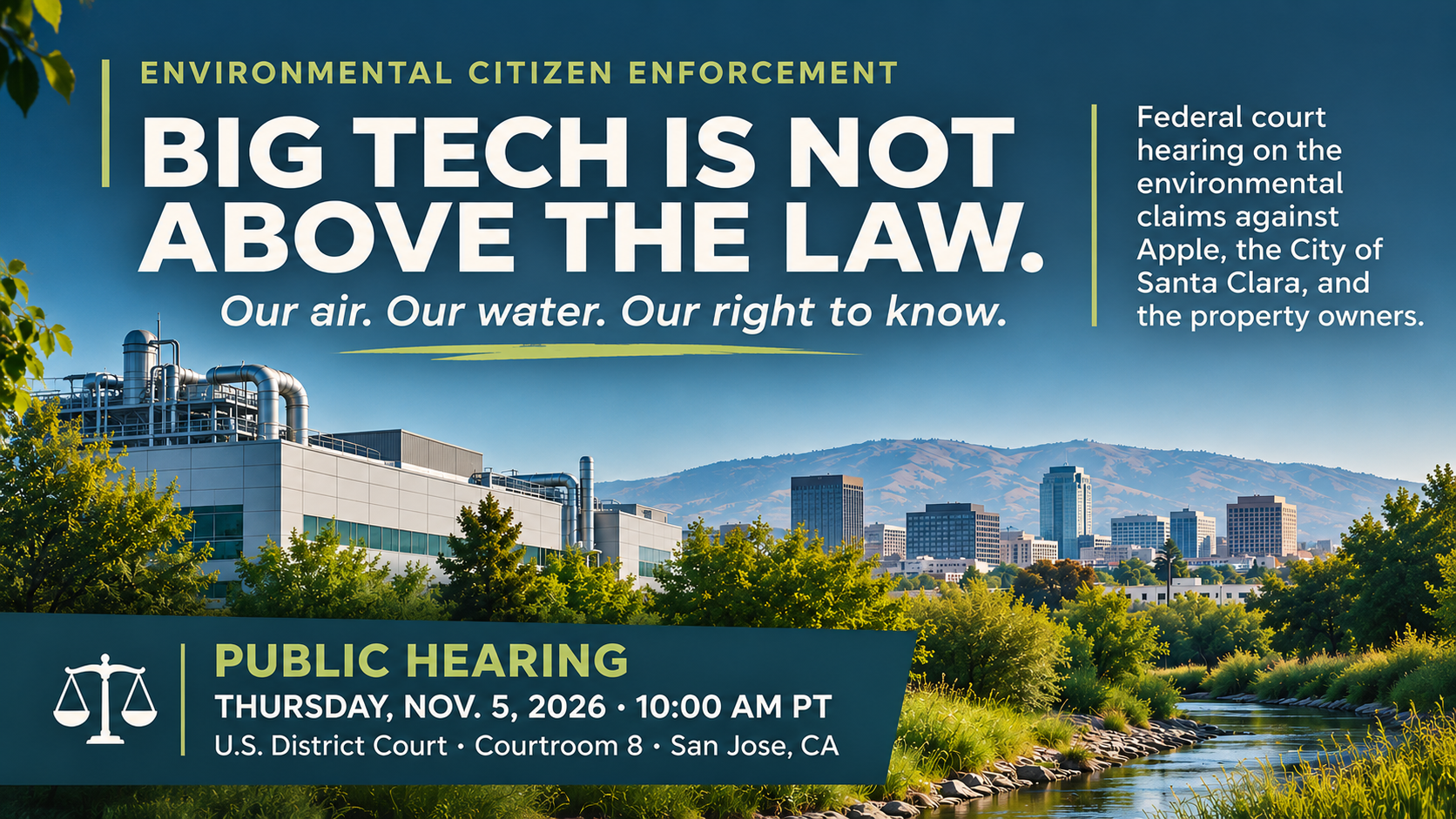
11/5/26 - U.S. Court Hearing in San Jose about Apple's Chip Fab at Santa Clara Square
Press release: attend a federal court hearing in San Jose on Nov. 5 2026 for the environmental citizen suit & public nuisance lawsuit: Gjøvik v. Apple Inc., et al. (5:25-cv-07360-PCP) & support the community around Santa Clara Square.
On November 5, I'll be in federal court fighting to keep my environmental citizen suit against Apple, the City of Santa Clara, and the property owners moving forward. Here's why this case matters for Santa Clara and for the public's right to enforce environmental law.
A semiconductor fabrication facility is not an ordinary office building. It can involve highly hazardous gases, industrial solvents, hazardous waste, wastewater, air-emissions equipment, and extensive safety and disclosure obligations. When such a facility operates next to apartments, parks, playgrounds, and a creek, environmental compliance is not a paperwork formality. It is a public-health and community-accountability imperative.
Apple operates such a facility at 3250 Scott Boulevard in Santa Clara.
My federal environmental citizen suit challenges hazardous-waste management, air emissions, water discharges, and chemical reporting associated with that facility, as well as the roles of municipal and property-owner defendants. The question animating this case is straightforward: Who is responsible for enforcing environmental protections when industrial activity happens in the middle of a community?
This case rests on a regulatory record—not just concern. EPA conducted inspections in 2023 and 2024 and identified hazardous-waste violations later addressed in an October 2025 administrative consent agreement. The pleadings describe 19 RCRA violations involving more than 100 occurrences. The Bay Area Air Quality Management District also issued notices of violation, followed by a May 2026 settlement. These are concrete regulatory actions, not hypothetical questions.
My court filings also identify chemical-throughput certifications that I contend show exceedances of specific air-permit limits for arsine, phosphine, and boron trichloride. They address wastewater and stormwater control deficiencies, hazardous-waste management, and the reporting of toxic chemicals. The record also includes my observations of unusual conditions in San Tomas Aquino Creek in 2026, raising further questions about industrial discharges and watershed protection.
For years, communities across Silicon Valley have lived beside industrial facilities without always knowing what hazardous substances are on-site, what permits require, or what regulatory records reveal. The public has a right to ask those questions, obtain information, and seek enforcement where the law provides it.
A government settlement is not a blanket license to pollute. The defendants point to prior regulatory enforcement and earlier litigation as grounds for dismissing claims. I disagree with their interpretation of the law and the record. My position is that administrative resolutions addressing identified past violations do not automatically dispose of separate, ongoing, or otherwise actionable violations.
Citizen-suit provisions exist because Congress recognized that government enforcement alone may not always be sufficient. They give eligible members of the public a role in enforcing specific environmental duties. A corporation's size, resources, or reputation cannot exempt it from those statutes. Environmental law must mean something even when the defendant is one of the largest corporations in the world.
Santa Clara has responsibilities of its own. The City of Santa Clara argues that it should be dismissed because it is merely a regulator and because enforcement decisions are discretionary.
But my Clean Water Act claims do not stop at the proposition that the City should regulate Apple more aggressively. The opposition identifies the City's own responsibilities under municipal stormwater permitting and regional wastewater arrangements and argues that the City must answer for failures to comply with its independent legal obligations. That is an important distinction.
Public agencies can be regulators, permittees, infrastructure owners, and operators in overlapping systems. Governmental authority does not erase obligations that environmental law imposes on the government itself. I am asking the Court to examine the City's actual duties, not to let the label “regulator” end the inquiry.
The November 5 hearing is the next fight. The defendants have filed motions to dismiss the Third Amended Complaint. They challenge constitutional standing, pre-suit notice, the scope of the citizen-suit statutes, whether particular violations remain actionable, and the sufficiency of the pleading. The hearing concerns those legal challenges. It is not a trial adjudicating every underlying environmental fact. But my position is clear: The complaint states viable claims. The record warrants scrutiny. The Court should deny dismissal.
This litigation is about more than one building and one group of defendants. It concerns what environmental laws mean in practice when a major technology company uses hazardous industrial substances close to places where people live, walk, and play. Clean air, clean water, transparent reporting, and meaningful enforcement are not special favors. They are public protections.
Join the public hearing!
Thursday, November 5, 2026 — 10:00 a.m. PST
U.S. District Court — Northern District of California
Courtroom 8, Fourth Floor
280 South First Street
San Jose, California 95113
Official hearing and Zoom information: https://cand.uscourts.gov/judges/pcp/pitts-p-casey
Gjøvik v. Apple Inc., et al.
No. 5:25-cv-07360-PCP
Judge P. Casey Pitts
BIG TECH IS NOT ABOVE THE LAW.
OUR AIR. OUR WATER. OUR RIGHT TO KNOW.
SIGN THE PETITION:
Sign the Change.org petition to shutdown Apple's 3250 Scott chip fab!
Referenced court filings: Third Amended Complaint (Dkt. 119), defendants' motions (Dkts. 127–128), plaintiff's oppositions (Dkts. 138 and 142), and defendants' replies (Dkts. 145–146). View the full docket here.
Ashley M. Gjøvik, BS, JD, PMP
Location: Alviso, San José, California
Phone: (415) 964-6272
Website: ashleygjovik.com
For more information:
https://www.ashleygjovik.com/3250scott.html
Add Your Comments
We are 100% volunteer and depend on your participation to sustain our efforts!
Donate

$110.00 donated
in the past month
Get Involved
If you'd like to help with maintaining or developing the website, contact us.
Publish
Publish your stories and upcoming events on Indybay.
Topics
More
Search Indybay's Archives
Advanced Search
►
▼
IMC Network