







 Publish to Newswire
 Add an Event
From the Open-Publishing Calendar
From the Open-Publishing Newswire
Indybay Feature
Before You Vote on Props “D, E, A, and F” What the Board of Supervisor’s Budget & Leg Said
A review of what SF Prop D,E,A & F Mean
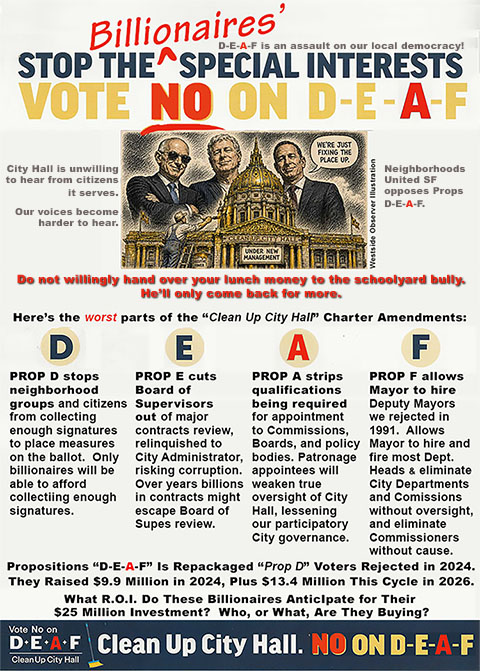
Before You Vote on Props “D, E, A, and F”
What the Board of Supervisor’s Budget and Legislative Analyst Found — and What It Left Out
Don’t hand over your lunch money to the schoolyard bully! He’ll only come back wanting more.
Dear Friends,
On July 14, Supervisor Shamann Walton asked the Board’s Budget and Legislative Analyst (BLA) to analyze Mayor Lurie’s three Charter amendments — Propositions D, E, and F — by September 8, so voters could weigh the findings before the November election ballots went out. The BLA missed that deadline by a month. An unfinished, undated draft surfaced September 25, buried in a Board agenda packet. The final report, dated October 8, only became available on October 12 in response to a public records request I had filed. By then, ballots had been in mailboxes for ten days.
BLA reports are policy documents meant to guide development of City policies on behalf of San Francisco residents. Here is what BLA’s final analysis shows, and what it doesn’t.
Proposition D: Shutting Out Grassroots Initiatives
Signatures to qualify a ballot initiative would quadruple, from 10,615 to 42,460. The BLA estimates a grassroots campaign’s cost would rise from about $320,000 to $1.5 million, with paid circulators alone costing over $1 million. The final report even contains a new error, claiming 70 percent of signatures collected are “invalid” when its own text says 70 percent are valid.
Meanwhile, Mayor Lurie’s own three measures — “Propositions D, E, and F” — reached the ballot by signature petition, given the $4.5 million Lurie’s “Clean Up City Hall” campaign committee (funded by billionaires, centimillionaires, and millionaires) spent to collect the necessary number of signatures to qualify for the ballot. Higher thresholds don’t stop big money; they stop everyone else. As of October 16, Lurie’s campaign committee has raised $14 million to pass the three ballot measures, plus another $425,000 seeking to pass “Proposition A.” That excludes the $9.9 million spent in November 2024 trying to pass the exact same “reforms” via the 2024 “Proposition D.” What are these billionaires trying to buy by raising close to $25 million just for the “D-E-A-F” ballot measure reforms package for Mayor Lurie?
Proposition E: Less Oversight of City Contracts
This is the BLA’s analysis report’s best work. Raising the Board of Supervisors contract-approval threshold from $10 million to $25 million would have cut Board review from 304 contracts to 115 between 2023 and 2025, leaving about $2.5 billion in unreviewed contracts.
Board of Supervisors review of contracts caught real problems. It cut a Mid-Market Foundation amendment from $7.7 million to $3.8 million after unnecessary overhead surfaced. It flagged a nonprofit facing insolvency, which had no chief financial officer. That discovery led to an audit that found $5.6 million paid without verifying eligibility.
Below the proposed $25 million contract threshold, the BLA admits: “There is no comparable public process.” The BLA meant that there is no independent review of a given contract proposed by a City Department, and no questions are ever raised in public. That’s because contracts below the threshold line ae approved administratively by the same department that chose the contractor, and only the City Department will manage the contract.
Eliminating public review is the opposite of public transparency, since public review exists precisely because outside eyes catch what Department insiders won’t flag themselves and don’t want you to know. Mayor Lurie and his campaign committee are complicit in trying to eliminate public scrutiny, which will lead to more corruption, not less.
Worse, only the City Administrator could introduce procurement laws if “Prop E” were to pass, which the Board couldn’t amend. New procurement rules would take effect automatically in 60 days unless disapproved, and the Mayor alone could kill one, while the Board would need a majority vote. What replaces Board oversight? In the BLA’s words: “No new oversight or audit mechanism is proposed.” In plain language, that means no substitute for Board of Supervisors review exists in “Proposition E.”
The report headlines $3.8 million to $23 million in procurement “savings.” Those figures are staff time, not cash, built on a cost estimate the BLA itself calls unreliable.
Between its draft and final analysis reports, the BLA also deleted the Human Resources Department’s statement that it knows of five training system contracts, not the 20 Proposition E claims in the legal text of the measure, as a justification and reason to consolidate all City contracting under the City Administrator. Clearly, it was eliminated from the final BLA’s analysis, given a clearly unsupportable false assertion.
Proposition F: More “Unitary Executive” Power to the Mayor
The Mayor could fire 27 of 62 department heads at will, up from five, including the heads of Police, Fire, Public Health, the MTA, the PUC, the Airport, and Recreation and Park.
Commissions would need to forward only one candidate, instead of three names on a “short list” from which the Mayor could choose a new Department Head. Nearly all members of Boards, Commissions, and advisory bodies would become removable without cause, as so-called “at will” appointees.
The BLA calls the added cost “modest,” about $268,000 a year if Department Head turnover were to double. That figure spreads three severance payments across all 26 recent departures. But firing power adds involuntary departures, exactly the kind that trigger severance payment awards to Department Heads removed involuntarily. Counted properly, each added firing costs about $117,000, and doubles turnover costs to about $708,000 a year — roughly 2.6 times the BLA’s figure.
Between its draft and final analyses, the BLA deleted its finding that only one of those 26 departures was involuntary, along with research showing new administrations push out senior staff.
Proposition F would also allow an unlimited number of deputy mayors, banned by voters since 1991. Copying Boston’s 14 Deputy Mayors would cost about $4 million a year with benefits. The Planning Department’s own organizational chart cites an anticipated “Charter Reform November 2026” step toward a merged permitting department, even before anyone has voted on “Prop F.”
What the BLA Report Ducked
Walton asked 14 questions. Two were dropped outright and several were narrowed, with no explanation. The final fixed surface errors — wrong dates, impossible numbers, a $1 million misstatement — but left most substantive problems standing. Proposition A, which moves nine commissions out of the Charter, got no BLA analysis at all.
Still, the BLA’s own conclusion states the stakes plainly: These measures trade fewer independent checks for faster executive action handing too much “unitary executive” power to the Mayor, at the cost of vastly reducing Board of Supervisors review and oversight over City contracts, Board control of procurement law, and citizens’ ability to reach the ballot.
A generative AI review of the final BLA report, graded as a policy analysis in a graduate government course, gave it a “C” for responsiveness to Walton’s request, a “D+” as a public service to voters, and a “C–” overall. The generative AI’s low grades were well deserved, given the AI’s overall summary, which reads:
“Many of the impacts appear to affect[democratic City] governance leaving the question of whether clearer executive accountability and faster administration warrant fewer independent checks [-and-balances to governance], and [public] oversight, [including] the loss of Board review for a substantial number and dollar value of contracts, the City Administrator's exclusive control over procurement legislation, and the higher bar for citizen [ballot measure] initiatives.”
If you haven’t voted yet, please weigh these facts before you do. And please forward this to anyone who hasn’t mailed in their ballot.
Thank you for reading, and thank you for voting.
Patrick
To see Supervisor’s Walton’s July 14 cost inquiry of Mayor Lurie’s Propositions D, E, and F, the Budget and Legislative Analyst’s draft and final inadequate cost analysis reports, and the two generative AI critique’s of the BLA’s deficient cost analysis, they can be accessed on-line,
What the Board of Supervisor’s Budget and Legislative Analyst Found — and What It Left Out
Don’t hand over your lunch money to the schoolyard bully! He’ll only come back wanting more.
Dear Friends,
On July 14, Supervisor Shamann Walton asked the Board’s Budget and Legislative Analyst (BLA) to analyze Mayor Lurie’s three Charter amendments — Propositions D, E, and F — by September 8, so voters could weigh the findings before the November election ballots went out. The BLA missed that deadline by a month. An unfinished, undated draft surfaced September 25, buried in a Board agenda packet. The final report, dated October 8, only became available on October 12 in response to a public records request I had filed. By then, ballots had been in mailboxes for ten days.
BLA reports are policy documents meant to guide development of City policies on behalf of San Francisco residents. Here is what BLA’s final analysis shows, and what it doesn’t.
Proposition D: Shutting Out Grassroots Initiatives
Signatures to qualify a ballot initiative would quadruple, from 10,615 to 42,460. The BLA estimates a grassroots campaign’s cost would rise from about $320,000 to $1.5 million, with paid circulators alone costing over $1 million. The final report even contains a new error, claiming 70 percent of signatures collected are “invalid” when its own text says 70 percent are valid.
Meanwhile, Mayor Lurie’s own three measures — “Propositions D, E, and F” — reached the ballot by signature petition, given the $4.5 million Lurie’s “Clean Up City Hall” campaign committee (funded by billionaires, centimillionaires, and millionaires) spent to collect the necessary number of signatures to qualify for the ballot. Higher thresholds don’t stop big money; they stop everyone else. As of October 16, Lurie’s campaign committee has raised $14 million to pass the three ballot measures, plus another $425,000 seeking to pass “Proposition A.” That excludes the $9.9 million spent in November 2024 trying to pass the exact same “reforms” via the 2024 “Proposition D.” What are these billionaires trying to buy by raising close to $25 million just for the “D-E-A-F” ballot measure reforms package for Mayor Lurie?
Proposition E: Less Oversight of City Contracts
This is the BLA’s analysis report’s best work. Raising the Board of Supervisors contract-approval threshold from $10 million to $25 million would have cut Board review from 304 contracts to 115 between 2023 and 2025, leaving about $2.5 billion in unreviewed contracts.
Board of Supervisors review of contracts caught real problems. It cut a Mid-Market Foundation amendment from $7.7 million to $3.8 million after unnecessary overhead surfaced. It flagged a nonprofit facing insolvency, which had no chief financial officer. That discovery led to an audit that found $5.6 million paid without verifying eligibility.
Below the proposed $25 million contract threshold, the BLA admits: “There is no comparable public process.” The BLA meant that there is no independent review of a given contract proposed by a City Department, and no questions are ever raised in public. That’s because contracts below the threshold line ae approved administratively by the same department that chose the contractor, and only the City Department will manage the contract.
Eliminating public review is the opposite of public transparency, since public review exists precisely because outside eyes catch what Department insiders won’t flag themselves and don’t want you to know. Mayor Lurie and his campaign committee are complicit in trying to eliminate public scrutiny, which will lead to more corruption, not less.
Worse, only the City Administrator could introduce procurement laws if “Prop E” were to pass, which the Board couldn’t amend. New procurement rules would take effect automatically in 60 days unless disapproved, and the Mayor alone could kill one, while the Board would need a majority vote. What replaces Board oversight? In the BLA’s words: “No new oversight or audit mechanism is proposed.” In plain language, that means no substitute for Board of Supervisors review exists in “Proposition E.”
The report headlines $3.8 million to $23 million in procurement “savings.” Those figures are staff time, not cash, built on a cost estimate the BLA itself calls unreliable.
Between its draft and final analysis reports, the BLA also deleted the Human Resources Department’s statement that it knows of five training system contracts, not the 20 Proposition E claims in the legal text of the measure, as a justification and reason to consolidate all City contracting under the City Administrator. Clearly, it was eliminated from the final BLA’s analysis, given a clearly unsupportable false assertion.
Proposition F: More “Unitary Executive” Power to the Mayor
The Mayor could fire 27 of 62 department heads at will, up from five, including the heads of Police, Fire, Public Health, the MTA, the PUC, the Airport, and Recreation and Park.
Commissions would need to forward only one candidate, instead of three names on a “short list” from which the Mayor could choose a new Department Head. Nearly all members of Boards, Commissions, and advisory bodies would become removable without cause, as so-called “at will” appointees.
The BLA calls the added cost “modest,” about $268,000 a year if Department Head turnover were to double. That figure spreads three severance payments across all 26 recent departures. But firing power adds involuntary departures, exactly the kind that trigger severance payment awards to Department Heads removed involuntarily. Counted properly, each added firing costs about $117,000, and doubles turnover costs to about $708,000 a year — roughly 2.6 times the BLA’s figure.
Between its draft and final analyses, the BLA deleted its finding that only one of those 26 departures was involuntary, along with research showing new administrations push out senior staff.
Proposition F would also allow an unlimited number of deputy mayors, banned by voters since 1991. Copying Boston’s 14 Deputy Mayors would cost about $4 million a year with benefits. The Planning Department’s own organizational chart cites an anticipated “Charter Reform November 2026” step toward a merged permitting department, even before anyone has voted on “Prop F.”
What the BLA Report Ducked
Walton asked 14 questions. Two were dropped outright and several were narrowed, with no explanation. The final fixed surface errors — wrong dates, impossible numbers, a $1 million misstatement — but left most substantive problems standing. Proposition A, which moves nine commissions out of the Charter, got no BLA analysis at all.
Still, the BLA’s own conclusion states the stakes plainly: These measures trade fewer independent checks for faster executive action handing too much “unitary executive” power to the Mayor, at the cost of vastly reducing Board of Supervisors review and oversight over City contracts, Board control of procurement law, and citizens’ ability to reach the ballot.
A generative AI review of the final BLA report, graded as a policy analysis in a graduate government course, gave it a “C” for responsiveness to Walton’s request, a “D+” as a public service to voters, and a “C–” overall. The generative AI’s low grades were well deserved, given the AI’s overall summary, which reads:
“Many of the impacts appear to affect[democratic City] governance leaving the question of whether clearer executive accountability and faster administration warrant fewer independent checks [-and-balances to governance], and [public] oversight, [including] the loss of Board review for a substantial number and dollar value of contracts, the City Administrator's exclusive control over procurement legislation, and the higher bar for citizen [ballot measure] initiatives.”
If you haven’t voted yet, please weigh these facts before you do. And please forward this to anyone who hasn’t mailed in their ballot.
Thank you for reading, and thank you for voting.
Patrick
To see Supervisor’s Walton’s July 14 cost inquiry of Mayor Lurie’s Propositions D, E, and F, the Budget and Legislative Analyst’s draft and final inadequate cost analysis reports, and the two generative AI critique’s of the BLA’s deficient cost analysis, they can be accessed on-line,
Add Your Comments
We are 100% volunteer and depend on your participation to sustain our efforts!
Donate

$85.00 donated
in the past month
Get Involved
If you'd like to help with maintaining or developing the website, contact us.
Publish
Publish your stories and upcoming events on Indybay.
Topics
More
Search Indybay's Archives
Advanced Search
►
▼
IMC Network