


 Publish to Newswire
 Add an Event
From the Open-Publishing Calendar
From the Open-Publishing Newswire
Indybay Feature
No More Techno Fascists Buying Elections in San Francisco Speak-out
 Import event into your personal calendar
Date:
Saturday, October 10, 2026
Time:
11:00 AM
-
12:00 PM
Event Type:
Press Conference
Organizer/Author:
UFCLP
Location Details:
2026 Larkin St.
San Francisco
San Francisco
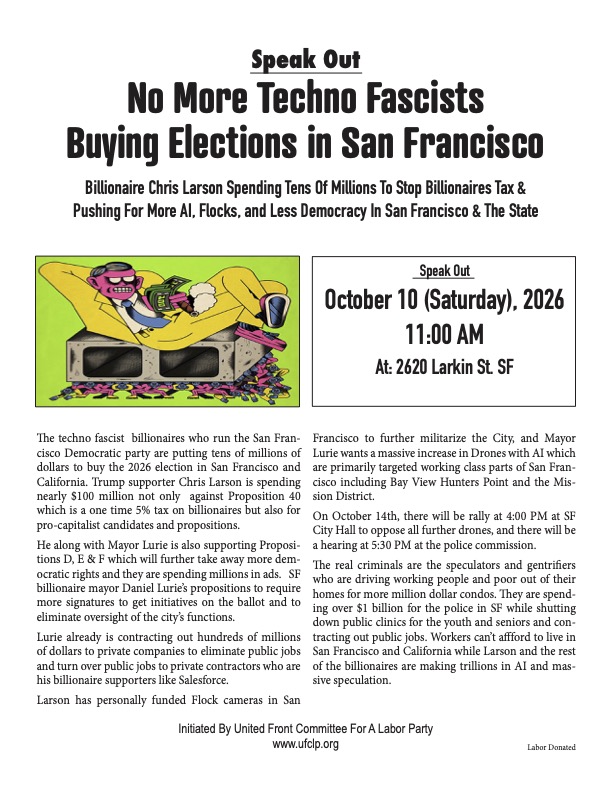
No More Techno Fascists
Buying Elections in San Francisco
Billionaire Chris Larson Spending Tens Of Millions To Stop Billionaires Tax &
Pushing For More AI, Flocks, and Less Democracy In San Francisco & The State
Speak Out
October 10 (Saturday), 2026
11:00 AM
At: 2620 Larkin St. SF
The techno fascist billionaires who run the San Francisco Democratic party are putting tens of millions of dollars to buy the 2026 election in San Francisco and California. Trump supporter Chris Larson is spending nearly $100 million not only against Proposition 40 which is a one time 5% tax on billionaires but also for pro-capitalist candidates and propositions.
He along with Mayor Lurie is also supporting Propositions D, E & F which will further take away more democratic rights and give us more corruption by the billionaires. They are spending millions in ads 24 hours a day. SF billionaire mayor Daniel Lurie’s propositions to require more signatures to get initiatives on the ballot and to eliminate oversight of the city’s functions.
Lurie already is contracting out hundreds of millions of dollars to private companies to eliminate public jobs and turn over public jobs to private contractors who are his billionaire supporters like Salesforce.
Larson has personally funded Flock cameras in San Francisco to further militarize the City, and Mayor Lurie wants a massive increase in Drones with AI which are primarily targeted working class parts of San Francisco including Bay View Hunters Point and the Mission District.
On October 14th, there will be rally at 4:00 PM at SF City Hall to oppose all further drones, and there will be a hearing at 5:30 PM at the police commission which will be voting on whether to support a massive expansion of drones in San Francisco. While city services are being cut they want hundreds of millions more for drones, flock cameras and spying on the people of San Francisco.
The real criminals are the billionaires, speculators and gentrifiers who are driving working people and poor out of their homes for more million dollar condos. They are spending over $1 billion for the police in SF while shutting down public clinics for the youth and seniors and contracting out thousands of public jobs. Workers can’t afford to live in San Francisco and California while Larson and the rest of the billionaires are making trillions in AI, privatization and massive speculation.
Initiated By United Front Committee For A Labor Party
http://www.ufclp.org
For more information:
http://www.ufclp.org
Added to the calendar on Sat, Oct 3, 2026 3:16PM

Add Your Comments
Comments
(Hide Comments)

Billionaires pour money into effort to defeat billionaire tax
Stripe CEO Patrick Collison (worth $17.5 billion) chipped in $15 million; venture investor Vinod Khosla (worth $11.5 billion), $12.6 million; former Google CEO Eric Schmidt (worth $37.8 billion), $12.1 million; and Ripple Executive Chairman Chris Larsen (worth $8.4 billion), $10 million.
By Troy Wolverton | Examiner staff writer 9 hrs ago
The Building a Better California PAC formed by Alphabet co-founder and centibillionaire Sergey Brin (seen in March 2025 ) has raised $110.7 million since the end of June.
Evan Agostini, Invision/Associated Press
If campaign funding is any indication, the state’s billionaires are really opposed to paying a tax on their wealth.
Thanks to a flood of money from the ultrarich in recent weeks, the fight over the billionaire tax being proposed via Proposition 40 is on track to be the second-most expensive ballot battle in state history.
And with Election Day still more than a month away, the brawl could get even pricier.
“The billionaires have the money to spend, so it makes sense that they’re spending it,” said Sarah Hill, a political-science professor at California State University, Fullerton.
Pushed by the Service Employees International Union-United Healthcare Workers West to make up for federal cuts to health-care funding — the bulk of which will start taking effect next year — Prop. 40 would impose a one-time tax of up to 5% on the nonproperty wealth of the state’s billionaires.
Propositions 41 and 42 — placed on the ballot by opponents of the tax measure — would nullify Prop. 40 if either passes with more votes.
Through Thursday, the combined contributions to the campaigns for and against those propositions had hit $243.7 million, according to data from the Secretary of State’s office.
That tops the $226 million that was raised for and against Proposition 22, a 2020 measure set working conditions for ride-hail and delivery drivers. That contest previously ranked as the state’s second-priciest ballot-measure battle.
The only ballot fight more expensive was the one over propositions 26 and 27 — a pair of competing sports-gambling measures in 2022 — according to Ballotopedia. The campaigns for and against those measures together raised $571.6 million, according to the Secretary of State’s office.
While the billionaire-tax battle might not reach that level, it’s been gaining ground quickly. Just since the end of June, $103.5 million has been sunk into the tax fight. Of that amount, only about $432,000 went to the pro-tax effort.
Suzanne Jimenez, the chief of staff at SEIU-UHW, said she wasn’t surprised by how much money was flooding into the effort to defeat the billionaire tax. Billionaires seem willing to spend whatever it takes to shoot it down, no matter the consequences, she said.
“I think it just speaks to how really screwed up or how kind of skewed priorities are in this state where billionaires are willing to spend hundreds of millions of dollars ... instead of just paying a very minimal tax to make sure we have a functioning health-care system,” Jimenez said.
Nearly all of the $103 million raised since June 30 by the individual campaigns fighting the billionaire tax or promoting the rival measures came from Building a Better California. That political-action committee, which was formed by Alphabet co-founder and centibillionaire Sergey Brin, itself has raised $110.7 million since the end of June, according to campaign-finance records from the California secretary of state.
The tally of recent contributors to Building a Better California reads like a list of Silicon Valley’s rich and famous — many of them billionaires, according to Forbes magazine.
Since July 1, Brin — the world’s fifth-wealthiest person, with $225.4 billion in assets — and John Doerr, the chairman of venture-capital firm Kleiner Perkins, who is worth $22.7 billion, each contributed $20 million.
Stripe CEO Patrick Collison (worth $17.5 billion) chipped in $15 million; venture investor Vinod Khosla (worth $11.5 billion), $12.6 million; former Google CEO Eric Schmidt (worth $37.8 billion), $12.1 million; and Ripple Executive Chairman Chris Larsen (worth $8.4 billion), $10 million.
State campaign-finance records show Stripe CEO Patrick Collison (seen in November), who is worth $17.5 billion, has contributed $15 million to the Building a Better California PAC.
Jeff Chiu/Associated Press
Other tech and venture billionaires contributing to the campaign over the last three months include Rippling CEO Parker Conrad; Affirm CEO Max Levchin; former Zynga CEO Mark Pincus; venture capitalist and Palantir co-founder Joe Lonsdale; and Jed McCaleb, Ripple’s former chief technology officer.
The remaining 17 contributors in recent months include Stewart Resnick, the CEO of agricultural giant The Wonderful Company, who is worth $5.4 billion; Reddit CEO Steve Huffman, whose stock in the company is worth hundreds of millions of dollars; and a collection of investment professionals, including Alfred Lin and Shaun Maguire from blue-chip Silicon Valley venture firm Sequoia Capital.
Since it was formed in January, Building a Better California has raised $228.8 million, $200.5 million of which it has already contributed to the anti-Prop. 40 and and pro-Prop. 41 and 42 campaigns.
By comparison, the yes on 22 committee, which was mostly funded by Uber, Lyft, Instacart, DoorDash and PostMates, raised $205 million through the entire course of its campaign to promote Prop. 22.
Just by himself, Brin has contributed a total of $102 million to Building a Better California, easily making him its biggest donor.
In an email, Building a Better California spokesperson Abby Lunardini quibbled with the comparison to other ballot battles. The Prop. 22 fight involved one ballot measure instead of three, she noted. Building a Better California’s spending reflects the signature gathering and other efforts to get propositions 41 and 42 on the ballot, she said.
Lunardini declined to comment about the billionaires’ contributions to the campaign against the tax.
SEIU-UHW has provided 99% of the $31.8 million raised to date by the yes on 40 campaign, but only about $172,000 since June 30.
Other than that, the biggest contributions to the pro-tax campaign have come from Hillary Perkins of San Rafael, who donated $100,000; Ross Boucher of San Francisco, who gave $50,000. John O’Farrell of Atherton, Alan Davis of San Francisco and the Oakland-based council of the American Federation of State, County & Municipal Employees union gave $25,000 each.
Billionaire-tax proponents have no illusions about being able to keep up with their opponents’ campaign funding and spending, Jimenez said.
“We don’t have those types of resources,” she said.
Hill said the outcome of a ballot proposition isn’t necessarily determined by how much money is spent for or against it, but it’s better to have more money than less.
By default, voters typically vote against propositions — and campaign spending against a particular measure can help submarine it, Hill said.
“It’s much easier to convince voters to vote no than yes, because if they’re confused or in doubt, they keep the status quo,” she said. “They just say no.”
The spending against the proposition might be starting to make a difference. While polls earlier this year showed strong support for the billionaire tax, more recent ones indicate a much closer contest.
A poll earlier this week from Politico and the UC Berkeley Citrin Center found the race to be a dead heat among likely voters.
It’s unclear just how much of the money raised by the ballot-measure campaign committees — as opposed to Building a Better California — has been spent. The campaigns update their expenditures quarterly, and their next reports likely won’t come out until after the election.
But through the end of June — the most recent period for which they’d disclosed their spending — the campaigns for and against propositions 40, 41 and 42 had collectively spent $138.6 million of the $140.2 million they’d raised.
That’s almost certainly going to go up. In recent weeks, the no on 40 and yes on 42 campaigns, in particular, have been signing advertising contracts with cable and satellite systems and local broadcasters, according to documents filed with the Federal Communications Commission.
In San Diego, those campaigns have already started airing ads on cable channels.
Instead of focusing on a TV-ad blitz, the yes on 40 campaign plans to lean on volunteers and allied organizations such as Indivisible and the Democratic Socialists of America to get the word out about the measure via phone calls, text messages and door-to-door canvassing, Jimenez said.
And she thinks the ad campaign by opponents could backfire. Voters are likely to question just why there are so many antitax ads on the air and wonder who’s behind them, she said.
“As people just do a little bit of digging, they see it’s billionaires saying, ‘Hey, don’t tax me.’” she said. “And I think voters are going to see through that.”
Written in part by a pair of UC Berkeley professors, Prop. 40 was designed as a response to last year’s federal One Big Beautiful Bill Act. Also known as House Resolution 1, that measure — which cut health-care spending nationwide — is expected to cost California about $100 billion over the next five years.
Proponents of Prop. 40 project it will raise a similar amount of money, 90% of which would go toward funding health care in the state. The other 10% would be set aside for education and food-assistance programs.
The measure has the backing not only of SEIU-UHW, but the California Federation of Labor Unions, the state’s Democratic Party and the California Nurses Association.
Opponents of the measure include many of the state’s top-ranking public officials and those running for its top offices, including Gov. Gavin Newsom, Lt. Gov. Eleni Kounalakis, Treasurer Fiona Ma, and gubernatorial candidates Xavier Becerra and Steve Hilton.
It’s also opposed by the California Teachers Association, the California Medical Association, Planned Parenthood, the state Republican Party and an array of business and antitax groups.
California Gov. Gavin Newsom.png
6ab5b0dc66882.image.jpg
While the state Democratic Party supports Prop. 40, Gov. Gavin Newsom and other top Democratic officials in California have come out against the wealth-tax measure.
Jeff Chiu/Associated Press
Such figures and groups have warned that the measure could end up decreasing state revenues in the long run by encouraging billionaires to flee the state.
Brin, for example, reportedly moved to Nevada recently, although it’s unclear whether that will get him out of paying the tax because he would have had to establish full-time residency there by the beginning of this year.
Sponsored by Building a Better California, propositions 41 and 42 were designed as poison pills for the billionaire tax — if Prop. 40 passes, it won’t take effect if either Prop. 41 or Prop. 42 draw more votes.
Prop. 41 would require that any money raised by taxes passed after Jan. 1 of this year would be subject to the so-called Gann spending limit put in place by Proposition 4 in 1979.
Prop. 42 would essentially bar all nonproperty wealth taxes and prohibit the state from applying any such taxes retroactively.
Stripe CEO Patrick Collison (worth $17.5 billion) chipped in $15 million; venture investor Vinod Khosla (worth $11.5 billion), $12.6 million; former Google CEO Eric Schmidt (worth $37.8 billion), $12.1 million; and Ripple Executive Chairman Chris Larsen (worth $8.4 billion), $10 million.
By Troy Wolverton | Examiner staff writer 9 hrs ago
The Building a Better California PAC formed by Alphabet co-founder and centibillionaire Sergey Brin (seen in March 2025 ) has raised $110.7 million since the end of June.
Evan Agostini, Invision/Associated Press
If campaign funding is any indication, the state’s billionaires are really opposed to paying a tax on their wealth.
Thanks to a flood of money from the ultrarich in recent weeks, the fight over the billionaire tax being proposed via Proposition 40 is on track to be the second-most expensive ballot battle in state history.
And with Election Day still more than a month away, the brawl could get even pricier.
“The billionaires have the money to spend, so it makes sense that they’re spending it,” said Sarah Hill, a political-science professor at California State University, Fullerton.
Pushed by the Service Employees International Union-United Healthcare Workers West to make up for federal cuts to health-care funding — the bulk of which will start taking effect next year — Prop. 40 would impose a one-time tax of up to 5% on the nonproperty wealth of the state’s billionaires.
Propositions 41 and 42 — placed on the ballot by opponents of the tax measure — would nullify Prop. 40 if either passes with more votes.
Through Thursday, the combined contributions to the campaigns for and against those propositions had hit $243.7 million, according to data from the Secretary of State’s office.
That tops the $226 million that was raised for and against Proposition 22, a 2020 measure set working conditions for ride-hail and delivery drivers. That contest previously ranked as the state’s second-priciest ballot-measure battle.
The only ballot fight more expensive was the one over propositions 26 and 27 — a pair of competing sports-gambling measures in 2022 — according to Ballotopedia. The campaigns for and against those measures together raised $571.6 million, according to the Secretary of State’s office.
While the billionaire-tax battle might not reach that level, it’s been gaining ground quickly. Just since the end of June, $103.5 million has been sunk into the tax fight. Of that amount, only about $432,000 went to the pro-tax effort.
Suzanne Jimenez, the chief of staff at SEIU-UHW, said she wasn’t surprised by how much money was flooding into the effort to defeat the billionaire tax. Billionaires seem willing to spend whatever it takes to shoot it down, no matter the consequences, she said.
“I think it just speaks to how really screwed up or how kind of skewed priorities are in this state where billionaires are willing to spend hundreds of millions of dollars ... instead of just paying a very minimal tax to make sure we have a functioning health-care system,” Jimenez said.
Nearly all of the $103 million raised since June 30 by the individual campaigns fighting the billionaire tax or promoting the rival measures came from Building a Better California. That political-action committee, which was formed by Alphabet co-founder and centibillionaire Sergey Brin, itself has raised $110.7 million since the end of June, according to campaign-finance records from the California secretary of state.
The tally of recent contributors to Building a Better California reads like a list of Silicon Valley’s rich and famous — many of them billionaires, according to Forbes magazine.
Since July 1, Brin — the world’s fifth-wealthiest person, with $225.4 billion in assets — and John Doerr, the chairman of venture-capital firm Kleiner Perkins, who is worth $22.7 billion, each contributed $20 million.
Stripe CEO Patrick Collison (worth $17.5 billion) chipped in $15 million; venture investor Vinod Khosla (worth $11.5 billion), $12.6 million; former Google CEO Eric Schmidt (worth $37.8 billion), $12.1 million; and Ripple Executive Chairman Chris Larsen (worth $8.4 billion), $10 million.
State campaign-finance records show Stripe CEO Patrick Collison (seen in November), who is worth $17.5 billion, has contributed $15 million to the Building a Better California PAC.
Jeff Chiu/Associated Press
Other tech and venture billionaires contributing to the campaign over the last three months include Rippling CEO Parker Conrad; Affirm CEO Max Levchin; former Zynga CEO Mark Pincus; venture capitalist and Palantir co-founder Joe Lonsdale; and Jed McCaleb, Ripple’s former chief technology officer.
The remaining 17 contributors in recent months include Stewart Resnick, the CEO of agricultural giant The Wonderful Company, who is worth $5.4 billion; Reddit CEO Steve Huffman, whose stock in the company is worth hundreds of millions of dollars; and a collection of investment professionals, including Alfred Lin and Shaun Maguire from blue-chip Silicon Valley venture firm Sequoia Capital.
Since it was formed in January, Building a Better California has raised $228.8 million, $200.5 million of which it has already contributed to the anti-Prop. 40 and and pro-Prop. 41 and 42 campaigns.
By comparison, the yes on 22 committee, which was mostly funded by Uber, Lyft, Instacart, DoorDash and PostMates, raised $205 million through the entire course of its campaign to promote Prop. 22.
Just by himself, Brin has contributed a total of $102 million to Building a Better California, easily making him its biggest donor.
In an email, Building a Better California spokesperson Abby Lunardini quibbled with the comparison to other ballot battles. The Prop. 22 fight involved one ballot measure instead of three, she noted. Building a Better California’s spending reflects the signature gathering and other efforts to get propositions 41 and 42 on the ballot, she said.
Lunardini declined to comment about the billionaires’ contributions to the campaign against the tax.
SEIU-UHW has provided 99% of the $31.8 million raised to date by the yes on 40 campaign, but only about $172,000 since June 30.
Other than that, the biggest contributions to the pro-tax campaign have come from Hillary Perkins of San Rafael, who donated $100,000; Ross Boucher of San Francisco, who gave $50,000. John O’Farrell of Atherton, Alan Davis of San Francisco and the Oakland-based council of the American Federation of State, County & Municipal Employees union gave $25,000 each.
Billionaire-tax proponents have no illusions about being able to keep up with their opponents’ campaign funding and spending, Jimenez said.
“We don’t have those types of resources,” she said.
Hill said the outcome of a ballot proposition isn’t necessarily determined by how much money is spent for or against it, but it’s better to have more money than less.
By default, voters typically vote against propositions — and campaign spending against a particular measure can help submarine it, Hill said.
“It’s much easier to convince voters to vote no than yes, because if they’re confused or in doubt, they keep the status quo,” she said. “They just say no.”
The spending against the proposition might be starting to make a difference. While polls earlier this year showed strong support for the billionaire tax, more recent ones indicate a much closer contest.
A poll earlier this week from Politico and the UC Berkeley Citrin Center found the race to be a dead heat among likely voters.
It’s unclear just how much of the money raised by the ballot-measure campaign committees — as opposed to Building a Better California — has been spent. The campaigns update their expenditures quarterly, and their next reports likely won’t come out until after the election.
But through the end of June — the most recent period for which they’d disclosed their spending — the campaigns for and against propositions 40, 41 and 42 had collectively spent $138.6 million of the $140.2 million they’d raised.
That’s almost certainly going to go up. In recent weeks, the no on 40 and yes on 42 campaigns, in particular, have been signing advertising contracts with cable and satellite systems and local broadcasters, according to documents filed with the Federal Communications Commission.
In San Diego, those campaigns have already started airing ads on cable channels.
Instead of focusing on a TV-ad blitz, the yes on 40 campaign plans to lean on volunteers and allied organizations such as Indivisible and the Democratic Socialists of America to get the word out about the measure via phone calls, text messages and door-to-door canvassing, Jimenez said.
And she thinks the ad campaign by opponents could backfire. Voters are likely to question just why there are so many antitax ads on the air and wonder who’s behind them, she said.
“As people just do a little bit of digging, they see it’s billionaires saying, ‘Hey, don’t tax me.’” she said. “And I think voters are going to see through that.”
Written in part by a pair of UC Berkeley professors, Prop. 40 was designed as a response to last year’s federal One Big Beautiful Bill Act. Also known as House Resolution 1, that measure — which cut health-care spending nationwide — is expected to cost California about $100 billion over the next five years.
Proponents of Prop. 40 project it will raise a similar amount of money, 90% of which would go toward funding health care in the state. The other 10% would be set aside for education and food-assistance programs.
The measure has the backing not only of SEIU-UHW, but the California Federation of Labor Unions, the state’s Democratic Party and the California Nurses Association.
Opponents of the measure include many of the state’s top-ranking public officials and those running for its top offices, including Gov. Gavin Newsom, Lt. Gov. Eleni Kounalakis, Treasurer Fiona Ma, and gubernatorial candidates Xavier Becerra and Steve Hilton.
It’s also opposed by the California Teachers Association, the California Medical Association, Planned Parenthood, the state Republican Party and an array of business and antitax groups.
California Gov. Gavin Newsom.png
6ab5b0dc66882.image.jpg
While the state Democratic Party supports Prop. 40, Gov. Gavin Newsom and other top Democratic officials in California have come out against the wealth-tax measure.
Jeff Chiu/Associated Press
Such figures and groups have warned that the measure could end up decreasing state revenues in the long run by encouraging billionaires to flee the state.
Brin, for example, reportedly moved to Nevada recently, although it’s unclear whether that will get him out of paying the tax because he would have had to establish full-time residency there by the beginning of this year.
Sponsored by Building a Better California, propositions 41 and 42 were designed as poison pills for the billionaire tax — if Prop. 40 passes, it won’t take effect if either Prop. 41 or Prop. 42 draw more votes.
Prop. 41 would require that any money raised by taxes passed after Jan. 1 of this year would be subject to the so-called Gann spending limit put in place by Proposition 4 in 1979.
Prop. 42 would essentially bar all nonproperty wealth taxes and prohibit the state from applying any such taxes retroactively.
For more information:
http://battle/article_31b8898d-bb5a-4ff5-9...
We are 100% volunteer and depend on your participation to sustain our efforts!
Donate

$110.00 donated
in the past month
Get Involved
If you'd like to help with maintaining or developing the website, contact us.
Publish
Publish your stories and upcoming events on Indybay.
Topics
More
Search Indybay's Archives
Advanced Search
►
▼
IMC Network