







 Publish to Newswire
 Add an Event
From the Open-Publishing Calendar
From the Open-Publishing Newswire
Indybay Feature
Rally To Stop Chatbots Replacing Workers At Kaiser, Defend Healthcare Workers & Single Pay
 Import event into your personal calendar
Date:
Friday, September 04, 2026
Time:
12:00 PM
-
1:30 PM
Event Type:
Protest
Organizer/Author:
National Single Payer, CUSP, UFCLP
Location Details:
San Francisco Kaiser Hospital
2645 Geary Blvd
San Francisco
2645 Geary Blvd
San Francisco
On Labor Day Weekend
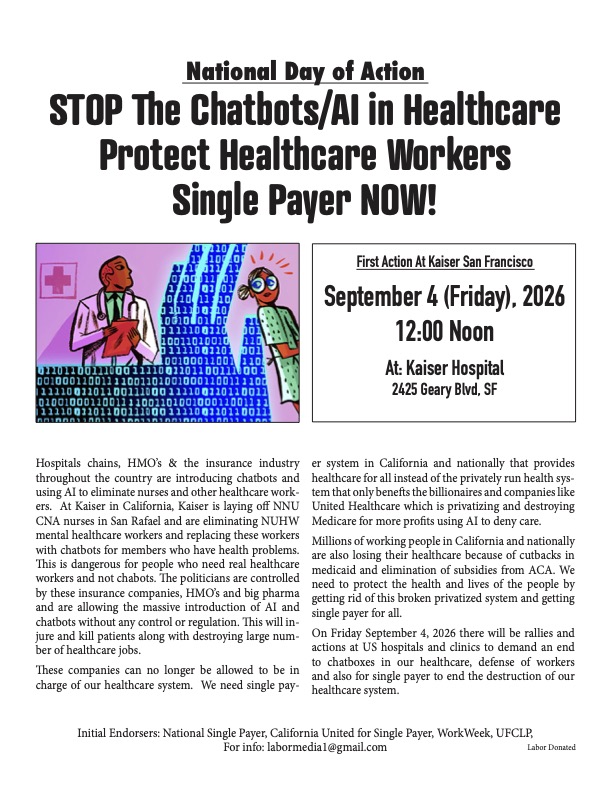
STOP The Chatbots/Al in Healthcare
Protect Healthcare Workers
Single Payer NOW!
First Action At Kaiser San Francisco
September 4 (Friday). 2026
12:00 Noon
At: Kaiser Hospital
2425 Geary Bivd, SF
STOP The Chatbots/Al in Healthcare
Protect Healthcare Workers
Single Payer NOW!
First Action At Kaiser San Francisco
September 4 (Friday). 2026
12:00 Noon
At: Kaiser Hospital
2425 Geary Bivd, SF
Hospitals chains, HMO’s & the insurance industry throughout the country are introducing chatbots and using AI to eliminate nurses and other healthcare workers.
At Kaiser in California, Kaiser is laying off NNU CNA nurses in San Rafael and are eliminating NUHW mental healthcare workers and replacing these workers with chatbots for members who have health problems.
This is dangerous for people who need real healthcare workers and not chabots. The politicians are controlled by these insurance companies, HMO’s and big pharma and are allowing the massive introduction of AI and chatbots without any control or regulation. This will injure and kill patients along with destroying large number of healthcare jobs.
These companies can no longer be allowed to be in charge of our healthcare system. We need single payer system in California and nationally that provides healthcare
for all instead of the privately run health system that only benefts the billionaires and companies like United Healthcare which is privatizing and destroying Medicare for more profits
using Al to deny care.
Millions of working people in California and nationally are also losing their healthcare because of cutbacks in medicaid and elimination of subsidies from ACA. We need to protect the health and lives of the people by getting rid of this broken privatized system and getting single payer for all.
On Friday September 4, 2026 there will be rallies and actions at US hospitals and clinics to demand an end to chatboxes in our healthcare, defense of workers and also for single payer to end the destruction of our healthcare system.
Initial Endorsers: National Single Payer, California United for Single Payer,
Work Week, UFCLP,
For info: mailto:labormedial [at] gmail.com
Initial Endorsers: National Single Payez, California United for Single Payer, WorkWeek, UFCLP,
For info: labormedial [at] gmail.com
Newsom Demos In California slashing Medi-Cal asset limits by 84%. Here’s who will be affected
The modifications were part of Gov. Gavin Newsom’s efforts to balance the state budgetamid soaring Medi-Cal costs and billions in cuts from the federal government due to the GOP’s tax and spending megabill signed by President Donald Trump in July 2025.
https://www.sfchronicle.com/personal-finance/article/medi-cal-medicaid-asset-california-22362049.php
By Jessica Roy,
Personal Finance Columnist
Aug 1, 2026
Clients receive help renewing Medi-Cal coverage at Families Together of Orange County in Tustin in 2023. Beginning in July 2027, some seniors, disabled Californians and people who need long-term care will face sharply lower asset limits to qualify for the program.
Clients receive help renewing Medi-Cal coverage at Families Together of Orange County in Tustin in 2023. Beginning in July 2027, some seniors, disabled Californians and people who need long-term care will face sharply lower asset limits to qualify for the program.
Many seniors and disabled people in California who need long-term care will soon face a dramatic reduction in assets they can keep and still qualify for Medi-Cal.
Starting in July 2027, the individual limit will fall from $130,000 to $21,000, while the limit for couples will drop from $195,000 to $31,000 when they apply for Medi-Cal — California’s Medicaid program — or renew their coverage. That’s an 84% decrease.
The rules will primarily affect people who qualify because of their age, disability or need for nursing-home or other long-term care.
The change is a turnaround from the approach the state adopted in 2022. Before that year, Medi-Cal assets were very low. Many enrollees could have only $2,000 in countable assets, or $3,000 for a two-person household — numbers that hadn’t been changed or adjusted for inflation since they were implemented in 1989.
Those limits left people in profound poverty, said Cindy George, the senior personal finance editor for prescription comparison cost website GoodRx.
“Advocates for seniors and people with disabilities had long pushed for higher Medi-Cal asset limits — or none at all — to allow individuals and families to keep their affordable health insurance without financial insecurity,” George said.
In 2022, the limits increased substantially: To $130,000 for an individual plus $65,000 for each additional family member. The asset limit was eliminated entirely in 2024.
California then revisited that decision, and in January 2026, the $130,000 individual and $195,000 married couple asset limits were put back in place. But that’s changing again beginning on July 1, 2027, to a much lower limit: $21,000 for one person, $31,000 for a couple, and another $1,550 for each additional qualified person who lives in your house.
The modifications were part of Gov. Gavin Newsom’s efforts to balance the state budgetamid soaring Medi-Cal costs and billions in cuts from the federal government due to the GOP’s tax and spending megabill signed by President Donald Trump in July 2025.
These changes, along with others at the state and federal level to Medicaid programs, could have broader impacts on all Californians, said Kristof Stremikis, the director of market analysis and insight for the Oakland-based nonprofit philanthropy California Health Care Foundation. A report from the foundation found the policy changes could lead to up to 2 million Californians losing health care coverage.
“Medi-Cal finances so much of our delivery system here in California,” he said. “I think you’re going to start to see access challenges for Medi-Cal enrollees, but even more broadly, you’re really going to see strain on the system that shows up for everyone in longer waiting times, difficulty finding doctors, that type of thing. We’re in for a rough ride.”
If you or a family member is on Medi-Cal, here’s what you need to know about the new eligibility requirements.
Who is impacted by California’s 2027 Medi-Cal asset limit changes?
The new limit doesn’t apply to everyone on Medi-Cal. People who use the program under federal modified adjusted gross income rules, like many children, pregnant people, parents and working-age adults, are not subject to asset tests.
These changes will primarily impact people who are enrolled in Medi-Cal outside the federal MAGI rules, including people who are 65 or older, are blind, have a disability, live in a nursing home or receive other long-term care services paid for by Medi-Cal, or who use a Medicare Savings Program.
What’s changing for Medi-Cal asset limits?
Medi-Cal eligibility is determined in part by your assets. Here’s a list of current asset limits and what they’re changing to in July 2027.
Asset limits
What’s counted:
Money in your bank account
Cash
Secondary homes
Second vehicles
Other investments or financial resources
The current limit for the total value of those assets is $130,000, plus another $65,000 per person who lives in your home for up to 10 people.
The new limit will be $21,000 for one person, another $10,000 for a spouse, and then another $1,550 per each additional qualified person in your home, up to 10 people total. Adult children, roommates and some others do not qualify.
California has a program called Spousal Impoverishment that can protect some additional assets from being counted toward eligibility for a spouse or domestic partner.
Non-countable assets
There are certain types of assets that typically aren’t counted against Medi-Cal eligibility. These include:
A primary residence
One car
Household goods and personal items in the primary residence
Retirement funds, like 401(ks) and IRAs, if regular payments are being received from them
Though primary residences are not counted for eligibility, the state can pursue an estate to recover certain costs after death, said Mark Gilfix, an estate planning and elder law attorney based in Palo Alto. He said a primary home properly titled in a living trust generally keeps it out of probate, shielding it from the estate recovery process.
What do people currently on Medi-Cal need to do?
Not all enrollees will have their assets tested on July 1 of next year; the asset limits will be reported and assessed on a rolling basis when people renew their coverage.
To maintain eligibility for the program, participants will need to transfer or spend down assets to the new limits, Gilfix said, and administrators may review where those assets went to make sure transactions were made appropriately. Giving away or selling assets for less than they’re worth can delay long-term care coverage, according to an FAQ from the state Department of Health Care Services. Working with a qualified financial adviser or elder law attorney may help you protect eligibility.
Who is accountable?’ Kaiser therapists challenge use of AI in mental health screening
As the provider and its therapists clash over AI, a new complaint says an algorithm, not a clinician, is deciding patients’ care within seconds.
https://sfstandard.com/2026/07/21/kaiser-ai-mental-health-screening-complaint-nuhw/
A modern glass and metal building displays the words "KAISER PERMANENTE" near the top, with tree branches framing the left side.
The healthcare giant has found itself at the center of a labor dispute over the role of AI. | Source: Getty Images
A woman with light skin, blue eyes, and brown hair styled in an updo wears a black top and has a subtle smile on her face.
By Jennifer Wadsworth
Senior News Editor
Published Jul. 21, 2026at6:00am
Ilana Marcucci-Morris spends less time doing triage these days and more time, as she describes it, cleaning up after robots.
As one of the licensed clinicians Kaiser Permanente patients reach when they call seeking mental healthcare, she used to spend 10 to 15 minutes on the phone assessing for evidence of suicide risk, domestic violence, substance use, or homicidal thoughts before deciding what kind of care was needed.
Now that initial screenings are often handled by phone clerks or an online questionnaire, she increasingly finds herself fixing mistakes made by operators and automated tools.
“I call it ‘service recovery’ more than official triage,” she said.
Subtle cues she picks up during assessments — tics, tone, even words left unsaid — are being missed by automated screenings and untrained clerical staff.
Patients are more likely to arrive at their first appointment intoxicated, in withdrawal, or confused about why they’re seeing a social worker instead of a psychiatrist who can prescribe medication. Others are referred to outside telehealth providers who later decide they’re not equipped to treat them, sending them back to Kaiser weeks later, angrier and worse off. Still others wait weeks for care that once took days.
When people reach out for mental healthcare, that first step can be one of the most crucial to get right. “Our job at the beginning is to instill hope,” Marcucci-Morris said. “You’re not well now, but I want to give you hope that you can get well.” Delays and mistakes at that tenuous early stage risk “reinforcing hopelessness” instead.
“Even if other things don’t go well in behavioral healthcare,” she added, “most science says you better nail it at the start.”
At the center of the dispute is a simple question: When someone seeks mental healthcare, who should decide what happens next?
Kaiser therapists say the system is increasingly allowing software and unlicensed staff to make screening decisions that California law says must be made by licensed clinicians — an allegation at the heart of a new regulatory complaint and a hearing this week at San Francisco City Hall.
A crowd of protesters in red shirts hold signs saying “Patient Health Not Corporate Wealth” while a person with a megaphone speaks passionately.
Ilana Marcucci-Morris, a licensed clinician, during a 2022 protest outside Kaiser’s corporate building in Oakland. | Source: Courtesy NUHW
A test case for AI in healthcare
The dispute unfolding at Kaiser, California’s largest private employer(opens in new tab), as it negotiates a contract with the National Union of Healthcare Workers has been described as one of the nation’s first labor fights over AI.
So it’s fitting that in San Francisco — the global hub of artificial intelligence — a local lawmaker is convening a special hearing(opens in new tab) Tuesday about contract demands(opens in new tab) that would let the HMO expand the use of automated tools in mental healthcare and lay off the therapists who currently provide it.
A black briefcase with a clasp is centered inside a shiny black and yellow snow globe on a bright yellow background.
More about
The Future of Work
Four people sit or stand separately in individual glass phone booths in a modern office space with blue carpet and bright overhead lighting.
In San Francisco’s hot-again office market, you need a glow-up to succeed
The torch of the Statue of Liberty is being lit by a large, glowing Nike swoosh in the sky against an orange background.
IDEAS
The American dream is broken. Here’s what it would take to fix it
Tech is in flux; tourism is sluggish. SF’s recovery hangs in the balance
Supervisor Chyanne Chen, who called for the hearing, said she wants to make sure ongoing negotiations between Kaiser and the NUHW protect patients as much as employees. “Every single person, their story is a little different, their circumstances are different, their needs are very different,” she said. That complexity, she added, doesn’t lend itself to the standardization of an algorithm.
Kaiser has repeatedly denied using AI to replace human care.
“Artificial intelligence holds significant potential to benefit healthcare by supporting better diagnostics, enhancing patient-clinician relationships, optimizing clinicians’ time, and ensuring fairness in care experiences and health outcomes by addressing individual needs,” the company told reporters when its therapists went on strike in the spring.
But a complaint from NUHW offers new evidence that the union says shows Kaiser is already leaning on automation to make the kind of clinical calls that are supposed to be handled by licensed providers. The complaint, filed Monday with California’s Department of Managed Health Care and the U.S. Department of Labor, centers on Kaiser’s e-visit tool, an online questionnaire the company directs patients toward when they’re seeking care for anxiety or depression.
Have thoughts on this story?
Start the conversation
To test the tool, the union had four Kaiser members complete it, answering the questions to reflect various levels of symptom severity. Each time, the tool generated a care recommendation — a referral to virtual therapy, a referral to an outside provider, or simply a suggestion to try a self-care app — within two seconds of the last question being answered, according to screenshots included in the complaint.
That’s hard to square with how Kaiser describes the screening to patients. In a December 2025 post(opens in new tab) on its website, the company said that when a member completes an e-visit, “the answers are reviewed by a healthcare professional, and the member receives a response by secure message within four hours, and usually sooner.”
For Marcucci-Morris, the instant turnarounds uncovered by the union testing confirmed what she’d suspected for years.
“That’s 100% of my job,” she said. “But now it’s automated or algorithmic or AI or whatever it is, making decisions that have taken me decades to be able to legally do.”
From advice nurse to algorithm
The shift began in 2023, when Kaiser introduced One Mental Health, a regional phone line. For years before that, any patient who told their doctor they needed mental healthcare, or called Kaiser directly, first spoke with a licensed clinician like Marcucci-Morris.
“Any time someone expresses some sort of mental health need to their doctor or any part of the health plan, a referral would be generated to psychiatry,” she said. “But the first step would be to get on the phone with someone like me, a licensed human provider.”
That changed with the new phone screening. Patients calling in were routed first to clerical staff who are generally required to have only a high school diploma, according to a complaint(opens in new tab)the union filed last year. Those operators pose a scripted set of questions, loosely modeled on the ones clinicians might ask, and are supposed to escalate a call to a provider only if a patient says something alarming enough to trigger it, according to the union’s complaint.
But Kaiser has been tightlipped about exactly when that escalation is supposed to happen. Marcucci-Morris said she often learned the details only after the fact, by piecing together information from patients’ charts.
Around the same time, Kaiser began steering another set of patients toward a second, newer pathway: online questionnaires called e-visits, which let people seeking care for anxiety or depression screen themselves without speaking to anyone at all.
A black box
Kaiser has never disclosed how the e-visit tool works, despite repeated requests, according to Fred Seavey, NUHW’s research director. That lack of transparency troubles Marcucci-Morris most. If she makes the wrong call, there’s a clear line of accountability.
“If I commit malpractice, the state can take my license away from me,” she said. “What happens when technology gets it wrong? Who is accountable?”
Related
‘A huge betrayal’: Parents fume as Kaiser ends gender-affirming surgeries for kids(opens in new tab)
‘Trust nurses, not AI’: Workers protest use of artificial intelligence at Kaiser hospitals(opens in new tab)
SF’s mental health overhaul wasn’t ‘the big magical pill we’d hoped for’(opens in new tab)
Kaiser’s mental health system has faced repeated regulatory action. In 2023, it agreed to a $200 million settlement(opens in new tab) over failures to provide timely care. A subsequent state survey(opens in new tab)found that it still could not demonstrate adequate suicide-risk screening, and in February it agreed to pay $31.1 million(opens in new tab) to settle a federal investigation into its use of questionnaires to restrict access to care.
To Seavey, that history undercuts any assurance Kaiser might offer about the algorithm behind its e-visit tool. “You’ve had to pay out nearly a quarter billion dollars for dozens of violations, and you’re asking us to trust you?” he said. “We want to see it. Why can’t you show us the algorithm?”
Kaiser did not directly address the two-second turnaround times documented in the union’s testing, or Seavey’s request to see the algorithm.
In a statement on Tuesday, the company said it “disagree[s] with the union’s characterization” of its behavioral health processes, and said its e-visit tool “does not use AI to diagnose patients, make clinical decisions, or determine medical necessity,” adding that clinical decisions “remain with licensed health care professionals.”
Kaiser also said the tool was developed with input from therapists and NUHW representatives, and that patients can call a phone number listed on every e-visit screen to reach a live person.
Tuesday’s hearing, Chen said, is a chance to get answers before the next contract is signed.
Marcucci-Morris plans to be there.
“I have never felt better because a chatbot gave me a reassuring statement,” Marcucci-Morris said. “We heal through empathy. That is not something technology can give people.”
‘Who is accountable?’ Kaiser therapists challenge use of AI in mental health screening
As the provider and its therapists clash over AI, a new complaint says an algorithm, not a clinician, is deciding patients’ care within seconds.
https://sfstandard.com/2026/07/21/kaiser-ai-mental-health-screening-complaint-nuhw/
A modern glass and metal building displays the words "KAISER PERMANENTE" near the top, with tree branches framing the left side.
The healthcare giant has found itself at the center of a labor dispute over the role of AI. | Source: Getty Images
A woman with light skin, blue eyes, and brown hair styled in an updo wears a black top and has a subtle smile on her face.
By Jennifer Wadsworth
Senior News Editor
Published Jul. 21, 2026at6:00am
Ilana Marcucci-Morris spends less time doing triage these days and more time, as she describes it, cleaning up after robots.
As one of the licensed clinicians Kaiser Permanente patients reach when they call seeking mental healthcare, she used to spend 10 to 15 minutes on the phone assessing for evidence of suicide risk, domestic violence, substance use, or homicidal thoughts before deciding what kind of care was needed.
Now that initial screenings are often handled by phone clerks or an online questionnaire, she increasingly finds herself fixing mistakes made by operators and automated tools.
ADVERTISEMENT
Subscribe.jpeg
“I call it ‘service recovery’ more than official triage,” she said.
Subtle cues she picks up during assessments — tics, tone, even words left unsaid — are being missed by automated screenings and untrained clerical staff.
Patients are more likely to arrive at their first appointment intoxicated, in withdrawal, or confused about why they’re seeing a social worker instead of a psychiatrist who can prescribe medication. Others are referred to outside telehealth providers who later decide they’re not equipped to treat them, sending them back to Kaiser weeks later, angrier and worse off. Still others wait weeks for care that once took days.
When people reach out for mental healthcare, that first step can be one of the most crucial to get right. “Our job at the beginning is to instill hope,” Marcucci-Morris said. “You’re not well now, but I want to give you hope that you can get well.” Delays and mistakes at that tenuous early stage risk “reinforcing hopelessness” instead.
“Even if other things don’t go well in behavioral healthcare,” she added, “most science says you better nail it at the start.”
At the center of the dispute is a simple question: When someone seeks mental healthcare, who should decide what happens next?
Kaiser therapists say the system is increasingly allowing software and unlicensed staff to make screening decisions that California law says must be made by licensed clinicians — an allegation at the heart of a new regulatory complaint and a hearing this week at San Francisco City Hall.
A crowd of protesters in red shirts hold signs saying “Patient Health Not Corporate Wealth” while a person with a megaphone speaks passionately.
Ilana Marcucci-Morris, a licensed clinician, during a 2022 protest outside Kaiser’s corporate building in Oakland. | Source: Courtesy NUHW
A test case for AI in healthcare
The dispute unfolding at Kaiser, California’s largest private employer(opens in new tab), as it negotiates a contract with the National Union of Healthcare Workers has been described as one of the nation’s first labor fights over AI.
So it’s fitting that in San Francisco — the global hub of artificial intelligence — a local lawmaker is convening a special hearing(opens in new tab) Tuesday about contract demands(opens in new tab) that would let the HMO expand the use of automated tools in mental healthcare and lay off the therapists who currently provide it.
A black briefcase with a clasp is centered inside a shiny black and yellow snow globe on a bright yellow background.
More about
The Future of Work
Four people sit or stand separately in individual glass phone booths in a modern office space with blue carpet and bright overhead lighting.
In San Francisco’s hot-again office market, you need a glow-up to succeed
The torch of the Statue of Liberty is being lit by a large, glowing Nike swoosh in the sky against an orange background.
IDEAS
The American dream is broken. Here’s what it would take to fix it
Tech is in flux; tourism is sluggish. SF’s recovery hangs in the balance
Supervisor Chyanne Chen, who called for the hearing, said she wants to make sure ongoing negotiations between Kaiser and the NUHW protect patients as much as employees. “Every single person, their story is a little different, their circumstances are different, their needs are very different,” she said. That complexity, she added, doesn’t lend itself to the standardization of an algorithm.
Kaiser has repeatedly denied using AI to replace human care.
“Artificial intelligence holds significant potential to benefit healthcare by supporting better diagnostics, enhancing patient-clinician relationships, optimizing clinicians’ time, and ensuring fairness in care experiences and health outcomes by addressing individual needs,” the company told reporters when its therapists went on strike in the spring.
But a complaint from NUHW offers new evidence that the union says shows Kaiser is already leaning on automation to make the kind of clinical calls that are supposed to be handled by licensed providers. The complaint, filed Monday with California’s Department of Managed Health Care and the U.S. Department of Labor, centers on Kaiser’s e-visit tool, an online questionnaire the company directs patients toward when they’re seeking care for anxiety or depression.
Have thoughts on this story?
Start the conversation
To test the tool, the union had four Kaiser members complete it, answering the questions to reflect various levels of symptom severity. Each time, the tool generated a care recommendation — a referral to virtual therapy, a referral to an outside provider, or simply a suggestion to try a self-care app — within two seconds of the last question being answered, according to screenshots included in the complaint.
That’s hard to square with how Kaiser describes the screening to patients. In a December 2025 post(opens in new tab) on its website, the company said that when a member completes an e-visit, “the answers are reviewed by a healthcare professional, and the member receives a response by secure message within four hours, and usually sooner.”
For Marcucci-Morris, the instant turnarounds uncovered by the union testing confirmed what she’d suspected for years.
“That’s 100% of my job,” she said. “But now it’s automated or algorithmic or AI or whatever it is, making decisions that have taken me decades to be able to legally do.”
From advice nurse to algorithm
The shift began in 2023, when Kaiser introduced One Mental Health, a regional phone line. For years before that, any patient who told their doctor they needed mental healthcare, or called Kaiser directly, first spoke with a licensed clinician like Marcucci-Morris.
“Any time someone expresses some sort of mental health need to their doctor or any part of the health plan, a referral would be generated to psychiatry,” she said. “But the first step would be to get on the phone with someone like me, a licensed human provider.”
That changed with the new phone screening. Patients calling in were routed first to clerical staff who are generally required to have only a high school diploma, according to a complaint(opens in new tab)the union filed last year. Those operators pose a scripted set of questions, loosely modeled on the ones clinicians might ask, and are supposed to escalate a call to a provider only if a patient says something alarming enough to trigger it, according to the union’s complaint.
But Kaiser has been tightlipped about exactly when that escalation is supposed to happen. Marcucci-Morris said she often learned the details only after the fact, by piecing together information from patients’ charts.
Around the same time, Kaiser began steering another set of patients toward a second, newer pathway: online questionnaires called e-visits, which let people seeking care for anxiety or depression screen themselves without speaking to anyone at all.
A black box
Kaiser has never disclosed how the e-visit tool works, despite repeated requests, according to Fred Seavey, NUHW’s research director. That lack of transparency troubles Marcucci-Morris most. If she makes the wrong call, there’s a clear line of accountability.
“If I commit malpractice, the state can take my license away from me,” she said. “What happens when technology gets it wrong? Who is accountable?”
Related
‘A huge betrayal’: Parents fume as Kaiser ends gender-affirming surgeries for kids(opens in new tab)
‘Trust nurses, not AI’: Workers protest use of artificial intelligence at Kaiser hospitals(opens in new tab)
SF’s mental health overhaul wasn’t ‘the big magical pill we’d hoped for’(opens in new tab)
Kaiser’s mental health system has faced repeated regulatory action. In 2023, it agreed to a $200 million settlement(opens in new tab) over failures to provide timely care. A subsequent state survey(opens in new tab)found that it still could not demonstrate adequate suicide-risk screening, and in February it agreed to pay $31.1 million(opens in new tab) to settle a federal investigation into its use of questionnaires to restrict access to care.
To Seavey, that history undercuts any assurance Kaiser might offer about the algorithm behind its e-visit tool. “You’ve had to pay out nearly a quarter billion dollars for dozens of violations, and you’re asking us to trust you?” he said. “We want to see it. Why can’t you show us the algorithm?”
Kaiser did not directly address the two-second turnaround times documented in the union’s testing, or Seavey’s request to see the algorithm.
In a statement on Tuesday, the company said it “disagree[s] with the union’s characterization” of its behavioral health processes, and said its e-visit tool “does not use AI to diagnose patients, make clinical decisions, or determine medical necessity,” adding that clinical decisions “remain with licensed health care professionals.”
Kaiser also said the tool was developed with input from therapists and NUHW representatives, and that patients can call a phone number listed on every e-visit screen to reach a live person.
Tuesday’s hearing, Chen said, is a chance to get answers before the next contract is signed.
Marcucci-Morris plans to be there.
“I have never felt better because a chatbot gave me a reassuring statement,” Marcucci-Morris said. “We heal through empathy. That is not something technology can give people.”
Kaiser nurses say AI surveillance is squeezing compassion out of patient calls
https://northeasttimes.com/2026/07/18/kaiser-nurses-say-ai-surveillance-is-squeezing-compassion-out-of-patient-calls/
BY Maya Brooks
CULTURE & TRENDS WRITER
PUBLISHED
July 18, 2026
If you call a Kaiser Permanente advice line because you just got a devastating diagnosis or you’re worried a loved one is in crisis, a registered nurse picks up. But that nurse may be watching a clock, aware that spending more than 15 minutes with you could land them in a performance evaluation meeting.
That is the picture painted by seven current and former Kaiser call center nurses who spoke to CalMatters and The Markup in an investigation published this month. The nurses described a workplace where software tracks call length, predicts daily productivity, and, for a stretch last year, used artificial intelligence to grade the empathy and tone in their voices. Their accounts arrive as the California Nurses Association begins negotiating a new contract with Kaiser this summer, with AI expected to be a central issue.
Kaiser Permanente is the largest private employer in California, providing healthcare to more than 12 million people nationwide, according to CalMatters. How the company deploys AI to manage its workforce could set precedents that ripple across the healthcare industry and into the lives of patients far beyond California, including anyone who relies on a phone triage line as a first point of contact with a provider.
Fifteen minutes on the clock
Nurses told CalMatters that exceeding 15 minutes on a call routinely draws criticism from management or triggers a performance evaluation meeting. Call time factors into monthly performance scores, they said.
Raquel Alvarez Sanchez, a Kaiser advice nurse in Vallejo since 2010 and a union steward, described staying on the line for more than an hour last year with a patient who was suicidal, waiting for police to arrive. She said she was aware the call would throw off her average handle time for weeks.
“I think at some point all of the nurses have been talked to about their average handle time. The only thing I can think of is they’re doing it for profit.”
Sanchez said she has accompanied colleagues to evaluation meetings where they were found to have done everything right on a call except keeping it under 15 minutes, according to CalMatters. She said she has not seen nurses fired for long calls, but fears the pressure can push them to quit or retire early.
Another nurse, speaking anonymously due to fear of retribution, described cutting short a call with an elderly woman who had just received a terminal cancer diagnosis. The nurse said the woman was not suicidal but was in shock and needed someone to talk to. The nurse held back from offering comfort because she feared it would hurt her monthly score, CalMatters reported.
An AI tool that graded empathy and tone
In summer 2024, Kaiser began testing an AI tool that attempted to assess empathy and tone in the voices of both nurses and patients, according to nurses who spoke with CalMatters. Nurses circulated a petition calling for patient privacy protections, more transparency, and the right to exercise professional judgment. The campaign used the slogan “Trust nurses, not AI,” the same phrase nurses had carried at protests outside San Francisco hospitals earlier that year.
The AI tests ended in November 2024, but union representatives were told managers may bring the program back, CalMatters reported.
“AI did not understand our job and would grade us wrong all the time.”
That was the assessment of one nurse who spoke on condition of anonymity. Sanchez said existing surveillance already felt oppressive, “and that was intensified when they said we’re going to use AI to evaluate our calls and grade us.”
A Kaiser spokesperson declined to answer questions about the AI tool or its use in call centers, according to CalMatters.
Kaiser disputes the nurses’ account
Kaiser Permanente said its performance evaluations help improve patient outcomes. A company spokesperson told CalMatters, “Kaiser Permanente does not use Average Handle Time to assess agent performance or enforce call time metrics. Any tools used in contact center settings support our quality assurance efforts and have human review and oversight.”
Spokesperson Vincent Staupe added that Kaiser uses AI responsibly, with human oversight, and by “prioritizing patient safety, privacy, and equity.” But he said the company does not share details about internal technology systems “for security and operational reasons,” according to CalMatters.
Thirty seconds between a suicidal caller and the next ring
Nurses also described shrinking time between calls. In years past, they said, they got roughly 10 minutes after a call to finish chart notes or collect themselves after a difficult conversation. Now they typically get 30 seconds or less when lines are busy, though more time is available during slow periods or with a manager’s permission after an especially hard call, CalMatters reported.
Charlotte Capulong, a 22-year call center nurse veteran who helped organize against the AI tone tool, said nurses felt harassed in evaluation meetings even when they had performed all other duties correctly.
“You aren’t calling Comcast. We’re dealing with life here.”
Nurses said they are instructed to stick to a script and give no more than two to three pieces of advice per call, according to CalMatters. That means they may sometimes have to choose between withholding guidance and facing a performance hearing.
Consumer Watchdog patient advocate Michele Ramos told CalMatters the time pressures may fit a broader pattern. Kaiser was hit with a record $50 million fine as part of a settlement over findings that it delayed behavioral health appointments and pushed patients into group therapy instead of individual sessions, according to the California Department of Managed Health Care. Kaiser also settled with the U.S. Department of Labor over investigations into its substance use and mental health services.
“Kaiser’s been known through the years to manage dollars over managing care, and I think this would be a contributor to that, which is only going to fail patients.”
Contract talks and California legislation loom
The California Nurses Association is bargaining on behalf of 25,000 Kaiser nurses, including about 1,000 in call centers, according to CalMatters. Kaiser nurses went on strike against AI for one day in March and picketed against AI last fall. CNA representatives declined to discuss specific contract provisions they plan to seek ahead of summer talks.
At the same time, California lawmakers are considering several bills regulating AI in the workplace, including one that would protect doctors and nurses from retaliation if they override automated care recommendations, CalMatters reported.
Virginia Dolleghast, a Cornell University researcher who has studied surveillance technology in call centers for more than a decade, told CalMatters that what Kaiser nurses describe is part of a broader trend across industries.
“Stress and burnout can lead to more mistakes across a range of areas, and in the healthcare setting that is much higher risk because you’re dealing with people’s lives and their health.”
A 2023 academic survey of call centers in four countries found that nearly half of respondents said AI monitoring tools made their jobs more stressful, according to CalMatters. Half of more than 2,000 nurses in a 2024 National Nurses United survey said their employers use algorithmic systems to analyze health records.
A 2024 public records request by CalMatters to the California Department of Managed Health Care found no patient complaints against Kaiser related to call times. But the nurses say the risk is real, even if they cannot track outcomes once they hang up the phone.
STOP The Chatbots/Al in Healthcare
Protect Healthcare Workers
Single Payer NOW!
First Action At Kaiser San Francisco
September 4 (Friday). 2026
12:00 Noon
At: Kaiser Hospital
2425 Geary Bivd, SF
STOP The Chatbots/Al in Healthcare
Protect Healthcare Workers
Single Payer NOW!
First Action At Kaiser San Francisco
September 4 (Friday). 2026
12:00 Noon
At: Kaiser Hospital
2425 Geary Bivd, SF
Hospitals chains, HMO’s & the insurance industry throughout the country are introducing chatbots and using AI to eliminate nurses and other healthcare workers.
At Kaiser in California, Kaiser is laying off NNU CNA nurses in San Rafael and are eliminating NUHW mental healthcare workers and replacing these workers with chatbots for members who have health problems.
This is dangerous for people who need real healthcare workers and not chabots. The politicians are controlled by these insurance companies, HMO’s and big pharma and are allowing the massive introduction of AI and chatbots without any control or regulation. This will injure and kill patients along with destroying large number of healthcare jobs.
These companies can no longer be allowed to be in charge of our healthcare system. We need single payer system in California and nationally that provides healthcare
for all instead of the privately run health system that only benefts the billionaires and companies like United Healthcare which is privatizing and destroying Medicare for more profits
using Al to deny care.
Millions of working people in California and nationally are also losing their healthcare because of cutbacks in medicaid and elimination of subsidies from ACA. We need to protect the health and lives of the people by getting rid of this broken privatized system and getting single payer for all.
On Friday September 4, 2026 there will be rallies and actions at US hospitals and clinics to demand an end to chatboxes in our healthcare, defense of workers and also for single payer to end the destruction of our healthcare system.
Initial Endorsers: National Single Payer, California United for Single Payer,
Work Week, UFCLP,
For info: mailto:labormedial [at] gmail.com
Initial Endorsers: National Single Payez, California United for Single Payer, WorkWeek, UFCLP,
For info: labormedial [at] gmail.com
Newsom Demos In California slashing Medi-Cal asset limits by 84%. Here’s who will be affected
The modifications were part of Gov. Gavin Newsom’s efforts to balance the state budgetamid soaring Medi-Cal costs and billions in cuts from the federal government due to the GOP’s tax and spending megabill signed by President Donald Trump in July 2025.
https://www.sfchronicle.com/personal-finance/article/medi-cal-medicaid-asset-california-22362049.php
By Jessica Roy,
Personal Finance Columnist
Aug 1, 2026
Clients receive help renewing Medi-Cal coverage at Families Together of Orange County in Tustin in 2023. Beginning in July 2027, some seniors, disabled Californians and people who need long-term care will face sharply lower asset limits to qualify for the program.
Clients receive help renewing Medi-Cal coverage at Families Together of Orange County in Tustin in 2023. Beginning in July 2027, some seniors, disabled Californians and people who need long-term care will face sharply lower asset limits to qualify for the program.
Many seniors and disabled people in California who need long-term care will soon face a dramatic reduction in assets they can keep and still qualify for Medi-Cal.
Starting in July 2027, the individual limit will fall from $130,000 to $21,000, while the limit for couples will drop from $195,000 to $31,000 when they apply for Medi-Cal — California’s Medicaid program — or renew their coverage. That’s an 84% decrease.
The rules will primarily affect people who qualify because of their age, disability or need for nursing-home or other long-term care.
The change is a turnaround from the approach the state adopted in 2022. Before that year, Medi-Cal assets were very low. Many enrollees could have only $2,000 in countable assets, or $3,000 for a two-person household — numbers that hadn’t been changed or adjusted for inflation since they were implemented in 1989.
Those limits left people in profound poverty, said Cindy George, the senior personal finance editor for prescription comparison cost website GoodRx.
“Advocates for seniors and people with disabilities had long pushed for higher Medi-Cal asset limits — or none at all — to allow individuals and families to keep their affordable health insurance without financial insecurity,” George said.
In 2022, the limits increased substantially: To $130,000 for an individual plus $65,000 for each additional family member. The asset limit was eliminated entirely in 2024.
California then revisited that decision, and in January 2026, the $130,000 individual and $195,000 married couple asset limits were put back in place. But that’s changing again beginning on July 1, 2027, to a much lower limit: $21,000 for one person, $31,000 for a couple, and another $1,550 for each additional qualified person who lives in your house.
The modifications were part of Gov. Gavin Newsom’s efforts to balance the state budgetamid soaring Medi-Cal costs and billions in cuts from the federal government due to the GOP’s tax and spending megabill signed by President Donald Trump in July 2025.
These changes, along with others at the state and federal level to Medicaid programs, could have broader impacts on all Californians, said Kristof Stremikis, the director of market analysis and insight for the Oakland-based nonprofit philanthropy California Health Care Foundation. A report from the foundation found the policy changes could lead to up to 2 million Californians losing health care coverage.
“Medi-Cal finances so much of our delivery system here in California,” he said. “I think you’re going to start to see access challenges for Medi-Cal enrollees, but even more broadly, you’re really going to see strain on the system that shows up for everyone in longer waiting times, difficulty finding doctors, that type of thing. We’re in for a rough ride.”
If you or a family member is on Medi-Cal, here’s what you need to know about the new eligibility requirements.
Who is impacted by California’s 2027 Medi-Cal asset limit changes?
The new limit doesn’t apply to everyone on Medi-Cal. People who use the program under federal modified adjusted gross income rules, like many children, pregnant people, parents and working-age adults, are not subject to asset tests.
These changes will primarily impact people who are enrolled in Medi-Cal outside the federal MAGI rules, including people who are 65 or older, are blind, have a disability, live in a nursing home or receive other long-term care services paid for by Medi-Cal, or who use a Medicare Savings Program.
What’s changing for Medi-Cal asset limits?
Medi-Cal eligibility is determined in part by your assets. Here’s a list of current asset limits and what they’re changing to in July 2027.
Asset limits
What’s counted:
Money in your bank account
Cash
Secondary homes
Second vehicles
Other investments or financial resources
The current limit for the total value of those assets is $130,000, plus another $65,000 per person who lives in your home for up to 10 people.
The new limit will be $21,000 for one person, another $10,000 for a spouse, and then another $1,550 per each additional qualified person in your home, up to 10 people total. Adult children, roommates and some others do not qualify.
California has a program called Spousal Impoverishment that can protect some additional assets from being counted toward eligibility for a spouse or domestic partner.
Non-countable assets
There are certain types of assets that typically aren’t counted against Medi-Cal eligibility. These include:
A primary residence
One car
Household goods and personal items in the primary residence
Retirement funds, like 401(ks) and IRAs, if regular payments are being received from them
Though primary residences are not counted for eligibility, the state can pursue an estate to recover certain costs after death, said Mark Gilfix, an estate planning and elder law attorney based in Palo Alto. He said a primary home properly titled in a living trust generally keeps it out of probate, shielding it from the estate recovery process.
What do people currently on Medi-Cal need to do?
Not all enrollees will have their assets tested on July 1 of next year; the asset limits will be reported and assessed on a rolling basis when people renew their coverage.
To maintain eligibility for the program, participants will need to transfer or spend down assets to the new limits, Gilfix said, and administrators may review where those assets went to make sure transactions were made appropriately. Giving away or selling assets for less than they’re worth can delay long-term care coverage, according to an FAQ from the state Department of Health Care Services. Working with a qualified financial adviser or elder law attorney may help you protect eligibility.
Who is accountable?’ Kaiser therapists challenge use of AI in mental health screening
As the provider and its therapists clash over AI, a new complaint says an algorithm, not a clinician, is deciding patients’ care within seconds.
https://sfstandard.com/2026/07/21/kaiser-ai-mental-health-screening-complaint-nuhw/
A modern glass and metal building displays the words "KAISER PERMANENTE" near the top, with tree branches framing the left side.
The healthcare giant has found itself at the center of a labor dispute over the role of AI. | Source: Getty Images
A woman with light skin, blue eyes, and brown hair styled in an updo wears a black top and has a subtle smile on her face.
By Jennifer Wadsworth
Senior News Editor
Published Jul. 21, 2026at6:00am
Ilana Marcucci-Morris spends less time doing triage these days and more time, as she describes it, cleaning up after robots.
As one of the licensed clinicians Kaiser Permanente patients reach when they call seeking mental healthcare, she used to spend 10 to 15 minutes on the phone assessing for evidence of suicide risk, domestic violence, substance use, or homicidal thoughts before deciding what kind of care was needed.
Now that initial screenings are often handled by phone clerks or an online questionnaire, she increasingly finds herself fixing mistakes made by operators and automated tools.
“I call it ‘service recovery’ more than official triage,” she said.
Subtle cues she picks up during assessments — tics, tone, even words left unsaid — are being missed by automated screenings and untrained clerical staff.
Patients are more likely to arrive at their first appointment intoxicated, in withdrawal, or confused about why they’re seeing a social worker instead of a psychiatrist who can prescribe medication. Others are referred to outside telehealth providers who later decide they’re not equipped to treat them, sending them back to Kaiser weeks later, angrier and worse off. Still others wait weeks for care that once took days.
When people reach out for mental healthcare, that first step can be one of the most crucial to get right. “Our job at the beginning is to instill hope,” Marcucci-Morris said. “You’re not well now, but I want to give you hope that you can get well.” Delays and mistakes at that tenuous early stage risk “reinforcing hopelessness” instead.
“Even if other things don’t go well in behavioral healthcare,” she added, “most science says you better nail it at the start.”
At the center of the dispute is a simple question: When someone seeks mental healthcare, who should decide what happens next?
Kaiser therapists say the system is increasingly allowing software and unlicensed staff to make screening decisions that California law says must be made by licensed clinicians — an allegation at the heart of a new regulatory complaint and a hearing this week at San Francisco City Hall.
A crowd of protesters in red shirts hold signs saying “Patient Health Not Corporate Wealth” while a person with a megaphone speaks passionately.
Ilana Marcucci-Morris, a licensed clinician, during a 2022 protest outside Kaiser’s corporate building in Oakland. | Source: Courtesy NUHW
A test case for AI in healthcare
The dispute unfolding at Kaiser, California’s largest private employer(opens in new tab), as it negotiates a contract with the National Union of Healthcare Workers has been described as one of the nation’s first labor fights over AI.
So it’s fitting that in San Francisco — the global hub of artificial intelligence — a local lawmaker is convening a special hearing(opens in new tab) Tuesday about contract demands(opens in new tab) that would let the HMO expand the use of automated tools in mental healthcare and lay off the therapists who currently provide it.
A black briefcase with a clasp is centered inside a shiny black and yellow snow globe on a bright yellow background.
More about
The Future of Work
Four people sit or stand separately in individual glass phone booths in a modern office space with blue carpet and bright overhead lighting.
In San Francisco’s hot-again office market, you need a glow-up to succeed
The torch of the Statue of Liberty is being lit by a large, glowing Nike swoosh in the sky against an orange background.
IDEAS
The American dream is broken. Here’s what it would take to fix it
Tech is in flux; tourism is sluggish. SF’s recovery hangs in the balance
Supervisor Chyanne Chen, who called for the hearing, said she wants to make sure ongoing negotiations between Kaiser and the NUHW protect patients as much as employees. “Every single person, their story is a little different, their circumstances are different, their needs are very different,” she said. That complexity, she added, doesn’t lend itself to the standardization of an algorithm.
Kaiser has repeatedly denied using AI to replace human care.
“Artificial intelligence holds significant potential to benefit healthcare by supporting better diagnostics, enhancing patient-clinician relationships, optimizing clinicians’ time, and ensuring fairness in care experiences and health outcomes by addressing individual needs,” the company told reporters when its therapists went on strike in the spring.
But a complaint from NUHW offers new evidence that the union says shows Kaiser is already leaning on automation to make the kind of clinical calls that are supposed to be handled by licensed providers. The complaint, filed Monday with California’s Department of Managed Health Care and the U.S. Department of Labor, centers on Kaiser’s e-visit tool, an online questionnaire the company directs patients toward when they’re seeking care for anxiety or depression.
Have thoughts on this story?
Start the conversation
To test the tool, the union had four Kaiser members complete it, answering the questions to reflect various levels of symptom severity. Each time, the tool generated a care recommendation — a referral to virtual therapy, a referral to an outside provider, or simply a suggestion to try a self-care app — within two seconds of the last question being answered, according to screenshots included in the complaint.
That’s hard to square with how Kaiser describes the screening to patients. In a December 2025 post(opens in new tab) on its website, the company said that when a member completes an e-visit, “the answers are reviewed by a healthcare professional, and the member receives a response by secure message within four hours, and usually sooner.”
For Marcucci-Morris, the instant turnarounds uncovered by the union testing confirmed what she’d suspected for years.
“That’s 100% of my job,” she said. “But now it’s automated or algorithmic or AI or whatever it is, making decisions that have taken me decades to be able to legally do.”
From advice nurse to algorithm
The shift began in 2023, when Kaiser introduced One Mental Health, a regional phone line. For years before that, any patient who told their doctor they needed mental healthcare, or called Kaiser directly, first spoke with a licensed clinician like Marcucci-Morris.
“Any time someone expresses some sort of mental health need to their doctor or any part of the health plan, a referral would be generated to psychiatry,” she said. “But the first step would be to get on the phone with someone like me, a licensed human provider.”
That changed with the new phone screening. Patients calling in were routed first to clerical staff who are generally required to have only a high school diploma, according to a complaint(opens in new tab)the union filed last year. Those operators pose a scripted set of questions, loosely modeled on the ones clinicians might ask, and are supposed to escalate a call to a provider only if a patient says something alarming enough to trigger it, according to the union’s complaint.
But Kaiser has been tightlipped about exactly when that escalation is supposed to happen. Marcucci-Morris said she often learned the details only after the fact, by piecing together information from patients’ charts.
Around the same time, Kaiser began steering another set of patients toward a second, newer pathway: online questionnaires called e-visits, which let people seeking care for anxiety or depression screen themselves without speaking to anyone at all.
A black box
Kaiser has never disclosed how the e-visit tool works, despite repeated requests, according to Fred Seavey, NUHW’s research director. That lack of transparency troubles Marcucci-Morris most. If she makes the wrong call, there’s a clear line of accountability.
“If I commit malpractice, the state can take my license away from me,” she said. “What happens when technology gets it wrong? Who is accountable?”
Related
‘A huge betrayal’: Parents fume as Kaiser ends gender-affirming surgeries for kids(opens in new tab)
‘Trust nurses, not AI’: Workers protest use of artificial intelligence at Kaiser hospitals(opens in new tab)
SF’s mental health overhaul wasn’t ‘the big magical pill we’d hoped for’(opens in new tab)
Kaiser’s mental health system has faced repeated regulatory action. In 2023, it agreed to a $200 million settlement(opens in new tab) over failures to provide timely care. A subsequent state survey(opens in new tab)found that it still could not demonstrate adequate suicide-risk screening, and in February it agreed to pay $31.1 million(opens in new tab) to settle a federal investigation into its use of questionnaires to restrict access to care.
To Seavey, that history undercuts any assurance Kaiser might offer about the algorithm behind its e-visit tool. “You’ve had to pay out nearly a quarter billion dollars for dozens of violations, and you’re asking us to trust you?” he said. “We want to see it. Why can’t you show us the algorithm?”
Kaiser did not directly address the two-second turnaround times documented in the union’s testing, or Seavey’s request to see the algorithm.
In a statement on Tuesday, the company said it “disagree[s] with the union’s characterization” of its behavioral health processes, and said its e-visit tool “does not use AI to diagnose patients, make clinical decisions, or determine medical necessity,” adding that clinical decisions “remain with licensed health care professionals.”
Kaiser also said the tool was developed with input from therapists and NUHW representatives, and that patients can call a phone number listed on every e-visit screen to reach a live person.
Tuesday’s hearing, Chen said, is a chance to get answers before the next contract is signed.
Marcucci-Morris plans to be there.
“I have never felt better because a chatbot gave me a reassuring statement,” Marcucci-Morris said. “We heal through empathy. That is not something technology can give people.”
‘Who is accountable?’ Kaiser therapists challenge use of AI in mental health screening
As the provider and its therapists clash over AI, a new complaint says an algorithm, not a clinician, is deciding patients’ care within seconds.
https://sfstandard.com/2026/07/21/kaiser-ai-mental-health-screening-complaint-nuhw/
A modern glass and metal building displays the words "KAISER PERMANENTE" near the top, with tree branches framing the left side.
The healthcare giant has found itself at the center of a labor dispute over the role of AI. | Source: Getty Images
A woman with light skin, blue eyes, and brown hair styled in an updo wears a black top and has a subtle smile on her face.
By Jennifer Wadsworth
Senior News Editor
Published Jul. 21, 2026at6:00am
Ilana Marcucci-Morris spends less time doing triage these days and more time, as she describes it, cleaning up after robots.
As one of the licensed clinicians Kaiser Permanente patients reach when they call seeking mental healthcare, she used to spend 10 to 15 minutes on the phone assessing for evidence of suicide risk, domestic violence, substance use, or homicidal thoughts before deciding what kind of care was needed.
Now that initial screenings are often handled by phone clerks or an online questionnaire, she increasingly finds herself fixing mistakes made by operators and automated tools.
ADVERTISEMENT
Subscribe.jpeg
“I call it ‘service recovery’ more than official triage,” she said.
Subtle cues she picks up during assessments — tics, tone, even words left unsaid — are being missed by automated screenings and untrained clerical staff.
Patients are more likely to arrive at their first appointment intoxicated, in withdrawal, or confused about why they’re seeing a social worker instead of a psychiatrist who can prescribe medication. Others are referred to outside telehealth providers who later decide they’re not equipped to treat them, sending them back to Kaiser weeks later, angrier and worse off. Still others wait weeks for care that once took days.
When people reach out for mental healthcare, that first step can be one of the most crucial to get right. “Our job at the beginning is to instill hope,” Marcucci-Morris said. “You’re not well now, but I want to give you hope that you can get well.” Delays and mistakes at that tenuous early stage risk “reinforcing hopelessness” instead.
“Even if other things don’t go well in behavioral healthcare,” she added, “most science says you better nail it at the start.”
At the center of the dispute is a simple question: When someone seeks mental healthcare, who should decide what happens next?
Kaiser therapists say the system is increasingly allowing software and unlicensed staff to make screening decisions that California law says must be made by licensed clinicians — an allegation at the heart of a new regulatory complaint and a hearing this week at San Francisco City Hall.
A crowd of protesters in red shirts hold signs saying “Patient Health Not Corporate Wealth” while a person with a megaphone speaks passionately.
Ilana Marcucci-Morris, a licensed clinician, during a 2022 protest outside Kaiser’s corporate building in Oakland. | Source: Courtesy NUHW
A test case for AI in healthcare
The dispute unfolding at Kaiser, California’s largest private employer(opens in new tab), as it negotiates a contract with the National Union of Healthcare Workers has been described as one of the nation’s first labor fights over AI.
So it’s fitting that in San Francisco — the global hub of artificial intelligence — a local lawmaker is convening a special hearing(opens in new tab) Tuesday about contract demands(opens in new tab) that would let the HMO expand the use of automated tools in mental healthcare and lay off the therapists who currently provide it.
A black briefcase with a clasp is centered inside a shiny black and yellow snow globe on a bright yellow background.
More about
The Future of Work
Four people sit or stand separately in individual glass phone booths in a modern office space with blue carpet and bright overhead lighting.
In San Francisco’s hot-again office market, you need a glow-up to succeed
The torch of the Statue of Liberty is being lit by a large, glowing Nike swoosh in the sky against an orange background.
IDEAS
The American dream is broken. Here’s what it would take to fix it
Tech is in flux; tourism is sluggish. SF’s recovery hangs in the balance
Supervisor Chyanne Chen, who called for the hearing, said she wants to make sure ongoing negotiations between Kaiser and the NUHW protect patients as much as employees. “Every single person, their story is a little different, their circumstances are different, their needs are very different,” she said. That complexity, she added, doesn’t lend itself to the standardization of an algorithm.
Kaiser has repeatedly denied using AI to replace human care.
“Artificial intelligence holds significant potential to benefit healthcare by supporting better diagnostics, enhancing patient-clinician relationships, optimizing clinicians’ time, and ensuring fairness in care experiences and health outcomes by addressing individual needs,” the company told reporters when its therapists went on strike in the spring.
But a complaint from NUHW offers new evidence that the union says shows Kaiser is already leaning on automation to make the kind of clinical calls that are supposed to be handled by licensed providers. The complaint, filed Monday with California’s Department of Managed Health Care and the U.S. Department of Labor, centers on Kaiser’s e-visit tool, an online questionnaire the company directs patients toward when they’re seeking care for anxiety or depression.
Have thoughts on this story?
Start the conversation
To test the tool, the union had four Kaiser members complete it, answering the questions to reflect various levels of symptom severity. Each time, the tool generated a care recommendation — a referral to virtual therapy, a referral to an outside provider, or simply a suggestion to try a self-care app — within two seconds of the last question being answered, according to screenshots included in the complaint.
That’s hard to square with how Kaiser describes the screening to patients. In a December 2025 post(opens in new tab) on its website, the company said that when a member completes an e-visit, “the answers are reviewed by a healthcare professional, and the member receives a response by secure message within four hours, and usually sooner.”
For Marcucci-Morris, the instant turnarounds uncovered by the union testing confirmed what she’d suspected for years.
“That’s 100% of my job,” she said. “But now it’s automated or algorithmic or AI or whatever it is, making decisions that have taken me decades to be able to legally do.”
From advice nurse to algorithm
The shift began in 2023, when Kaiser introduced One Mental Health, a regional phone line. For years before that, any patient who told their doctor they needed mental healthcare, or called Kaiser directly, first spoke with a licensed clinician like Marcucci-Morris.
“Any time someone expresses some sort of mental health need to their doctor or any part of the health plan, a referral would be generated to psychiatry,” she said. “But the first step would be to get on the phone with someone like me, a licensed human provider.”
That changed with the new phone screening. Patients calling in were routed first to clerical staff who are generally required to have only a high school diploma, according to a complaint(opens in new tab)the union filed last year. Those operators pose a scripted set of questions, loosely modeled on the ones clinicians might ask, and are supposed to escalate a call to a provider only if a patient says something alarming enough to trigger it, according to the union’s complaint.
But Kaiser has been tightlipped about exactly when that escalation is supposed to happen. Marcucci-Morris said she often learned the details only after the fact, by piecing together information from patients’ charts.
Around the same time, Kaiser began steering another set of patients toward a second, newer pathway: online questionnaires called e-visits, which let people seeking care for anxiety or depression screen themselves without speaking to anyone at all.
A black box
Kaiser has never disclosed how the e-visit tool works, despite repeated requests, according to Fred Seavey, NUHW’s research director. That lack of transparency troubles Marcucci-Morris most. If she makes the wrong call, there’s a clear line of accountability.
“If I commit malpractice, the state can take my license away from me,” she said. “What happens when technology gets it wrong? Who is accountable?”
Related
‘A huge betrayal’: Parents fume as Kaiser ends gender-affirming surgeries for kids(opens in new tab)
‘Trust nurses, not AI’: Workers protest use of artificial intelligence at Kaiser hospitals(opens in new tab)
SF’s mental health overhaul wasn’t ‘the big magical pill we’d hoped for’(opens in new tab)
Kaiser’s mental health system has faced repeated regulatory action. In 2023, it agreed to a $200 million settlement(opens in new tab) over failures to provide timely care. A subsequent state survey(opens in new tab)found that it still could not demonstrate adequate suicide-risk screening, and in February it agreed to pay $31.1 million(opens in new tab) to settle a federal investigation into its use of questionnaires to restrict access to care.
To Seavey, that history undercuts any assurance Kaiser might offer about the algorithm behind its e-visit tool. “You’ve had to pay out nearly a quarter billion dollars for dozens of violations, and you’re asking us to trust you?” he said. “We want to see it. Why can’t you show us the algorithm?”
Kaiser did not directly address the two-second turnaround times documented in the union’s testing, or Seavey’s request to see the algorithm.
In a statement on Tuesday, the company said it “disagree[s] with the union’s characterization” of its behavioral health processes, and said its e-visit tool “does not use AI to diagnose patients, make clinical decisions, or determine medical necessity,” adding that clinical decisions “remain with licensed health care professionals.”
Kaiser also said the tool was developed with input from therapists and NUHW representatives, and that patients can call a phone number listed on every e-visit screen to reach a live person.
Tuesday’s hearing, Chen said, is a chance to get answers before the next contract is signed.
Marcucci-Morris plans to be there.
“I have never felt better because a chatbot gave me a reassuring statement,” Marcucci-Morris said. “We heal through empathy. That is not something technology can give people.”
Kaiser nurses say AI surveillance is squeezing compassion out of patient calls
https://northeasttimes.com/2026/07/18/kaiser-nurses-say-ai-surveillance-is-squeezing-compassion-out-of-patient-calls/
BY Maya Brooks
CULTURE & TRENDS WRITER
PUBLISHED
July 18, 2026
If you call a Kaiser Permanente advice line because you just got a devastating diagnosis or you’re worried a loved one is in crisis, a registered nurse picks up. But that nurse may be watching a clock, aware that spending more than 15 minutes with you could land them in a performance evaluation meeting.
That is the picture painted by seven current and former Kaiser call center nurses who spoke to CalMatters and The Markup in an investigation published this month. The nurses described a workplace where software tracks call length, predicts daily productivity, and, for a stretch last year, used artificial intelligence to grade the empathy and tone in their voices. Their accounts arrive as the California Nurses Association begins negotiating a new contract with Kaiser this summer, with AI expected to be a central issue.
Kaiser Permanente is the largest private employer in California, providing healthcare to more than 12 million people nationwide, according to CalMatters. How the company deploys AI to manage its workforce could set precedents that ripple across the healthcare industry and into the lives of patients far beyond California, including anyone who relies on a phone triage line as a first point of contact with a provider.
Fifteen minutes on the clock
Nurses told CalMatters that exceeding 15 minutes on a call routinely draws criticism from management or triggers a performance evaluation meeting. Call time factors into monthly performance scores, they said.
Raquel Alvarez Sanchez, a Kaiser advice nurse in Vallejo since 2010 and a union steward, described staying on the line for more than an hour last year with a patient who was suicidal, waiting for police to arrive. She said she was aware the call would throw off her average handle time for weeks.
“I think at some point all of the nurses have been talked to about their average handle time. The only thing I can think of is they’re doing it for profit.”
Sanchez said she has accompanied colleagues to evaluation meetings where they were found to have done everything right on a call except keeping it under 15 minutes, according to CalMatters. She said she has not seen nurses fired for long calls, but fears the pressure can push them to quit or retire early.
Another nurse, speaking anonymously due to fear of retribution, described cutting short a call with an elderly woman who had just received a terminal cancer diagnosis. The nurse said the woman was not suicidal but was in shock and needed someone to talk to. The nurse held back from offering comfort because she feared it would hurt her monthly score, CalMatters reported.
An AI tool that graded empathy and tone
In summer 2024, Kaiser began testing an AI tool that attempted to assess empathy and tone in the voices of both nurses and patients, according to nurses who spoke with CalMatters. Nurses circulated a petition calling for patient privacy protections, more transparency, and the right to exercise professional judgment. The campaign used the slogan “Trust nurses, not AI,” the same phrase nurses had carried at protests outside San Francisco hospitals earlier that year.
The AI tests ended in November 2024, but union representatives were told managers may bring the program back, CalMatters reported.
“AI did not understand our job and would grade us wrong all the time.”
That was the assessment of one nurse who spoke on condition of anonymity. Sanchez said existing surveillance already felt oppressive, “and that was intensified when they said we’re going to use AI to evaluate our calls and grade us.”
A Kaiser spokesperson declined to answer questions about the AI tool or its use in call centers, according to CalMatters.
Kaiser disputes the nurses’ account
Kaiser Permanente said its performance evaluations help improve patient outcomes. A company spokesperson told CalMatters, “Kaiser Permanente does not use Average Handle Time to assess agent performance or enforce call time metrics. Any tools used in contact center settings support our quality assurance efforts and have human review and oversight.”
Spokesperson Vincent Staupe added that Kaiser uses AI responsibly, with human oversight, and by “prioritizing patient safety, privacy, and equity.” But he said the company does not share details about internal technology systems “for security and operational reasons,” according to CalMatters.
Thirty seconds between a suicidal caller and the next ring
Nurses also described shrinking time between calls. In years past, they said, they got roughly 10 minutes after a call to finish chart notes or collect themselves after a difficult conversation. Now they typically get 30 seconds or less when lines are busy, though more time is available during slow periods or with a manager’s permission after an especially hard call, CalMatters reported.
Charlotte Capulong, a 22-year call center nurse veteran who helped organize against the AI tone tool, said nurses felt harassed in evaluation meetings even when they had performed all other duties correctly.
“You aren’t calling Comcast. We’re dealing with life here.”
Nurses said they are instructed to stick to a script and give no more than two to three pieces of advice per call, according to CalMatters. That means they may sometimes have to choose between withholding guidance and facing a performance hearing.
Consumer Watchdog patient advocate Michele Ramos told CalMatters the time pressures may fit a broader pattern. Kaiser was hit with a record $50 million fine as part of a settlement over findings that it delayed behavioral health appointments and pushed patients into group therapy instead of individual sessions, according to the California Department of Managed Health Care. Kaiser also settled with the U.S. Department of Labor over investigations into its substance use and mental health services.
“Kaiser’s been known through the years to manage dollars over managing care, and I think this would be a contributor to that, which is only going to fail patients.”
Contract talks and California legislation loom
The California Nurses Association is bargaining on behalf of 25,000 Kaiser nurses, including about 1,000 in call centers, according to CalMatters. Kaiser nurses went on strike against AI for one day in March and picketed against AI last fall. CNA representatives declined to discuss specific contract provisions they plan to seek ahead of summer talks.
At the same time, California lawmakers are considering several bills regulating AI in the workplace, including one that would protect doctors and nurses from retaliation if they override automated care recommendations, CalMatters reported.
Virginia Dolleghast, a Cornell University researcher who has studied surveillance technology in call centers for more than a decade, told CalMatters that what Kaiser nurses describe is part of a broader trend across industries.
“Stress and burnout can lead to more mistakes across a range of areas, and in the healthcare setting that is much higher risk because you’re dealing with people’s lives and their health.”
A 2023 academic survey of call centers in four countries found that nearly half of respondents said AI monitoring tools made their jobs more stressful, according to CalMatters. Half of more than 2,000 nurses in a 2024 National Nurses United survey said their employers use algorithmic systems to analyze health records.
A 2024 public records request by CalMatters to the California Department of Managed Health Care found no patient complaints against Kaiser related to call times. But the nurses say the risk is real, even if they cannot track outcomes once they hang up the phone.
For more information:
http://www.ufclp.org
Added to the calendar on Tue, Aug 18, 2026 3:16PM
Add Your Comments
We are 100% volunteer and depend on your participation to sustain our efforts!
Donate

$110.00 donated
in the past month
Get Involved
If you'd like to help with maintaining or developing the website, contact us.
Publish
Publish your stories and upcoming events on Indybay.
Topics
More
Search Indybay's Archives
Advanced Search
►
▼
IMC Network