







 Publish to Newswire
 Add an Event
From the Open-Publishing Calendar
From the Open-Publishing Newswire
Indybay Feature
HHS goes after the horrific grim reaper
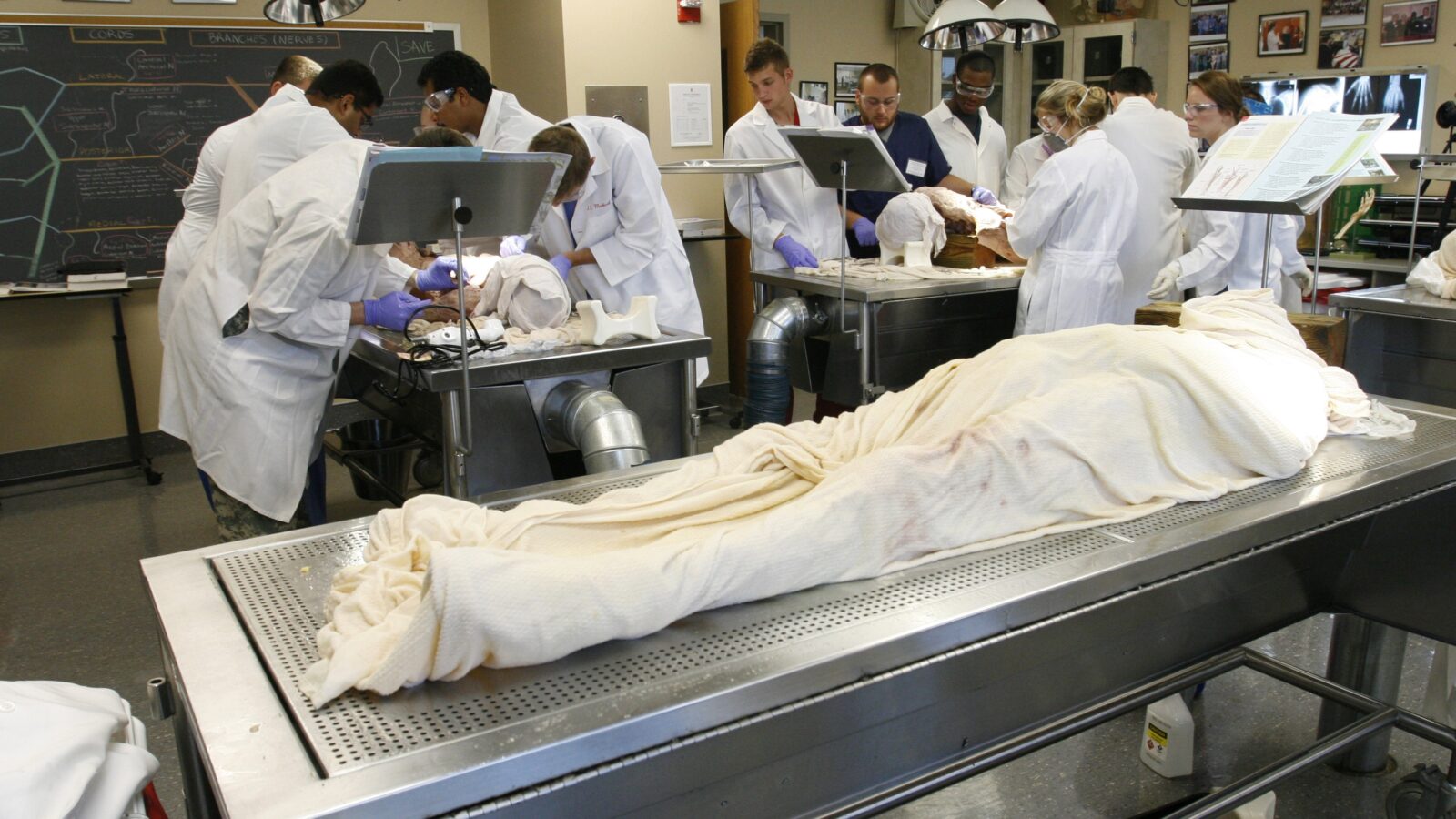
Medical students dissecting human cadavers.
HHS goes after the horrific grim reaper
HHS nails corrupt organ procurement organization (OPO)
By Lynda Carson - August 7, 2026
Volunteer prospective organ donors, beware. Just try to imagine being an organ donor, only to learn in a report about a nonprofit organization called Network for Hope, that in some states they have been trying to remove organs from people while they are still alive, and not dead. As a result, the HHS goes after the grim reaper.
Indeed. A few news articles about organs being removed from live people may be found by clicking here.
Todays grim news for the day, in these horrific times we find ourselves in.
That’s right. Todays grim news for the day, during some horrific times under the convicted felon President Donald J. Trump regime. Network for Hope, a federally designated organ procurement organization (OPO) serving Kentucky and parts of Indiana, Ohio, and West Virginia, has been operating in such a way that some potential donors may not have been deceased at the time organ procurement was initiated — raising serious questions.
Some grim information about body brokers in America, may be found by clicking here.
That’s right. Network for Hope, a federally designated organ procurement organization (OPO), has reportedly been trying to harvest organs from people while they are still alive, and not yet dead. Volunteer organ donors should be fully aware of some of the risks involved in becoming a volunteer organ donor in the U.S.A.
Some recent headlines or articles about the Network for Hope, may be found by clicking here.
2024 - 990 Tax Filing For Network of Hope:
According to their latest 990 tax filing for 2024, the Network for Hope a 501 (c)(3) nonprofit, has been tax exempt since December 1987. They had gross receipts of $67,880,807, and after subtracting their liabilities from their assets, they had net assets or a fund balance of $27,847,463. Their president and coo, Julie Bergen, raked in $338,121, plus $13,000 in other compensation. Apparently, they spent $1,000,000 in lobbying expenditures in 2024. In 2023, the Network for Hope was known as Kentucky Organ Donor Affiliates (KODA). More about Network for Hope a.k.a. KODA may be found by clicking here.
U.S. Department of Health and Human Services (HHS) Press Release:
According to an August 5, 2026 press release from the U.S. Department of Health and Human Services (HHS), in part it says, “The U.S. Department of Health and Human Services (HHS) today began the decertification of Network for Hope, the federally designated organ procurement organization (OPO) serving Kentucky and parts of Indiana, Ohio, and West Virginia, after multiple federal reviews found persistent patient safety failures despite extensive oversight and despite Network for Hope having been provided repeated opportunities to correct them. Those failures put prospective organ donors and patients awaiting lifesaving transplants at risk.”
However, an extraordinary horrific question remains. Why did it take so long for the convicted felon President Donald J. Trump regime and the HHS to take action against the Network for Hope? The federal government knew at a minimum that since October of 2024 and before, that there were major problems with the Network for Hope a.k.a. Kentucky Organ Donor Affiliates (KODA). But, it did not announce that it was taking action until August 5, 2026, nearly two years later.
A statement in response to HHS from Network for Hope, may be found here, https://www.networkforhope.org/ .
The Network for Hope a.k.a. Kentucky Organ Donor Affiliates (KODA):
Reportedly, according to an October 17, 2024 ‘NPR’ report called 'Horrifying' mistake to take organs from a living person was averted, witnesses say, and in part it says, “A man declared dead almost had surgery to donate his organs, but he was still alive. At a hospital in Kentucky, a man who had been declared dead after a drug overdose was moving and visibly crying as he was prepped for surgery to donate his vital organs. The surgery was stopped, and the man is alive three years later.”
According to the report, “Natasha Miller says she was getting ready to do her job preserving donated organs for transplantation when the nurses wheeled the donor into the operating room.
She quickly realized something wasn't right. Though the donor had been declared dead, he seemed to her very much alive.
"He was moving around — kind of thrashing. Like, moving, thrashing around on the bed," Miller told NPR in an interview. "And then when we went over there, you could see he had tears coming down. He was crying visibly."
The donor's condition alarmed everyone in the operating room at Baptist Health hospital in Richmond, Ky., including the two doctors, who refused to participate in the organ retrieval, she says.
"The procuring surgeon, he was like, 'I'm out of it. I don't want to have anything to do with it,' " Miller says. "It was very chaotic. Everyone was just very upset."
Miller says she overheard the case coordinator at the hospital for her employer, Kentucky Organ Donor Affiliates (KODA), call her supervisor for advice.
"So the coordinator calls the supervisor at the time. And she was saying that he was telling her that she needed to 'find another doctor to do it' – that, 'We were going to do this case. She needs to find someone else,' " Miller says. "And she's like, 'There is no one else.' She's crying — the coordinator — because she's getting yelled at."
"Everybody's worst nightmare"
The organ retrieval was canceled. But some KODA workers say they later quit over the October 2021 incident, including another organ preservationist, Nyckoletta Martin.
"I've dedicated my entire life to organ donation and transplant. It's very scary to me now that these things are allowed to happen and there's not more in place to protect donors," says Martin.
Martin was not assigned to the operating room that day, but she says she thought she might get drafted. So she started to review case notes from earlier in the day. She became alarmed when she read that the donor showed signs of life when doctors tried to examine his heart, she says.
"The donor had woken up during his procedure that morning for a cardiac catheterization. And he was thrashing around on the table," Martin says.
Cardiac catheterization is performed on potential organ donors to evaluate whether the heart is healthy enough to go to a person in need of a new heart.
Martin says doctors sedated the patient when he woke up and plans to recover his organs proceeded.
KODA officials downplayed the incident afterwards, according to Martin. She was dismayed at that, she says.
"That's everybody's worst nightmare, right? Being alive during surgery and knowing that someone is going to cut you open and take your body parts out?" Martin says. "That's horrifying."
The patient:
Donna Rhorer of Richmond, Kentucky, told NPR that her 36-year-old brother, Anthony Thomas "TJ" Hoover II, was the patient involved in the case. He was rushed to the hospital because of a drug overdose, she says.
Rhorer was at the hospital that day. She says she became concerned something wasn't right when TJ appeared to open his eyes and look around as he was being wheeled from intensive care to the operating room.
"It was like it was his way of letting us know, you know, 'Hey, I'm still here,' " Rhorer told NPR in an interview.
But Rhorer says she and other family members were told what they saw was just a common reflex. TJ Hoover now lives with Rhorer, and she serves as his legal guardian.
The general outline of the incident was disclosed in September by a letter Nyckoletta Martin wrote to the House Energy and Commerce Committee, which held a hearing investigating organ procurement organizations. She later provided additional details about the case to NPR.
"Several of us that were employees needed to go to therapy. It took its toll on a lot of people, especially me," Martin told NPR.”
Nyckolletta Martin, faced retaliation after blowing the whistle on Network for Hope.
More about Nyckolletta Martin, who faced retaliation after blowing the whistle, may be found by clicking here.
After blowing the whistle about Kentucky Organ Donor Affiliates (KODA), wanting to remove organs from a person who was still alive, Nyckolletta Martin faced retaliation after blowing the whistle.
Reportedly, in an October 1, 2024 article with ’The Journal of Nursing’, in part it says, “A former organ procurement worker who told Congress she was pressured to take organs from a person who was still alive was fired after her allegation was relayed during a recent hearing.
Nyckolletta Martin, who had previously worked for an organ collection group called Kentucky Organ Donor Affiliates, said Tuesday that she had been fired by her most recent employer, which makes devices that help preserve hearts, lungs and livers during transport.
Martin was fired two days after a letter, which she wrote to the House Energy and Commerce Committee’s Oversight and Investigations Subcommittee alleging the pressure on organ collectors, was discussed during a Sept. 11 hearing.”
The U.S. House Committee on Ways and Means Report:
According to another article dated September 4, 2025, in part it says, “Kentucky-based non-profit "Network for Hope" is under investigation again to determine if the organization has violated it's tax-exempt status.
The U.S. House Committee on Ways and Means report that the investigation is due to a "alarming" patient safety report.
In a letter to the non-profit, Committee Chairman Jason Smith and Oversight Subcommittee Chairman David Schweikert "(demanded) documents and records related to allegations of improper Medicare billing, financial conflicts of interest, and unsafe practices."
The announcement comes after the Health Resources and Services Administration's investigation into Kentucky Organ Donor Affiliates, or KODA, one of two organ procurement organizations that merged with Network of Hope.
According to that investigation, 73 of 350 organ procurement cases handled by KODA between 2021 and 2024 included instances that should have prompted officials to stop the procedure sooner, due to patients' improving levels of consciousness.
The Committee on Ways and Means is alarmed by the Health Resources & Services Administration (“HRSA”) report which found that KODA officials pushed hospital workers toward organ recovery despite signs of revival in patients, and we want to examine the extent to which your organization is being reimbursed by Medicare for substandard and unsafe patient safety procedures during cases in which your organization may have operated outside of the standard of care or the law." the letter from Smith and Schweikert wrote.”
That’s right. In this country, things are so crazy sometimes cadavers are being sold for testing bombs by the military.
For more, click here for more about what happens to donated bodies in America.
Lynda Carson may be reached at newzland2 [at] gmail.com
>>>>>>>
>>>>>>>
HHS nails corrupt organ procurement organization (OPO)
By Lynda Carson - August 7, 2026
Volunteer prospective organ donors, beware. Just try to imagine being an organ donor, only to learn in a report about a nonprofit organization called Network for Hope, that in some states they have been trying to remove organs from people while they are still alive, and not dead. As a result, the HHS goes after the grim reaper.
Indeed. A few news articles about organs being removed from live people may be found by clicking here.
Todays grim news for the day, in these horrific times we find ourselves in.
That’s right. Todays grim news for the day, during some horrific times under the convicted felon President Donald J. Trump regime. Network for Hope, a federally designated organ procurement organization (OPO) serving Kentucky and parts of Indiana, Ohio, and West Virginia, has been operating in such a way that some potential donors may not have been deceased at the time organ procurement was initiated — raising serious questions.
Some grim information about body brokers in America, may be found by clicking here.
That’s right. Network for Hope, a federally designated organ procurement organization (OPO), has reportedly been trying to harvest organs from people while they are still alive, and not yet dead. Volunteer organ donors should be fully aware of some of the risks involved in becoming a volunteer organ donor in the U.S.A.
Some recent headlines or articles about the Network for Hope, may be found by clicking here.
2024 - 990 Tax Filing For Network of Hope:
According to their latest 990 tax filing for 2024, the Network for Hope a 501 (c)(3) nonprofit, has been tax exempt since December 1987. They had gross receipts of $67,880,807, and after subtracting their liabilities from their assets, they had net assets or a fund balance of $27,847,463. Their president and coo, Julie Bergen, raked in $338,121, plus $13,000 in other compensation. Apparently, they spent $1,000,000 in lobbying expenditures in 2024. In 2023, the Network for Hope was known as Kentucky Organ Donor Affiliates (KODA). More about Network for Hope a.k.a. KODA may be found by clicking here.
U.S. Department of Health and Human Services (HHS) Press Release:
According to an August 5, 2026 press release from the U.S. Department of Health and Human Services (HHS), in part it says, “The U.S. Department of Health and Human Services (HHS) today began the decertification of Network for Hope, the federally designated organ procurement organization (OPO) serving Kentucky and parts of Indiana, Ohio, and West Virginia, after multiple federal reviews found persistent patient safety failures despite extensive oversight and despite Network for Hope having been provided repeated opportunities to correct them. Those failures put prospective organ donors and patients awaiting lifesaving transplants at risk.”
However, an extraordinary horrific question remains. Why did it take so long for the convicted felon President Donald J. Trump regime and the HHS to take action against the Network for Hope? The federal government knew at a minimum that since October of 2024 and before, that there were major problems with the Network for Hope a.k.a. Kentucky Organ Donor Affiliates (KODA). But, it did not announce that it was taking action until August 5, 2026, nearly two years later.
A statement in response to HHS from Network for Hope, may be found here, https://www.networkforhope.org/ .
The Network for Hope a.k.a. Kentucky Organ Donor Affiliates (KODA):
Reportedly, according to an October 17, 2024 ‘NPR’ report called 'Horrifying' mistake to take organs from a living person was averted, witnesses say, and in part it says, “A man declared dead almost had surgery to donate his organs, but he was still alive. At a hospital in Kentucky, a man who had been declared dead after a drug overdose was moving and visibly crying as he was prepped for surgery to donate his vital organs. The surgery was stopped, and the man is alive three years later.”
According to the report, “Natasha Miller says she was getting ready to do her job preserving donated organs for transplantation when the nurses wheeled the donor into the operating room.
She quickly realized something wasn't right. Though the donor had been declared dead, he seemed to her very much alive.
"He was moving around — kind of thrashing. Like, moving, thrashing around on the bed," Miller told NPR in an interview. "And then when we went over there, you could see he had tears coming down. He was crying visibly."
The donor's condition alarmed everyone in the operating room at Baptist Health hospital in Richmond, Ky., including the two doctors, who refused to participate in the organ retrieval, she says.
"The procuring surgeon, he was like, 'I'm out of it. I don't want to have anything to do with it,' " Miller says. "It was very chaotic. Everyone was just very upset."
Miller says she overheard the case coordinator at the hospital for her employer, Kentucky Organ Donor Affiliates (KODA), call her supervisor for advice.
"So the coordinator calls the supervisor at the time. And she was saying that he was telling her that she needed to 'find another doctor to do it' – that, 'We were going to do this case. She needs to find someone else,' " Miller says. "And she's like, 'There is no one else.' She's crying — the coordinator — because she's getting yelled at."
"Everybody's worst nightmare"
The organ retrieval was canceled. But some KODA workers say they later quit over the October 2021 incident, including another organ preservationist, Nyckoletta Martin.
"I've dedicated my entire life to organ donation and transplant. It's very scary to me now that these things are allowed to happen and there's not more in place to protect donors," says Martin.
Martin was not assigned to the operating room that day, but she says she thought she might get drafted. So she started to review case notes from earlier in the day. She became alarmed when she read that the donor showed signs of life when doctors tried to examine his heart, she says.
"The donor had woken up during his procedure that morning for a cardiac catheterization. And he was thrashing around on the table," Martin says.
Cardiac catheterization is performed on potential organ donors to evaluate whether the heart is healthy enough to go to a person in need of a new heart.
Martin says doctors sedated the patient when he woke up and plans to recover his organs proceeded.
KODA officials downplayed the incident afterwards, according to Martin. She was dismayed at that, she says.
"That's everybody's worst nightmare, right? Being alive during surgery and knowing that someone is going to cut you open and take your body parts out?" Martin says. "That's horrifying."
The patient:
Donna Rhorer of Richmond, Kentucky, told NPR that her 36-year-old brother, Anthony Thomas "TJ" Hoover II, was the patient involved in the case. He was rushed to the hospital because of a drug overdose, she says.
Rhorer was at the hospital that day. She says she became concerned something wasn't right when TJ appeared to open his eyes and look around as he was being wheeled from intensive care to the operating room.
"It was like it was his way of letting us know, you know, 'Hey, I'm still here,' " Rhorer told NPR in an interview.
But Rhorer says she and other family members were told what they saw was just a common reflex. TJ Hoover now lives with Rhorer, and she serves as his legal guardian.
The general outline of the incident was disclosed in September by a letter Nyckoletta Martin wrote to the House Energy and Commerce Committee, which held a hearing investigating organ procurement organizations. She later provided additional details about the case to NPR.
"Several of us that were employees needed to go to therapy. It took its toll on a lot of people, especially me," Martin told NPR.”
Nyckolletta Martin, faced retaliation after blowing the whistle on Network for Hope.
More about Nyckolletta Martin, who faced retaliation after blowing the whistle, may be found by clicking here.
After blowing the whistle about Kentucky Organ Donor Affiliates (KODA), wanting to remove organs from a person who was still alive, Nyckolletta Martin faced retaliation after blowing the whistle.
Reportedly, in an October 1, 2024 article with ’The Journal of Nursing’, in part it says, “A former organ procurement worker who told Congress she was pressured to take organs from a person who was still alive was fired after her allegation was relayed during a recent hearing.
Nyckolletta Martin, who had previously worked for an organ collection group called Kentucky Organ Donor Affiliates, said Tuesday that she had been fired by her most recent employer, which makes devices that help preserve hearts, lungs and livers during transport.
Martin was fired two days after a letter, which she wrote to the House Energy and Commerce Committee’s Oversight and Investigations Subcommittee alleging the pressure on organ collectors, was discussed during a Sept. 11 hearing.”
The U.S. House Committee on Ways and Means Report:
According to another article dated September 4, 2025, in part it says, “Kentucky-based non-profit "Network for Hope" is under investigation again to determine if the organization has violated it's tax-exempt status.
The U.S. House Committee on Ways and Means report that the investigation is due to a "alarming" patient safety report.
In a letter to the non-profit, Committee Chairman Jason Smith and Oversight Subcommittee Chairman David Schweikert "(demanded) documents and records related to allegations of improper Medicare billing, financial conflicts of interest, and unsafe practices."
The announcement comes after the Health Resources and Services Administration's investigation into Kentucky Organ Donor Affiliates, or KODA, one of two organ procurement organizations that merged with Network of Hope.
According to that investigation, 73 of 350 organ procurement cases handled by KODA between 2021 and 2024 included instances that should have prompted officials to stop the procedure sooner, due to patients' improving levels of consciousness.
The Committee on Ways and Means is alarmed by the Health Resources & Services Administration (“HRSA”) report which found that KODA officials pushed hospital workers toward organ recovery despite signs of revival in patients, and we want to examine the extent to which your organization is being reimbursed by Medicare for substandard and unsafe patient safety procedures during cases in which your organization may have operated outside of the standard of care or the law." the letter from Smith and Schweikert wrote.”
That’s right. In this country, things are so crazy sometimes cadavers are being sold for testing bombs by the military.
For more, click here for more about what happens to donated bodies in America.
Lynda Carson may be reached at newzland2 [at] gmail.com
>>>>>>>
>>>>>>>
Add Your Comments
We are 100% volunteer and depend on your participation to sustain our efforts!
Donate

$85.00 donated
in the past month
Get Involved
If you'd like to help with maintaining or developing the website, contact us.
Publish
Publish your stories and upcoming events on Indybay.
Topics
More
Search Indybay's Archives
Advanced Search
►
▼
IMC Network