







 Publish to Newswire
 Add an Event
From the Open-Publishing Calendar
From the Open-Publishing Newswire
Indybay Feature
pride untamed: escaping the cult of queer memory
the san francisco police department descended on a bunch of queers to beat the law into them, and everything that followed is up for debate. but are we describing 1966, or 2026? unfortunately, in a poetic, if depressing, continuation of historical queer subjugation, this was san francisco pride weekend, 2026.
the san francisco police department descended on a bunch of queers to beat the law into them, and everything that followed is up for debate. but are we describing 1966, or 2026? unfortunately, in a poetic, if depressing, continuation of historical queer subjugation, this was san francisco pride weekend, 2026. we were targeted for being faggots and dykes and trannies, and we were beaten while marching, while partying, while loving, and fighting, and surely while fucking. while we are used to neutral indifference for our plight from tourists and allies, there were hundreds of queer marchers completely stopped in their tracks this year. our queer and trans allies did nothing?! how did this happen?? multiple comrades were grabbed by the police, and even though there were more of us than of them, there was hardly a response from the crowd! no, pride was not a riot this year, despite the tone of some retrospective pieces putting a gymnastic level of spin on an indifferent reaction and the resigned normalization of police brutality. we lost, and we lost hard, and we are hurting.
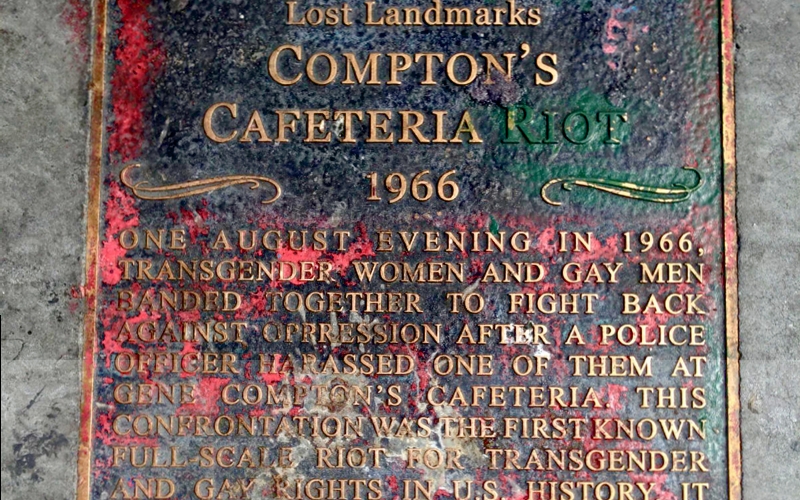
every year on the friday of pride weekend, thousands of people flock to san francisco and descend on dolores park to celebrate the existence of gender variant people before marching to the historic location of the compton’s cafeteria riot. this riot, which is perhaps the first to be lead by cross dressing sex workers in the so-called united states of america, was a multi-day retaliation against the police for their repeated acts of violence against queer people. the intersection where the old compton’s stands is in the tenderloin district, a historic containment zone, where people who engaged in vice of all kinds were able to eke out an existence despite state repression, so long as they did not leave and bother their wealthier neighbors in surrounding neighborhoods. to this day the tenderloin is seen as a blighted area, with more conservative voices highlighting the unsavory elements: drug use, theft, sex work, the homeless, and transsexuals.
for past violence to be frozen into a false idol of progress, the violence daily committed by the state and its foot-soldiers against queers must also be framed as something that is a mistake not to be given untoward concern. this violence is surely different from that violence, right? there is a chasm of understanding occupying the area between the historical police brutality experienced by the trans community and the immediate police brutality before our eyes today. we are a group who has been targeted over and over again by the powers that be throughout the history of this country. we cannot even pretend to know each reason someone may be radicalized against the state. there are as many reasons to reject it as there are people. but if you are trans and you got out of bed today, you almost certainly have had experiences that could persuade you that the current system is not designed for your well-being. our lived experiences should therefore ground our understanding of our community and its historical events. that said, many remain shielded from the radicalizing knowledge of history by other aspects of their identities—whether it be proximity to whiteness, their class, the invisibility of their queerness, etc. if we are truly learning from our history, then decades of being targets of hate by the pigs should prepare us to act when it happens again, and again, and again—but we might just not be learning from history.
most people had never heard of compton’s cafeteria riot until this century, the details of which are so poorly documented that we still do not know what day it occurred on. yet we live in the technologically easiest time in history for us to share, access, and begin understanding even the most obscure anti-repressive memory. with the police brutality of pride weekend this year, many are now being thrown into their first experiences organizing and surviving state oppression in a world that mostly likes to pretend we do not and have never existed. Even for those of us without these experiences, through the mere circumstance of our existing and being punished for existing, all of us are directly connected to our radical elders. what can be done to ensure there are more comrades who understand the terrain of our battle, and preempt yet more of our siblings from trusting the gaping maw of liberal reform and acceptability politics that swallows them down whole?
in order to understand why we suffered so badly at what should be our own march this year, we have to look at the particularities of how it is structured to co-opt and eradicate liberatory politics. in meek deference to our fallen ancestors, a pre-approved route is followed by the faithful from dolores to the intersection of turk and taylor, the site of the compton’s cafeteria riot in 1966. seemingly, during trans march, a miracle occurs—orchestrated by the city of san francisco—where the former site of compton’s becomes crystallized as an area for veneration. attendees of the march complete their pilgrimage at the now sanctified turk and taylor, in the transgender cultural district, where a street party and speeches await them, and they never see the poor and disenfranchised, many of whom are queer, who have been thrown out by society, are daily brutalized by the police, have had their belongings stolen or destroyed by the department of public works, and who, when they do make the news, are only ever blamed (and in passing) for their own sorry existences. we march yearly, as if with the sole intent of stating as loudly as we can, “not those queers!” hoping that this year, for the first time in history, the police will see a difference between us and them. many believed it was working, and for those who did, this year’s happenings were a terrible shock.
participants in trans march will wear t-shirts of raised fists commemorating street queens and faggot revolutionaries at stonewall and other iconic moments of queer history, proudly proclaiming “pride was a riot,” or if they’re a bit spicier, “pride is a riot.” present day, present time! rites such as these, performed in the consecrated pride space, complete the crystallization of compton’s as something detached from current experience, and the act of passive memory, expressed through the presence of bricks and incendiary chants, allow the pilgrim to believe that the respect paid in their glance to the past absolves or protects them from the possibility of present atrocities against trans and gender variant people worldwide, just out of view. this is in part due to the conspicuous absence of police for the majority of the march. they are seen only occasionally at the margins. the police, who do in fact keep a detail on the entire stretch of the trans march, mostly do so out of eyesight, utilizing surveillance technology and the weedy tangle of side streets in the city to obscure their activities. they only step obviously out into the limelight again at the end of the parade, as a dozen or so police vehicles demarcate the end of the celebration. this, as if to say, “enough now,” signals a return to the status quo and the furthest extension of the state’s tolerance for us.
when the sf trans march concluded at turk and taylor this year, revelers were caught off guard by the police presence. but every prior year the march’s terminus has been surrounded by the police. typically their presence is only noted by the vigilant among us, and broadly trusted to be inert by the rest. admittedly, they have not acted with this level of force since trans march began in 2004. so when the pigs cut through the crowd like a hot knife through butter, almost everyone was taken by surprise. with urgency and complete indifference towards public safety, the cops rushed and shoved past the bewildered crowd, roughly grabbing multiple marchers. they whipped out their billy clubs, and up to a hundred additional pigs quickly revealed themselves with rifles carried openly and at the ready. drone surveillance had long since been deployed. the cops were prepared for all of this in advance, but almost all marchers present, including more radical or experienced elements, were not ready for a conflict with a militarized force, even while mayor daniel lurie announced his intent at the top of the weekend to escalate policing during pride. surely lurie did that to keep us safe though, right?
trans march is now more widely regarded as a social occasion than a political action; many involved do not expect police activity. while we, or others, may point out tactical flaws to marchers’ real time responses to police violence, it is significant to us primarily as an indicator of a more grave problem. the problem is plain: many freeze when the police make their presence known. while acknowledging that queer and trans people have statistically greater incidences of ptsd than cishet society has, and that many will experience an involuntary freeze response under extreme stress, the degree of inaction cannot solely be attributed to prior trauma. the confusion and context collapse that marchers were asked to process this year surely contributed to inaction and the unnecessary arrest and physical manhandling of further comrades. many attendees were just inexperienced, and had no tools or experience to draw on to push back effectively. reality remains inconceivable to many, as evidenced by questions overheard such as “what is happening?” or “why are the police arresting that person?” or “are we going to be safe?” the answer to all of these questions were right in front of them: you are a tranny faggot dyke he-she, your continued public existence is criminal, if not on paper, then in the hearts of the many. marchers asking such ignorant questions in as immediately knowable of circumstances belie a fundamental ideological difference between radical queers and the more normative marchers—one that is recreated constantly by the selective documentation and divided understanding of our history that has largely been given over to those whose objective is preserving the status quo, just with gayer face paint on it.
many of us are defined as much by the pervasive violence we experience, whether it be from the hands of parents, religious figures, bosses, cops, doctors, or state and medical bureaucracy. but political figures as conservative as scott wiener (who was justly booed by trans march attendees, and not for the first time this year) or as progressive as the organizers of pride are easily able to de-fang millions of queers by sanitizing or censoring the ways we have survived this long in the sights of systemic and targeted violence. reform-minded gays, no matter how much they share in our oppression, must also be seen as an opponent in our combat against the state and against fascism. a gay liberal or a gay nazi is still a liberal or a nazi.
fascists are the eternal enemy of any faggot who doesn’t hate themself, but they were not present on this particular battlefield: the pigs, the sfpd, the defenders of liberal capitalism, were. gays have had dozens, if not hundreds, of experiences organizing against the cops, but one memory often neglected in queer celebrations comes to mind. we’d like to think the white night rioters had it going on when they decided to test just how flammable a police cruiser can be. some brief historical context is needed. for a variety of reasons, many of which have roots in american settler-colonialism and the nineteenth century gold rush, san francisco has been a town with a significantly visible gay population, and an equal and opposite conservative policing element meant to keep it in check. the one has rarely, if ever, existed without the other. and with the rise of the general gay rights movement starting in the 1950s, san francisco was a hotbed of queer organizing. the efforts tended more toward reform, with radical organizers being tossed aside whenever an opportunity to lick a boot presented itself. those reformist organizers had enough of a base to push to allow cops to be openly gay (a genuine rarity at the time) and to elect harvey milk, an openly gay man, as a city supervisor. the contradictions of police reform laid the foundations for what was to come.
in 1978, noted and virulent homophobe (and former cop) dan white, who had recently resigned his position as a city supervisor, assassinated supervisor harvey milk and mayor george moscone. this hateful act was partially because white wanted his job back, and moscone and milk both denied him that. but the cold-blooded murder was also in part a response to moscone approving the presence of gay cops on the police force, which disgusted him. and white’s eventual trial ended in a genuine shock: he received a lenient sentence for assassinating milk and moscone! the message being that no matter what the level of your democratic political activation, your life will still matter less if you are a faggot. this clearly absurd sentencing lead thousands of queers to the streets in one of the most widespread uprisings of its type ever. dubbed the white night riots, they are rarely mentioned at any pride events these days. though the white night riots eventually petered out, and were co-opted by the liberal agenda, the fear of a similar uprising remains so strong that even now it is rarely spoken of by any queer organization collaborating with the city, lest anyone else have a good idea.
with the arrests and beatings of trannies, faggots, dykes, and their consorts at this year’s trans march, we have been presented with an unfortunately resonant opportunity to truly understand the struggles of years past. that this occurred during a national, as well as local, increase in state-level violence (to be blunt: trans rights are being erased from the books while the sfpd and ice work together to regularly brutalize anyone whose existence is a problem for their white supremacist christian breeder agenda and we all know it) should feel entirely predictable. but it should also steel our convictions to do more and better going forward: we are not going anywhere. the need for a directed trans liberatory resistance to the agents of the state did not begin and end with compton’s in 1966, nor with the white night riots in 1979.
we believe that the organizers of trans march have weaponized queer memory to take space and establish a de-fanged political environment that erases our voices and the realness of our daily struggles. to the extent we make any claims about a future for the trans march, our view is that it is in the best interest of self-invested trannies, dykes, and faggots—failed men and women all—to abandon the san francisco trans march as it officially stands. what once was spontaneous, radical, and revelatory, has long since become stagnant and performative. if it was just boring, we would continue onward ignoring it, but it is now not only boring, but also a hazard, so it has to go. there are 365 days of the year, and an infinity of destinations where we can replace that celebration and express ourselves. it does not benefit us to tell the police when and where we will be willing to receive their violence—keep them guessing, let them earn their overtime that is bleeding the city coffers dry while community resources continue to be cut. today the trans march is a corruption of memory from years past. we must let it go if we are to truly learn from the violence wrought by the state—not just to our queer ancestors and comrades, but to all marginalized people to this day, and to us again in 2026. if we don’t, we are choosing to march into the arms of the police, and we would hope anyone willing to do that would be doing so not over-confidently.
there is no unifying queer or trans politic, nor can there be, which is how traitors like caitlyn jenner or scott wiener can drive forward a disgusting, inhumane “gay” politic. any insistence of “love conquering hate” leaves us howling in anger: love will not stop the cop wielding a billy club. hate won’t either. it’s equal and opposite action that stops the forward momentum of a force. such knowledge may materially connect you to a history you only ever saw yourself as benefiting from, but not being a part of, if you simply allow yourself to build those connections between the theoretical, the documentarian, and the everyday reality you live in.
some antifascists hold to what is called a “three way fight” strategy when weighing tactics used against fascists. the three way fight posits that there are always three poles in our conflict: fascists, bourgeois liberal capitalism, and revolutionary/radical anti-fascism. while liberals and leftists will occasionally fight together against fascism, the distance between their ideological goals are so significant that the fight between them will always retrench itself as soon as the immediate external threat has passed. ignoring this pattern is the program of reformists and fools. a classic example of this push and pull was joe biden arguing for the need to fight fascism (ie, trump), but when trump’s power seemed to have waned biden turned against the radical antifascists. we believe that a three way fight analysis is useful here, but in a different way. what complicates matters significantly is the fact that not everybody present at trans march is necessarily a liberal. however, the inaction we saw in the face of brutality means that we insurgents against the state must convert people into comrades while fighting off cops and peace-policing liberals. this may be easier said than done, even though, in fact, the march is steeped in liberatory rhetoric, and many people show up to this event trusting them to put their words into action.
we believe it is our duty, and part of our ongoing struggle as radical queers, to ensure that our potential allies in the fight become our accomplices, and we believe this can manifest. many of those present who did nothing may yet bloom into true comrades with time. one of them might be you. not one of us has never missed an opportunity to do more. we cannot accept the censored queer rites we are asked to perform to compton’s and stonewall as they stand, not when the hands leading us are tainted in our blood and the blood of our ancestors. accepting the consecrated brick as communion from the hands of the state will only lead to our own smashed teeth. we can better honor the historical pain our community has experienced by organizing specifically around confronting the constant harm done to our community, emphasizing the ways that bigotry and oppression continue to harm us even at our own events. and perhaps the single most important long term tool for our community’s survival, education, needs to be actively engaged with and through as a constant reminder of the structural conditions that create this ongoing regime of violence: the coercive and destructive hierarchies created by capitalism and by the state.
we fully advocate changing the hearts of our fellow queers through propaganda, care work, and, when possible, direct action. there are many carceral targets that would make a fantastic mark, such as the former site of compton’s cafeteria, now owned and operated by a for-profit prison company, but if trans march is any indication, there is not yet a mass of queer rage to drive this movement forward. while it may be optimistic to imagine the return of a queer insurrectionist impulse in our lifetimes, the alternative to strengthening the radical nature of our community is the slow, constant erosion of our rights, our autonomy, and our culture. any activity that underlines that the past is also with us in the present will be more effective for creating a greater sense of shared history. alongside our homeless and otherwise marginalized friends, we are seen as an easy target on the path to create a city-scale playground exclusive to the tech elite. we must prove that we will not go down easily, unless eradication is our perverse goal. we are insatiable, ungovernable queers, faggots, dykes, and trannies, driven mad by the cries of our wounded, our ancestors, and by the ongoing epidemic of state violence against all marginalized people. we cannot be stopped for we are impelled by our rage for our community’s dead and damaged spirits as we push ever onward towards a real liberatory hope. come find us in the streets, joyous and unruly.
knowing our history is growing our history. trans march was started with an anonymous call to take to the streets and commemorate gwen araujo, a local trans woman who was brought to an early death like so many before and since who was murdered because her body, her soul was seen as so vile by those outside of our community that it needed to be eradicated. we marched that year to give our voices and our beings to araujo and to ourselves. but somewhere along the way we forgot. we began to rely on the state apparatus, built upon the bodies of so many dead, for legitimacy. we selectively edited the record of our resistances in the pursuit of acceptability. our subjugation will not end in our lifetimes if our most radical impulse is to ask the numbing peace-keepers of the world—the non-profit organizations, the political parties, liberals all—to take the lead for us. there is real pain knowing that many of us continue to be slaughtered for our race, for our ability, for our class, for our caste, for our insanity, for our sexuality and gender. so many of us carry the wounds of state violence, of self-harm, of trauma, of rape, of abuse. knowing that much of this is ingrained in capitalism, in settler colonialism, in our prison system, in our family systems, can help us better understand our real enemies. more importantly, it can help us do more for each other, bring us closer to a direct community care. there’s no justice to be doled out to us by our oppressors; there’s only us. we may be bruised and beaten, but together we can heal and grow into a force for liberation. we are not few in number, but when our community figureheads bleed us of our collective rage and distract us with misdirection over how we even got here, we will never reach our potential.
may our numbers grow, and may we never capitulate to a ruling class who can not be bothered to hide their contempt for us. and maybe, just maybe, next time one of us is under the boot of a pig, we can trust our community to reach out a hand or a fist to help us.
every year on the friday of pride weekend, thousands of people flock to san francisco and descend on dolores park to celebrate the existence of gender variant people before marching to the historic location of the compton’s cafeteria riot. this riot, which is perhaps the first to be lead by cross dressing sex workers in the so-called united states of america, was a multi-day retaliation against the police for their repeated acts of violence against queer people. the intersection where the old compton’s stands is in the tenderloin district, a historic containment zone, where people who engaged in vice of all kinds were able to eke out an existence despite state repression, so long as they did not leave and bother their wealthier neighbors in surrounding neighborhoods. to this day the tenderloin is seen as a blighted area, with more conservative voices highlighting the unsavory elements: drug use, theft, sex work, the homeless, and transsexuals.
for past violence to be frozen into a false idol of progress, the violence daily committed by the state and its foot-soldiers against queers must also be framed as something that is a mistake not to be given untoward concern. this violence is surely different from that violence, right? there is a chasm of understanding occupying the area between the historical police brutality experienced by the trans community and the immediate police brutality before our eyes today. we are a group who has been targeted over and over again by the powers that be throughout the history of this country. we cannot even pretend to know each reason someone may be radicalized against the state. there are as many reasons to reject it as there are people. but if you are trans and you got out of bed today, you almost certainly have had experiences that could persuade you that the current system is not designed for your well-being. our lived experiences should therefore ground our understanding of our community and its historical events. that said, many remain shielded from the radicalizing knowledge of history by other aspects of their identities—whether it be proximity to whiteness, their class, the invisibility of their queerness, etc. if we are truly learning from our history, then decades of being targets of hate by the pigs should prepare us to act when it happens again, and again, and again—but we might just not be learning from history.
most people had never heard of compton’s cafeteria riot until this century, the details of which are so poorly documented that we still do not know what day it occurred on. yet we live in the technologically easiest time in history for us to share, access, and begin understanding even the most obscure anti-repressive memory. with the police brutality of pride weekend this year, many are now being thrown into their first experiences organizing and surviving state oppression in a world that mostly likes to pretend we do not and have never existed. Even for those of us without these experiences, through the mere circumstance of our existing and being punished for existing, all of us are directly connected to our radical elders. what can be done to ensure there are more comrades who understand the terrain of our battle, and preempt yet more of our siblings from trusting the gaping maw of liberal reform and acceptability politics that swallows them down whole?
in order to understand why we suffered so badly at what should be our own march this year, we have to look at the particularities of how it is structured to co-opt and eradicate liberatory politics. in meek deference to our fallen ancestors, a pre-approved route is followed by the faithful from dolores to the intersection of turk and taylor, the site of the compton’s cafeteria riot in 1966. seemingly, during trans march, a miracle occurs—orchestrated by the city of san francisco—where the former site of compton’s becomes crystallized as an area for veneration. attendees of the march complete their pilgrimage at the now sanctified turk and taylor, in the transgender cultural district, where a street party and speeches await them, and they never see the poor and disenfranchised, many of whom are queer, who have been thrown out by society, are daily brutalized by the police, have had their belongings stolen or destroyed by the department of public works, and who, when they do make the news, are only ever blamed (and in passing) for their own sorry existences. we march yearly, as if with the sole intent of stating as loudly as we can, “not those queers!” hoping that this year, for the first time in history, the police will see a difference between us and them. many believed it was working, and for those who did, this year’s happenings were a terrible shock.
participants in trans march will wear t-shirts of raised fists commemorating street queens and faggot revolutionaries at stonewall and other iconic moments of queer history, proudly proclaiming “pride was a riot,” or if they’re a bit spicier, “pride is a riot.” present day, present time! rites such as these, performed in the consecrated pride space, complete the crystallization of compton’s as something detached from current experience, and the act of passive memory, expressed through the presence of bricks and incendiary chants, allow the pilgrim to believe that the respect paid in their glance to the past absolves or protects them from the possibility of present atrocities against trans and gender variant people worldwide, just out of view. this is in part due to the conspicuous absence of police for the majority of the march. they are seen only occasionally at the margins. the police, who do in fact keep a detail on the entire stretch of the trans march, mostly do so out of eyesight, utilizing surveillance technology and the weedy tangle of side streets in the city to obscure their activities. they only step obviously out into the limelight again at the end of the parade, as a dozen or so police vehicles demarcate the end of the celebration. this, as if to say, “enough now,” signals a return to the status quo and the furthest extension of the state’s tolerance for us.
when the sf trans march concluded at turk and taylor this year, revelers were caught off guard by the police presence. but every prior year the march’s terminus has been surrounded by the police. typically their presence is only noted by the vigilant among us, and broadly trusted to be inert by the rest. admittedly, they have not acted with this level of force since trans march began in 2004. so when the pigs cut through the crowd like a hot knife through butter, almost everyone was taken by surprise. with urgency and complete indifference towards public safety, the cops rushed and shoved past the bewildered crowd, roughly grabbing multiple marchers. they whipped out their billy clubs, and up to a hundred additional pigs quickly revealed themselves with rifles carried openly and at the ready. drone surveillance had long since been deployed. the cops were prepared for all of this in advance, but almost all marchers present, including more radical or experienced elements, were not ready for a conflict with a militarized force, even while mayor daniel lurie announced his intent at the top of the weekend to escalate policing during pride. surely lurie did that to keep us safe though, right?
trans march is now more widely regarded as a social occasion than a political action; many involved do not expect police activity. while we, or others, may point out tactical flaws to marchers’ real time responses to police violence, it is significant to us primarily as an indicator of a more grave problem. the problem is plain: many freeze when the police make their presence known. while acknowledging that queer and trans people have statistically greater incidences of ptsd than cishet society has, and that many will experience an involuntary freeze response under extreme stress, the degree of inaction cannot solely be attributed to prior trauma. the confusion and context collapse that marchers were asked to process this year surely contributed to inaction and the unnecessary arrest and physical manhandling of further comrades. many attendees were just inexperienced, and had no tools or experience to draw on to push back effectively. reality remains inconceivable to many, as evidenced by questions overheard such as “what is happening?” or “why are the police arresting that person?” or “are we going to be safe?” the answer to all of these questions were right in front of them: you are a tranny faggot dyke he-she, your continued public existence is criminal, if not on paper, then in the hearts of the many. marchers asking such ignorant questions in as immediately knowable of circumstances belie a fundamental ideological difference between radical queers and the more normative marchers—one that is recreated constantly by the selective documentation and divided understanding of our history that has largely been given over to those whose objective is preserving the status quo, just with gayer face paint on it.
many of us are defined as much by the pervasive violence we experience, whether it be from the hands of parents, religious figures, bosses, cops, doctors, or state and medical bureaucracy. but political figures as conservative as scott wiener (who was justly booed by trans march attendees, and not for the first time this year) or as progressive as the organizers of pride are easily able to de-fang millions of queers by sanitizing or censoring the ways we have survived this long in the sights of systemic and targeted violence. reform-minded gays, no matter how much they share in our oppression, must also be seen as an opponent in our combat against the state and against fascism. a gay liberal or a gay nazi is still a liberal or a nazi.
fascists are the eternal enemy of any faggot who doesn’t hate themself, but they were not present on this particular battlefield: the pigs, the sfpd, the defenders of liberal capitalism, were. gays have had dozens, if not hundreds, of experiences organizing against the cops, but one memory often neglected in queer celebrations comes to mind. we’d like to think the white night rioters had it going on when they decided to test just how flammable a police cruiser can be. some brief historical context is needed. for a variety of reasons, many of which have roots in american settler-colonialism and the nineteenth century gold rush, san francisco has been a town with a significantly visible gay population, and an equal and opposite conservative policing element meant to keep it in check. the one has rarely, if ever, existed without the other. and with the rise of the general gay rights movement starting in the 1950s, san francisco was a hotbed of queer organizing. the efforts tended more toward reform, with radical organizers being tossed aside whenever an opportunity to lick a boot presented itself. those reformist organizers had enough of a base to push to allow cops to be openly gay (a genuine rarity at the time) and to elect harvey milk, an openly gay man, as a city supervisor. the contradictions of police reform laid the foundations for what was to come.
in 1978, noted and virulent homophobe (and former cop) dan white, who had recently resigned his position as a city supervisor, assassinated supervisor harvey milk and mayor george moscone. this hateful act was partially because white wanted his job back, and moscone and milk both denied him that. but the cold-blooded murder was also in part a response to moscone approving the presence of gay cops on the police force, which disgusted him. and white’s eventual trial ended in a genuine shock: he received a lenient sentence for assassinating milk and moscone! the message being that no matter what the level of your democratic political activation, your life will still matter less if you are a faggot. this clearly absurd sentencing lead thousands of queers to the streets in one of the most widespread uprisings of its type ever. dubbed the white night riots, they are rarely mentioned at any pride events these days. though the white night riots eventually petered out, and were co-opted by the liberal agenda, the fear of a similar uprising remains so strong that even now it is rarely spoken of by any queer organization collaborating with the city, lest anyone else have a good idea.
with the arrests and beatings of trannies, faggots, dykes, and their consorts at this year’s trans march, we have been presented with an unfortunately resonant opportunity to truly understand the struggles of years past. that this occurred during a national, as well as local, increase in state-level violence (to be blunt: trans rights are being erased from the books while the sfpd and ice work together to regularly brutalize anyone whose existence is a problem for their white supremacist christian breeder agenda and we all know it) should feel entirely predictable. but it should also steel our convictions to do more and better going forward: we are not going anywhere. the need for a directed trans liberatory resistance to the agents of the state did not begin and end with compton’s in 1966, nor with the white night riots in 1979.
we believe that the organizers of trans march have weaponized queer memory to take space and establish a de-fanged political environment that erases our voices and the realness of our daily struggles. to the extent we make any claims about a future for the trans march, our view is that it is in the best interest of self-invested trannies, dykes, and faggots—failed men and women all—to abandon the san francisco trans march as it officially stands. what once was spontaneous, radical, and revelatory, has long since become stagnant and performative. if it was just boring, we would continue onward ignoring it, but it is now not only boring, but also a hazard, so it has to go. there are 365 days of the year, and an infinity of destinations where we can replace that celebration and express ourselves. it does not benefit us to tell the police when and where we will be willing to receive their violence—keep them guessing, let them earn their overtime that is bleeding the city coffers dry while community resources continue to be cut. today the trans march is a corruption of memory from years past. we must let it go if we are to truly learn from the violence wrought by the state—not just to our queer ancestors and comrades, but to all marginalized people to this day, and to us again in 2026. if we don’t, we are choosing to march into the arms of the police, and we would hope anyone willing to do that would be doing so not over-confidently.
there is no unifying queer or trans politic, nor can there be, which is how traitors like caitlyn jenner or scott wiener can drive forward a disgusting, inhumane “gay” politic. any insistence of “love conquering hate” leaves us howling in anger: love will not stop the cop wielding a billy club. hate won’t either. it’s equal and opposite action that stops the forward momentum of a force. such knowledge may materially connect you to a history you only ever saw yourself as benefiting from, but not being a part of, if you simply allow yourself to build those connections between the theoretical, the documentarian, and the everyday reality you live in.
some antifascists hold to what is called a “three way fight” strategy when weighing tactics used against fascists. the three way fight posits that there are always three poles in our conflict: fascists, bourgeois liberal capitalism, and revolutionary/radical anti-fascism. while liberals and leftists will occasionally fight together against fascism, the distance between their ideological goals are so significant that the fight between them will always retrench itself as soon as the immediate external threat has passed. ignoring this pattern is the program of reformists and fools. a classic example of this push and pull was joe biden arguing for the need to fight fascism (ie, trump), but when trump’s power seemed to have waned biden turned against the radical antifascists. we believe that a three way fight analysis is useful here, but in a different way. what complicates matters significantly is the fact that not everybody present at trans march is necessarily a liberal. however, the inaction we saw in the face of brutality means that we insurgents against the state must convert people into comrades while fighting off cops and peace-policing liberals. this may be easier said than done, even though, in fact, the march is steeped in liberatory rhetoric, and many people show up to this event trusting them to put their words into action.
we believe it is our duty, and part of our ongoing struggle as radical queers, to ensure that our potential allies in the fight become our accomplices, and we believe this can manifest. many of those present who did nothing may yet bloom into true comrades with time. one of them might be you. not one of us has never missed an opportunity to do more. we cannot accept the censored queer rites we are asked to perform to compton’s and stonewall as they stand, not when the hands leading us are tainted in our blood and the blood of our ancestors. accepting the consecrated brick as communion from the hands of the state will only lead to our own smashed teeth. we can better honor the historical pain our community has experienced by organizing specifically around confronting the constant harm done to our community, emphasizing the ways that bigotry and oppression continue to harm us even at our own events. and perhaps the single most important long term tool for our community’s survival, education, needs to be actively engaged with and through as a constant reminder of the structural conditions that create this ongoing regime of violence: the coercive and destructive hierarchies created by capitalism and by the state.
we fully advocate changing the hearts of our fellow queers through propaganda, care work, and, when possible, direct action. there are many carceral targets that would make a fantastic mark, such as the former site of compton’s cafeteria, now owned and operated by a for-profit prison company, but if trans march is any indication, there is not yet a mass of queer rage to drive this movement forward. while it may be optimistic to imagine the return of a queer insurrectionist impulse in our lifetimes, the alternative to strengthening the radical nature of our community is the slow, constant erosion of our rights, our autonomy, and our culture. any activity that underlines that the past is also with us in the present will be more effective for creating a greater sense of shared history. alongside our homeless and otherwise marginalized friends, we are seen as an easy target on the path to create a city-scale playground exclusive to the tech elite. we must prove that we will not go down easily, unless eradication is our perverse goal. we are insatiable, ungovernable queers, faggots, dykes, and trannies, driven mad by the cries of our wounded, our ancestors, and by the ongoing epidemic of state violence against all marginalized people. we cannot be stopped for we are impelled by our rage for our community’s dead and damaged spirits as we push ever onward towards a real liberatory hope. come find us in the streets, joyous and unruly.
knowing our history is growing our history. trans march was started with an anonymous call to take to the streets and commemorate gwen araujo, a local trans woman who was brought to an early death like so many before and since who was murdered because her body, her soul was seen as so vile by those outside of our community that it needed to be eradicated. we marched that year to give our voices and our beings to araujo and to ourselves. but somewhere along the way we forgot. we began to rely on the state apparatus, built upon the bodies of so many dead, for legitimacy. we selectively edited the record of our resistances in the pursuit of acceptability. our subjugation will not end in our lifetimes if our most radical impulse is to ask the numbing peace-keepers of the world—the non-profit organizations, the political parties, liberals all—to take the lead for us. there is real pain knowing that many of us continue to be slaughtered for our race, for our ability, for our class, for our caste, for our insanity, for our sexuality and gender. so many of us carry the wounds of state violence, of self-harm, of trauma, of rape, of abuse. knowing that much of this is ingrained in capitalism, in settler colonialism, in our prison system, in our family systems, can help us better understand our real enemies. more importantly, it can help us do more for each other, bring us closer to a direct community care. there’s no justice to be doled out to us by our oppressors; there’s only us. we may be bruised and beaten, but together we can heal and grow into a force for liberation. we are not few in number, but when our community figureheads bleed us of our collective rage and distract us with misdirection over how we even got here, we will never reach our potential.
may our numbers grow, and may we never capitulate to a ruling class who can not be bothered to hide their contempt for us. and maybe, just maybe, next time one of us is under the boot of a pig, we can trust our community to reach out a hand or a fist to help us.
Add Your Comments
Latest Comments
Listed below are the latest comments about this post.
These comments are submitted anonymously by website visitors.
TITLE
AUTHOR
DATE
Net banging smh
Tue, Jul 28, 2026 12:52PM
We are 100% volunteer and depend on your participation to sustain our efforts!
Donate

$85.00 donated
in the past month
Get Involved
If you'd like to help with maintaining or developing the website, contact us.
Publish
Publish your stories and upcoming events on Indybay.
Topics
More
Search Indybay's Archives
Advanced Search
►
▼
IMC Network