







 Publish to Newswire
 Add an Event
From the Open-Publishing Calendar
From the Open-Publishing Newswire
Indybay Feature
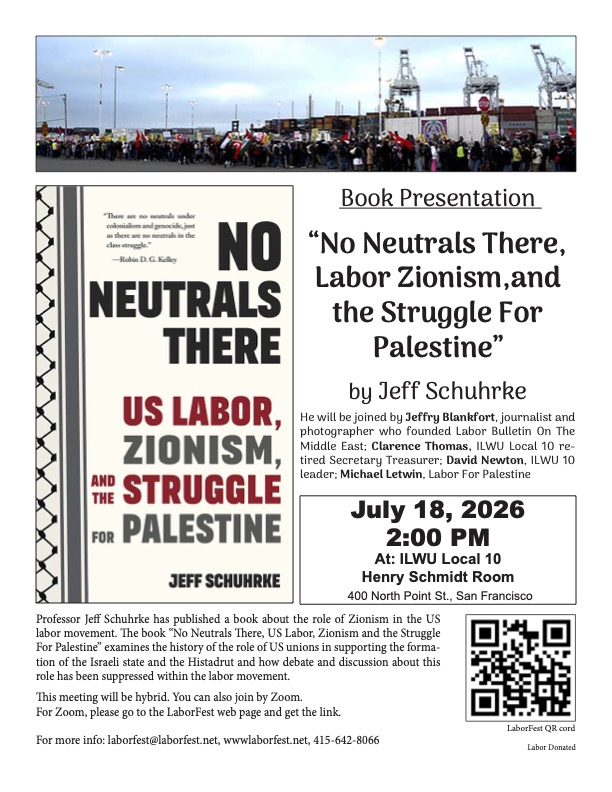
“No Neutrals There, Labor Zionism, & the Struggle For Palestine” Book Presentation & Panel
 Import event into your personal calendar
Date:
Saturday, July 18, 2026
Time:
2:00 PM
-
4:00 PM
Event Type:
Panel Discussion
Organizer/Author:
LaborFest.net
Location Details:
Henry Schmidt Room
ILWU Local 10
400 North Point St.
San Francisco
ILWU Local 10
400 North Point St.
San Francisco
Labor historian Jeff Schuhrke presents his new book “No Neutrals There, Labor Zionism, and the Struggle For Palestine”
He will be joined by Jeffry Blankfort, journalist and photographer who founded Labor Bulletin On The Middle East; Clarence Thomas, ILWU Local 10 retired Secretary Treasurer; David Newton, ILWU 10 leader and Michael Letwin with Labor For Palestine
July 18, 2026
2:00 PM
At: ILWU Local 10
Henry Schmidt Room
400 North Point St., San Francisco
Professor Jeff Schuhrke has published a book about the role of Zionism in the US
labor movement. The book “No Neutrals There, US Labor, Zionism and the Struggle
For Palestine” examines the history of the role of US unions in supporting the forma-
tion of the Israeli state and the Histadrut and how debate and discussion about this
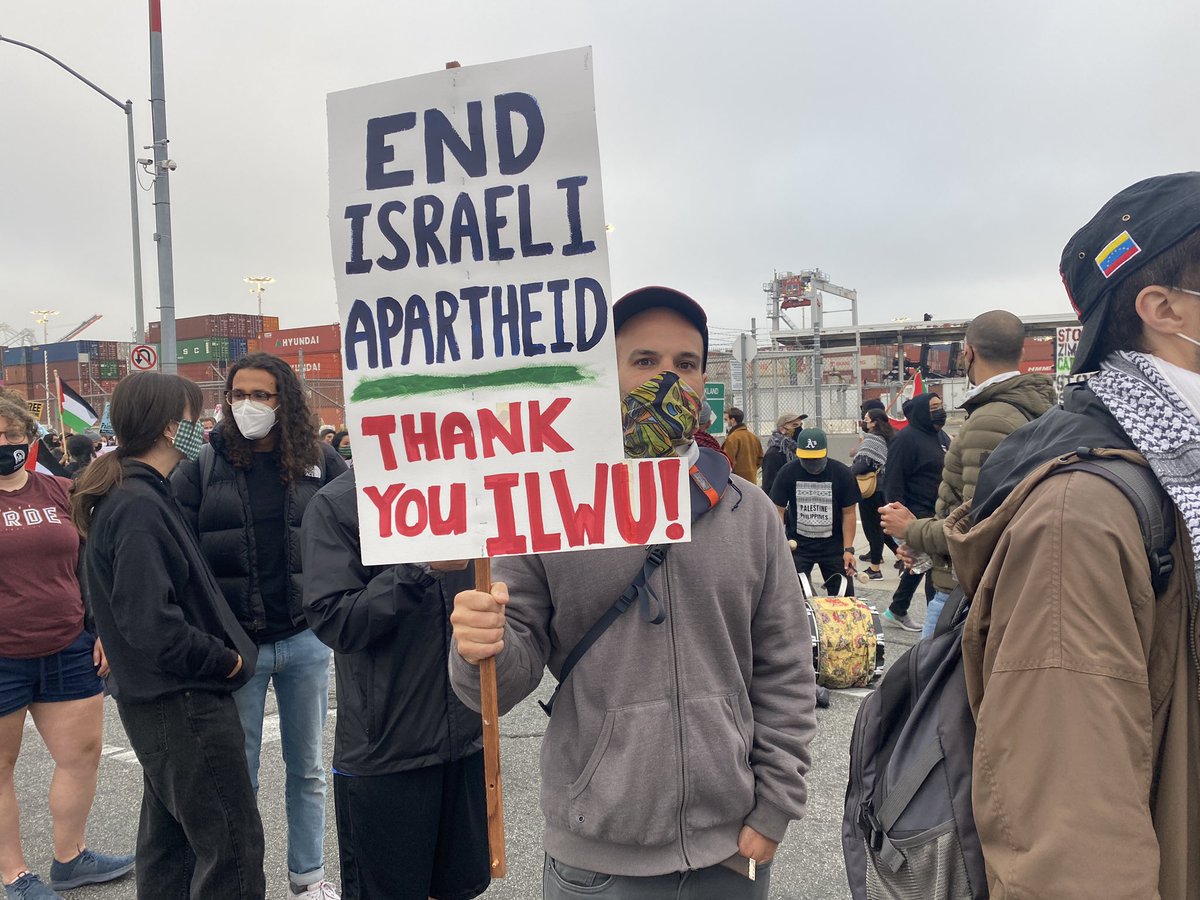
role has been suppressed within the labor movement. The ILWU Local 10 has played a historic role in boycotting the Israeli ZIM shipping line from coming to San Francisco and the West Coast.
This meeting will be hybrid. You can also join by Zoom.
For Zoom, please go to the LaborFest.net web page and get the link.
For more info: laborfest [at] laborfest.net, wwwlaborfest.net, 415-642-8066
No Neutrals There
How Jeff Schuhrke Excavates a Century of Labor, Empire, and Palestine
https://3arabawy.substack.com/p/no-neutrals-there
HOSSAM EL-HAMALAWY
NOV 13
There is a story American labor history has long refused to tell itself, a story about the movement’s complicity in empire. It is not about the picket lines of Flint or the coal seams of West Virginia, but about the docks of Haifa and the weapons assembly lines that fed the Israeli state. Jeff Schuhrke’s No Neutrals There drags that buried history into daylight, and in doing so forces a reckoning not only with the labor movement’s past but with its soul.
Published by Haymarket Books, the volume arrives with impeccable timing. Israel’s 2023–25 assault on Gaza, what Palestinian unions rightly called a genocide, has confronted American unions with a moral test: to continue arming the oppressor or to heed the call of workers under siege. Schuhrke opens with that moment, the Palestinian trade unions’ appeal for international solidarity, and the shameful reaction of the AFL-CIO bureaucracy that moved to quash even mild dissent within its ranks. It is a scene of bureaucratic cowardice, perfectly emblematic of the historical pattern his book reconstructs.
From there, Schuhrke rewinds more than a century, tracing how U.S. union officialdom became one of Zionism’s most reliable allies. He does not write as a polemicist throwing stones from the outside. He is a labor historian steeped in the movement’s inner grammar, aware of its emancipatory traditions but unsparing about their betrayal. The book’s title, No Neutrals There, comes from Florence Reece’s 1931 miners’ ballad and from George Habash’s revolutionary dictum that no one is neutral between oppressor and oppressed. Schuhrke weaves those lines into a transnational argument: labor solidarity means choosing sides, and for too long, American unions chose the wrong one.
The House That Zionism Built
At the heart of No Neutrals There is a devastating historical insight. U.S. labor’s alignment with Zionism was never an accident or a misunderstanding; it was a structural choice rooted in the movement’s own settler-colonial origins and Cold War anti-communism.
Schuhrke begins in the early twentieth century, when Jewish immigrant workers (Bundists, anarchists, and socialists) were remaking the sweatshops of New York. Many of them rejected Zionism outright. Their loyalty was to the shop floor, not to a promised land. The idea that freedom could be achieved by fleeing to Palestine rather than fighting capitalism where they stood struck them as bourgeois escapism. Yet, as Schuhrke shows, a gradual transformation took place. Labor Zionism, with its rhetoric of collective farms and “making the desert bloom,” managed to seduce segments of the American trade-union leadership.
He draws a sharp parallel: the Zionist project of “redeeming” the land through Jewish labor echoed the American myth of the frontier, where white settlers “tamed” supposedly empty lands. The same logic that erased Native Americans resonated with U.S. labor officials who imagined their movement as the vanguard of a civilizing mission. When AFL leader Samuel Gompers endorsed Woodrow Wilson’s entry into World War I and backed the Balfour Declaration’s promise of a “Jewish homeland,” it was not despite his pragmatism; it was the logical extension of it. Respectability and empire marched hand in hand.
Schuhrke’s archival work is impressive. He reconstructs the decades in which the AFL and later the AFL-CIO became fundraisers, propagandists, and de facto lobbyists for Israel. Labor Zionism’s institutions, such as the Histadrut, the Jewish Agency, and the Jewish Labor Committee, were embraced as fraternal partners. American union dues flowed to the Jewish National Fund. Delegations of U.S. labor leaders toured kibbutzim and returned preaching the virtues of “democratic socialism” in Israel, blind to the ruins of Palestinian villages beneath their feet.
What makes Schuhrke’s account so potent is that he does not let nostalgia soften the picture. The same AFL-CIO that crushed the left at home and collaborated with the CIA abroad also underwrote Israeli colonization. During the Cold War, the federation’s foreign-policy operatives, from Jay Lovestone to Irving Brown, used the language of labor solidarity to build pro-U.S. unions worldwide. Israel, they believed, was the model: a “socialist” state friendly to Washington, efficient at repressing communists, and ruthless toward the Arab poor.
The author quotes an AFL-CIO declaration from 1982, issued amid Israel’s invasion of Lebanon: “The AFL-CIO is not neutral. We support Israel.” It was meant as a boast. Schuhrke turns it into an indictment.
Against Forgetting
Yet No Neutrals There is not a dirge. It is a recovery project. Schuhrke insists that another lineage exists, a minority tradition of American workers who stood with Palestine. He resurrects the voices of Arab American organizers, Black radicals, anti-Zionist Jews, and rank-and-file militants who refused to let “internationalism” be reduced to flag-waving.
Among the most compelling sections are those recounting the 1970s and 1980s, when the New York City Labor Against the War coalition and the United Electrical Workers began linking U.S. imperialism, apartheid South Africa, and the occupation of Palestine as facets of the same system. He reminds us that some longshore unions on the West Coast, descendants of the radical ILWU tradition, did take principled stands, refusing to handle apartheid cargo and, later, weapons bound for Israel. These were exceptions, but they mattered. They proved that solidarity across borders was not a utopian dream but a worker’s duty.
Schuhrke writes without academic hedging. His sentences have moral clarity, the kind that feels almost old-fashioned in an era of moral relativism. When he recounts how AFL-CIO officials rationalized Israel’s massacres as “self-defense,” he does not conceal his outrage. Yet he never slips into caricature. He wants the reader to understand why union leaders made these choices, including the patronage networks, the fear of government repression, and the lure of respectability, as well as why they can no longer hide behind them.
Gaza, Guns, and the Future of Solidarity
The book’s framing chapter, set amid the Gaza war of 2023–25, makes clear that this is not a relic of Cold War history. The same ideological reflexes that bound labor to empire still operate. The AFL-CIO’s reflexive deference to President Biden, its fear of losing political access, its silence while U.S.-made bombs leveled hospitals, all this repeats the past in real time.
Schuhrke documents how a new generation of unionists has begun to revolt against that silence. Graduate workers at the University of California, teachers in Chicago, postal workers, and rank-and-file Teamsters have pushed their unions to endorse ceasefire resolutions and to consider boycotting weapons shipments. He treats these initiatives not as isolated acts but as signs of an emerging moral awakening.
The chapter’s conclusion reads almost prophetic. The future of U.S. labor, he argues, depends on whether it can free itself from the imperial logic that shackled it to Zionism. Internationalism, if it is to mean anything, must include Palestine. Otherwise, “solidarity forever” will remain a hollow refrain.
A Historian with a Hammer
Schuhrke writes with the discipline of a historian but the urgency of an activist. His prose carries the cadence of a union song, measured, rhythmic, but edged with defiance. He moves effortlessly between archival detail and political meditation, quoting speeches, resolutions, and forgotten pamphlets without losing narrative flow. The introduction alone, beginning with that 2023 call from Palestinian trade unions, is worth the price of the book.
What makes No Neutrals There exceptional is its refusal to treat labor history as a museum piece. For Schuhrke, history is a weapon. He uses it to challenge the alibis of the present, to remind readers that neutrality is complicity, that the moral horizon of a movement is measured not by its slogans but by the lives it chooses to defend.
He also rescues the meaning of internationalism from the bureaucrats who buried it. The old labor diplomacy of the AFL-CIO, stuffed shirts on overseas junkets preaching “free enterprise,” is here exposed as what it was: an appendage of the State Department. Against that counterfeit, Schuhrke proposes a revived internationalism rooted in anti-imperialism, demilitarization, and environmental justice. The book’s final pages sketch an agenda that feels both visionary and concrete: divest union pensions from Israeli occupation, disrupt arms shipments, defend pro-Palestine activists from repression, and redirect military budgets toward public welfare. In his hands, these are not slogans; they are tasks.
Reading Across Time
For readers outside the United States, the book has an added resonance. The patterns Schuhrke identifies include the alignment of labor bureaucracies with ruling elites, the use of “solidarity” as diplomatic theater, and the silencing of anti-imperialist voices, all of which are hardly unique to America. They describe the fate of many postcolonial and neoliberal unions across the Global South, Egypt included. In that sense, No Neutrals There is a mirror held up to all movements that once claimed to speak for workers but ended up defending their own privilege.
Schuhrke’s narrative also punctures the sentimental myth of “labor Zionism” as a noble socialist experiment gone astray. He shows that the kibbutz utopia was never innocent: it was built on expropriated land and racial exclusion. The Israeli labor federation, the Histadrut, was both a trade union and an employer, enforcing the color line between Jewish and Arab workers.
No Neutrals There: US Labor, Zionism, and the Struggle for Palestine by Jeff Schuhrke: A Review Essay
https://www.greensocialthought.org/labor-economics/no-neutrals-there-us-labor-zionism-and-the-struggle-for-palestine-by-jeff-schuhrke-a-review-essay/
Examines US labor leaders’ support for the Zionist movement for over 100 years, and the growing resistance inside the trade union movement to such.
Written by Kim Scipes – in Labor / Economics
October 31, 2025 – Originally Published in Green Social Thought
Jeff Schuhrke’s latest book, No Neutrals There: US Labor, Zionism, and the Struggle for Palestine, is a major contribution by a US scholar and activist in support of Palestinians’ struggle for life, liberation, and independence. Written specifically to advance the struggle against Zionism against especially the top level “leadership” of the AFL-CIO and the US Empire, this actually is going to be a major source for information for activists across the US and the world, going far beyond the limits of the labor movement. What Schuhrke provides is a clear but nuanced account of the struggle by Palestinians against Zionist occupation and colonization of Palestine, while foregrounding attention on the role of supporting Zionism by top level leaders of the US labor movement.
Schuhrke introduces the book with a broad overview of US labor politics concerning Palestine. He points to the refusal of AFL-CIO officials in late 2023 to allow rank and file members in the Olympia, Washington area to express their solidarity with Palestinian workers; these American workers had responded to Palestinian unions’ calls for direct international solidarity by asking workers around the world not to make or transport weapons to Israel. However, AFL-CIO “leaders” claimed that foreign policy issues are the sole provenance of national level leaders and demanded the central labor council remove their positions from their web site and any literature and rescind any passed related resolutions. Schuhrke then points out that this was not surprising: national level labor leaders, starting with those of the American Federation of Labor (AFL), later joined by their counterparts in the Congress of Industrial Organizations (CIO), and then together after their 1955 merger, have supported Zionism for more than 100 years.
He distinguishes Zionism, a political movement, from Judaism, a religion, and points out that not all Zionists are Jewish, and that not all Jews are Zionists; in fact, he argues that many Jews are opposed to Zionism. The Zionists, however, have dominated the colonial movement into the Middle East at the direct expense of the indigenous Palestinian peoples, initially under British imperialism but especially continuing since the founding of Israel as an independent state in 1948. (Notice how Israel is regularly considered a “Jewish” state when, in actuality, it should be known as a “Zionist” state…?)
The issue he uses throughout the book is pointing out the hypocrisy of AFL-CIO leadership, who basically say union members cannot engage in “outside” politics when the so-called leadership has done so for over 100 years. And importantly—based on his previous work, Blue Collar Empire: The Untold Story of US Labor’s Global Anticommunist Crusade (2024, Verso) and my AFL-CIO’s Secret War against Developing Country Workers: Solidarity or Sabotage? (2010, Lexington Books)—he argues:
The other fundamental reason for American labor’s long-standing alliance with Zionism and the State of Israel is that it has historically been crucial to the AFL-CIO’s larger goal of supporting US imperialism around the globe.
And he uses the rest of the book to show exactly what the labor leadership did and to try to explain why they did it.
Schuhrke begins his historical account by distinguishing between two major responses by particularly Eastern European Jews to the issue of antisemitism. More working class Jews tended to unite under the policies of proletarian internationalism, while better off Jews tended to unite under another approach. They created two main organizations: the Jewish Labor Bund (“Bund” meaning union) and the Zionist Organization. He writes,
Though they were each the product of European modernity, the Bund and the Zionist Organization embodied different answers to antisemitic oppression. While the former represented a proletarian Jewish movement dedicated to liberation through class struggle and socialism, the latter was a more bourgeois configuration that sought Jewish emancipation through nationalism and settler colonialism.
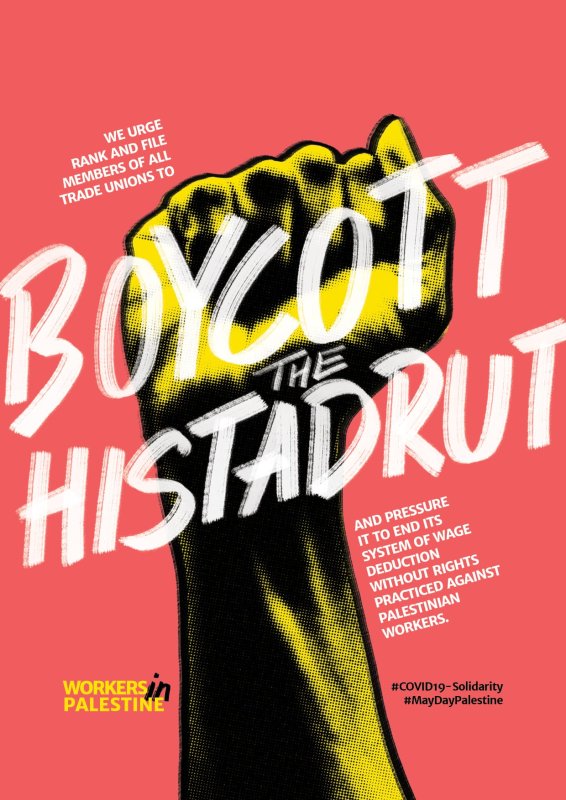
Schuhrke explains the affinity of US labor leaders to Zionism, and he uses the concept of “Labor Zionism” to do so. Some Zionist leaders recognized the need to build an economy that could employ Jewish “working class” immigrants once they reached the Middle East. In fact, a key institution in this process has been the Histadrut, which portrays itself as a Jewish labor center but, as Schuhrke shows, has always been at the heart of the Zionist Israeli state: the Histadrut has always been much more than a Zionist labor center taking care of Jewish workers. Founded in December 1920, its formal name being The General Organization of Hebrew Workers in the Land of Israel, the Histadrut “would function as a federation of Israel’s nascent Jewish trade unions, similar to the role of the AFL in the United States but—much more importantly—it would also drive and direct the construction of a Jewish-only economic sector.”
He suggests its importance:
Besides the trade unions, then, the Histadrut also established kibbutzim and moshavim, new industrial enterprises, housing and construction companies, a transportation network, a workers’ bank …and workers’ sick fund…. All of these would deliberately deny and job opportunities or social services to native Palestinian workers to further edify ‘Hebrew Labor’. The paramilitary Haganah was also folded into the Histadrut.
Recognizing this reality, that the Histadrut has been part of the Zionist state-in-formation and then later, the Zionist Israeli state, then all labor ties to the Histadrut today should be cut.
Yet, one can see why pro-Zionist US labor leaders would glom onto the Histadrut; it looks close enough like a labor center to seem legitimate, and most American workers don’t know the difference. Well, game over: with Schuhrke’s research, they now do!
Yet it makes sense as to why pro-labor Zionism appealed to American labor leaders, and Zionist leaders played on that American affinity, which obviously continues to date, as he so clearly illuminates throughout the book.
However, as Schuhrke details, any such effort to support Jewish workers always came at and continues to come at the expense of the indigenous Palestinians. Why, he asks, did they only care about the Jewish immigrants and never about the indigenous Palestinians, and not even working class Palestinians?
He ties this lack of concern about Palestinians to “settler colonialism,” comparing Jewish settlers in the Middle East to white Americans who settled the American West, the latter who ignored the impact of US colonialism on indigenous Native Americans.
Schuhrke continues the history of AFL-CIO support for Israel, upon establishment in 1948 and subsequently. This includes support for Israel after the Nakba (“the catastrophe”), where
All told, between December 1947 and January 1949, an estimated 15,000 Palestinian Arabs were killed and another 750,000 were expelled from their homes [by Zionist forces-KS], where they and their ancestors had lived for many centuries. To this day, they and their descendants have not been allowed to return.
He continues his historical account of Israeli oppression—and US labor leaders’ support—up to the present day.
He also talks increasingly about efforts by US trade unionists to support Palestinian workers, challenge AFL-CIO leaders, and increasingly challenge the US Empire. This begins with the Labor Committee on the Middle East, started by Jeff Blankfort and Steve Zeltzer in the San Francisco Bay Area during the late 1980s, but has continued through Labor for Palestine, which was established 2004, as “a new network of unions and community groups to serve as a locus of organizing and political education.” As discussed herein, these efforts have expanded inside the labor movement over the following years.
As said previously, this book is a major contribution in supporting the Palestinians’ struggle, challenging Israeli, US government and labor movement support for Zionism. It deserves wide circulation and readership.
There are a couple of refinements I would make to the book, areas that I think could be strengthened. Zionist settler colonialism is one: I think Schuhrke is dead right on this.
However, while good, his explanation only goes so far: he doesn’t go further and address the central issue of white supremacy and racism, which is at the heart of all settler colonialism anywhere in the world. (I include racism with white supremacy because one can mistreat others based on skin color and other differences, etc., without believing you are necessarily superior.) Without taking it to this central level, one cannot explain the intensity and perseverance of this white supremacy and racism over such a long period of time.
To understand how white supremacy and racism got created in the formerly British colonies/today’s United States, we must go back and examine the Virginia elites’ response to Bacon’s Rebellion in 1676-77—where Black and white indentured servants united and almost overthrew the colonial government (Jamestown was burnt to the ground)—to ensure that was never replicated.
The elite’s program in response to the Rebellion was to break apart white and Black unity, and they did this not by elevating whites over Blacks, and improving the poor whites’ lives, but to lowering Blacks below whites. In the earliest days of the British colonies, especially Virginia, unlike what most Americans have been taught, most Blacks did not enter the colonies as slaves; about three-quarters of them got here the way most poor whites did, as indentured servants; they would sell their freedom for a period of around seven years of labor in exchange for passage to the colonies. (Conditions of this indenture could range from just hard work up to basic enslavement, including whipping of both whites and Blacks, depending on the predilections of the owner.) Once indentureship was ended, these people each gained all of the rights and privileges as every other “free” person in that particular colony.
However, after the Rebellion was defeated, the elites started passing laws and ending rights of Blacks—and eventually they changed Black indentured servitude to chattel or lifetime slavery. They did not do this for whites. So, for example, in 1735, after 100 years of having the vote, Black Virginians had the vote taken away from them; over time, they had lost the right to bring charges against whites, to testify in trials, to run for office, etc., and slavers could legally separate enslaved families, etc.
At the same time and especially using churches and “Sunday schools”—there weren’t any public schools at the time—the elites and their delegates went around and told poor whites that Blacks were “subhuman” and didn’t deserve anything else but enslavement and mistreatment and, ultimately, “suggested” whites themselves could suffer the same fate if they didn’t accept the program of Black enslavement. Most, but not all, whites accepted this Black enslavement, educating their offspring and those around them that this was good and just—and necessary. And that this was the “natural order” of things. So, it was propagated throughout US society.
[Note: this not only obviously hurt Blacks’ life situations, but also whites’; without Black support, whites were confined to the conditions the elites were willing to allow, and white conditions were not improved beyond that. Many of the troops who fought for the Confederacy were extremely poor.]
I think this is a more accurate and complete understanding of how white supremacy and racism emerged and, obviously, it still exists. I think had Schuhrke known the full history of this, it would have made his case of mistreatment of the Palestinians more accurate and complete, and given a much stronger explanation than what he provided. He’s on the right track; he just did not go far enough.
[NOTE: My account is based on the research of Theodore W. Allen in his profound, two volume study, The Creation of the White Race, and especially Volume 2. For a review of that, Edward Baptist’s The Half Has Never Been Told: Slavery and the Making of American Capitalism, and Swen Becker’s Empire of Cotton: A Global History, see my review in Logos, which is on-line for free at https://logosjournal.com/article/review-black-subjugation-in-america/.]
There is one more issue worthy of further comment.
While he discusses the growing attention being paid to the Palestinian issue within the labor movement, which is correct, he also suggests that this attention is broader and more powerful than it really is. In other words, there is increased attention being paid to Palestine, but it seems overwhelmingly confined to activists, many who come out of graduate school unions, although more and more are emerging in more traditional unions. This is important and unions have not handled it as well as they could have, but with few exceptions, this activism has not included the mainstream, non-activist portion of almost all unions. Unfortunately, I do not see qualitative change in AFL-CIO policy re Israel any time soon, and I doubt Schuhrke does himself. Yet, it appears he’s written this so that activists in the labor movement can work within their unions and other organizations to expand their efforts and educate co-members, with the goal of ultimately giving this challenge a real chance to succeed, while helping other activists to challenge the powers-to-be on their fronts. I think Israel’s post-October 7, 2023, war in Gaza has opened Zionism to more and more questioning and, increasingly, repudiation; something about genocide is not very appealing to the peoples of the world. This book, as is said, is “on time.”
The fact is that the one, on-going failure we left activists have been not able to overcome is that we’ve been unable to reach enough rank and file members so as to educate them and get them to challenge labor “leadership’s” domination over the unions. The one case where activists succeeded, in California in 2004, was overturned by a corrupt move by AFSCME President Gerald McEntee on behalf of AFL-CIO President John Sweeney at the 2005 National Convention in Chicago; McEntee changed a unanimous resolution from the 2004 California State AFL-CIO convention condemning AFL-CIO foreign policy to one praising it, and then not allowing people to speak for the overturned resolution; activists did not have the support to stop this move. We keep trying: see the website of LEPAIO, the Labor Education Project on the AFL-CIO’s International Operations at https://aflcio-int.education/ for recent work, including educational webinars.
It is the lack of democracy within the AFL-CIO that has limited discussion of these and other issues, such as labor imperialism, that are critical to workers and their well-being. The support for Zionism has been a project of high level “leaders,” behind the backs and unknown but in the name of US workers. It has been able to preclude worker-member initiative and has worked to constrain efforts to build global labor solidarity with workers world-wide.
Yet the “success” against leftist anti-imperialists to date might be coming back to kick top-level trade union leaders in the ass. As President Trump rides rampant over the Constitution, and we need organized and educated unionists to stand up to stop Trump’s incipient fascism, the numbers of members who will respond will probably not be enough to prevail; the failure might be all-but-complete; and these official labor leaders themselves might bear the burden of Trump’s assault.
He will be joined by Jeffry Blankfort, journalist and photographer who founded Labor Bulletin On The Middle East; Clarence Thomas, ILWU Local 10 retired Secretary Treasurer; David Newton, ILWU 10 leader and Michael Letwin with Labor For Palestine
July 18, 2026
2:00 PM
At: ILWU Local 10
Henry Schmidt Room
400 North Point St., San Francisco
Professor Jeff Schuhrke has published a book about the role of Zionism in the US
labor movement. The book “No Neutrals There, US Labor, Zionism and the Struggle
For Palestine” examines the history of the role of US unions in supporting the forma-
tion of the Israeli state and the Histadrut and how debate and discussion about this
role has been suppressed within the labor movement. The ILWU Local 10 has played a historic role in boycotting the Israeli ZIM shipping line from coming to San Francisco and the West Coast.
This meeting will be hybrid. You can also join by Zoom.
For Zoom, please go to the LaborFest.net web page and get the link.
For more info: laborfest [at] laborfest.net, wwwlaborfest.net, 415-642-8066
No Neutrals There
How Jeff Schuhrke Excavates a Century of Labor, Empire, and Palestine
https://3arabawy.substack.com/p/no-neutrals-there
HOSSAM EL-HAMALAWY
NOV 13
There is a story American labor history has long refused to tell itself, a story about the movement’s complicity in empire. It is not about the picket lines of Flint or the coal seams of West Virginia, but about the docks of Haifa and the weapons assembly lines that fed the Israeli state. Jeff Schuhrke’s No Neutrals There drags that buried history into daylight, and in doing so forces a reckoning not only with the labor movement’s past but with its soul.
Published by Haymarket Books, the volume arrives with impeccable timing. Israel’s 2023–25 assault on Gaza, what Palestinian unions rightly called a genocide, has confronted American unions with a moral test: to continue arming the oppressor or to heed the call of workers under siege. Schuhrke opens with that moment, the Palestinian trade unions’ appeal for international solidarity, and the shameful reaction of the AFL-CIO bureaucracy that moved to quash even mild dissent within its ranks. It is a scene of bureaucratic cowardice, perfectly emblematic of the historical pattern his book reconstructs.
From there, Schuhrke rewinds more than a century, tracing how U.S. union officialdom became one of Zionism’s most reliable allies. He does not write as a polemicist throwing stones from the outside. He is a labor historian steeped in the movement’s inner grammar, aware of its emancipatory traditions but unsparing about their betrayal. The book’s title, No Neutrals There, comes from Florence Reece’s 1931 miners’ ballad and from George Habash’s revolutionary dictum that no one is neutral between oppressor and oppressed. Schuhrke weaves those lines into a transnational argument: labor solidarity means choosing sides, and for too long, American unions chose the wrong one.
The House That Zionism Built
At the heart of No Neutrals There is a devastating historical insight. U.S. labor’s alignment with Zionism was never an accident or a misunderstanding; it was a structural choice rooted in the movement’s own settler-colonial origins and Cold War anti-communism.
Schuhrke begins in the early twentieth century, when Jewish immigrant workers (Bundists, anarchists, and socialists) were remaking the sweatshops of New York. Many of them rejected Zionism outright. Their loyalty was to the shop floor, not to a promised land. The idea that freedom could be achieved by fleeing to Palestine rather than fighting capitalism where they stood struck them as bourgeois escapism. Yet, as Schuhrke shows, a gradual transformation took place. Labor Zionism, with its rhetoric of collective farms and “making the desert bloom,” managed to seduce segments of the American trade-union leadership.
He draws a sharp parallel: the Zionist project of “redeeming” the land through Jewish labor echoed the American myth of the frontier, where white settlers “tamed” supposedly empty lands. The same logic that erased Native Americans resonated with U.S. labor officials who imagined their movement as the vanguard of a civilizing mission. When AFL leader Samuel Gompers endorsed Woodrow Wilson’s entry into World War I and backed the Balfour Declaration’s promise of a “Jewish homeland,” it was not despite his pragmatism; it was the logical extension of it. Respectability and empire marched hand in hand.
Schuhrke’s archival work is impressive. He reconstructs the decades in which the AFL and later the AFL-CIO became fundraisers, propagandists, and de facto lobbyists for Israel. Labor Zionism’s institutions, such as the Histadrut, the Jewish Agency, and the Jewish Labor Committee, were embraced as fraternal partners. American union dues flowed to the Jewish National Fund. Delegations of U.S. labor leaders toured kibbutzim and returned preaching the virtues of “democratic socialism” in Israel, blind to the ruins of Palestinian villages beneath their feet.
What makes Schuhrke’s account so potent is that he does not let nostalgia soften the picture. The same AFL-CIO that crushed the left at home and collaborated with the CIA abroad also underwrote Israeli colonization. During the Cold War, the federation’s foreign-policy operatives, from Jay Lovestone to Irving Brown, used the language of labor solidarity to build pro-U.S. unions worldwide. Israel, they believed, was the model: a “socialist” state friendly to Washington, efficient at repressing communists, and ruthless toward the Arab poor.
The author quotes an AFL-CIO declaration from 1982, issued amid Israel’s invasion of Lebanon: “The AFL-CIO is not neutral. We support Israel.” It was meant as a boast. Schuhrke turns it into an indictment.
Against Forgetting
Yet No Neutrals There is not a dirge. It is a recovery project. Schuhrke insists that another lineage exists, a minority tradition of American workers who stood with Palestine. He resurrects the voices of Arab American organizers, Black radicals, anti-Zionist Jews, and rank-and-file militants who refused to let “internationalism” be reduced to flag-waving.
Among the most compelling sections are those recounting the 1970s and 1980s, when the New York City Labor Against the War coalition and the United Electrical Workers began linking U.S. imperialism, apartheid South Africa, and the occupation of Palestine as facets of the same system. He reminds us that some longshore unions on the West Coast, descendants of the radical ILWU tradition, did take principled stands, refusing to handle apartheid cargo and, later, weapons bound for Israel. These were exceptions, but they mattered. They proved that solidarity across borders was not a utopian dream but a worker’s duty.
Schuhrke writes without academic hedging. His sentences have moral clarity, the kind that feels almost old-fashioned in an era of moral relativism. When he recounts how AFL-CIO officials rationalized Israel’s massacres as “self-defense,” he does not conceal his outrage. Yet he never slips into caricature. He wants the reader to understand why union leaders made these choices, including the patronage networks, the fear of government repression, and the lure of respectability, as well as why they can no longer hide behind them.
Gaza, Guns, and the Future of Solidarity
The book’s framing chapter, set amid the Gaza war of 2023–25, makes clear that this is not a relic of Cold War history. The same ideological reflexes that bound labor to empire still operate. The AFL-CIO’s reflexive deference to President Biden, its fear of losing political access, its silence while U.S.-made bombs leveled hospitals, all this repeats the past in real time.
Schuhrke documents how a new generation of unionists has begun to revolt against that silence. Graduate workers at the University of California, teachers in Chicago, postal workers, and rank-and-file Teamsters have pushed their unions to endorse ceasefire resolutions and to consider boycotting weapons shipments. He treats these initiatives not as isolated acts but as signs of an emerging moral awakening.
The chapter’s conclusion reads almost prophetic. The future of U.S. labor, he argues, depends on whether it can free itself from the imperial logic that shackled it to Zionism. Internationalism, if it is to mean anything, must include Palestine. Otherwise, “solidarity forever” will remain a hollow refrain.
A Historian with a Hammer
Schuhrke writes with the discipline of a historian but the urgency of an activist. His prose carries the cadence of a union song, measured, rhythmic, but edged with defiance. He moves effortlessly between archival detail and political meditation, quoting speeches, resolutions, and forgotten pamphlets without losing narrative flow. The introduction alone, beginning with that 2023 call from Palestinian trade unions, is worth the price of the book.
What makes No Neutrals There exceptional is its refusal to treat labor history as a museum piece. For Schuhrke, history is a weapon. He uses it to challenge the alibis of the present, to remind readers that neutrality is complicity, that the moral horizon of a movement is measured not by its slogans but by the lives it chooses to defend.
He also rescues the meaning of internationalism from the bureaucrats who buried it. The old labor diplomacy of the AFL-CIO, stuffed shirts on overseas junkets preaching “free enterprise,” is here exposed as what it was: an appendage of the State Department. Against that counterfeit, Schuhrke proposes a revived internationalism rooted in anti-imperialism, demilitarization, and environmental justice. The book’s final pages sketch an agenda that feels both visionary and concrete: divest union pensions from Israeli occupation, disrupt arms shipments, defend pro-Palestine activists from repression, and redirect military budgets toward public welfare. In his hands, these are not slogans; they are tasks.
Reading Across Time
For readers outside the United States, the book has an added resonance. The patterns Schuhrke identifies include the alignment of labor bureaucracies with ruling elites, the use of “solidarity” as diplomatic theater, and the silencing of anti-imperialist voices, all of which are hardly unique to America. They describe the fate of many postcolonial and neoliberal unions across the Global South, Egypt included. In that sense, No Neutrals There is a mirror held up to all movements that once claimed to speak for workers but ended up defending their own privilege.
Schuhrke’s narrative also punctures the sentimental myth of “labor Zionism” as a noble socialist experiment gone astray. He shows that the kibbutz utopia was never innocent: it was built on expropriated land and racial exclusion. The Israeli labor federation, the Histadrut, was both a trade union and an employer, enforcing the color line between Jewish and Arab workers.
No Neutrals There: US Labor, Zionism, and the Struggle for Palestine by Jeff Schuhrke: A Review Essay
https://www.greensocialthought.org/labor-economics/no-neutrals-there-us-labor-zionism-and-the-struggle-for-palestine-by-jeff-schuhrke-a-review-essay/
Examines US labor leaders’ support for the Zionist movement for over 100 years, and the growing resistance inside the trade union movement to such.
Written by Kim Scipes – in Labor / Economics
October 31, 2025 – Originally Published in Green Social Thought
Jeff Schuhrke’s latest book, No Neutrals There: US Labor, Zionism, and the Struggle for Palestine, is a major contribution by a US scholar and activist in support of Palestinians’ struggle for life, liberation, and independence. Written specifically to advance the struggle against Zionism against especially the top level “leadership” of the AFL-CIO and the US Empire, this actually is going to be a major source for information for activists across the US and the world, going far beyond the limits of the labor movement. What Schuhrke provides is a clear but nuanced account of the struggle by Palestinians against Zionist occupation and colonization of Palestine, while foregrounding attention on the role of supporting Zionism by top level leaders of the US labor movement.
Schuhrke introduces the book with a broad overview of US labor politics concerning Palestine. He points to the refusal of AFL-CIO officials in late 2023 to allow rank and file members in the Olympia, Washington area to express their solidarity with Palestinian workers; these American workers had responded to Palestinian unions’ calls for direct international solidarity by asking workers around the world not to make or transport weapons to Israel. However, AFL-CIO “leaders” claimed that foreign policy issues are the sole provenance of national level leaders and demanded the central labor council remove their positions from their web site and any literature and rescind any passed related resolutions. Schuhrke then points out that this was not surprising: national level labor leaders, starting with those of the American Federation of Labor (AFL), later joined by their counterparts in the Congress of Industrial Organizations (CIO), and then together after their 1955 merger, have supported Zionism for more than 100 years.
He distinguishes Zionism, a political movement, from Judaism, a religion, and points out that not all Zionists are Jewish, and that not all Jews are Zionists; in fact, he argues that many Jews are opposed to Zionism. The Zionists, however, have dominated the colonial movement into the Middle East at the direct expense of the indigenous Palestinian peoples, initially under British imperialism but especially continuing since the founding of Israel as an independent state in 1948. (Notice how Israel is regularly considered a “Jewish” state when, in actuality, it should be known as a “Zionist” state…?)
The issue he uses throughout the book is pointing out the hypocrisy of AFL-CIO leadership, who basically say union members cannot engage in “outside” politics when the so-called leadership has done so for over 100 years. And importantly—based on his previous work, Blue Collar Empire: The Untold Story of US Labor’s Global Anticommunist Crusade (2024, Verso) and my AFL-CIO’s Secret War against Developing Country Workers: Solidarity or Sabotage? (2010, Lexington Books)—he argues:
The other fundamental reason for American labor’s long-standing alliance with Zionism and the State of Israel is that it has historically been crucial to the AFL-CIO’s larger goal of supporting US imperialism around the globe.
And he uses the rest of the book to show exactly what the labor leadership did and to try to explain why they did it.
Schuhrke begins his historical account by distinguishing between two major responses by particularly Eastern European Jews to the issue of antisemitism. More working class Jews tended to unite under the policies of proletarian internationalism, while better off Jews tended to unite under another approach. They created two main organizations: the Jewish Labor Bund (“Bund” meaning union) and the Zionist Organization. He writes,
Though they were each the product of European modernity, the Bund and the Zionist Organization embodied different answers to antisemitic oppression. While the former represented a proletarian Jewish movement dedicated to liberation through class struggle and socialism, the latter was a more bourgeois configuration that sought Jewish emancipation through nationalism and settler colonialism.
Schuhrke explains the affinity of US labor leaders to Zionism, and he uses the concept of “Labor Zionism” to do so. Some Zionist leaders recognized the need to build an economy that could employ Jewish “working class” immigrants once they reached the Middle East. In fact, a key institution in this process has been the Histadrut, which portrays itself as a Jewish labor center but, as Schuhrke shows, has always been at the heart of the Zionist Israeli state: the Histadrut has always been much more than a Zionist labor center taking care of Jewish workers. Founded in December 1920, its formal name being The General Organization of Hebrew Workers in the Land of Israel, the Histadrut “would function as a federation of Israel’s nascent Jewish trade unions, similar to the role of the AFL in the United States but—much more importantly—it would also drive and direct the construction of a Jewish-only economic sector.”
He suggests its importance:
Besides the trade unions, then, the Histadrut also established kibbutzim and moshavim, new industrial enterprises, housing and construction companies, a transportation network, a workers’ bank …and workers’ sick fund…. All of these would deliberately deny and job opportunities or social services to native Palestinian workers to further edify ‘Hebrew Labor’. The paramilitary Haganah was also folded into the Histadrut.
Recognizing this reality, that the Histadrut has been part of the Zionist state-in-formation and then later, the Zionist Israeli state, then all labor ties to the Histadrut today should be cut.
Yet, one can see why pro-Zionist US labor leaders would glom onto the Histadrut; it looks close enough like a labor center to seem legitimate, and most American workers don’t know the difference. Well, game over: with Schuhrke’s research, they now do!
Yet it makes sense as to why pro-labor Zionism appealed to American labor leaders, and Zionist leaders played on that American affinity, which obviously continues to date, as he so clearly illuminates throughout the book.
However, as Schuhrke details, any such effort to support Jewish workers always came at and continues to come at the expense of the indigenous Palestinians. Why, he asks, did they only care about the Jewish immigrants and never about the indigenous Palestinians, and not even working class Palestinians?
He ties this lack of concern about Palestinians to “settler colonialism,” comparing Jewish settlers in the Middle East to white Americans who settled the American West, the latter who ignored the impact of US colonialism on indigenous Native Americans.
Schuhrke continues the history of AFL-CIO support for Israel, upon establishment in 1948 and subsequently. This includes support for Israel after the Nakba (“the catastrophe”), where
All told, between December 1947 and January 1949, an estimated 15,000 Palestinian Arabs were killed and another 750,000 were expelled from their homes [by Zionist forces-KS], where they and their ancestors had lived for many centuries. To this day, they and their descendants have not been allowed to return.
He continues his historical account of Israeli oppression—and US labor leaders’ support—up to the present day.
He also talks increasingly about efforts by US trade unionists to support Palestinian workers, challenge AFL-CIO leaders, and increasingly challenge the US Empire. This begins with the Labor Committee on the Middle East, started by Jeff Blankfort and Steve Zeltzer in the San Francisco Bay Area during the late 1980s, but has continued through Labor for Palestine, which was established 2004, as “a new network of unions and community groups to serve as a locus of organizing and political education.” As discussed herein, these efforts have expanded inside the labor movement over the following years.
As said previously, this book is a major contribution in supporting the Palestinians’ struggle, challenging Israeli, US government and labor movement support for Zionism. It deserves wide circulation and readership.
There are a couple of refinements I would make to the book, areas that I think could be strengthened. Zionist settler colonialism is one: I think Schuhrke is dead right on this.
However, while good, his explanation only goes so far: he doesn’t go further and address the central issue of white supremacy and racism, which is at the heart of all settler colonialism anywhere in the world. (I include racism with white supremacy because one can mistreat others based on skin color and other differences, etc., without believing you are necessarily superior.) Without taking it to this central level, one cannot explain the intensity and perseverance of this white supremacy and racism over such a long period of time.
To understand how white supremacy and racism got created in the formerly British colonies/today’s United States, we must go back and examine the Virginia elites’ response to Bacon’s Rebellion in 1676-77—where Black and white indentured servants united and almost overthrew the colonial government (Jamestown was burnt to the ground)—to ensure that was never replicated.
The elite’s program in response to the Rebellion was to break apart white and Black unity, and they did this not by elevating whites over Blacks, and improving the poor whites’ lives, but to lowering Blacks below whites. In the earliest days of the British colonies, especially Virginia, unlike what most Americans have been taught, most Blacks did not enter the colonies as slaves; about three-quarters of them got here the way most poor whites did, as indentured servants; they would sell their freedom for a period of around seven years of labor in exchange for passage to the colonies. (Conditions of this indenture could range from just hard work up to basic enslavement, including whipping of both whites and Blacks, depending on the predilections of the owner.) Once indentureship was ended, these people each gained all of the rights and privileges as every other “free” person in that particular colony.
However, after the Rebellion was defeated, the elites started passing laws and ending rights of Blacks—and eventually they changed Black indentured servitude to chattel or lifetime slavery. They did not do this for whites. So, for example, in 1735, after 100 years of having the vote, Black Virginians had the vote taken away from them; over time, they had lost the right to bring charges against whites, to testify in trials, to run for office, etc., and slavers could legally separate enslaved families, etc.
At the same time and especially using churches and “Sunday schools”—there weren’t any public schools at the time—the elites and their delegates went around and told poor whites that Blacks were “subhuman” and didn’t deserve anything else but enslavement and mistreatment and, ultimately, “suggested” whites themselves could suffer the same fate if they didn’t accept the program of Black enslavement. Most, but not all, whites accepted this Black enslavement, educating their offspring and those around them that this was good and just—and necessary. And that this was the “natural order” of things. So, it was propagated throughout US society.
[Note: this not only obviously hurt Blacks’ life situations, but also whites’; without Black support, whites were confined to the conditions the elites were willing to allow, and white conditions were not improved beyond that. Many of the troops who fought for the Confederacy were extremely poor.]
I think this is a more accurate and complete understanding of how white supremacy and racism emerged and, obviously, it still exists. I think had Schuhrke known the full history of this, it would have made his case of mistreatment of the Palestinians more accurate and complete, and given a much stronger explanation than what he provided. He’s on the right track; he just did not go far enough.
[NOTE: My account is based on the research of Theodore W. Allen in his profound, two volume study, The Creation of the White Race, and especially Volume 2. For a review of that, Edward Baptist’s The Half Has Never Been Told: Slavery and the Making of American Capitalism, and Swen Becker’s Empire of Cotton: A Global History, see my review in Logos, which is on-line for free at https://logosjournal.com/article/review-black-subjugation-in-america/.]
There is one more issue worthy of further comment.
While he discusses the growing attention being paid to the Palestinian issue within the labor movement, which is correct, he also suggests that this attention is broader and more powerful than it really is. In other words, there is increased attention being paid to Palestine, but it seems overwhelmingly confined to activists, many who come out of graduate school unions, although more and more are emerging in more traditional unions. This is important and unions have not handled it as well as they could have, but with few exceptions, this activism has not included the mainstream, non-activist portion of almost all unions. Unfortunately, I do not see qualitative change in AFL-CIO policy re Israel any time soon, and I doubt Schuhrke does himself. Yet, it appears he’s written this so that activists in the labor movement can work within their unions and other organizations to expand their efforts and educate co-members, with the goal of ultimately giving this challenge a real chance to succeed, while helping other activists to challenge the powers-to-be on their fronts. I think Israel’s post-October 7, 2023, war in Gaza has opened Zionism to more and more questioning and, increasingly, repudiation; something about genocide is not very appealing to the peoples of the world. This book, as is said, is “on time.”
The fact is that the one, on-going failure we left activists have been not able to overcome is that we’ve been unable to reach enough rank and file members so as to educate them and get them to challenge labor “leadership’s” domination over the unions. The one case where activists succeeded, in California in 2004, was overturned by a corrupt move by AFSCME President Gerald McEntee on behalf of AFL-CIO President John Sweeney at the 2005 National Convention in Chicago; McEntee changed a unanimous resolution from the 2004 California State AFL-CIO convention condemning AFL-CIO foreign policy to one praising it, and then not allowing people to speak for the overturned resolution; activists did not have the support to stop this move. We keep trying: see the website of LEPAIO, the Labor Education Project on the AFL-CIO’s International Operations at https://aflcio-int.education/ for recent work, including educational webinars.
It is the lack of democracy within the AFL-CIO that has limited discussion of these and other issues, such as labor imperialism, that are critical to workers and their well-being. The support for Zionism has been a project of high level “leaders,” behind the backs and unknown but in the name of US workers. It has been able to preclude worker-member initiative and has worked to constrain efforts to build global labor solidarity with workers world-wide.
Yet the “success” against leftist anti-imperialists to date might be coming back to kick top-level trade union leaders in the ass. As President Trump rides rampant over the Constitution, and we need organized and educated unionists to stand up to stop Trump’s incipient fascism, the numbers of members who will respond will probably not be enough to prevail; the failure might be all-but-complete; and these official labor leaders themselves might bear the burden of Trump’s assault.
For more information:
http://www.laborfest.net
Added to the calendar on Fri, Jul 10, 2026 11:25PM
Add Your Comments
We are 100% volunteer and depend on your participation to sustain our efforts!
Donate

$110.00 donated
in the past month
Get Involved
If you'd like to help with maintaining or developing the website, contact us.
Publish
Publish your stories and upcoming events on Indybay.
Topics
More
Search Indybay's Archives
Advanced Search
►
▼
IMC Network