







 Publish to Newswire
 Add an Event
From the Open-Publishing Calendar
From the Open-Publishing Newswire
Indybay Feature
Petition · Reverse the dismissal of 1,047 Japanese National Railway workers
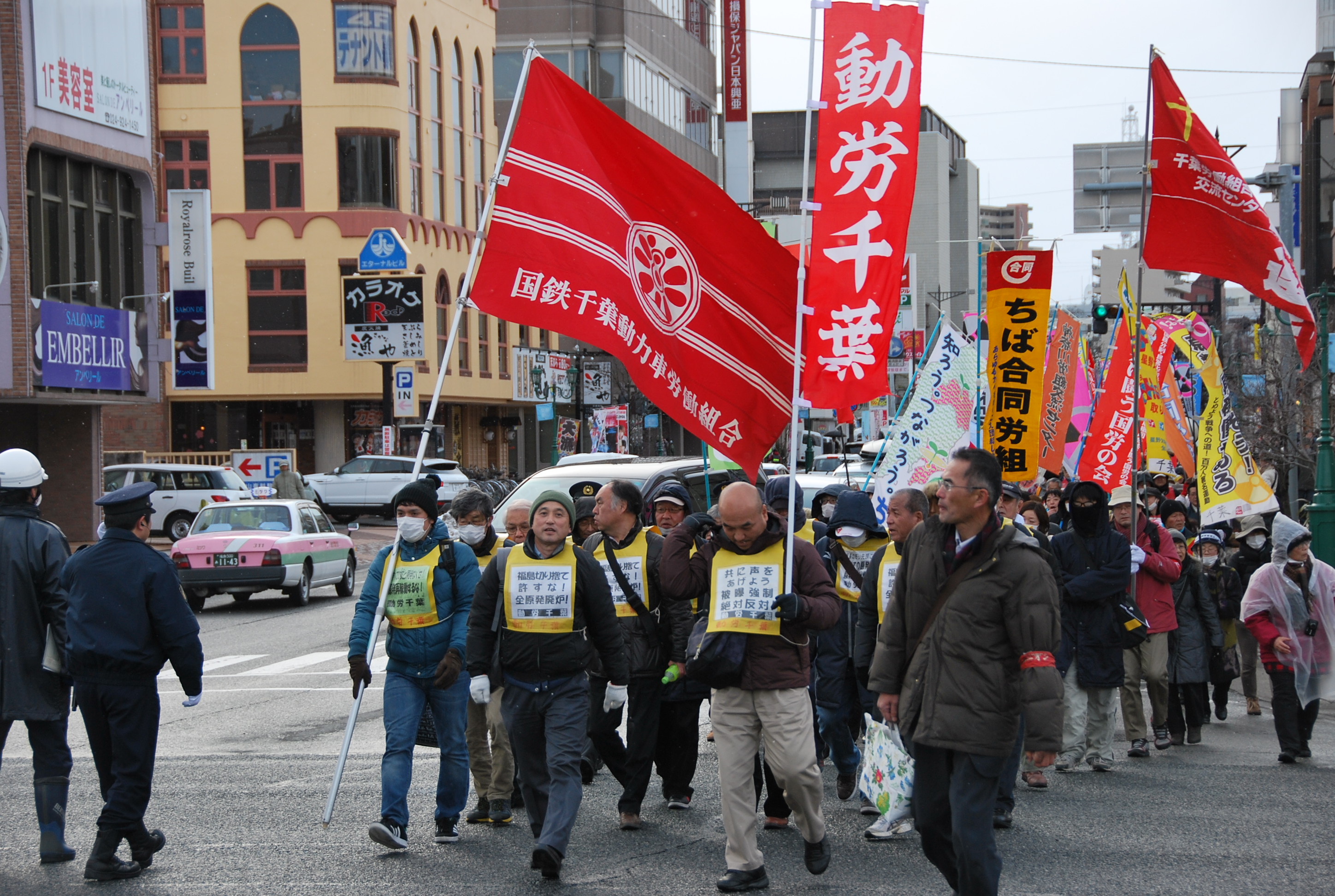
The militant railway union in Japan Doro-Chiba has been fighting against the illegal layoffs during privatization and their case goes to trial this month. They are asking for international support for their petition of solidarity.
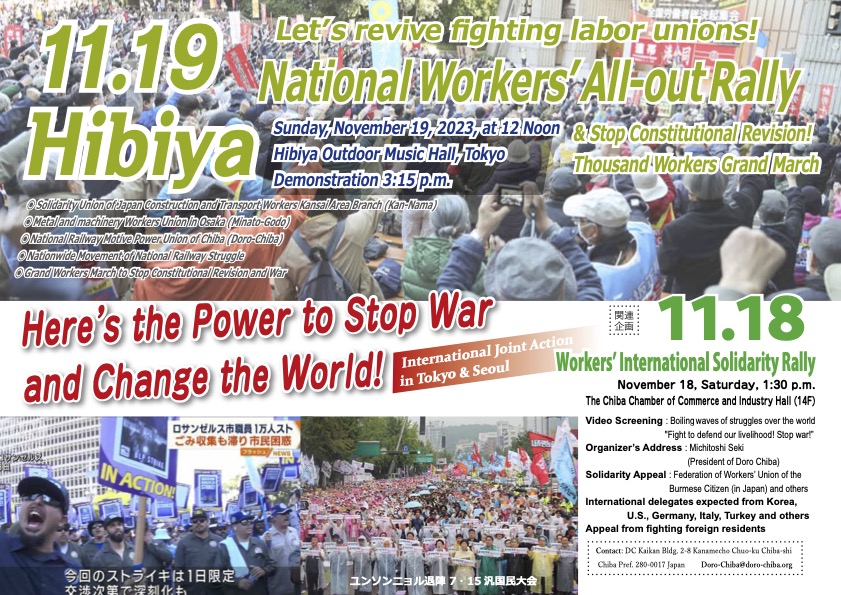
Reverse the dismissal of 1,047 Japanese National Railway workers
https://www.change.org/p/reverse-the-dismissal-of-1-047-japanese-national-railway-workers
The Issue
In 1987, during the privatization and division of Japanese National Railways (JNR), 1,047 workers were dismissed--the largest unfair labor practice in Japan since the end of WWII.
For four decades, Doro-Chiba and Doro Federation has been fighting to have the firing reversed. In 2015, the Supreme Court has ruled that the criterion for excluding union members who oppose the division and privatization of JNR, which were established when employing JNR union members to JR, constituted unfair labor practices. The formulation of the rejection criterion was ordered and decided by the JR Establishment Committee, and therefore JR is liable for unfair labor practices. JR, however, does not withdraw the dismissal and refuses collective bargaining.
The Central Labor Relations Commission refused to even conduct an investigation of the facts and enforced an order to deny the case. An outrageous act that abandons the Labor Relations Commission's mission of protecting workers' right to organize. The Tokyo District Court's decision allowed dismissal by concealing the truth, even though it could not disprove JR’s unfair labor practices.
We urge that the Tokyo High Court issue a judgment to reinstate the 1,047 workers to JR.
---------------------------------
This is an article written by former president of Doro-Chiba who led the strikes in 1985 and 1986 against the division and privatization of National Railways:
https://www.doro-chiba.org/english/nakano/works/on-rail/ch04.html
--------------------------------
When you sign on, feel free to list any job title and/or union affiliation that you have (if relevant).
For example:
"Jane Doe (President, ABC Union, Vancouver, Canada)"
Additional Info About Doro-Chiba
Japanese Railway Workers Doro-Chiba International Fight Against War and JR Privatization
https://youtu.be/yXYHbxES0gY
Toward a Historic Victory for the Revocation of the Dismissal of 1,047 Japan National Railway Workers!
The Door has Opened for the Questioning of Witnesses: the former chairs of JR West and of JR East
Join the petition campaign for reinstatement of fired 1,047 JNR Workers!
The Division and Privatization of the Japanese National Railways
On April 1, 1987, the Japan National Railways (JNR) was split up and privatized into seven companies―JR East, JR Central, JR West, JR Hokkaido, JR Shikoku, JR Kyushu, and JR Freight. More than 39 years have passed since then, Doro-Chiba has been continuing its struggle to this day under the banner of the Withdraw Dismissals of 1,047 Japan National Railway Workers.
This is because this attack is not an “issue of the past,” but a “current impending issue.” The Division and Privatization of JNR was the largest postwar attack on the labor movement, directed not merely at JNR workers but at all workers. Then-Prime Minister Yasuhiro Nakasone stated his intentions, saying, “We have carried out the Division and Privatization of JNR with the clear intention of crushing the National Railway Workers’ Union (Kokuro) and driving the Japanese Trade Union Confederation (Sohyo) and the Socialist Party to ruin,” and “Through administrative reform, we will purify the foundation of politics and enact our fine Constitution (destroying Article 9: “renunciation of war and war potential”) as the supreme norm of the nation.”
That attack was fierce. On July 26, 1985, the final report on the Division and Privatization of the JNR was released, and a brutalonslaught swept through the workplaces. There were a relentless wave of forced reassignments and the violent clashes over them. The betrayal by the Doro Headquarters (now East Japan Railway Workers’ Union) became increasingly apparent to the rank-and -file on a daily basis, and the leadership of Kokuro, the largest labor union at the time, was repeatedly thrown into turmoil.
As a result of the Division and Privatization of JNR in 1987, 200,000 out of the 400,000 workers were forced out of their jobs, and 200 were driven to suicide. The National Railway Workers’ Union (Kokuro) was whittled down from 200,000 to 40,000 members; labor movement leaders were left trembling with fear; the Sohyo* dissolved itself; and the Socialist Party was dismantled. From this point on, the entire Japanese labor movement was forced into retreat, and a full-scale neoliberal offensive began, creating 21 million non-regular workers and bringing about a reality of societal collapse.
*Sohyo (Japanese Trade Union Confederation): The largest national trade union center formed in July 1950. It was the central force in the labor movement at the time and served as the support base for Japan Social Party. It voluntarily dissolved in 1989, and the Rengo (Japan Trade Union Confederation) was formed.
The Struggle of Doro-Chiba and the Achievements of Brother Yamamoto
Doro-Chiba was the only union to rise up and fight back against this attack by launching strikes (in two waves: November 1985 and February 1986). Doro-Chiba had 1,100 members at the time. For them, this was a make or break struggle. There were repeated, intense workplace-wide debates over the strike strategy; discussions involving families and the local community to organize the strike; and a struggle against massive and severe disciplinary actions of the management, including the dismissal of 28 members for participating in the strike. The 12 union members who had not been fired after the two strikes were removed from JR’s hiring list.
It was a process in which every member engaged in serious discussions, resolve themselves to the task, made their own decision, fought, and steadfastly upheld their unity. It was through this struggle that Doro-Chiba was able to preserve its unity and enter the new JR system.
Partly because Brother Yamamoto’s workplace was very close to a key base of Doro-Chiba, he fought alongside with the union as it broke away from the Doro Headquarters and forged itself into a militant labor union. In particular, he was engaged from the very beginning in the Save Takiguchi Campaign launched in response to the targeted dismissal of union activist Makoto Takiguchi. Our relationship was such that whenever he got the information that violent “organizers” from the Doro Headquarters were coming, he would take a “half-day off,” rush out of his workplace, and hurry to our aid.
During the subsequent struggle against the Division and Privatization of JNR, he spearheaded the 100-Million-Yen Fund Campaign alongside the effort to screen a documentary film about Doro-Chiba’s struggle. This led to the establishment of the Support Committee of Doro-Chiba. Driven by the goal of spreading the report of the actual development of Doro-Chiba’s fight across the country, he served as the Committee’s secretary-general for many years; Brother Yamamoto was always present at the union’s actions and meetings. It was through such dedicated effort of Brother Yamamoto that support was garnered from all over the country, enabling Doro-Chiba to sustain its struggle.
International Solidarity Fostered Through the Struggle againstprivatization of JNR
For Doro-Chiba in particular, the significant expansion of international solidarity has been carried out largely by the tremendous efforts of Brother Yamamoto. It all began in 2002, when Brother Steve Zelzer was invited to the Solidarity Festival of Kokuro. He happened to walk into the Doro-Chiba tent. After learning about Doro-Chiba’s struggle against the Division and Privatization of the JNR, Zeltzer-san invited Doro-Chiba to the Labor Festa, which marked the beginning of our exchange with the International Longshore and Warehouse Union (ILWU). Comrades from the United States—including ILWU Locals 10, 34, 21, 19 and 52, as well as UTLA (United Teachers of Los Angels)—have participated many times in the November Workers’ Rally organized by Doro-Chiba. We express our heartfelt gratitude to them.
Solidarity between Japanese and South Korean labor movements began when workers from the Korean Confederation of Trade Unions (KCTU) participated in a rally in Japan on August 15, 2003. Since then, over the subsequent two decades, we have been able to build an invaluable bond of solidarity with the KCTU’s Seoul Regional Council and the Seoul Regional Headquarters of the Railway Workers’ Union—relationships that go far beyond mere ceremonial exchanges between leaders to encompass joint struggles at the grassroots level. These ties of solidarity have since expanded to include partnership in Germany, Brazil, Turkey, Italy, China, and Taiwan.
This process took place at a time when the JR administration was launching a massive offensive in the form of comprehensive outsourcing of operations, and Doro-Chiba was furiously fighting back against it. For Doro-Chiba, the expansion of international solidarity became a powerful source of strength in the struggle. The development of this international solidarity would not have been possible without Brother Yamamoto’s dedicated efforts.
The Current State of the Struggle against the Division and Privatization of JNR
The struggle against the Division and Privatization of the JNR continues as the movement of Withdraw Dismissals of 1,047 Japan National Railway Workers.
Following the Division and Privatization of the JNR and the start of JR (Japan Railway) in April 1987, 7,628 workers were refused employment by the JR Companies and were retained by the JNR Settlement Corporation under fixed-term contracts with the stipulation that they would be employed for only three years for the purpose of reemployment. The figure 1,047 indicates the number of people who were ultimately fired by the Settlement Corporation on April 1, 1990, after that three-year had elapsed. These workersresolved to continue their struggle, declaring, “We absolutely cannot accept this,” and vowing to fight until the very end for the withdrawal of their dismissals and reinstatement at JR.
Through this long-term struggle, Doro-Chiba uncovered the hidden truth, and in 2015, the Supreme Court ruled that “the criteria used by JR to reject their hiring applications constituted an unfair labor practice.” Even then, Brother Yamamoto continued to rally nationwide support for the petition campaign demanding the withdrawal of the dismissal and reinstatement at JR, successfully collecting over 100,000 signatures addressed to the Supreme Court. This served as a powerful force in putting pressure on both JR and the courts.
We are currently waging a campaign demanding that “all trials be retried” based on the truths we have uncovered. The legal battle is currently at the Tokyo High Court stage, and the third hearing on July 16 will be a decisive moment: either we will succeed in having two individuals who know the “hidden truths” called as witnesses, or the case will be dismissed at the conclusion of the trial.
https://www.change.org/p/reverse-the-dismissal-of-1-047-japanese-national-railway-workers
The Issue
In 1987, during the privatization and division of Japanese National Railways (JNR), 1,047 workers were dismissed--the largest unfair labor practice in Japan since the end of WWII.
For four decades, Doro-Chiba and Doro Federation has been fighting to have the firing reversed. In 2015, the Supreme Court has ruled that the criterion for excluding union members who oppose the division and privatization of JNR, which were established when employing JNR union members to JR, constituted unfair labor practices. The formulation of the rejection criterion was ordered and decided by the JR Establishment Committee, and therefore JR is liable for unfair labor practices. JR, however, does not withdraw the dismissal and refuses collective bargaining.
The Central Labor Relations Commission refused to even conduct an investigation of the facts and enforced an order to deny the case. An outrageous act that abandons the Labor Relations Commission's mission of protecting workers' right to organize. The Tokyo District Court's decision allowed dismissal by concealing the truth, even though it could not disprove JR’s unfair labor practices.
We urge that the Tokyo High Court issue a judgment to reinstate the 1,047 workers to JR.
---------------------------------
This is an article written by former president of Doro-Chiba who led the strikes in 1985 and 1986 against the division and privatization of National Railways:
https://www.doro-chiba.org/english/nakano/works/on-rail/ch04.html
--------------------------------
When you sign on, feel free to list any job title and/or union affiliation that you have (if relevant).
For example:
"Jane Doe (President, ABC Union, Vancouver, Canada)"
Additional Info About Doro-Chiba
Japanese Railway Workers Doro-Chiba International Fight Against War and JR Privatization
https://youtu.be/yXYHbxES0gY
Toward a Historic Victory for the Revocation of the Dismissal of 1,047 Japan National Railway Workers!
The Door has Opened for the Questioning of Witnesses: the former chairs of JR West and of JR East
Join the petition campaign for reinstatement of fired 1,047 JNR Workers!
The Division and Privatization of the Japanese National Railways
On April 1, 1987, the Japan National Railways (JNR) was split up and privatized into seven companies―JR East, JR Central, JR West, JR Hokkaido, JR Shikoku, JR Kyushu, and JR Freight. More than 39 years have passed since then, Doro-Chiba has been continuing its struggle to this day under the banner of the Withdraw Dismissals of 1,047 Japan National Railway Workers.
This is because this attack is not an “issue of the past,” but a “current impending issue.” The Division and Privatization of JNR was the largest postwar attack on the labor movement, directed not merely at JNR workers but at all workers. Then-Prime Minister Yasuhiro Nakasone stated his intentions, saying, “We have carried out the Division and Privatization of JNR with the clear intention of crushing the National Railway Workers’ Union (Kokuro) and driving the Japanese Trade Union Confederation (Sohyo) and the Socialist Party to ruin,” and “Through administrative reform, we will purify the foundation of politics and enact our fine Constitution (destroying Article 9: “renunciation of war and war potential”) as the supreme norm of the nation.”
That attack was fierce. On July 26, 1985, the final report on the Division and Privatization of the JNR was released, and a brutalonslaught swept through the workplaces. There were a relentless wave of forced reassignments and the violent clashes over them. The betrayal by the Doro Headquarters (now East Japan Railway Workers’ Union) became increasingly apparent to the rank-and -file on a daily basis, and the leadership of Kokuro, the largest labor union at the time, was repeatedly thrown into turmoil.
As a result of the Division and Privatization of JNR in 1987, 200,000 out of the 400,000 workers were forced out of their jobs, and 200 were driven to suicide. The National Railway Workers’ Union (Kokuro) was whittled down from 200,000 to 40,000 members; labor movement leaders were left trembling with fear; the Sohyo* dissolved itself; and the Socialist Party was dismantled. From this point on, the entire Japanese labor movement was forced into retreat, and a full-scale neoliberal offensive began, creating 21 million non-regular workers and bringing about a reality of societal collapse.
*Sohyo (Japanese Trade Union Confederation): The largest national trade union center formed in July 1950. It was the central force in the labor movement at the time and served as the support base for Japan Social Party. It voluntarily dissolved in 1989, and the Rengo (Japan Trade Union Confederation) was formed.
The Struggle of Doro-Chiba and the Achievements of Brother Yamamoto
Doro-Chiba was the only union to rise up and fight back against this attack by launching strikes (in two waves: November 1985 and February 1986). Doro-Chiba had 1,100 members at the time. For them, this was a make or break struggle. There were repeated, intense workplace-wide debates over the strike strategy; discussions involving families and the local community to organize the strike; and a struggle against massive and severe disciplinary actions of the management, including the dismissal of 28 members for participating in the strike. The 12 union members who had not been fired after the two strikes were removed from JR’s hiring list.
It was a process in which every member engaged in serious discussions, resolve themselves to the task, made their own decision, fought, and steadfastly upheld their unity. It was through this struggle that Doro-Chiba was able to preserve its unity and enter the new JR system.
Partly because Brother Yamamoto’s workplace was very close to a key base of Doro-Chiba, he fought alongside with the union as it broke away from the Doro Headquarters and forged itself into a militant labor union. In particular, he was engaged from the very beginning in the Save Takiguchi Campaign launched in response to the targeted dismissal of union activist Makoto Takiguchi. Our relationship was such that whenever he got the information that violent “organizers” from the Doro Headquarters were coming, he would take a “half-day off,” rush out of his workplace, and hurry to our aid.
During the subsequent struggle against the Division and Privatization of JNR, he spearheaded the 100-Million-Yen Fund Campaign alongside the effort to screen a documentary film about Doro-Chiba’s struggle. This led to the establishment of the Support Committee of Doro-Chiba. Driven by the goal of spreading the report of the actual development of Doro-Chiba’s fight across the country, he served as the Committee’s secretary-general for many years; Brother Yamamoto was always present at the union’s actions and meetings. It was through such dedicated effort of Brother Yamamoto that support was garnered from all over the country, enabling Doro-Chiba to sustain its struggle.
International Solidarity Fostered Through the Struggle againstprivatization of JNR
For Doro-Chiba in particular, the significant expansion of international solidarity has been carried out largely by the tremendous efforts of Brother Yamamoto. It all began in 2002, when Brother Steve Zelzer was invited to the Solidarity Festival of Kokuro. He happened to walk into the Doro-Chiba tent. After learning about Doro-Chiba’s struggle against the Division and Privatization of the JNR, Zeltzer-san invited Doro-Chiba to the Labor Festa, which marked the beginning of our exchange with the International Longshore and Warehouse Union (ILWU). Comrades from the United States—including ILWU Locals 10, 34, 21, 19 and 52, as well as UTLA (United Teachers of Los Angels)—have participated many times in the November Workers’ Rally organized by Doro-Chiba. We express our heartfelt gratitude to them.
Solidarity between Japanese and South Korean labor movements began when workers from the Korean Confederation of Trade Unions (KCTU) participated in a rally in Japan on August 15, 2003. Since then, over the subsequent two decades, we have been able to build an invaluable bond of solidarity with the KCTU’s Seoul Regional Council and the Seoul Regional Headquarters of the Railway Workers’ Union—relationships that go far beyond mere ceremonial exchanges between leaders to encompass joint struggles at the grassroots level. These ties of solidarity have since expanded to include partnership in Germany, Brazil, Turkey, Italy, China, and Taiwan.
This process took place at a time when the JR administration was launching a massive offensive in the form of comprehensive outsourcing of operations, and Doro-Chiba was furiously fighting back against it. For Doro-Chiba, the expansion of international solidarity became a powerful source of strength in the struggle. The development of this international solidarity would not have been possible without Brother Yamamoto’s dedicated efforts.
The Current State of the Struggle against the Division and Privatization of JNR
The struggle against the Division and Privatization of the JNR continues as the movement of Withdraw Dismissals of 1,047 Japan National Railway Workers.
Following the Division and Privatization of the JNR and the start of JR (Japan Railway) in April 1987, 7,628 workers were refused employment by the JR Companies and were retained by the JNR Settlement Corporation under fixed-term contracts with the stipulation that they would be employed for only three years for the purpose of reemployment. The figure 1,047 indicates the number of people who were ultimately fired by the Settlement Corporation on April 1, 1990, after that three-year had elapsed. These workersresolved to continue their struggle, declaring, “We absolutely cannot accept this,” and vowing to fight until the very end for the withdrawal of their dismissals and reinstatement at JR.
Through this long-term struggle, Doro-Chiba uncovered the hidden truth, and in 2015, the Supreme Court ruled that “the criteria used by JR to reject their hiring applications constituted an unfair labor practice.” Even then, Brother Yamamoto continued to rally nationwide support for the petition campaign demanding the withdrawal of the dismissal and reinstatement at JR, successfully collecting over 100,000 signatures addressed to the Supreme Court. This served as a powerful force in putting pressure on both JR and the courts.
We are currently waging a campaign demanding that “all trials be retried” based on the truths we have uncovered. The legal battle is currently at the Tokyo High Court stage, and the third hearing on July 16 will be a decisive moment: either we will succeed in having two individuals who know the “hidden truths” called as witnesses, or the case will be dismissed at the conclusion of the trial.
For more information:
https://www.change.org/p/reverse-the-dismi...
Add Your Comments
We are 100% volunteer and depend on your participation to sustain our efforts!
Donate

$110.00 donated
in the past month
Get Involved
If you'd like to help with maintaining or developing the website, contact us.
Publish
Publish your stories and upcoming events on Indybay.
Topics
More
Search Indybay's Archives
Advanced Search
►
▼
IMC Network