







 Publish to Newswire
 Add an Event
From the Open-Publishing Calendar
From the Open-Publishing Newswire
Indybay Feature
California
Central Valley
East Bay
Environment & Forest Defense
Global Justice & Anti-Capitalism
Government & Elections
Health, Housing & Public Services
Retirees, CA Workers Testify and Hold Vigil Urging CalPERS to Divest from Big Oil
The meeting came at a time when many pension funds throughout the country and world have recognized the risk of fossil fuel investments
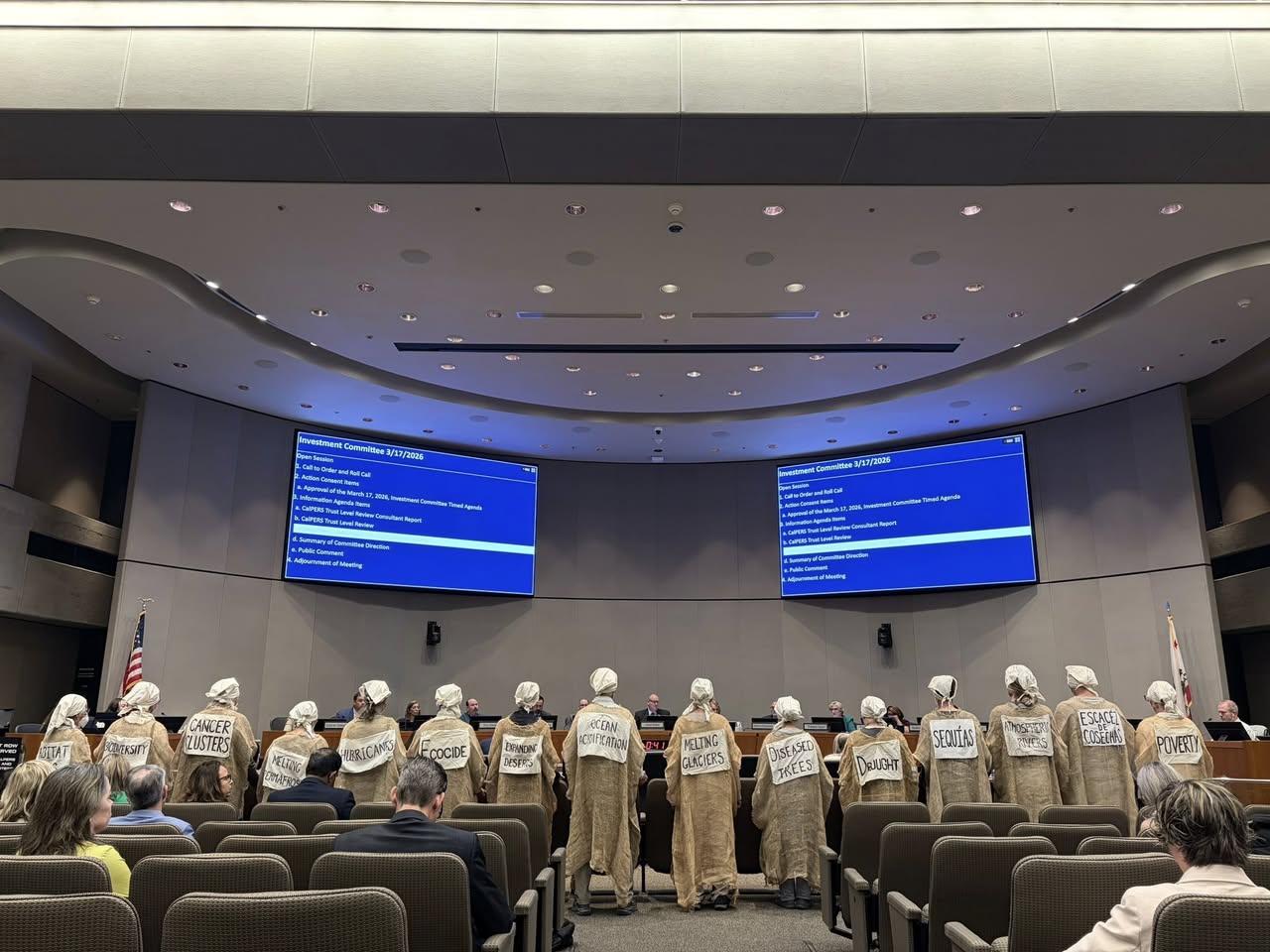
Sacramento - Retirees, California State Workers, Third Act Sacramento and Fossil Free California members provided testimony and held a silent vigil with “Climate Lamentors” inside the CalPERS Investment Committee Meeting on March 17 to urge CalPERS to divest from fossil fuel investments.
Ten people spoke at the public meeting at the Lincoln Park Auditorium in Sacramento about what they called “risky investments in gas and oil companies," while 15 activists dressed as “Climate Lamentors” in brown outfits displaying signs representing the impacts of fossil fuels.
The meeting came at a time when many pension funds throughout the country and world have recognized the risk of fossil fuel investments and have already divested from them, according to advocates.
“Globally, 1,667 pension funds with assets of about $40 trillion have made commitments to divest from fossil fuels,” according to a statement from Third Act Sacramento. “Full divestment commitments have been made by the State of Maine, the York City Employees Retirement Systems, NYC Teachers Retirement System, NYC Board of Education, District of Columbia Board, City of Chicago pensions, Baltimore pensions, Pittsburgh, San Diego, the Los Angeles Retirement System and the San Mateo County fund.”
They pointed out the following alarming data:
• CalPERS fossil fuel investments are risky. The fossil fuel sector is a
losing proposition, they contend. In eight of the 10 years between 2012 and 2021, the energy sector trailed the performance of the S&P 500, and in five of those years, it placed dead last. The sector's prices then rebounded, but are now driven largely by geopolitical events, such as the war in Ukraine and now Iran. (source: https://ieefa.org/resources/passive-investing-warming-world)
• Dr Diana Cassady (Third Act Sacramento CalPERS Team Lead) stated: “CalPERS is bankrolling the climate crisis.” The pension fund has over $27.9 billion invested in fossil fuel companies – more than any pension fund in the country. The State of California is suing five fossil fuel companies for misleading the public about climate change – and CalPERS invests our pensions in all five of them!
The oil and gas industry is a malignant influence on our politics. They spent $34 million in 2025 on lobbying Sacramento lawmakers. Chevron led with $12.9 million. Consequently, lawmakers approved widely-opposed legislation boosting oil production in Kern County, which suffers 12 times the state’s average of respiratory diseases and heart disease leading to death.
Dr. Glayol Sahba, a family physician and a co-facilitator for Third Act Sacramento. a group of over 700 Sacramento elders who are dedicated to help stabilize our climate and our democracy, testified at the meeting.
“There are so many reasons to divest, not engage with fossil fuel companies. The most important reason of all is that they are contributing to the ever accelerating process of climate change! one recent study showed that the rate of climate change has doubled in just the last 10 years. I just want to point out the top health consequences of continued fossil fuels in the world,” she stated.
These consequences include the following, according to Sahba:
“a 2021 Harvard-led study estimated 8.7 million deaths in 2018 from fine particles linked to fossil fuels. Continued investment in fossil fuels will exacerbate our climate destabilization even further.
“Heat related deaths, cardiovascular illness, especially in vulnerable populations. such as the elderly and the young.
“Increased vector, born illnesses, such as Lyme disease, and many others
“Increased risks of asthma and other pulmonary conditions.
“Wildfires, floods, droughts, loss of life, communities and , livelihoods are already here!
“Fossil fuels at every stage of their extraction, refining, burning and plastics production , and methane leaking exhausted wells harm frontline communities, workers, pollute our environment and the climate.”
Focusing on one notorious polluter, she said Chevron “deliberately dumped 16 billion gallons of toxic wastewater” into Ecuador’s Amazon Rainforest between 1964 and 1990, in what is considered the world’s largest oil-related catastrophe. It has yet to clean up this wastewater.
She also said Chevron polluted the Niger Delta, decimating the region’s ecosystem and devastated indigenous groups’ waterways, food systems, and livelihoods. The company has yet to clean up this pollution.
Chevron fuels violence against indigenous communities:
“Chevron has repeatedly been sued for violence against indigenous communities around the world. As of 2021, it has faced at least 13 accusations of genocide and 17 accusations of torture, according to research by environmental anthropologist Dr. Nan Greer,” noted Sahba.
In addition, she said Chevron’s construction of a pipeline from Chad to Cameroon on indigenous lands from 2000–2003 displaced some 22,000 indigenous persons through the contamination of their water sources and soil.
“The company’s activities have played a role in the destruction of marginalized people’s homes, resources, and livelihoods in Azerbaijan, Angola, Argentina, Canada, China, East Timor, Ecuador, Ghana, Indonesia, Kazakhstan, Poland, Thailand, Venezuela, the U.S.,” Sahba stated.
She urged CalPERS to divest from climate and community-destroying Fossil Fuels!
”They are also volatile assets doomed to becoming stranded assets,” Sahba concluded.
Sara Theiss of Fossil Free California also addressed the Committee, saying that she is disappointed that in revamping CalPERS’ investment policies, “you kept the outdated introduction and Part A of CalPERS divestment policy.”
She said these sections are based on false assumptions, e.g., that divesting from a sector ""almost invariably harm(s) investment performance." She made three points:
First: “There is ample evidence to the contrary. For example, in both absolute and risk-adjusted terms, three of the most common indices used to benchmark US institutional investment fund portfolios as of 2024 had underperformed their variants without fossil fuels over the prior 5 and 10 years. And this is net of fees. See pages 7-9 of the handout for my source on this point. (A PDF of this report is here.)
Second: “The Divestment Policy states that “CalPERS fiduciary obligations generally preclude CalPERS from sacrificing investment performance for the purpose of achieving goals that do not directly relate to CalPERS operations or benefits.”
Third, she said oil and gas prices are no longer tied to the economy as a whole, but are subject to the volatility of geopolitical events. This of course ups the riskiness of such investments.
“In 2023, oil prices went up to $125/barrel due to the Ukraine war,” Theiss testified.
“Now, we are moving into that same territory with the war with Iran. We are watching untold suffering on our TV screens; the war has taken over the region, and the world economy is being impacted.
“The war is also destroying billions of dollars of US military infrastructure in the Middle East as well as the security rationale for US bases there. (US suffers nearly $4B in military losses in first fortnight of Iran war, TRT World, Mar. 13, 2026.) The world, especially the Middle East, will be quite different when the active part of this war ends. (The Gulf that emerges from the Iran war will be very different, The Atlantic Council.),
“However, at least since I have been involved in FFCA in 2018, we have striven to make the case for exiting the oil and gas sector due to losses and financial risk, while also pointing out the positive impact on CalPERS current and future beneficiaries this will have, as well as the moral and ecological benefits of doing so,” she argued. “On a personal note, I am outraged that my pension contributions are supporting the sector that is providing a major reason for the war.”
Like Sahba, she urged CalPERS to “stop seeing divestment” as a “dirty word,” and told the CalPERS officials to get rid of its “outdated divestment policy.”
Third Actors and Fossil Free CA have spent the last year at the CalPERS headquarters reminding employees, the investment team staff, and CalPERS board members that they need to sell their billions of dollars of investment in oil and gas companies,” according to the group. I have been a participant in many of these events and have performed songs I have written at them.
More Information: ThirdAct.org/sacramento
Chevron and Big Oil spent a total of $34 million to lobby California officials in 2025
This is a critical time in California, the U.S, and the world as Big Oil spends huge amounts of money influencing politicians and world leaders to increase fossil fuel production as we experience a growing number of climate catastrophes.
Big Oil pumped $34 million into influencing lawmakers in Sacramento in 2025, allowing fossil fuel corporations to stonewall and roll back critical health and climate policy in a year marked by the LA Fires and climate disasters across the planet.
This total wasn't far from 2024’s $38 million total, the fossil fuel industry’s highest spending year ever, according to an analysis by Sunstone Strategies for the Climate Center. Influence spending in the fourth quarter of 2025 was $7.7 million.
As usual, Chevron and the Western States Petroleum Association (WSPA) spent the most money in the fossil fuel industry - 73% of the $34 million. Chevron finished first in the spending with $12.9 million, while WSPA placed second with $12.4 million, coming to a total of $25.3 million.
Chevron and the Western States Petroleum Association have not been only the biggest spenders in the fossil fuel industry, but have been the top spenders on overall lobbying in Sacramento most years.
Californians for Energy Independence, an oil industry front group heavily funded by companies like Chevron that advocates for local oil and gas production, also poured $6.7 million into “general issues relating to energy independence in California,” according to disclosures on the California Secretary of the State’s website.
“This amount is not included in the total lobbying number, since it falls under Chevron’s expenses instead. Almost all of this lobbying spending is found in a payment for Winner And Mandabach Campaigns LLC, a national consulting firm specializing in ballot measure campaigns,” the analysis pointed out.
Top 5 lobbying and influence spenders of 2025:
Company/Trade Association Amount
Chevron U.S.A., Inc. $12,935,583.66
Western States Petroleum Association $12,405,328.58
Californians For Energy Independence $6,737,655.88
Phillips 66 $1,058,331.41
Marathon Petroleum Corporation $877,022.75
Top 5 lobbying and influence spenders of Q4:
Company/Trade Association Amount
Western States Petroleum Association $3,525,971.27
Chevron U.S.A., Inc. $2,113,122.50
Californians For Energy Independence $1,035,800.00
Phillips 66 $340,529.20
Marathon Petroleum Corporation $210,019.12
Chevron, known throughout the world for its complicity in the Gaza genocide and its long record of human rights violations and environmental devastation from Richmond, California to the Amazon, was among Big Oil groups pushing back against key climate bills like the Polluters Pay Climate Superfund Act.
This landmark law would hold major corporate climate polluters accountable for their fair share of the climate damages facing the state, according to advocates. Shell and WSPA also lobbied against this bill, resulting ultimately in the failure of the Legislature to advance this bill last session after industry attacks.
The bill’s sponsors said they remain committed to the campaign for a Polluter Pays Climate Superfund Act. Tracy, CA recently became the 25th locality to endorse the Act, according to advocates.
In addition, lobbying disclosures reveal lobbying by Valero, Phillips 66, and Exxon Mobil for SB 237, a gut-and-amend bill rushed through at the end of 2025 session to roll back environmental regulations and allow thousands of new oil and gas wells to be drilled per year.
The bill, opposed by climate and environmental justice organizations, sought to open up Kern County to “increased dangerous, toxic drilling,” ostensibly in response to the closure of the Phillips 66 refinery in Southern California and upcoming closure of the Valero refinery in Benicia, advocates noted.
“While frontline communities in Kern County and across California suffer from chronic exposure to pollution due to oil drilling, Big Oil is weaponizing its wealth to secure industry friendly policy that pads their bottom line with disregard to impacted Californians,” the analysis pointed out.
Ten people spoke at the public meeting at the Lincoln Park Auditorium in Sacramento about what they called “risky investments in gas and oil companies," while 15 activists dressed as “Climate Lamentors” in brown outfits displaying signs representing the impacts of fossil fuels.
The meeting came at a time when many pension funds throughout the country and world have recognized the risk of fossil fuel investments and have already divested from them, according to advocates.
“Globally, 1,667 pension funds with assets of about $40 trillion have made commitments to divest from fossil fuels,” according to a statement from Third Act Sacramento. “Full divestment commitments have been made by the State of Maine, the York City Employees Retirement Systems, NYC Teachers Retirement System, NYC Board of Education, District of Columbia Board, City of Chicago pensions, Baltimore pensions, Pittsburgh, San Diego, the Los Angeles Retirement System and the San Mateo County fund.”
They pointed out the following alarming data:
• CalPERS fossil fuel investments are risky. The fossil fuel sector is a
losing proposition, they contend. In eight of the 10 years between 2012 and 2021, the energy sector trailed the performance of the S&P 500, and in five of those years, it placed dead last. The sector's prices then rebounded, but are now driven largely by geopolitical events, such as the war in Ukraine and now Iran. (source: https://ieefa.org/resources/passive-investing-warming-world)
• Dr Diana Cassady (Third Act Sacramento CalPERS Team Lead) stated: “CalPERS is bankrolling the climate crisis.” The pension fund has over $27.9 billion invested in fossil fuel companies – more than any pension fund in the country. The State of California is suing five fossil fuel companies for misleading the public about climate change – and CalPERS invests our pensions in all five of them!
The oil and gas industry is a malignant influence on our politics. They spent $34 million in 2025 on lobbying Sacramento lawmakers. Chevron led with $12.9 million. Consequently, lawmakers approved widely-opposed legislation boosting oil production in Kern County, which suffers 12 times the state’s average of respiratory diseases and heart disease leading to death.
Dr. Glayol Sahba, a family physician and a co-facilitator for Third Act Sacramento. a group of over 700 Sacramento elders who are dedicated to help stabilize our climate and our democracy, testified at the meeting.
“There are so many reasons to divest, not engage with fossil fuel companies. The most important reason of all is that they are contributing to the ever accelerating process of climate change! one recent study showed that the rate of climate change has doubled in just the last 10 years. I just want to point out the top health consequences of continued fossil fuels in the world,” she stated.
These consequences include the following, according to Sahba:
“a 2021 Harvard-led study estimated 8.7 million deaths in 2018 from fine particles linked to fossil fuels. Continued investment in fossil fuels will exacerbate our climate destabilization even further.
“Heat related deaths, cardiovascular illness, especially in vulnerable populations. such as the elderly and the young.
“Increased vector, born illnesses, such as Lyme disease, and many others
“Increased risks of asthma and other pulmonary conditions.
“Wildfires, floods, droughts, loss of life, communities and , livelihoods are already here!
“Fossil fuels at every stage of their extraction, refining, burning and plastics production , and methane leaking exhausted wells harm frontline communities, workers, pollute our environment and the climate.”
Focusing on one notorious polluter, she said Chevron “deliberately dumped 16 billion gallons of toxic wastewater” into Ecuador’s Amazon Rainforest between 1964 and 1990, in what is considered the world’s largest oil-related catastrophe. It has yet to clean up this wastewater.
She also said Chevron polluted the Niger Delta, decimating the region’s ecosystem and devastated indigenous groups’ waterways, food systems, and livelihoods. The company has yet to clean up this pollution.
Chevron fuels violence against indigenous communities:
“Chevron has repeatedly been sued for violence against indigenous communities around the world. As of 2021, it has faced at least 13 accusations of genocide and 17 accusations of torture, according to research by environmental anthropologist Dr. Nan Greer,” noted Sahba.
In addition, she said Chevron’s construction of a pipeline from Chad to Cameroon on indigenous lands from 2000–2003 displaced some 22,000 indigenous persons through the contamination of their water sources and soil.
“The company’s activities have played a role in the destruction of marginalized people’s homes, resources, and livelihoods in Azerbaijan, Angola, Argentina, Canada, China, East Timor, Ecuador, Ghana, Indonesia, Kazakhstan, Poland, Thailand, Venezuela, the U.S.,” Sahba stated.
She urged CalPERS to divest from climate and community-destroying Fossil Fuels!
”They are also volatile assets doomed to becoming stranded assets,” Sahba concluded.
Sara Theiss of Fossil Free California also addressed the Committee, saying that she is disappointed that in revamping CalPERS’ investment policies, “you kept the outdated introduction and Part A of CalPERS divestment policy.”
She said these sections are based on false assumptions, e.g., that divesting from a sector ""almost invariably harm(s) investment performance." She made three points:
First: “There is ample evidence to the contrary. For example, in both absolute and risk-adjusted terms, three of the most common indices used to benchmark US institutional investment fund portfolios as of 2024 had underperformed their variants without fossil fuels over the prior 5 and 10 years. And this is net of fees. See pages 7-9 of the handout for my source on this point. (A PDF of this report is here.)
Second: “The Divestment Policy states that “CalPERS fiduciary obligations generally preclude CalPERS from sacrificing investment performance for the purpose of achieving goals that do not directly relate to CalPERS operations or benefits.”
Third, she said oil and gas prices are no longer tied to the economy as a whole, but are subject to the volatility of geopolitical events. This of course ups the riskiness of such investments.
“In 2023, oil prices went up to $125/barrel due to the Ukraine war,” Theiss testified.
“Now, we are moving into that same territory with the war with Iran. We are watching untold suffering on our TV screens; the war has taken over the region, and the world economy is being impacted.
“The war is also destroying billions of dollars of US military infrastructure in the Middle East as well as the security rationale for US bases there. (US suffers nearly $4B in military losses in first fortnight of Iran war, TRT World, Mar. 13, 2026.) The world, especially the Middle East, will be quite different when the active part of this war ends. (The Gulf that emerges from the Iran war will be very different, The Atlantic Council.),
“However, at least since I have been involved in FFCA in 2018, we have striven to make the case for exiting the oil and gas sector due to losses and financial risk, while also pointing out the positive impact on CalPERS current and future beneficiaries this will have, as well as the moral and ecological benefits of doing so,” she argued. “On a personal note, I am outraged that my pension contributions are supporting the sector that is providing a major reason for the war.”
Like Sahba, she urged CalPERS to “stop seeing divestment” as a “dirty word,” and told the CalPERS officials to get rid of its “outdated divestment policy.”
Third Actors and Fossil Free CA have spent the last year at the CalPERS headquarters reminding employees, the investment team staff, and CalPERS board members that they need to sell their billions of dollars of investment in oil and gas companies,” according to the group. I have been a participant in many of these events and have performed songs I have written at them.
More Information: ThirdAct.org/sacramento
Chevron and Big Oil spent a total of $34 million to lobby California officials in 2025
This is a critical time in California, the U.S, and the world as Big Oil spends huge amounts of money influencing politicians and world leaders to increase fossil fuel production as we experience a growing number of climate catastrophes.
Big Oil pumped $34 million into influencing lawmakers in Sacramento in 2025, allowing fossil fuel corporations to stonewall and roll back critical health and climate policy in a year marked by the LA Fires and climate disasters across the planet.
This total wasn't far from 2024’s $38 million total, the fossil fuel industry’s highest spending year ever, according to an analysis by Sunstone Strategies for the Climate Center. Influence spending in the fourth quarter of 2025 was $7.7 million.
As usual, Chevron and the Western States Petroleum Association (WSPA) spent the most money in the fossil fuel industry - 73% of the $34 million. Chevron finished first in the spending with $12.9 million, while WSPA placed second with $12.4 million, coming to a total of $25.3 million.
Chevron and the Western States Petroleum Association have not been only the biggest spenders in the fossil fuel industry, but have been the top spenders on overall lobbying in Sacramento most years.
Californians for Energy Independence, an oil industry front group heavily funded by companies like Chevron that advocates for local oil and gas production, also poured $6.7 million into “general issues relating to energy independence in California,” according to disclosures on the California Secretary of the State’s website.
“This amount is not included in the total lobbying number, since it falls under Chevron’s expenses instead. Almost all of this lobbying spending is found in a payment for Winner And Mandabach Campaigns LLC, a national consulting firm specializing in ballot measure campaigns,” the analysis pointed out.
Top 5 lobbying and influence spenders of 2025:
Company/Trade Association Amount
Chevron U.S.A., Inc. $12,935,583.66
Western States Petroleum Association $12,405,328.58
Californians For Energy Independence $6,737,655.88
Phillips 66 $1,058,331.41
Marathon Petroleum Corporation $877,022.75
Top 5 lobbying and influence spenders of Q4:
Company/Trade Association Amount
Western States Petroleum Association $3,525,971.27
Chevron U.S.A., Inc. $2,113,122.50
Californians For Energy Independence $1,035,800.00
Phillips 66 $340,529.20
Marathon Petroleum Corporation $210,019.12
Chevron, known throughout the world for its complicity in the Gaza genocide and its long record of human rights violations and environmental devastation from Richmond, California to the Amazon, was among Big Oil groups pushing back against key climate bills like the Polluters Pay Climate Superfund Act.
This landmark law would hold major corporate climate polluters accountable for their fair share of the climate damages facing the state, according to advocates. Shell and WSPA also lobbied against this bill, resulting ultimately in the failure of the Legislature to advance this bill last session after industry attacks.
The bill’s sponsors said they remain committed to the campaign for a Polluter Pays Climate Superfund Act. Tracy, CA recently became the 25th locality to endorse the Act, according to advocates.
In addition, lobbying disclosures reveal lobbying by Valero, Phillips 66, and Exxon Mobil for SB 237, a gut-and-amend bill rushed through at the end of 2025 session to roll back environmental regulations and allow thousands of new oil and gas wells to be drilled per year.
The bill, opposed by climate and environmental justice organizations, sought to open up Kern County to “increased dangerous, toxic drilling,” ostensibly in response to the closure of the Phillips 66 refinery in Southern California and upcoming closure of the Valero refinery in Benicia, advocates noted.
“While frontline communities in Kern County and across California suffer from chronic exposure to pollution due to oil drilling, Big Oil is weaponizing its wealth to secure industry friendly policy that pads their bottom line with disregard to impacted Californians,” the analysis pointed out.
Add Your Comments
We are 100% volunteer and depend on your participation to sustain our efforts!
Donate

$65.00 donated
in the past month
Get Involved
If you'd like to help with maintaining or developing the website, contact us.
Publish
Publish your stories and upcoming events on Indybay.
Topics
More
Search Indybay's Archives
Advanced Search
►
▼
IMC Network