







 Publish to Newswire
 Add an Event
From the Open-Publishing Calendar
From the Open-Publishing Newswire
Indybay Feature
Just Security: Iran, the Nuremberg Inheritance, and the Trump-Netanyahu Axis
After the Iran Strikes, Shouldn’t Nuremberg’s Legacy Apply to Trump and Netanyahu?
Nuremberg’s promise was simple but radical: power does not erase responsibility. The Iran strikes — and the global reaction to them — test whether that promise is finally meant for everyone.
Nuremberg’s promise was simple but radical: power does not erase responsibility. The Iran strikes — and the global reaction to them — test whether that promise is finally meant for everyone.
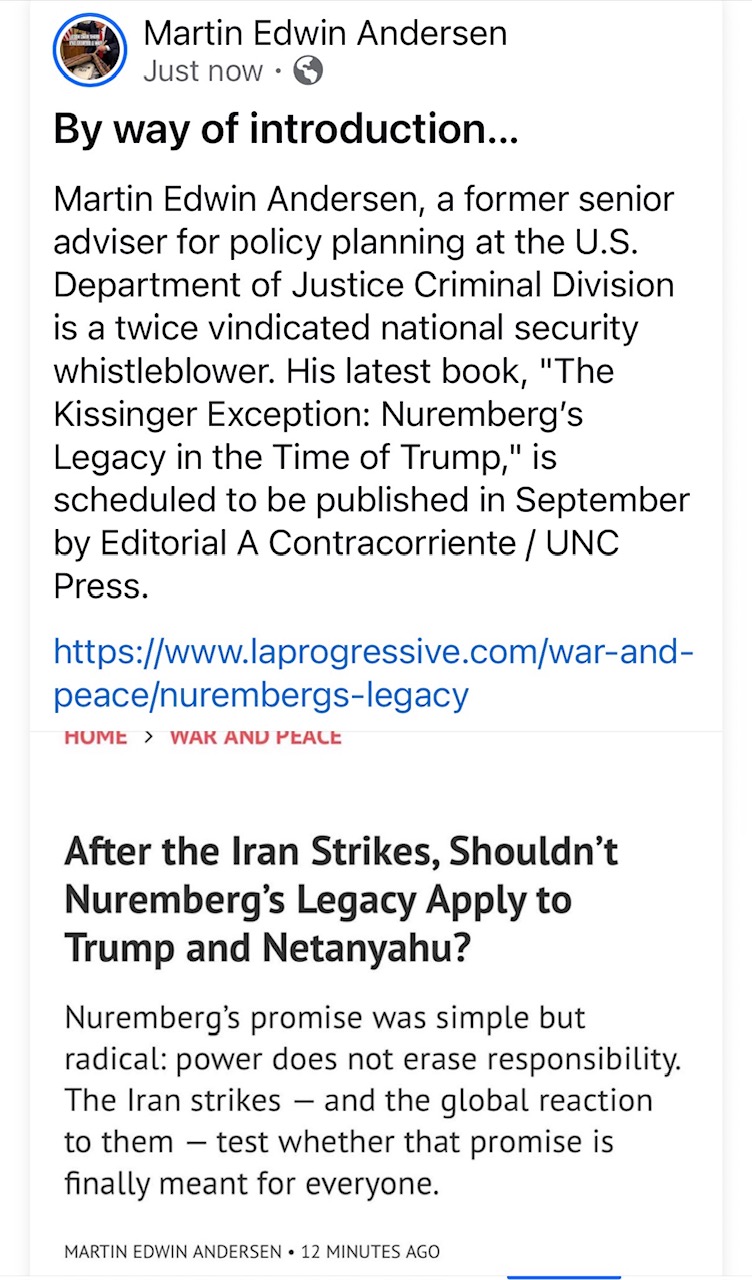
Iran, the Nuremberg Inheritance, and the Trump-Netanyahu Axis
By Martin Edwin Andersen
The February–March 2026 strikes on Iran test whether the prohibition on aggressive war, first enforced at Nuremberg and later codified in the Rome Statute, constrains powerful states in practice. Iran was the 7th country attacked in the first 13 months of a Trump administration headed by the would-be Nobel Peace Prize winner.
Following coordinated airstrikes by the United States and Israel conducted against targets inside Iran, including military installations and nuclear infrastructure, Iran responded with missile attacks across the region. An emergency meeting of the United Nations Security Council followed. Secretary-General Antonio Guterres warned that the use of force risked further destabilization throughout the Middle East and urged restraint. A growing number of governments described the strikes as violations of the U.N. Charter. U.N. human rights experts raised concerns about civilian harm, including reports that civilian institutions, including schools, were struck in the regime-change effort.
The legal questions the crisis has raised are direct and familiar: Was the use of force lawful under Article 51 of the Charter? If not, does it fall within the contemporary definition of aggression? And if civilian casualties occurred, what standards govern potential responsibility for those harms?
Those questions return to principles first articulated at Nuremberg.
I. The Charter Framework
Article 2(4) of the United Nations Charter prohibits the threat or use of force against the territorial integrity or political independence of any state.¹ The only recognized exceptions are Security Council authorization and self-defense following an armed attack.² The February–March 2026 strikes were not authorized by the Security Council but their legality depends on Article 51, which requires immediate reporting of such actions to the Council.
The late president of Tel Aviv University Yoram Dinstein argued consistently that self-defense arises only in response to an armed attack and that anticipatory force is permissible only where an attack is imminent.³ He distinguished sharply between anticipatory and preventive war. Preventive action — force undertaken to eliminate a potential future threat absent imminence — does not satisfy Charter requirements. Dinstein’s use of the 1837 Caroline correspondence (centering on American jurist Daniel Webster’s criteria of “necessity” and “proportionality”) remains central in customary law analysis, requiring necessity that is “instant, overwhelming, leaving no choice of means.”⁴
While contemporary military technologies complicate assessments of imminence, mainstream doctrine maintains that the threshold remains high. If the 2026 strikes were not undertaken in response to an imminent armed attack, they fall within Article 2(4)’s prohibition.
That conclusion does not, by itself, establish criminal liability. It does, however, necessarily frame the aggression analysis.
II. Aggression After Kampala
At Nuremberg, aggressive war was condemned but, due largely to the Cold War, left without a permanent enforcement mechanism. For decades, the prohibition operated largely as a political norm. The Rome Statute, the fundamental treaty of the International Criminal Court (ICC) and in effect since July 2002, narrowed that gap.
Article 8 bis, activated in 2017, defines aggression as the planning or execution by a person in effective control of state political or military action of an act of force constituting a “manifest violation” of the Charter by its character, gravity, and scale.⁵ The “manifest” qualifier is critical. Claus Kreß, chair of German and international criminal law at the University of Cologne, emphasizes that it excludes legally ambiguous or borderline cases.⁶ Only clear and serious breaches qualify.
Applied to the Iran strikes, analysis thus turns on three variables:
• Character: Was the operation defensive in response to imminent attack, or preventive in nature?
• Gravity: What was the scale of destruction and military effect?
• Scale: Was the use of force limited and discrete, or part of a sustained campaign?
If the U.S. and Israeli defense is that the operation was preventive and substantial in scope, critics could argue that it has satisfied the manifest threshold. Yet jurisdiction remains decisive, and for that reason, despairing. The United States and Israel are not parties to the Rome Statute, and Article 15 bis restricts ICC aggression jurisdiction over nationals of non-States Parties absent Security Council referral.⁷
Despite enormous push-back from around the world, given geopolitical realities a necessary referral remains unlikely.
The aggression norm is therefore codified and precise. However, its enforceability remains conditioned by institutional barriers that have saved other U.S. and Israeli leaders from being held accountable.
III. Kissinger and the Institutional Gap
The early 1970s demonstrate how different the institutional landscape once was. As National Security Adviser and Secretary of State Henry Kissinger operated in a system where the prohibition on aggressive war had moral force but limited institutional reach.
In Cambodia (1969–1973), cross-border bombing implicated sovereignty concerns under Article 2(4).⁸ Hundreds of thousands of civilians were killed. At the time, the crime of aggression was not codified in treaty form, and no permanent tribunal existed to evaluate leadership responsibility.
In Bangladesh (1971), the “Blood Telegram” recorded internal U.S. dissent over atrocities committed by Pakistani forces, which ended up totaling more than a million killed.⁹ Under modern doctrine, aiding-and-abetting liability requires substantial assistance provided with the purpose of facilitating crimes.¹⁰ That purposive threshold is demanding and fact-intensive. Kissinger was never forced to answer questions in court.
In Chile (1973), declassified records confirmed U.S. involvement in destabilization efforts prior to the coup, resulting in a far-right military terrorist organizational reach as far as a mile from the White House.¹¹ Today, liability would require proof of contribution to a widespread or systematic attack against civilians with knowledge of that attack under Article 7 of the Rome Statute.
In each of the three cases, sovereignty and civilian-protection norms were recognized. What did not exist was a permanent criminal institution capable of adjudicating potential leadership responsibility. Benjamin Ferencz, one of the original Nuremberg prosecutors, argued that aggressive war must be punishable in practice, not merely condemned in principle.¹² Without a permanent court, that aspiration lacked enforcement.
Kissinger’s exposure was constrained less by doctrinal uncertainty than by institutional absence.
IV. Continuity in Strategic Thought
Kissinger later maintained advisory relationships with Donald Trump and Benjamin Netanyahu. He repeatedly met with Trump during his presidency, declaring even before the insurgent president-elect was inaugurated the first time, that Trump was “the most unique that I have experienced in one respect. No baggage.” (In 2011 and 2012 Trump had in fact sent out several proclamations on X claiming that President Barack Obama, a target of his racist attacks, would “start a war with Iran” either to be re-elected as president or “because of his inability to negotiate properly – not skilled!”)¹³
According to Kissinger, his long engagement with Israeli leadership reflected a strategic framework rooted in deterrence and regional equilibrium following the 1973 war. Netanyahu’s greatest association with Nuremberg’s legacy was a 2015 speech in which he claimed a Palestinian motivation for Adolf Hitler’s Holocaust. Netanyahu called his frequent meetings with Kissinger "masterclasses in statesmanship."¹⁴
Kissinger also maintained a highly-controversial dialogue with Vladimir Putin and argued for sustained great-power engagement even as the Russian masterminded invasions of neighboring countries and the brutal repression of ethnic minorities inside Russia itself.¹⁵ The ICC’s March 17, 2023 arrest warrant against Putin for the alleged unlawful deportation and transfer of Ukrainian children marked a change in institutional capacity.¹⁶ A sitting head of state was formally accused under a permanent international court.
Nuremberg has surfaced in contemporary political debate. During the 2016 campaign, Trump’s suggestion that terrorists’ families should be targeted prompted former Defense Secretary William Cohen to warn that such actions could expose those carrying them out to war crimes liability.¹⁷ Ferencz likewise cautioned that dismissing international criminal institutions risks eroding the legal order constructed after World War II.¹⁸
Netanyahu has invoked Nuremberg in historical arguments concerning Haj Amin al-Husseini and has criticized modern international proceedings as distortions of post-1945 legal principles.
Worldwide condemnation was not long in coming. Israeli opposition leader Isaac Herzog, called the remark "a dangerous distortion of history [that] trivializes the Holocaust, trivializes the Nazis and the share of the terrible dictator Adolf Hitler's terrible tragedy of our people during the Holocaust."¹⁹
The recurring invocation of Nuremberg reflects its enduring authority. The challenge lies in consistent application.
V. Civilian Harm and the Mental Element
Reports of civilian casualties from the Iran strikes raise separate issues under international humanitarian law. The Rome Statute criminalizes intentionally directing attacks against civilians and launching attacks with knowledge that incidental civilian harm would be clearly excessive relative to anticipated military advantage.²⁰
Known for his legal analysis of the killing of Saudi international terrorist Osama bin Laden and for his role in the creation of the ICC, Kai Ambos stresses that disproportionate attack liability requires proof of knowledge under Article 30.²¹ Criminal responsibility turns on awareness, not negligence. The assessment is fact-intensive and requires examination of targeting procedures, intelligence inputs, and proportionality calculations.
Civilian harm alone, however, does not establish criminal liability.
VI. Command Responsibility
Article 28 codifies civilian superior responsibility.²² Liability requires effective control, knowledge or conscious disregard of crimes, and failure to take necessary and reasonable preventive measures.
“Effective control” means material authority to prevent or punish.²³ The doctrine reflects decades of jurisprudential refinement and limits liability to situations of demonstrable operational authority.
Applied to the Iran strikes, inquiry faces a trove of information on decision-making structures and documented warnings. Available corrective mechanisms still fall short but by much less than before.
VII. Institutional Posture and Enforcement
During his presidency, Donald Trump issued Executive Order 13928 authorizing sanctions against ICC officials investigating U.S. personnel.²⁴ Israel has contested ICC jurisdiction in the Situation in Palestine.²⁵ Such objections are legally arguable. In proceedings involving alleged Charter violations, however, prior engagement with international legal mechanisms may shape judicial evaluation of asserted compliance.
Under the Nuremberg legacy and subsequent international law, the recent U.S.–Israel military assault on Iran raises serious questions about:
• Aggression against the sovereignty of Iran
• Leadership decapitation without clear self-defense basis
• Civilian harm
Legally, the most plausible charges under international law would be:
• Crime of aggression
• War crimes (civilian harm)
• Crimes against humanity (if systematic civilian targeting is shown)
Historically “Aggression Against Sovereignty” is a legal concept rooted in:
• UN Charter Article 2(4): prohibits force against “territorial integrity or political independence” of any state.
• Nuremberg Charter: punished “crimes against peace” (waging wars of aggression).
• Rome Statute (ICC): defines crime of aggression in terms of planning/initiating attacks on the sovereignty of another state.
Aggression Against Sovereignty lexicon was developed by:
• Nuremberg Tribunal judgments (1946)
• UN Charter (1945)
• Later codification in Rome Statute (1998)
The descriptor reflects that, legally, attacking another state’s territory with the aim of displacing its government or neutralizing its leadership without lawful justification is defined as aggressive use of force.
VIII. Conclusion
The February–March 2026 strikes therefore test not the existence of legal norms, but their reach at a time U.S. and Israeli democracies are at a nadir. Aggression is codified. Command responsibility is defined. A permanent court exists. Arrest warrants have been issued against sitting heads of state in other conflicts.
The prohibition announced at Nuremberg — that individuals who wield state power are not beyond law — now operates within an institutional structure that did not exist in Kissinger’s era. Whether that structure constrains powerful states consistently remains the central question.
_______________________________________________________________________
Martin Edwin Andersen, a former senior adviser for policy planning at the U.S. Department of Justice Criminal Division, is a twice vindicated national security whistleblower. His latest book, The Kissinger Exception: Nuremberg’s Legacy in the Time of Trump is scheduled to be published in September by Editorial A Contracorriente / UNC Press.
https://martinandersen.academia.edu/
________________________________________
Notes
1. International Military Tribunal. (1946). Judgment.
2. United Nations. (1945). Charter of the United Nations, art. 2(4).
3. United Nations. (1945). Charter of the United Nations, arts. 39–42, 51.
4. Dinstein, Y. (2017). War, aggression and self-defence (6th ed.).
5. International Criminal Court. (1998/2010). Rome Statute, art. 8 bis.
6. Kreß, C. (2022). Crime of aggression. JICJ, 20.
7. Rome Statute, art. 15 bis(5).
8. Shawcross, W. (1979). Sideshow.
9. Blood, A. (1971). Telegram.
10. Rome Statute, art. 25(3)(c).
11. U.S. Department of State. (2006). FRUS: Chile 1969–1973.
12. Ferencz, B. (various writings).
13. White House. (2017). Meeting readout.
14. Kissinger, H. (1979). White House Years; Prime Minister’s Office, Israel. (2023, September 21). Prime Minister Benjamin Netanyahu meets with former U.S. Secretary of State Henry Kissinger. https://www.gov.il/en/pages/event-kissinger210923.
15. Kissinger, H. (2014). World Order.
16. ICC. (2023, Mar. 17). Arrest warrants in Situation in Ukraine.
17. Cohen, W. (2016). Public statements.
18. Ferencz, B. (public commentary).
19. Netanyahu speech (2015).
20. Rome Statute, art. 8(2)(b).
21. Ambos, K. (2013). Treatise.
22. Rome Statute, art. 28.
23. Prosecutor v. Delalić (ICTY).
24. Executive Order 13928 (2020).
25. ICC, Situation in Palestine (2021); Information for victims, State of Palestine, ICC-01/18 (Updated on 07/03/2025).
By Martin Edwin Andersen
The February–March 2026 strikes on Iran test whether the prohibition on aggressive war, first enforced at Nuremberg and later codified in the Rome Statute, constrains powerful states in practice. Iran was the 7th country attacked in the first 13 months of a Trump administration headed by the would-be Nobel Peace Prize winner.
Following coordinated airstrikes by the United States and Israel conducted against targets inside Iran, including military installations and nuclear infrastructure, Iran responded with missile attacks across the region. An emergency meeting of the United Nations Security Council followed. Secretary-General Antonio Guterres warned that the use of force risked further destabilization throughout the Middle East and urged restraint. A growing number of governments described the strikes as violations of the U.N. Charter. U.N. human rights experts raised concerns about civilian harm, including reports that civilian institutions, including schools, were struck in the regime-change effort.
The legal questions the crisis has raised are direct and familiar: Was the use of force lawful under Article 51 of the Charter? If not, does it fall within the contemporary definition of aggression? And if civilian casualties occurred, what standards govern potential responsibility for those harms?
Those questions return to principles first articulated at Nuremberg.
I. The Charter Framework
Article 2(4) of the United Nations Charter prohibits the threat or use of force against the territorial integrity or political independence of any state.¹ The only recognized exceptions are Security Council authorization and self-defense following an armed attack.² The February–March 2026 strikes were not authorized by the Security Council but their legality depends on Article 51, which requires immediate reporting of such actions to the Council.
The late president of Tel Aviv University Yoram Dinstein argued consistently that self-defense arises only in response to an armed attack and that anticipatory force is permissible only where an attack is imminent.³ He distinguished sharply between anticipatory and preventive war. Preventive action — force undertaken to eliminate a potential future threat absent imminence — does not satisfy Charter requirements. Dinstein’s use of the 1837 Caroline correspondence (centering on American jurist Daniel Webster’s criteria of “necessity” and “proportionality”) remains central in customary law analysis, requiring necessity that is “instant, overwhelming, leaving no choice of means.”⁴
While contemporary military technologies complicate assessments of imminence, mainstream doctrine maintains that the threshold remains high. If the 2026 strikes were not undertaken in response to an imminent armed attack, they fall within Article 2(4)’s prohibition.
That conclusion does not, by itself, establish criminal liability. It does, however, necessarily frame the aggression analysis.
II. Aggression After Kampala
At Nuremberg, aggressive war was condemned but, due largely to the Cold War, left without a permanent enforcement mechanism. For decades, the prohibition operated largely as a political norm. The Rome Statute, the fundamental treaty of the International Criminal Court (ICC) and in effect since July 2002, narrowed that gap.
Article 8 bis, activated in 2017, defines aggression as the planning or execution by a person in effective control of state political or military action of an act of force constituting a “manifest violation” of the Charter by its character, gravity, and scale.⁵ The “manifest” qualifier is critical. Claus Kreß, chair of German and international criminal law at the University of Cologne, emphasizes that it excludes legally ambiguous or borderline cases.⁶ Only clear and serious breaches qualify.
Applied to the Iran strikes, analysis thus turns on three variables:
• Character: Was the operation defensive in response to imminent attack, or preventive in nature?
• Gravity: What was the scale of destruction and military effect?
• Scale: Was the use of force limited and discrete, or part of a sustained campaign?
If the U.S. and Israeli defense is that the operation was preventive and substantial in scope, critics could argue that it has satisfied the manifest threshold. Yet jurisdiction remains decisive, and for that reason, despairing. The United States and Israel are not parties to the Rome Statute, and Article 15 bis restricts ICC aggression jurisdiction over nationals of non-States Parties absent Security Council referral.⁷
Despite enormous push-back from around the world, given geopolitical realities a necessary referral remains unlikely.
The aggression norm is therefore codified and precise. However, its enforceability remains conditioned by institutional barriers that have saved other U.S. and Israeli leaders from being held accountable.
III. Kissinger and the Institutional Gap
The early 1970s demonstrate how different the institutional landscape once was. As National Security Adviser and Secretary of State Henry Kissinger operated in a system where the prohibition on aggressive war had moral force but limited institutional reach.
In Cambodia (1969–1973), cross-border bombing implicated sovereignty concerns under Article 2(4).⁸ Hundreds of thousands of civilians were killed. At the time, the crime of aggression was not codified in treaty form, and no permanent tribunal existed to evaluate leadership responsibility.
In Bangladesh (1971), the “Blood Telegram” recorded internal U.S. dissent over atrocities committed by Pakistani forces, which ended up totaling more than a million killed.⁹ Under modern doctrine, aiding-and-abetting liability requires substantial assistance provided with the purpose of facilitating crimes.¹⁰ That purposive threshold is demanding and fact-intensive. Kissinger was never forced to answer questions in court.
In Chile (1973), declassified records confirmed U.S. involvement in destabilization efforts prior to the coup, resulting in a far-right military terrorist organizational reach as far as a mile from the White House.¹¹ Today, liability would require proof of contribution to a widespread or systematic attack against civilians with knowledge of that attack under Article 7 of the Rome Statute.
In each of the three cases, sovereignty and civilian-protection norms were recognized. What did not exist was a permanent criminal institution capable of adjudicating potential leadership responsibility. Benjamin Ferencz, one of the original Nuremberg prosecutors, argued that aggressive war must be punishable in practice, not merely condemned in principle.¹² Without a permanent court, that aspiration lacked enforcement.
Kissinger’s exposure was constrained less by doctrinal uncertainty than by institutional absence.
IV. Continuity in Strategic Thought
Kissinger later maintained advisory relationships with Donald Trump and Benjamin Netanyahu. He repeatedly met with Trump during his presidency, declaring even before the insurgent president-elect was inaugurated the first time, that Trump was “the most unique that I have experienced in one respect. No baggage.” (In 2011 and 2012 Trump had in fact sent out several proclamations on X claiming that President Barack Obama, a target of his racist attacks, would “start a war with Iran” either to be re-elected as president or “because of his inability to negotiate properly – not skilled!”)¹³
According to Kissinger, his long engagement with Israeli leadership reflected a strategic framework rooted in deterrence and regional equilibrium following the 1973 war. Netanyahu’s greatest association with Nuremberg’s legacy was a 2015 speech in which he claimed a Palestinian motivation for Adolf Hitler’s Holocaust. Netanyahu called his frequent meetings with Kissinger "masterclasses in statesmanship."¹⁴
Kissinger also maintained a highly-controversial dialogue with Vladimir Putin and argued for sustained great-power engagement even as the Russian masterminded invasions of neighboring countries and the brutal repression of ethnic minorities inside Russia itself.¹⁵ The ICC’s March 17, 2023 arrest warrant against Putin for the alleged unlawful deportation and transfer of Ukrainian children marked a change in institutional capacity.¹⁶ A sitting head of state was formally accused under a permanent international court.
Nuremberg has surfaced in contemporary political debate. During the 2016 campaign, Trump’s suggestion that terrorists’ families should be targeted prompted former Defense Secretary William Cohen to warn that such actions could expose those carrying them out to war crimes liability.¹⁷ Ferencz likewise cautioned that dismissing international criminal institutions risks eroding the legal order constructed after World War II.¹⁸
Netanyahu has invoked Nuremberg in historical arguments concerning Haj Amin al-Husseini and has criticized modern international proceedings as distortions of post-1945 legal principles.
Worldwide condemnation was not long in coming. Israeli opposition leader Isaac Herzog, called the remark "a dangerous distortion of history [that] trivializes the Holocaust, trivializes the Nazis and the share of the terrible dictator Adolf Hitler's terrible tragedy of our people during the Holocaust."¹⁹
The recurring invocation of Nuremberg reflects its enduring authority. The challenge lies in consistent application.
V. Civilian Harm and the Mental Element
Reports of civilian casualties from the Iran strikes raise separate issues under international humanitarian law. The Rome Statute criminalizes intentionally directing attacks against civilians and launching attacks with knowledge that incidental civilian harm would be clearly excessive relative to anticipated military advantage.²⁰
Known for his legal analysis of the killing of Saudi international terrorist Osama bin Laden and for his role in the creation of the ICC, Kai Ambos stresses that disproportionate attack liability requires proof of knowledge under Article 30.²¹ Criminal responsibility turns on awareness, not negligence. The assessment is fact-intensive and requires examination of targeting procedures, intelligence inputs, and proportionality calculations.
Civilian harm alone, however, does not establish criminal liability.
VI. Command Responsibility
Article 28 codifies civilian superior responsibility.²² Liability requires effective control, knowledge or conscious disregard of crimes, and failure to take necessary and reasonable preventive measures.
“Effective control” means material authority to prevent or punish.²³ The doctrine reflects decades of jurisprudential refinement and limits liability to situations of demonstrable operational authority.
Applied to the Iran strikes, inquiry faces a trove of information on decision-making structures and documented warnings. Available corrective mechanisms still fall short but by much less than before.
VII. Institutional Posture and Enforcement
During his presidency, Donald Trump issued Executive Order 13928 authorizing sanctions against ICC officials investigating U.S. personnel.²⁴ Israel has contested ICC jurisdiction in the Situation in Palestine.²⁵ Such objections are legally arguable. In proceedings involving alleged Charter violations, however, prior engagement with international legal mechanisms may shape judicial evaluation of asserted compliance.
Under the Nuremberg legacy and subsequent international law, the recent U.S.–Israel military assault on Iran raises serious questions about:
• Aggression against the sovereignty of Iran
• Leadership decapitation without clear self-defense basis
• Civilian harm
Legally, the most plausible charges under international law would be:
• Crime of aggression
• War crimes (civilian harm)
• Crimes against humanity (if systematic civilian targeting is shown)
Historically “Aggression Against Sovereignty” is a legal concept rooted in:
• UN Charter Article 2(4): prohibits force against “territorial integrity or political independence” of any state.
• Nuremberg Charter: punished “crimes against peace” (waging wars of aggression).
• Rome Statute (ICC): defines crime of aggression in terms of planning/initiating attacks on the sovereignty of another state.
Aggression Against Sovereignty lexicon was developed by:
• Nuremberg Tribunal judgments (1946)
• UN Charter (1945)
• Later codification in Rome Statute (1998)
The descriptor reflects that, legally, attacking another state’s territory with the aim of displacing its government or neutralizing its leadership without lawful justification is defined as aggressive use of force.
VIII. Conclusion
The February–March 2026 strikes therefore test not the existence of legal norms, but their reach at a time U.S. and Israeli democracies are at a nadir. Aggression is codified. Command responsibility is defined. A permanent court exists. Arrest warrants have been issued against sitting heads of state in other conflicts.
The prohibition announced at Nuremberg — that individuals who wield state power are not beyond law — now operates within an institutional structure that did not exist in Kissinger’s era. Whether that structure constrains powerful states consistently remains the central question.
_______________________________________________________________________
Martin Edwin Andersen, a former senior adviser for policy planning at the U.S. Department of Justice Criminal Division, is a twice vindicated national security whistleblower. His latest book, The Kissinger Exception: Nuremberg’s Legacy in the Time of Trump is scheduled to be published in September by Editorial A Contracorriente / UNC Press.
https://martinandersen.academia.edu/
________________________________________
Notes
1. International Military Tribunal. (1946). Judgment.
2. United Nations. (1945). Charter of the United Nations, art. 2(4).
3. United Nations. (1945). Charter of the United Nations, arts. 39–42, 51.
4. Dinstein, Y. (2017). War, aggression and self-defence (6th ed.).
5. International Criminal Court. (1998/2010). Rome Statute, art. 8 bis.
6. Kreß, C. (2022). Crime of aggression. JICJ, 20.
7. Rome Statute, art. 15 bis(5).
8. Shawcross, W. (1979). Sideshow.
9. Blood, A. (1971). Telegram.
10. Rome Statute, art. 25(3)(c).
11. U.S. Department of State. (2006). FRUS: Chile 1969–1973.
12. Ferencz, B. (various writings).
13. White House. (2017). Meeting readout.
14. Kissinger, H. (1979). White House Years; Prime Minister’s Office, Israel. (2023, September 21). Prime Minister Benjamin Netanyahu meets with former U.S. Secretary of State Henry Kissinger. https://www.gov.il/en/pages/event-kissinger210923.
15. Kissinger, H. (2014). World Order.
16. ICC. (2023, Mar. 17). Arrest warrants in Situation in Ukraine.
17. Cohen, W. (2016). Public statements.
18. Ferencz, B. (public commentary).
19. Netanyahu speech (2015).
20. Rome Statute, art. 8(2)(b).
21. Ambos, K. (2013). Treatise.
22. Rome Statute, art. 28.
23. Prosecutor v. Delalić (ICTY).
24. Executive Order 13928 (2020).
25. ICC, Situation in Palestine (2021); Information for victims, State of Palestine, ICC-01/18 (Updated on 07/03/2025).
For more information:
https://www.laprogressive.com/war-and-peac...
Add Your Comments
We are 100% volunteer and depend on your participation to sustain our efforts!
Donate

$110.00 donated
in the past month
Get Involved
If you'd like to help with maintaining or developing the website, contact us.
Publish
Publish your stories and upcoming events on Indybay.
Topics
More
Search Indybay's Archives
Advanced Search
►
▼
IMC Network