







 Publish to Newswire
 Add an Event
From the Open-Publishing Calendar
From the Open-Publishing Newswire
Indybay Feature
Intersections of Climate Change: Fire, Settlements, and Stewardship in the Santa Cruz Mountains
 Import event into your personal calendar
Date:
Wednesday, March 04, 2026
Time:
6:00 PM
-
7:30 PM
Event Type:
Panel Discussion
Organizer/Author:
Institute of the Arts and Sciences
Location Details:
Institute of the Arts and Sciences, 100 Panetta Avenue, Santa Cruz
Unexpected Returns: The Historic Entanglements of Fire, Settlement, and Stewardship in the Santa Cruz Mountains
Wildfires are an increasing feature of contemporary life in California. Media and scientific accounts tell us that we are in a new age of “megafires”. What combination of human settlement, land use and climate change propels these fires? What drives people to make their homes in increasingly flammable landscapes, and with what effect? In this event Miriam Greenberg and Andrew Matthews present the findings of UCSC researchers who have spent three years studying the ecological, social, and political economic processes that have set the stage for contemporary wildfires, in what has become known as the “Wildland Urban Interface” (WUI).
Come and learn about the deeper histories of indigenous burning, settler ranching, fire suppression, extractive industries and urbanization that have produced fire prone landscapes in the Santa Cruz Mountains. We will share new maps of logging-fueled 19th century megafires; historical photographs of early twentieth century orchards and vineyards planted in the burn scar; and oral accounts of how fire and ranching cleared the land for subsequent waves of rural homebuilding and population growth. Further we explore how today, in the context of climate change, and as WUI growth draws more people into the beauty of rural living and possibility of affordable housing, it builds upon these land use legacies to spark the return and increasing destructiveness of megafire. Yet, we also are learning from these histories, and the recent experience of the 2020 CZU Fire, to reshape our relationship with fire, plants, land, and housing.
Miriam Greenberg is Professor of Sociology at the University of California Santa Cruz, and co-director of the Center for Critical Urban and Environmental Studies. She holds a PhD in Sociology from the City University of New York Graduate Center, and is the author of Branding New York: How a City in Crisis was Sold to the World (Routledge, 2008); Crisis Cities: Disaster and Redevelopment in New York and New Orleans (Oxford, 2014), co-authored with Kevin Fox Gotham; and The City is the Factory: New Solidarities and Spatial Tactics in an Urban Age, co-edited with Penny Lewis (Cornell, 2017). She has also undertaken engaged, public-facing research projects exploring urban and environmental justice issues in California, including the Critical Sustainabilities project, which can be found at: https://critical-sustainabilities.ucsc.edu/, and (with Steve McKay) the project No Place Like Home, on the experience of the affordable housing crisis in Santa Cruz County, which can be found at: http://noplacelikehomeucsc.org/.
She is currently P.I. on the project WUI Research for Resilience: Addressing California’s Climate, Conservation, and Housing Crisis, which is part of the UCOP Climate Action Research Initiative. A recent publication in PNAS lays out the conceptual framework for this project: “Relational geographies of urban unsustainability: The entanglement of California’s housing crisis with WUI growth and climate change.”(2024).
Andrew Mathews is Professor of Anthropology at the University of California, Santa Cruz. He holds a joint Ph.D. in forestry and anthropology from Yale University. He has studied relationships between people, plants, and landscape in Mexico, Italy, and California. His interests range from ethnoecology, STS, political ecology, and environmental history, in publications on Indigenous forest management in Mexico (Instituting Nature, MIT Press, 2011), to environmental humanities, human plant relations, historical ecology, and landscape ethnography, in Italian landscapes (Trees are Shape Shifters Yale, 2022). He is now studing the relationship between fire, grazing, and the political geomorphology of landscapes in California and in Italy.
This event is presented as part of An Aesthetics of Resilience, a collaborative research initiative of the Institute of the Arts and Sciences and the Friedlaender Lab at UC Santa Cruz. The project brings scientists, artists, humanists, and activists together to examine multiple experiences of vulnerability in the face of climate change and is supported by a University of California Office of the President California Climate Action Seed Grant, with additional support from the Coha Nowark Art + Science Fund.
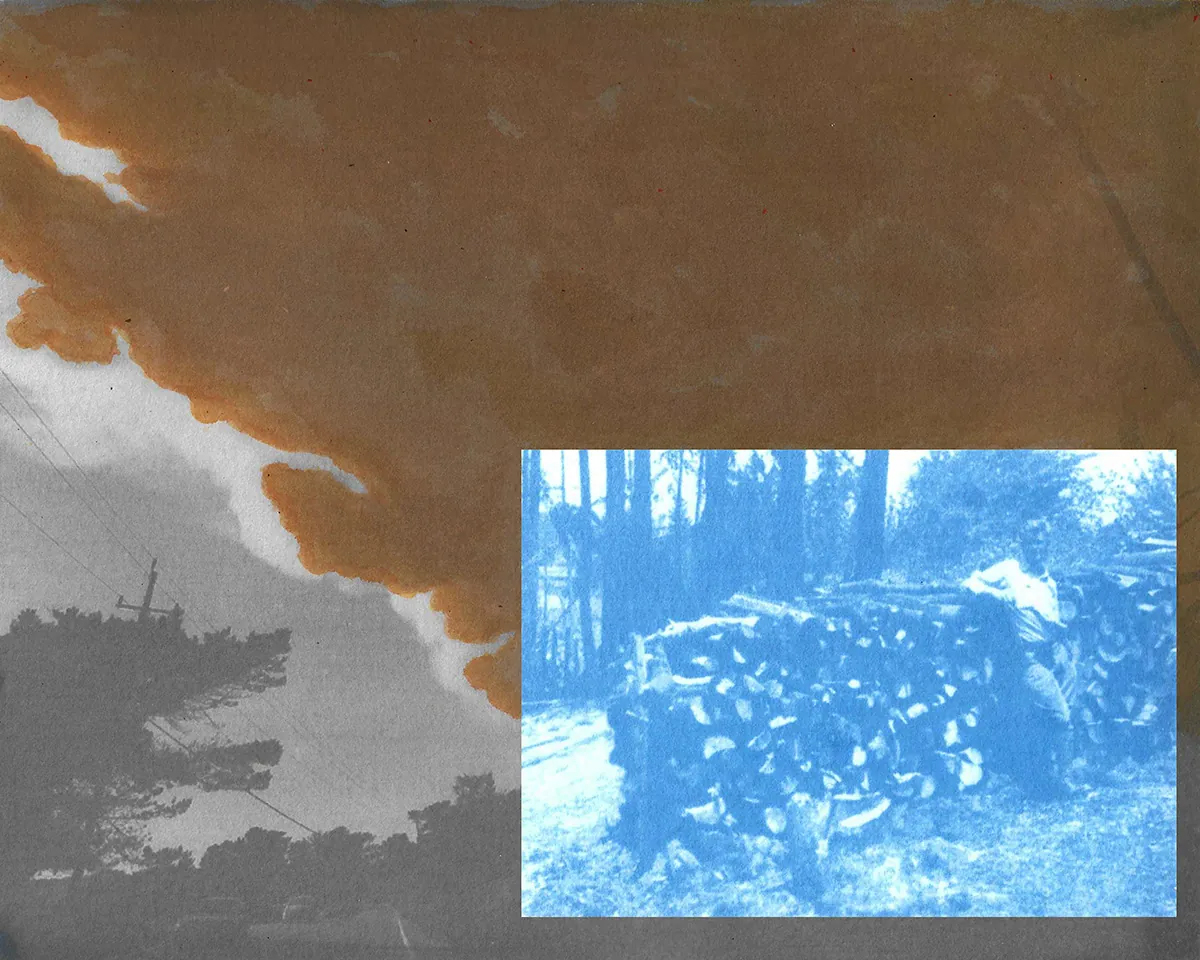
Image by Raty Syka.
Free
Wildfires are an increasing feature of contemporary life in California. Media and scientific accounts tell us that we are in a new age of “megafires”. What combination of human settlement, land use and climate change propels these fires? What drives people to make their homes in increasingly flammable landscapes, and with what effect? In this event Miriam Greenberg and Andrew Matthews present the findings of UCSC researchers who have spent three years studying the ecological, social, and political economic processes that have set the stage for contemporary wildfires, in what has become known as the “Wildland Urban Interface” (WUI).
Come and learn about the deeper histories of indigenous burning, settler ranching, fire suppression, extractive industries and urbanization that have produced fire prone landscapes in the Santa Cruz Mountains. We will share new maps of logging-fueled 19th century megafires; historical photographs of early twentieth century orchards and vineyards planted in the burn scar; and oral accounts of how fire and ranching cleared the land for subsequent waves of rural homebuilding and population growth. Further we explore how today, in the context of climate change, and as WUI growth draws more people into the beauty of rural living and possibility of affordable housing, it builds upon these land use legacies to spark the return and increasing destructiveness of megafire. Yet, we also are learning from these histories, and the recent experience of the 2020 CZU Fire, to reshape our relationship with fire, plants, land, and housing.
Miriam Greenberg is Professor of Sociology at the University of California Santa Cruz, and co-director of the Center for Critical Urban and Environmental Studies. She holds a PhD in Sociology from the City University of New York Graduate Center, and is the author of Branding New York: How a City in Crisis was Sold to the World (Routledge, 2008); Crisis Cities: Disaster and Redevelopment in New York and New Orleans (Oxford, 2014), co-authored with Kevin Fox Gotham; and The City is the Factory: New Solidarities and Spatial Tactics in an Urban Age, co-edited with Penny Lewis (Cornell, 2017). She has also undertaken engaged, public-facing research projects exploring urban and environmental justice issues in California, including the Critical Sustainabilities project, which can be found at: https://critical-sustainabilities.ucsc.edu/, and (with Steve McKay) the project No Place Like Home, on the experience of the affordable housing crisis in Santa Cruz County, which can be found at: http://noplacelikehomeucsc.org/.
She is currently P.I. on the project WUI Research for Resilience: Addressing California’s Climate, Conservation, and Housing Crisis, which is part of the UCOP Climate Action Research Initiative. A recent publication in PNAS lays out the conceptual framework for this project: “Relational geographies of urban unsustainability: The entanglement of California’s housing crisis with WUI growth and climate change.”(2024).
Andrew Mathews is Professor of Anthropology at the University of California, Santa Cruz. He holds a joint Ph.D. in forestry and anthropology from Yale University. He has studied relationships between people, plants, and landscape in Mexico, Italy, and California. His interests range from ethnoecology, STS, political ecology, and environmental history, in publications on Indigenous forest management in Mexico (Instituting Nature, MIT Press, 2011), to environmental humanities, human plant relations, historical ecology, and landscape ethnography, in Italian landscapes (Trees are Shape Shifters Yale, 2022). He is now studing the relationship between fire, grazing, and the political geomorphology of landscapes in California and in Italy.
This event is presented as part of An Aesthetics of Resilience, a collaborative research initiative of the Institute of the Arts and Sciences and the Friedlaender Lab at UC Santa Cruz. The project brings scientists, artists, humanists, and activists together to examine multiple experiences of vulnerability in the face of climate change and is supported by a University of California Office of the President California Climate Action Seed Grant, with additional support from the Coha Nowark Art + Science Fund.
Image by Raty Syka.
Free
For more information:
https://ias.ucsc.edu/event/unexpected-retu...
Added to the calendar on Wed, Feb 11, 2026 12:51PM
Add Your Comments
We are 100% volunteer and depend on your participation to sustain our efforts!
Donate

$85.00 donated
in the past month
Get Involved
If you'd like to help with maintaining or developing the website, contact us.
Publish
Publish your stories and upcoming events on Indybay.
Topics
More
Search Indybay's Archives
Advanced Search
►
▼
IMC Network