







 Publish to Newswire
 Add an Event
From the Open-Publishing Calendar
From the Open-Publishing Newswire
Indybay Feature
Report Back from NYE Demonstration at California City ICE Detention Facility
Noise demo pulled off deep in the desert at newly re-opened detention facility.
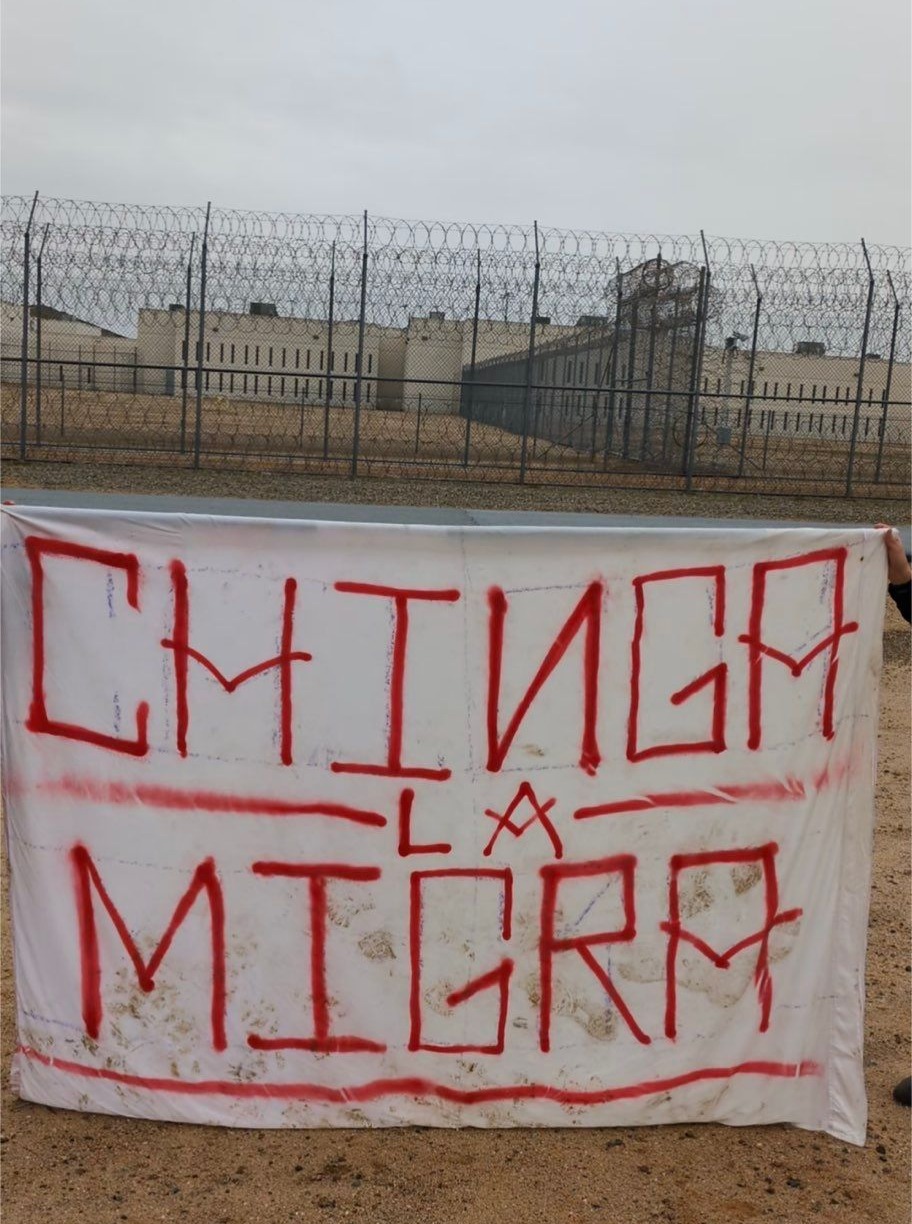
On the 31st of December we drove from opposite ends of the state into the Mojave desert. Some compas came from the north and others the south. Our objective: to demonstrate love for our gente—the migrant captives—and opposition towards the deportation regime. Our target: the California City Correctional Facility (CAC).
Operated by Corecivic, CAC is like most prisons: a facility deliberately situated in the middle of nowhere to maroon. It is yet another instance in the architecture of disappearance—a carceral colony tucked behind a single main road. CAC was California‘s only private prison until it was closed in March of 2024, and then, as quickly as it was killed off, resuscitated into an ICE detention facility in 2025, one of largest in the state. This is what “shutting down” a prison means to the liberal progressive regime: endless permutations of incarceration and ceaseless resurrections of a thing that should be buried.
There were not many of us at this demonstration, but that didn’t matter. And doesn’t matter. You don’t need a gang of people to change the state of things. You don’t need an army to respond to an enemy. A handful of “pocos pero locos” will do.
The best way to describe this demonstration was “ad hoc.” This is not to say everything was held together with paper clips and chewing gum. No, on the contrary, we did our homework, but each assignment in rapid succession: everything was patched together with what little time we could steal. The demonstration was assembled in the fleeting intervals between a flurry of political projects and the demands of our daily lives. We borrowed speakers from comrades, organized sleeping arrangements on living room floors, arranged a legal hotline, and studied property parcel and easement maps beforehand. Moments prior to the demonstration, we prepared a banner on the fly, reviewed our plan of action, discussed contingencies, and hopped into a few selected cars with our sights set on the stomping grounds of our enemy.
When we pulled up to the detention facility, a security guard immediately told us to leave from the safety of his patrol truck. The grunt asserted we were on private property, but we insisted it was an easement. In hindsight, it didn't matter; we were not interested in engaging in a useless debate on legality, but merely deployed the law to stymie CoreCivic. As we told the rent-a-cop, we were staging a protest and would not leave. After some back and forth, he relented and did not fight us, instead grabbing his radio and calling for reinforcements.
In the meantime, we rolled out giant speakers and unfurled the banner which we had spray-painted together hours prior. It was cloudy, cold and slightly drizzling—but if security couldn’t stop us, then the elements wouldn’t either.
We were loud as fuck, nearly blowing out the 1,000-Watt speakers. We bumped classic corridos, cumbias, and mariachi, with a sprinkle of political jams, focusing on music we thought people would want to hear. We chanted, spoke to our people inside, and heard our words echo loudly between the concrete walls all throughout the facility. Sound travels far in the desert. Some people riding quads in the sand dunes nearby pulled up to watch, and when we waved at them, they waved back. It put a smile on our faces to know we could find friends in the most desolate of places.
As the demonstration unfolded, the contingent of security guards grew from four to eight. They threatened us with the police, but we told them to fucking call the cops. They heckled us left and right, arguing the protest was pointless, that nobody on the inside could hear us—when in reality we could hardly hear them. Most of these motherfuckers had “nopales en sus frentes”, but one sellout recording us caught our eye in particular because of his facial hair: he had a Cantinflas mustache. You cannot make this shit up. This is the biggest contradiction inherent to the deportation regime: cannibalization. Everywhere you go you see and hear the children of migrants, willfully devouring their own in the name of American imperialism.
Lacking any plan, the security guards started filming us and our license plates—as if it hadn't occurred to us that we would be recorded. The moment this little show began, we knew we had the upper hand. This is the strategy of you'd-better-stop-or-we'll-tell. We are sorry to admit this, but pulling out phones to film during confrontations is generally what we do when we are losing and when we have no better option. It was funny to see the tables turned, to be on the other side of "the whole world is watching!" for once.
Eventually two cops arrived on scene and, dumbasses that they are, confused their strategy and ended up playing good cop/good cop, and stood off to the side as we wrapped up our demonstration. One of them tried to make small talk and speak to us in Spanish. He asked if we had people on the inside. We asked him the same. He responded “Si tengo dos primos ahí. Los agarraron por pendejos. Estaban de pandilleros en Los Ángeles.”
At the end of the conversation, this sellout tried shaking hands with one of us, who responded: I don’t shake hands or bump fists with the cops. “Why?” the pig asked, half laughing and half incredulous. And he was told straight out, “because we are enemies.”
We understand that long before ICE hit the scene, it was the cops who were busting heads and kidnapping our people. We understand this is still their function today. Let’s talk plainly: the pig does to the people what the migra does to the migrant. There isn’t any discernible difference between one gun and the other. They are two sides of the same military campaign.
We didn’t come to the doorstep of our enemy to have a pleasant dialogue. Nether did we come to simply bark at the deportation regime, but rather to remind them and, most importantly, ourselves and our people that we have teeth.
This is critical in an age of heightened psychological warfare, in an age of defanging, where every pathologist of peace is praised as a hero and every fighter is disappeared as a villain.
We yelled into the microphone:
“[A los migrantes,] estamos aquí porque nos oponemos al régimen actual…Así que no se rindan, no se dejen, no se claudiquen. Aquí estamos para apoyar a su lucha.”
So, we spent some more time blasting music, banging pots, chanting, and speaking on the mic.
When the cops pressed us to leave, we forestalled. We said we needed to consult with the rest of our group as we had no leader, and would spend the next 10 minutes slowly making rounds talking to one another, mainly about other topics, stalling until about the hour mark. At that point we concluded the protest on our own terms, to the great relief of the police and wannabe-cops. We said fair-well to those held captive:
“Feliz año nuevo! Les queremos!”
Then we drove to the next town over to debrief, assessing the action. We highlighted victories, engaged in self-critique, and questioned how we grow from here. We did all this while joking around over shared food and beer, feeling the joy of solidarity, keeping in our hearts those captured and those who continue to fight back.
SO, WHAT?
Frankly, we entered this demonstration somewhat nervous. We did not know what to expect despite many years of experience with prison noise demos. Adding to our uncertainty were felony-level charges for recent demonstrations in other cities gone awry as well as the general heightened political repression sweeping the country, particularly against anti-ICE actions. It felt risky, and we were uncertain if we were making a choice we might regret.
We recognize a large component of political and ideological control is shifting and establishing what people conceive as reasonable and even possible. In the past year alone we have witnessed a rapid and insidious normalization of daily terror—at home and abroad—and a popular response that is greatly constrained by legalism and passive observation. The endgame is the production of the eternal onlooker in the face of naked violence, the reconstitution of our reality as museum where “look but don’t touch” is the cardinal rule.
This is not to say all those who watch are operatives of pacification. We will never spit on the names of Renae Good, Alex Pretti and so many others murdered and maimed by federal agents. Rather, we are here to invoke the names of those rarely invoked. We are driven by those who have been arrested, incarcerated, and buried alive for engaging in the distinct tactics we need here and now. We are saying there is more to life than death.
If this demonstration was nothing else, it was to break from the paradigm of death.
We wanted to overcome our inertia, step outside of the familiar, broaden our horizons, and make advances into enemy territory. We wanted to knock on the feds' own front door, make them nervous, show them that we are organized, that we do not cower in fear, and that we do not forget the migrant captives. Most importantly, we wanted to go to our people trapped in that detention hellscape, and show them that we love them and that we are willing to risk our relative freedom for theirs. We wanted to show them that we will fight for them, with them, that it is beautiful to fight, and that tomorrow is a new day. This is all to say, we wanted to remind our people of the kind of future we can have by taking our power.
During this demonstration, we strengthened our collective capacity and extended our trust. Although we were a small crew of vouched-for people, everyone left with new connections based on having pulled something off together and getting to know people who showed up when it mattered. All of us walked away excited to do it again—and larger!
While the noise demo certainly may have gone differently, it ultimately went smoothly. A moderate amount of planning went into it and nothing happened we did not predict. The demo turned out to be not significantly riskier than previous demos. We were deep in CoreCivic territory. But rather than us being disadvantaged by their terrain, they were caught off guard, did not know what to do, and did not want the trouble. They tried multiple times to intimidate us, and when we were not intimidated, they did not have a solid plan B.
We went forward with this noise demo despite the unstable and volatile political climate in the spirit of cautious bravery, in the spirit of experimentation. We refused to let the system set the terms. If we cower from taking strategic actions out of fear for what might happen, we have already lost the fight before it has even begun.
That is not to say be reckless, of course. Experimentation means just that—trying things with open eyes with a willingness to be wrong. To throw things at the wall to see what sticks, and pivot accordingly: a dialectical and deliberate process. "Lento, pero avanzo."
Those of us inside the border empire of the so-called United States, those of us on the outside of the prison walls, are often the ones best positioned to take action against carceral imperialism, deal heavy blows, and inflict significant damage to its position of domination.
We are sharing this report back and reflection in part to encourage others to attempt similar or completely distinct actions. In these changing and uncertain times, there are as many opportunities for success as there are for failure. And we will not know which is which unless we try.
Operated by Corecivic, CAC is like most prisons: a facility deliberately situated in the middle of nowhere to maroon. It is yet another instance in the architecture of disappearance—a carceral colony tucked behind a single main road. CAC was California‘s only private prison until it was closed in March of 2024, and then, as quickly as it was killed off, resuscitated into an ICE detention facility in 2025, one of largest in the state. This is what “shutting down” a prison means to the liberal progressive regime: endless permutations of incarceration and ceaseless resurrections of a thing that should be buried.
There were not many of us at this demonstration, but that didn’t matter. And doesn’t matter. You don’t need a gang of people to change the state of things. You don’t need an army to respond to an enemy. A handful of “pocos pero locos” will do.
The best way to describe this demonstration was “ad hoc.” This is not to say everything was held together with paper clips and chewing gum. No, on the contrary, we did our homework, but each assignment in rapid succession: everything was patched together with what little time we could steal. The demonstration was assembled in the fleeting intervals between a flurry of political projects and the demands of our daily lives. We borrowed speakers from comrades, organized sleeping arrangements on living room floors, arranged a legal hotline, and studied property parcel and easement maps beforehand. Moments prior to the demonstration, we prepared a banner on the fly, reviewed our plan of action, discussed contingencies, and hopped into a few selected cars with our sights set on the stomping grounds of our enemy.
When we pulled up to the detention facility, a security guard immediately told us to leave from the safety of his patrol truck. The grunt asserted we were on private property, but we insisted it was an easement. In hindsight, it didn't matter; we were not interested in engaging in a useless debate on legality, but merely deployed the law to stymie CoreCivic. As we told the rent-a-cop, we were staging a protest and would not leave. After some back and forth, he relented and did not fight us, instead grabbing his radio and calling for reinforcements.
In the meantime, we rolled out giant speakers and unfurled the banner which we had spray-painted together hours prior. It was cloudy, cold and slightly drizzling—but if security couldn’t stop us, then the elements wouldn’t either.
We were loud as fuck, nearly blowing out the 1,000-Watt speakers. We bumped classic corridos, cumbias, and mariachi, with a sprinkle of political jams, focusing on music we thought people would want to hear. We chanted, spoke to our people inside, and heard our words echo loudly between the concrete walls all throughout the facility. Sound travels far in the desert. Some people riding quads in the sand dunes nearby pulled up to watch, and when we waved at them, they waved back. It put a smile on our faces to know we could find friends in the most desolate of places.
As the demonstration unfolded, the contingent of security guards grew from four to eight. They threatened us with the police, but we told them to fucking call the cops. They heckled us left and right, arguing the protest was pointless, that nobody on the inside could hear us—when in reality we could hardly hear them. Most of these motherfuckers had “nopales en sus frentes”, but one sellout recording us caught our eye in particular because of his facial hair: he had a Cantinflas mustache. You cannot make this shit up. This is the biggest contradiction inherent to the deportation regime: cannibalization. Everywhere you go you see and hear the children of migrants, willfully devouring their own in the name of American imperialism.
Lacking any plan, the security guards started filming us and our license plates—as if it hadn't occurred to us that we would be recorded. The moment this little show began, we knew we had the upper hand. This is the strategy of you'd-better-stop-or-we'll-tell. We are sorry to admit this, but pulling out phones to film during confrontations is generally what we do when we are losing and when we have no better option. It was funny to see the tables turned, to be on the other side of "the whole world is watching!" for once.
Eventually two cops arrived on scene and, dumbasses that they are, confused their strategy and ended up playing good cop/good cop, and stood off to the side as we wrapped up our demonstration. One of them tried to make small talk and speak to us in Spanish. He asked if we had people on the inside. We asked him the same. He responded “Si tengo dos primos ahí. Los agarraron por pendejos. Estaban de pandilleros en Los Ángeles.”
At the end of the conversation, this sellout tried shaking hands with one of us, who responded: I don’t shake hands or bump fists with the cops. “Why?” the pig asked, half laughing and half incredulous. And he was told straight out, “because we are enemies.”
We understand that long before ICE hit the scene, it was the cops who were busting heads and kidnapping our people. We understand this is still their function today. Let’s talk plainly: the pig does to the people what the migra does to the migrant. There isn’t any discernible difference between one gun and the other. They are two sides of the same military campaign.
We didn’t come to the doorstep of our enemy to have a pleasant dialogue. Nether did we come to simply bark at the deportation regime, but rather to remind them and, most importantly, ourselves and our people that we have teeth.
This is critical in an age of heightened psychological warfare, in an age of defanging, where every pathologist of peace is praised as a hero and every fighter is disappeared as a villain.
We yelled into the microphone:
“[A los migrantes,] estamos aquí porque nos oponemos al régimen actual…Así que no se rindan, no se dejen, no se claudiquen. Aquí estamos para apoyar a su lucha.”
So, we spent some more time blasting music, banging pots, chanting, and speaking on the mic.
When the cops pressed us to leave, we forestalled. We said we needed to consult with the rest of our group as we had no leader, and would spend the next 10 minutes slowly making rounds talking to one another, mainly about other topics, stalling until about the hour mark. At that point we concluded the protest on our own terms, to the great relief of the police and wannabe-cops. We said fair-well to those held captive:
“Feliz año nuevo! Les queremos!”
Then we drove to the next town over to debrief, assessing the action. We highlighted victories, engaged in self-critique, and questioned how we grow from here. We did all this while joking around over shared food and beer, feeling the joy of solidarity, keeping in our hearts those captured and those who continue to fight back.
SO, WHAT?
Frankly, we entered this demonstration somewhat nervous. We did not know what to expect despite many years of experience with prison noise demos. Adding to our uncertainty were felony-level charges for recent demonstrations in other cities gone awry as well as the general heightened political repression sweeping the country, particularly against anti-ICE actions. It felt risky, and we were uncertain if we were making a choice we might regret.
We recognize a large component of political and ideological control is shifting and establishing what people conceive as reasonable and even possible. In the past year alone we have witnessed a rapid and insidious normalization of daily terror—at home and abroad—and a popular response that is greatly constrained by legalism and passive observation. The endgame is the production of the eternal onlooker in the face of naked violence, the reconstitution of our reality as museum where “look but don’t touch” is the cardinal rule.
This is not to say all those who watch are operatives of pacification. We will never spit on the names of Renae Good, Alex Pretti and so many others murdered and maimed by federal agents. Rather, we are here to invoke the names of those rarely invoked. We are driven by those who have been arrested, incarcerated, and buried alive for engaging in the distinct tactics we need here and now. We are saying there is more to life than death.
If this demonstration was nothing else, it was to break from the paradigm of death.
We wanted to overcome our inertia, step outside of the familiar, broaden our horizons, and make advances into enemy territory. We wanted to knock on the feds' own front door, make them nervous, show them that we are organized, that we do not cower in fear, and that we do not forget the migrant captives. Most importantly, we wanted to go to our people trapped in that detention hellscape, and show them that we love them and that we are willing to risk our relative freedom for theirs. We wanted to show them that we will fight for them, with them, that it is beautiful to fight, and that tomorrow is a new day. This is all to say, we wanted to remind our people of the kind of future we can have by taking our power.
During this demonstration, we strengthened our collective capacity and extended our trust. Although we were a small crew of vouched-for people, everyone left with new connections based on having pulled something off together and getting to know people who showed up when it mattered. All of us walked away excited to do it again—and larger!
While the noise demo certainly may have gone differently, it ultimately went smoothly. A moderate amount of planning went into it and nothing happened we did not predict. The demo turned out to be not significantly riskier than previous demos. We were deep in CoreCivic territory. But rather than us being disadvantaged by their terrain, they were caught off guard, did not know what to do, and did not want the trouble. They tried multiple times to intimidate us, and when we were not intimidated, they did not have a solid plan B.
We went forward with this noise demo despite the unstable and volatile political climate in the spirit of cautious bravery, in the spirit of experimentation. We refused to let the system set the terms. If we cower from taking strategic actions out of fear for what might happen, we have already lost the fight before it has even begun.
That is not to say be reckless, of course. Experimentation means just that—trying things with open eyes with a willingness to be wrong. To throw things at the wall to see what sticks, and pivot accordingly: a dialectical and deliberate process. "Lento, pero avanzo."
Those of us inside the border empire of the so-called United States, those of us on the outside of the prison walls, are often the ones best positioned to take action against carceral imperialism, deal heavy blows, and inflict significant damage to its position of domination.
We are sharing this report back and reflection in part to encourage others to attempt similar or completely distinct actions. In these changing and uncertain times, there are as many opportunities for success as there are for failure. And we will not know which is which unless we try.
Add Your Comments
We are 100% volunteer and depend on your participation to sustain our efforts!
Donate

$85.00 donated
in the past month
Get Involved
If you'd like to help with maintaining or developing the website, contact us.
Publish
Publish your stories and upcoming events on Indybay.
Topics
More
Search Indybay's Archives
Advanced Search
►
▼
IMC Network