







 Publish to Newswire
 Add an Event
From the Open-Publishing Calendar
From the Open-Publishing Newswire
Indybay Feature
Rob Nilsson’s collection of 9@Night Films playing at the Tenderloin Museum
Collection of "9@Night Films" directed by Rob Nilsson, playing at the Tenderloin Museum, in San Francisco.
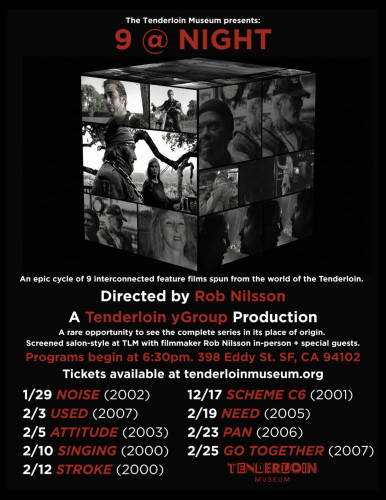
Rob Nilsson’s collection of 9@Night Films playing at the Tenderloin Museum
Maverick independent filmmaker Rob Nilsson’s films to be played in San Francisco
By Lynda Carson - January 29, 2026
Oakland, CA - This evening on January 29, 2026, legendary actor, director, and filmmaker Rob Nilsson will be at the Tenderloin Museum in San Francisco, for the beginning of nine of his 9@Night films that are scheduled to be played at the Tenderloin Museum.
In support of my friend Rob Nilsson having his films played at the Tenderloin Museum, and elsewhere.
That’s right. The entire collection of Rob Nilsson’s “9@Night Films” that include former actors or performers of the Tenderloin yGroup, are scheduled to be played at the Tenderloin Museum starting tonight.
For what it’s worth. Years ago Rob Nilsson’s drama acting workshop in the Tenderloin involving the Tenderloin Action Group, was renamed the Tenderloin yGroup, or became the Tenderloin yGroup. The first film release involving the Tenderloin yGroup and directed by Rob Nilsson was the film Chalk.
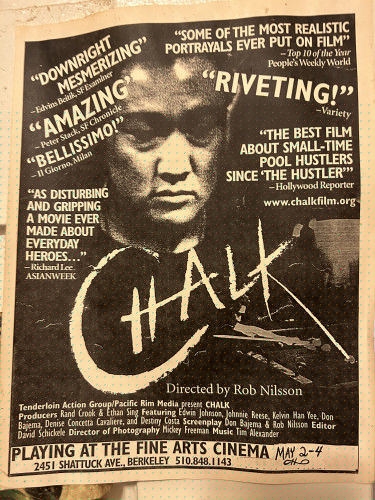
According to a film review about the film Chalk in the San Francisco Chronicle years ago on October 9, 1998, in part it says, “It's pretty impressive, what Nilsson does with his cast of homeless, "grass-roots visionaries" who still meet for acting classes at the Tenderloin YMCA every Wednesday night. Unlike most professional-amateur productions where off-the-street actors embarrass themselves, "Chalk" knows what it wants to do and has the actors to get it done. The editing shows signs of wrestling with a too-long movie, but some scenes are downright mesmerizing.”
An archived website for the Tenderloin yGroup, reveals that the film Chalk, directed by Rob Nilsson, was made with the contributions of labor, including services and equipment from top flight San Francisco film artists, technicians and film/video facilities. CHALK was also financed by generous believers and benefits attended by supporters such as Boz Scaggs, Tom Waits, Gregg Allman, Gena Rowlands, and Harvey Mandel.
Rob Nilsson's collection of ”9 @ Night Films” at the Tenderloin Museum
The film called, NOISE - Film 1 of Rob Nilsson's "9 @ Night" will play Thursday, January 29, 2026 | 6:30-8:30pm, at 398 Eddy St. SF, CA 94102, at the Tenderloin Museum.
https://www.tenderloinmuseum.org/upcoming-public-programs
According to the website for the Tenderloin Museum, in part it says, “It is profound to have in the Tenderloin a museum which will capture the rich and diverse history of the neighborhood and the people who have worked to bring about positive change to the lives of those most marginalized.” – The Rev. Cecil Williams, of Glide Memorial Church.
In a recent January 27 email from my friend Rob Nilsson, he wrote;
“Hi Lynda, Once again thanks for your great help in getting this Points Around the Bay Nilsson Retrospective going. We had a great success, a packed house and enthusiastic audience response with ON THE EDGE AGAIN at the Sequoia in Mill Valley. But some of the few remaining art houses around the bay are still tough to get access to.
Alex Spotto at the Tenderloin Museum,, 398 Eddy St., SF, is going to play all of our 9 @ Night Films created in the Tenderloin with the Tenderloin yGroup (1998-2007) a free workshop for homeless, inner city residents, local actors and all comers which met at the Faithful Fools Street Ministry on Hyde near Eddy. And the Roxie, San Francisco's greatest and oldest art house will be giving us dates for SIGNAL 7, 1983, the first Direct Action film, presented by Francis Coppola and ON THE EDGE AGAIN with Bruce Dern, Pam Grier and John Marley.
I've lived in Berkeley for 30 some years and run my Citizen Cinema workshops with which we made 10 or so feature films all of which premiered at the prestigious Mill Valley Film Festival and played in festivals around the world. I sympathize with the problem the remaining Berkeley and Oakland cinemas have. America is still addicted to Hollywood.
True the film biz has recently helped artistic talents such as Sean Baker and Chloe Zhao make films with million dollar budgets, but the Tenderloin Action Group, the Tenderloin yGroup and Citizen Cinema didn't throw big money at films which, to me, are better because they work only with imagination and dedication to show the world, "the way things seem to be." We worked together in workshops, which you have attended, that helped actors and everyday people experience their artistic talents while learning to become fully functioning and emotionally alive. And to this day we form communities rather than dazzle the public with so- called Stars.
So I'm hoping that the excellent East Bay art houses such as the Elmwood in Berkeley, the New Parkway in Oakland and the Orinda in Contra Costa County will give us dates in order to complete our Points Around the Bay Retrospective.
Thanks again for all your support over the years. Onward! Rob.”
According to an archived website for the Tenderloin yGroup, in part it says;
Tenderloin yGroup
In 1991, the Tenderloin yGroup (then the Tenderloin Action Group) was born. A drama workshop for homeless people and inner city San Francisco residents, the Ygroup has met every week for the last 11 years in an atmosphere crackling with challenge and emotion. The Ygroup's videotapes of those Wednesday night sessions are a collective cry of humanity's pain, outrage, humor, joy and personal catharsis. People from all races and nationalities, bad luck, no luck and down on their luck, poor in material means but rich in human capacity sit in the 'circle of risk and protection' and tell buried truths, look for emotional bridgeheads to blow, encounter the 10,000 selves, the blood, sweat and tears of human confrontation, and bring their personal cries, songs, rants, tantrums, brainstorms, unique visions and quixotic poetry into the circle.
In 1996 the first feature film cast from this group was completed. CHALK had its U.S. premiere at the San Francisco International Film Festival, and its International debut at the Locarno International Film Festival. It has since played to sold-out audiences at international film festivals around the world and has had theatrical distribution in San Francisco, Berkeley, Portland, with upcoming dates in Minneapolis, Chicago and other major American cities.
Made with the contributions of labor, services and equipment from top flight San Francisco film artists, technicians and film/video facilities, CHALK was also financed by generous believers and benefits attended by supporters such as Boz Scaggs, Tom Waits, Gregg Allman, Gena Rowlands, and Harvey Mandel.
The long standing dream of a viable feature film as close to the street as to the bone, made with a committed troupe of unknown street actors, and a top flight crew of dedicated professionals, has now been realized. The Ygroup Workshop has now been transformed into a rehearsal and production session, where the new films are being developed and produced. Future acting workshops and other community outreach programs are being contemplated and will be announced.
More on Tenderloin yGroup (Members' Journals)
Tenderloin yGroup (cont'd)
Reflections on The Tenderloin yGroup By Destiny Costa
The Tenderloin yGroup was a magical time in my life, a time when tragedy crashed into my dreams.
I had no reason to be homeless except for what I thought was love. When love betrayed me and left me alone three thousand miles from home The Tenderloin yGroup became my family.
The group back then was amazing. It introduced me to the spirit of those passed out or just broken down on the streets. Most of all it introduced me to myself. Terrifying at first but after a while I couldn't look back or picture a time that my strength didn't exist. It is an undeniable fact that when all instincts are threatened the human has an innate ability to survive, no matter what. Get up and fight for yourselfófor life.
The opportunity to discover this part of myself in depth, to be able to let it explode with others, without judgment was a gift. Tenderloin Action Group was where my soul screamed from the back door of the abyss and was heard and applauded.
The Tenderloin yGroup was doing a scene in front of a grocery store at 6th and Howard one night and Destiny Costa came along. She observed for a while and suddenly, it seemed, she was in the scene. She screamed, she ranted ... her power energized everyone. Destiny burned with a white flame that night, joined the workshop and became one of its powerhouse women. She played Wanda, one of the lead roles in our first feature film, CHALK. She was living in a shelter when we met her, but was working in shelters before long, giving back to others from the depth and compassion we observed the first time we met her.
———————
More about the Tenderloin Action Group - Tenderloin YGroup.
By Gabriela Maltz-Larkin:
When I first walked into a Tuesday night workshop of The Tenderloin Action group I had no idea what to expect. What I have taken away with me, from my four year association with TAG under the direction of Rob Nilsson, is more than I ever imagined.
I have always known I wanted to be an actress. I'd minored in the theater arts at San Francisco State University and had been involved in guerrilla theater with Teatro Latino in my youth growing up in the Mission district. Nothing prepared me for the soul searching, gut wrenching, baring of my being through improvisational exercises played out in the unique environment that is TAG. With the guidance of an intuitive director, who many times has had the uncanny ability to bring improvisational exercises to life and to relate them to my true life experiences that would have taken years of therapy to address the many issues I have had and continue to wrestle with. Previously I had never had an opportunity to express them in a caring, protective yet daring, unrestricted, no holds barred environment that is the workshop.
TAG has been a place for me to express tremendous rage, fear, grief and sometimes intoxicated joy without feeling the slightest bit of censorship or shame. Rob has often had to remind me not to apologize for my feelings but to be honest and true. I have tried to be so, not only in the workshop but in my real life too.
TYG has been instrumental in helping me deal with emotions that might otherwise have been quelled with intoxicating substances or therapeutic drugs. The freedom of the workshop has allowed me to relive events and situations in my life buried deep in my psyche that have shaped who I am, what I feel and do. It has seen me through the break up of a relationship or two, professional losses, separations from my child, the loss of an aunt as well as my step brother and step sister, the looming pain of losing contact with my little sister and my mentally ill mother and lastly the joy mixed with pain of reuniting with a father after nineteen years. TAG has seen me struggle to maintain myself above water in the face of adversity and my attempts to be happy and realize I am strong and I will survive.
TYG has been an outlet for the wounded inner child in me, a vehicle for my ability to interpret and feel on command. More than an actors workshop and to some just "passing through" a form of therapy.
For someone like me I can only say it has been a life saving, life cherishing experience. Being in the moment, reliving life's joys and pains, being in a circle of protection, existing in your space, feeling everything and not being afraid.
(( Gabriella has an open pipeline to deep anger and despair, as candid and immediate as her spontaneity, joy and willingness to seek the unknown spaces. She has electrified us, kept us in stitches or been an example of raw nerve. Even her occasional "eruptions" in the world show class and a political bent. A recent episode for which she was briefly hospitalized was tearing up $200 in cash in front of the Martin Luther King monument. Street theatre, madness, uncontrollable impulse? ...Gabriella's basic honesty assures us that we'll never wonder where she's coming from. ))
More about the Tenderloin Action Group, below…
By Edwin Johnson:
I entered The Tenderloin Action Group in 1990, the most uptight, paranoid, mind polluted individual in the place. I had no self confidence and would sit in on meetings and try not to participate. I dreaded the idea of getting up before the group and performing, but Rob Nilsson wouldn't let me get away.
We were well on the way with CHALK before I really got the feel for improv, from then on I could work towards emotional growth.
The workshop has enabled me to reach out and focus on spontaneity, a greater autonomy and a better perception of reality.
The workshop has not only given me the opportunity to see myself on the big screen, it has opened me up to new values on life. Now I'm able to reach out and help others get in touch with the hidden resources of their souls.
(( “A very successful Broadway producer viewed CHALK and said, "Edwin Johnson is a screen presence for the ages." But don't expect a larger than life ego with attitude. Edwin was lying on cardboard in alleys when we met him, and he doesn't forget where he comes from. Not only is he an improvisational actor of rare skill and power, he now works in a halfway house for people convicted of drug related offenses. He has become a dedicated actor and when CHALK showed at the Locarno International Film Festival recently, he spoke with quiet assurance on Swiss, Italian, and Polish TV about the transitions in his life inspired by TAG.” ))
For those who are interested, bring a friend or two, and go ahead to see the collection of “9@Nine Films,” directed by the legendary film director Rob Nilsson, at the Tenderloin Museum, at 398 Eddy St. SF, CA 94102.
https://www.tenderloinmuseum.org/upcoming-public-programs
Rob Nilsson, a San Francisco based director, won the Camera d'Or at Cannes for NORTHERN LIGHTS and the Grand Jury Prize at the Sundance Film Festival for HEAT AND SUNLIGHT. He is the first American film director to have won both awards.
If all goes well, further below is an old group photo from around 1998 of Rob Nilsson, and the Tenderloin Action Group / Tenderloin yGroup near Baker Beach in San Francisco. Thats me, Lynda Carson on the far right side of photo, looking to my left.
Plus two flyers of the film Chalk, a film directed by legendary filmmaker Rob Nilsson involving the Tenderloin Action Group / Tenderloin yGroup.
Lynda Carson may be reached at newzland2 [at] gmail.com
>>>>>>>>
>>>>>>>>
Maverick independent filmmaker Rob Nilsson’s films to be played in San Francisco
By Lynda Carson - January 29, 2026
Oakland, CA - This evening on January 29, 2026, legendary actor, director, and filmmaker Rob Nilsson will be at the Tenderloin Museum in San Francisco, for the beginning of nine of his 9@Night films that are scheduled to be played at the Tenderloin Museum.
In support of my friend Rob Nilsson having his films played at the Tenderloin Museum, and elsewhere.
That’s right. The entire collection of Rob Nilsson’s “9@Night Films” that include former actors or performers of the Tenderloin yGroup, are scheduled to be played at the Tenderloin Museum starting tonight.
For what it’s worth. Years ago Rob Nilsson’s drama acting workshop in the Tenderloin involving the Tenderloin Action Group, was renamed the Tenderloin yGroup, or became the Tenderloin yGroup. The first film release involving the Tenderloin yGroup and directed by Rob Nilsson was the film Chalk.
According to a film review about the film Chalk in the San Francisco Chronicle years ago on October 9, 1998, in part it says, “It's pretty impressive, what Nilsson does with his cast of homeless, "grass-roots visionaries" who still meet for acting classes at the Tenderloin YMCA every Wednesday night. Unlike most professional-amateur productions where off-the-street actors embarrass themselves, "Chalk" knows what it wants to do and has the actors to get it done. The editing shows signs of wrestling with a too-long movie, but some scenes are downright mesmerizing.”
An archived website for the Tenderloin yGroup, reveals that the film Chalk, directed by Rob Nilsson, was made with the contributions of labor, including services and equipment from top flight San Francisco film artists, technicians and film/video facilities. CHALK was also financed by generous believers and benefits attended by supporters such as Boz Scaggs, Tom Waits, Gregg Allman, Gena Rowlands, and Harvey Mandel.
Rob Nilsson's collection of ”9 @ Night Films” at the Tenderloin Museum
The film called, NOISE - Film 1 of Rob Nilsson's "9 @ Night" will play Thursday, January 29, 2026 | 6:30-8:30pm, at 398 Eddy St. SF, CA 94102, at the Tenderloin Museum.
https://www.tenderloinmuseum.org/upcoming-public-programs
According to the website for the Tenderloin Museum, in part it says, “It is profound to have in the Tenderloin a museum which will capture the rich and diverse history of the neighborhood and the people who have worked to bring about positive change to the lives of those most marginalized.” – The Rev. Cecil Williams, of Glide Memorial Church.
In a recent January 27 email from my friend Rob Nilsson, he wrote;
“Hi Lynda, Once again thanks for your great help in getting this Points Around the Bay Nilsson Retrospective going. We had a great success, a packed house and enthusiastic audience response with ON THE EDGE AGAIN at the Sequoia in Mill Valley. But some of the few remaining art houses around the bay are still tough to get access to.
Alex Spotto at the Tenderloin Museum,, 398 Eddy St., SF, is going to play all of our 9 @ Night Films created in the Tenderloin with the Tenderloin yGroup (1998-2007) a free workshop for homeless, inner city residents, local actors and all comers which met at the Faithful Fools Street Ministry on Hyde near Eddy. And the Roxie, San Francisco's greatest and oldest art house will be giving us dates for SIGNAL 7, 1983, the first Direct Action film, presented by Francis Coppola and ON THE EDGE AGAIN with Bruce Dern, Pam Grier and John Marley.
I've lived in Berkeley for 30 some years and run my Citizen Cinema workshops with which we made 10 or so feature films all of which premiered at the prestigious Mill Valley Film Festival and played in festivals around the world. I sympathize with the problem the remaining Berkeley and Oakland cinemas have. America is still addicted to Hollywood.
True the film biz has recently helped artistic talents such as Sean Baker and Chloe Zhao make films with million dollar budgets, but the Tenderloin Action Group, the Tenderloin yGroup and Citizen Cinema didn't throw big money at films which, to me, are better because they work only with imagination and dedication to show the world, "the way things seem to be." We worked together in workshops, which you have attended, that helped actors and everyday people experience their artistic talents while learning to become fully functioning and emotionally alive. And to this day we form communities rather than dazzle the public with so- called Stars.
So I'm hoping that the excellent East Bay art houses such as the Elmwood in Berkeley, the New Parkway in Oakland and the Orinda in Contra Costa County will give us dates in order to complete our Points Around the Bay Retrospective.
Thanks again for all your support over the years. Onward! Rob.”
According to an archived website for the Tenderloin yGroup, in part it says;
Tenderloin yGroup
In 1991, the Tenderloin yGroup (then the Tenderloin Action Group) was born. A drama workshop for homeless people and inner city San Francisco residents, the Ygroup has met every week for the last 11 years in an atmosphere crackling with challenge and emotion. The Ygroup's videotapes of those Wednesday night sessions are a collective cry of humanity's pain, outrage, humor, joy and personal catharsis. People from all races and nationalities, bad luck, no luck and down on their luck, poor in material means but rich in human capacity sit in the 'circle of risk and protection' and tell buried truths, look for emotional bridgeheads to blow, encounter the 10,000 selves, the blood, sweat and tears of human confrontation, and bring their personal cries, songs, rants, tantrums, brainstorms, unique visions and quixotic poetry into the circle.
In 1996 the first feature film cast from this group was completed. CHALK had its U.S. premiere at the San Francisco International Film Festival, and its International debut at the Locarno International Film Festival. It has since played to sold-out audiences at international film festivals around the world and has had theatrical distribution in San Francisco, Berkeley, Portland, with upcoming dates in Minneapolis, Chicago and other major American cities.
Made with the contributions of labor, services and equipment from top flight San Francisco film artists, technicians and film/video facilities, CHALK was also financed by generous believers and benefits attended by supporters such as Boz Scaggs, Tom Waits, Gregg Allman, Gena Rowlands, and Harvey Mandel.
The long standing dream of a viable feature film as close to the street as to the bone, made with a committed troupe of unknown street actors, and a top flight crew of dedicated professionals, has now been realized. The Ygroup Workshop has now been transformed into a rehearsal and production session, where the new films are being developed and produced. Future acting workshops and other community outreach programs are being contemplated and will be announced.
More on Tenderloin yGroup (Members' Journals)
Tenderloin yGroup (cont'd)
Reflections on The Tenderloin yGroup By Destiny Costa
The Tenderloin yGroup was a magical time in my life, a time when tragedy crashed into my dreams.
I had no reason to be homeless except for what I thought was love. When love betrayed me and left me alone three thousand miles from home The Tenderloin yGroup became my family.
The group back then was amazing. It introduced me to the spirit of those passed out or just broken down on the streets. Most of all it introduced me to myself. Terrifying at first but after a while I couldn't look back or picture a time that my strength didn't exist. It is an undeniable fact that when all instincts are threatened the human has an innate ability to survive, no matter what. Get up and fight for yourselfófor life.
The opportunity to discover this part of myself in depth, to be able to let it explode with others, without judgment was a gift. Tenderloin Action Group was where my soul screamed from the back door of the abyss and was heard and applauded.
The Tenderloin yGroup was doing a scene in front of a grocery store at 6th and Howard one night and Destiny Costa came along. She observed for a while and suddenly, it seemed, she was in the scene. She screamed, she ranted ... her power energized everyone. Destiny burned with a white flame that night, joined the workshop and became one of its powerhouse women. She played Wanda, one of the lead roles in our first feature film, CHALK. She was living in a shelter when we met her, but was working in shelters before long, giving back to others from the depth and compassion we observed the first time we met her.
———————
More about the Tenderloin Action Group - Tenderloin YGroup.
By Gabriela Maltz-Larkin:
When I first walked into a Tuesday night workshop of The Tenderloin Action group I had no idea what to expect. What I have taken away with me, from my four year association with TAG under the direction of Rob Nilsson, is more than I ever imagined.
I have always known I wanted to be an actress. I'd minored in the theater arts at San Francisco State University and had been involved in guerrilla theater with Teatro Latino in my youth growing up in the Mission district. Nothing prepared me for the soul searching, gut wrenching, baring of my being through improvisational exercises played out in the unique environment that is TAG. With the guidance of an intuitive director, who many times has had the uncanny ability to bring improvisational exercises to life and to relate them to my true life experiences that would have taken years of therapy to address the many issues I have had and continue to wrestle with. Previously I had never had an opportunity to express them in a caring, protective yet daring, unrestricted, no holds barred environment that is the workshop.
TAG has been a place for me to express tremendous rage, fear, grief and sometimes intoxicated joy without feeling the slightest bit of censorship or shame. Rob has often had to remind me not to apologize for my feelings but to be honest and true. I have tried to be so, not only in the workshop but in my real life too.
TYG has been instrumental in helping me deal with emotions that might otherwise have been quelled with intoxicating substances or therapeutic drugs. The freedom of the workshop has allowed me to relive events and situations in my life buried deep in my psyche that have shaped who I am, what I feel and do. It has seen me through the break up of a relationship or two, professional losses, separations from my child, the loss of an aunt as well as my step brother and step sister, the looming pain of losing contact with my little sister and my mentally ill mother and lastly the joy mixed with pain of reuniting with a father after nineteen years. TAG has seen me struggle to maintain myself above water in the face of adversity and my attempts to be happy and realize I am strong and I will survive.
TYG has been an outlet for the wounded inner child in me, a vehicle for my ability to interpret and feel on command. More than an actors workshop and to some just "passing through" a form of therapy.
For someone like me I can only say it has been a life saving, life cherishing experience. Being in the moment, reliving life's joys and pains, being in a circle of protection, existing in your space, feeling everything and not being afraid.
(( Gabriella has an open pipeline to deep anger and despair, as candid and immediate as her spontaneity, joy and willingness to seek the unknown spaces. She has electrified us, kept us in stitches or been an example of raw nerve. Even her occasional "eruptions" in the world show class and a political bent. A recent episode for which she was briefly hospitalized was tearing up $200 in cash in front of the Martin Luther King monument. Street theatre, madness, uncontrollable impulse? ...Gabriella's basic honesty assures us that we'll never wonder where she's coming from. ))
More about the Tenderloin Action Group, below…
By Edwin Johnson:
I entered The Tenderloin Action Group in 1990, the most uptight, paranoid, mind polluted individual in the place. I had no self confidence and would sit in on meetings and try not to participate. I dreaded the idea of getting up before the group and performing, but Rob Nilsson wouldn't let me get away.
We were well on the way with CHALK before I really got the feel for improv, from then on I could work towards emotional growth.
The workshop has enabled me to reach out and focus on spontaneity, a greater autonomy and a better perception of reality.
The workshop has not only given me the opportunity to see myself on the big screen, it has opened me up to new values on life. Now I'm able to reach out and help others get in touch with the hidden resources of their souls.
(( “A very successful Broadway producer viewed CHALK and said, "Edwin Johnson is a screen presence for the ages." But don't expect a larger than life ego with attitude. Edwin was lying on cardboard in alleys when we met him, and he doesn't forget where he comes from. Not only is he an improvisational actor of rare skill and power, he now works in a halfway house for people convicted of drug related offenses. He has become a dedicated actor and when CHALK showed at the Locarno International Film Festival recently, he spoke with quiet assurance on Swiss, Italian, and Polish TV about the transitions in his life inspired by TAG.” ))
For those who are interested, bring a friend or two, and go ahead to see the collection of “9@Nine Films,” directed by the legendary film director Rob Nilsson, at the Tenderloin Museum, at 398 Eddy St. SF, CA 94102.
https://www.tenderloinmuseum.org/upcoming-public-programs
Rob Nilsson, a San Francisco based director, won the Camera d'Or at Cannes for NORTHERN LIGHTS and the Grand Jury Prize at the Sundance Film Festival for HEAT AND SUNLIGHT. He is the first American film director to have won both awards.
If all goes well, further below is an old group photo from around 1998 of Rob Nilsson, and the Tenderloin Action Group / Tenderloin yGroup near Baker Beach in San Francisco. Thats me, Lynda Carson on the far right side of photo, looking to my left.
Plus two flyers of the film Chalk, a film directed by legendary filmmaker Rob Nilsson involving the Tenderloin Action Group / Tenderloin yGroup.
Lynda Carson may be reached at newzland2 [at] gmail.com
>>>>>>>>
>>>>>>>>


Add Your Comments
Comments
(Hide Comments)
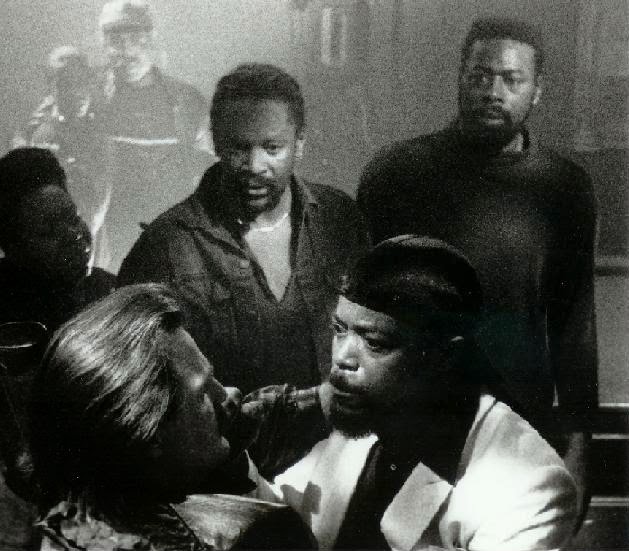
(Note: Image from the film Chalk.)
Film of the Week: Chalk - 2019 review of Chalk directed by Rob Nilsson
Posted by Lynda Carson
Oakland, CA
>>>>>>>>
>>>>>>>>
Film of the Week: Chalk
By Jonathan Romney on July 26, 2019
Click below...
https://www.filmcomment.com/blog/film-of-the-week-chalk/
Chalk is an exciting rediscovery—a crackling, nervy gem from what now seems like a very distant era. Except that it’s not from the era you might assume on first sight. Rob Nilsson’s film was made in 1996 (although it wasn’t released in the U.S. till 2000), but has the distinct look and feel of a film from the mid-’80s, with its intense colors and glaring neons, and the heightened melodramatic register of some scenes. Even some of the women’s hairstyles seem to be from that earlier decade, although maybe that’s the point—the enclosed world depicted here is one that seems to have been left behind by history, and certainly by prosperity.
Revived this week at Metrograph in New York, Chalk has an incandescent intensity to it, although I have no idea whether that’s common to Nilsson’s work. The director, now 79, is much respected as a long-time outsider among U.S. independents; still maintaining a prolific output, he started his feature career in 1978, winning the Caméra d’Or in Cannes with his co-directed Northern Lights, and a Grand Jury Prize in Sundance with 1987’s Heat and Sunlight; he also made 1986’s On the Edge, starring Bruce Dern and Pam Grier.
Chalk, however, emerges from Nilsson’s long and productive association with the Tenderloin Action Group, a San Francisco workshop in which he collaborated with nonprofessional actors, many of them street people, on improvised dramas. In fact, Chalk began with a script (credited to Nilsson and one of the film’s two professional actors, Don Bajema). But the improvisation is apparent throughout, and overall the film lives up to the quote from Nilsson that is the first thing you see when you look at his website.
“Cinema doesn’t interest me much unless I feel that pull of the ordinary, that thrill of real behavior leading, I hope, to those cathartic moments which seem to be the point of it all.”
Chalk is certainly big on catharsis, but the ordinary that runs through it is of a somewhat stylized kind: for example, we see a traffic cone blown off a sidewalk by wind, but the sidewalk is wet with rain and steeped in heavy reflections of the sort you associate with ’80s neo-noir. And the “real behavior” is of a hothouse variety, set as it is in the context of a family drama whose tensions are sometimes downright Shakespearean.
The chalk of the title is the kind used by pool players, and here it embodies some kind of integrity, grit: no-account people are dismissed by one character as “all talk and no chalk.” Nilsson’s main setting is the Crabtree, a run-down pool hall in an industrial district of San Francisco, near train tracks and surrounded by cranes. The place was founded by an African-American pool player named Watson (Edwin John), now elderly and ill. The joint is essentially run by Lois (Denise Concetta Cavaliere), the no-nonsense young woman who works behind the bar, but its presiding figureheads are Watson’s scions: Jones (Johnnie Reese), whose mother Watson met during in the Korean War, and the adopted Chinese-American TC (Kelvin Han Yee). The latter is the self-styled spirit of the place—“I’m TC and you can find me up at the Crabtree—that’s what I’m about”—but he isn’t using his talent as best he might, instead hustling lesser players and enthused rubes out of pocket cash.
While an eminence grise mentor figure (John Tidwell) offers advice, the boys are at odds over the love that Watson gives TC but seems to refuse Jones. For reasons of his own, Jones is determined to set up his brother in a match with a renowned player named Dorian—played by Bajema in a glowering, faintly deranged manner that’s nicely underwritten by his lean, wolfish look faintly suggestive of either Jerry Lee Lewis or a young Harry Dean Stanton. The film opens mesmerizingly in a scene in which the tough-looking Jones goes to ask Dorian to play against his brother—and is given a more than humiliating bum’s rush by the much slighter-looking man. The opening is superb: DP Mickey Freeman’s DV camera weaves in slow motion along with Jones as he steps past tables drenched in pools of light, weaving through the place as if cautiously negotiating crowds of ghosts. The scene ends ominously with something you don’t see often—a fade to blazing red.
The drama—a calculated slow burn at 144 minutes—is largely composed of a series of confrontations leading up to a culminating extended game. There’s a tender scene between Walter and Lois, whom he says is like a daughter, and one that’s considerably more tense; various face-offs between Jones and TC; and a deeply unsettling scene in which Dorian makes a brutal move on Lois, with whom he’s earlier been flirting. Two terrific moments unfold between Dorian and his girlfriend Wanda (Destiny Costa), who sees through his posturing demon prince persona. One of these, in the back of a cab, is very droll, Wanda countering Dorian’s pseudo-mystical ramblings with the rejoinder, “I don’t want to hear any more Japanese hieroglyphic cosmology, if you don’t fucking mind.” The other is downright bizarre, as Dorian asks Wanda to ram his cue up his butt as part of what he calls a “pagan ritual”: the film’s splashes of deranged machismo neatly point up the fact that pool is after all a game about rods and balls.
The sense of territory, is neatly mapped out. In contrast to the enclosed, stagnant space of the Crabtree, with its cluttered back storeroom where Walter sleeps, is the upmarket venue where Dorian holds sway; unlike the Crabtree’s ’80s-style neon reds and blues (in 1999, critic Marjorie Baumgarten invoked the look of a Miller beer ad), this venue comes in blandly chic tones of green and lilac.
Nilsson gets terrific performances out of his mainly nonprofessional cast, some of whom he worked with several times, while others, like Cavaliere and Costa, have no other film credits. Edwin Johnson is very poignant as patriarch Watson, dignified but infinitely vulnerable, while Cavaliere’s forthright Lois, the sanest and the sharpest character here, works up a formidable intensity in a love scene with TC. Han Yee also stands out as TC, the wayward joker son, a Prince Hal who may never have it in him to become king. He represents a different, more feckless kind of dissolution to Dorian, Han Yee’s floppy lock giving the grinning narcissist character a tormented touch of Mickey Rourke; indeed, he has one ferociously unrestrained meltdown scene, raging in a shaft of white light.
Freeman’s camerawork has a marvelous way with faces as objects, notably in close-ups that make Johnny and TC resemble sculptures in bronze—all the more so because faces in this film often shine with sweat, as befits the tension, the overall sense of hot nights and high stakes. The pool games are shot with bracing invention, whether the camera is slowly arcing over the green baize from above, or whether Nilsson and Freeman are coming up with novelty angles on the action, pumped up by David Schickele’s staccato editing: a tight close-up of a pocket, or a spinning shot, as if from the viewpoint of the ball itself.
The sound is densely atmospheric throughout—whether in ominous background thunder and the passing of nearby trains, or in the Crabtree’s background music of blues (a lot of it featuring veteran guitarist Harvey Mandel) or, in one scene, Charles Mingus’s “Self-Portrait in Three Colors,” a lament that seems to be leaking in from somewhere in the far, far distance.
Dramatically (sometimes melodramatically) sombre as the film is, there are nice touches of humor, as in a scene where a clutch of supposedly bohemian bikers turn up again as inept white rappers, presumptuously calling themselves the “New Last Poets.” There are sharp touches among the background characters too: a racist onlooker whining about the Rolling Stones playing black music; a mustachioed player who offers TC some laconic advice, aware from experience that pool is no way to earn a living. And the film has some superb dashes of vernacular wisdom, like this formula for the difficulty of exceeding your own limits: “You can’t bite your own teeth.”
Nilsson is an avowed admirer of John Cassavetes, but while reviews of Chalk have made that comparison, the film’s claustrophobic mood and its occasional theatricality (and I mean that in a positive way) also put me in mind of Tennessee Williams, or Sam Shepard. It is sometimes, admittedly, a film of broad strokes: I couldn’t quite believe it when Watson, racked with a deathly cough, says, “Get out there and go finish that goddam match!” And the drama erupts more than a little crazily at the end, departing from any base level of street-thriller realism as we discover the real stakes are in the enmity between Dorian and Jones.
A sometimes (deliberately?) muddy sound mix undeniably enhances the film’s rawness, but doesn’t always make it easy to follow, with the dialogue sometimes lost against background music or noise. But even where you don’t get all the words, it’s the sometimes raspy grain of the voices, along with the body language, the style, and the looks of the characters that communicate as much as words, in a way that’s super-expressive, sometimes to the point of being as expressionistic. It’s a terrific revival, and a timely one—you could hardly have a more fitting movie for a hot, tense urban summer.
Jonathan Romney is a contributing editor to Film Comment and writes its Film of the Week column. He is a member of the London Film Critics Circle.
>>>>>>>
>>>>>>>
Film of the Week: Chalk - 2019 review of Chalk directed by Rob Nilsson
Posted by Lynda Carson
Oakland, CA
>>>>>>>>
>>>>>>>>
Film of the Week: Chalk
By Jonathan Romney on July 26, 2019
Click below...
https://www.filmcomment.com/blog/film-of-the-week-chalk/
Chalk is an exciting rediscovery—a crackling, nervy gem from what now seems like a very distant era. Except that it’s not from the era you might assume on first sight. Rob Nilsson’s film was made in 1996 (although it wasn’t released in the U.S. till 2000), but has the distinct look and feel of a film from the mid-’80s, with its intense colors and glaring neons, and the heightened melodramatic register of some scenes. Even some of the women’s hairstyles seem to be from that earlier decade, although maybe that’s the point—the enclosed world depicted here is one that seems to have been left behind by history, and certainly by prosperity.
Revived this week at Metrograph in New York, Chalk has an incandescent intensity to it, although I have no idea whether that’s common to Nilsson’s work. The director, now 79, is much respected as a long-time outsider among U.S. independents; still maintaining a prolific output, he started his feature career in 1978, winning the Caméra d’Or in Cannes with his co-directed Northern Lights, and a Grand Jury Prize in Sundance with 1987’s Heat and Sunlight; he also made 1986’s On the Edge, starring Bruce Dern and Pam Grier.
Chalk, however, emerges from Nilsson’s long and productive association with the Tenderloin Action Group, a San Francisco workshop in which he collaborated with nonprofessional actors, many of them street people, on improvised dramas. In fact, Chalk began with a script (credited to Nilsson and one of the film’s two professional actors, Don Bajema). But the improvisation is apparent throughout, and overall the film lives up to the quote from Nilsson that is the first thing you see when you look at his website.
“Cinema doesn’t interest me much unless I feel that pull of the ordinary, that thrill of real behavior leading, I hope, to those cathartic moments which seem to be the point of it all.”
Chalk is certainly big on catharsis, but the ordinary that runs through it is of a somewhat stylized kind: for example, we see a traffic cone blown off a sidewalk by wind, but the sidewalk is wet with rain and steeped in heavy reflections of the sort you associate with ’80s neo-noir. And the “real behavior” is of a hothouse variety, set as it is in the context of a family drama whose tensions are sometimes downright Shakespearean.
The chalk of the title is the kind used by pool players, and here it embodies some kind of integrity, grit: no-account people are dismissed by one character as “all talk and no chalk.” Nilsson’s main setting is the Crabtree, a run-down pool hall in an industrial district of San Francisco, near train tracks and surrounded by cranes. The place was founded by an African-American pool player named Watson (Edwin John), now elderly and ill. The joint is essentially run by Lois (Denise Concetta Cavaliere), the no-nonsense young woman who works behind the bar, but its presiding figureheads are Watson’s scions: Jones (Johnnie Reese), whose mother Watson met during in the Korean War, and the adopted Chinese-American TC (Kelvin Han Yee). The latter is the self-styled spirit of the place—“I’m TC and you can find me up at the Crabtree—that’s what I’m about”—but he isn’t using his talent as best he might, instead hustling lesser players and enthused rubes out of pocket cash.
While an eminence grise mentor figure (John Tidwell) offers advice, the boys are at odds over the love that Watson gives TC but seems to refuse Jones. For reasons of his own, Jones is determined to set up his brother in a match with a renowned player named Dorian—played by Bajema in a glowering, faintly deranged manner that’s nicely underwritten by his lean, wolfish look faintly suggestive of either Jerry Lee Lewis or a young Harry Dean Stanton. The film opens mesmerizingly in a scene in which the tough-looking Jones goes to ask Dorian to play against his brother—and is given a more than humiliating bum’s rush by the much slighter-looking man. The opening is superb: DP Mickey Freeman’s DV camera weaves in slow motion along with Jones as he steps past tables drenched in pools of light, weaving through the place as if cautiously negotiating crowds of ghosts. The scene ends ominously with something you don’t see often—a fade to blazing red.
The drama—a calculated slow burn at 144 minutes—is largely composed of a series of confrontations leading up to a culminating extended game. There’s a tender scene between Walter and Lois, whom he says is like a daughter, and one that’s considerably more tense; various face-offs between Jones and TC; and a deeply unsettling scene in which Dorian makes a brutal move on Lois, with whom he’s earlier been flirting. Two terrific moments unfold between Dorian and his girlfriend Wanda (Destiny Costa), who sees through his posturing demon prince persona. One of these, in the back of a cab, is very droll, Wanda countering Dorian’s pseudo-mystical ramblings with the rejoinder, “I don’t want to hear any more Japanese hieroglyphic cosmology, if you don’t fucking mind.” The other is downright bizarre, as Dorian asks Wanda to ram his cue up his butt as part of what he calls a “pagan ritual”: the film’s splashes of deranged machismo neatly point up the fact that pool is after all a game about rods and balls.
The sense of territory, is neatly mapped out. In contrast to the enclosed, stagnant space of the Crabtree, with its cluttered back storeroom where Walter sleeps, is the upmarket venue where Dorian holds sway; unlike the Crabtree’s ’80s-style neon reds and blues (in 1999, critic Marjorie Baumgarten invoked the look of a Miller beer ad), this venue comes in blandly chic tones of green and lilac.
Nilsson gets terrific performances out of his mainly nonprofessional cast, some of whom he worked with several times, while others, like Cavaliere and Costa, have no other film credits. Edwin Johnson is very poignant as patriarch Watson, dignified but infinitely vulnerable, while Cavaliere’s forthright Lois, the sanest and the sharpest character here, works up a formidable intensity in a love scene with TC. Han Yee also stands out as TC, the wayward joker son, a Prince Hal who may never have it in him to become king. He represents a different, more feckless kind of dissolution to Dorian, Han Yee’s floppy lock giving the grinning narcissist character a tormented touch of Mickey Rourke; indeed, he has one ferociously unrestrained meltdown scene, raging in a shaft of white light.
Freeman’s camerawork has a marvelous way with faces as objects, notably in close-ups that make Johnny and TC resemble sculptures in bronze—all the more so because faces in this film often shine with sweat, as befits the tension, the overall sense of hot nights and high stakes. The pool games are shot with bracing invention, whether the camera is slowly arcing over the green baize from above, or whether Nilsson and Freeman are coming up with novelty angles on the action, pumped up by David Schickele’s staccato editing: a tight close-up of a pocket, or a spinning shot, as if from the viewpoint of the ball itself.
The sound is densely atmospheric throughout—whether in ominous background thunder and the passing of nearby trains, or in the Crabtree’s background music of blues (a lot of it featuring veteran guitarist Harvey Mandel) or, in one scene, Charles Mingus’s “Self-Portrait in Three Colors,” a lament that seems to be leaking in from somewhere in the far, far distance.
Dramatically (sometimes melodramatically) sombre as the film is, there are nice touches of humor, as in a scene where a clutch of supposedly bohemian bikers turn up again as inept white rappers, presumptuously calling themselves the “New Last Poets.” There are sharp touches among the background characters too: a racist onlooker whining about the Rolling Stones playing black music; a mustachioed player who offers TC some laconic advice, aware from experience that pool is no way to earn a living. And the film has some superb dashes of vernacular wisdom, like this formula for the difficulty of exceeding your own limits: “You can’t bite your own teeth.”
Nilsson is an avowed admirer of John Cassavetes, but while reviews of Chalk have made that comparison, the film’s claustrophobic mood and its occasional theatricality (and I mean that in a positive way) also put me in mind of Tennessee Williams, or Sam Shepard. It is sometimes, admittedly, a film of broad strokes: I couldn’t quite believe it when Watson, racked with a deathly cough, says, “Get out there and go finish that goddam match!” And the drama erupts more than a little crazily at the end, departing from any base level of street-thriller realism as we discover the real stakes are in the enmity between Dorian and Jones.
A sometimes (deliberately?) muddy sound mix undeniably enhances the film’s rawness, but doesn’t always make it easy to follow, with the dialogue sometimes lost against background music or noise. But even where you don’t get all the words, it’s the sometimes raspy grain of the voices, along with the body language, the style, and the looks of the characters that communicate as much as words, in a way that’s super-expressive, sometimes to the point of being as expressionistic. It’s a terrific revival, and a timely one—you could hardly have a more fitting movie for a hot, tense urban summer.
Jonathan Romney is a contributing editor to Film Comment and writes its Film of the Week column. He is a member of the London Film Critics Circle.
>>>>>>>
>>>>>>>
We are 100% volunteer and depend on your participation to sustain our efforts!
Donate

$110.00 donated
in the past month
Get Involved
If you'd like to help with maintaining or developing the website, contact us.
Publish
Publish your stories and upcoming events on Indybay.
Topics
More
Search Indybay's Archives
Advanced Search
►
▼
IMC Network