







 Publish to Newswire
 Add an Event
From the Open-Publishing Calendar
From the Open-Publishing Newswire
Indybay Feature
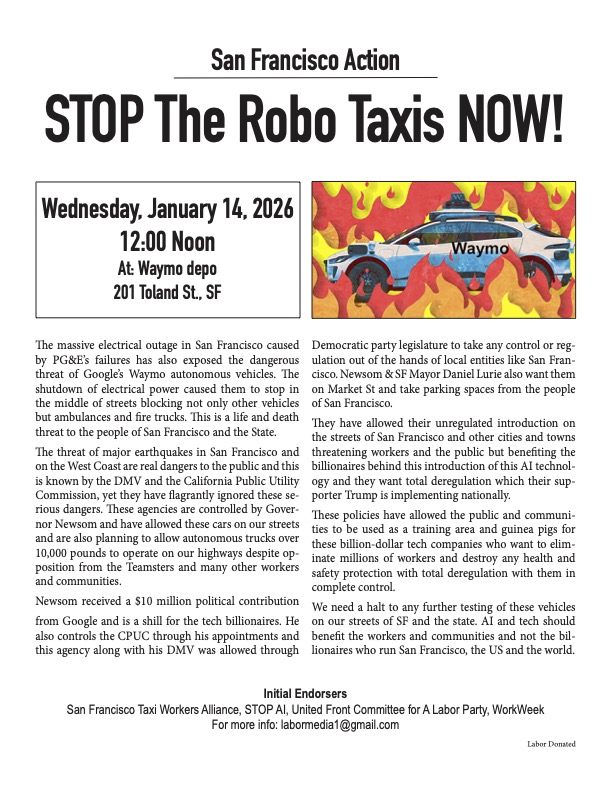
SF Action - Shut the Robo Taxis Down NOW!
 Import event into your personal calendar
Date:
Wednesday, January 14, 2026
Time:
12:00 PM
-
1:00 PM
Event Type:
Protest
Organizer/Author:
United Front Committee For A Labor Party
Location Details:
Waymo Depot
201 Toland St.
San Francisco
201 Toland St.
San Francisco
The massive electrical outage in San Francisco caused by PG&E’s failures has also exposed the dangerous threat of Google’s Waymo autonomous vehicles. The shutdown of electrical power caused them to stop in the middle of streets blocking not only other vehicles but ambulances and fire trucks. This is a life and death threat to the people of San Francisco and the State.
The threat of major earthquakes in San Francisco and on the West Coast are real dangers to the public and this is known by the DMV and the California Public Utility Commission, yet they have flagrantly ignored these serious dangers. These agencies are controlled by Governor Newsom and have allowed these cars on our streets and are also planning to allow autonomous trucks over 10,000 pounds to operate on our highways despite opposition from the Teamsters and many other workers and communities.
Newsom received a $10 million political contribution from Google and is a shill for the tech billionaires. He also controls the CPUC through his appointments and this agency along with his DMV was allowed through Democratic party legislature to take any control or regulation out of the hands of local entities like San Francisco. Newsom & SF Mayor Daniel Lurie also want them on Market St and to take parking spaces from the people of San Francisco.
They have allowed their unregulated introduction on the streets of San Francisco and other cities and towns threatening workers and the public but benefiting the billionaires behind this introduction of this AI technology and they want total deregulation which their supporter Trump is implementing nationally.
These policies have allowed the public and communities to be used as a training area and guinea pigs for these billion-dollar tech companies who want to eliminate millions of workers and destroy any health and safety protection with total deregulation with them in complete control.
We need a halt to any further testing of these vehicles on our streets of SF and the state. AI and tech should benefit the workers and communities and not the billionaires who run San Francisco, the US and the world.
Initial Endorsers
San Francisco Taxi Workers Alliance, STOP AI, United Front Committee for A Labor Party, WorkWeek
For more info: labormedia1 [at] gmail.com
How Self-Driving Cars will Destroy Cities (and what to do about it)
https://www.youtube.com/watch?v=040ejWnFkj0
Robotaxis, a ‘needless and dangerous corporate experiment’
https://www.thestand.org/2025/10/robotaxis-a-needless-and-dangerous-corporate-experiment/
Drivers Union is voicing opposition to untested autonomous vehicles on public roads without human safety operators
SEATTLE, WA (October 30, 2025) — While Waymo lobbyists snacked on canapés at a cocktail party, rideshare drivers represented by the Drivers Union crowded the sidewalk in Seattle’s Belltown neighborhood on Thursday, protesting the company’s plan to flood the city’s streets with robotaxis.
This action comes on the heels of an open letter circulated by the Drivers Union, laying out serious concerns with unmanned autonomous vehicles on Washington’s roads, including threats to safety and local jobs.
A Waymo unmanned vehicle recently failed to recognize a school bus in Atlanta, bypassing the flashing lights and stop arm to zip by children getting off the bus. Regulators think this failure may be widespread, and now 2,000 Waymo vehicles are under investigation. It’s just one of countless examples of autonomous vehicles failing to follow rules of the road, as tech companies use local communities as guinea pigs for tech not yet, perhaps ever, safe for public roads. Advocates warn these threats to safety are more serious for children and people of color due to poorly-developed algorithms.
“We’ve seen a frightening trend by robotaxi software to perpetuate racial and other biases,” Drivers Union President Peter Kuel said in a statement. “Research shows that driverless vehicles are less likely to detect people with darker skin and less likely to recognize children than adult pedestrians.”
Advocates are also concerned about local job losses. The business practices of rideshare companies like Uber and Lyft already threaten workers’ economic stability. Through the Drivers Union, workers have been able to fight back against some of these companies’ anti-worker policies. But that progress is under threat with the introduction of untested autonomous vehicle tech.
“Please remember that rideshare drivers like me are members of our local community – working hard every day to support our community and families,” said Adama Dukuray, a rideshare driver for more than 10 years who joined yesterday’s protest. “By organizing with Drivers Union, we’ve made progress in pushing back on Uber and Lyft to achieve basic protections like a minimum wage, access to benefits like paid sick leave, and legal protections against unfair deactivation. It would be disastrous if another big tech company came into our community, took our jobs, and erased the gains we have won – all while increasing congestion with more unnecessary cars on our streets.”
The bottom line, “Robotaxis threaten union jobs that provide economic security to thousands of local workers,” said Kuel.
For these reasons and more, robotaxis are deeply unpopular. One poll of 8,000 respondents saw the majority say they want to see robotaxis outlawed altogether. So why the push to get them on our streets?
Tech companies based hundreds of miles away are chasing profits, betting on a future market for robotaxis that financial analysts aren’t confident will ever materialize. With the dangers this untested tech poses for local communities, the question becomes: where are the guardrails?
Drivers Union wants to see regulators deny permitting to robotaxis, appropriately regulate and require human safety operators in vehicles, and leave Washington off the list of places allowing what the union calls a “needless and dangerous corporate experiment to play out on public streets.”
“With driverless robotaxis, Waymo wants to conduct a dangerous experiment on the residents of Seattle,” said Paul Dascher, Secretary-Treasurer of Teamsters Local 117. “These vehicles have been known to hit pedestrians, block emergency vehicles, and impede the flow of traffic. Seattle needs human drivers, not corporate robots.”
Supporters are encouraged to sign-on to the drivers’ open letter and join the call for effective regulation of autonomous vehicles.
Drivers Union is the voice for Washington’s more than 30,000 ride-hail drivers and is certified by Washington Department of Labor & Industries as the statewide Driver Resource Center. For more information, visit DriversUnionWA.org.
Robotaxis without a brake pedal or mirrors? Not so fast, feds say.
A previously undisclosed safety report could throw a wrench into the push for autonomous cars designed without a driver in mind.
https://www.washingtonpost.com/business/2025/03/11/zoox-autonomous-nhtsa-safety/
March 11, 2025 at 7:05 a.m. EDTToday at 7:05 a.m. EDT
7 min
93
A Zoox robotaxi spotted in San Francisco in January. (Chris Velazco/The Washington Post)
By Ian Duncan
and
Trisha Thadani
An Amazon-backed self-driving taxi failed to meet vehicle safety standards because it lacks basics like a brake pedal and rearview mirrors, according to a report by federal inspectors that raises questions about the industry’s plans to put a new generation of autonomous vehicles on U.S. roads.
Get a curated selection of 10 of our best stories in your inbox every weekend.
The National Highway Traffic Safety Administration report was produced as part of a review last year of an unusual vehicle by Amazon subsidiary Zoox that, without a steering wheel or other human controls, has no way for a person to drive. Zoox has asserted that the vehicle’s technology, backed by artificial intelligence, complies with the agency’s standards. But the NHTSA report documents “apparent noncompliances” with eight safety rules.
The contents of the previously undisclosed review suggest that rules written when autonomous vehicles were the stuff of futuristic musings pose a legal impediment to the industry’s ambitions, even as plans for self-driving vehicles accelerate. Zoox has a small pilot fleet on the roads in California and Nevada and says it has completed thousands of trips carrying employees and guests. It is finalizing plans to launch public service in Las Vegas this year.
Tesla also is planning to build robotaxis without pedals and mirrors, vehicles that chief executive Elon Musk has said represent the future of his company. Tesla has applied for permission to transport nonpaying customers in California, and it has said it plans to put autonomous versions of its existing electric vehicles on the road this year.
Musk told financial analysts last year before President Donald Trump’s election that he would seek to use his influence in the White House to create a regulatory path to get autonomous vehicles on the road.
NHTSA did not make the December findings on Zoox’s vehicle public; the agency’s review of the robotaxi’s design remains open. The Washington Post obtained the report through a public records request made to state regulators in California, who had a copy.
By documenting the apparent noncompliances of the Zoox, NHTSA could be setting the table for a recall, under agency procedures. It is unclear whether the Trump administration will attempt a change in course. The agency said it remains in discussion with Zoox and was “considering all options.”
“We will continue to support transportation technology innovation while maintaining the safety of America’s roads,” NHTSA said in a statement. Tesla and the White House, where Musk is a key adviser to Trump as leader of the U.S. DOGE Service, did not respond to a request for comment.
The review underscores how NHTSA has struggled to keep up with rapidly evolving technology. Matthew Wansley, a professor at Cardozo School of Law who focuses on autonomous vehicles, said the findings do not necessarily mean the vehicle is inherently unsafe, nor do they say anything about the ability of Zoox’s autonomous driving system to safely navigate traffic.
Zoox could have sought an exemption from the safety rules, but NHTSA has never granted one to an autonomous passenger vehicle. Instead, the company self-certified that its vehicle complied with the rules as it raced to be the first company to put a purpose-built robotaxi on the road and claim a share of what could become a multitrillion-dollar market.
Zoox’s vehicle bears little resemblance to a normal car. The plan is for customers to summon a ride using an app, much like a regular ride-sharing vehicle, getting in through bus-like doors and sitting facing one another.
The vehicle navigates itself, seeing the world through a set of cameras and laser-based sensors. It largely relies on its own abilities to drive, but the company says teams of remote operators can seize control to help handle unusual situations. Passengers can call for assistance via a touch screen and open the doors using an emergency release.
Phil Koopman, an expert on autonomous vehicles at Carnegie Mellon University, said Zoox’s strategy was to “get on the road and ask forgiveness later,” betting that it could scale up faster than regulators could handle. Koopman said the report shows investigators caught up.
“This proves Zoox is willing to bend the rules to make progress,” Koopman said. “There’s no question.”
Zoox is a subsidiary of Amazon, whose founder Jeff Bezos owns The Washington Post. The company said it stands by its position that the vehicle complies with the federal standards.
“Our recent discussions with NHTSA are about mirrors, windshield wipers, a defroster, and a foot-activated brake pedal — equipment that makes sense for vehicles with human drivers, but not for the Zoox purpose-built robotaxi,” Zoox said in a statement. “Our purpose-built design means that the robotaxi can never be operated by a human driver, and our AI driver doesn’t rely on this equipment to view the world.”
It is unclear when NHTSA might conclude its review.
An industry group that represents Zoox called on NHTSA in January to reinterpret its rules to allow for autonomous vehicles without traditional controls, and Transportation Secretary Sean P. Duffy has said creating a path to get more autonomous vehicles on the road is a priority. Duffy’s office did not respond to a request for comment.
The federal review could also complicate the companies’ dealings with state regulators. The inspection report was provided to officials at the California and Nevada departments of motor vehicles, which released copies to The Post under public records requests. Legal experts said the findings could call into question Zoox’s ability to test in California, because state rules require autonomous vehicles to comply with the federal standards.
“I just don’t know how the California DMV can continue to let Zoox test with this vehicle without some document from NHTSA that exempts Zoox from compliance,” Wansley said.
The California DMV said in a statement that it was aware of the federal review and noted that it was ongoing. It referred other questions to NHTSA and Zoox. A spokeswoman for the Nevada DMV said it had not taken any action based on the report.
The uncertainty over robotaxis rules is compounded by the way the federal government regulates auto safety. NHTSA regulations allow manufacturers to self-certify that their vehicles meet safety standards. The agency is left to investigate any safety issues once vehicles are already on the road.
In 2022, Zoox attached a label to its vehicle asserting that it complied with the rules. In 2024, a trio of NHTSA employees showed up at a Zoox facility in Las Vegas, bearing calipers, a ruler, a set of scales and masking tape to put that assertion to the test, according to their report. They documented apparent noncompliances with eight federal standards, including the lack of brake pedals, rearview mirrors, windshield wipers and defoggers. (The lack of a steering wheel does not fall afoul of the rules because of changes NHTSA made to safety standards in 2022.)
Experts said many of the findings do not necessarily call into question the safety of the vehicle because the required controls and mirrors are not used by its computerized driver. But the investigators did find that the vehicles’ windshields were not made with the required type of glass, which could pose risk in a crash.
Michael Brooks, the executive director of the Center for Auto Safety, said the failure to use the correct type of glass raised the question about other potential issues that could only be revealed in crash tests.
“That’s a big screwup on their part,” Brooks said.
Waymo, Google parent Alphabet’s autonomous driving unit, opted to use modified versions of regular road-legal cars with a normal set of controls for humans. It has emerged as the industry’s leading player, with its taxi service driving 150,000 passenger trips a week in multiple cities. In January, Tekedra Mawakana, the company’s co-chief executive, said that she didn’t see its approach changing soon and that a new vehicle would continue to have human controls.
“Because it’s required so by law that cars that are FMVSS certified have all of the human controls,” she said, referring to the federal standards using an acronym. “And so it has all of the human controls.”
Waymo’s robotaxis couldn’t handle S.F.’s power outage. What happens when an earthquake hits?
https://www.sfchronicle.com/sf/article/waymo-power-outage-earthquake-21257311.php
By Kate Talerico,
Staff Writer
Dec 23, 2025
A Waymo driverless robotaxi is unable to detect traffic lights after a major power outage in San Francisco on Saturday. The company’s stalled cars caused congestion around the city during the outage.
A Waymo driverless robotaxi is unable to detect traffic lights after a major power outage in San Francisco on Saturday. The company’s stalled cars caused congestion around the city during the outage.
Tayfun Coskun/Anadolu via Getty Images
In a city struggling to see its way through the dark, it became the prevailing sight of San Francisco’s worst blackout in years: Waymo robotaxis stalled on city streets.
As traffic signals went dark Saturday following a fire at a PG&E substation, dozens of Waymos came to a halt, blocking intersections and holding up traffic. Now officials are calling for answers over what caused the self-driving cars to stall out, and whether the system is prepared to handle a larger emergency like an earthquake.
Though Waymos are designed to treat an intersection without signals as a four-way stop, the sheer scale of the outage appears to have overloaded the system. The situation was also compounded by Waymos lining up behind one another. Detecting a stopped car ahead, the following Waymo dutifully waited — triggering a domino effect that left entire intersections blocked. Human drivers swerved around the stranded cars, pedestrians darted between them, and frustration mounted as traffic ground to a halt.
Eventually, tow truck operators and first responders stepped in, manually overriding Waymo systems to clear the streets. The ride-hailing service suspended its operations across the Bay Area through Sunday evening.
The episode has rattled transportation experts and elected officials, who worry that Waymo’s rapid scale-up in San Francisco is outpacing its ability to respond to major emergencies.
On Monday, Supervisors Bilal Mahmood and Alan Wong called for a hearing into Waymo’s emergency response. In an interview with the Chronicle, Mahmood said the immobilized Waymos slowed down the fire department’s response to two separate fires — one at the original PG&E substation and another in Chinatown.
“San Franciscans deserve answers into why Waymo was unable to handle such a large-scale infrastructure failure, and what they plan to do about it in the future to mitigate these types of impacts,” Mahmood said.
Mayor Daniel Lurie said, during a Monday press conference, that the city had been in communication with Waymo during the weekend outage.
“I made a call to the Waymo CEO and asked them to get the cars off the road immediately,” Lurie said. “They were very understanding. … but we need them to be more proactive.”
Waymo, owned by Google parent Alphabet, began deploying its cars in San Francisco in 2023, and has grown its local fleet to around 1,000 cars. Earlier this year, state regulators approved the company to expand its driverless taxi service to the Peninsulaand parts of the South Bay, extending as far as San Jose.
Some say that Saturday’s fiasco could be a make-or-break moment for the company, comparing it to a 2023 incident involving rival Cruise, when 10 Cruise driverless cars blocked traffic in North Beach. Cruise blamed the backup on “wireless connectivity issues” created by the influx of concertgoers at the Outside Lands music festival.
A Waymo vehicle sits idling at an intersection with no operating traffic lights due to power outages, in San Francisco on Saturday.
A Waymo vehicle sits idling at an intersection with no operating traffic lights due to power outages, in San Francisco on Saturday.
Jeff Chiu/Associated Press
In a statement, Waymo pointed to widespread gridlock citywide.
“While the failure of the utility infrastructure was significant, we are committed to ensuring our technology adjusts to traffic flow during such events,” a Waymo spokesperson said in a statement. “We are focused on rapidly integrating the lessons learned from this event, and are committed to earning and maintaining the trust of the communities we serve every day.”
Waymo says it maintains a 24/7 emergency response hotline for police and fire officials and equips vehicles with two-way voice communication, allowing first responders to speak directly with remote human operators to pull the vehicles off the roads.
Saturday’s outage, however, raised a central question city leaders now want answered: whether those safeguards are enough to get a large volume of cars off the streets quickly when multiple systems fail at once.
“The concern around autonomous vehicles is whether it’s possible for them to scale further without severely disrupting emergency operations in a real emergency, rather than what was a fairly minor power outage,” said former SFMTA director Jeffrey Tumlin in an interview Monday. “What happens in an even worse disaster — like a major earthquake — if there are even more autonomous vehicles on our streets that all brick at the same time?”
Self-driving vehicles, he said, are “a fragile system built on top of other fragile systems” — namely, PG&E’s power grid and the 5G networks, which are put under strain in situations like the weekend’s power outage.
San Francisco is limited in how much it can regulate Waymo itself. In California, autonomous vehicle testing and deployment are regulated primarily by the state.
William Riggs, a University of San Francisco engineering professor who studies autonomous vehicles, said the failure may not lie with the cars themselves so much as the ecosystem supporting them.
“It’s not necessarily a vehicle technology failure — the vehicle is doing what it’s supposed to do,” Riggs said. “We should step back and look at the systemic issues as opposed to the vehicle issues.”
State Sen. Scott Wiener agreed, saying that the blame lies primarily with PG&E, while also calling on Waymo to take steps to ensure that the problem wouldn’t happen again.
“This is on PG&E for allowing this meltdown to happen because of the company’s inability to maintain its infrastructure,” said Wiener, who is currently running to replace Rep. Nancy Pelosi. “When the power goes out, dangerous things happen on many levels, and one of the problems it led to was this Waymo situation.”
Both Google and Waymo have contributed to Wiener’s campaigns in the past.
Wiener and Riggs see the moment as a learning opportunity for Waymo, with the hopes that it can adjust its errors ahead of any more serious disasters.
“This is part of the grand experiment we’re all in,” Riggs said. “We can see what happens in these types of situations, and now we can adjust and make sure it doesn’t happen in the future.”
But not everyone wants to be a guinea pig in Waymo’s lab.
“Public safety must be prioritized over corporate experimentation,” said Joseph Augusto, a San Francisco Uber driver and member of the California Gig Workers Union, in a statement. “If Waymo vehicles can’t operate safely during emergencies like power outages, their permits should be suspended until they can prove, without question, that they won’t put drivers, passengers, pedestrians, or first responders in harm’s way.”
Dec 23, 2025
The threat of major earthquakes in San Francisco and on the West Coast are real dangers to the public and this is known by the DMV and the California Public Utility Commission, yet they have flagrantly ignored these serious dangers. These agencies are controlled by Governor Newsom and have allowed these cars on our streets and are also planning to allow autonomous trucks over 10,000 pounds to operate on our highways despite opposition from the Teamsters and many other workers and communities.
Newsom received a $10 million political contribution from Google and is a shill for the tech billionaires. He also controls the CPUC through his appointments and this agency along with his DMV was allowed through Democratic party legislature to take any control or regulation out of the hands of local entities like San Francisco. Newsom & SF Mayor Daniel Lurie also want them on Market St and to take parking spaces from the people of San Francisco.
They have allowed their unregulated introduction on the streets of San Francisco and other cities and towns threatening workers and the public but benefiting the billionaires behind this introduction of this AI technology and they want total deregulation which their supporter Trump is implementing nationally.
These policies have allowed the public and communities to be used as a training area and guinea pigs for these billion-dollar tech companies who want to eliminate millions of workers and destroy any health and safety protection with total deregulation with them in complete control.
We need a halt to any further testing of these vehicles on our streets of SF and the state. AI and tech should benefit the workers and communities and not the billionaires who run San Francisco, the US and the world.
Initial Endorsers
San Francisco Taxi Workers Alliance, STOP AI, United Front Committee for A Labor Party, WorkWeek
For more info: labormedia1 [at] gmail.com
How Self-Driving Cars will Destroy Cities (and what to do about it)
https://www.youtube.com/watch?v=040ejWnFkj0
Robotaxis, a ‘needless and dangerous corporate experiment’
https://www.thestand.org/2025/10/robotaxis-a-needless-and-dangerous-corporate-experiment/
Drivers Union is voicing opposition to untested autonomous vehicles on public roads without human safety operators
SEATTLE, WA (October 30, 2025) — While Waymo lobbyists snacked on canapés at a cocktail party, rideshare drivers represented by the Drivers Union crowded the sidewalk in Seattle’s Belltown neighborhood on Thursday, protesting the company’s plan to flood the city’s streets with robotaxis.
This action comes on the heels of an open letter circulated by the Drivers Union, laying out serious concerns with unmanned autonomous vehicles on Washington’s roads, including threats to safety and local jobs.
A Waymo unmanned vehicle recently failed to recognize a school bus in Atlanta, bypassing the flashing lights and stop arm to zip by children getting off the bus. Regulators think this failure may be widespread, and now 2,000 Waymo vehicles are under investigation. It’s just one of countless examples of autonomous vehicles failing to follow rules of the road, as tech companies use local communities as guinea pigs for tech not yet, perhaps ever, safe for public roads. Advocates warn these threats to safety are more serious for children and people of color due to poorly-developed algorithms.
“We’ve seen a frightening trend by robotaxi software to perpetuate racial and other biases,” Drivers Union President Peter Kuel said in a statement. “Research shows that driverless vehicles are less likely to detect people with darker skin and less likely to recognize children than adult pedestrians.”
Advocates are also concerned about local job losses. The business practices of rideshare companies like Uber and Lyft already threaten workers’ economic stability. Through the Drivers Union, workers have been able to fight back against some of these companies’ anti-worker policies. But that progress is under threat with the introduction of untested autonomous vehicle tech.
“Please remember that rideshare drivers like me are members of our local community – working hard every day to support our community and families,” said Adama Dukuray, a rideshare driver for more than 10 years who joined yesterday’s protest. “By organizing with Drivers Union, we’ve made progress in pushing back on Uber and Lyft to achieve basic protections like a minimum wage, access to benefits like paid sick leave, and legal protections against unfair deactivation. It would be disastrous if another big tech company came into our community, took our jobs, and erased the gains we have won – all while increasing congestion with more unnecessary cars on our streets.”
The bottom line, “Robotaxis threaten union jobs that provide economic security to thousands of local workers,” said Kuel.
For these reasons and more, robotaxis are deeply unpopular. One poll of 8,000 respondents saw the majority say they want to see robotaxis outlawed altogether. So why the push to get them on our streets?
Tech companies based hundreds of miles away are chasing profits, betting on a future market for robotaxis that financial analysts aren’t confident will ever materialize. With the dangers this untested tech poses for local communities, the question becomes: where are the guardrails?
Drivers Union wants to see regulators deny permitting to robotaxis, appropriately regulate and require human safety operators in vehicles, and leave Washington off the list of places allowing what the union calls a “needless and dangerous corporate experiment to play out on public streets.”
“With driverless robotaxis, Waymo wants to conduct a dangerous experiment on the residents of Seattle,” said Paul Dascher, Secretary-Treasurer of Teamsters Local 117. “These vehicles have been known to hit pedestrians, block emergency vehicles, and impede the flow of traffic. Seattle needs human drivers, not corporate robots.”
Supporters are encouraged to sign-on to the drivers’ open letter and join the call for effective regulation of autonomous vehicles.
Drivers Union is the voice for Washington’s more than 30,000 ride-hail drivers and is certified by Washington Department of Labor & Industries as the statewide Driver Resource Center. For more information, visit DriversUnionWA.org.
Robotaxis without a brake pedal or mirrors? Not so fast, feds say.
A previously undisclosed safety report could throw a wrench into the push for autonomous cars designed without a driver in mind.
https://www.washingtonpost.com/business/2025/03/11/zoox-autonomous-nhtsa-safety/
March 11, 2025 at 7:05 a.m. EDTToday at 7:05 a.m. EDT
7 min
93
A Zoox robotaxi spotted in San Francisco in January. (Chris Velazco/The Washington Post)
By Ian Duncan
and
Trisha Thadani
An Amazon-backed self-driving taxi failed to meet vehicle safety standards because it lacks basics like a brake pedal and rearview mirrors, according to a report by federal inspectors that raises questions about the industry’s plans to put a new generation of autonomous vehicles on U.S. roads.
Get a curated selection of 10 of our best stories in your inbox every weekend.
The National Highway Traffic Safety Administration report was produced as part of a review last year of an unusual vehicle by Amazon subsidiary Zoox that, without a steering wheel or other human controls, has no way for a person to drive. Zoox has asserted that the vehicle’s technology, backed by artificial intelligence, complies with the agency’s standards. But the NHTSA report documents “apparent noncompliances” with eight safety rules.
The contents of the previously undisclosed review suggest that rules written when autonomous vehicles were the stuff of futuristic musings pose a legal impediment to the industry’s ambitions, even as plans for self-driving vehicles accelerate. Zoox has a small pilot fleet on the roads in California and Nevada and says it has completed thousands of trips carrying employees and guests. It is finalizing plans to launch public service in Las Vegas this year.
Tesla also is planning to build robotaxis without pedals and mirrors, vehicles that chief executive Elon Musk has said represent the future of his company. Tesla has applied for permission to transport nonpaying customers in California, and it has said it plans to put autonomous versions of its existing electric vehicles on the road this year.
Musk told financial analysts last year before President Donald Trump’s election that he would seek to use his influence in the White House to create a regulatory path to get autonomous vehicles on the road.
NHTSA did not make the December findings on Zoox’s vehicle public; the agency’s review of the robotaxi’s design remains open. The Washington Post obtained the report through a public records request made to state regulators in California, who had a copy.
By documenting the apparent noncompliances of the Zoox, NHTSA could be setting the table for a recall, under agency procedures. It is unclear whether the Trump administration will attempt a change in course. The agency said it remains in discussion with Zoox and was “considering all options.”
“We will continue to support transportation technology innovation while maintaining the safety of America’s roads,” NHTSA said in a statement. Tesla and the White House, where Musk is a key adviser to Trump as leader of the U.S. DOGE Service, did not respond to a request for comment.
The review underscores how NHTSA has struggled to keep up with rapidly evolving technology. Matthew Wansley, a professor at Cardozo School of Law who focuses on autonomous vehicles, said the findings do not necessarily mean the vehicle is inherently unsafe, nor do they say anything about the ability of Zoox’s autonomous driving system to safely navigate traffic.
Zoox could have sought an exemption from the safety rules, but NHTSA has never granted one to an autonomous passenger vehicle. Instead, the company self-certified that its vehicle complied with the rules as it raced to be the first company to put a purpose-built robotaxi on the road and claim a share of what could become a multitrillion-dollar market.
Zoox’s vehicle bears little resemblance to a normal car. The plan is for customers to summon a ride using an app, much like a regular ride-sharing vehicle, getting in through bus-like doors and sitting facing one another.
The vehicle navigates itself, seeing the world through a set of cameras and laser-based sensors. It largely relies on its own abilities to drive, but the company says teams of remote operators can seize control to help handle unusual situations. Passengers can call for assistance via a touch screen and open the doors using an emergency release.
Phil Koopman, an expert on autonomous vehicles at Carnegie Mellon University, said Zoox’s strategy was to “get on the road and ask forgiveness later,” betting that it could scale up faster than regulators could handle. Koopman said the report shows investigators caught up.
“This proves Zoox is willing to bend the rules to make progress,” Koopman said. “There’s no question.”
Zoox is a subsidiary of Amazon, whose founder Jeff Bezos owns The Washington Post. The company said it stands by its position that the vehicle complies with the federal standards.
“Our recent discussions with NHTSA are about mirrors, windshield wipers, a defroster, and a foot-activated brake pedal — equipment that makes sense for vehicles with human drivers, but not for the Zoox purpose-built robotaxi,” Zoox said in a statement. “Our purpose-built design means that the robotaxi can never be operated by a human driver, and our AI driver doesn’t rely on this equipment to view the world.”
It is unclear when NHTSA might conclude its review.
An industry group that represents Zoox called on NHTSA in January to reinterpret its rules to allow for autonomous vehicles without traditional controls, and Transportation Secretary Sean P. Duffy has said creating a path to get more autonomous vehicles on the road is a priority. Duffy’s office did not respond to a request for comment.
The federal review could also complicate the companies’ dealings with state regulators. The inspection report was provided to officials at the California and Nevada departments of motor vehicles, which released copies to The Post under public records requests. Legal experts said the findings could call into question Zoox’s ability to test in California, because state rules require autonomous vehicles to comply with the federal standards.
“I just don’t know how the California DMV can continue to let Zoox test with this vehicle without some document from NHTSA that exempts Zoox from compliance,” Wansley said.
The California DMV said in a statement that it was aware of the federal review and noted that it was ongoing. It referred other questions to NHTSA and Zoox. A spokeswoman for the Nevada DMV said it had not taken any action based on the report.
The uncertainty over robotaxis rules is compounded by the way the federal government regulates auto safety. NHTSA regulations allow manufacturers to self-certify that their vehicles meet safety standards. The agency is left to investigate any safety issues once vehicles are already on the road.
In 2022, Zoox attached a label to its vehicle asserting that it complied with the rules. In 2024, a trio of NHTSA employees showed up at a Zoox facility in Las Vegas, bearing calipers, a ruler, a set of scales and masking tape to put that assertion to the test, according to their report. They documented apparent noncompliances with eight federal standards, including the lack of brake pedals, rearview mirrors, windshield wipers and defoggers. (The lack of a steering wheel does not fall afoul of the rules because of changes NHTSA made to safety standards in 2022.)
Experts said many of the findings do not necessarily call into question the safety of the vehicle because the required controls and mirrors are not used by its computerized driver. But the investigators did find that the vehicles’ windshields were not made with the required type of glass, which could pose risk in a crash.
Michael Brooks, the executive director of the Center for Auto Safety, said the failure to use the correct type of glass raised the question about other potential issues that could only be revealed in crash tests.
“That’s a big screwup on their part,” Brooks said.
Waymo, Google parent Alphabet’s autonomous driving unit, opted to use modified versions of regular road-legal cars with a normal set of controls for humans. It has emerged as the industry’s leading player, with its taxi service driving 150,000 passenger trips a week in multiple cities. In January, Tekedra Mawakana, the company’s co-chief executive, said that she didn’t see its approach changing soon and that a new vehicle would continue to have human controls.
“Because it’s required so by law that cars that are FMVSS certified have all of the human controls,” she said, referring to the federal standards using an acronym. “And so it has all of the human controls.”
Waymo’s robotaxis couldn’t handle S.F.’s power outage. What happens when an earthquake hits?
https://www.sfchronicle.com/sf/article/waymo-power-outage-earthquake-21257311.php
By Kate Talerico,
Staff Writer
Dec 23, 2025
A Waymo driverless robotaxi is unable to detect traffic lights after a major power outage in San Francisco on Saturday. The company’s stalled cars caused congestion around the city during the outage.
A Waymo driverless robotaxi is unable to detect traffic lights after a major power outage in San Francisco on Saturday. The company’s stalled cars caused congestion around the city during the outage.
Tayfun Coskun/Anadolu via Getty Images
In a city struggling to see its way through the dark, it became the prevailing sight of San Francisco’s worst blackout in years: Waymo robotaxis stalled on city streets.
As traffic signals went dark Saturday following a fire at a PG&E substation, dozens of Waymos came to a halt, blocking intersections and holding up traffic. Now officials are calling for answers over what caused the self-driving cars to stall out, and whether the system is prepared to handle a larger emergency like an earthquake.
Though Waymos are designed to treat an intersection without signals as a four-way stop, the sheer scale of the outage appears to have overloaded the system. The situation was also compounded by Waymos lining up behind one another. Detecting a stopped car ahead, the following Waymo dutifully waited — triggering a domino effect that left entire intersections blocked. Human drivers swerved around the stranded cars, pedestrians darted between them, and frustration mounted as traffic ground to a halt.
Eventually, tow truck operators and first responders stepped in, manually overriding Waymo systems to clear the streets. The ride-hailing service suspended its operations across the Bay Area through Sunday evening.
The episode has rattled transportation experts and elected officials, who worry that Waymo’s rapid scale-up in San Francisco is outpacing its ability to respond to major emergencies.
On Monday, Supervisors Bilal Mahmood and Alan Wong called for a hearing into Waymo’s emergency response. In an interview with the Chronicle, Mahmood said the immobilized Waymos slowed down the fire department’s response to two separate fires — one at the original PG&E substation and another in Chinatown.
“San Franciscans deserve answers into why Waymo was unable to handle such a large-scale infrastructure failure, and what they plan to do about it in the future to mitigate these types of impacts,” Mahmood said.
Mayor Daniel Lurie said, during a Monday press conference, that the city had been in communication with Waymo during the weekend outage.
“I made a call to the Waymo CEO and asked them to get the cars off the road immediately,” Lurie said. “They were very understanding. … but we need them to be more proactive.”
Waymo, owned by Google parent Alphabet, began deploying its cars in San Francisco in 2023, and has grown its local fleet to around 1,000 cars. Earlier this year, state regulators approved the company to expand its driverless taxi service to the Peninsulaand parts of the South Bay, extending as far as San Jose.
Some say that Saturday’s fiasco could be a make-or-break moment for the company, comparing it to a 2023 incident involving rival Cruise, when 10 Cruise driverless cars blocked traffic in North Beach. Cruise blamed the backup on “wireless connectivity issues” created by the influx of concertgoers at the Outside Lands music festival.
A Waymo vehicle sits idling at an intersection with no operating traffic lights due to power outages, in San Francisco on Saturday.
A Waymo vehicle sits idling at an intersection with no operating traffic lights due to power outages, in San Francisco on Saturday.
Jeff Chiu/Associated Press
In a statement, Waymo pointed to widespread gridlock citywide.
“While the failure of the utility infrastructure was significant, we are committed to ensuring our technology adjusts to traffic flow during such events,” a Waymo spokesperson said in a statement. “We are focused on rapidly integrating the lessons learned from this event, and are committed to earning and maintaining the trust of the communities we serve every day.”
Waymo says it maintains a 24/7 emergency response hotline for police and fire officials and equips vehicles with two-way voice communication, allowing first responders to speak directly with remote human operators to pull the vehicles off the roads.
Saturday’s outage, however, raised a central question city leaders now want answered: whether those safeguards are enough to get a large volume of cars off the streets quickly when multiple systems fail at once.
“The concern around autonomous vehicles is whether it’s possible for them to scale further without severely disrupting emergency operations in a real emergency, rather than what was a fairly minor power outage,” said former SFMTA director Jeffrey Tumlin in an interview Monday. “What happens in an even worse disaster — like a major earthquake — if there are even more autonomous vehicles on our streets that all brick at the same time?”
Self-driving vehicles, he said, are “a fragile system built on top of other fragile systems” — namely, PG&E’s power grid and the 5G networks, which are put under strain in situations like the weekend’s power outage.
San Francisco is limited in how much it can regulate Waymo itself. In California, autonomous vehicle testing and deployment are regulated primarily by the state.
William Riggs, a University of San Francisco engineering professor who studies autonomous vehicles, said the failure may not lie with the cars themselves so much as the ecosystem supporting them.
“It’s not necessarily a vehicle technology failure — the vehicle is doing what it’s supposed to do,” Riggs said. “We should step back and look at the systemic issues as opposed to the vehicle issues.”
State Sen. Scott Wiener agreed, saying that the blame lies primarily with PG&E, while also calling on Waymo to take steps to ensure that the problem wouldn’t happen again.
“This is on PG&E for allowing this meltdown to happen because of the company’s inability to maintain its infrastructure,” said Wiener, who is currently running to replace Rep. Nancy Pelosi. “When the power goes out, dangerous things happen on many levels, and one of the problems it led to was this Waymo situation.”
Both Google and Waymo have contributed to Wiener’s campaigns in the past.
Wiener and Riggs see the moment as a learning opportunity for Waymo, with the hopes that it can adjust its errors ahead of any more serious disasters.
“This is part of the grand experiment we’re all in,” Riggs said. “We can see what happens in these types of situations, and now we can adjust and make sure it doesn’t happen in the future.”
But not everyone wants to be a guinea pig in Waymo’s lab.
“Public safety must be prioritized over corporate experimentation,” said Joseph Augusto, a San Francisco Uber driver and member of the California Gig Workers Union, in a statement. “If Waymo vehicles can’t operate safely during emergencies like power outages, their permits should be suspended until they can prove, without question, that they won’t put drivers, passengers, pedestrians, or first responders in harm’s way.”
Dec 23, 2025
For more information:
http://www.ufclp.org
Added to the calendar on Wed, Jan 7, 2026 2:06PM

Add Your Comments
We are 100% volunteer and depend on your participation to sustain our efforts!
Donate

$85.00 donated
in the past month
Get Involved
If you'd like to help with maintaining or developing the website, contact us.
Publish
Publish your stories and upcoming events on Indybay.
Topics
More
Search Indybay's Archives
Advanced Search
►
▼
IMC Network