







 Publish to Newswire
 Add an Event
From the Open-Publishing Calendar
From the Open-Publishing Newswire
Indybay Feature
New Ultralight Radio Tags Are Tracking Monarch Butterflies in Santa Cruz
SANTA CRUZ, Calif.; December 10, 2025—Scientists are now tracking the movements of imperiled monarch butterflies in Santa Cruz with the help of new ultralight radio tags.

The Xerces Society and Point Blue Conservation Science are partnering with California State Parks and Santa Cruz County Parks to study monarch butterfly movement during their overwintering season. The conservationists gathered in mid November to attach small tags, weighing less than a tenth of a gram, to individual monarchs at Natural Bridges State Beach, Lighthouse Field State Beach, and Moran Lake County Park. Additional monarchs have been tagged by project partners further south on the Central Coast.
“The tagged butterflies will help us understand when and where monarchs move among overwintering sites and the surrounding areas,” said Emma Pelton, senior conservation biologist with the Xerces Society. “These details will help us identify where to prioritize conservation of western monarch habitat, as well as provide the most accurate picture of their home range to date.”
Western monarch populations have declined more than 99% since the 1980s, and protecting and restoring overwintering habitat is a crucial part of the species’ recovery plan.
The BlūMorpho transmitter was developed by Cellular Tracking Technologies and Cape May Point Arts and Science Center. The tag weighs just 0.06-0.07 grams, consisting of a tiny solar panel and short antenna. Previous monarch radio tags were heavier and could only be detected by specialized receivers. The new tags are far lighter and can be detected much more easily, because they can be detected by cellular-connected devices (e.g., cellphones and tablets) that have Bluetooth capabilities and location enabled. Now, there is potential to get hundreds or even thousands of detections per tag, giving scientists a much better picture of monarch movement.
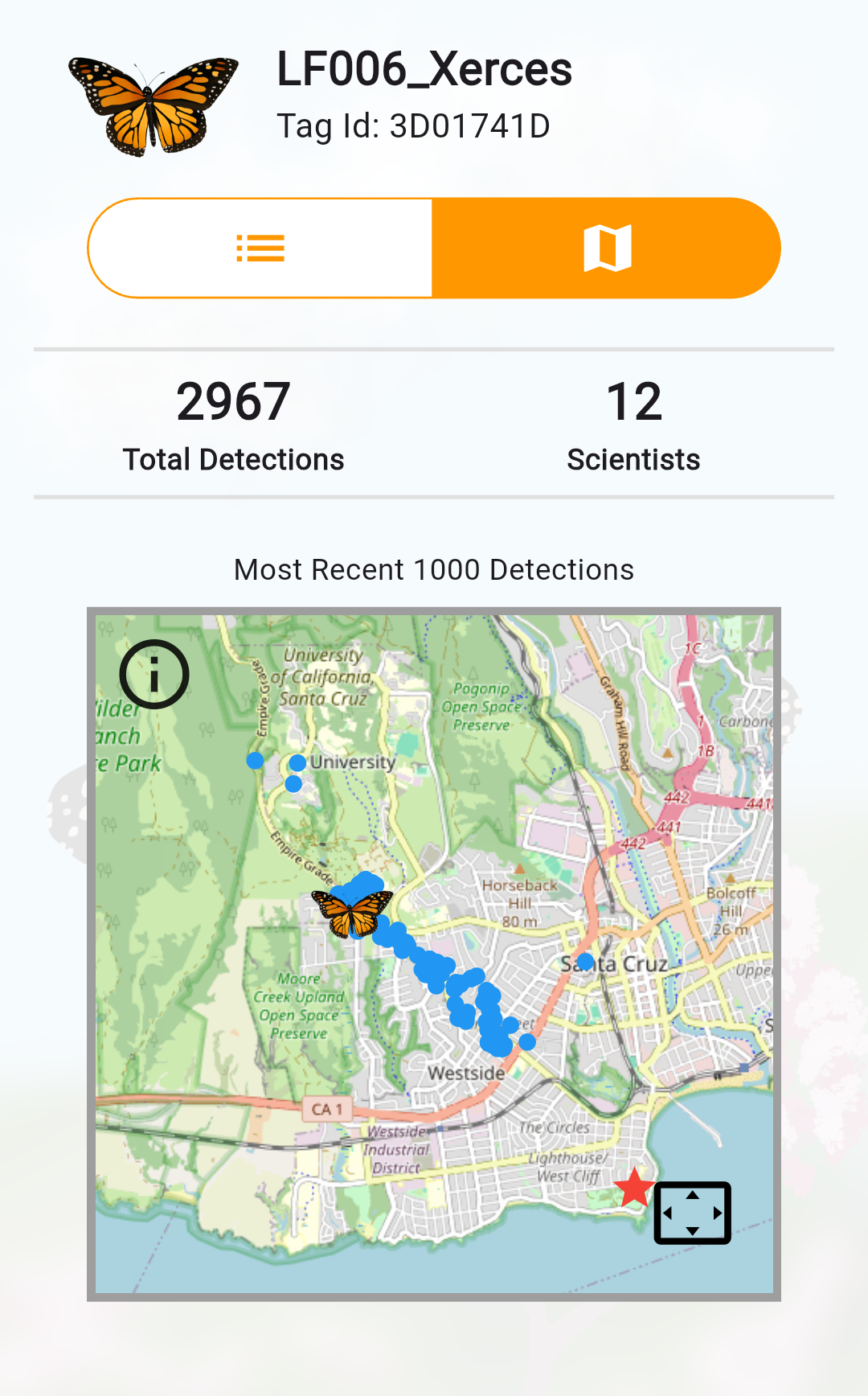
Pelton said the tagged monarchs are already revealing movement patterns, including some surprises. A monarch named ML004 flew more than 100 miles south along the coast in just two days, from Moran Lake to Cambria. Other tagged butterflies, including LF006, have been detected moving inland to visit less well known overwintering sites on the University of California-Santa Cruz campus and in surrounding neighborhoods.
“This study has already shown that overwintering monarchs frequently fly across towns and cities,” said Blake Barbaree, senior ecologist with Point Blue. “This underscores how much we can help overwintering monarchs at home and in our communities by planting pesticide-free flowers that provide nectar.”
Natural Bridges State Beach, Lighthouse Field State Beach, and Moran Lake County Park are the most important monarch overwintering sites in Santa Cruz County, and in recent years, home to the highest number of overwintering monarchs along the entire California coast. Preserving and enhancing the overwintering habitat within these unique areas is critical to ensure the long-term success of the iconic western monarch migration.
Individuals can follow along the journey of tagged monarchs by downloading the Project Monarch app, which allows phones to act as a mini-receiver and track tagged monarchs in real time. Volunteers with the annual Western Monarch Count have been helping accelerate data collection by making regular visits to overwintering sites to count monarchs and search for tags.
Top Photo: A monarch with a BlūMorpho tag is released at Moran Lake County Park in November 2025. Image credit: Elena Oey, Point Blue.
Note: Handling and tagging monarchs in California requires permission from the California Department of Fish and Wildlife. This project is operating under a Scientific Collecting Permit as well as a permit from California State Parks and permission from County Parks.
About Xerces Society for Invertebrate Conservation:
The Xerces Society for Invertebrate Conservation is a donor-supported nonprofit organization that protects our world through the conservation of invertebrates and their habitats. Xerces works throughout North America to conserve pollinators and other invertebrates, protect endangered species, and reduce pesticide use and impacts.
About Point Blue Conservation Science:
Point Blue’s 160 scientists advance conservation of birds, other wildlife, and ecosystems through science, partnerships, and outreach. Their highest priority is to transform conservation by addressing the convergence of environmental and social dimensions across communities and ecosystems. They call this Connected Conservation. Visit Point Blue at http://www.pointblue.org.
About California State Parks:
The mission of California State Parks is to provide for the health, inspiration and education of the people of California by helping to preserve the state's extraordinary biological diversity, protecting its most valued natural and cultural resources, and creating opportunities for high-quality outdoor recreation.
With 280 state park units, over 340 miles of coastline, 970 miles of lake and river frontage, 15,000 campsites, 5,200 miles of trails, 3,195 historic buildings and more than 11,000 known prehistoric and historic archaeological sites, the department contains the largest and most diverse recreational, natural and cultural heritage holdings of any state agency in the nation.
About Santa Cruz County Parks:
The County of Santa Cruz Department of Parks, Open Space and Cultural Services mission is to provide safe, well-designed and maintained parks, and a wide variety of recreational and cultural opportunities for our diverse community. Our over 70 parks and coastal access sites provide stewardship and access for the diverse natural and cultural resources in Santa Cruz County.
https://www.xerces.org/press/new-ultralight-radio-tags-are-tracking-monarch-butterflies-in-santa-cruz
“The tagged butterflies will help us understand when and where monarchs move among overwintering sites and the surrounding areas,” said Emma Pelton, senior conservation biologist with the Xerces Society. “These details will help us identify where to prioritize conservation of western monarch habitat, as well as provide the most accurate picture of their home range to date.”
Western monarch populations have declined more than 99% since the 1980s, and protecting and restoring overwintering habitat is a crucial part of the species’ recovery plan.
The BlūMorpho transmitter was developed by Cellular Tracking Technologies and Cape May Point Arts and Science Center. The tag weighs just 0.06-0.07 grams, consisting of a tiny solar panel and short antenna. Previous monarch radio tags were heavier and could only be detected by specialized receivers. The new tags are far lighter and can be detected much more easily, because they can be detected by cellular-connected devices (e.g., cellphones and tablets) that have Bluetooth capabilities and location enabled. Now, there is potential to get hundreds or even thousands of detections per tag, giving scientists a much better picture of monarch movement.
Pelton said the tagged monarchs are already revealing movement patterns, including some surprises. A monarch named ML004 flew more than 100 miles south along the coast in just two days, from Moran Lake to Cambria. Other tagged butterflies, including LF006, have been detected moving inland to visit less well known overwintering sites on the University of California-Santa Cruz campus and in surrounding neighborhoods.
“This study has already shown that overwintering monarchs frequently fly across towns and cities,” said Blake Barbaree, senior ecologist with Point Blue. “This underscores how much we can help overwintering monarchs at home and in our communities by planting pesticide-free flowers that provide nectar.”
Natural Bridges State Beach, Lighthouse Field State Beach, and Moran Lake County Park are the most important monarch overwintering sites in Santa Cruz County, and in recent years, home to the highest number of overwintering monarchs along the entire California coast. Preserving and enhancing the overwintering habitat within these unique areas is critical to ensure the long-term success of the iconic western monarch migration.
Individuals can follow along the journey of tagged monarchs by downloading the Project Monarch app, which allows phones to act as a mini-receiver and track tagged monarchs in real time. Volunteers with the annual Western Monarch Count have been helping accelerate data collection by making regular visits to overwintering sites to count monarchs and search for tags.
Top Photo: A monarch with a BlūMorpho tag is released at Moran Lake County Park in November 2025. Image credit: Elena Oey, Point Blue.
Note: Handling and tagging monarchs in California requires permission from the California Department of Fish and Wildlife. This project is operating under a Scientific Collecting Permit as well as a permit from California State Parks and permission from County Parks.
About Xerces Society for Invertebrate Conservation:
The Xerces Society for Invertebrate Conservation is a donor-supported nonprofit organization that protects our world through the conservation of invertebrates and their habitats. Xerces works throughout North America to conserve pollinators and other invertebrates, protect endangered species, and reduce pesticide use and impacts.
About Point Blue Conservation Science:
Point Blue’s 160 scientists advance conservation of birds, other wildlife, and ecosystems through science, partnerships, and outreach. Their highest priority is to transform conservation by addressing the convergence of environmental and social dimensions across communities and ecosystems. They call this Connected Conservation. Visit Point Blue at http://www.pointblue.org.
About California State Parks:
The mission of California State Parks is to provide for the health, inspiration and education of the people of California by helping to preserve the state's extraordinary biological diversity, protecting its most valued natural and cultural resources, and creating opportunities for high-quality outdoor recreation.
With 280 state park units, over 340 miles of coastline, 970 miles of lake and river frontage, 15,000 campsites, 5,200 miles of trails, 3,195 historic buildings and more than 11,000 known prehistoric and historic archaeological sites, the department contains the largest and most diverse recreational, natural and cultural heritage holdings of any state agency in the nation.
About Santa Cruz County Parks:
The County of Santa Cruz Department of Parks, Open Space and Cultural Services mission is to provide safe, well-designed and maintained parks, and a wide variety of recreational and cultural opportunities for our diverse community. Our over 70 parks and coastal access sites provide stewardship and access for the diverse natural and cultural resources in Santa Cruz County.
https://www.xerces.org/press/new-ultralight-radio-tags-are-tracking-monarch-butterflies-in-santa-cruz
For more information:
https://www.xerces.org/
Add Your Comments
We are 100% volunteer and depend on your participation to sustain our efforts!
Donate

$65.00 donated
in the past month
Get Involved
If you'd like to help with maintaining or developing the website, contact us.
Publish
Publish your stories and upcoming events on Indybay.
Topics
More
Search Indybay's Archives
Advanced Search
►
▼
IMC Network