







 Publish to Newswire
 Add an Event
From the Open-Publishing Calendar
From the Open-Publishing Newswire
Indybay Feature
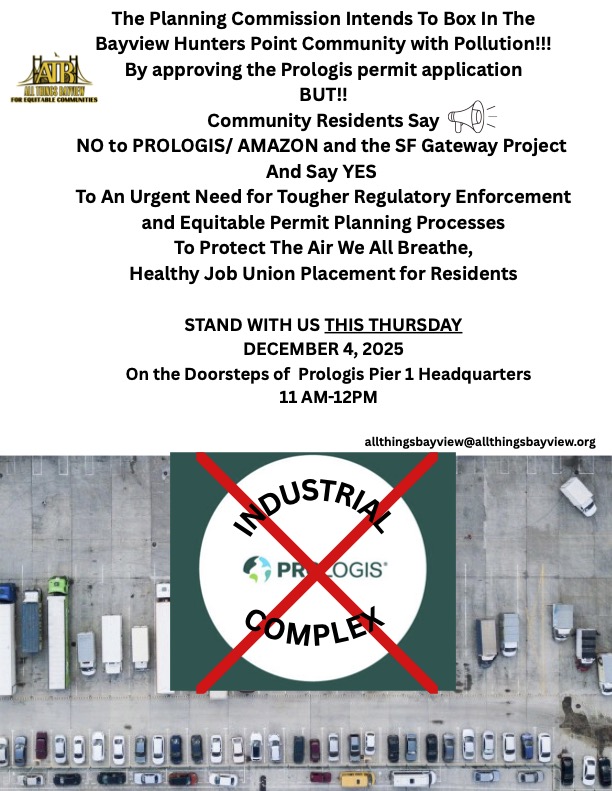
STOP Prologis Amazon Gateway Project Poisoning Our Community & Systemic Racism
 Import event into your personal calendar
Date:
Thursday, December 04, 2025
Time:
11:00 AM
-
11:00 AM
Event Type:
Protest
Organizer/Author:
All Things Bayview
Location Details:
Prologis World Headquarter
Pier 1 San Francisco
Pier 1 San Francisco
Rally Against Gateway Prologis Amazon Warehouse, NoMore Pollution & Poison In Hunters Point
Bad Deal For Hunters Point Residents and Workers & Systemic Racism in SFPUC And Corruption of CCSF
No More Toxic Pollution, Amazon Union Busting and Justice and Healthcare for Hunters Point and Bay View residents.
Friday December 4, 2025 11:00 AM
Prologis World Headquarters
Pier 1
The Embardadero
San Francisco
The billionaires have completely captured control of San Francisco. One of the billionaires now running San Francisco is Hamid Moghadam who is a crony of Mayor Daniel Lurie.
With the support of Lurie he is pushing the Gateway E-Commerce Amazon Project on Toland St. In the Bay View.
It will bring more than 6,000 trucks into the neighborhood, further polluting and poisoning the community. It will also allow union Amazon to occupy a new warehouse in San Francisco. Moghadam is known as Amazon’s landlord around the country and the world.
The new multi-billion dollar project has gotten a pass on environmental dangers and being a vehicle for techno-fascist Bezos to build a major non-union Amazon warehouse project in San Francisco. The Board Of Supervisors have also refused to even ask who the tenant will be and why billionaire Moghadam can’t build working class housing for the workers instead of forcing them to commute many hours.
The Navy, City and State continue to cover-up the dangerous contamination at the radioactive Hunters Point shipyard. Even though plutonium has been found in the outside air, residents and workers are only being offered $1200 which will not get them healthcare and money to move out to safer housing.
There is also a systemic racist frame-up going on at the SFPUC and other departments. At the SFPUC a laborer who is Samoan and his son along with another worker were framed up and fired because they raised health and safety issues.
They are demanding a full investigation against the corrupt manager Dennis Herrera and full return to work of the Laborers.
Speakers representing the residents, workers and community will be speaking out about the health dangers, environmental dangers and systemic racism that is putting the lives of Hunters Point Bayview residents in jeopardy.
Initiated by All Thing Bayview, WorkWeek, United Front Committee For A Labor Party
allthingsbayview [at] allthingsbayview.org
“The teamsters are working hard to make sure billion-dollar delivery companies like Amazon and autonomous vehicle companies like Waymo, follow the rules like everybody else,” said Teamster International Vice President Peter Finn.
He pointed to Amazon’s ongoing refusal to bargain with workers seeking union recognition from the company at its existing San Francisco warehouse. Finn views the parcel delivery allowance that’s baked into the Gateway special use district as wiping away regulations that give the city leverage against Amazon and other companies.
“Why should the city reward that bad behavior with a sweetheart deal?” Finn said. “Prologis may own the buildings, but it’s companies like Amazon that lease the space — and it’s their workers who deserve respect, not retaliation. We support development that lifts up working people, not one that sidelines them.”
HUGE SF GATEWAY DELIVERY HUB
REPLACING AMAZON WAREHOUSES
IS UP FOR A VOTE
LINK:
https://thefrisc.com/huge-sf-gateway-delivery-hub-replacing-amazon-warehouses-is-up-for-a-vote/
SUBHEADING:
The local supervisor is the project’s City Hall champion — and a thorn in Amazon’s side. The developer won’t say if the online giant will be a tenant.
by Adam Brinklow
September 25, 2025
In southeast San Francisco, several sprawling redevelopment projects are in motion along the bay shore, from Candlestick Point and the Hunters Point shipyard all the way up to Pier 70. Some are moving faster than others.
But a smaller development, in an industrial pocket of Bayview-Hunters Point about a mile inland, is gaining momentum after a decade of delays — and how it fares will be a bellwether in San Francisco’s neverending tug-of-war over land use. It faces a key vote this afternoon at the city’s Planning Commission.
UPDATE, 9/26/25:
The Planning Commission approved the project’s environmental review and development agreement 6-0 after more than two and a half hours of public comment and debate. Commissioner Kathrin Moore was not present for the vote. “It’s really great that this area is going to get a great big modernization,” said Commissioner Derek Braun.
Unlike the giant projects along the bay, the SF Gateway is all about jobs. There’s not a single new home involved. The proposal calls for knocking down four old warehouses in the shadow of the elevated 280 freeway and replacing them with a pair of nearly 100-foot-tall buildings. All in all it would cover four very long city blocks.
SF-based Prologis, which develops warehouses and other supply-chain real estate, says the SF Gateway will serve in part as a parcel delivery service hub, with other uses — ground-floor retail, artist studios, light-industrial spaces, and more — sprinkled throughout.
Prologis has not named any clients. But two of the buildings slated for demolition are Amazon warehouses, fueling suspicion that the online giant will stay on and gain even greater purchase in the city.
The project also stirs up union politics and environmental concerns, and it could suffer fallout from last week’s Joel Engardio recall, even though the landslide vote happened on the other side of town.
Four into two: An architect’s rendering of the SF Gateway buildings, which would replace four large warehouses. The site will serve as a parcel distribution hub with additional retail and “maker” space. Some neighbors fear the environmental impact of the additional traffic. Their local supervisor supports the project.
And this being San Francisco, there are angry neighbors who don’t want their views ruined.
But the SF Gateway also has an ace up its sleeve — the backing of Sup. Shamann Walton who, in other instances, has amplified concerns that the project’s opponents raise. In fact, if he were at the wheel of a delivery van, one might say he’s made an unexpected turn.
Anti-Amazon
Prologis first proposed the SF Gateway in 2015. The company now says its design will accommodate a “diverse and evolving range” of light industrial uses, known in SF jargon as production, distribution, and repair (PDR).
PDR space has eroded over the years in the city. But the rise of online shopping, amplified by the pandemic, has boosted the need for package distribution centers.
To Save Small Business, SF Must Unplug From Its Amazon Addiction
Indeed, most of the SF Gateway’s 1.6 million-plus square feet could be dedicated to shipping and delivery. But it will also include at least 20,000 feet of “maker space” for local artists and roughly 8,400 feet of new ground-level retail. All told there will be 1,125 parking spaces and what Prologis says will be the largest solar power array in the city.
For years Amazon has looked to expand its SF operations at Recology’s old 7th Street site. The supervisors delayed those plans in 2022 with a unanimous vote to require special permission to open a new delivery warehouse in the city. The legislation was authored by Sup. Shamann Walton, who represents the Bayview. At the time he called it a tool to make sure that businesses of that size and magnitude, when they come into the neighborhood … they’re going to benefit the community and the neighborhood.”
(Walton was interviewed for a pro-union news video called “How to Stop an Amazon Warehouse From Taking Over Your Town.”)
Two views of the back of one of the Amazon warehouses that would be replaced by the SF Gateway project. (Photos: Alex Lash)
The Teamsters Joint Council 7 and other labor groups backed that 2022 vote. They also used California’s environmental laws in 2020 to appeal Amazon’s attempt to open a Whole Foods grocery in an empty spot in SF’s City Center mall. (Walton and the rest of the supervisors voted in favor of the appeal.)
Unions and their backers have frequently accused Amazon of anti-union politics. Teamsters official Peter Finn told The Chronicle in June that SF Gateway was a “sweetheart deal that rewards “companies like Amazon.”
(The Teamsters did not respond to questions from The Frisc.)
We don’t trust the process.
ROCHELLE HOLMES, SPOKESPERSON FOR ALL THINGS BAYVIEW AND CRITIC OF THE SF GATEWAY PROJECT
When asked if Amazon will be an SF Gateway tenant, a company spokesperson told The Frisc, “We’re following the redevelopment process that Prologis is currently leading with the city. That said, our Toland Street delivery station remains operational, and we don’t have any plans to change our footprint in this area at this time.”
Comments in opposition to the project cite spoiled views from neighboring hills and its size that would “dwarf the neighborhood.” Sue Hestor, an attorney and longtime anti-development advocate, lives in Bernal Heights — separated from the site by several industrial blocks and Highway 101 — and tells The Frisc she already deals with “an Amazon swarm” of delivery trucks.
Health, history, and delivery
More concerns are related to potential environmental and health effects. Many of SF’s worst environmental sites, including the Navy shipyard and power plants, have been in the southeast, and the city is still dealing with their toxic legacies.
Racist 20th century redlining was limited the city’s Black population from moving after the Great Migration to the neighborhood for World War II-era military jobs.
This Bayview Shore Lacks Climate, Flood Protection. Can SF Count on the Feds to Help?
The SF Gateway is now part of larger concerns of environmental injustice. “There’s a burden of toxic pollution in this neighborhood,” longtime Bayview resident Blair Sandler, who lives four blocks from the project site, tells The Frisc.
Sandler says all the extra delivery vans are another case of dumping a problem on Bayview’s doorstep. Public health research has found that Bayview residents suffer greater rates of diseases like asthma and some cancers.
The Hated Hunters Point Power Plant Is Gone, But PG&E’s Delays Keep the Community in Limbo )
In a 2023 analysis the California Air Quality Resource Board estimated the SF Gateway could add more than 6,000 daily vehicle trips to current levels on “local roadways.” The board also urged the project to plan for zero-emission technology.
A Frisc investigation last year found that opposition to parcel delivery expansion from unions and elected officials could slow the conversion to electric vehicles.
Political Power Plays Are Short-Circuiting San Francisco’s Climate Goals.
In response to questions about health concerns, Prologis spokesperson Mattie Sorrentino referred The Frisc to the company’s environmental impact report, required by state law. SF’s Planning Commission will consider the report at its meeting today.
The report references air quality hundreds of times and concludes that most effects “would be less than significant.” For potentially significant effects, such as exhaust from on-site equipment, the company says it will use electric tools and yard equipment such as forklifts, and limit idling of gas-powered vehicles to less than two minutes on-site.
The elevated 280 freeway cuts through the middle of the SF Gateway site, flanked by the four warehouses slated for demolition. The Gateway’s two buildings could rise above the top deck of the freeway.
California’s environmental laws are considered some of the nation’s most stringent. Rochelle Holmes, spokesperson for All Things Bayview and a critic of the project, doesn’t buy it: “We don’t trust the process. They don’t live here.”
But Shamann Walton, the project’s biggest champion in City Hall, does live in the neighborhood. “We have no support from Walton at all,” says Holmes.
A ‘milestone’
Amazon’s plan to convert the old Recology site in SF’s Design District into a distribution hub is still in the works. Whole Foods pulled the plug on its City Center plan last year ; an Asian market says it will move into the space in 2026 — marking nine years of vacancy.
This April, Walton introduced a bill to clear the way for the long-stalled Gateway project. In a press release, he called it “a milestone for District 10” and a major investment in the neighborhood. Walton echoed Prologis with estimates of thousands of jobs and millions of dollars that the project will inject into the area. (The supervisor and his staff did not respond to requests for comment.)
Prologis spokesperson Sorrentino highlighted Walton’s support and the company’s own “strong focus on listening to ensure this project reflects local priorities.”
Timing and politics could play a role if and when the SF Gateway project reaches the Board of Supervisors. The legislation has six cosponsors, enough to win final passage when it gets to the board.
But one sponsor is the now-ousted Sup. Joel Engardio. It’s unclear when the board will certify his recall loss. His seat will become vacant 10 days after the certification, according to the Chronicle, so it’s unclear whether Engardio or his successor will have a say about SF Gateway. Mayor Daniel Lurie, who will appoint Engardio’s replacement, has many layers to consider — including labor and development politics.
But it might not come to that. If the Planning Commission approves the environmental report today, the project moves to City Hall. Depending how the bill moves through committee, potential amendments, and to a final vote, Engardio might still be on board. One might even say it’s a matter of logistics.
US navy accused of cover-up over dangerous plutonium in San Francisco
Advocates allege navy knew levels of airborne plutonium at Hunters Point shipyard were high before it alerted officials
https://www.theguardian.com/us-news/2025/nov/27/us-navy-san-francisco-plutonium
Tom Perkins
Thu 27 Nov 2025 08.00 EST
The US navy knew of potentially dangerous levels of airborne plutonium in San Francisco for almost a year before it alerted city officials after it carried out testing that detected radioactive material in November last year, public health advocates allege.
The plutonium levels exceeded the federal action threshold at the navy’s highly contaminated, 866-acre Hunters Point Naval Shipyard. It was detected in an area adjacent to a residential neighborhood filled with condos, and which includes a public park.
The city is planning to redevelop Hunters Point with up to 10,000 housing units and new waterfront commercial districts. The property was used as a staging ground for nuclear weapons testing, and the discovery marks the latest in a series of controversies and cover-ups of dangerous, radioactive material at the site.
The navy is trying to avoid spending several billion dollars to do a proper clean up, said Jeff Ruch, senior counsel with the Public Employees for Environmental Responsibility nonprofit, which is involved in litigation at the site.
“It’s been one thing after another after another,” Ruch said. “What else is in the closet? We don’t know and we’re not going to search the closet to find out.”
The navy did not respond to a request for comment from the Guardian.
The test results became public on 30 October when the city released a bulletin alerting residents to the issue. The tests had been conducted the previous November. Since the bulletin became public, attorneys, public health advocates and nearby community members have been attempting to get more information, and last week met navy officials for the first time.
In the bulletin, city health officials said: “Full transparency with our communities and the department of public health is critical, and we share your deep concerns regarding the 11-month delay in communication from the navy.”
The navy claimed the reading may be in error, though public health advocates and attorneys so far remain skeptical. The navy did not deny that it withheld the results, and Michael Pound, the navy’s environmental coordinator overseeing the clean-up, apologized at a recent community meeting for not releasing them sooner.
“I’ve spent a fair amount of time up here getting to know the community, getting to know your concerns, transparency and trust, and on this issue we did not do a good job,” Pound said.
The navy during the 1950s used Hunters Point to decontaminate 79 ships irradiated during nuclear weapons tests in the Pacific Ocean. That caused radioactive waste to be spread throughout the shipyard, and the Environmental Protection Agency in 1989 listed the yard as a “superfund” site, a designation for the nation’s most polluted areas.
About 2,000 grams of plutonium-239, a highly radioactive material and one of the most lethal substances on the planet, is estimated to be at Hunters Point, per a report provided to the EPA by nuclear experts on failures in the site’s clean-up. Air exposure can cause cellular damage and radiation sickness, while the inhalation of one-millionth of an ounce will cause cancer with a virtual 100% statistical certainty.
An array of other toxic and radioactive substances are also on the site. Hunters Point held a secret navy research lab where animals were injected with strontium-90. In 2023, the navy and a contractor were accused of falsifying strontium-90 test results.
The EPA and navy are legally required to ensure that dust kicked up during the clean-up does not present a health risk to workers and nearby residents, said Steve Castleman, supervising attorney of Berkeley Law’s Environmental Law Clinic. It is engaged in litigation with the navy and the EPA, in part claiming that the government is failing to meet clean-up standards that have been strengthened since the project started.
The navy took 200 air samples for plutonium in November 2024 and found one that was at a level two times higher than the federal action threshold, according to Castleman and the EPA. The exposure levels at which plutonium can cause cancer are very low, but the low levels also makes it difficult to measure, Castleman said.
The navy has claimed it re-checked that sample and the second reading was a non-detect, the EPA said. The navy has also said the levels in the air and the amount of time at which people are potentially exposed is safe, Castleman said.
But the navy’s history of dealing with the records has generated skepticism among neighbors and public health advocates, Castleman added.
“Can you trust them to report this honestly?” he asked, adding that the navy has not yet provided data to the public to support its claim.
In a statement, an EPA spokesperson said the agency has “requested all of the data used by the navy so our agency could verify the findings ourselves.
“[The] EPA will prioritize the review of the Pu-239 results to make a final determination on what risk there is to the public.”
The EPA is overseeing the clean-up, but Ruch characterized it as a “98lb weakling” that is failing to protect residents. The navy has said it did not carry out nuclear work on 90% of the site, so the EPA is not requiring it to look for radiation in those areas, despite radioactive material turning up across the yard, Ruch said.
The EPA disagreed, and said “the site has been fully characterized” and “the vast majority of historic radiological material at the Hunters Point site has been removed or remediated” despite that it regularly turns up on site.
Workers in the 1950s initially tried cleaning the ships returning from nuclear testing with brooms, Ruch said, using the anecdote to illustrate how little the government knew about how to work with radioactive material. Crews later sandblasted the ships, and the grit was reused around the yard, Ruch said.
The navy sent ships with goats into the blast zone, and the radioactive material in or on the animals was likely spread through Hunters Point either in contaminated feces, or when the animals were incinerated, experts say. The navy also burned irradiated fuel on site.
One parcel on the site has been turned over to developers, and residents living there say unremediated contamination is behind a cluster of cancer and other health problems.
The city and federal government have proposed capping the property with four inches of clean dirt, but Ruch said that is insufficient because it still risks exposing people to whatever is underneath, which still remains a mystery.
“There are several thousand tons of radioactive grit that have never been accounted for that were buried,” Ruch said. “Where was it buried? The navy doesn’t know and it doesn’t want to look.”
The US navy knew of potentially dangerous levels of airborne plutonium in San Francisco for almost a year before it alerted city officials after it carried out testing that detected radioactive material in November last year, public health advocates allege.
The plutonium levels exceeded the federal action threshold at the navy’s highly contaminated, 866-acre Hunters Point Naval Shipyard. It was detected in an area adjacent to a residential neighborhood filled with condos, and which includes a public park.
The city is planning to redevelop Hunters Point with up to 10,000 housing units and new waterfront commercial districts. The property was used as a staging ground for nuclear weapons testing, and the discovery marks the latest in a series of controversies and cover-ups of dangerous, radioactive material at the site.
The navy is trying to avoid spending several billion dollars to do a proper clean up, said Jeff Ruch, senior counsel with the Public Employees for Environmental Responsibility nonprofit, which is involved in litigation at the site.
“It’s been one thing after another after another,” Ruch said. “What else is in the closet? We don’t know and we’re not going to search the closet to find out.”
The navy did not respond to a request for comment from the Guardian.
The test results became public on 30 October when the city released a bulletin alerting residents to the issue. The tests had been conducted the previous November. Since the bulletin became public, attorneys, public health advocates and nearby community members have been attempting to get more information, and last week met navy officials for the first time.
In the bulletin, city health officials said: “Full transparency with our communities and the department of public health is critical, and we share your deep concerns regarding the 11-month delay in communication from the navy.”
$1B S.F. shipyard lawsuit may end with just $1,200 payout for each resident or $7,813,000 After Attorney Fees But No Healthcare For Contaminated & Sick
$1B S.F. shipyard lawsuit may end with just $1,200 payout for each resident
https://www.sfchronicle.com/sf/article/shipyard-lawsuit-settlement-21206277.php
By Laura Waxmann,
Staff Writer
Nov 25, 2025
Audience members listen as Dr. Kathryn Higley, Navy’s Community Technical Advisor, speaks during The Mayor’s Hunters Point Shipyard Citizens Advisory Committee meeting in San Francisco on Nov. 17. Residents could finally see payments from a lawsuit related to the cleanup of radioactive materials in the area.
Audience members listen as Dr. Kathryn Higley, Navy’s Community Technical Advisor, speaks during The Mayor’s Hunters Point Shipyard Citizens Advisory Committee meeting in San Francisco on Nov. 17. Residents could finally see payments from a lawsuit related to the cleanup of radioactive materials in the area.
Scott Strazzante/S.F. Chronicle
Residents of San Francisco’s Bayview Hunters Point are used to waiting — for clean soil, for new homes and for answers about potential health risks that come from living near a previously radiation-contaminated site that was not properly cleaned.
Now, they’re waiting for a federal judge to decide whether the latest bid to settle their longstanding lawsuit over the toxic cleanup of the former Naval Shipyard is good enough for a community that has waited years for restitution.
The proposed agreement, unveiled in court filings Monday, offers each of the 6,500 residents — including 781 minors — in the lawsuit a $1,202 payout after attorney fees are deducted. It’s a modest increase from the $606 per person sum that was rejected by the same judge earlier this year as “paltry” and “unfair.”
And yet, the new deal, which now also involves ex-Navy contractor Tetra Tech EC, still represents a fraction of the compensation that residents living near the Shipyard once sought. It marks the latest turn in a 2018 lawsuit that began as a $1 billion demand for accountability following revelations that Tetra Tech EC workers had swapped soil samples, fabricated results and misled regulators — misconduct that caused residents fearing elevated cancer risks and other health impacts to sue.
Residents of the Hunters Point shipyard in San Francisco may finally get payments related to a longstanding lawsuit around the cleanup of radioactive materials in the area.
Residents of the Hunters Point shipyard in San Francisco may finally get payments related to a longstanding lawsuit around the cleanup of radioactive materials in the area.
Scott Strazzante/S.F. Chronicle
The case has hung over the city’s most ambitious redevelopment project and deepened community skepticism. Two previous attempts to settle the lawsuit collapsed under U.S. District Court Judge James Donato, most recently for undervaluing the alleged harm. Now, with this new deal back before the court, the question becomes: will a slightly larger payout satisfy the judge, and the community after years of distrust, delays and fraud?
That question has sharpened in light of new transparency lapses: A week ago, Navy officials apologized to community members for waiting nearly a year to disclose that an airborne sample of plutonium-239, a radioactive heavy metal, had been detected in an active cleanup zone at the Superfund site.
Court records show that the attorney representing the Hunters Point residents, Cabral Bonner, Tetra Tech EC and the site’s developers reached the latest settlement in the months before the Navy finally alerted local health officials about the plutonium discovery in October.
Lennar and its offshoot, Five Point Holdings — the developers behind the massive plan that produced several hundreds homes at a hilltop area of the Shipyard before stalling out in 2018 — have agreed to shoulder much of the proposed payout, court records show. Meanwhile, Tetra Tech EC would contribute just over $200 per plaintiff.
In contrast, the ex-Navy contractor agreed to settle a Shipyard case brought against it by the U.S. Department of Justice for $97 million earlier this year.
Tetra Tech EC declined to comment on the pending settlement with the Hunters Point residents. The developers could not immediately be reached for comment.
“The settlement, while not what was anticipated when we initially filed the lawsuit, is still a win for the community,” said Bonner, adding that residents of the area have faced “decades of environmental racism” and that “no one has stepped up to take responsibility — not the city, not the state, not the developers.”
Bonner acknowledged that Tetra Tech EC’s share of the payout is “nominal,” but pointed out that “it’s more than they want to pay.”
“The real harm in this case was done by the Navy,” Bonner said, but added: “Tetra Tech didn’t help anything out.”
Bonner told the Chronicle that the agreement means that residents are barred from reviving any of their claims for the period prior to the settlement, but could sue for new claims if more issues arise related to the cleanup or redevelopment efforts.
In a court filing Monday, Bonner wrote that the agreement underscores a fundamental barrier in environmental-justice cases: proving “causation,” even when communities have lived next to contamination for generations and have long feared its health toll.
Bonner said that the complaint was drafted after two Tetra Tech EC employees pleaded guilty to falsifying documents and after internal whistleblowers described the contractors “widespread fraud” (Tetra Tech has always denied that the fraud was widespread, instead blaming a group of “rogue” employees).
Bonner added that his clients hired medical expert Dr. James Dahlgren, who has been studying people with toxic exposure since the 1970s. His research showed that members of the Bayview Hunters Point community “have plutonium in their bodies that could only have come from (the Shipyard).”
But Tetra Tech EC and the developers pushed back, stating in court records that negative health outcomes in the community could not be clearly linked to their activities at the Shipyard.
“A primary challenge is differentiating between the fear of cancer caused by defendants and that caused by other environmental hazards to which the (Bayview Hunters Point) community has been subjected,” Bonner said.
Bonner said in the court filing that the recent revelation about the airborne plutonium-239, which is man-made and used primarily in nuclear weapons and power plants, provides the “exposure pathway that defendants argue was lacking.”
But the disclosure came after the parties in the legal case completed discovery. Bonner told the Chronicle it would likely have done little to alter the settlement’s trajectory.
“It would be different if that air monitor they were using was located in the middle of the Hunters Point community — a monitor there registering (elevated) levels of plutonium is a different story than a monitor on the Naval Shipyard itself,” he said. “The fact that they could have that information and sit on it for a whole year without anyone knowing about it — all those things exemplify the challenges that we faced.”
In regard to the plutonium-239 issue, Navy officials described the concerning sample as an “outlier” at a heated community meeting last week, and said that it measured as a dose “far below” levels that could pose a health risk to workers and the community — but above the “action level” agreed upon by the Navy and its regulatory partners in the Shipyard’s cleanup plan.
But not everyone agrees.
The Committee to Bridge the Gap, an environmental policy watchdog organization that has long tracked the Shipyard’s cleanup, issued a statement last week that described the contaminant as an “extraordinarily poisonous substance” that has a half-life of more than 24,000 years.
“The appearance of plutonium-239 in air filters at Hunters Point shows that radioactive particles were suspended in the air and not safely locked away in the ground as residents have long been promised,” the group said, and added that the “full extent of contamination at some 90% of the Hunters Point property remains unknown.”
Speaker Emerita Nancy Pelosi sent a letter about the issue to U.S. Secretary of the Navy John Phelan on Monday, in which she called for transparency in the Shipyard cleanup. During her time in Congress she secured over $1 billion in federal funding toward the effort.
"The continued cadence of misfires in communication and delays with the completion of the cleanup further erode the public trust in the Navy’s ability to complete this long-awaited clean up and redevelopment,” Pelosi said, and added that the plans to continue to “fight to ensure robust resources” so that the project can be completed “once and for all.”
But, she added: “That effort is entirely reliant on the Navy's ongoing, frequent dialogue with total transparency.”
Nov 25, 2025
Photo of Laura Waxmann
Laura Waxmann
REPORTER
Bad Deal For Hunters Point Residents and Workers & Systemic Racism in SFPUC And Corruption of CCSF
No More Toxic Pollution, Amazon Union Busting and Justice and Healthcare for Hunters Point and Bay View residents.
Friday December 4, 2025 11:00 AM
Prologis World Headquarters
Pier 1
The Embardadero
San Francisco
The billionaires have completely captured control of San Francisco. One of the billionaires now running San Francisco is Hamid Moghadam who is a crony of Mayor Daniel Lurie.
With the support of Lurie he is pushing the Gateway E-Commerce Amazon Project on Toland St. In the Bay View.
It will bring more than 6,000 trucks into the neighborhood, further polluting and poisoning the community. It will also allow union Amazon to occupy a new warehouse in San Francisco. Moghadam is known as Amazon’s landlord around the country and the world.
The new multi-billion dollar project has gotten a pass on environmental dangers and being a vehicle for techno-fascist Bezos to build a major non-union Amazon warehouse project in San Francisco. The Board Of Supervisors have also refused to even ask who the tenant will be and why billionaire Moghadam can’t build working class housing for the workers instead of forcing them to commute many hours.
The Navy, City and State continue to cover-up the dangerous contamination at the radioactive Hunters Point shipyard. Even though plutonium has been found in the outside air, residents and workers are only being offered $1200 which will not get them healthcare and money to move out to safer housing.
There is also a systemic racist frame-up going on at the SFPUC and other departments. At the SFPUC a laborer who is Samoan and his son along with another worker were framed up and fired because they raised health and safety issues.
They are demanding a full investigation against the corrupt manager Dennis Herrera and full return to work of the Laborers.
Speakers representing the residents, workers and community will be speaking out about the health dangers, environmental dangers and systemic racism that is putting the lives of Hunters Point Bayview residents in jeopardy.
Initiated by All Thing Bayview, WorkWeek, United Front Committee For A Labor Party
allthingsbayview [at] allthingsbayview.org
“The teamsters are working hard to make sure billion-dollar delivery companies like Amazon and autonomous vehicle companies like Waymo, follow the rules like everybody else,” said Teamster International Vice President Peter Finn.
He pointed to Amazon’s ongoing refusal to bargain with workers seeking union recognition from the company at its existing San Francisco warehouse. Finn views the parcel delivery allowance that’s baked into the Gateway special use district as wiping away regulations that give the city leverage against Amazon and other companies.
“Why should the city reward that bad behavior with a sweetheart deal?” Finn said. “Prologis may own the buildings, but it’s companies like Amazon that lease the space — and it’s their workers who deserve respect, not retaliation. We support development that lifts up working people, not one that sidelines them.”
HUGE SF GATEWAY DELIVERY HUB
REPLACING AMAZON WAREHOUSES
IS UP FOR A VOTE
LINK:
https://thefrisc.com/huge-sf-gateway-delivery-hub-replacing-amazon-warehouses-is-up-for-a-vote/
SUBHEADING:
The local supervisor is the project’s City Hall champion — and a thorn in Amazon’s side. The developer won’t say if the online giant will be a tenant.
by Adam Brinklow
September 25, 2025
In southeast San Francisco, several sprawling redevelopment projects are in motion along the bay shore, from Candlestick Point and the Hunters Point shipyard all the way up to Pier 70. Some are moving faster than others.
But a smaller development, in an industrial pocket of Bayview-Hunters Point about a mile inland, is gaining momentum after a decade of delays — and how it fares will be a bellwether in San Francisco’s neverending tug-of-war over land use. It faces a key vote this afternoon at the city’s Planning Commission.
UPDATE, 9/26/25:
The Planning Commission approved the project’s environmental review and development agreement 6-0 after more than two and a half hours of public comment and debate. Commissioner Kathrin Moore was not present for the vote. “It’s really great that this area is going to get a great big modernization,” said Commissioner Derek Braun.
Unlike the giant projects along the bay, the SF Gateway is all about jobs. There’s not a single new home involved. The proposal calls for knocking down four old warehouses in the shadow of the elevated 280 freeway and replacing them with a pair of nearly 100-foot-tall buildings. All in all it would cover four very long city blocks.
SF-based Prologis, which develops warehouses and other supply-chain real estate, says the SF Gateway will serve in part as a parcel delivery service hub, with other uses — ground-floor retail, artist studios, light-industrial spaces, and more — sprinkled throughout.
Prologis has not named any clients. But two of the buildings slated for demolition are Amazon warehouses, fueling suspicion that the online giant will stay on and gain even greater purchase in the city.
The project also stirs up union politics and environmental concerns, and it could suffer fallout from last week’s Joel Engardio recall, even though the landslide vote happened on the other side of town.
Four into two: An architect’s rendering of the SF Gateway buildings, which would replace four large warehouses. The site will serve as a parcel distribution hub with additional retail and “maker” space. Some neighbors fear the environmental impact of the additional traffic. Their local supervisor supports the project.
And this being San Francisco, there are angry neighbors who don’t want their views ruined.
But the SF Gateway also has an ace up its sleeve — the backing of Sup. Shamann Walton who, in other instances, has amplified concerns that the project’s opponents raise. In fact, if he were at the wheel of a delivery van, one might say he’s made an unexpected turn.
Anti-Amazon
Prologis first proposed the SF Gateway in 2015. The company now says its design will accommodate a “diverse and evolving range” of light industrial uses, known in SF jargon as production, distribution, and repair (PDR).
PDR space has eroded over the years in the city. But the rise of online shopping, amplified by the pandemic, has boosted the need for package distribution centers.
To Save Small Business, SF Must Unplug From Its Amazon Addiction
Indeed, most of the SF Gateway’s 1.6 million-plus square feet could be dedicated to shipping and delivery. But it will also include at least 20,000 feet of “maker space” for local artists and roughly 8,400 feet of new ground-level retail. All told there will be 1,125 parking spaces and what Prologis says will be the largest solar power array in the city.
For years Amazon has looked to expand its SF operations at Recology’s old 7th Street site. The supervisors delayed those plans in 2022 with a unanimous vote to require special permission to open a new delivery warehouse in the city. The legislation was authored by Sup. Shamann Walton, who represents the Bayview. At the time he called it a tool to make sure that businesses of that size and magnitude, when they come into the neighborhood … they’re going to benefit the community and the neighborhood.”
(Walton was interviewed for a pro-union news video called “How to Stop an Amazon Warehouse From Taking Over Your Town.”)
Two views of the back of one of the Amazon warehouses that would be replaced by the SF Gateway project. (Photos: Alex Lash)
The Teamsters Joint Council 7 and other labor groups backed that 2022 vote. They also used California’s environmental laws in 2020 to appeal Amazon’s attempt to open a Whole Foods grocery in an empty spot in SF’s City Center mall. (Walton and the rest of the supervisors voted in favor of the appeal.)
Unions and their backers have frequently accused Amazon of anti-union politics. Teamsters official Peter Finn told The Chronicle in June that SF Gateway was a “sweetheart deal that rewards “companies like Amazon.”
(The Teamsters did not respond to questions from The Frisc.)
We don’t trust the process.
ROCHELLE HOLMES, SPOKESPERSON FOR ALL THINGS BAYVIEW AND CRITIC OF THE SF GATEWAY PROJECT
When asked if Amazon will be an SF Gateway tenant, a company spokesperson told The Frisc, “We’re following the redevelopment process that Prologis is currently leading with the city. That said, our Toland Street delivery station remains operational, and we don’t have any plans to change our footprint in this area at this time.”
Comments in opposition to the project cite spoiled views from neighboring hills and its size that would “dwarf the neighborhood.” Sue Hestor, an attorney and longtime anti-development advocate, lives in Bernal Heights — separated from the site by several industrial blocks and Highway 101 — and tells The Frisc she already deals with “an Amazon swarm” of delivery trucks.
Health, history, and delivery
More concerns are related to potential environmental and health effects. Many of SF’s worst environmental sites, including the Navy shipyard and power plants, have been in the southeast, and the city is still dealing with their toxic legacies.
Racist 20th century redlining was limited the city’s Black population from moving after the Great Migration to the neighborhood for World War II-era military jobs.
This Bayview Shore Lacks Climate, Flood Protection. Can SF Count on the Feds to Help?
The SF Gateway is now part of larger concerns of environmental injustice. “There’s a burden of toxic pollution in this neighborhood,” longtime Bayview resident Blair Sandler, who lives four blocks from the project site, tells The Frisc.
Sandler says all the extra delivery vans are another case of dumping a problem on Bayview’s doorstep. Public health research has found that Bayview residents suffer greater rates of diseases like asthma and some cancers.
The Hated Hunters Point Power Plant Is Gone, But PG&E’s Delays Keep the Community in Limbo )
In a 2023 analysis the California Air Quality Resource Board estimated the SF Gateway could add more than 6,000 daily vehicle trips to current levels on “local roadways.” The board also urged the project to plan for zero-emission technology.
A Frisc investigation last year found that opposition to parcel delivery expansion from unions and elected officials could slow the conversion to electric vehicles.
Political Power Plays Are Short-Circuiting San Francisco’s Climate Goals.
In response to questions about health concerns, Prologis spokesperson Mattie Sorrentino referred The Frisc to the company’s environmental impact report, required by state law. SF’s Planning Commission will consider the report at its meeting today.
The report references air quality hundreds of times and concludes that most effects “would be less than significant.” For potentially significant effects, such as exhaust from on-site equipment, the company says it will use electric tools and yard equipment such as forklifts, and limit idling of gas-powered vehicles to less than two minutes on-site.
The elevated 280 freeway cuts through the middle of the SF Gateway site, flanked by the four warehouses slated for demolition. The Gateway’s two buildings could rise above the top deck of the freeway.
California’s environmental laws are considered some of the nation’s most stringent. Rochelle Holmes, spokesperson for All Things Bayview and a critic of the project, doesn’t buy it: “We don’t trust the process. They don’t live here.”
But Shamann Walton, the project’s biggest champion in City Hall, does live in the neighborhood. “We have no support from Walton at all,” says Holmes.
A ‘milestone’
Amazon’s plan to convert the old Recology site in SF’s Design District into a distribution hub is still in the works. Whole Foods pulled the plug on its City Center plan last year ; an Asian market says it will move into the space in 2026 — marking nine years of vacancy.
This April, Walton introduced a bill to clear the way for the long-stalled Gateway project. In a press release, he called it “a milestone for District 10” and a major investment in the neighborhood. Walton echoed Prologis with estimates of thousands of jobs and millions of dollars that the project will inject into the area. (The supervisor and his staff did not respond to requests for comment.)
Prologis spokesperson Sorrentino highlighted Walton’s support and the company’s own “strong focus on listening to ensure this project reflects local priorities.”
Timing and politics could play a role if and when the SF Gateway project reaches the Board of Supervisors. The legislation has six cosponsors, enough to win final passage when it gets to the board.
But one sponsor is the now-ousted Sup. Joel Engardio. It’s unclear when the board will certify his recall loss. His seat will become vacant 10 days after the certification, according to the Chronicle, so it’s unclear whether Engardio or his successor will have a say about SF Gateway. Mayor Daniel Lurie, who will appoint Engardio’s replacement, has many layers to consider — including labor and development politics.
But it might not come to that. If the Planning Commission approves the environmental report today, the project moves to City Hall. Depending how the bill moves through committee, potential amendments, and to a final vote, Engardio might still be on board. One might even say it’s a matter of logistics.
US navy accused of cover-up over dangerous plutonium in San Francisco
Advocates allege navy knew levels of airborne plutonium at Hunters Point shipyard were high before it alerted officials
https://www.theguardian.com/us-news/2025/nov/27/us-navy-san-francisco-plutonium
Tom Perkins
Thu 27 Nov 2025 08.00 EST
The US navy knew of potentially dangerous levels of airborne plutonium in San Francisco for almost a year before it alerted city officials after it carried out testing that detected radioactive material in November last year, public health advocates allege.
The plutonium levels exceeded the federal action threshold at the navy’s highly contaminated, 866-acre Hunters Point Naval Shipyard. It was detected in an area adjacent to a residential neighborhood filled with condos, and which includes a public park.
The city is planning to redevelop Hunters Point with up to 10,000 housing units and new waterfront commercial districts. The property was used as a staging ground for nuclear weapons testing, and the discovery marks the latest in a series of controversies and cover-ups of dangerous, radioactive material at the site.
The navy is trying to avoid spending several billion dollars to do a proper clean up, said Jeff Ruch, senior counsel with the Public Employees for Environmental Responsibility nonprofit, which is involved in litigation at the site.
“It’s been one thing after another after another,” Ruch said. “What else is in the closet? We don’t know and we’re not going to search the closet to find out.”
The navy did not respond to a request for comment from the Guardian.
The test results became public on 30 October when the city released a bulletin alerting residents to the issue. The tests had been conducted the previous November. Since the bulletin became public, attorneys, public health advocates and nearby community members have been attempting to get more information, and last week met navy officials for the first time.
In the bulletin, city health officials said: “Full transparency with our communities and the department of public health is critical, and we share your deep concerns regarding the 11-month delay in communication from the navy.”
The navy claimed the reading may be in error, though public health advocates and attorneys so far remain skeptical. The navy did not deny that it withheld the results, and Michael Pound, the navy’s environmental coordinator overseeing the clean-up, apologized at a recent community meeting for not releasing them sooner.
“I’ve spent a fair amount of time up here getting to know the community, getting to know your concerns, transparency and trust, and on this issue we did not do a good job,” Pound said.
The navy during the 1950s used Hunters Point to decontaminate 79 ships irradiated during nuclear weapons tests in the Pacific Ocean. That caused radioactive waste to be spread throughout the shipyard, and the Environmental Protection Agency in 1989 listed the yard as a “superfund” site, a designation for the nation’s most polluted areas.
About 2,000 grams of plutonium-239, a highly radioactive material and one of the most lethal substances on the planet, is estimated to be at Hunters Point, per a report provided to the EPA by nuclear experts on failures in the site’s clean-up. Air exposure can cause cellular damage and radiation sickness, while the inhalation of one-millionth of an ounce will cause cancer with a virtual 100% statistical certainty.
An array of other toxic and radioactive substances are also on the site. Hunters Point held a secret navy research lab where animals were injected with strontium-90. In 2023, the navy and a contractor were accused of falsifying strontium-90 test results.
The EPA and navy are legally required to ensure that dust kicked up during the clean-up does not present a health risk to workers and nearby residents, said Steve Castleman, supervising attorney of Berkeley Law’s Environmental Law Clinic. It is engaged in litigation with the navy and the EPA, in part claiming that the government is failing to meet clean-up standards that have been strengthened since the project started.
The navy took 200 air samples for plutonium in November 2024 and found one that was at a level two times higher than the federal action threshold, according to Castleman and the EPA. The exposure levels at which plutonium can cause cancer are very low, but the low levels also makes it difficult to measure, Castleman said.
The navy has claimed it re-checked that sample and the second reading was a non-detect, the EPA said. The navy has also said the levels in the air and the amount of time at which people are potentially exposed is safe, Castleman said.
But the navy’s history of dealing with the records has generated skepticism among neighbors and public health advocates, Castleman added.
“Can you trust them to report this honestly?” he asked, adding that the navy has not yet provided data to the public to support its claim.
In a statement, an EPA spokesperson said the agency has “requested all of the data used by the navy so our agency could verify the findings ourselves.
“[The] EPA will prioritize the review of the Pu-239 results to make a final determination on what risk there is to the public.”
The EPA is overseeing the clean-up, but Ruch characterized it as a “98lb weakling” that is failing to protect residents. The navy has said it did not carry out nuclear work on 90% of the site, so the EPA is not requiring it to look for radiation in those areas, despite radioactive material turning up across the yard, Ruch said.
The EPA disagreed, and said “the site has been fully characterized” and “the vast majority of historic radiological material at the Hunters Point site has been removed or remediated” despite that it regularly turns up on site.
Workers in the 1950s initially tried cleaning the ships returning from nuclear testing with brooms, Ruch said, using the anecdote to illustrate how little the government knew about how to work with radioactive material. Crews later sandblasted the ships, and the grit was reused around the yard, Ruch said.
The navy sent ships with goats into the blast zone, and the radioactive material in or on the animals was likely spread through Hunters Point either in contaminated feces, or when the animals were incinerated, experts say. The navy also burned irradiated fuel on site.
One parcel on the site has been turned over to developers, and residents living there say unremediated contamination is behind a cluster of cancer and other health problems.
The city and federal government have proposed capping the property with four inches of clean dirt, but Ruch said that is insufficient because it still risks exposing people to whatever is underneath, which still remains a mystery.
“There are several thousand tons of radioactive grit that have never been accounted for that were buried,” Ruch said. “Where was it buried? The navy doesn’t know and it doesn’t want to look.”
The US navy knew of potentially dangerous levels of airborne plutonium in San Francisco for almost a year before it alerted city officials after it carried out testing that detected radioactive material in November last year, public health advocates allege.
The plutonium levels exceeded the federal action threshold at the navy’s highly contaminated, 866-acre Hunters Point Naval Shipyard. It was detected in an area adjacent to a residential neighborhood filled with condos, and which includes a public park.
The city is planning to redevelop Hunters Point with up to 10,000 housing units and new waterfront commercial districts. The property was used as a staging ground for nuclear weapons testing, and the discovery marks the latest in a series of controversies and cover-ups of dangerous, radioactive material at the site.
The navy is trying to avoid spending several billion dollars to do a proper clean up, said Jeff Ruch, senior counsel with the Public Employees for Environmental Responsibility nonprofit, which is involved in litigation at the site.
“It’s been one thing after another after another,” Ruch said. “What else is in the closet? We don’t know and we’re not going to search the closet to find out.”
The navy did not respond to a request for comment from the Guardian.
The test results became public on 30 October when the city released a bulletin alerting residents to the issue. The tests had been conducted the previous November. Since the bulletin became public, attorneys, public health advocates and nearby community members have been attempting to get more information, and last week met navy officials for the first time.
In the bulletin, city health officials said: “Full transparency with our communities and the department of public health is critical, and we share your deep concerns regarding the 11-month delay in communication from the navy.”
$1B S.F. shipyard lawsuit may end with just $1,200 payout for each resident or $7,813,000 After Attorney Fees But No Healthcare For Contaminated & Sick
$1B S.F. shipyard lawsuit may end with just $1,200 payout for each resident
https://www.sfchronicle.com/sf/article/shipyard-lawsuit-settlement-21206277.php
By Laura Waxmann,
Staff Writer
Nov 25, 2025
Audience members listen as Dr. Kathryn Higley, Navy’s Community Technical Advisor, speaks during The Mayor’s Hunters Point Shipyard Citizens Advisory Committee meeting in San Francisco on Nov. 17. Residents could finally see payments from a lawsuit related to the cleanup of radioactive materials in the area.
Audience members listen as Dr. Kathryn Higley, Navy’s Community Technical Advisor, speaks during The Mayor’s Hunters Point Shipyard Citizens Advisory Committee meeting in San Francisco on Nov. 17. Residents could finally see payments from a lawsuit related to the cleanup of radioactive materials in the area.
Scott Strazzante/S.F. Chronicle
Residents of San Francisco’s Bayview Hunters Point are used to waiting — for clean soil, for new homes and for answers about potential health risks that come from living near a previously radiation-contaminated site that was not properly cleaned.
Now, they’re waiting for a federal judge to decide whether the latest bid to settle their longstanding lawsuit over the toxic cleanup of the former Naval Shipyard is good enough for a community that has waited years for restitution.
The proposed agreement, unveiled in court filings Monday, offers each of the 6,500 residents — including 781 minors — in the lawsuit a $1,202 payout after attorney fees are deducted. It’s a modest increase from the $606 per person sum that was rejected by the same judge earlier this year as “paltry” and “unfair.”
And yet, the new deal, which now also involves ex-Navy contractor Tetra Tech EC, still represents a fraction of the compensation that residents living near the Shipyard once sought. It marks the latest turn in a 2018 lawsuit that began as a $1 billion demand for accountability following revelations that Tetra Tech EC workers had swapped soil samples, fabricated results and misled regulators — misconduct that caused residents fearing elevated cancer risks and other health impacts to sue.
Residents of the Hunters Point shipyard in San Francisco may finally get payments related to a longstanding lawsuit around the cleanup of radioactive materials in the area.
Residents of the Hunters Point shipyard in San Francisco may finally get payments related to a longstanding lawsuit around the cleanup of radioactive materials in the area.
Scott Strazzante/S.F. Chronicle
The case has hung over the city’s most ambitious redevelopment project and deepened community skepticism. Two previous attempts to settle the lawsuit collapsed under U.S. District Court Judge James Donato, most recently for undervaluing the alleged harm. Now, with this new deal back before the court, the question becomes: will a slightly larger payout satisfy the judge, and the community after years of distrust, delays and fraud?
That question has sharpened in light of new transparency lapses: A week ago, Navy officials apologized to community members for waiting nearly a year to disclose that an airborne sample of plutonium-239, a radioactive heavy metal, had been detected in an active cleanup zone at the Superfund site.
Court records show that the attorney representing the Hunters Point residents, Cabral Bonner, Tetra Tech EC and the site’s developers reached the latest settlement in the months before the Navy finally alerted local health officials about the plutonium discovery in October.
Lennar and its offshoot, Five Point Holdings — the developers behind the massive plan that produced several hundreds homes at a hilltop area of the Shipyard before stalling out in 2018 — have agreed to shoulder much of the proposed payout, court records show. Meanwhile, Tetra Tech EC would contribute just over $200 per plaintiff.
In contrast, the ex-Navy contractor agreed to settle a Shipyard case brought against it by the U.S. Department of Justice for $97 million earlier this year.
Tetra Tech EC declined to comment on the pending settlement with the Hunters Point residents. The developers could not immediately be reached for comment.
“The settlement, while not what was anticipated when we initially filed the lawsuit, is still a win for the community,” said Bonner, adding that residents of the area have faced “decades of environmental racism” and that “no one has stepped up to take responsibility — not the city, not the state, not the developers.”
Bonner acknowledged that Tetra Tech EC’s share of the payout is “nominal,” but pointed out that “it’s more than they want to pay.”
“The real harm in this case was done by the Navy,” Bonner said, but added: “Tetra Tech didn’t help anything out.”
Bonner told the Chronicle that the agreement means that residents are barred from reviving any of their claims for the period prior to the settlement, but could sue for new claims if more issues arise related to the cleanup or redevelopment efforts.
In a court filing Monday, Bonner wrote that the agreement underscores a fundamental barrier in environmental-justice cases: proving “causation,” even when communities have lived next to contamination for generations and have long feared its health toll.
Bonner said that the complaint was drafted after two Tetra Tech EC employees pleaded guilty to falsifying documents and after internal whistleblowers described the contractors “widespread fraud” (Tetra Tech has always denied that the fraud was widespread, instead blaming a group of “rogue” employees).
Bonner added that his clients hired medical expert Dr. James Dahlgren, who has been studying people with toxic exposure since the 1970s. His research showed that members of the Bayview Hunters Point community “have plutonium in their bodies that could only have come from (the Shipyard).”
But Tetra Tech EC and the developers pushed back, stating in court records that negative health outcomes in the community could not be clearly linked to their activities at the Shipyard.
“A primary challenge is differentiating between the fear of cancer caused by defendants and that caused by other environmental hazards to which the (Bayview Hunters Point) community has been subjected,” Bonner said.
Bonner said in the court filing that the recent revelation about the airborne plutonium-239, which is man-made and used primarily in nuclear weapons and power plants, provides the “exposure pathway that defendants argue was lacking.”
But the disclosure came after the parties in the legal case completed discovery. Bonner told the Chronicle it would likely have done little to alter the settlement’s trajectory.
“It would be different if that air monitor they were using was located in the middle of the Hunters Point community — a monitor there registering (elevated) levels of plutonium is a different story than a monitor on the Naval Shipyard itself,” he said. “The fact that they could have that information and sit on it for a whole year without anyone knowing about it — all those things exemplify the challenges that we faced.”
In regard to the plutonium-239 issue, Navy officials described the concerning sample as an “outlier” at a heated community meeting last week, and said that it measured as a dose “far below” levels that could pose a health risk to workers and the community — but above the “action level” agreed upon by the Navy and its regulatory partners in the Shipyard’s cleanup plan.
But not everyone agrees.
The Committee to Bridge the Gap, an environmental policy watchdog organization that has long tracked the Shipyard’s cleanup, issued a statement last week that described the contaminant as an “extraordinarily poisonous substance” that has a half-life of more than 24,000 years.
“The appearance of plutonium-239 in air filters at Hunters Point shows that radioactive particles were suspended in the air and not safely locked away in the ground as residents have long been promised,” the group said, and added that the “full extent of contamination at some 90% of the Hunters Point property remains unknown.”
Speaker Emerita Nancy Pelosi sent a letter about the issue to U.S. Secretary of the Navy John Phelan on Monday, in which she called for transparency in the Shipyard cleanup. During her time in Congress she secured over $1 billion in federal funding toward the effort.
"The continued cadence of misfires in communication and delays with the completion of the cleanup further erode the public trust in the Navy’s ability to complete this long-awaited clean up and redevelopment,” Pelosi said, and added that the plans to continue to “fight to ensure robust resources” so that the project can be completed “once and for all.”
But, she added: “That effort is entirely reliant on the Navy's ongoing, frequent dialogue with total transparency.”
Nov 25, 2025
Photo of Laura Waxmann
Laura Waxmann
REPORTER
Added to the calendar on Mon, Dec 1, 2025 2:12PM


Add Your Comments
We are 100% volunteer and depend on your participation to sustain our efforts!
Donate

$110.00 donated
in the past month
Get Involved
If you'd like to help with maintaining or developing the website, contact us.
Publish
Publish your stories and upcoming events on Indybay.
Topics
More
Search Indybay's Archives
Advanced Search
►
▼
IMC Network