







 Publish to Newswire
 Add an Event
From the Open-Publishing Calendar
From the Open-Publishing Newswire
Indybay Feature
Trump to pardon notorious drug kingpin Juan Orlando Hernandez
Hazelton Federal Correctional Complex, where Whitey Bulger was killed, reportedly is known as the second deadliest prison in the country.
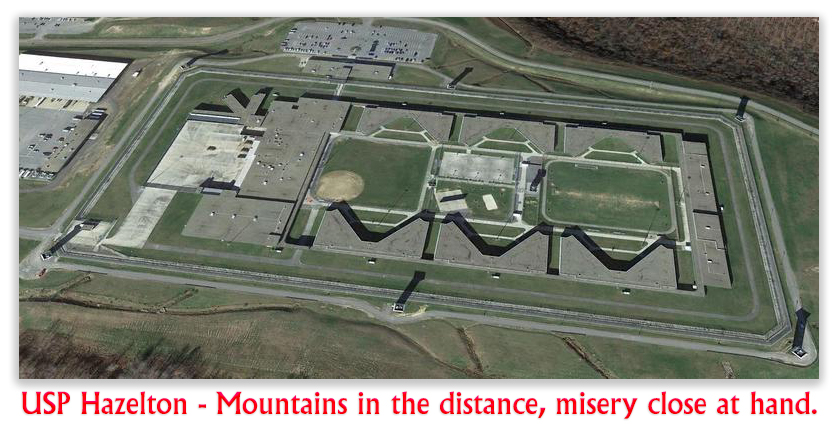
Trump to pardon notorious drug kingpin Juan Orlando Hernandez
Former president of Honduras, Juan Orlando Hernandez to receive corrupt Trump pardon from Hazelton Federal Correctional Complex
By Lynda Carson - November 30, 2025
According to a news report from the BBC, in part it says, “Juan Orlando Hernández was sentenced to 45 years in prison for drug trafficking and firearms offenses. Donald Trump has said that he will pardon the former president of Honduras, Juan Orlando Hernández, who was convicted of drug trafficking charges in a US court last year. The US president said Hernández had been "treated very harshly and unfairly" in a social media post announcing the move on Friday. Hernández was found guilty in March 2024 of conspiring to import cocaine into the US, and of possessing machine guns. He was sentenced to 45 years in prison.”
The convicted felon President Trump has made the news repeatedly for illegally blowing up boats in the water that he claims are drug dealers, without offering any proof. Us military personnel have been reminded that they do not have to follow any unlawful or illegal orders, and that has upset the convicted felon in the White House to extremes.
Note: US troops https://www.indybay.org/newsitems/2016/09/07/18790947.php were deeply involved in trafficking of heroin and opium in Afghanistan. Report, from KABUL - Opium addiction - 2007.
“Barbosa said the next challenge will be high
addiction levels, especially among returnees from Iran and
the ethnic Turkmen community in Jowzan and Faryab provinces.
Children as young as five are addicted, as a result of their
mothers blowing opium smoke into their faces to calm them
down or licking their hands while they harvest resin from the
poppy flowers. Doctors report they must travel to homes to
provide care, as addicts are too embarrassed to come to the
medical clinic to seek help.”
News Headlines for Drug Trafficking Kingpins:
Click below…
https://news.google.com/search?q=drug%20trafficking%20kingpins&hl=en-US&gl=US&ceid=US%3Aen
Drug Kingpin Juan Orlando Hernandez.
According to public records, Juan Orlando Hernandez, age 57, white male, register number: 91441-054, is a federal inmate located at Hazelton United States Prison, in West, Virginia, with a release date of 6/19/2060. Hazelton Federal Correctional Complex, where Whitey Bulger was killed, reportedly is known as the second deadliest prison in the country.
Reportedly, “Hernández hired lobby firm BGR group for $660,000. - Secretary Rubio has been one of the top recipients in campaign contributions from BGR, and may have helped to get a pardon for Hernandez.”
According to the website for the Department of Justice, in a big headline, in part it says, “Juan Orlando Hernández, Former President of Honduras, Sentenced to 45 Years in Prison for Conspiring to Distribute More Than 400 Tons of Cocaine and Related Firearms Offenses.”
That’s right. This is a bad hombre https://en.wikipedia.org/wiki/Juan_Orlando_Hern%C3%A1ndez , convicted of trafficking tons of cocaine and firearms. Just the sort of guy you would expect the convicted felon President Trump to pardon, when considering the 1,500 or so January 6 federal criminals he pardoned, that attacked the Capitol building in an effort to overturn the election on behalf of Trump.
Convicted felon President Trump makes the DOJ look stupid for going after drug kingpin Juan Orlando Hernandez, meanwhile notorious drug kingpin Joaquin "El Chapo" Guzman has sued the federal Supermax prison in Colorado where he resides over “torture” conditions.
Juan Orlando Hernández To Be Pardoned By Convicted Felon President Trump.
The June 26, 2024, DOJ release in part also says, “Hernández Conspired with Some of the Largest Drug Traffickers in the World to Transport Tons of Cocaine through Honduras to the United States.
The former president of Honduras, Juan Orlando Hernández, 55, also known as JOH, was sentenced today to 540 months in prison and 60 months of supervised release for cocaine importation and related weapons offenses. The former two-term president was in office until weeks before his extradition to the United States in April 2022. Hernández was convicted on March 8 following a three-week jury trial.
“As President of Honduras, Juan Orlando Hernández abused his power to support one of the largest and most violent drug trafficking conspiracies in the world, and the people of Honduras and the United States bore the consequences,” said Attorney General Merrick B. Garland. “Thanks to the diligent work of the Justice Department’s agents and prosecutors, Hernández will now spend more than four decades in prison. The Justice Department will hold accountable all those who engage in violent drug trafficking, regardless of how powerful they are or what position they hold.”
“The Drug Enforcement Administration (DEA) is relentlessly focused on dismantling drug trafficking organizations that threaten the safety and health of the American people,” said DEA Administrator Anne Milgram. “Former Honduran President Juan Orlando Hernández financed his political career with drug trafficking profits and abused his authority as President of Honduras to traffic hundreds of tons of cocaine to the United States. Let me be clear, political actors who use their power to traffic in drugs and corruption will be brought to justice in the United States.”
“As the former two-term president of Honduras, Juan Orlando Hernández had every opportunity to affect positive change for his country," said U.S. Attorney Damian Williams for the Southern District of New York. "Instead, Hernández helped to facilitate the importation of an almost unfathomable 400 tons of cocaine to this country: billions of individual doses sent to the United States with the protection and support of the former president of Honduras. Now, after years of destructive narco-trafficking of the highest imaginable magnitude, Hernández will spend 45 years where he belongs: in federal prison.”
According to court documents, from at least in or about 2004, up to and including in or about 2022, Hernández, the former two-term president of Honduras and former president of the Honduran National Congress, was at the center of one of the largest and most violent drug-trafficking conspiracies in the world. During his political career, Hernández abused his powerful positions and authority in Honduras to facilitate the importation of over 400 tons of cocaine into the U.S. Hernández’s co-conspirators were armed with machine guns and destructive devices, including AK-47s, AR-15s, and grenade launchers, which they used to protect their massive cocaine loads as they transited across Honduras on their way to the United States, protect the money they made from the eventual sale of this cocaine, and guard their drug-trafficking territory from rivals. Hernández received millions of dollars of drug money from some of the largest and most violent drug-trafficking organizations in Honduras, Mexico, and elsewhere, and used those bribes to fuel his rise in Honduran politics. In turn, as Hernández rose to power in Honduras, he provided increased support and protection for his co-conspirators, allowing them to move mountains of cocaine, commit acts of violence and murder, and help turn Honduras into one of the most dangerous countries in the world.
During his time in office, Hernández publicly promoted legislation and the efforts he purported to undertake in support of anti-narcotics measures in Honduras. At the same time, he protected and enriched the drug traffickers in his inner circle and those who provided him with cocaine-fueled bribes that allowed him to obtain and stay in power in Honduras. For example, Hernández selectively upheld extraditions by supporting and taking credit for extraditions to the United States of certain drug traffickers who threatened his grip on power, while at the same time promising drug traffickers who bribed him and followed his instructions that they would remain safe in Honduras. In addition, Hernández and his co-conspirators abused Honduran institutions, including the Honduran National Police and Honduran military, to protect and grow their conspiracy. Among other things, members of the conspiracy used heavily armed Honduran National Police officers to protect their cocaine loads as they transited through Honduras towards the United States for eventual distribution. Members of the conspiracy also turned to violence and murder to protect and grow their drug trafficking enterprise, attacking and murdering rival traffickers and those who threatened their grip on the Honduran cocaine trade.
Several of Hernández’s co-conspirators have already been convicted and sentenced in connection with this investigation. Among others, Hernández’s brother, Juan Antonio Hernández Alvarado, also known as Tony Hernández, was convicted after trial in October 2019 and sentenced to life in prison, and Geovanny Fuentes Ramirez, a violent cocaine trafficker who met with Hernández on multiple occasions to discuss their drug trafficking partnership, was convicted after trial in March 2021 and sentenced to life in prison. Juan Carlos Bonilla Valladares, also known as El Tigre, the former chief of the Honduran National Police, pleaded guilty to his participation in the cocaine importation conspiracy and is scheduled to be sentenced on Aug. 1, and Mauricio Hernández Pineda, a former member of the Honduran National Police and Hernández’s cousin, pleaded guilty to his participation in the cocaine importation conspiracy and is scheduled to be sentenced on July 2.
In total, Hernández and his co-conspirators trafficked more than 400 tons of U.S.-bound cocaine through Honduras during Hernández’s tenure in the Honduran government. This amounts to well over approximately 4.5 billion individual doses of cocaine.
The DEA investigated the case.
The Justice Department’s Office of International Affairs provided valuable assistance in securing Hernández’s arrest and extradition.
Trial Attorneys Andrea Broach and Jessica Fender of the National Security Division’s Counterterrorism Section and Assistant U.S. Attorney Jacob H. Gutwillig, David J. Robles, Elinor L. Tarlow, and Kyle A. Wirshba for the Southern District of New York prosecuted the case.”
As far back as 2003, Juan Orlando Hernandez was known for his involvement in drug trafficking in Honduras. Reportedly, “Josías Aguilar, an attorney who had previously worked as a detective in two operations against the Valle Valle Cartel at the age of 21, exposed the connections between the drug trade and siblings Tony and Juan Orlando Hernandez. While working for the Attorney General’s Office, Aguilar brought to light the former president’s connections to drug trafficking and reported it to his supervisor, Soraya Cálix, as well as the outgoing Attorney General, Óscar Fernando Chinchilla. This story narrates everything that the Public Ministry failed to do over a decade against the Honduran narco-state.”
More about drug trafficking in Honduras.
According to a December 31, 1975 report called,
NARCOTICS ACTIVITIES IN HONDURAS.
In part it says, “BEGIN SUMMARY: CHIEF OF HONDURAN INVESTIGATIVE POLICE
SERIOUSLY CONCERNED AT INCREASE IN NARCOTICS TRAFFIC TO
AND THROUGH HONDURAS. HE DESIRES INCREASE COORDINATION
WITH DEA AND CENTRAL AMERICAN COUNTERPARTS AND REQUESTS
U.S. ASSISTANCE FOR TRAINING. END SUMMARY.
EMBASSY NARCOTICS COORDINATOR DISCUSSED LOCAL
NARCOTICS SITUATION WITH MAJOR ENRIQUE TAYLOR CALDERINI,
CHIEF OF DIRECTION DE INVESTIGACION NACIONAL (DIN) THE
HONDURAN CRIMINAL INVESTIGATION AGENCY OF THE NATIONAL
POLICE (FUSEP). TAYLOR FORCEFULLY EXPRESSED CONCERN
THAT ILLICIT DRUG TRAFFICKING WAS INCREASING IN HONDURAS.
HE BELIEVES THAT SIGNIFICANT AMOUNTS OF COCAINE AND MARI-
JUANA ARE PASSING THROUGH HONDURAS FROM SOUTH AMERICA TO
THE UNITED STATES RESULTING ALSO IN GREATER USE OF THESE
DRUGS LOCALLY. HE SAID LOCAL MARIJUANA USERS ARE TURNING
TO OUTSIDE SOURCES COMPLAINING HOME-GROWN GRASS NOT SUF-
FICIENTLY STRONG. POLICE HAVE ALSO RECENTLY UNCOVERED
FIRST KNOWN LOCAL USE OF HASHISH.
TAYLOR BLAMES COLUMBIANS AND CHILEANS LINKED WITH "MAFIA"
FOR INCREASED TRAFFICKING, BUT ALSO BELIEVES SOME U.S. CITI-
ZENS MAY BE INVOLVED, PARTICULARLY IN BAY ISLANDS AREA.
TAYLOR INDICATED STRONG DESIRE TO INCREASE COORDINATION
WITH DEA POINTING OUT THAT HIS AGENCY'S RESOURCES IN BOTH
MANPOWER AND MONEY ARE VERY LIMITED. HE PARTICULARLY WOULD
LIKE DEA ASSISTANCE IN TRAINING HIS PERSONNEL. HE WAS RE-
SPONSIVE TO EMBOFF'S COMMENTS ON POSSIBILITY OF FUTURE
CENTRAL AMERICAN REGIONAL TRAINING COURSE AND RECOGNIZED
DESIRABILITY OF CLOSER COORDINATION WITH OTHER CENTRAL AMERICAN
POLICE AGENCIES, HOWEVER, HE OBVIOUSLY WOULD PREFER AN IN-
COUNTRY TRAINING PROGRAM FOR A LARGER NUMBER OF AGENTS.
HE EMPHASIZED THE NEED FOR LEARNING "EMPIRICAL" SKILLS
SUCH AS STREET LEVEL IDENTIFICATION OF ILLICIT SUBSTANCES
RATHER THAN MORE SOPHISTICATED TRAINING. HE EXPRESSED DIS-
APPOINTMENT THAT PREVIOUS HONDURAN PARTICIPANTS IN U.S.
TRAINING PROGRAMS HAVE NOT BEEN SUCCESSFUL IN CONSTRUCTING
LOCAL TRAINING PROGRAMS TO PASS ON WHAT THEY LEARNED.
TAYLOR ALSO EXPRESSED NEED FOR ASSISTANCE IN ESTABLISH-
ING A CRIMINAL LABORATORY CAPABLE OF ANALYSING AND
IDENTIFYING ILLICIT DRUGS.
COMMENT: TAYLOR'S CONCERN QUITE GENUINE ALTHOUGH
WHETHER IT REFLECTS INCREASE IN TRAFFICKING OR INCREASED
POLICE AWARENESS OF TRAFFICKING DEBATABLE. EMBASSY CON-
CURS IN NEED FOR U.S. ASSISTANCE IN TRAINING LOCAL NAR-
COTICS AGENTS AND STRONLY SUPPORTS IDEA OF REGIONAL
COURSE AS SUGGESTED IN REFTEL. LABORATORY EQUIPMENT IS
PERENNIAL REQUEST WHICH EMBASSY DOES NOT SUPPORT IN
VIEW ACCESSIBILITY TO ADEQUATE LABORATORY FACILITIES
THROUGH OTHER GOH AGENCIES. EMBASSY HOPES DEA CAN IN-
CREASE THEIR COOPERATION WITH DIN, PLACING GREATER
EMPHASIS AT PRESENT ON TRAINING AND INSTITUTION BUILDING
THAN ON OPERATIONS.”
In a June 26, 2003 report called, MEDIA REACTION ON DRUG TRAFFICKING, JUNE 26, 2003.
In part it says, “Article in Tegucigalpa-based liberal daily "La Tribuna"
on 6/26 entitled "U.S. Ambassador doesn't see results
against narcos." "U.S. Ambassador Larry Palmer affirmed that
his government, just like the rest of Hondurans, expects to
see positive results in the fight against narco-
trafficking."
"The Ambassador stated, `We want results: drug seizures,
arrests of narco traffickers and convictions for those
responsible of such acts. we are deeply concerned with the
recent rise of organized crime and narco trafficking'."
"He added, `More than a year ago, the Embassy received an
anonymous report that gives names of many people linked to
narco-trafficking and organized crime. We'd like to see a
thorough investigation by the Honduran authorities to find
out whether those allegations are true or not; the Honduran
people are entitled to know'."
"Concerning the arrest of Cesar Diaz, the Honduran member of
the Central American Parliament who was arrested in
Nicaragua with 7 kilos of heroin, he declared `it is more
important what comes after his apprehension. I hope the
Honduran authorities do their best to penalize rigorously
those responsible for narco-trafficking'."
Article in San Pedro Sula-based liberal daily "La Prensa"
on 6/26 entitled "The U.S. demands the maximum penalty for
narcos". "U.S. Ambassador Larry Palmer sent a clear
challenge to the Judicial branch, the police and the General
Attorney's Office: seize more drugs and penalize drug
traffickers with the maximum penalty."
"In a press conference, Palmer affirmed, `The police and the
General Attorney Office's are responsible for finding out
the whereabouts of narco-traffickers. We expect positive
results from their task'."
"About the arrest of Congressman Cesar Diaz, the Ambassador
stated that the behavior of one person can't affect the
image of the whole country. He declared that the important
thing is that those guilty of these crimes must be severely
punished by law."
Article in "La Tribuna" on 6/26 entitled "U.S. aid is
only enough for their advisors". "The coordinator of
prosecutors of the Attorney General Office, Humberto
Palacios Moya, said that they will only keep arresting minor
users of marijuana and cocaine if the U.S. doesn't help to
improve their logistical structures."
"Palacios affirmed, `The anti-narcotics police has only 29
agents for the whole country, we have said this to the
National Congress and the U.S. Embassy but their answer is
that they have given enough money for the fight against
drugs. what the Americans do not say is that their money
mainly goes to the DEA advisors and other international
organizations'."
Article in "La Tribuna" on 6/26 entitled "The Attorney
General's Office is also infiltrated". "Alfredo Landaverde,
former Executive Director of the National Council against
Narco Trafficking, challenged governmental authorities to
categorically face narco-trafficking, one of the most
dangerous branches of organized crime."
"Concerning the infiltration of organized crime in the
country's security forces, he emphatically affirmed, `many
policemen have personally told me they are afraid of some of
their colleagues because they know they work for criminal
organizations. Honduras has a few good prosecutors, judges
and policemen determined to fight against organized crime
but beside them, we can also find infiltrated officials'."
"He added, `I know they will call me once again to confirm
those accusations. Then, I guess they will also call the
U.S. embassy's DCM Roger Pierce for saying that as well'."
Article in "La Tribuna" on 6/26 entitled "Four Colombians
are arrested in narco plane case". "Four Colombians and two
Hondurans were arrested and accused for being tied with the
narco organizations operating in the region of Colon, which
recently burned and destroyed a plane that was used to
transport 500 kilos of cocaine, apparently from Colombia".
Article in "La Prensa" on 6/26 entitled "Maduro asks the
U.S. for help". "President Maduro stated that the fight
against drug trafficking is much more difficult for a poor
country like Honduras, and `that is why I'm asking the U.S.
which has always been an extraordinary ally, to increase its
support on this issue. this campaign requires a lot of money
and we need the help of a big country like the U.S.'."
"Maduro declared, the fight against drug trafficking
demands sophisticated equipment, such as radars and special
vehicles the country can't afford because public funds are
used to address other priorities, such as the fight against
crime and health and education programs'."
Article in Tegucigalpa-based moderate daily "El Heraldo"
on 6/26 entitled "The U.S. should aid more". "President
Maduro stated the United States has helped, but not in the
degree this country needs for accomplishable results.
Ambassador Larry Palmer replied, `the Honduran public has
the right to know and if they determine these allegations to
be true, then we want the guilty to receive the maximum
penalty of the law. I won't be satisfied until all drug-
traffickers are in jail, but it's a pretty hard fight'."
"Maduro added, `Honduras needs more help because the public
funds go towards teenage delinquency and education systems.
Money and sophisticated equipment are needed for this
project, and the amount of money Honduras currently has is
not enough to cover certain needs'."
Additionally, according to a July 8, 2003 report called ANOTHER HONDURAN CONGRESSMAN BUSTED ON DRUG CHARGES, in part it says,
“SUMMARY: Yet another Honduran political figure was
implicated in drug trafficking when he was arrested on July 6
fleeing the scene of an airplane crash in the eastern
department of Olancho. National Party Deputy, Armando Avila
Panchame, was arrested by the police for drug trafficking and
attempted murder (for running his car through two police
roadblocks.) President Ricardo Maduro, President of the
National Congress Pepe Lobo, and Attorney General Roy Medina
-- all indicated congressional immunity would be lifted to
pursue the prosecution of this deputy. This arrest could
prove to be a key test of the political and judicial
systems, ability to attack the growing narcocorruption
problem in Honduras. END SUMMARY
On Saturday, July 5, Honduran police authorities,
responding to intelligence information, mounted an operation
against a suspected drug trafficking airplane that crashed in
the eastern Honduran department of Olancho. The operation
resulted in the arrest of nine individuals, including a
member of the Honduran National Congress, Armando Avila
Panchame, a Colombian, and a Venezuelan. Unfortunately,
there were no drugs seized or found; however police are still
conducting a series of searches of the surrounding areas.
Canine units, funded by a State International Narcotics and
Law Enforcement (INL) program, did alert to the rpesence of
drugs in the aircraft and vehicles. The bold narco aircraft
landing took place on a secondary paved roadway that was
blocked by drug traffickers, vehicles, which had been
modified to illuminate the makeshift runway with floodlights.
Trees along the roadway had also been removed with
chainsaws. Police recovered automatic AK-47 and M-16 rifles,
200 rounds of ammunition, satellite phones, radio equipment,
and night reflector vests at the location. It appears that
the aircraft successfully unloaded its cargo, but in its
haste to depart as police descended on the scene it struck
one of the vehicles that had secured one end of the
improvised runway.
(SBU) There is some media speculation, based on public
statements made by the son of the notorious (and currently
incarcerated in the U.S.) drug trafficker Ramon Matta, that
there was a confrontation between rival drug cartels. The
location of the drug delivery abutted a ranch owned by the
Matta family. Matta is claiming to have aided police by
informaing them of the landing of the suspect aircraft and
ythen shooting at it as it tried to depart. He also said he
permitted searches of his property for the missing drugs.
(Comment: Police report no such cooperation and have said
that the shots fired from the Matta group were a signal to
the aircraft,s pilot that police were approaching. There
were bullet holes observed in the aircraft. End Comment.)
While no drugs were seized, Honduran Deputy Avila
Panchame is charged with attempted murder for having run his
vehicle through two police roadblocks. The statements of two
police officers at those roadblocks accuse Avila Panchame of
refusing to stop and charging through the roadblocks. He is
also being charged with drug trafficking. The arrest of a
member of Congress is keeping the spotlight on the extent to
which narcocorruption is permeating Honduran institutions.
President Maduro, President of the National Congress Pepe
Lobo, and the Attorney General have all indicated
congressional immunity will be waived in this case to pursue
the prosecution of this deputy on the drug charges. Under
the Honduran Constitution, immunity for attempted murder or
murder are exempt from any congressional immunity claim
(Comment: This incident is not the first time that Avila
Panchame has come to the Embassy,s attention for possible
involvement in drug trafficking. Earlier in April of this
year, the same vehicle in which he was traveling during this
incident was observed by witnesses at the scene of an earlier
suspected crashed aircraft. In that incident police seized
397 kilos of cocaine, but no arrests were ever made. End
Comment.)
COMMENT: This arrest could prove to be a key test of
the political and judicial systems, ability to attack the
growing narco-corruption problem in Honduras. Avila Panchame
is now the third Honduran political figure to be arrested on
drug trafficking charges in the last year. Coming on the
heels of the June 20 arrest of Liberal Party Central American
Parliament member Cesar Diaz in Nicaragua (reftel) and last
summer,s arrest of a former deputy in Panama (both of whom
were arrested in possession of heroin) the media is
highlighting the mounting connections between international
drug traffickers and Honduran political elites. As reported
septel, the Ambassador recently placed the Attorney General
on notice that his office must produce some high-profile
drug-trafficking and corruption prosecutions immediately or
risk losing further U.S. support. We will be monitoring
developments in this case closely.”
Additionally, according to December 10, 2003 report called HONDURAN POLICE SEIZE 636 KILOS OF COCAINE AND ARREST PARLACEN STAFF MEMBER FOR DEALING COCAINE, in part it says, “Summary: On December 4, Honduran authorities seized
approximately 636 kilos of cocaine from a truck in San Pedro
Sula. The seizure of the drugs was the result of
well-executed police work, acting upon a tip that a large
amount of drugs would soon be moving through the country.
The drugs were discovered in a concealed compartment in the
back of a truck. This brings the total amount of cocaine
seized this year in Honduras to approximately 5,700 kilos.
Also, later that same day, Jorge Alberto Caceres, (a PARLACEN
staff member) was arrested for distributing and selling
cocaine in the parliament's offices. End Summary.
On December 4, Honduran authorities seized approximately
636 kilos of cocaine from a truck in San Pedro Sula. Police
initially stopped the vehicle because his windows were
completely tinted (Note: It is technically illegal in
Honduras to have one's windows 100 percent tinted. End
note). After approaching the vehicle, the police noticed
that the "very nervous" driver possessed two cellular phones,
a radio, and various sets of keys. The driver, who claimed
to be from Honduras, then presented "suspicious"
identification, and when police asked him some very basic
questions about Honduras, he was unable to answer. The
police then performed a complete search of the vehicle
leading to the discovery of the concealed compartment.
According to the Vice Minister of Security, Armando
Calidonio, the seizure was the product of an operation led by
the National Police, who acted upon general information they
had received that a rather large shipment of drugs would soon
transit the country. It appears that the 636 kilos were only
a part of the original shipment of approximately 1,200 kilos.
According to the driver, the remainder had been placed in
another identical vehicle. It is suspected that the other
half of the shipment has already left the country.
In an unrelated incident later that same day, police
arrested Jorge Alberto Caceres, a staff member of the Central
American Parliament (PARLACEN), for distributing and selling
cocaine in the parliament's offices in Tegucigalpa. Hours
before Caceres' arrest, four other men were arrested upon
leaving PARLACEN, all of whom were found to be in possession
of cocaine, presumably for the purpose of selling it.
The sting operation at PARLACEN was part of a month-long
investigation, in which government officials claim to have
videotaped Caceres selling cocaine on various occasions. A
search of Caceres' office came up empty, but authorities
presume that the drugs are hidden somewhere else in the
PARLACEN complex. (Note: According to press reports, the
director of PARLACEN only gave authorities permission to
search Caceres' office. End Note). Caceres is the second
Honduran at PARLACEN this year to be arrested on drug-related
charges. Earlier this year, Cesar Diaz was arrested in
Nicaragua when police found seven kilos of heroin in his
vehicle (reftel). He was later convicted of trafficking and
possession of heroin.
These latest seizures bring the total amount of cocaine
seized this year in Honduras to approximately 5,700 kilos.
This is significantly more than has been seized in the last
seven years combined.”
In a December 17, 2009 report called MEXICAN NAVY OPERATION NETS DRUG KINGPIN ARTURO BELTRAN LEYVA.
In part it says, “Summary. Mexican Navy forces acting on U.S.
information killed Arturo Beltran Leyva in an operation on
December 16, the highest-level takedown of a cartel figure
under the Calderon administration. The operation is a clear
victory for the Mexican Government and an example of
excellent USG-GOM cooperation. The unit that conducted the
operation had recieved extensive U.S. training. Arturo
Beltran Leyva's death will not solve Mexico's drug problem,
but it will hopefully generate the momentum necessary to make
sustained progress against other drug trafficking
organizations. End Summary.
The Operation
-------------
Mexican Navy (SEMAR) sources revealed on the night of
December 17 that SEMAR forces killed Arturo Beltran Leyva
(ABL), head of the Beltran Leyva Organization, during a
shoot-out in Cuernavaca (approximately 50 miles south of
Mexico City) that afternoon. At least three other cartel
operatives were killed during the raid, with a fourth
committing suicide. While it still has not been confirmed,
Embassy officials believe the latter to be ABL's brother,
Hector, which would mean that all Beltran Leyva brothers are
either dead or in prison. Arturo Beltran Leyva has a long
history of involvement in the Mexican drug trade, and worked
with Joaquin "El Chapo" Guzman and his Sinaloa Cartel before
splitting in 2008. The rivalry between the Sinaloa and
Beltran Leyva organizations has been a key factor driving the
escalating levels of narcotics-related violence in recent
years. Born in Sinaloa, ABL has been key to the importation
and distribution of cocaine and heroin in the United States,
and also has extensive money laundering capabilities,
corruption networks, and international contacts in Colombia
and the U.S.
Embassy law enforcement officials say that the arrest
operation targeting ABL began about a week prior to his death
when the Embassy relayed detailed information on his location
to SEMAR. The SEMAR unit has been trained extensively by
NORTHCOM over the past several years. SEMAR raided an
identified location, where they killed several ABL bodyguards
and arrested over 23 associates, while ABL and Hector
escaped. On Monday, the Embassy interagency linked ABL to an
apartment building located in Cuernavaca (about an hour south
of Mexico City), where ABL was in hiding. SEMAR initiated an
arrest operation on Wednesday afternoon, surrounding the
identified apartment complex, and establishing a security
perimeter. ABL's forces fired on the SEMAR operatives and
engaged in a sustained firefight that wounded three SEMAR
marines and possibly killed one. SEMAR forces evacuated
residents of the apartment complex to the gym, according to
press accounts, and no civilian casualties have so far been
reported.
The Mexican Interagency
-----------------------
The successful operation against ABL comes on the
heels of an aggressive SEMAR effort in Monterrey against Zeta
forces (ref a) and highlights its emerging role as a key
player in the counternarcotics fight. SEMAR is well-trained,
well-equipped, and has shown itself capable of responding
quickly to actionable intelligence. Its success puts the
Army (SEDENA) in the difficult position of explaining why it
has been reluctant to act on good intelligence and conduct
operations against high-level targets. The U.S. interagency
originally provided the information to SEDENA, whose refusal
to move quickly reflected a risk aversion that cost the
institution a major counternarcotics victory. SEDENA did
provide backup to SEMAR during the firefight with ABL forces,
but can take little credit for the operation. Public
Security Secretary (SSP) Genaro Garcia Luna can also be
counted as a net loser in the Mexican interagency following
the ABL operation. SSP considers high-level Beltran Leyva
targets to be its responsibility, and Garcia Luna has already
said privately that the operation should have been his.
The Impact on Violence
----------------------
It is early to say with a great degree of confidence
what kind of effect ABL's death will have on levels of
narco-related violence in Mexico. A spike is probably likely
in the short term as inter- and intra-cartel battles are
intensified by the sudden leadership gap in one of the
country's most important cartels. With all the Beltran Leyva
brothers likely dead or in prison, there are a number of
other cartel functionaries likely to vie for the leadership
slot. Moreover, rival organizations may intensify efforts to
expand their influence in the disarray likely to follow ABL's
death. At the very least, efforts to clean the Beltran Leyva
house and rout out suspected informers will be bloody, and
retaliation by the organization against Mexican law
enforcement or military officials is not out of the cards.
In the medium to longer term, ABL's death could have
the potential to lower the level of narco-violence rates.
ABL himself was a particularly violent leader with numerous
effective assassin teams. Moreover, the Sinaloa-Beltran
Leyva rivalry has been responsible for a large number of
narcotics-related homicides in Mexico, and also largely
personally driven by the Beltran Leyva brothers themselves.
Emboffs speculate that Beltran Leyva associates, under
pressure and perhaps more vulnerable due to leadership
deficiencies, could move to align more closely again with
Sinaloa, which they might think offers a more natural
protection than the Zetas.
The Boost for Calderon
----------------------
SEMAR's successful operation against ABL is a major
victory for President Calderon and his war against organized
crime. ABL is the highest ranking target taken down by the
Calderon government, and his status as one of the most
important and long-standing of Mexican drug traffickers makes
his takedown even more symbolically important. President
Calderon has openly admitted to having a tough year -- his
party lost big in the midterm elections, he is confronting an
economic crisis, and nationwide homicide rates continue to
climb -- and contacts have told Poloff that he has seemed
"down" in meetings. The SEMAR operation is undoubtedly a
huge boost for him, both in terms of bolstering public
support for his security efforts and in reassuring himself
that important security accomplishments in this area are
possible. Calderon's political opponents will also find it
far less useful to accuse the President of hanging on to an
ineffective anti-crime strategy that nets numerous mid- to
low-level cartel figures but fails to rein in the major
kingpins. The major Mexico City dailies have run front page
Beltran Leyva stories, and President Calderon's remarks in a
press conference from Copenhagen highlighting that the
operation represents an "important achievement for the
Mexican people and government" were widely covered.
Comment
-------
The operation against Arturo Beltran Leyva is a clear
victory for the Mexican Government and an example of
excellent USG-GOM cooperation. Seamless Embassy interagency
collaboration combined with a willing, capable, and ready
SEMAR produced one of the greatest successes to date in the
counternarcotics fight. ABL's death will provide an
important boost to Calderon and hopefully will cultivate a
greater sense of confidence within Mexican security agencies
that will encourage them to take greater advantage of similar
opportunities. SEMAR's win in particular may encourage
SEDENA to be more proactive and less risk averse in future
operations. ABL's death will certainly not resolve Mexico's
drug problem, but it will likely generate the momentum
necessary within the GOM security apparatus to make sustained
and real progress against the country's drug trafficking
organizations.
Visit Mexico City's Classified Web Site at
http://www.state.sgov.gov/p/wha/mexicocity and the North American
Partnership Blog at http://www.intelink.gov/communities/state/nap /
PASCUAL
Drug Kingpins and TMM shipping line.
By Port Watch.
https://www.indybay.org/newsitems/2003/01/23/15647041.php
TMM – Transportacion Maritima Mexicana - . Ports, see link below…
Ports: https://sanpedro.com/commercial-shipping/#google_vignette
https://transportacionmaritima.com/en/port-agency/
Reportedly, Some Narco Trafficking Dealings of "TMM/Transportacion Maritima Mexicana.
Click below…
http://www.customscorruption.com/white_tiger/WhiteTigerAttachmentInsight7.gif
Operation White Tiger
https://www.customscorruption.com/white_tiger/operation.htm
https://www.customscorruption.com/white_tiger/WhiteTigerDoc1.gif
https://www.customscorruption.com/white_tiger/WhiteTigerDoc2.gif
https://www.customscorruption.com/white_tiger/WhiteTigerDoc3.gif
https://www.customscorruption.com/white_tiger/WhiteTigerDoc4.gif
https://www.customscorruption.com/white_tiger/WhiteTigerDoc5.gif
TMM, owned by drug kingpins used to, or still may operate out of the Port of Oakland.
TMM - Carlos Hank Rohn
https://www.customscorruption.com/white_tiger/WhiteTigerAttachmentInsight7.gif
The Politics of Heroin in Southeast Asia, by Alfred W. McCoy
https://renincorp.org/bookshelf/politics-of-heroin-in-south.pdf
The Politics of Heroin: CIA Complicity in the Global Drug Trade (ISBN 1-55652-483-8).
Click below…
https://ia904503.us.archive.org/24/items/alfred-w.-mc-coy-the-politics-of-heroin-2003/Alfred%20W.%20McCoy%20-%20The%20politics%20of%20heroin%20-%202003.pdf
Dark Alliance: The CIA, the Contras, and the Crack Cocaine Explosion
by Gary Webb
Click below…
https://archive.org/stream/dark-alliance-the-cia-the-con-gary-webb/Dark%20Alliance_%20The%20CIA%2C%20the%20Con%20-%20Gary%20Webb_djvu.txt
Dark Alliance: The CIA, the Contras, and the Crack Cocaine Explosion
by Gary Webb
https://archive.org/details/dark-alliance-the-cia-the-con-gary-webb/mode/1up
The Storm Over Dark Alliance
https://nsarchive2.gwu.edu/NSAEBB/NSAEBB113/storm.htm
Lynda Carson may be reached at newzland2 [at] gmail.com
>>>>>>>>
>>>>>>>>
Former president of Honduras, Juan Orlando Hernandez to receive corrupt Trump pardon from Hazelton Federal Correctional Complex
By Lynda Carson - November 30, 2025
According to a news report from the BBC, in part it says, “Juan Orlando Hernández was sentenced to 45 years in prison for drug trafficking and firearms offenses. Donald Trump has said that he will pardon the former president of Honduras, Juan Orlando Hernández, who was convicted of drug trafficking charges in a US court last year. The US president said Hernández had been "treated very harshly and unfairly" in a social media post announcing the move on Friday. Hernández was found guilty in March 2024 of conspiring to import cocaine into the US, and of possessing machine guns. He was sentenced to 45 years in prison.”
The convicted felon President Trump has made the news repeatedly for illegally blowing up boats in the water that he claims are drug dealers, without offering any proof. Us military personnel have been reminded that they do not have to follow any unlawful or illegal orders, and that has upset the convicted felon in the White House to extremes.
Note: US troops https://www.indybay.org/newsitems/2016/09/07/18790947.php were deeply involved in trafficking of heroin and opium in Afghanistan. Report, from KABUL - Opium addiction - 2007.
“Barbosa said the next challenge will be high
addiction levels, especially among returnees from Iran and
the ethnic Turkmen community in Jowzan and Faryab provinces.
Children as young as five are addicted, as a result of their
mothers blowing opium smoke into their faces to calm them
down or licking their hands while they harvest resin from the
poppy flowers. Doctors report they must travel to homes to
provide care, as addicts are too embarrassed to come to the
medical clinic to seek help.”
News Headlines for Drug Trafficking Kingpins:
Click below…
https://news.google.com/search?q=drug%20trafficking%20kingpins&hl=en-US&gl=US&ceid=US%3Aen
Drug Kingpin Juan Orlando Hernandez.
According to public records, Juan Orlando Hernandez, age 57, white male, register number: 91441-054, is a federal inmate located at Hazelton United States Prison, in West, Virginia, with a release date of 6/19/2060. Hazelton Federal Correctional Complex, where Whitey Bulger was killed, reportedly is known as the second deadliest prison in the country.
Reportedly, “Hernández hired lobby firm BGR group for $660,000. - Secretary Rubio has been one of the top recipients in campaign contributions from BGR, and may have helped to get a pardon for Hernandez.”
According to the website for the Department of Justice, in a big headline, in part it says, “Juan Orlando Hernández, Former President of Honduras, Sentenced to 45 Years in Prison for Conspiring to Distribute More Than 400 Tons of Cocaine and Related Firearms Offenses.”
That’s right. This is a bad hombre https://en.wikipedia.org/wiki/Juan_Orlando_Hern%C3%A1ndez , convicted of trafficking tons of cocaine and firearms. Just the sort of guy you would expect the convicted felon President Trump to pardon, when considering the 1,500 or so January 6 federal criminals he pardoned, that attacked the Capitol building in an effort to overturn the election on behalf of Trump.
Convicted felon President Trump makes the DOJ look stupid for going after drug kingpin Juan Orlando Hernandez, meanwhile notorious drug kingpin Joaquin "El Chapo" Guzman has sued the federal Supermax prison in Colorado where he resides over “torture” conditions.
Juan Orlando Hernández To Be Pardoned By Convicted Felon President Trump.
The June 26, 2024, DOJ release in part also says, “Hernández Conspired with Some of the Largest Drug Traffickers in the World to Transport Tons of Cocaine through Honduras to the United States.
The former president of Honduras, Juan Orlando Hernández, 55, also known as JOH, was sentenced today to 540 months in prison and 60 months of supervised release for cocaine importation and related weapons offenses. The former two-term president was in office until weeks before his extradition to the United States in April 2022. Hernández was convicted on March 8 following a three-week jury trial.
“As President of Honduras, Juan Orlando Hernández abused his power to support one of the largest and most violent drug trafficking conspiracies in the world, and the people of Honduras and the United States bore the consequences,” said Attorney General Merrick B. Garland. “Thanks to the diligent work of the Justice Department’s agents and prosecutors, Hernández will now spend more than four decades in prison. The Justice Department will hold accountable all those who engage in violent drug trafficking, regardless of how powerful they are or what position they hold.”
“The Drug Enforcement Administration (DEA) is relentlessly focused on dismantling drug trafficking organizations that threaten the safety and health of the American people,” said DEA Administrator Anne Milgram. “Former Honduran President Juan Orlando Hernández financed his political career with drug trafficking profits and abused his authority as President of Honduras to traffic hundreds of tons of cocaine to the United States. Let me be clear, political actors who use their power to traffic in drugs and corruption will be brought to justice in the United States.”
“As the former two-term president of Honduras, Juan Orlando Hernández had every opportunity to affect positive change for his country," said U.S. Attorney Damian Williams for the Southern District of New York. "Instead, Hernández helped to facilitate the importation of an almost unfathomable 400 tons of cocaine to this country: billions of individual doses sent to the United States with the protection and support of the former president of Honduras. Now, after years of destructive narco-trafficking of the highest imaginable magnitude, Hernández will spend 45 years where he belongs: in federal prison.”
According to court documents, from at least in or about 2004, up to and including in or about 2022, Hernández, the former two-term president of Honduras and former president of the Honduran National Congress, was at the center of one of the largest and most violent drug-trafficking conspiracies in the world. During his political career, Hernández abused his powerful positions and authority in Honduras to facilitate the importation of over 400 tons of cocaine into the U.S. Hernández’s co-conspirators were armed with machine guns and destructive devices, including AK-47s, AR-15s, and grenade launchers, which they used to protect their massive cocaine loads as they transited across Honduras on their way to the United States, protect the money they made from the eventual sale of this cocaine, and guard their drug-trafficking territory from rivals. Hernández received millions of dollars of drug money from some of the largest and most violent drug-trafficking organizations in Honduras, Mexico, and elsewhere, and used those bribes to fuel his rise in Honduran politics. In turn, as Hernández rose to power in Honduras, he provided increased support and protection for his co-conspirators, allowing them to move mountains of cocaine, commit acts of violence and murder, and help turn Honduras into one of the most dangerous countries in the world.
During his time in office, Hernández publicly promoted legislation and the efforts he purported to undertake in support of anti-narcotics measures in Honduras. At the same time, he protected and enriched the drug traffickers in his inner circle and those who provided him with cocaine-fueled bribes that allowed him to obtain and stay in power in Honduras. For example, Hernández selectively upheld extraditions by supporting and taking credit for extraditions to the United States of certain drug traffickers who threatened his grip on power, while at the same time promising drug traffickers who bribed him and followed his instructions that they would remain safe in Honduras. In addition, Hernández and his co-conspirators abused Honduran institutions, including the Honduran National Police and Honduran military, to protect and grow their conspiracy. Among other things, members of the conspiracy used heavily armed Honduran National Police officers to protect their cocaine loads as they transited through Honduras towards the United States for eventual distribution. Members of the conspiracy also turned to violence and murder to protect and grow their drug trafficking enterprise, attacking and murdering rival traffickers and those who threatened their grip on the Honduran cocaine trade.
Several of Hernández’s co-conspirators have already been convicted and sentenced in connection with this investigation. Among others, Hernández’s brother, Juan Antonio Hernández Alvarado, also known as Tony Hernández, was convicted after trial in October 2019 and sentenced to life in prison, and Geovanny Fuentes Ramirez, a violent cocaine trafficker who met with Hernández on multiple occasions to discuss their drug trafficking partnership, was convicted after trial in March 2021 and sentenced to life in prison. Juan Carlos Bonilla Valladares, also known as El Tigre, the former chief of the Honduran National Police, pleaded guilty to his participation in the cocaine importation conspiracy and is scheduled to be sentenced on Aug. 1, and Mauricio Hernández Pineda, a former member of the Honduran National Police and Hernández’s cousin, pleaded guilty to his participation in the cocaine importation conspiracy and is scheduled to be sentenced on July 2.
In total, Hernández and his co-conspirators trafficked more than 400 tons of U.S.-bound cocaine through Honduras during Hernández’s tenure in the Honduran government. This amounts to well over approximately 4.5 billion individual doses of cocaine.
The DEA investigated the case.
The Justice Department’s Office of International Affairs provided valuable assistance in securing Hernández’s arrest and extradition.
Trial Attorneys Andrea Broach and Jessica Fender of the National Security Division’s Counterterrorism Section and Assistant U.S. Attorney Jacob H. Gutwillig, David J. Robles, Elinor L. Tarlow, and Kyle A. Wirshba for the Southern District of New York prosecuted the case.”
As far back as 2003, Juan Orlando Hernandez was known for his involvement in drug trafficking in Honduras. Reportedly, “Josías Aguilar, an attorney who had previously worked as a detective in two operations against the Valle Valle Cartel at the age of 21, exposed the connections between the drug trade and siblings Tony and Juan Orlando Hernandez. While working for the Attorney General’s Office, Aguilar brought to light the former president’s connections to drug trafficking and reported it to his supervisor, Soraya Cálix, as well as the outgoing Attorney General, Óscar Fernando Chinchilla. This story narrates everything that the Public Ministry failed to do over a decade against the Honduran narco-state.”
More about drug trafficking in Honduras.
According to a December 31, 1975 report called,
NARCOTICS ACTIVITIES IN HONDURAS.
In part it says, “BEGIN SUMMARY: CHIEF OF HONDURAN INVESTIGATIVE POLICE
SERIOUSLY CONCERNED AT INCREASE IN NARCOTICS TRAFFIC TO
AND THROUGH HONDURAS. HE DESIRES INCREASE COORDINATION
WITH DEA AND CENTRAL AMERICAN COUNTERPARTS AND REQUESTS
U.S. ASSISTANCE FOR TRAINING. END SUMMARY.
EMBASSY NARCOTICS COORDINATOR DISCUSSED LOCAL
NARCOTICS SITUATION WITH MAJOR ENRIQUE TAYLOR CALDERINI,
CHIEF OF DIRECTION DE INVESTIGACION NACIONAL (DIN) THE
HONDURAN CRIMINAL INVESTIGATION AGENCY OF THE NATIONAL
POLICE (FUSEP). TAYLOR FORCEFULLY EXPRESSED CONCERN
THAT ILLICIT DRUG TRAFFICKING WAS INCREASING IN HONDURAS.
HE BELIEVES THAT SIGNIFICANT AMOUNTS OF COCAINE AND MARI-
JUANA ARE PASSING THROUGH HONDURAS FROM SOUTH AMERICA TO
THE UNITED STATES RESULTING ALSO IN GREATER USE OF THESE
DRUGS LOCALLY. HE SAID LOCAL MARIJUANA USERS ARE TURNING
TO OUTSIDE SOURCES COMPLAINING HOME-GROWN GRASS NOT SUF-
FICIENTLY STRONG. POLICE HAVE ALSO RECENTLY UNCOVERED
FIRST KNOWN LOCAL USE OF HASHISH.
TAYLOR BLAMES COLUMBIANS AND CHILEANS LINKED WITH "MAFIA"
FOR INCREASED TRAFFICKING, BUT ALSO BELIEVES SOME U.S. CITI-
ZENS MAY BE INVOLVED, PARTICULARLY IN BAY ISLANDS AREA.
TAYLOR INDICATED STRONG DESIRE TO INCREASE COORDINATION
WITH DEA POINTING OUT THAT HIS AGENCY'S RESOURCES IN BOTH
MANPOWER AND MONEY ARE VERY LIMITED. HE PARTICULARLY WOULD
LIKE DEA ASSISTANCE IN TRAINING HIS PERSONNEL. HE WAS RE-
SPONSIVE TO EMBOFF'S COMMENTS ON POSSIBILITY OF FUTURE
CENTRAL AMERICAN REGIONAL TRAINING COURSE AND RECOGNIZED
DESIRABILITY OF CLOSER COORDINATION WITH OTHER CENTRAL AMERICAN
POLICE AGENCIES, HOWEVER, HE OBVIOUSLY WOULD PREFER AN IN-
COUNTRY TRAINING PROGRAM FOR A LARGER NUMBER OF AGENTS.
HE EMPHASIZED THE NEED FOR LEARNING "EMPIRICAL" SKILLS
SUCH AS STREET LEVEL IDENTIFICATION OF ILLICIT SUBSTANCES
RATHER THAN MORE SOPHISTICATED TRAINING. HE EXPRESSED DIS-
APPOINTMENT THAT PREVIOUS HONDURAN PARTICIPANTS IN U.S.
TRAINING PROGRAMS HAVE NOT BEEN SUCCESSFUL IN CONSTRUCTING
LOCAL TRAINING PROGRAMS TO PASS ON WHAT THEY LEARNED.
TAYLOR ALSO EXPRESSED NEED FOR ASSISTANCE IN ESTABLISH-
ING A CRIMINAL LABORATORY CAPABLE OF ANALYSING AND
IDENTIFYING ILLICIT DRUGS.
COMMENT: TAYLOR'S CONCERN QUITE GENUINE ALTHOUGH
WHETHER IT REFLECTS INCREASE IN TRAFFICKING OR INCREASED
POLICE AWARENESS OF TRAFFICKING DEBATABLE. EMBASSY CON-
CURS IN NEED FOR U.S. ASSISTANCE IN TRAINING LOCAL NAR-
COTICS AGENTS AND STRONLY SUPPORTS IDEA OF REGIONAL
COURSE AS SUGGESTED IN REFTEL. LABORATORY EQUIPMENT IS
PERENNIAL REQUEST WHICH EMBASSY DOES NOT SUPPORT IN
VIEW ACCESSIBILITY TO ADEQUATE LABORATORY FACILITIES
THROUGH OTHER GOH AGENCIES. EMBASSY HOPES DEA CAN IN-
CREASE THEIR COOPERATION WITH DIN, PLACING GREATER
EMPHASIS AT PRESENT ON TRAINING AND INSTITUTION BUILDING
THAN ON OPERATIONS.”
In a June 26, 2003 report called, MEDIA REACTION ON DRUG TRAFFICKING, JUNE 26, 2003.
In part it says, “Article in Tegucigalpa-based liberal daily "La Tribuna"
on 6/26 entitled "U.S. Ambassador doesn't see results
against narcos." "U.S. Ambassador Larry Palmer affirmed that
his government, just like the rest of Hondurans, expects to
see positive results in the fight against narco-
trafficking."
"The Ambassador stated, `We want results: drug seizures,
arrests of narco traffickers and convictions for those
responsible of such acts. we are deeply concerned with the
recent rise of organized crime and narco trafficking'."
"He added, `More than a year ago, the Embassy received an
anonymous report that gives names of many people linked to
narco-trafficking and organized crime. We'd like to see a
thorough investigation by the Honduran authorities to find
out whether those allegations are true or not; the Honduran
people are entitled to know'."
"Concerning the arrest of Cesar Diaz, the Honduran member of
the Central American Parliament who was arrested in
Nicaragua with 7 kilos of heroin, he declared `it is more
important what comes after his apprehension. I hope the
Honduran authorities do their best to penalize rigorously
those responsible for narco-trafficking'."
Article in San Pedro Sula-based liberal daily "La Prensa"
on 6/26 entitled "The U.S. demands the maximum penalty for
narcos". "U.S. Ambassador Larry Palmer sent a clear
challenge to the Judicial branch, the police and the General
Attorney's Office: seize more drugs and penalize drug
traffickers with the maximum penalty."
"In a press conference, Palmer affirmed, `The police and the
General Attorney Office's are responsible for finding out
the whereabouts of narco-traffickers. We expect positive
results from their task'."
"About the arrest of Congressman Cesar Diaz, the Ambassador
stated that the behavior of one person can't affect the
image of the whole country. He declared that the important
thing is that those guilty of these crimes must be severely
punished by law."
Article in "La Tribuna" on 6/26 entitled "U.S. aid is
only enough for their advisors". "The coordinator of
prosecutors of the Attorney General Office, Humberto
Palacios Moya, said that they will only keep arresting minor
users of marijuana and cocaine if the U.S. doesn't help to
improve their logistical structures."
"Palacios affirmed, `The anti-narcotics police has only 29
agents for the whole country, we have said this to the
National Congress and the U.S. Embassy but their answer is
that they have given enough money for the fight against
drugs. what the Americans do not say is that their money
mainly goes to the DEA advisors and other international
organizations'."
Article in "La Tribuna" on 6/26 entitled "The Attorney
General's Office is also infiltrated". "Alfredo Landaverde,
former Executive Director of the National Council against
Narco Trafficking, challenged governmental authorities to
categorically face narco-trafficking, one of the most
dangerous branches of organized crime."
"Concerning the infiltration of organized crime in the
country's security forces, he emphatically affirmed, `many
policemen have personally told me they are afraid of some of
their colleagues because they know they work for criminal
organizations. Honduras has a few good prosecutors, judges
and policemen determined to fight against organized crime
but beside them, we can also find infiltrated officials'."
"He added, `I know they will call me once again to confirm
those accusations. Then, I guess they will also call the
U.S. embassy's DCM Roger Pierce for saying that as well'."
Article in "La Tribuna" on 6/26 entitled "Four Colombians
are arrested in narco plane case". "Four Colombians and two
Hondurans were arrested and accused for being tied with the
narco organizations operating in the region of Colon, which
recently burned and destroyed a plane that was used to
transport 500 kilos of cocaine, apparently from Colombia".
Article in "La Prensa" on 6/26 entitled "Maduro asks the
U.S. for help". "President Maduro stated that the fight
against drug trafficking is much more difficult for a poor
country like Honduras, and `that is why I'm asking the U.S.
which has always been an extraordinary ally, to increase its
support on this issue. this campaign requires a lot of money
and we need the help of a big country like the U.S.'."
"Maduro declared, the fight against drug trafficking
demands sophisticated equipment, such as radars and special
vehicles the country can't afford because public funds are
used to address other priorities, such as the fight against
crime and health and education programs'."
Article in Tegucigalpa-based moderate daily "El Heraldo"
on 6/26 entitled "The U.S. should aid more". "President
Maduro stated the United States has helped, but not in the
degree this country needs for accomplishable results.
Ambassador Larry Palmer replied, `the Honduran public has
the right to know and if they determine these allegations to
be true, then we want the guilty to receive the maximum
penalty of the law. I won't be satisfied until all drug-
traffickers are in jail, but it's a pretty hard fight'."
"Maduro added, `Honduras needs more help because the public
funds go towards teenage delinquency and education systems.
Money and sophisticated equipment are needed for this
project, and the amount of money Honduras currently has is
not enough to cover certain needs'."
Additionally, according to a July 8, 2003 report called ANOTHER HONDURAN CONGRESSMAN BUSTED ON DRUG CHARGES, in part it says,
“SUMMARY: Yet another Honduran political figure was
implicated in drug trafficking when he was arrested on July 6
fleeing the scene of an airplane crash in the eastern
department of Olancho. National Party Deputy, Armando Avila
Panchame, was arrested by the police for drug trafficking and
attempted murder (for running his car through two police
roadblocks.) President Ricardo Maduro, President of the
National Congress Pepe Lobo, and Attorney General Roy Medina
-- all indicated congressional immunity would be lifted to
pursue the prosecution of this deputy. This arrest could
prove to be a key test of the political and judicial
systems, ability to attack the growing narcocorruption
problem in Honduras. END SUMMARY
On Saturday, July 5, Honduran police authorities,
responding to intelligence information, mounted an operation
against a suspected drug trafficking airplane that crashed in
the eastern Honduran department of Olancho. The operation
resulted in the arrest of nine individuals, including a
member of the Honduran National Congress, Armando Avila
Panchame, a Colombian, and a Venezuelan. Unfortunately,
there were no drugs seized or found; however police are still
conducting a series of searches of the surrounding areas.
Canine units, funded by a State International Narcotics and
Law Enforcement (INL) program, did alert to the rpesence of
drugs in the aircraft and vehicles. The bold narco aircraft
landing took place on a secondary paved roadway that was
blocked by drug traffickers, vehicles, which had been
modified to illuminate the makeshift runway with floodlights.
Trees along the roadway had also been removed with
chainsaws. Police recovered automatic AK-47 and M-16 rifles,
200 rounds of ammunition, satellite phones, radio equipment,
and night reflector vests at the location. It appears that
the aircraft successfully unloaded its cargo, but in its
haste to depart as police descended on the scene it struck
one of the vehicles that had secured one end of the
improvised runway.
(SBU) There is some media speculation, based on public
statements made by the son of the notorious (and currently
incarcerated in the U.S.) drug trafficker Ramon Matta, that
there was a confrontation between rival drug cartels. The
location of the drug delivery abutted a ranch owned by the
Matta family. Matta is claiming to have aided police by
informaing them of the landing of the suspect aircraft and
ythen shooting at it as it tried to depart. He also said he
permitted searches of his property for the missing drugs.
(Comment: Police report no such cooperation and have said
that the shots fired from the Matta group were a signal to
the aircraft,s pilot that police were approaching. There
were bullet holes observed in the aircraft. End Comment.)
While no drugs were seized, Honduran Deputy Avila
Panchame is charged with attempted murder for having run his
vehicle through two police roadblocks. The statements of two
police officers at those roadblocks accuse Avila Panchame of
refusing to stop and charging through the roadblocks. He is
also being charged with drug trafficking. The arrest of a
member of Congress is keeping the spotlight on the extent to
which narcocorruption is permeating Honduran institutions.
President Maduro, President of the National Congress Pepe
Lobo, and the Attorney General have all indicated
congressional immunity will be waived in this case to pursue
the prosecution of this deputy on the drug charges. Under
the Honduran Constitution, immunity for attempted murder or
murder are exempt from any congressional immunity claim
(Comment: This incident is not the first time that Avila
Panchame has come to the Embassy,s attention for possible
involvement in drug trafficking. Earlier in April of this
year, the same vehicle in which he was traveling during this
incident was observed by witnesses at the scene of an earlier
suspected crashed aircraft. In that incident police seized
397 kilos of cocaine, but no arrests were ever made. End
Comment.)
COMMENT: This arrest could prove to be a key test of
the political and judicial systems, ability to attack the
growing narco-corruption problem in Honduras. Avila Panchame
is now the third Honduran political figure to be arrested on
drug trafficking charges in the last year. Coming on the
heels of the June 20 arrest of Liberal Party Central American
Parliament member Cesar Diaz in Nicaragua (reftel) and last
summer,s arrest of a former deputy in Panama (both of whom
were arrested in possession of heroin) the media is
highlighting the mounting connections between international
drug traffickers and Honduran political elites. As reported
septel, the Ambassador recently placed the Attorney General
on notice that his office must produce some high-profile
drug-trafficking and corruption prosecutions immediately or
risk losing further U.S. support. We will be monitoring
developments in this case closely.”
Additionally, according to December 10, 2003 report called HONDURAN POLICE SEIZE 636 KILOS OF COCAINE AND ARREST PARLACEN STAFF MEMBER FOR DEALING COCAINE, in part it says, “Summary: On December 4, Honduran authorities seized
approximately 636 kilos of cocaine from a truck in San Pedro
Sula. The seizure of the drugs was the result of
well-executed police work, acting upon a tip that a large
amount of drugs would soon be moving through the country.
The drugs were discovered in a concealed compartment in the
back of a truck. This brings the total amount of cocaine
seized this year in Honduras to approximately 5,700 kilos.
Also, later that same day, Jorge Alberto Caceres, (a PARLACEN
staff member) was arrested for distributing and selling
cocaine in the parliament's offices. End Summary.
On December 4, Honduran authorities seized approximately
636 kilos of cocaine from a truck in San Pedro Sula. Police
initially stopped the vehicle because his windows were
completely tinted (Note: It is technically illegal in
Honduras to have one's windows 100 percent tinted. End
note). After approaching the vehicle, the police noticed
that the "very nervous" driver possessed two cellular phones,
a radio, and various sets of keys. The driver, who claimed
to be from Honduras, then presented "suspicious"
identification, and when police asked him some very basic
questions about Honduras, he was unable to answer. The
police then performed a complete search of the vehicle
leading to the discovery of the concealed compartment.
According to the Vice Minister of Security, Armando
Calidonio, the seizure was the product of an operation led by
the National Police, who acted upon general information they
had received that a rather large shipment of drugs would soon
transit the country. It appears that the 636 kilos were only
a part of the original shipment of approximately 1,200 kilos.
According to the driver, the remainder had been placed in
another identical vehicle. It is suspected that the other
half of the shipment has already left the country.
In an unrelated incident later that same day, police
arrested Jorge Alberto Caceres, a staff member of the Central
American Parliament (PARLACEN), for distributing and selling
cocaine in the parliament's offices in Tegucigalpa. Hours
before Caceres' arrest, four other men were arrested upon
leaving PARLACEN, all of whom were found to be in possession
of cocaine, presumably for the purpose of selling it.
The sting operation at PARLACEN was part of a month-long
investigation, in which government officials claim to have
videotaped Caceres selling cocaine on various occasions. A
search of Caceres' office came up empty, but authorities
presume that the drugs are hidden somewhere else in the
PARLACEN complex. (Note: According to press reports, the
director of PARLACEN only gave authorities permission to
search Caceres' office. End Note). Caceres is the second
Honduran at PARLACEN this year to be arrested on drug-related
charges. Earlier this year, Cesar Diaz was arrested in
Nicaragua when police found seven kilos of heroin in his
vehicle (reftel). He was later convicted of trafficking and
possession of heroin.
These latest seizures bring the total amount of cocaine
seized this year in Honduras to approximately 5,700 kilos.
This is significantly more than has been seized in the last
seven years combined.”
In a December 17, 2009 report called MEXICAN NAVY OPERATION NETS DRUG KINGPIN ARTURO BELTRAN LEYVA.
In part it says, “Summary. Mexican Navy forces acting on U.S.
information killed Arturo Beltran Leyva in an operation on
December 16, the highest-level takedown of a cartel figure
under the Calderon administration. The operation is a clear
victory for the Mexican Government and an example of
excellent USG-GOM cooperation. The unit that conducted the
operation had recieved extensive U.S. training. Arturo
Beltran Leyva's death will not solve Mexico's drug problem,
but it will hopefully generate the momentum necessary to make
sustained progress against other drug trafficking
organizations. End Summary.
The Operation
-------------
Mexican Navy (SEMAR) sources revealed on the night of
December 17 that SEMAR forces killed Arturo Beltran Leyva
(ABL), head of the Beltran Leyva Organization, during a
shoot-out in Cuernavaca (approximately 50 miles south of
Mexico City) that afternoon. At least three other cartel
operatives were killed during the raid, with a fourth
committing suicide. While it still has not been confirmed,
Embassy officials believe the latter to be ABL's brother,
Hector, which would mean that all Beltran Leyva brothers are
either dead or in prison. Arturo Beltran Leyva has a long
history of involvement in the Mexican drug trade, and worked
with Joaquin "El Chapo" Guzman and his Sinaloa Cartel before
splitting in 2008. The rivalry between the Sinaloa and
Beltran Leyva organizations has been a key factor driving the
escalating levels of narcotics-related violence in recent
years. Born in Sinaloa, ABL has been key to the importation
and distribution of cocaine and heroin in the United States,
and also has extensive money laundering capabilities,
corruption networks, and international contacts in Colombia
and the U.S.
Embassy law enforcement officials say that the arrest
operation targeting ABL began about a week prior to his death
when the Embassy relayed detailed information on his location
to SEMAR. The SEMAR unit has been trained extensively by
NORTHCOM over the past several years. SEMAR raided an
identified location, where they killed several ABL bodyguards
and arrested over 23 associates, while ABL and Hector
escaped. On Monday, the Embassy interagency linked ABL to an
apartment building located in Cuernavaca (about an hour south
of Mexico City), where ABL was in hiding. SEMAR initiated an
arrest operation on Wednesday afternoon, surrounding the
identified apartment complex, and establishing a security
perimeter. ABL's forces fired on the SEMAR operatives and
engaged in a sustained firefight that wounded three SEMAR
marines and possibly killed one. SEMAR forces evacuated
residents of the apartment complex to the gym, according to
press accounts, and no civilian casualties have so far been
reported.
The Mexican Interagency
-----------------------
The successful operation against ABL comes on the
heels of an aggressive SEMAR effort in Monterrey against Zeta
forces (ref a) and highlights its emerging role as a key
player in the counternarcotics fight. SEMAR is well-trained,
well-equipped, and has shown itself capable of responding
quickly to actionable intelligence. Its success puts the
Army (SEDENA) in the difficult position of explaining why it
has been reluctant to act on good intelligence and conduct
operations against high-level targets. The U.S. interagency
originally provided the information to SEDENA, whose refusal
to move quickly reflected a risk aversion that cost the
institution a major counternarcotics victory. SEDENA did
provide backup to SEMAR during the firefight with ABL forces,
but can take little credit for the operation. Public
Security Secretary (SSP) Genaro Garcia Luna can also be
counted as a net loser in the Mexican interagency following
the ABL operation. SSP considers high-level Beltran Leyva
targets to be its responsibility, and Garcia Luna has already
said privately that the operation should have been his.
The Impact on Violence
----------------------
It is early to say with a great degree of confidence
what kind of effect ABL's death will have on levels of
narco-related violence in Mexico. A spike is probably likely
in the short term as inter- and intra-cartel battles are
intensified by the sudden leadership gap in one of the
country's most important cartels. With all the Beltran Leyva
brothers likely dead or in prison, there are a number of
other cartel functionaries likely to vie for the leadership
slot. Moreover, rival organizations may intensify efforts to
expand their influence in the disarray likely to follow ABL's
death. At the very least, efforts to clean the Beltran Leyva
house and rout out suspected informers will be bloody, and
retaliation by the organization against Mexican law
enforcement or military officials is not out of the cards.
In the medium to longer term, ABL's death could have
the potential to lower the level of narco-violence rates.
ABL himself was a particularly violent leader with numerous
effective assassin teams. Moreover, the Sinaloa-Beltran
Leyva rivalry has been responsible for a large number of
narcotics-related homicides in Mexico, and also largely
personally driven by the Beltran Leyva brothers themselves.
Emboffs speculate that Beltran Leyva associates, under
pressure and perhaps more vulnerable due to leadership
deficiencies, could move to align more closely again with
Sinaloa, which they might think offers a more natural
protection than the Zetas.
The Boost for Calderon
----------------------
SEMAR's successful operation against ABL is a major
victory for President Calderon and his war against organized
crime. ABL is the highest ranking target taken down by the
Calderon government, and his status as one of the most
important and long-standing of Mexican drug traffickers makes
his takedown even more symbolically important. President
Calderon has openly admitted to having a tough year -- his
party lost big in the midterm elections, he is confronting an
economic crisis, and nationwide homicide rates continue to
climb -- and contacts have told Poloff that he has seemed
"down" in meetings. The SEMAR operation is undoubtedly a
huge boost for him, both in terms of bolstering public
support for his security efforts and in reassuring himself
that important security accomplishments in this area are
possible. Calderon's political opponents will also find it
far less useful to accuse the President of hanging on to an
ineffective anti-crime strategy that nets numerous mid- to
low-level cartel figures but fails to rein in the major
kingpins. The major Mexico City dailies have run front page
Beltran Leyva stories, and President Calderon's remarks in a
press conference from Copenhagen highlighting that the
operation represents an "important achievement for the
Mexican people and government" were widely covered.
Comment
-------
The operation against Arturo Beltran Leyva is a clear
victory for the Mexican Government and an example of
excellent USG-GOM cooperation. Seamless Embassy interagency
collaboration combined with a willing, capable, and ready
SEMAR produced one of the greatest successes to date in the
counternarcotics fight. ABL's death will provide an
important boost to Calderon and hopefully will cultivate a
greater sense of confidence within Mexican security agencies
that will encourage them to take greater advantage of similar
opportunities. SEMAR's win in particular may encourage
SEDENA to be more proactive and less risk averse in future
operations. ABL's death will certainly not resolve Mexico's
drug problem, but it will likely generate the momentum
necessary within the GOM security apparatus to make sustained
and real progress against the country's drug trafficking
organizations.
Visit Mexico City's Classified Web Site at
http://www.state.sgov.gov/p/wha/mexicocity and the North American
Partnership Blog at http://www.intelink.gov/communities/state/nap /
PASCUAL
Drug Kingpins and TMM shipping line.
By Port Watch.
https://www.indybay.org/newsitems/2003/01/23/15647041.php
TMM – Transportacion Maritima Mexicana - . Ports, see link below…
Ports: https://sanpedro.com/commercial-shipping/#google_vignette
https://transportacionmaritima.com/en/port-agency/
Reportedly, Some Narco Trafficking Dealings of "TMM/Transportacion Maritima Mexicana.
Click below…
http://www.customscorruption.com/white_tiger/WhiteTigerAttachmentInsight7.gif
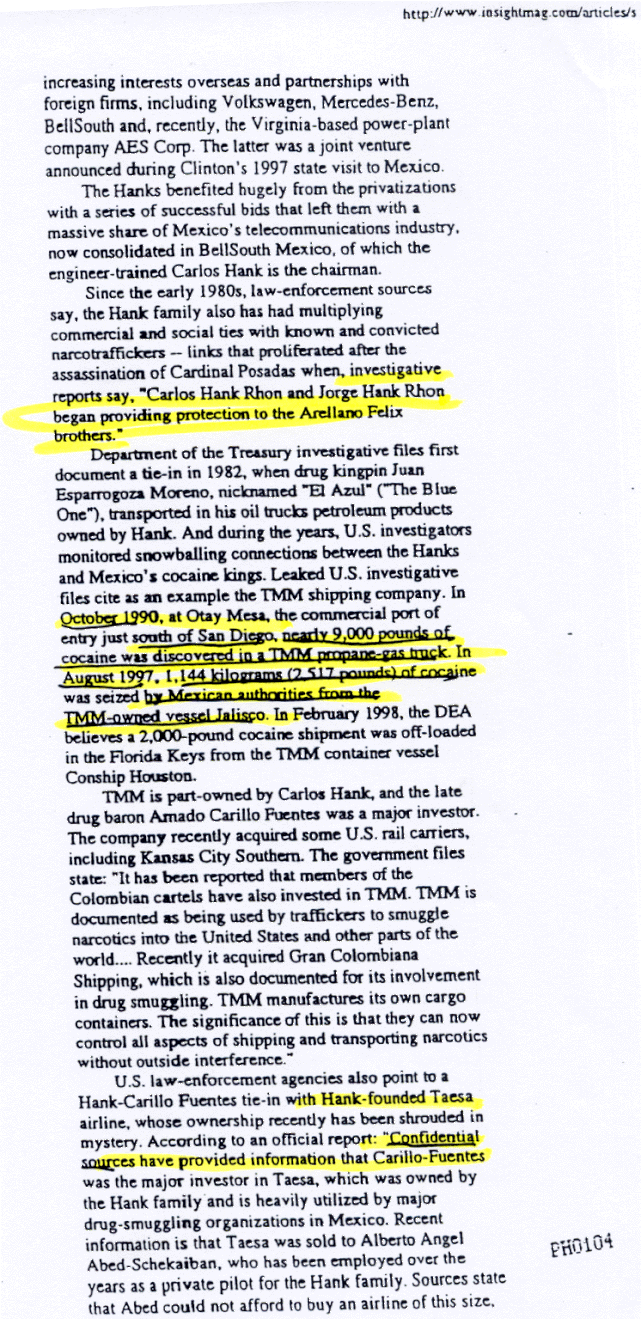
Operation White Tiger
https://www.customscorruption.com/white_tiger/operation.htm
https://www.customscorruption.com/white_tiger/WhiteTigerDoc1.gif

https://www.customscorruption.com/white_tiger/WhiteTigerDoc2.gif
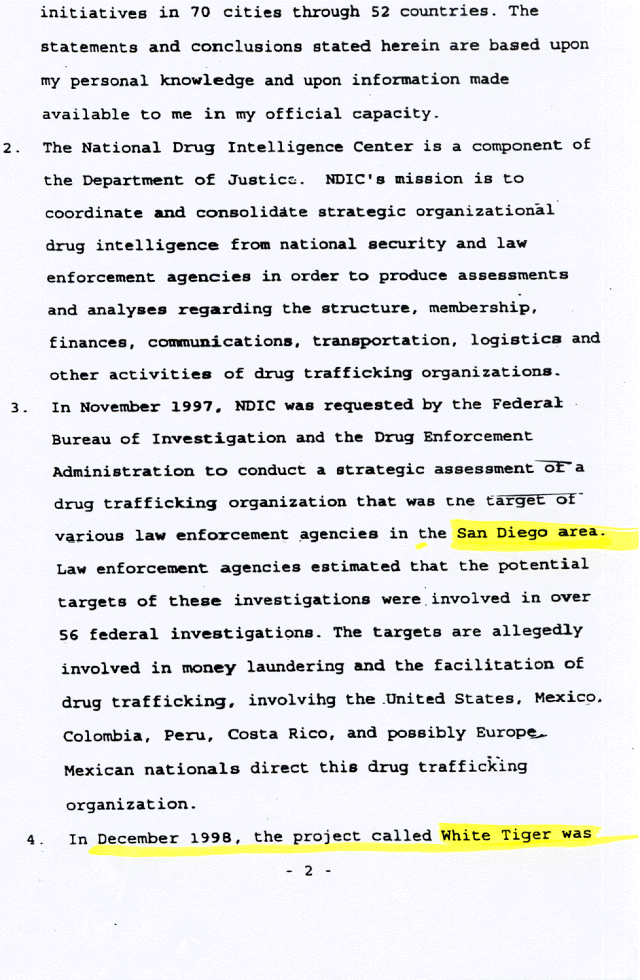
https://www.customscorruption.com/white_tiger/WhiteTigerDoc3.gif
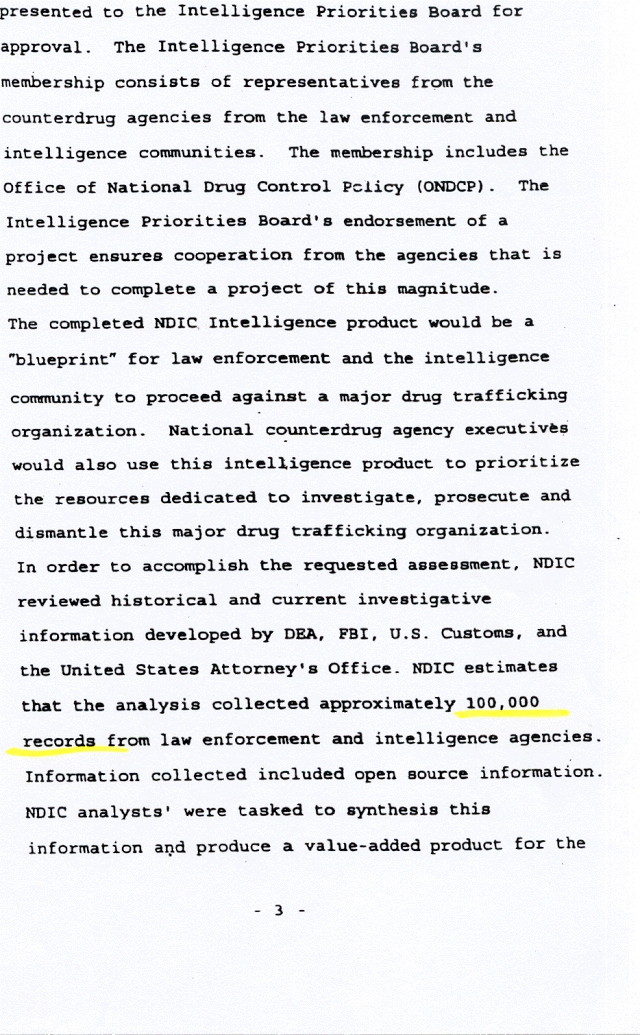
https://www.customscorruption.com/white_tiger/WhiteTigerDoc4.gif
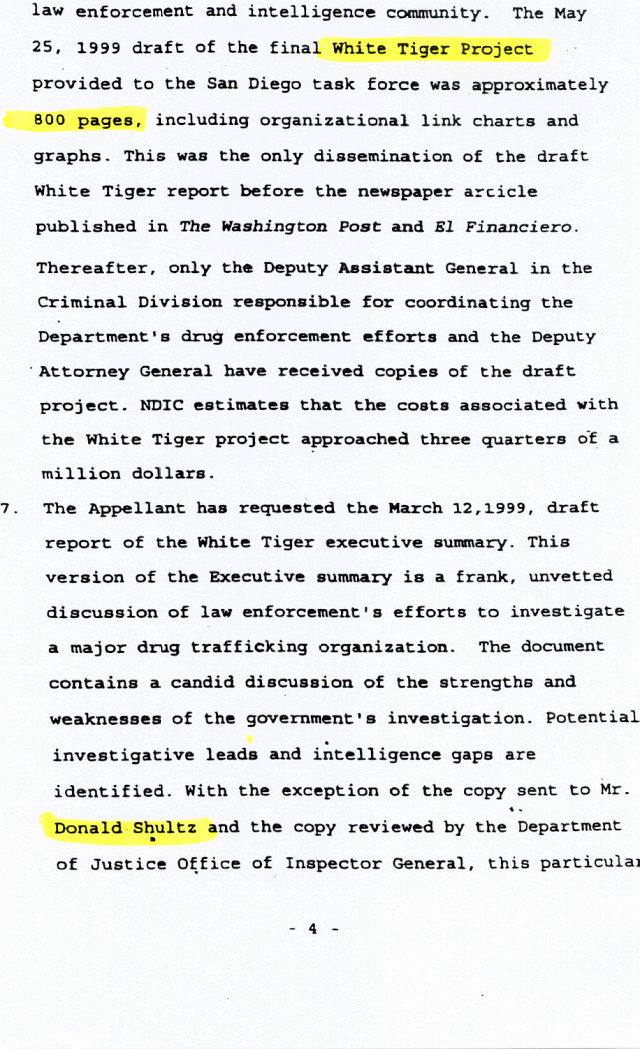
https://www.customscorruption.com/white_tiger/WhiteTigerDoc5.gif
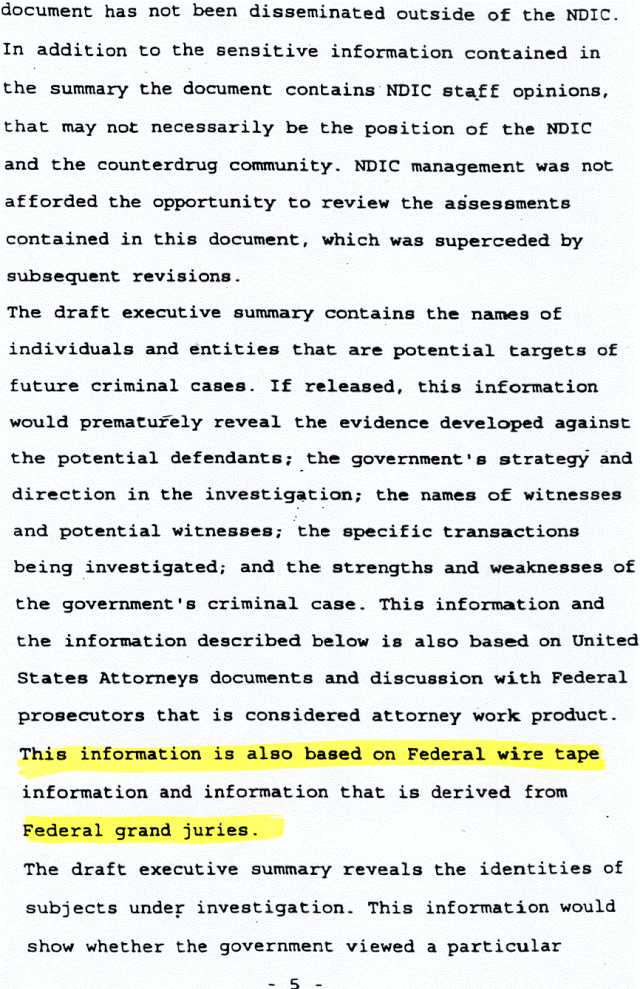
TMM, owned by drug kingpins used to, or still may operate out of the Port of Oakland.
TMM - Carlos Hank Rohn
https://www.customscorruption.com/white_tiger/WhiteTigerAttachmentInsight7.gif
The Politics of Heroin in Southeast Asia, by Alfred W. McCoy
https://renincorp.org/bookshelf/politics-of-heroin-in-south.pdf
The Politics of Heroin: CIA Complicity in the Global Drug Trade (ISBN 1-55652-483-8).
Click below…
https://ia904503.us.archive.org/24/items/alfred-w.-mc-coy-the-politics-of-heroin-2003/Alfred%20W.%20McCoy%20-%20The%20politics%20of%20heroin%20-%202003.pdf
Dark Alliance: The CIA, the Contras, and the Crack Cocaine Explosion
by Gary Webb
Click below…
https://archive.org/stream/dark-alliance-the-cia-the-con-gary-webb/Dark%20Alliance_%20The%20CIA%2C%20the%20Con%20-%20Gary%20Webb_djvu.txt
Dark Alliance: The CIA, the Contras, and the Crack Cocaine Explosion
by Gary Webb
https://archive.org/details/dark-alliance-the-cia-the-con-gary-webb/mode/1up
The Storm Over Dark Alliance
https://nsarchive2.gwu.edu/NSAEBB/NSAEBB113/storm.htm
Lynda Carson may be reached at newzland2 [at] gmail.com
>>>>>>>>
>>>>>>>>
Add Your Comments
Latest Comments
Listed below are the latest comments about this post.
These comments are submitted anonymously by website visitors.
TITLE
AUTHOR
DATE
CIA's Air America was trafficking in drugs in Thailand, Laos, Cambodia, and Vietnam...
Sun, Nov 30, 2025 6:22AM
We are 100% volunteer and depend on your participation to sustain our efforts!
Donate

$85.00 donated
in the past month
Get Involved
If you'd like to help with maintaining or developing the website, contact us.
Publish
Publish your stories and upcoming events on Indybay.
Topics
More
Search Indybay's Archives
Advanced Search
►
▼
IMC Network