







 Publish to Newswire
 Add an Event
From the Open-Publishing Calendar
From the Open-Publishing Newswire
Indybay Feature
Southside Complete Streets: A Ribbon Cut, a Reminder
This civic op-ed reflects on Berkeley’s Southside Complete Streets ribbon-cutting on October 1, 2025.
It celebrates new infrastructure for pedestrian safety, transit access, accessibility, and inclusion.
Coalition leaders, including BAROW and disabled advocates, are acknowledged for shaping the project.
Some civil leaders offered remarks affirming progress or recognizing that more collaborative work is needed.
The piece centers lived experience and collective effort in public space redesign.
It closes with a call to continue building inclusive, accessible, and sustainable public space.
It celebrates new infrastructure for pedestrian safety, transit access, accessibility, and inclusion.
Coalition leaders, including BAROW and disabled advocates, are acknowledged for shaping the project.
Some civil leaders offered remarks affirming progress or recognizing that more collaborative work is needed.
The piece centers lived experience and collective effort in public space redesign.
It closes with a call to continue building inclusive, accessible, and sustainable public space.
Southside Complete Streets: A Ribbon Cut, A Reminder
By Helen Walsh, resident of Berkeley
Celebrating progress while calling for deeper access and emergency planning
On October 1, 2025, Berkeley officials and community members gathered at Dana Street and Bancroft Way to celebrate the completion of the Southside Complete Streets Project. The redesign spans Bancroft Way, Dana Street, and Fulton Street—corridors adjacent to UC Berkeley—and includes protected bike lanes, raised intersections, accessible curb ramps, pedestrian safety islands, upgraded transit stops, and video detection for bicyclist signal recognition.
The project aligns with Berkeley’s Vision Zero Action Plan, Climate Action Plan, ADA Transition Plan, and other city policies. It was funded through local, state, and federal sources.
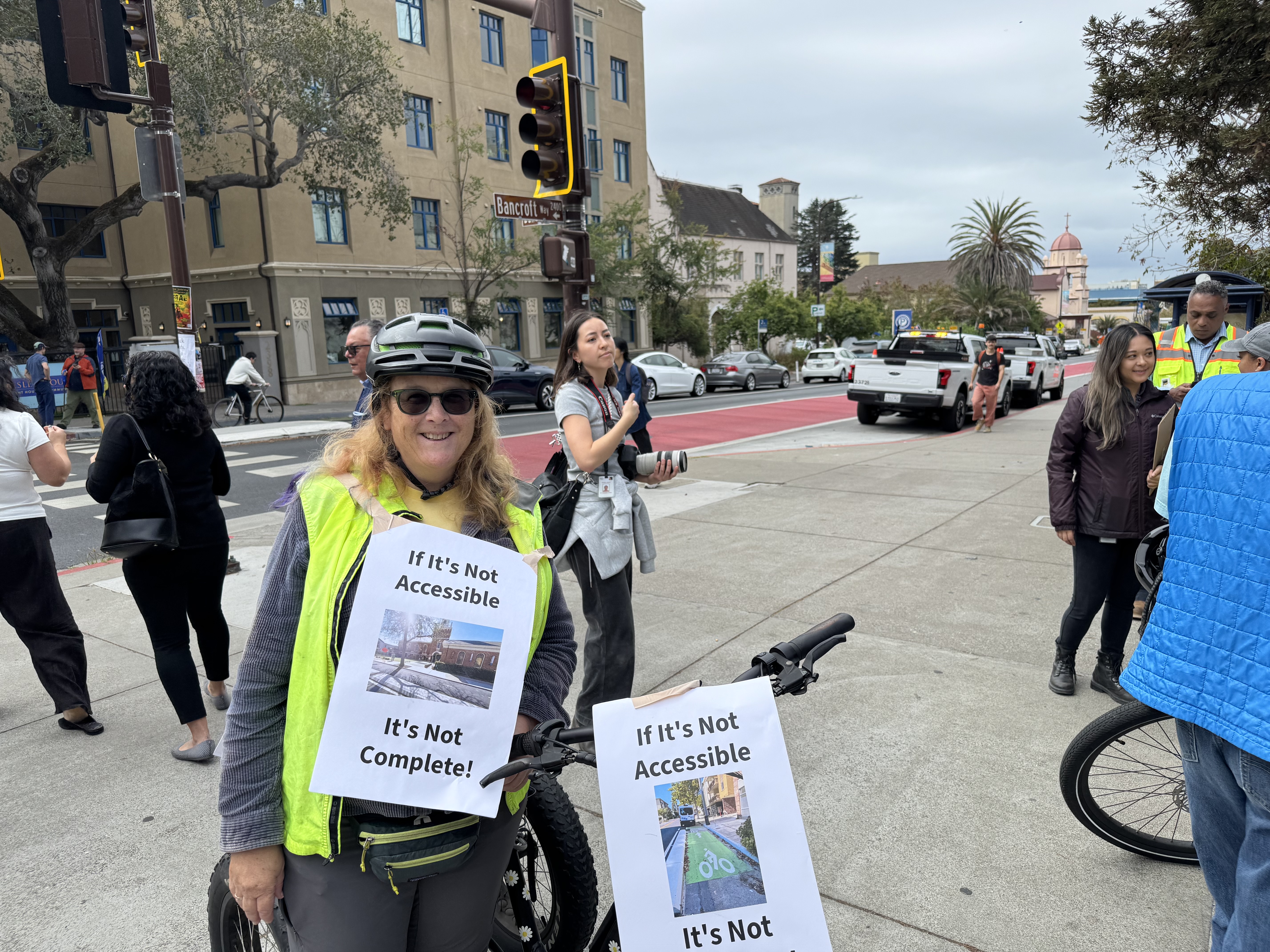
I attended the event with my adaptive three-wheel cycle, adorned with daisies and a sign that read: “If it’s not Accessible, it’s not Complete.”
Councilmember Mark Humbert reflected on Dana Street’s transformation, saying it had gone from “a freeway” to “a street that people can live on.” City Manager Paul Buddenhagen noted, “This is a project that’s been in the works for a long time.”
Mayor Adena Ishii acknowledged the Berkeley Commission on Disability and referenced the city’s adopted policy goals—centered on sustainability, equity, and access—as guiding principles. She emphasized that these goals work together to help Berkeley become “the safest, most climate resilient, and accessible community possible.” I appreciated the sentiment. I hope that as Berkeley moves forward, it continues to assess and strengthen accessibility across the public right of way—grounded in the understanding that accessibility should be the foundation of sustainability. Embedding accessibility into the initial planning of sustainable projects prevents costly retrofits and promotes social equity by removing barriers to services and opportunities, creating resilient, inclusive, and thriving environments for everyone.
Rubén Lizardo, Director of Local Government & Community Relations at UC Berkeley, affirmed the university’s partnership: “I know there are things we can do to improve safety for other modes of transportation, and rest assured I know that the city partners and the campus care about those issues.” Earlier that day, Rubén spoke with me directly about continuing the conversation around accessibility—a hopeful gesture toward deeper collaboration.
Also present were Rena Fischer, Vice Chair of the Berkeley Commission on Disability, and Michaela Tsztoo of Streets of Equality.
The Southside Complete Streets Project offers visible improvements—but also reveals where access was overlooked. Infrastructure designed to enhance safety or efficiency can still create barriers when disabled people and older adults are not fully considered. As someone who uses an adaptive three-wheel cycle, I’ve experienced firsthand how two-way bike lanes can create passing challenges—especially when space is tight or visibility is low. The absence of reflective markers and contrast cues makes navigation harder, particularly at night or in crowded conditions.
First Congregational Church of Berkeley (FCCB), located on Dana Street, I’ve seen how infrastructure choices shape who gets to participate. FCCB welcomes people of all ages and disabilities and serves as a community hub for events. The church, which is radically inclusive, hosts a wide range of social, educational, and artistic activities. The recent removal of its front loading zone—replaced by a two-way cycle track—means older adults and people with mobility disabilities can no longer be dropped off safely. In emergencies, those using mobility devices may be blocked from exiting. The cycle track’s raised separator creates a physical barrier, forcing evacuees to detour before reaching a safe zone. Accessibility and evacuation planning must go hand in hand.
BAROW (Berkeleyans for Accessible Right of Way) has called on the city to conduct disability impact reviews and restore safe loading zones. They’ve also urged planners to prioritize emergency evacuation access alongside climate resilience, and to engage disabled people in every phase of design and implementation.
When we center access and accessibility, we don’t just complete streets—we complete a community that builds on the legacy of Berkeley’s Ed Roberts curb cut.
By Helen Walsh, resident of Berkeley
Celebrating progress while calling for deeper access and emergency planning
On October 1, 2025, Berkeley officials and community members gathered at Dana Street and Bancroft Way to celebrate the completion of the Southside Complete Streets Project. The redesign spans Bancroft Way, Dana Street, and Fulton Street—corridors adjacent to UC Berkeley—and includes protected bike lanes, raised intersections, accessible curb ramps, pedestrian safety islands, upgraded transit stops, and video detection for bicyclist signal recognition.
The project aligns with Berkeley’s Vision Zero Action Plan, Climate Action Plan, ADA Transition Plan, and other city policies. It was funded through local, state, and federal sources.
I attended the event with my adaptive three-wheel cycle, adorned with daisies and a sign that read: “If it’s not Accessible, it’s not Complete.”
Councilmember Mark Humbert reflected on Dana Street’s transformation, saying it had gone from “a freeway” to “a street that people can live on.” City Manager Paul Buddenhagen noted, “This is a project that’s been in the works for a long time.”
Mayor Adena Ishii acknowledged the Berkeley Commission on Disability and referenced the city’s adopted policy goals—centered on sustainability, equity, and access—as guiding principles. She emphasized that these goals work together to help Berkeley become “the safest, most climate resilient, and accessible community possible.” I appreciated the sentiment. I hope that as Berkeley moves forward, it continues to assess and strengthen accessibility across the public right of way—grounded in the understanding that accessibility should be the foundation of sustainability. Embedding accessibility into the initial planning of sustainable projects prevents costly retrofits and promotes social equity by removing barriers to services and opportunities, creating resilient, inclusive, and thriving environments for everyone.
Rubén Lizardo, Director of Local Government & Community Relations at UC Berkeley, affirmed the university’s partnership: “I know there are things we can do to improve safety for other modes of transportation, and rest assured I know that the city partners and the campus care about those issues.” Earlier that day, Rubén spoke with me directly about continuing the conversation around accessibility—a hopeful gesture toward deeper collaboration.
Also present were Rena Fischer, Vice Chair of the Berkeley Commission on Disability, and Michaela Tsztoo of Streets of Equality.
The Southside Complete Streets Project offers visible improvements—but also reveals where access was overlooked. Infrastructure designed to enhance safety or efficiency can still create barriers when disabled people and older adults are not fully considered. As someone who uses an adaptive three-wheel cycle, I’ve experienced firsthand how two-way bike lanes can create passing challenges—especially when space is tight or visibility is low. The absence of reflective markers and contrast cues makes navigation harder, particularly at night or in crowded conditions.
First Congregational Church of Berkeley (FCCB), located on Dana Street, I’ve seen how infrastructure choices shape who gets to participate. FCCB welcomes people of all ages and disabilities and serves as a community hub for events. The church, which is radically inclusive, hosts a wide range of social, educational, and artistic activities. The recent removal of its front loading zone—replaced by a two-way cycle track—means older adults and people with mobility disabilities can no longer be dropped off safely. In emergencies, those using mobility devices may be blocked from exiting. The cycle track’s raised separator creates a physical barrier, forcing evacuees to detour before reaching a safe zone. Accessibility and evacuation planning must go hand in hand.
BAROW (Berkeleyans for Accessible Right of Way) has called on the city to conduct disability impact reviews and restore safe loading zones. They’ve also urged planners to prioritize emergency evacuation access alongside climate resilience, and to engage disabled people in every phase of design and implementation.
When we center access and accessibility, we don’t just complete streets—we complete a community that builds on the legacy of Berkeley’s Ed Roberts curb cut.
Add Your Comments
We are 100% volunteer and depend on your participation to sustain our efforts!
Donate

$90.00 donated
in the past month
Get Involved
If you'd like to help with maintaining or developing the website, contact us.
Publish
Publish your stories and upcoming events on Indybay.
Topics
More
Search Indybay's Archives
Advanced Search
►
▼
IMC Network