







 Publish to Newswire
 Add an Event
From the Open-Publishing Calendar
From the Open-Publishing Newswire
Indybay Feature
Santa Cruz Indymedia
Animal Liberation
Environment & Forest Defense
Health, Housing & Public Services
Humans and housing density are the leading cause of death for local pumas
Two new studies involving UC Santa Cruz researchers are shedding light on the challenges facing local pumas where humans are encroaching on their natural habitats. [Photo: North American Cougar (Puma concolor couguar) sub-adult female walking at night, Aptos, Monterey Bay, California]
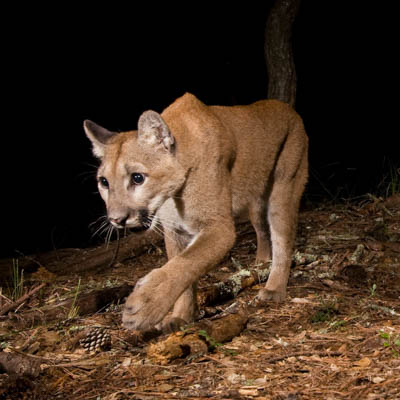
March 27, 2023 - Two new studies involving UC Santa Cruz researchers are shedding light on the challenges facing local pumas where humans are encroaching on their natural habitats.
Anna Nisi, a former graduate researcher for the Santa Cruz Puma Project, examined 11 years of research regarding the movement, mortality, and reproductive data for 67 pumas in the Santa Cruz mountains for a paper that recently appeared in Ecological Applications. The study looked at how exposure to human development impacted puma survival and population dynamics.
Nisi’s research found that pumas who live in areas with more human development have lower survival rates, with female pumas being more affected than males. Female pumas have an 18% decrease in survival rates in areas with higher human development. This has consequences for puma population dynamics – in other words, whether we can expect the puma population to increase or decrease over time.
“This study shows that minimizing further development in remote areas that are high-quality habitats for pumas is really important to make sure that the puma population can continue to live here into the future,” said Nisi.
Because adult female pumas do more poorly in areas with more human development, these places can’t support puma population growth. Much of the study area – 42% – fits that description. While this study estimates that the Santa Cruz Mountain puma population is stable, further development in remote areas could tip the balance and lead to a population decline. This study underscores that high-quality, remote habitats in the Santa Cruz Mountains should be protected for long-term puma population persistence.
A second paper for PNAS, that Nisi and environmental studies professor Chris Wilmers co-authored with John Benson from the University of Nebraska-Lincoln, looks at broad-scale patterns of survival and human-caused mortality for pumas in California. (Pumas are also referred to locally as mountain lions.) The PNAS study, which studied 590 mountain lions in 23 areas across California, including Santa Cruz, found that mountain lions were at greater risk of mortality from humans when they were closer to rural development. This study also found that human-caused mortality is additive to mortality from natural sources.
One of the contributing factors is the Wildland Urban Interface (WUI), which has greatly impacted puma mortality, according to environmental studies professor Chris Wilmers, who leads the Puma Project. The Wildland Urban Interface (WUI) is the area where human development and wildland vegetation meet, and in recent years it has expanded rapidly due to population growth and land use policies.
“Chronic exposure to housing increases mortality risk in pumas, and that goes to how we’ve developed the landscape as a society,” Wilmers said. “The WUI has been super lethal to our wildlife and has become a major environmental problem.”
The PNAS study found that while mountain lions have been protected from hunting, conflict with humans over livestock and collisions with vehicles also contribute to their mortality. The study’s results speak to the need for greater puma conservation efforts in human-dominated areas, said Wilmers, as well as the need to protect puma habitats and manage human development to minimize their impact on pumas in the future.
For more information:
https://news.ucsc.edu/2023/03/puma-surviva...
We are 100% volunteer and depend on your participation to sustain our efforts!
Donate

$30.00 donated
in the past month
Get Involved
If you'd like to help with maintaining or developing the website, contact us.
Publish
Publish your stories and upcoming events on Indybay.
Topics
More
Search Indybay's Archives
Advanced Search
►
▼
IMC Network
Researchers tested 14 creeks, six roadway outfalls and two estuaries in Central California during a 2025 storm and found the contaminant, known as 6PPD-quinone, in 98% of the water samples.
The compound forms when a chemical used in tires reacts with ozone in the air. Tire particles containing the contaminant can then wash into waterways during storms.
In Santa Cruz County, 6PPD-quinone was discovered in the San Lorenzo and Pajaro Rivers and Aptos, Arana, Carbonera, Branciforte, Soquel, Trout, Wilder, Waddell, and Scott Creeks.
Read more:
6PPD-Quinone Threatens Santa Cruz Salmon
https://www.goodtimes.sc/6ppd-quinone-santa-cruz-salmon/
Original study:
Potentially Lethal Concentrations of 6PPD-Quinone Occur in Endangered Species Act Listed Aquatic Habitats of Central California
https://pubs.acs.org/estlcu/article/13/10/1403/5439326/Potentially-Lethal-Concentrations-of-6PPD-Quinone
Abstract
Roadway runoff is the major source of N-(1,3-dimethylbutyl)-N′-phenyl-p-phenylenediamine-quinone (6PPDQ), a tire rubber-derived transformation product that causes acute mortality in some salmonid species. Despite its widespread occurrence, little data exist for watersheds that are Endangered Species Act (ESA) listed as critical habitat for populations of coho salmon (Oncorhynchus kisutch) and coastal rainbow trout (Oncorhynchus mykiss irideus) that are acutely susceptible to 6PPDQ. Here, we quantified 6PPDQ during a storm event across high-risk, roadway-impacted watersheds in Central California, sampling six roadway outfalls, fourteen creeks or rivers, and two estuaries. Median 6PPDQ concentrations in outfall (n = 9), creek (n = 48), and estuary (n = 2) samples were 350, 62, and 1.9 ng/L, respectively. 6PPDQ was detected in 98% of samples, with 78% of storm samples exceeding the EPA Acute Aquatic Life Screening value (11 ng/L) and 69% exceeding 24-h LC50 values for juvenile coho salmon. Concentrations peaked early during the storm and correlated significantly with traffic intensity (R2 = 0.50, p < 0.005), highlighting the chemical loading potential of busy roads. These data document high and sustained concentrations of 6PPDQ within multiple ESA-listed critical habitats, underscoring the need for improved source control to prevent possible mortalities of susceptible species within these watersheds.