







 Publish to Newswire
 Add an Event
From the Open-Publishing Calendar
From the Open-Publishing Newswire
Indybay Feature
Managing for Monarchs in the West
A new guide to protecting the monarch butterfly from the Pacific to the Rockies.
PORTLAND, Ore.; May 1, 2018—With the number of monarch butterflies in western North America dwindling year after year, it has never been more urgent to manage the vast open spaces of the western states with these butterflies in mind. Planting milkweed is important for the future of the monarch, but conservation demands a more holistic approach to land management.
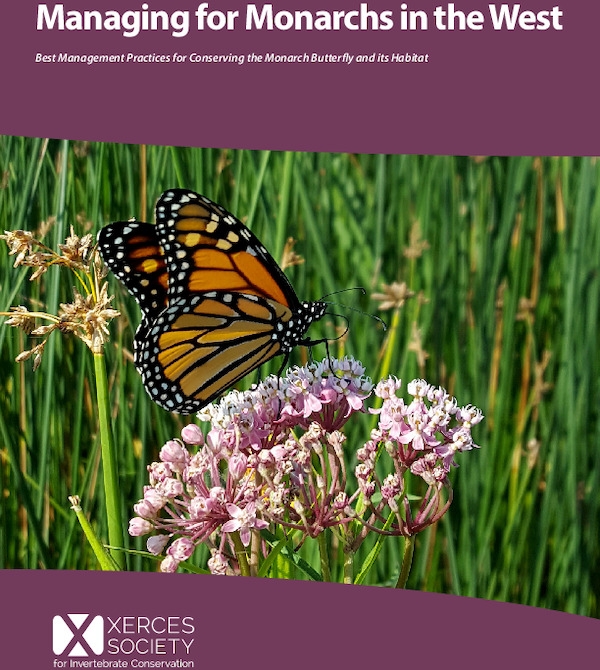
To guide conservation efforts, on Monday the Xerces Society for Invertebrate Conservation released Managing for Monarchs in the West: Best Management Practices for Conserving the Monarch Butterfly and its Habitat. This document combines the best-available science with land manager knowledge to provide recommendations for managing monarch breeding and migratory habitat.
“Thanks to its annual migration, the tiny monarch connects all communities in the West,” said Sarina Jepsen, Endangered Species Program Director for the Xerces Society. “We talked with many people who manage land while developing these guidelines, and it became obvious that saving this butterfly is something that everyone can contribute to.”
Managing for Monarchs in the West provides evidence-based best management practices for how to mow, burn, or graze land with confidence of knowing that you are not disrupting breeding monarchs. Invasive non-native and noxious plant management, pesticide use, recreation, and climate change impacts are also addressed.
“The most important part of monarch conservation in the West is to identify, protect, and manage existing high-quality monarch habitat,” noted Emma Pelton, Conservation Biologist with the Xerces Society.
These areas offer native milkweeds, to provide food for caterpillars (and nectar for adults), and other flowers—preferably native—to provide nectar for adults. “It’s also important that these areas are kept safe from pesticides,” Pelton added.
Although these guidelines are written for public land managers, the advice also will be useful to private landowners, nonprofits, and others interested in incorporating monarchs into their land care.
To help reverse the western monarchs’ decline, we need to improve protection and management of the butterfly’s habitat across its range—especially on public lands. These BMPs provides actionable, practical guidance that empowers western land managers to be part of the solution.
Photo credit: Xerces Society/Stephanie McKnight
For More Information
Managing for Monarchs in the West: Best Management Practices for Conserving the Monarch Butterfly and its Habitat can be downloaded for free at xerces.org/managing-monarchs-in-the-west/
Read more about Xerces’ Monarch Conservation work, including efforts to conserve overwintering sites in California and restore breeding habitat in key regions of the United States at http://www.xerces.org/monarchs
Long-term data about the number of monarch butterflies in western North America is at http://www.westernmonarchcount.org
Help expand knowledge of monarchs and their breeding areas in the western US by contributing sightings to the Western Monarch & Milkweed Mapping project, at https://www.monarchmilkweedmapper.org/
About The Xerces Society
The Xerces Society for Invertebrate Conservation is a nonprofit organization that protects wildlife through the conservation of invertebrates and their habitat. Established in 1971, the Society is a trusted source for science-based information and advice. We collaborate with people and institutions at all levels and our work to protect monarchs, bumble bees and many other species encompasses all landscapes. Our team draws together experts from the fields of habitat restoration, entomology, botany and conservation biology with a single focus—protecting the life that sustains us. To learn more about our work, visit http://www.xerces.org.
https://xerces.org/2018/04/30/managing-for-monarchs-in-the-west/
To guide conservation efforts, on Monday the Xerces Society for Invertebrate Conservation released Managing for Monarchs in the West: Best Management Practices for Conserving the Monarch Butterfly and its Habitat. This document combines the best-available science with land manager knowledge to provide recommendations for managing monarch breeding and migratory habitat.
“Thanks to its annual migration, the tiny monarch connects all communities in the West,” said Sarina Jepsen, Endangered Species Program Director for the Xerces Society. “We talked with many people who manage land while developing these guidelines, and it became obvious that saving this butterfly is something that everyone can contribute to.”
Managing for Monarchs in the West provides evidence-based best management practices for how to mow, burn, or graze land with confidence of knowing that you are not disrupting breeding monarchs. Invasive non-native and noxious plant management, pesticide use, recreation, and climate change impacts are also addressed.
“The most important part of monarch conservation in the West is to identify, protect, and manage existing high-quality monarch habitat,” noted Emma Pelton, Conservation Biologist with the Xerces Society.
These areas offer native milkweeds, to provide food for caterpillars (and nectar for adults), and other flowers—preferably native—to provide nectar for adults. “It’s also important that these areas are kept safe from pesticides,” Pelton added.
Although these guidelines are written for public land managers, the advice also will be useful to private landowners, nonprofits, and others interested in incorporating monarchs into their land care.
To help reverse the western monarchs’ decline, we need to improve protection and management of the butterfly’s habitat across its range—especially on public lands. These BMPs provides actionable, practical guidance that empowers western land managers to be part of the solution.
Photo credit: Xerces Society/Stephanie McKnight
For More Information
Managing for Monarchs in the West: Best Management Practices for Conserving the Monarch Butterfly and its Habitat can be downloaded for free at xerces.org/managing-monarchs-in-the-west/
Read more about Xerces’ Monarch Conservation work, including efforts to conserve overwintering sites in California and restore breeding habitat in key regions of the United States at http://www.xerces.org/monarchs
Long-term data about the number of monarch butterflies in western North America is at http://www.westernmonarchcount.org
Help expand knowledge of monarchs and their breeding areas in the western US by contributing sightings to the Western Monarch & Milkweed Mapping project, at https://www.monarchmilkweedmapper.org/
About The Xerces Society
The Xerces Society for Invertebrate Conservation is a nonprofit organization that protects wildlife through the conservation of invertebrates and their habitat. Established in 1971, the Society is a trusted source for science-based information and advice. We collaborate with people and institutions at all levels and our work to protect monarchs, bumble bees and many other species encompasses all landscapes. Our team draws together experts from the fields of habitat restoration, entomology, botany and conservation biology with a single focus—protecting the life that sustains us. To learn more about our work, visit http://www.xerces.org.
https://xerces.org/2018/04/30/managing-for-monarchs-in-the-west/
For more information:
https://xerces.org/
Add Your Comments
We are 100% volunteer and depend on your participation to sustain our efforts!
Donate

$110.00 donated
in the past month
Get Involved
If you'd like to help with maintaining or developing the website, contact us.
Publish
Publish your stories and upcoming events on Indybay.
Topics
More
Search Indybay's Archives
Advanced Search
►
▼
IMC Network