







 Publish to Newswire
 Add an Event
From the Open-Publishing Calendar
From the Open-Publishing Newswire
Indybay Feature
Korean American Forum of California (KAFC) denounces recent accord between Japan & Korea
Korean American Forum of California (KAFC) denounces the recent accord between Governments of Japan and South Korea regarding the Military Sexual Slavery by the Japanese Imperial Army from 1932 until end of WWII.
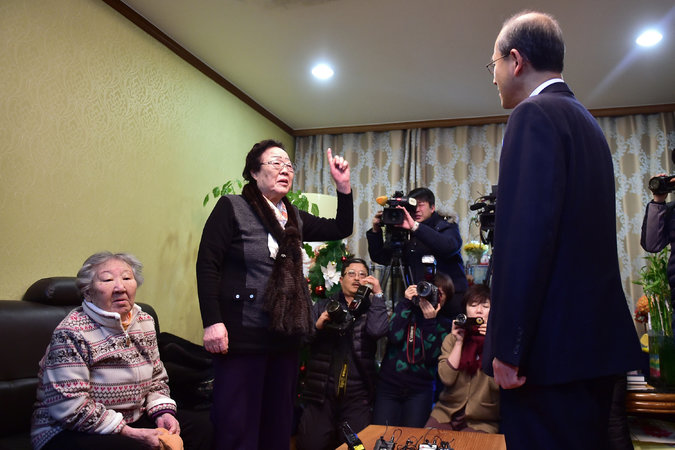
Korean American Forum of California (KAFC) denounces the recent accord between Governments of Japan and South Korea regarding the Military Sexual Slavery by the Japanese Imperial Army from 1932 until end of WWII.
We wholeheartedly agree with the activist victims who are affectionately known as ‘Halmonis’ or ‘Grandmas’, who immediately denounced the agreement as a sham. One of the most prominent and leading activist, Grandma Yongsoo Lee denounced the agreement stating, "this agreement seems to have been made without having the victims in mind. I dismiss it in its entirety."
There are several problems with the recent agreement,
1. The agreement is a regression from the Kono Statement because it does not acknowledge "coercion" which has been part of Abe regime’s attempt to whitewash the history.
2. The agreement does not specify if the "heartfelt apology" will be an official, cabinet approved apology, which then can be retracted and denied again by future leaders of Japan. Abe and other political leaders of Japan have done this to earlier statements.
3. This agreement falls short of the most basic guideline suggested by the US Congress. When measured up to the US H.Res.121, which was unanimously passed in 2007, this agreement is missing the most essential elements. For example, US H.Res.121 states the following:
“Japanese government should accept historical responsibility for the sexual slavery and largest case of human trafficking, officially and sincerely apologize in an unequivocal manner, and to educate the next generation about this crime of humanity so that the same tragedy will never repeat itself."
4. We believe any settlement should be based on the 7 demands of the victims and must include all victims from 11 countries and not just South Koreans.
(http://kaforumca.org/7-demands-by-the-victims/):
1. Full acknowledgement of the military sexual slavery implemented by the Imperial Armed Forces of Japan between 1932 to 1945
2. Thorough and complete investigation to fully chronicle the scope of the crime
3. Formal apology from the National Assembly (Diet) of Japan
4. Legal and full reparations to all victims
5. Prosecution of the criminals responsible for the crime
6. Full and ongoing education through proper recording and acknowledgement in textbooks and history books in Japan
7. Building of memorials and museums to commemorate the victims and preserve the history of sexual slavery by the Japanese Military
5. Japan's demand to remove the Peace Monument in front of the Japanese embassy in Seoul is an example of how Abe and his government are attempting to continue to whitewash the issue. If the apology is genuine, Japan should welcome such monuments and embrace the incredible struggle of the Halmonis that it represents.
Even after numerous apologies, prosecuting the war criminals and making government reparations to the victims, the German Chancellor renewed German government’s apology for the Holocaust victims again. No German officials protest or demand removal of any Holocaust memorials or sections about the Holocaust in children’s textbook. In every classroom in Germany, the children learn about the mistakes their ancestors made to make sure they don’t make the same mistake.
On the contrary, Prime Minister Abe visited Yasukuni Shrine in December of 2013, where millions of war-dead, including 14 class-A WWII war criminals are revered as national heroes. Despite sharp criticisms from neighboring countries as well as the US, he sent his wife to Yasukuni in 2015, and again, Abe’s wife made a visit to Yasukuni Shrine today. This clearly shows where Abe stands on this issue of Japan’s war crimes.
The over-emphasis on the provision that gags South Korean government from raising the issue, which by-the-way should not ever be part of any agreement related to this issue, also clearly shows that Japan is continuing its efforts to silence the victims and whitewash the history.
The only way Japan can show the whole world that it means what it says is to embrace the 7 demands aforementioned, just like Germany did for the Holocaust, and enter into a full agreement that covers victims of all 11 countries and not just South Korea.
This accord is being rejected by the most vocal and active leaders among the victims and the advocacy groups that have been fighting to bring Japan to face the issue. Both governments of Japan and South Korea should cease and desist from carrying out such agreement that fails to reflect all of the major demands of the victims and fails to bring finality to the issue by failing to include victims and other stakeholders from 10 other countries.
KAFC reaffirms our commitment to support the Halmonis and their righteous 7 principled demands aforementioned and reaffirm our commitment to raise awareness in the US about the largest and longest running institutionalized sexual slavery in human history by the Japanese Imperial Armed Forces.
Phyllis Kim (김현정 사무국장)
Executive Director
Korean American Forum of California
kaforumca.org
Korean Citizens and foreign residents gather to express solidarity with comfort women
http://english.hani.co.kr/arti/english_edition/e_international/724278.html
Posted on : Dec.31,2015 17:51 KSTModified on : Dec.31,2015 17:51 KST
On the heels of Monday’s settlement, 2015’s final protest in support of the comfort women calls for Japan to express “heartfelt regrets”
<145155170770_20160101.JPG>
An umbrella keeps the rain off the statue of a young girl symbolizing the comfort women during a candlelight vigil across from the Japanese embassy in Seoul’s Jongno district, the evening of Dec. 30 (photo by Kim Tae-hyeong, staff photographer)
On Dec. 28, the first Wednesday demonstration was held since the governments of South Korea and Japan declared that they had reached an agreement on the issue of the comfort women, who were forced to serve as sex slaves for the Imperial Japanese Army. Given that there was a much bigger turnout than usual in front of the Japanese embassy in Seoul’s Jongno District, the Hankyoreh decided to find out what had brought the participants onto the street.
<145155161059_20160101.JPG>
Yun Han-tak
Yun Han-tak, 77, who lived in Sancheong County in South Gyeongsang Province during his youth, vividly remembers when the Japanese army raided his village.
“One day, Japanese forces descended upon the village and went off with the older girls and conscripted the older boys. We were all so frightened that we ran away into Jiri Mountain and didn’t come back to the village until after liberation,” Yun said. When he thinks back to that experience, he feels “anger and humiliation.”
“The statue of the young girl was made so that neither Japan nor our descendants would forget those memories. Japan’s request for the statue’s removal implies that Japan refuses to acknowledge its faults,” he said.
<145155161069_20160101.JPG>
Kang Ye-eun
Kang Ye-eun, 28, who teaches history at Suwon High School in Gyeonggi Province, attended the meeting with nine students from a history club.
“When the results of the talks were released, students came to the office and asked me if it was true. While I was teaching the students about the issue of the comfort women this semester, I always taught them that knowing things the right way was better than knowing a lot of things,” Kang said.
“We also studied how the South Korean government has responded. But then the negotiations ended up like this,” she said despondently.
<145155161079_20160101.JPG>
Yoshihiro Wada
Yoshihiro Wada, a 31-year-old doctoral student in literature who came to Yonsei University three years ago, noted that “conscientious citizens in Japan have also been consistently calling for a sincere apology from Prime Minister Abe.”
“The first thing that got reported [on the talks] in Japan was the part about ‘putting up money.’ But I don’t think money is the issue here,” he added. “I think Abe should apologize now to the comfort women survivors, but I have to wonder if he’s someone with that kind of an understanding of history.”
<145155161090_20160101.JPG>
Lee Bo-ra and her Daughter Kim Da-in
Lee Bo-ra, a 46-year-old mother with a daughter in her third year of middle school, shared her reaction to hearing the results of the talks.
“I wondered why it was that a woman president couldn’t share a deep understanding of the suffering of these women,” Lee said.
“It makes me angry that the President would make such an irresponsible agreement. I don’t think it’s something she could have agreed to if she truly sympathized with the terrible suffering of these women,” she added.
“I think her responsibility now is to keep working toward getting an apology [from Japan] and demanding that it take legal responsibility.”
Daughter Kim Da-in, 15, recalled asking her mother, “Do you mean those women went through all that when they were my age?”
“The comfort women issue is something we’re studying in school right now. There’s the problem that it happened in the first place, and then there’s also the problem that it hasn’t been resolved,” she added.
<145155161100_20160101.JPG>
Cornelia Schmidt
Dec. 30 marked the second visit to a Wednesday demonstration for Cornelia Schmidt, a 23-year-old from Germany who has been studying at Korea University since August. Schmidt, who recalled reading about the comfort women issue in a book two years ago, contrasted Japan’s approach with that of Germany, which has been making consistent efforts to atone for its past misdeeds. In her view, Tokyo has gone about addressing historical issues badly.
“It’s shocking to think that this infringement of women’s human rights and character was conducted systematically at the government level,” Schmidt said.
“The Japanese government should be expressing its heartfelt regrets and remorse to the victims, but you don’t see any of that in these negotiations,” she added.
By Kim Mi-hyang, Kwon Seung-rok, and Ko Han-sol, staff reporters
South Korea-Japan comfort women resolution faces blowback
http://english.hani.co.kr/arti/english_edition/e_international/724279.html
Posted on : Dec.31,2015 17:55 KSTModified on : Dec.31,2015 17:55 KST
<145155170784_20160101.JPG>
University students who are members of the Peace Butterfly Network and other organizations express opposition to the removal of the statue and call for renegotiation of the recent comfort women settlement and for the Japanese government to acknowledge its legal responsibility during a candlelight vigil, Dec. 30
Japanese media reports Korean government tacitly agreed to the removal of comfort women statue as a precondition for US$8.3 million in compensation
The agreement reached by South Korea and Japan’s foreign ministers over the comfort women issue on Dec. 28 has been facing heavy turbulence in the two days since.
Government officials and news outlets in Japan have been issuing statements that seem to contradict the spirit of the agreement, while in South Korea the comfort women survivors themselves and advocacy groups like the Korean Council for the Women Drafted for Military Sexual Slavery by Japan (Jeongdaehyeop) have been up in arms over the terms. Opposition parties in South Korea have made open calls for annulling the agreement and reopening negotiations.
Meanwhile, the Blue House and Ministry of Foreign Affairs have appeared baffled by the mounting criticism. Some observers are now saying there is a possibility of the heavy backlash resulting in the agreement going down in history as a major diplomatic failure for President Park Geun-hye.
A Dec. 30 report in Japan’s Sankei Shimbun newspaper quoted Prime Minister Shinzo Abe as telling associates that “everything is over as of yesterday [Dec. 28] and we can’t apologize anymore.”
“I will not be speaking on this issue again,” Abe was quoted as saying of future relations with Seoul.
Abe also reportedly hinted at the South Korean government’s tacit consent to his attitude.
“I mentioned this fact in the telephone conversation [with Park on the evening of Dec. 28],” he was quoted as saying.
With signs that Abe has no intention of expressing any apology or remorse himself, the agreement is now vulnerable to charges that it represents a step backward from the 1995 establishment of the Asian Women’s Fund, which included personal letters of apology from the Japanese Prime Minister, or the so-called “Sasae plan” considered during the Lee Myung-bak presidency (2008-13).
Meanwhile, a game of “to tell the truth” is unfolding with reports in numerous Japanese news outlets that one of the conditions for Tokyo putting up one billion yen (9.743 billion won/US$8.3 million) out of its budget is the removal of a peace statue symbolizing the comfort women that currently stands in front of the Japanese embassy in Seoul.
“Several Japanese government sources said that South Korea provided behind-the-scenes confirmation about the precondition,” the Asahi Shimbun newspaper reported in a front-page article on Dec. 30.
The Yomiuri Shimbun newspaper similarly quoted a senior Japanese government source as saying Tokyo had “requested to Seoul that the little girl statue be taken down as soon as possible, and confirmed that the South Korean government stated that it intends to work toward achieving that.”
A Blue House source strenuously denied the reports, saying they had “no basis whatsoever in fact.”
Minister of Foreign Affairs Yun Byung-se also expressed his “hope that there will be no words or actions from Japan that could generate misunderstandings.”
The growing controversy prompted Japan’s foreign ministry to confirm to the Hankyoreh on the afternoon of Dec. 30 that “the agreement is what Minister Kishida and Minister Yun stated at the press conference, no more, no less.”
“With the emotions in the [Japanese] public, there may be some people who would like to see the peace monument [statue] removed because we’re paying one billion yen, but those thoughts are very different from any kind of precondition to the promise,” the official said.
The group Jeongdaehyeop released a statement on Dec. 30 urging the governments of South Korea and Japan to “immediately cancel this hastily reached agreement and listen to the demands of the victims so they can resolve the comfort issue in a proper way that is acceptable to the victims.”
Jeongdaehyeop is currently planning to form a “response organization” with experts and representatives from civil society in South Korea and abroad, along with weekly relay demonstrations every Wednesday in front of little girl statues representing comfort women erected around the country.
Comfort woman survivor Lee Yong-soo, 88, also called for the agreement’s nullification while appearing at noon on Dec. 30 for the 1,211th Wednesday demonstration by survivors in front of the Japanese embassy in Seoul’s Jongno district.
“If only to fulfill the wishes of the other women who have passed away already, we should be accepting an official apology and legal compensation from Japan,” Lee insisted.
Moon Jae-in, chairman of the opposition The Minjoo Party of Korea (TMPK), also called on Seoul to renegotiate the agreement while speaking at a supreme council meeting on Dec. 30.
“Since this agreement constitutes a pact or agreement whereby the public’s rights are forfeited, the public’s consent should be sought,” Moon said.
“Because there was no such consent, I hereby declare it null and void,” he added.
The TMPK now plans to submit a motion for Yun Byung-se’s removal as Minister of Foreign Affairs and to pursue a fact-finding investigation at the National Assembly Standing Committee level.
By Gil Yun-hyung, Tokyo correspondent
South Korean and Japanese Leaders Feel Backlash From ‘Comfort Women’ Deal “Which country do you belong to?” Lee Yong-su, 88, shouted at Lim Sung-nam, the first vice foreign minister of South Korea, as he entered a shelter for the women in Seoul, a visit arranged by Ms. Park’s government as part of a damage-control effort, according to the Yonhap News Agency. “You could have at least let us know what kind of deal you were striking with Japan.”
http://www.nytimes.com/2015/12/30/world/asia/south-korea-japan-comfort-women.html?hp&action=click&pgtype=Homepage&clickSource=story-heading&module=second-column-region®ion=top-news&WT.nav=top-news&_r=0
By JONATHAN SOBLE and CHOE SANG-HUNDEC. 29, 2015
<30Korea-web1-master675.jpg>
Lee Yong-su, one of South Korea's so-called comfort women, confronted Lim Sung-nam, the first vice foreign minister, during his visit to a shelter for the women in Seoul on Tuesday. CreditPool photo by Jung Yeon-Je
TOKYO — The leaders of South Korea and Japan faced a barrage of criticism on Tuesday from nationalists upset about a landmark deal aimed at resolving a dispute over Korean women who had been pressed into sexual servitude in Japanese military brothels before and during World War II.
President Park Geun-hye of South Korea and Prime Minister Shinzo Abe of Japan had long cultivated reputations as hard-liners in their countries’ recurring battles over history. While Ms. Park had demanded that Japan do more to atone for its 35 years of colonial rule on the Korean Peninsula, Mr. Abe had suggested that Japanese rule was less brutal than Koreans say it was.
In recent years, their stances had deepened the conflict but won support from self-declared patriots at home.
So the compromise agreement announced on Monday, in which Japan offered a new apology and $8.3 million to help care for surviving victims — in return for a South Korean promise not to press any future claims — seemed to some observers to borrow a page from the diplomatic playbook of Richard M. Nixon. They drew comparisons to the former American president’s decision to seek détente with China in 1972, a move that was both surprising and politically feasible given his longstanding anti-Communist credentials.
<30Korea-web2-articleLarge.jpg>
A protest against Japan and South Korea's deal to resolve the dispute over former Korean "comfort women" outside Prime Minister Shinzo Abe's official residence in Tokyo, on Tuesday. CreditEugene Hoshiko/Associated Press
Yet the apparently sudden change of course by Ms. Park and Mr. Abe has inevitably left some feeling betrayed. And analysts said it carried unequal political risks, with Ms. Park facing a fiercer backlash, in part because the surviving women themselves said they had no voice in shaping the diplomatic deal.
“Which country do you belong to?” Lee Yong-su, 88, shouted at Lim Sung-nam, the first vice foreign minister of South Korea, as he entered a shelter for the women in Seoul, a visit arranged by Ms. Park’s government as part of a damage-control effort, according to the Yonhap News Agency. “You could have at least let us know what kind of deal you were striking with Japan.”
Only 46 Korean women who said they were among the tens of thousands who were forced to work in brothels from the early 1930s until 1945 are still alive. They are reported to object that the money offered by Japan did not take the form of official reparations, which would carry an acknowledgment of legal as well as moral responsibility, but instead were presented as a humanitarian contribution.
And although the two governments did not see the amount paid as being as important as putting the issue to rest, many found the $8.3 million — roughly $180,000 per survivor — insulting.
“That’s really stingy,” said Lee Sung-yoon, a professor in Korean studies at the Fletcher School of Law and Diplomacy at Tufts University. “You know what you get for a personal injury lawsuit after spilling hot coffee on yourself in America?”
He continued: “Victims of systematic and widespread rape or, in today’s parlance, crime against humanity, deserve much more than that.”
Mr. Lee said that Ms. Park’s political foes could now paint her as “a pro-Japanese collaborator, as they already have her father.” Her father, the former military dictator Park Chung-hee, had served as an officer in the Japanese Imperial Army.
In the South Korean Parliament, some opposition lawmakers called for an apology from Ms. Park and the resignation of Foreign Minister Yun Byung-se on Tuesday, holding them responsible for what at least one lawmaker called a “traitorous” deal.
The two governments may be hoping that pragmatic considerations outweigh such sentiments. The agreement was welcomed by the United States, for whom both South Korea and Japan are vital allies. All three countries are eager to improve security cooperation in the face of an increasingly assertive China and an advancing North Korean nuclear weapons program.
South Korean newspapers offered limited endorsements of the deal, tempered by criticism that it did not include an admission of legal responsibility by Japan.
“It is pivotal to the Korea-U.S.-Japan alliance,” the mass-circulation daily JoongAng Ilbo said in an editorial: “You can choose your friends, but not your neighbors. Both nations must move forward.”
Ms. Park has some political room to take risks. She is barred by law from seeking another term in the next presidential election, in 2017. The main opposition party is fractured by infighting, and her governing party holds a majority in Parliament and leads by a large margin in approval ratings.
Insisting on formal reparations would almost certainly have scuttled the deal. South Korea renounced legal claims against Japan in a 1965 treaty normalizing relations between the two countries. Although South Korea says that the military brothel issue was never discussed during negotiations for that treaty and that it should be treated as an exception, Japan has been adamant in sticking to the letter of that agreement.
“For us, 1965 is final, legally speaking,” a Japanese government official said, speaking on the condition of anonymity because he was not authorized to discuss the negotiations. Making an exception for Korean “comfort women” — as they were euphemistically called by the Japanese — he said, would have opened Japan to a deluge of potential claims, including from women from other countries and from men who were rounded up to work in Japanese wartime industries such as coal mining. Many died from the dangerous work, as well as from malnutrition and other ill-treatment.
Mr. Abe also faced criticism after the deal, though analysts said he would probably gain more support from moderate Japanese voters than he would lose from the far right.
“Conservatives won’t abandon Abe, and from the point of view of middle-of-the-road Japanese, it’s a positive development,” said Masatoshi Honda, a professor at Kinjo Gakuin University.
“If a dovish prime minister had done it, he would have been eviscerated by the right,” he added. “It’s precisely because Abe is a conservative that he could pull this off.”
Some right-wing members of Mr. Abe’s governing Liberal Democratic Party insisted that the prime minister press Ms. Park to remove what they consider a provocative anti-Japanese symbol: the statue of a girl representing the “comfort women” that was installed by a civic group in front of the Japanese Embassy in Seoul.
In the deal announced on Monday, South Korea agreed only to take the matter up with the group, which has insisted it will not remove the statue. On Tuesday, the group and the women confirmed that they would continue their weekly protests in front of the embassy, which they have held every Wednesday since 1992.
In what struck some as an effort to retain credibility with the right, Mr. Abe’s wife, Akie, visited the Yasukuni Shrine in Tokyo on Monday that honors Japanese war dead, including leaders convicted as war criminals by Allied tribunals.
Much of the criticism in Japan came from further in the political margins, including from anonymous online ultranationalists known collectively as the “Net Right.” Some posted messages on Mr. Abe’s Facebook page and other forums calling him a “rotten traitor” and worse. “I feel completely deceived,” one wrote.
Kyoko Nakayama, a former political ally of Mr. Abe’s who now leads a small breakaway party of disgruntled former members of the Liberal Democratic Party, denounced the agreement as “the biggest stain on Abe’s diplomatic record.”
Jonathan Soble reported from Tokyo, and Choe Sang-hun from Seoul, South Korea.
We wholeheartedly agree with the activist victims who are affectionately known as ‘Halmonis’ or ‘Grandmas’, who immediately denounced the agreement as a sham. One of the most prominent and leading activist, Grandma Yongsoo Lee denounced the agreement stating, "this agreement seems to have been made without having the victims in mind. I dismiss it in its entirety."
There are several problems with the recent agreement,
1. The agreement is a regression from the Kono Statement because it does not acknowledge "coercion" which has been part of Abe regime’s attempt to whitewash the history.
2. The agreement does not specify if the "heartfelt apology" will be an official, cabinet approved apology, which then can be retracted and denied again by future leaders of Japan. Abe and other political leaders of Japan have done this to earlier statements.
3. This agreement falls short of the most basic guideline suggested by the US Congress. When measured up to the US H.Res.121, which was unanimously passed in 2007, this agreement is missing the most essential elements. For example, US H.Res.121 states the following:
“Japanese government should accept historical responsibility for the sexual slavery and largest case of human trafficking, officially and sincerely apologize in an unequivocal manner, and to educate the next generation about this crime of humanity so that the same tragedy will never repeat itself."
4. We believe any settlement should be based on the 7 demands of the victims and must include all victims from 11 countries and not just South Koreans.
(http://kaforumca.org/7-demands-by-the-victims/):
1. Full acknowledgement of the military sexual slavery implemented by the Imperial Armed Forces of Japan between 1932 to 1945
2. Thorough and complete investigation to fully chronicle the scope of the crime
3. Formal apology from the National Assembly (Diet) of Japan
4. Legal and full reparations to all victims
5. Prosecution of the criminals responsible for the crime
6. Full and ongoing education through proper recording and acknowledgement in textbooks and history books in Japan
7. Building of memorials and museums to commemorate the victims and preserve the history of sexual slavery by the Japanese Military
5. Japan's demand to remove the Peace Monument in front of the Japanese embassy in Seoul is an example of how Abe and his government are attempting to continue to whitewash the issue. If the apology is genuine, Japan should welcome such monuments and embrace the incredible struggle of the Halmonis that it represents.
Even after numerous apologies, prosecuting the war criminals and making government reparations to the victims, the German Chancellor renewed German government’s apology for the Holocaust victims again. No German officials protest or demand removal of any Holocaust memorials or sections about the Holocaust in children’s textbook. In every classroom in Germany, the children learn about the mistakes their ancestors made to make sure they don’t make the same mistake.
On the contrary, Prime Minister Abe visited Yasukuni Shrine in December of 2013, where millions of war-dead, including 14 class-A WWII war criminals are revered as national heroes. Despite sharp criticisms from neighboring countries as well as the US, he sent his wife to Yasukuni in 2015, and again, Abe’s wife made a visit to Yasukuni Shrine today. This clearly shows where Abe stands on this issue of Japan’s war crimes.
The over-emphasis on the provision that gags South Korean government from raising the issue, which by-the-way should not ever be part of any agreement related to this issue, also clearly shows that Japan is continuing its efforts to silence the victims and whitewash the history.
The only way Japan can show the whole world that it means what it says is to embrace the 7 demands aforementioned, just like Germany did for the Holocaust, and enter into a full agreement that covers victims of all 11 countries and not just South Korea.
This accord is being rejected by the most vocal and active leaders among the victims and the advocacy groups that have been fighting to bring Japan to face the issue. Both governments of Japan and South Korea should cease and desist from carrying out such agreement that fails to reflect all of the major demands of the victims and fails to bring finality to the issue by failing to include victims and other stakeholders from 10 other countries.
KAFC reaffirms our commitment to support the Halmonis and their righteous 7 principled demands aforementioned and reaffirm our commitment to raise awareness in the US about the largest and longest running institutionalized sexual slavery in human history by the Japanese Imperial Armed Forces.
Phyllis Kim (김현정 사무국장)
Executive Director
Korean American Forum of California
kaforumca.org
Korean Citizens and foreign residents gather to express solidarity with comfort women
http://english.hani.co.kr/arti/english_edition/e_international/724278.html
Posted on : Dec.31,2015 17:51 KSTModified on : Dec.31,2015 17:51 KST
On the heels of Monday’s settlement, 2015’s final protest in support of the comfort women calls for Japan to express “heartfelt regrets”
<145155170770_20160101.JPG>
An umbrella keeps the rain off the statue of a young girl symbolizing the comfort women during a candlelight vigil across from the Japanese embassy in Seoul’s Jongno district, the evening of Dec. 30 (photo by Kim Tae-hyeong, staff photographer)
On Dec. 28, the first Wednesday demonstration was held since the governments of South Korea and Japan declared that they had reached an agreement on the issue of the comfort women, who were forced to serve as sex slaves for the Imperial Japanese Army. Given that there was a much bigger turnout than usual in front of the Japanese embassy in Seoul’s Jongno District, the Hankyoreh decided to find out what had brought the participants onto the street.
<145155161059_20160101.JPG>
Yun Han-tak
Yun Han-tak, 77, who lived in Sancheong County in South Gyeongsang Province during his youth, vividly remembers when the Japanese army raided his village.
“One day, Japanese forces descended upon the village and went off with the older girls and conscripted the older boys. We were all so frightened that we ran away into Jiri Mountain and didn’t come back to the village until after liberation,” Yun said. When he thinks back to that experience, he feels “anger and humiliation.”
“The statue of the young girl was made so that neither Japan nor our descendants would forget those memories. Japan’s request for the statue’s removal implies that Japan refuses to acknowledge its faults,” he said.
<145155161069_20160101.JPG>
Kang Ye-eun
Kang Ye-eun, 28, who teaches history at Suwon High School in Gyeonggi Province, attended the meeting with nine students from a history club.
“When the results of the talks were released, students came to the office and asked me if it was true. While I was teaching the students about the issue of the comfort women this semester, I always taught them that knowing things the right way was better than knowing a lot of things,” Kang said.
“We also studied how the South Korean government has responded. But then the negotiations ended up like this,” she said despondently.
<145155161079_20160101.JPG>
Yoshihiro Wada
Yoshihiro Wada, a 31-year-old doctoral student in literature who came to Yonsei University three years ago, noted that “conscientious citizens in Japan have also been consistently calling for a sincere apology from Prime Minister Abe.”
“The first thing that got reported [on the talks] in Japan was the part about ‘putting up money.’ But I don’t think money is the issue here,” he added. “I think Abe should apologize now to the comfort women survivors, but I have to wonder if he’s someone with that kind of an understanding of history.”
<145155161090_20160101.JPG>
Lee Bo-ra and her Daughter Kim Da-in
Lee Bo-ra, a 46-year-old mother with a daughter in her third year of middle school, shared her reaction to hearing the results of the talks.
“I wondered why it was that a woman president couldn’t share a deep understanding of the suffering of these women,” Lee said.
“It makes me angry that the President would make such an irresponsible agreement. I don’t think it’s something she could have agreed to if she truly sympathized with the terrible suffering of these women,” she added.
“I think her responsibility now is to keep working toward getting an apology [from Japan] and demanding that it take legal responsibility.”
Daughter Kim Da-in, 15, recalled asking her mother, “Do you mean those women went through all that when they were my age?”
“The comfort women issue is something we’re studying in school right now. There’s the problem that it happened in the first place, and then there’s also the problem that it hasn’t been resolved,” she added.
<145155161100_20160101.JPG>
Cornelia Schmidt
Dec. 30 marked the second visit to a Wednesday demonstration for Cornelia Schmidt, a 23-year-old from Germany who has been studying at Korea University since August. Schmidt, who recalled reading about the comfort women issue in a book two years ago, contrasted Japan’s approach with that of Germany, which has been making consistent efforts to atone for its past misdeeds. In her view, Tokyo has gone about addressing historical issues badly.
“It’s shocking to think that this infringement of women’s human rights and character was conducted systematically at the government level,” Schmidt said.
“The Japanese government should be expressing its heartfelt regrets and remorse to the victims, but you don’t see any of that in these negotiations,” she added.
By Kim Mi-hyang, Kwon Seung-rok, and Ko Han-sol, staff reporters
South Korea-Japan comfort women resolution faces blowback
http://english.hani.co.kr/arti/english_edition/e_international/724279.html
Posted on : Dec.31,2015 17:55 KSTModified on : Dec.31,2015 17:55 KST
<145155170784_20160101.JPG>
University students who are members of the Peace Butterfly Network and other organizations express opposition to the removal of the statue and call for renegotiation of the recent comfort women settlement and for the Japanese government to acknowledge its legal responsibility during a candlelight vigil, Dec. 30
Japanese media reports Korean government tacitly agreed to the removal of comfort women statue as a precondition for US$8.3 million in compensation
The agreement reached by South Korea and Japan’s foreign ministers over the comfort women issue on Dec. 28 has been facing heavy turbulence in the two days since.
Government officials and news outlets in Japan have been issuing statements that seem to contradict the spirit of the agreement, while in South Korea the comfort women survivors themselves and advocacy groups like the Korean Council for the Women Drafted for Military Sexual Slavery by Japan (Jeongdaehyeop) have been up in arms over the terms. Opposition parties in South Korea have made open calls for annulling the agreement and reopening negotiations.
Meanwhile, the Blue House and Ministry of Foreign Affairs have appeared baffled by the mounting criticism. Some observers are now saying there is a possibility of the heavy backlash resulting in the agreement going down in history as a major diplomatic failure for President Park Geun-hye.
A Dec. 30 report in Japan’s Sankei Shimbun newspaper quoted Prime Minister Shinzo Abe as telling associates that “everything is over as of yesterday [Dec. 28] and we can’t apologize anymore.”
“I will not be speaking on this issue again,” Abe was quoted as saying of future relations with Seoul.
Abe also reportedly hinted at the South Korean government’s tacit consent to his attitude.
“I mentioned this fact in the telephone conversation [with Park on the evening of Dec. 28],” he was quoted as saying.
With signs that Abe has no intention of expressing any apology or remorse himself, the agreement is now vulnerable to charges that it represents a step backward from the 1995 establishment of the Asian Women’s Fund, which included personal letters of apology from the Japanese Prime Minister, or the so-called “Sasae plan” considered during the Lee Myung-bak presidency (2008-13).
Meanwhile, a game of “to tell the truth” is unfolding with reports in numerous Japanese news outlets that one of the conditions for Tokyo putting up one billion yen (9.743 billion won/US$8.3 million) out of its budget is the removal of a peace statue symbolizing the comfort women that currently stands in front of the Japanese embassy in Seoul.
“Several Japanese government sources said that South Korea provided behind-the-scenes confirmation about the precondition,” the Asahi Shimbun newspaper reported in a front-page article on Dec. 30.
The Yomiuri Shimbun newspaper similarly quoted a senior Japanese government source as saying Tokyo had “requested to Seoul that the little girl statue be taken down as soon as possible, and confirmed that the South Korean government stated that it intends to work toward achieving that.”
A Blue House source strenuously denied the reports, saying they had “no basis whatsoever in fact.”
Minister of Foreign Affairs Yun Byung-se also expressed his “hope that there will be no words or actions from Japan that could generate misunderstandings.”
The growing controversy prompted Japan’s foreign ministry to confirm to the Hankyoreh on the afternoon of Dec. 30 that “the agreement is what Minister Kishida and Minister Yun stated at the press conference, no more, no less.”
“With the emotions in the [Japanese] public, there may be some people who would like to see the peace monument [statue] removed because we’re paying one billion yen, but those thoughts are very different from any kind of precondition to the promise,” the official said.
The group Jeongdaehyeop released a statement on Dec. 30 urging the governments of South Korea and Japan to “immediately cancel this hastily reached agreement and listen to the demands of the victims so they can resolve the comfort issue in a proper way that is acceptable to the victims.”
Jeongdaehyeop is currently planning to form a “response organization” with experts and representatives from civil society in South Korea and abroad, along with weekly relay demonstrations every Wednesday in front of little girl statues representing comfort women erected around the country.
Comfort woman survivor Lee Yong-soo, 88, also called for the agreement’s nullification while appearing at noon on Dec. 30 for the 1,211th Wednesday demonstration by survivors in front of the Japanese embassy in Seoul’s Jongno district.
“If only to fulfill the wishes of the other women who have passed away already, we should be accepting an official apology and legal compensation from Japan,” Lee insisted.
Moon Jae-in, chairman of the opposition The Minjoo Party of Korea (TMPK), also called on Seoul to renegotiate the agreement while speaking at a supreme council meeting on Dec. 30.
“Since this agreement constitutes a pact or agreement whereby the public’s rights are forfeited, the public’s consent should be sought,” Moon said.
“Because there was no such consent, I hereby declare it null and void,” he added.
The TMPK now plans to submit a motion for Yun Byung-se’s removal as Minister of Foreign Affairs and to pursue a fact-finding investigation at the National Assembly Standing Committee level.
By Gil Yun-hyung, Tokyo correspondent
South Korean and Japanese Leaders Feel Backlash From ‘Comfort Women’ Deal “Which country do you belong to?” Lee Yong-su, 88, shouted at Lim Sung-nam, the first vice foreign minister of South Korea, as he entered a shelter for the women in Seoul, a visit arranged by Ms. Park’s government as part of a damage-control effort, according to the Yonhap News Agency. “You could have at least let us know what kind of deal you were striking with Japan.”
http://www.nytimes.com/2015/12/30/world/asia/south-korea-japan-comfort-women.html?hp&action=click&pgtype=Homepage&clickSource=story-heading&module=second-column-region®ion=top-news&WT.nav=top-news&_r=0
By JONATHAN SOBLE and CHOE SANG-HUNDEC. 29, 2015
<30Korea-web1-master675.jpg>
Lee Yong-su, one of South Korea's so-called comfort women, confronted Lim Sung-nam, the first vice foreign minister, during his visit to a shelter for the women in Seoul on Tuesday. CreditPool photo by Jung Yeon-Je
TOKYO — The leaders of South Korea and Japan faced a barrage of criticism on Tuesday from nationalists upset about a landmark deal aimed at resolving a dispute over Korean women who had been pressed into sexual servitude in Japanese military brothels before and during World War II.
President Park Geun-hye of South Korea and Prime Minister Shinzo Abe of Japan had long cultivated reputations as hard-liners in their countries’ recurring battles over history. While Ms. Park had demanded that Japan do more to atone for its 35 years of colonial rule on the Korean Peninsula, Mr. Abe had suggested that Japanese rule was less brutal than Koreans say it was.
In recent years, their stances had deepened the conflict but won support from self-declared patriots at home.
So the compromise agreement announced on Monday, in which Japan offered a new apology and $8.3 million to help care for surviving victims — in return for a South Korean promise not to press any future claims — seemed to some observers to borrow a page from the diplomatic playbook of Richard M. Nixon. They drew comparisons to the former American president’s decision to seek détente with China in 1972, a move that was both surprising and politically feasible given his longstanding anti-Communist credentials.
<30Korea-web2-articleLarge.jpg>
A protest against Japan and South Korea's deal to resolve the dispute over former Korean "comfort women" outside Prime Minister Shinzo Abe's official residence in Tokyo, on Tuesday. CreditEugene Hoshiko/Associated Press
Yet the apparently sudden change of course by Ms. Park and Mr. Abe has inevitably left some feeling betrayed. And analysts said it carried unequal political risks, with Ms. Park facing a fiercer backlash, in part because the surviving women themselves said they had no voice in shaping the diplomatic deal.
“Which country do you belong to?” Lee Yong-su, 88, shouted at Lim Sung-nam, the first vice foreign minister of South Korea, as he entered a shelter for the women in Seoul, a visit arranged by Ms. Park’s government as part of a damage-control effort, according to the Yonhap News Agency. “You could have at least let us know what kind of deal you were striking with Japan.”
Only 46 Korean women who said they were among the tens of thousands who were forced to work in brothels from the early 1930s until 1945 are still alive. They are reported to object that the money offered by Japan did not take the form of official reparations, which would carry an acknowledgment of legal as well as moral responsibility, but instead were presented as a humanitarian contribution.
And although the two governments did not see the amount paid as being as important as putting the issue to rest, many found the $8.3 million — roughly $180,000 per survivor — insulting.
“That’s really stingy,” said Lee Sung-yoon, a professor in Korean studies at the Fletcher School of Law and Diplomacy at Tufts University. “You know what you get for a personal injury lawsuit after spilling hot coffee on yourself in America?”
He continued: “Victims of systematic and widespread rape or, in today’s parlance, crime against humanity, deserve much more than that.”
Mr. Lee said that Ms. Park’s political foes could now paint her as “a pro-Japanese collaborator, as they already have her father.” Her father, the former military dictator Park Chung-hee, had served as an officer in the Japanese Imperial Army.
In the South Korean Parliament, some opposition lawmakers called for an apology from Ms. Park and the resignation of Foreign Minister Yun Byung-se on Tuesday, holding them responsible for what at least one lawmaker called a “traitorous” deal.
The two governments may be hoping that pragmatic considerations outweigh such sentiments. The agreement was welcomed by the United States, for whom both South Korea and Japan are vital allies. All three countries are eager to improve security cooperation in the face of an increasingly assertive China and an advancing North Korean nuclear weapons program.
South Korean newspapers offered limited endorsements of the deal, tempered by criticism that it did not include an admission of legal responsibility by Japan.
“It is pivotal to the Korea-U.S.-Japan alliance,” the mass-circulation daily JoongAng Ilbo said in an editorial: “You can choose your friends, but not your neighbors. Both nations must move forward.”
Ms. Park has some political room to take risks. She is barred by law from seeking another term in the next presidential election, in 2017. The main opposition party is fractured by infighting, and her governing party holds a majority in Parliament and leads by a large margin in approval ratings.
Insisting on formal reparations would almost certainly have scuttled the deal. South Korea renounced legal claims against Japan in a 1965 treaty normalizing relations between the two countries. Although South Korea says that the military brothel issue was never discussed during negotiations for that treaty and that it should be treated as an exception, Japan has been adamant in sticking to the letter of that agreement.
“For us, 1965 is final, legally speaking,” a Japanese government official said, speaking on the condition of anonymity because he was not authorized to discuss the negotiations. Making an exception for Korean “comfort women” — as they were euphemistically called by the Japanese — he said, would have opened Japan to a deluge of potential claims, including from women from other countries and from men who were rounded up to work in Japanese wartime industries such as coal mining. Many died from the dangerous work, as well as from malnutrition and other ill-treatment.
Mr. Abe also faced criticism after the deal, though analysts said he would probably gain more support from moderate Japanese voters than he would lose from the far right.
“Conservatives won’t abandon Abe, and from the point of view of middle-of-the-road Japanese, it’s a positive development,” said Masatoshi Honda, a professor at Kinjo Gakuin University.
“If a dovish prime minister had done it, he would have been eviscerated by the right,” he added. “It’s precisely because Abe is a conservative that he could pull this off.”
Some right-wing members of Mr. Abe’s governing Liberal Democratic Party insisted that the prime minister press Ms. Park to remove what they consider a provocative anti-Japanese symbol: the statue of a girl representing the “comfort women” that was installed by a civic group in front of the Japanese Embassy in Seoul.
In the deal announced on Monday, South Korea agreed only to take the matter up with the group, which has insisted it will not remove the statue. On Tuesday, the group and the women confirmed that they would continue their weekly protests in front of the embassy, which they have held every Wednesday since 1992.
In what struck some as an effort to retain credibility with the right, Mr. Abe’s wife, Akie, visited the Yasukuni Shrine in Tokyo on Monday that honors Japanese war dead, including leaders convicted as war criminals by Allied tribunals.
Much of the criticism in Japan came from further in the political margins, including from anonymous online ultranationalists known collectively as the “Net Right.” Some posted messages on Mr. Abe’s Facebook page and other forums calling him a “rotten traitor” and worse. “I feel completely deceived,” one wrote.
Kyoko Nakayama, a former political ally of Mr. Abe’s who now leads a small breakaway party of disgruntled former members of the Liberal Democratic Party, denounced the agreement as “the biggest stain on Abe’s diplomatic record.”
Jonathan Soble reported from Tokyo, and Choe Sang-hun from Seoul, South Korea.
For more information:
http://www.kaforumca.org
Add Your Comments
We are 100% volunteer and depend on your participation to sustain our efforts!
Donate

$110.00 donated
in the past month
Get Involved
If you'd like to help with maintaining or developing the website, contact us.
Publish
Publish your stories and upcoming events on Indybay.
Topics
More
Search Indybay's Archives
Advanced Search
►
▼
IMC Network