







 Publish to Newswire
 Add an Event
From the Open-Publishing Calendar
From the Open-Publishing Newswire
Indybay Feature
California
Santa Cruz Indymedia
Animal Liberation
Environment & Forest Defense
Health, Housing & Public Services
Bacon, Ham, Sausage May Be Labeled as Carcinogens in California
OAKLAND, Calif. — The World Health Organization today classified the consumption of processed meats like bacon, ham and sausage as carcinogenic to humans, and red meat as probably carcinogenic. Under California’s Proposition 65, today’s decision should trigger a similar classification in California, requiring these meats sold throughout the state to include a label warning that the products are known to the state of California to cause cancer.
“The World Health Organization has put these meats in the same category as cigarettes in terms of the death and danger they deliver,” said Stephanie Feldstein, population and sustainability director with the Center for Biological Diversity. “Now, California must follow suit with public health warnings on the label. And it’s no surprise: the science has been clear that these meats are bad for people, not to mention for wildlife and the planet.”
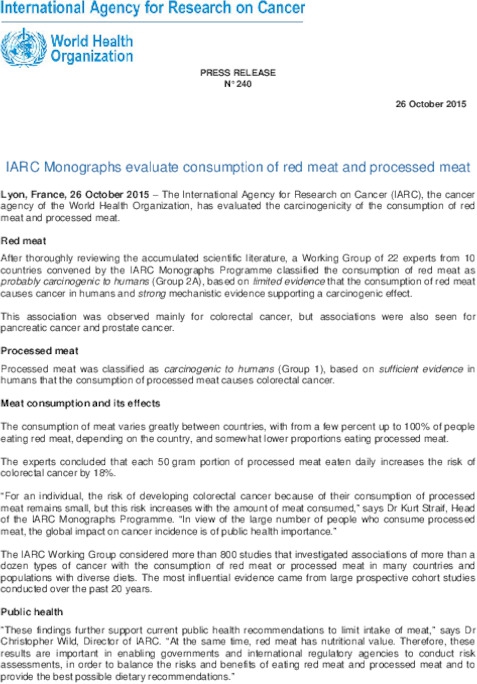
The new report by a working group of 22 experts from 10 countries places processed meat in the highest category of agents classified as “carcinogenic to humans,” alongside cigarettes, alcohol and asbestos. Red meat is classified in the second-highest category of “probably carcinogenic to humans.”
In addition to these products being hazardous to human health, processed and red meat production is also one of the leading hazards to the environment as a massive contributor to climate change, water pollution and habitat loss of threatened and endangered species.
Under Title 27 California Code of Regulations section 25904, a chemical or substance classified by the World Health Organization’s International Agency for Research on Cancer as carcinogenic to humans must be included on the list of chemicals known to the state to cause cancer. California businesses are required to provide a “clear and reasonable” warning before knowingly or intentionally exposing anyone to chemicals or substances on this list, which could mean product labels and warning signs where processed and red meats are sold or served throughout the state.
The Center for Biological Diversity is a national, nonprofit conservation organization with more than 900,000 members and online activists dedicated to the protection of endangered species and wild places.
For Immediate Release, October 26, 2015
http://www.biologicaldiversity.org/news/press_releases/2015/meat-10-26-2015.html
Center for Biological Diversity
http://www.biologicaldiversity.org/
The new report by a working group of 22 experts from 10 countries places processed meat in the highest category of agents classified as “carcinogenic to humans,” alongside cigarettes, alcohol and asbestos. Red meat is classified in the second-highest category of “probably carcinogenic to humans.”
In addition to these products being hazardous to human health, processed and red meat production is also one of the leading hazards to the environment as a massive contributor to climate change, water pollution and habitat loss of threatened and endangered species.
Under Title 27 California Code of Regulations section 25904, a chemical or substance classified by the World Health Organization’s International Agency for Research on Cancer as carcinogenic to humans must be included on the list of chemicals known to the state to cause cancer. California businesses are required to provide a “clear and reasonable” warning before knowingly or intentionally exposing anyone to chemicals or substances on this list, which could mean product labels and warning signs where processed and red meats are sold or served throughout the state.
The Center for Biological Diversity is a national, nonprofit conservation organization with more than 900,000 members and online activists dedicated to the protection of endangered species and wild places.
For Immediate Release, October 26, 2015
http://www.biologicaldiversity.org/news/press_releases/2015/meat-10-26-2015.html
Center for Biological Diversity
http://www.biologicaldiversity.org/
Add Your Comments
Comments
(Hide Comments)
Any food with more than 2% fat, except oatmeal, which is 4% fat, should be avoided by all of us who have to fight the battle of the bulge, and everyone else who cares about their health. Any food that has more than 500 mg of salt is guaranteed to raise the blood pressure, very bad.
1. Bacon is 39% fat and the fat is 44% saturated fat, 28% sodium (salt) with 671 mg of salt. You can get your 8 grams of protein from legumes such as lentils and navy beans, boiled with steamed rice. Vitamin C is in all fruits and vegetables, especially fruits, all having almost no fat or salt. See
http://www.thecaloriecounter.com/Foods/1000/10128/Food.aspx
2. Ham is 27% fat and the fat is 32% saturated fat. See
http://www.thecaloriecounter.com/Foods/1000/10166/Food.aspx
3. Sausage (pork) is 11% fat and the fat is 12% saturated.
http://www.thecaloriecounter.com/Foods/700/7063/Food.aspx
Clearly, bacon is by far the worst thing anyone can eat. All pork has be cooked well done to avoid getting disease such as trichinosis. If you just avoid all the meats and eat legumes instead, your health and figure improve drastically and your food budget slims down with you. You do not need to spend more than $50 a week person on food and avoiding meat and fish is a good way to keep your budget in line as well.
1. Bacon is 39% fat and the fat is 44% saturated fat, 28% sodium (salt) with 671 mg of salt. You can get your 8 grams of protein from legumes such as lentils and navy beans, boiled with steamed rice. Vitamin C is in all fruits and vegetables, especially fruits, all having almost no fat or salt. See
http://www.thecaloriecounter.com/Foods/1000/10128/Food.aspx
2. Ham is 27% fat and the fat is 32% saturated fat. See
http://www.thecaloriecounter.com/Foods/1000/10166/Food.aspx
3. Sausage (pork) is 11% fat and the fat is 12% saturated.
http://www.thecaloriecounter.com/Foods/700/7063/Food.aspx
Clearly, bacon is by far the worst thing anyone can eat. All pork has be cooked well done to avoid getting disease such as trichinosis. If you just avoid all the meats and eat legumes instead, your health and figure improve drastically and your food budget slims down with you. You do not need to spend more than $50 a week person on food and avoiding meat and fish is a good way to keep your budget in line as well.
new age health articles were saying this stuff in 1971!!! and lemming americans only talk about it because the ''organizations'' or officials talk about it. and lemming americans c all this ''news''!!
We are 100% volunteer and depend on your participation to sustain our efforts!
Donate

$95.00 donated
in the past month
Get Involved
If you'd like to help with maintaining or developing the website, contact us.
Publish
Publish your stories and upcoming events on Indybay.
Topics
More
Search Indybay's Archives
Advanced Search
►
▼
IMC Network