







 Publish to Newswire
 Add an Event
From the Open-Publishing Calendar
From the Open-Publishing Newswire
Indybay Feature
Canal littering exacerbates drinking water from canals
Recent decisions by Fresno Irrigation District are that "canal water [is] to be restricted to 90,000 acre-feet to recharge underground aquifers and to surface water treatment plants in Fresno and Clovis." (Fresno Bee, May 14th [29]) Canals conveying future potable water have severe implications when the canals are almost filthy enough to require wastewater treatment before being passed through the water treatment plant. This article talks about issues involving litter, herbicide use, and toxic waste-dumping in valley canals---issues not covered by the Fresno Bee. A good comparison regarding care of drainage water systems might be drawn from NW Washington State where the dikes are cleaned and mowed routinely.
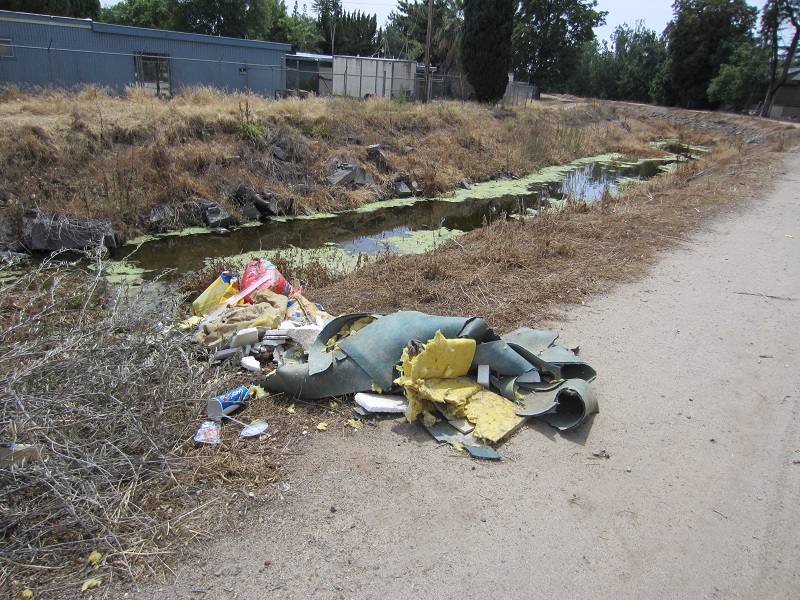
Changing canal environs due to drought
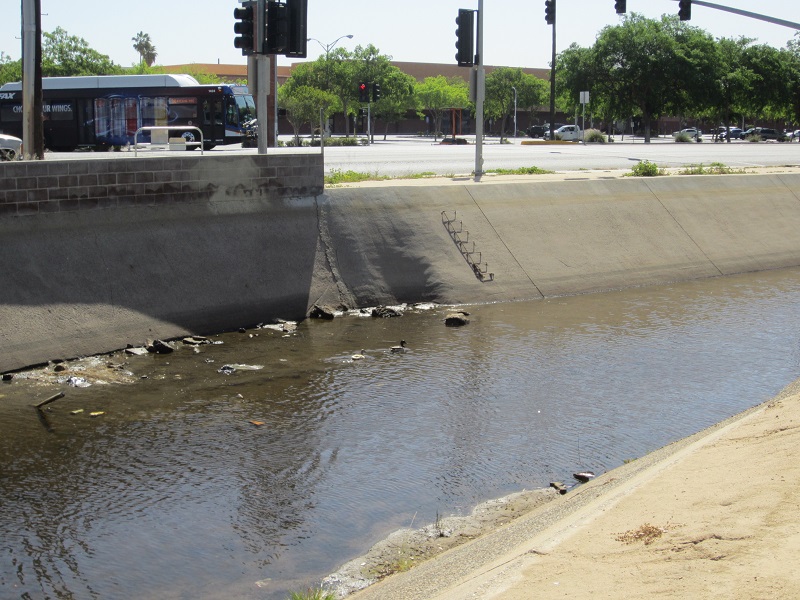
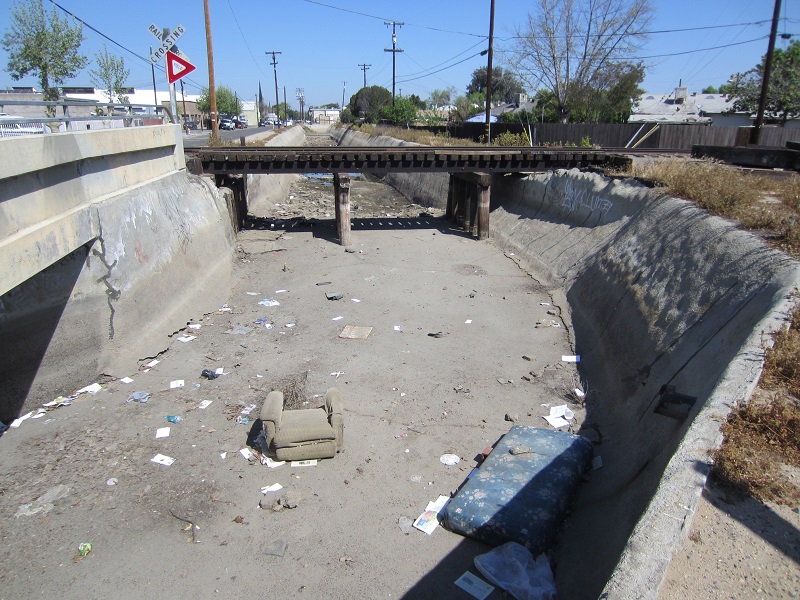
Fresno, CA -- At this time of year in the past, Central Valley canals are normally flowing full. In spring, it is the scene of a thriving ecosystem with ducks nesting and toads spawning in clear, gently flowing streams. However this year things are different. As of last year, the canal districts have had to decrease water allotments due to drought. As of late March, there was little to no water flowing in canals. Some canal-creek systems, such as Fancher Creek are doubling as emergency sanctuaries, attracting large white cranes and egrets that normally hang around the State Water Projects.
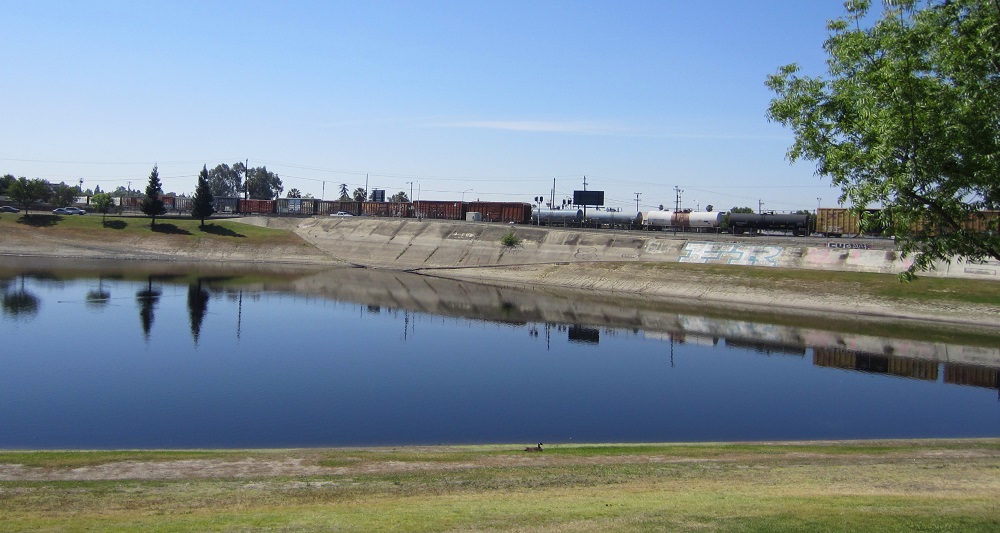
Low levels in Fresno Metropolitan Flood Control District detention ponds are also transforming these basins into common watering holes for a variety of small to large migrating birds, something that places them visibly at risk of surface water pollution.
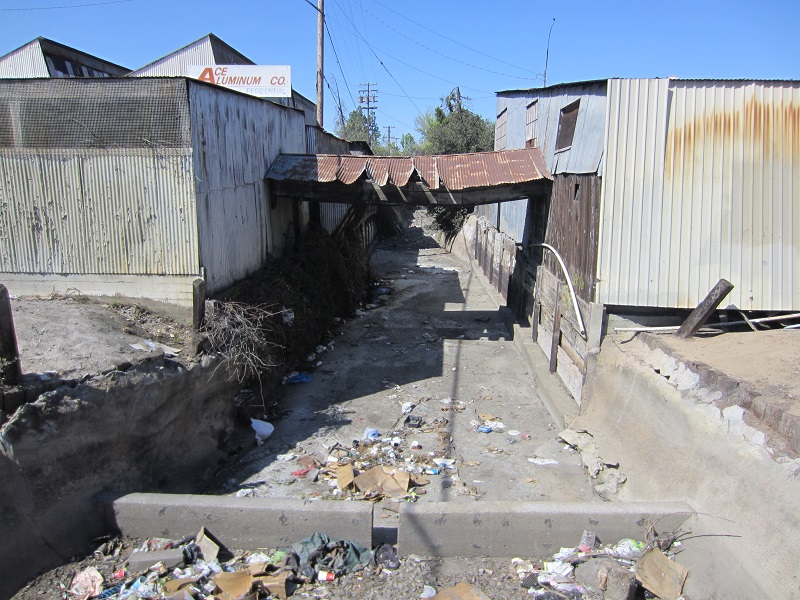
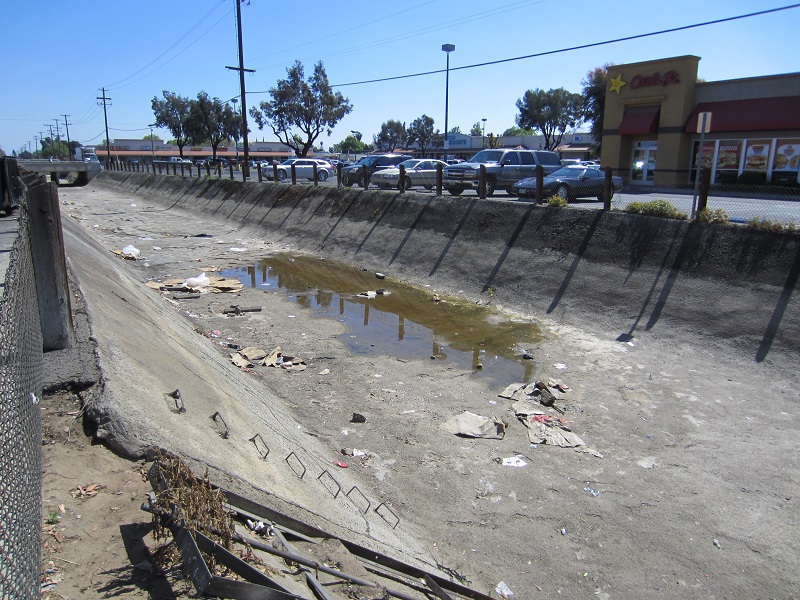
Surface pollution includes weed-killer (used extensively along canal-creek embankments supposedly as a low-cost solution for controlling weed growth), floating plastic debris, and litter of many varieties.
When open water is left standing too long, eutrophying algae also grows. Slippery duckweed provides healthy feeding to some bird species; however, insects like mosquitos too often provoke anti-ecological human responses. Pesticides collect in the water and can react with other debris to form toxic pollutants or carcinogens.
One thing is for certain: trying to identify and pin down responsibility on litter in canals and canal-creek systems is most assuredly difficult. Even the reasons for this are complex. Water, long considered part of the commons, has a history of underregulation.
If there were fair and equitable use and distribution, such as in the wilds with natural streams and ponds, no one would balk at the underregulation. In California's early days[1], Washo Indians survived on green belts along the Carson and Walker Rivers in the Eastern Sierras, sharing sinks with animals large and small; in the summer, they would move up to Tahoe, where they led an idyllic life fishing, gathering plants, and hunting small game. Living according to the fruits of the season, there was enough for all creatures, while the environment remained in delicate balance for centuries.
Competition among mining companies, logging companies, generations of ranchers, food growers and manufacturers, and most recently bottled water companies, along with dynamic population growth has led to intense water competition. Last year, for the first time in its history, the State Legislature passed a bill that will mandate green technology mapping and regulation of groundwater.[2]
With the United States undergoing a hydrofracking and natural gas boom, it is doubtful that it will include stricter mandates on surface water quality.[3] However this is what is needed to ensure that all surface water conveyance systems are better protected.
Litter and illegal dumping in surface waters is illegal. According to the California Penal Code Title 10, Section 374.7, a crime against public health and safety is committed if:
"A person who litters or causes to be littered, or dumps or causes to be dumped, waste matter into a bay, lagoon, channel, river, creek, slough, canal, lake, or reservoir, or other stream or body of water, or upon a bank, beach, or shore within 150 feet of the high water mark of a stream or body of water."
The pity is that it is only categorized as a misdemeanor with a maximum fine of $1000 upon the first conviction.[4]
What is more, authorities these days don't seem to be handing out littering tickets. It might be a good thing: often the litterbugs are passersby unrelated to the property owners whose property abuts the canal embankment. A member of the Fresno City Police Department Graffiti Team told this reporter that it would be like a double whammy if the innocent owner is forced to pay a penalty and also clean it up.
Need for local environmental movement
Local community education plays a vital role in galvanizing the public. An example is the Potomac Watershed surrounding Washington, D.C. What began as individual efforts to protect the Potomac River as a safe resource for boating, recreation, fishing, and historic preservation gradually became a regional environmental movement.
The Alice Ferguson Foundation[5] started as an educational center and conservancy providing community programs connecting people with the natural world (much like today's San Joaquin River Parkway[6] in the Central Valley). However in 2005, it took watershed stewardship to a whole new level with the Trash Free Potomac Watershed Initiative. The initiative supported the setup of a green technology organizational network to locate, volunteer, sponsor, or lead trash cleanup events and workshops.
In 1999, there were less than 100 Watershed cleanup events. Today there are dozens of events or projects each month. Over 150,000 participants are involved and they include young to old, and people of all races and socioeconomic levels. By 2011, many schools participated in litter prevention campaigns, and the Trash Free School Project began to help reduce school waste while encouraging re-use and recycling.
Neighboring counties, such as Prince George's County Government enroll schools and residents in subscriber lists for upcoming environmental activities. The Greater Washington Interfaith Power and Light (GWIPL)[7] is a charismatic outgrowth that helps congregations learn to "save energy, go green, and respond to climate change." In 2014, GWIPL even led a contingent to the New York City People's Climate March.
Mobilizing the Valley for greenup cleanup
Frequently the impetus for movement and change stems from personal need. For instance, Branch Avenue Litter Patrol began when this reporter noticed the abnormal number of bottles tossed in ditches near the Metro station. We signed up with the Trash Free Potomac[8] and with a little guidance from Green Hands USA[9] led several clean-up events. More important than the loads of trash picked, participation by a number of area residents ensured that this area will no longer be overlooked--a win-win for everyone.
A couple months ago this same reporter encountered a box of half-used Raid cans, herbicide boxes and bottles, and other pesticides parked along Fancher Creek in Fresno, CA. Over the next week, we began a self-initiated cleanup, and filled several large bags worth of plastic bottles, clothing, and other small junk. Later, District maintenance used herbicide spray on the canal embankment to control weeds; something quite extraordinary considering that manual labor here is so cheap.
We had made a call to the appropriate authority but there was no call back. With great effort, we were able to locate a few more resources for reporting illegal dumping. Two non-governmental agencies run free litter reporting websites: FresnoReport.org[10] and Litter-Bug.org[11]. Caltrans had taken down its littering website: Don't Trash California[12].
The City of Fresno Development and Resource Management does have a Community Revitalization/Code Enforcement Division with a webpage of ideas for dealing with issues, ways to improve one's neighborhood, and for reporting code violations[14]. And the Police Department supports crime and neighborhood watch[15] using green technology.
However, the impetus for a Trash Free Central Valley is largely missing from the public conversation. Trash-picking is associated with poor people picking out glass, aluminum, or plastic bottles for recycling since California's Bottle Bill[16] pays five to ten cents.
Last night, this reporter watched a couple scavengers riffle through a couple dumpsters throwing garbage bags out the bin in order to retrieve recyclables. It seems counter to the interest of the public when scavengers scatter litter for the sake of a couple bottles, yet this is because no one pays attention to using only the blue dumpster[17] for recycling.
As observed earlier[18] businesses routinely underestimate the number and size of bins needed because they want to economize on costs. As a result it is not at all uncommon to see trash overflowing from all bins and scattered in roads and along canals. Illegal dumping occurs when people treat the canals as if they were additional dumpsters.
Outside of a few attractive webpages and brochures, there is little dialogue about green or zero-waste community education. It's mostly missing in classrooms, in local television programming, in other media, or on roadside billboards.
Thus, the term "litter patrol" sounds foreign. It evokes surprise, as if trash is not a polite subject. There are no area Meetup.com[19] Valley groups focusing on community beautification and litter clean-up. Litter clean-up is not an activity in which the middle class, young or old, rich or poor, and people of all races feel free to engage in publicly.
We are told to just use common-sense approaches[20] with regard to picking up litter. Signs on canals merely warn about the dangers of falling in, not about littering. In fact, often the water is presumed to help decompose or carry litter away further downstream.
As it is, large rubbish and litter remains associated with homelessness and scavenging because information confined to websites, ads, or telephone book sections do little to instill understanding or to widen broad-based grassroots community support. Deeper understandings are fostered when conferences such as a Trash Summit[21] can be held.
Reconciling canals with the environment
Taiwan, a tiny island east of the People's Republic of China, attracts visitors near and far. Furthermore, it lives up to its reputation as an exotic beauty. In "Going Green Taiwanese Style" at Asian American Forum[22], travel-writer Christine Kroll wrote:
"[T]his island-nation's pro-active environmental intervention earned it 29th place among 132 nations for the World Economic Forum's 2012 Environmental Performance Index (EPI), ahead of Canada (37th), South Korea (43rd), Australia (48th), the US (49th), Singapore (52nd) and China (116th)."
If it's true that part of our enchantment with the wilderness is its pristine beauty, including waterfalls and mountains, then why wouldn't we extend this appreciation to natural or man-made water channels running through Californian cities?
Whether it's Tainan, Venice, or San Antonio, canals and river esplanades enhance the urban surroundings lending it a microclimate friendly for businesses, tourists, and sports enthusiasts. Smaller Californian cities, such as Stockton[23] encourage stream and canal cleanup. Considerations for a bike commuting plan in the Fresno area include development along the Mill Creek canal which would encourage cross-town commutes.
While it's tempting to let things grind to a halt due to the drought, it's counter-intuitive to progressive long-term engagement with the community. Rolling forward, one can envision all kinds of green technology opportunities part and parcel with improving the canal system, community projects that will stimulate body and soul.
Volunteers with local groups such as the Boys and Girls Club could learn to organize and help beautiful along the canals. Corps interns, college students, and others can earn credit or stipends from working with the irrigation districts in dealing with it's endless maintenance/inspection needs. Community service workers and other adult volunteers can participate in routine trash-free canal events that would foster pride of place.
In comparison, the present model of operations is restricted to for-profit approaches. The public is advised to use their common-sense when in the proximity of canals, whether they are strolling, bicycling, or otherwise accessing the embankments. It is already evident that the capitalist model of canal maintenance will never pay or motivate anyone to clean up trash sufficiently without community leadership.
The presence of a grey area in administration by the City, County, Districts, State, etc., makes it prone to abuses such as trash disposal, illegal dumping[24], water theft[25], gang fights, and midnight graffiti parties. Is it any wonder that there are links between poor health and a polluted environment[26]? We become what we eat, drink, breathe, dispose of, and have contact with whether directly or indirectly, then suffer the consequences.
Government officials, often eager to paper over problems, are generally not the ones willing to initiate change. Change must come from those willing to recognize that private wells and holding ponds are contaminated by surface water pollution whether from illegal dumping, accumulated litter, or even seepage from contaminated aquifers.
In Environmental Debt[27], Greenpeace Solutions Director Amy Larkin emphasized how Nature is increasingly holding us accountable for the environment. Only by recognizing externalities and being willing to mitigate for them will humanity outlive Nature.
If Californians can reconcile with their canals in the direction of environmental stewardship and collective responsibility, they can take the motto of "a culture of excellence where people get the best every day" to a whole new experiential level.
Notes:
1. Verna R. Johnston, Sierra Nevada: The Naturalist's Companion. Berkeley: University of California Press, 1998.
2. California Department of Water Resources. "Groundwater Information Center." http://water.ca.gov/groundwater/groundwater_management/legislation.cfm
3. Dan Bacher. "Water for fracking: How much does the oil/gas industry use?" Yubanet.com. http://bit.ly/1PfWdp8.
4. "Title 10. of Crimes Against the Public Health and Safety - California Penal Code Section 374.7." Onecle.com. http://law.onecle.com/california/penal/374.7.html.
5. Alice Ferguson Foundation, http://fergusonfoundation.org/
6. San Joaquin River Parkway and Conservation Trust, http://www.riverparkway.org/
7. Greater Washington Interfaith Power and Light (GWIPL), http://gwipl.org/
8. "Trash Free Potomac," Ferguson Foundation, http://trashnetwork.fergusonfoundation.org/
9. Green Hands USA, http://www.greenhandsusa.com/home
10. "Welcome to FERN," http://www.fresnoreport.org/
11. Litter-Bug.org, http://www.litter-bug.org/
12. "Don't Trash California," http://www.donttrashcalifornia.info/
14. City of Fresno Development and Resource Management, http://www.fresno.gov/Government/DepartmentDirectory/DARM/CodeEnforcement/default.htm
15. "Fresno Crime Watch," City of Fresno Police Department, http://www.fresno.gov/Government/DepartmentDirectory/Police/FresnoCrimeWatch/NeighborhoodWatch.htm
16. BottleBill.org, http://www.bottlebill.org/legislation/usa/california.htm
17. City of Fresno, Public Utilities--Solid Waste Recycling http://www.fresno.gov/Government/DepartmentDirectory/PublicUtilities/SolidWaste/ResidentialServices/Blue.htm
18. "Roadside Litter: Bottle Bill may help," http://www.examiner.com/green-technologies-in-washington-dc/christine-kroll?page=5
19. "Community & Environment," Meetup.com
20. "12 Ways to improve your neighborhood right now," City of Fresno, http://www.fresno.gov/NR/rdonlyres/5084782D-F939-4A5F-B6EC-7D74A16EC25E/0/TwelveWaystoImproveYourNeighborhoodRightNow.pdf
21. "2013 Potomac Watershed Trash Summit," http://fergusonfoundation.org/2013-potomac-watershed-trash-summit/
22. "Going Green Taiwanese Style," Asian-American Forum, http://www.aafspring12.blu-geese.org/
23. City of Stockton Stormwater Outreach, http://www.stocktongov.com/government/departments/municipalUtilities/utilStormOut.html
24. "A Watery Grave : Canal Near Tracy a Tempting Dumping Area for Cars, Even Bodies," Los Angeles Times, September 6, 1987, http://articles.latimes.com/1987-09-06/news/mn-6074_1_irrigation-canal
25. "Water Stolen as Drought Hits California," Press TV, September 7, 2013, http://www.presstv.ir/detail/2013/09/07/322634/water-stolen-as-drought-hits-california/
26. "Chronic diseases take their toll," Fresno Bee, April 11, 2015, http://www.fresnobee.com/2015/04/11/4471463/chronic-diseases-take-their-toll.html
27. "Book Review: Environmental Debt by Amy Larkin," http://www.examiner.com/review/earth-day-2015-book-review-environmental-debt
28. Article originally published at Resilience.org, "California Drought Exposes Canal Littering Problems," http://www.resilience.org/stories/2015-05-03/california-drought-exposes-canal-littering-problems
29. Tim Sheehan and Robert Rodriguez, "Fresno Irrigation District Farmers to get no water for the first time in a century," http://www.fresnobee.com/2015/05/14/4524961/historic-dry-up-no-canal-water.html
30. Visit the Slide-show at Examiner.com, http://www.examiner.com/article/california-drought-exposes-canal-litter-problem-pt-1
Photos furnished by author.
Fresno, CA -- At this time of year in the past, Central Valley canals are normally flowing full. In spring, it is the scene of a thriving ecosystem with ducks nesting and toads spawning in clear, gently flowing streams. However this year things are different. As of last year, the canal districts have had to decrease water allotments due to drought. As of late March, there was little to no water flowing in canals. Some canal-creek systems, such as Fancher Creek are doubling as emergency sanctuaries, attracting large white cranes and egrets that normally hang around the State Water Projects.
Low levels in Fresno Metropolitan Flood Control District detention ponds are also transforming these basins into common watering holes for a variety of small to large migrating birds, something that places them visibly at risk of surface water pollution.
Surface pollution includes weed-killer (used extensively along canal-creek embankments supposedly as a low-cost solution for controlling weed growth), floating plastic debris, and litter of many varieties.
When open water is left standing too long, eutrophying algae also grows. Slippery duckweed provides healthy feeding to some bird species; however, insects like mosquitos too often provoke anti-ecological human responses. Pesticides collect in the water and can react with other debris to form toxic pollutants or carcinogens.
One thing is for certain: trying to identify and pin down responsibility on litter in canals and canal-creek systems is most assuredly difficult. Even the reasons for this are complex. Water, long considered part of the commons, has a history of underregulation.
If there were fair and equitable use and distribution, such as in the wilds with natural streams and ponds, no one would balk at the underregulation. In California's early days[1], Washo Indians survived on green belts along the Carson and Walker Rivers in the Eastern Sierras, sharing sinks with animals large and small; in the summer, they would move up to Tahoe, where they led an idyllic life fishing, gathering plants, and hunting small game. Living according to the fruits of the season, there was enough for all creatures, while the environment remained in delicate balance for centuries.
Competition among mining companies, logging companies, generations of ranchers, food growers and manufacturers, and most recently bottled water companies, along with dynamic population growth has led to intense water competition. Last year, for the first time in its history, the State Legislature passed a bill that will mandate green technology mapping and regulation of groundwater.[2]
With the United States undergoing a hydrofracking and natural gas boom, it is doubtful that it will include stricter mandates on surface water quality.[3] However this is what is needed to ensure that all surface water conveyance systems are better protected.
Litter and illegal dumping in surface waters is illegal. According to the California Penal Code Title 10, Section 374.7, a crime against public health and safety is committed if:
"A person who litters or causes to be littered, or dumps or causes to be dumped, waste matter into a bay, lagoon, channel, river, creek, slough, canal, lake, or reservoir, or other stream or body of water, or upon a bank, beach, or shore within 150 feet of the high water mark of a stream or body of water."
The pity is that it is only categorized as a misdemeanor with a maximum fine of $1000 upon the first conviction.[4]
What is more, authorities these days don't seem to be handing out littering tickets. It might be a good thing: often the litterbugs are passersby unrelated to the property owners whose property abuts the canal embankment. A member of the Fresno City Police Department Graffiti Team told this reporter that it would be like a double whammy if the innocent owner is forced to pay a penalty and also clean it up.
Need for local environmental movement
Local community education plays a vital role in galvanizing the public. An example is the Potomac Watershed surrounding Washington, D.C. What began as individual efforts to protect the Potomac River as a safe resource for boating, recreation, fishing, and historic preservation gradually became a regional environmental movement.
The Alice Ferguson Foundation[5] started as an educational center and conservancy providing community programs connecting people with the natural world (much like today's San Joaquin River Parkway[6] in the Central Valley). However in 2005, it took watershed stewardship to a whole new level with the Trash Free Potomac Watershed Initiative. The initiative supported the setup of a green technology organizational network to locate, volunteer, sponsor, or lead trash cleanup events and workshops.
In 1999, there were less than 100 Watershed cleanup events. Today there are dozens of events or projects each month. Over 150,000 participants are involved and they include young to old, and people of all races and socioeconomic levels. By 2011, many schools participated in litter prevention campaigns, and the Trash Free School Project began to help reduce school waste while encouraging re-use and recycling.
Neighboring counties, such as Prince George's County Government enroll schools and residents in subscriber lists for upcoming environmental activities. The Greater Washington Interfaith Power and Light (GWIPL)[7] is a charismatic outgrowth that helps congregations learn to "save energy, go green, and respond to climate change." In 2014, GWIPL even led a contingent to the New York City People's Climate March.
Mobilizing the Valley for greenup cleanup
Frequently the impetus for movement and change stems from personal need. For instance, Branch Avenue Litter Patrol began when this reporter noticed the abnormal number of bottles tossed in ditches near the Metro station. We signed up with the Trash Free Potomac[8] and with a little guidance from Green Hands USA[9] led several clean-up events. More important than the loads of trash picked, participation by a number of area residents ensured that this area will no longer be overlooked--a win-win for everyone.
A couple months ago this same reporter encountered a box of half-used Raid cans, herbicide boxes and bottles, and other pesticides parked along Fancher Creek in Fresno, CA. Over the next week, we began a self-initiated cleanup, and filled several large bags worth of plastic bottles, clothing, and other small junk. Later, District maintenance used herbicide spray on the canal embankment to control weeds; something quite extraordinary considering that manual labor here is so cheap.
We had made a call to the appropriate authority but there was no call back. With great effort, we were able to locate a few more resources for reporting illegal dumping. Two non-governmental agencies run free litter reporting websites: FresnoReport.org[10] and Litter-Bug.org[11]. Caltrans had taken down its littering website: Don't Trash California[12].
The City of Fresno Development and Resource Management does have a Community Revitalization/Code Enforcement Division with a webpage of ideas for dealing with issues, ways to improve one's neighborhood, and for reporting code violations[14]. And the Police Department supports crime and neighborhood watch[15] using green technology.
However, the impetus for a Trash Free Central Valley is largely missing from the public conversation. Trash-picking is associated with poor people picking out glass, aluminum, or plastic bottles for recycling since California's Bottle Bill[16] pays five to ten cents.
Last night, this reporter watched a couple scavengers riffle through a couple dumpsters throwing garbage bags out the bin in order to retrieve recyclables. It seems counter to the interest of the public when scavengers scatter litter for the sake of a couple bottles, yet this is because no one pays attention to using only the blue dumpster[17] for recycling.
As observed earlier[18] businesses routinely underestimate the number and size of bins needed because they want to economize on costs. As a result it is not at all uncommon to see trash overflowing from all bins and scattered in roads and along canals. Illegal dumping occurs when people treat the canals as if they were additional dumpsters.
Outside of a few attractive webpages and brochures, there is little dialogue about green or zero-waste community education. It's mostly missing in classrooms, in local television programming, in other media, or on roadside billboards.
Thus, the term "litter patrol" sounds foreign. It evokes surprise, as if trash is not a polite subject. There are no area Meetup.com[19] Valley groups focusing on community beautification and litter clean-up. Litter clean-up is not an activity in which the middle class, young or old, rich or poor, and people of all races feel free to engage in publicly.
We are told to just use common-sense approaches[20] with regard to picking up litter. Signs on canals merely warn about the dangers of falling in, not about littering. In fact, often the water is presumed to help decompose or carry litter away further downstream.
As it is, large rubbish and litter remains associated with homelessness and scavenging because information confined to websites, ads, or telephone book sections do little to instill understanding or to widen broad-based grassroots community support. Deeper understandings are fostered when conferences such as a Trash Summit[21] can be held.
Reconciling canals with the environment
Taiwan, a tiny island east of the People's Republic of China, attracts visitors near and far. Furthermore, it lives up to its reputation as an exotic beauty. In "Going Green Taiwanese Style" at Asian American Forum[22], travel-writer Christine Kroll wrote:
"[T]his island-nation's pro-active environmental intervention earned it 29th place among 132 nations for the World Economic Forum's 2012 Environmental Performance Index (EPI), ahead of Canada (37th), South Korea (43rd), Australia (48th), the US (49th), Singapore (52nd) and China (116th)."
If it's true that part of our enchantment with the wilderness is its pristine beauty, including waterfalls and mountains, then why wouldn't we extend this appreciation to natural or man-made water channels running through Californian cities?
Whether it's Tainan, Venice, or San Antonio, canals and river esplanades enhance the urban surroundings lending it a microclimate friendly for businesses, tourists, and sports enthusiasts. Smaller Californian cities, such as Stockton[23] encourage stream and canal cleanup. Considerations for a bike commuting plan in the Fresno area include development along the Mill Creek canal which would encourage cross-town commutes.
While it's tempting to let things grind to a halt due to the drought, it's counter-intuitive to progressive long-term engagement with the community. Rolling forward, one can envision all kinds of green technology opportunities part and parcel with improving the canal system, community projects that will stimulate body and soul.
Volunteers with local groups such as the Boys and Girls Club could learn to organize and help beautiful along the canals. Corps interns, college students, and others can earn credit or stipends from working with the irrigation districts in dealing with it's endless maintenance/inspection needs. Community service workers and other adult volunteers can participate in routine trash-free canal events that would foster pride of place.
In comparison, the present model of operations is restricted to for-profit approaches. The public is advised to use their common-sense when in the proximity of canals, whether they are strolling, bicycling, or otherwise accessing the embankments. It is already evident that the capitalist model of canal maintenance will never pay or motivate anyone to clean up trash sufficiently without community leadership.
The presence of a grey area in administration by the City, County, Districts, State, etc., makes it prone to abuses such as trash disposal, illegal dumping[24], water theft[25], gang fights, and midnight graffiti parties. Is it any wonder that there are links between poor health and a polluted environment[26]? We become what we eat, drink, breathe, dispose of, and have contact with whether directly or indirectly, then suffer the consequences.
Government officials, often eager to paper over problems, are generally not the ones willing to initiate change. Change must come from those willing to recognize that private wells and holding ponds are contaminated by surface water pollution whether from illegal dumping, accumulated litter, or even seepage from contaminated aquifers.
In Environmental Debt[27], Greenpeace Solutions Director Amy Larkin emphasized how Nature is increasingly holding us accountable for the environment. Only by recognizing externalities and being willing to mitigate for them will humanity outlive Nature.
If Californians can reconcile with their canals in the direction of environmental stewardship and collective responsibility, they can take the motto of "a culture of excellence where people get the best every day" to a whole new experiential level.
Notes:
1. Verna R. Johnston, Sierra Nevada: The Naturalist's Companion. Berkeley: University of California Press, 1998.
2. California Department of Water Resources. "Groundwater Information Center." http://water.ca.gov/groundwater/groundwater_management/legislation.cfm
3. Dan Bacher. "Water for fracking: How much does the oil/gas industry use?" Yubanet.com. http://bit.ly/1PfWdp8.
4. "Title 10. of Crimes Against the Public Health and Safety - California Penal Code Section 374.7." Onecle.com. http://law.onecle.com/california/penal/374.7.html.
5. Alice Ferguson Foundation, http://fergusonfoundation.org/
6. San Joaquin River Parkway and Conservation Trust, http://www.riverparkway.org/
7. Greater Washington Interfaith Power and Light (GWIPL), http://gwipl.org/
8. "Trash Free Potomac," Ferguson Foundation, http://trashnetwork.fergusonfoundation.org/
9. Green Hands USA, http://www.greenhandsusa.com/home
10. "Welcome to FERN," http://www.fresnoreport.org/
11. Litter-Bug.org, http://www.litter-bug.org/
12. "Don't Trash California," http://www.donttrashcalifornia.info/
14. City of Fresno Development and Resource Management, http://www.fresno.gov/Government/DepartmentDirectory/DARM/CodeEnforcement/default.htm
15. "Fresno Crime Watch," City of Fresno Police Department, http://www.fresno.gov/Government/DepartmentDirectory/Police/FresnoCrimeWatch/NeighborhoodWatch.htm
16. BottleBill.org, http://www.bottlebill.org/legislation/usa/california.htm
17. City of Fresno, Public Utilities--Solid Waste Recycling http://www.fresno.gov/Government/DepartmentDirectory/PublicUtilities/SolidWaste/ResidentialServices/Blue.htm
18. "Roadside Litter: Bottle Bill may help," http://www.examiner.com/green-technologies-in-washington-dc/christine-kroll?page=5
19. "Community & Environment," Meetup.com
20. "12 Ways to improve your neighborhood right now," City of Fresno, http://www.fresno.gov/NR/rdonlyres/5084782D-F939-4A5F-B6EC-7D74A16EC25E/0/TwelveWaystoImproveYourNeighborhoodRightNow.pdf
21. "2013 Potomac Watershed Trash Summit," http://fergusonfoundation.org/2013-potomac-watershed-trash-summit/
22. "Going Green Taiwanese Style," Asian-American Forum, http://www.aafspring12.blu-geese.org/
23. City of Stockton Stormwater Outreach, http://www.stocktongov.com/government/departments/municipalUtilities/utilStormOut.html
24. "A Watery Grave : Canal Near Tracy a Tempting Dumping Area for Cars, Even Bodies," Los Angeles Times, September 6, 1987, http://articles.latimes.com/1987-09-06/news/mn-6074_1_irrigation-canal
25. "Water Stolen as Drought Hits California," Press TV, September 7, 2013, http://www.presstv.ir/detail/2013/09/07/322634/water-stolen-as-drought-hits-california/
26. "Chronic diseases take their toll," Fresno Bee, April 11, 2015, http://www.fresnobee.com/2015/04/11/4471463/chronic-diseases-take-their-toll.html
27. "Book Review: Environmental Debt by Amy Larkin," http://www.examiner.com/review/earth-day-2015-book-review-environmental-debt
28. Article originally published at Resilience.org, "California Drought Exposes Canal Littering Problems," http://www.resilience.org/stories/2015-05-03/california-drought-exposes-canal-littering-problems
29. Tim Sheehan and Robert Rodriguez, "Fresno Irrigation District Farmers to get no water for the first time in a century," http://www.fresnobee.com/2015/05/14/4524961/historic-dry-up-no-canal-water.html
30. Visit the Slide-show at Examiner.com, http://www.examiner.com/article/california-drought-exposes-canal-litter-problem-pt-1
Photos furnished by author.
For more information:
http://www.resilience.org/stories/2015-05-...
Add Your Comments
We are 100% volunteer and depend on your participation to sustain our efforts!
Donate

$110.00 donated
in the past month
Get Involved
If you'd like to help with maintaining or developing the website, contact us.
Publish
Publish your stories and upcoming events on Indybay.
Topics
More
Search Indybay's Archives
Advanced Search
►
▼
IMC Network