







 Publish to Newswire
 Add an Event
From the Open-Publishing Calendar
From the Open-Publishing Newswire
Indybay Feature
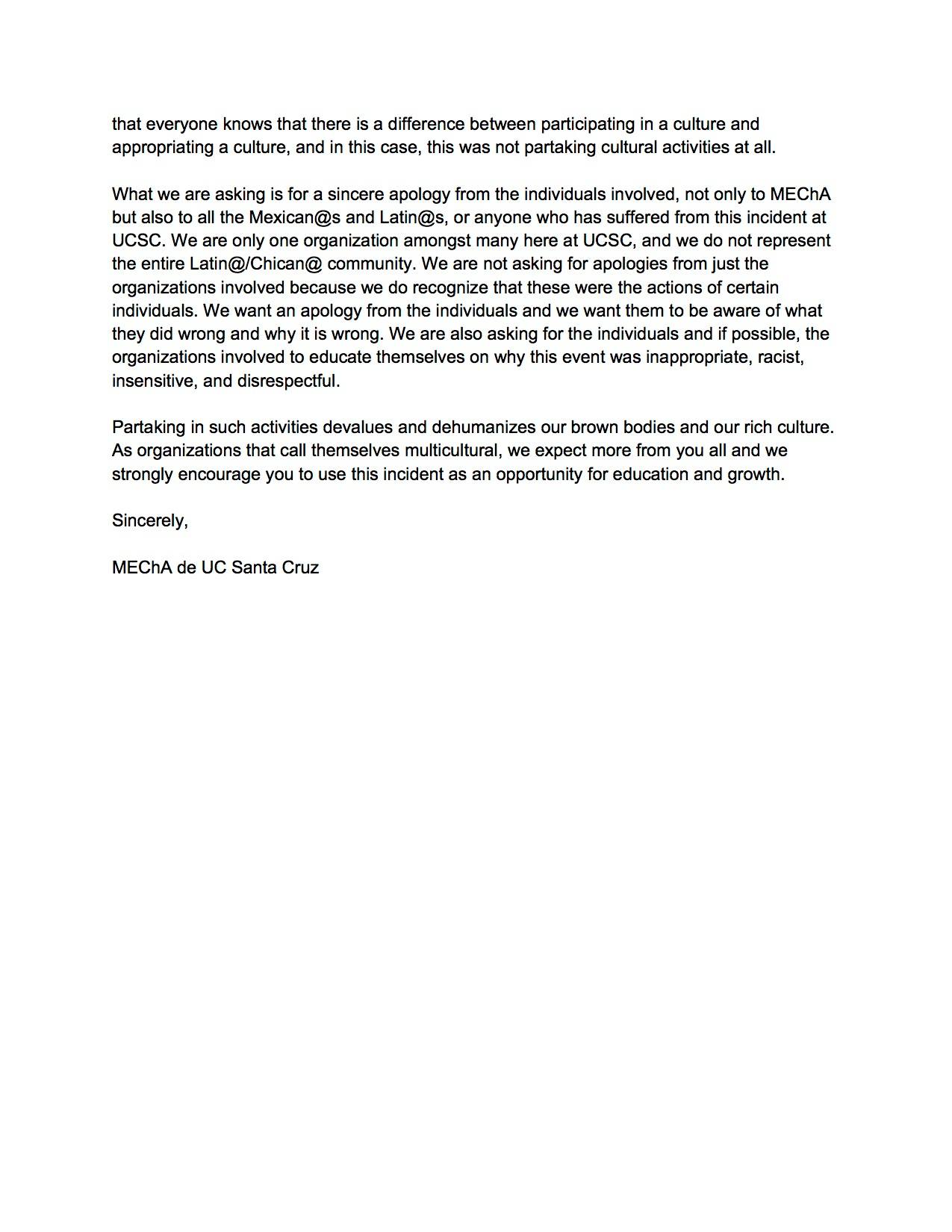
An open letter to the following Greek organizations from MEChA de UC Santa Cruz
An open letter to the following Greek organizations from MEChA de UC Santa Cruz: Kappa Zeta, Tau Kappa Epsilon, Sigma Phi Zeta and Lambda Phi Epsilon
We, el Movimiento Estudiantil Chican@ de Aztlán de UC Santa Cruz, a student-run and student-led organization committed to the advancement and civil rights of Chican@/Latin@ identifying people — who strive for the educational, gender, cultural, sexual orientation, economic, political, racial and social equity of the community and who strive for cultural competence and diversity — write this open letter to all parties involved in the recent online images of organization members partaking in events titled “Cinco de Drinko.”
We express the utmost outrage and disappointment over such images, as they are racist, culturally insensitive and inappropriate appropriations of the 5th of May. We would like to first point out that Cinco De Mayo is not Mexican Independence Day, it is a battle that symbolizes the struggles against the French in the late 1800s. However, this does not mean that it does not hold cultural significance to the Mexican community — especially in Puebla, Mexico. First, we are astonished at the lack of cultural sensitivity being displayed by your organizations. Some of your organizations pride themselves on being inclusive and multicultural, as open and welcoming spaces for students of all backgrounds. Secondly, we are astonished that these types of events still take place at a university that prides itself in being a Hispanic Serving Institution (HSI), especially from fellow students of color. We are astonished at this blatant flaunting of racist stereotypes and the lack of knowledge behind why cultural appropriation is problematic. Cultural appropriation is a gateway to racism. Regardless of intent, this photo and social media post was inappropriate.
The reasoning behind this letter is not only to address this specific incident, but to make sure that the public knows why it is offensive, and that way we can prevent this from happening again. It is not okay to use someone else’s culture as an excuse to drink, or consume any other substance of that manner. Our community, and communities of color in general, are very affected by negative stereotypes and by cultural appropriation. Both are problems that we have been battling for years and are working hard to get rid of. Secondly, it is important that everyone knows that there is a difference between participating in a culture and appropriating a culture, and in this case, this was not partaking in cultural activities at all.
What we are asking is for a sincere apology from the individuals involved, not only to MEChA but also to all the Mexican@s and Latin@s, or anyone who has suffered from this incident at UCSC. We are only one organization among many here at UCSC, and we do not represent the entire Latin@/Chican@ community. We are not asking for apologies from just the organizations involved because we do recognize that these were the actions of certain individuals. We want an apology from the individuals and we want them to be aware of what they did wrong and why it is wrong. We are also asking for the individuals and if possible, the organizations involved to educate themselves on why this event was inappropriate, racist, insensitive and disrespectful.
Partaking in such activities devalues and dehumanizes our brown bodies and our rich culture. As organizations that call themselves multicultural, we expect more from you all and we strongly encourage you to use this incident as an opportunity for education and growth.
Sincerely,
MEChA de UC Santa Cruz
We express the utmost outrage and disappointment over such images, as they are racist, culturally insensitive and inappropriate appropriations of the 5th of May. We would like to first point out that Cinco De Mayo is not Mexican Independence Day, it is a battle that symbolizes the struggles against the French in the late 1800s. However, this does not mean that it does not hold cultural significance to the Mexican community — especially in Puebla, Mexico. First, we are astonished at the lack of cultural sensitivity being displayed by your organizations. Some of your organizations pride themselves on being inclusive and multicultural, as open and welcoming spaces for students of all backgrounds. Secondly, we are astonished that these types of events still take place at a university that prides itself in being a Hispanic Serving Institution (HSI), especially from fellow students of color. We are astonished at this blatant flaunting of racist stereotypes and the lack of knowledge behind why cultural appropriation is problematic. Cultural appropriation is a gateway to racism. Regardless of intent, this photo and social media post was inappropriate.
The reasoning behind this letter is not only to address this specific incident, but to make sure that the public knows why it is offensive, and that way we can prevent this from happening again. It is not okay to use someone else’s culture as an excuse to drink, or consume any other substance of that manner. Our community, and communities of color in general, are very affected by negative stereotypes and by cultural appropriation. Both are problems that we have been battling for years and are working hard to get rid of. Secondly, it is important that everyone knows that there is a difference between participating in a culture and appropriating a culture, and in this case, this was not partaking in cultural activities at all.
What we are asking is for a sincere apology from the individuals involved, not only to MEChA but also to all the Mexican@s and Latin@s, or anyone who has suffered from this incident at UCSC. We are only one organization among many here at UCSC, and we do not represent the entire Latin@/Chican@ community. We are not asking for apologies from just the organizations involved because we do recognize that these were the actions of certain individuals. We want an apology from the individuals and we want them to be aware of what they did wrong and why it is wrong. We are also asking for the individuals and if possible, the organizations involved to educate themselves on why this event was inappropriate, racist, insensitive and disrespectful.
Partaking in such activities devalues and dehumanizes our brown bodies and our rich culture. As organizations that call themselves multicultural, we expect more from you all and we strongly encourage you to use this incident as an opportunity for education and growth.
Sincerely,
MEChA de UC Santa Cruz
Add Your Comments
Comments
(Hide Comments)
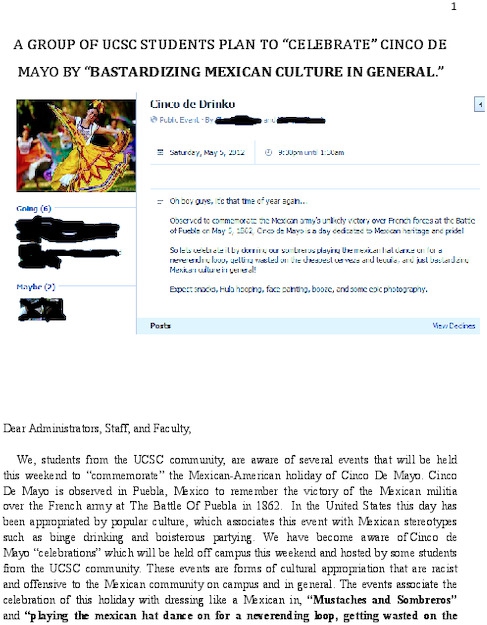
[ 6 page PDF includes Facebook events by UCSC students and a letter to UCSC Administrators, Staff, and Faculty ]
UCSC students will be holding a "Cinco de Drinko" party this weekend [2012] to commemorate Mexico's Cinco de Mayo. This event is not only racist and offensive but it perpetuates negative stereotypes of all people of color. We demand accountability for these actions and we call for UCSC administration to change the hostile racial climate of this campus.
--------------------------------------------------------------------
A GROUP OF UCSC STUDENTS PLAN TO “CELEBRATE” CINCO DE MAYO BY “BASTARDIZING MEXICAN CULTURE IN GENERAL.”
Dear Administrators, Staff, and Faculty,
We, students from the UCSC community, are aware of several events that will be held this weekend to “commemorate” the Mexican-American holiday of Cinco De Mayo. Cinco De Mayo is observed in Puebla, Mexico to remember the victory of the Mexican militia over the French army at The Battle Of Puebla in 1862. In the United States this day has been appropriated by popular culture, which associates this event with Mexican stereotypes such as binge drinking and boisterous partying. We have become aware of Cinco de Mayo “celebrations” which will be held off campus this weekend and hosted by some students from the UCSC community. These events are forms of cultural appropriation that are racist and offensive to the Mexican community on campus and in general. The events associate the celebration of this holiday with dressing like a Mexican in, “Mustaches and Sombreros” and “playing the mexican hat dance on for a neverending loop, getting wasted on the cheapest cerveza and tequila, and just bastardizing Mexican culture in general!” Events like these not only create a false idea of associating a Mexican celebration with drinking and alcoholism, but further perpetuate negative stereotypes and racist ideas of communities of color. These stereotypes have a material effect that demonize all communities of color and manifest themselves through the continual violent backlash that dominant society continues to support and fuel.
As concerned students we view these events not as isolated incidents, but as interconnected to our society’s climate that deem it “okay” to portray people of color’s cultures in a derogatory way. We see a connection between these racist episodes at our campus to those at other UC campuses, including the graffiti found in the Cowell bathroom that read, “Stop the Invasion, Kill a Mexican,” the anti-immigrant political culture at UCSC, Kresge's latest college night “Mexican Culture Night,” and our schools’ continued 40 year battle to obtain a Critical Race and Ethnic Studies Department. On other UC campuses we have seen similar racist messages, such as UC San Diego’s “Compton Cookout,” UCLA’s “Asians in the Library,” and UC Berkeley’s Racist “Bake Sale” to name a few. These types of events extend inaccurate portrayals of all cultures and ethnicities, which work to undermine some and uphold others. Most importantly, these stereotypes are manifested as true forms of violence that justify the continual state of repression against people of color. The recent murder of Trayvon Martin exemplifies racial violence, which in this case was enacted through the acceptance of racialized notions of criminality. Furthermore popular reporter Geraldo Rivera’s response to Trayvon Martin’s murder embodied these racist notions, “His hoodie killed Trayvon Martin as surely as George Zimmerman did...Agonize all you want about the unfairness of stereotypes...but don’t let your child go out into the hard cruel world wearing a costume that is really a sign that says ‘shoot me.' ” Geraldo Rivera’s statement demonstrates how our society not only internalizes and celebrates stereotypes, but also reacts to them in horrific ways that justify heinous hate crimes.
We, students of the UCSC, believe that these events are unacceptable and that they have been “dealt” with in inadequate ways that suppress and isolate these incidents instead of addressing them for what they are: a systemic institutionalized racist climate that has gone unchallenged by the University of California for far too long. The University not only fails to address racism at large, but ferociously supports and advocates for colorblind politics. The “Colorblind” rhetoric seeks to ignore the core question and repercussions of race and promotes a false notion of equality among society. Colorblind attitudes are prevalent in the argument against ethnic studies, a department that seeks to validate minoritized knowledge within institutions of higher education and brings to question the functionality of the constructions of race, class and gender. This is evident in the report “A Crisis of Competence: The Corrupting Effect of Political Activism in the University of California,” released by the National Association of Scholars, which argues against the “alienating” nature of ethnic studies:
What is happening to Shakespeare [apparently literary intellectualism is in danger of extinction] is happening to the humanities in general, and that carries still further the process of destroying an awareness of our past, and of who we are. When you are alienated from your own society, you are alienated from everything that made it what it is. It is worth noting again that these effects of radical alienation have an especially harmful effect on minorities. They need a sense of what this nation is and how it works, because that brings with it not just broad knowledge, but also confidence and optimism. Radical ideologues persuade minority students that they are better served by the recently formed and radicalized departments devoted to ethnic issues, but this interferes with everything that those students need to succeed.
We propose that by supporting the diverse groups of people at the UC with a Critical Race and Ethnic Studies (CRES) department, the UC can begin to change the rhetoric that posits Ethnic Studies as a divisive discipline among other systems of study. If as “minority students” we need a sense “of what this nation is and how it works,” then should we not openly discuss how this nation has been and continues to be hostile to certain groups of people, and has a history of promoting multiculturalist ideas that are supposed to promote diversity, yet continues to fail to instill “confidence” and “optimism” in its people? At the University, diversity remains a topic of needed elaboration, as it is constantly being contested and redefined. The University attempts to define diversity as “the inclusion of various types of people of different races, ethnicities, and communities.” Yet diversity does not equate to “equal access” and this is where the UC needs to make a difference. The UC needs to take responsibility for these events and create the educational dialogues needed about racism and hate with students on our campus and UC/CSU wide, to promote inclusion and discuss how systematic actions have denied equal access to various groups of people.
With this we demand an institutional house for a Critical Race and Ethnic Studies (CRES) Department on our campus, not a program that falls short of this urgent 40-year need. A CRES Department at this particular historical moment would be a huge step for the UC to begin to address issues of structural racism that are embedded within the institution. We believe that a CRES Department would only be able to thrive and change the structural racism at UCSC if the university administration commits to making new hires, instead of relying solely on the backs of overworked and overstretched faculty. Historically, UCSC has justified the lack of Ethnic Studies classes with the claim that Ethnic Studies and related concepts are “integrated into the campus curriculum.” Not only is Ethnic Studies relegated to watered-down “E” requirement classes, but when it is included in other disciplines, it is often in the form of a token lecture on race or non-Western culture that continues to place Ethnic Studies as an “alternative perspective” to the dominant traditional disciplines that historically excluded people of color and their knowledge. This marginalization effectively silences critical discussions about race, intersectionality, and power. It also leaves students of color feeling alienated in the classroom. A CRES Department would change the way UCSC relates to dialogue around race and the intersections of power.
In addition, CRES should be a creative and thriving project at UCSC especially in light of the institutions’ move towards status as a Hispanic Serving Institution (HSI). HSI designation will afford additional funding to the campus, which should lead to a vital discussion on how UCSC must serve its various communities through both rigorous academic support, but also institutional support that exemplifies the right to claim this status for serving our communities. The UC needs to sustain its mission to promote a hate and bias free environment, so that all students are able to foster their academic growth and as a sure way to improve retention rates for communities that have long been marginalized and ignored.
We conclude this letter with the following demands, which are designed to hold the hosts of the Cinco De Mayo party (Who are UCSC students) and the University of California, Santa Cruz accountable for the racism that students of color face on campus and its periphery.
We Demand….
A Critical Race and Ethnic Studies Department as outlined in the above paragraphs that should be established before the end of spring quarter of the academic year 2012-2013.
A public conversation between students of color, ethnic student organizations and UCSC administration and faculty that will be held before the end of May, 2012. This forum must be held on student terms.
This letter must be sent to all students, faculty and administrators of UCSC immediately.
A mandatory cultural awareness course for all faculty and UCSC students that is designed by students and faculty of color. For this to materialize, the university must hire a team of four students and at least one faculty member to work on this project over the summer so that this can be completed by Fall quarter 2012.
As you're reading this, people from all over UCSC and the community are viewing and sharing this letter.
Sincerely,
Concerned students of UCSC
UCSC students will be holding a "Cinco de Drinko" party this weekend [2012] to commemorate Mexico's Cinco de Mayo. This event is not only racist and offensive but it perpetuates negative stereotypes of all people of color. We demand accountability for these actions and we call for UCSC administration to change the hostile racial climate of this campus.
--------------------------------------------------------------------
A GROUP OF UCSC STUDENTS PLAN TO “CELEBRATE” CINCO DE MAYO BY “BASTARDIZING MEXICAN CULTURE IN GENERAL.”
Dear Administrators, Staff, and Faculty,
We, students from the UCSC community, are aware of several events that will be held this weekend to “commemorate” the Mexican-American holiday of Cinco De Mayo. Cinco De Mayo is observed in Puebla, Mexico to remember the victory of the Mexican militia over the French army at The Battle Of Puebla in 1862. In the United States this day has been appropriated by popular culture, which associates this event with Mexican stereotypes such as binge drinking and boisterous partying. We have become aware of Cinco de Mayo “celebrations” which will be held off campus this weekend and hosted by some students from the UCSC community. These events are forms of cultural appropriation that are racist and offensive to the Mexican community on campus and in general. The events associate the celebration of this holiday with dressing like a Mexican in, “Mustaches and Sombreros” and “playing the mexican hat dance on for a neverending loop, getting wasted on the cheapest cerveza and tequila, and just bastardizing Mexican culture in general!” Events like these not only create a false idea of associating a Mexican celebration with drinking and alcoholism, but further perpetuate negative stereotypes and racist ideas of communities of color. These stereotypes have a material effect that demonize all communities of color and manifest themselves through the continual violent backlash that dominant society continues to support and fuel.
As concerned students we view these events not as isolated incidents, but as interconnected to our society’s climate that deem it “okay” to portray people of color’s cultures in a derogatory way. We see a connection between these racist episodes at our campus to those at other UC campuses, including the graffiti found in the Cowell bathroom that read, “Stop the Invasion, Kill a Mexican,” the anti-immigrant political culture at UCSC, Kresge's latest college night “Mexican Culture Night,” and our schools’ continued 40 year battle to obtain a Critical Race and Ethnic Studies Department. On other UC campuses we have seen similar racist messages, such as UC San Diego’s “Compton Cookout,” UCLA’s “Asians in the Library,” and UC Berkeley’s Racist “Bake Sale” to name a few. These types of events extend inaccurate portrayals of all cultures and ethnicities, which work to undermine some and uphold others. Most importantly, these stereotypes are manifested as true forms of violence that justify the continual state of repression against people of color. The recent murder of Trayvon Martin exemplifies racial violence, which in this case was enacted through the acceptance of racialized notions of criminality. Furthermore popular reporter Geraldo Rivera’s response to Trayvon Martin’s murder embodied these racist notions, “His hoodie killed Trayvon Martin as surely as George Zimmerman did...Agonize all you want about the unfairness of stereotypes...but don’t let your child go out into the hard cruel world wearing a costume that is really a sign that says ‘shoot me.' ” Geraldo Rivera’s statement demonstrates how our society not only internalizes and celebrates stereotypes, but also reacts to them in horrific ways that justify heinous hate crimes.
We, students of the UCSC, believe that these events are unacceptable and that they have been “dealt” with in inadequate ways that suppress and isolate these incidents instead of addressing them for what they are: a systemic institutionalized racist climate that has gone unchallenged by the University of California for far too long. The University not only fails to address racism at large, but ferociously supports and advocates for colorblind politics. The “Colorblind” rhetoric seeks to ignore the core question and repercussions of race and promotes a false notion of equality among society. Colorblind attitudes are prevalent in the argument against ethnic studies, a department that seeks to validate minoritized knowledge within institutions of higher education and brings to question the functionality of the constructions of race, class and gender. This is evident in the report “A Crisis of Competence: The Corrupting Effect of Political Activism in the University of California,” released by the National Association of Scholars, which argues against the “alienating” nature of ethnic studies:
What is happening to Shakespeare [apparently literary intellectualism is in danger of extinction] is happening to the humanities in general, and that carries still further the process of destroying an awareness of our past, and of who we are. When you are alienated from your own society, you are alienated from everything that made it what it is. It is worth noting again that these effects of radical alienation have an especially harmful effect on minorities. They need a sense of what this nation is and how it works, because that brings with it not just broad knowledge, but also confidence and optimism. Radical ideologues persuade minority students that they are better served by the recently formed and radicalized departments devoted to ethnic issues, but this interferes with everything that those students need to succeed.
We propose that by supporting the diverse groups of people at the UC with a Critical Race and Ethnic Studies (CRES) department, the UC can begin to change the rhetoric that posits Ethnic Studies as a divisive discipline among other systems of study. If as “minority students” we need a sense “of what this nation is and how it works,” then should we not openly discuss how this nation has been and continues to be hostile to certain groups of people, and has a history of promoting multiculturalist ideas that are supposed to promote diversity, yet continues to fail to instill “confidence” and “optimism” in its people? At the University, diversity remains a topic of needed elaboration, as it is constantly being contested and redefined. The University attempts to define diversity as “the inclusion of various types of people of different races, ethnicities, and communities.” Yet diversity does not equate to “equal access” and this is where the UC needs to make a difference. The UC needs to take responsibility for these events and create the educational dialogues needed about racism and hate with students on our campus and UC/CSU wide, to promote inclusion and discuss how systematic actions have denied equal access to various groups of people.
With this we demand an institutional house for a Critical Race and Ethnic Studies (CRES) Department on our campus, not a program that falls short of this urgent 40-year need. A CRES Department at this particular historical moment would be a huge step for the UC to begin to address issues of structural racism that are embedded within the institution. We believe that a CRES Department would only be able to thrive and change the structural racism at UCSC if the university administration commits to making new hires, instead of relying solely on the backs of overworked and overstretched faculty. Historically, UCSC has justified the lack of Ethnic Studies classes with the claim that Ethnic Studies and related concepts are “integrated into the campus curriculum.” Not only is Ethnic Studies relegated to watered-down “E” requirement classes, but when it is included in other disciplines, it is often in the form of a token lecture on race or non-Western culture that continues to place Ethnic Studies as an “alternative perspective” to the dominant traditional disciplines that historically excluded people of color and their knowledge. This marginalization effectively silences critical discussions about race, intersectionality, and power. It also leaves students of color feeling alienated in the classroom. A CRES Department would change the way UCSC relates to dialogue around race and the intersections of power.
In addition, CRES should be a creative and thriving project at UCSC especially in light of the institutions’ move towards status as a Hispanic Serving Institution (HSI). HSI designation will afford additional funding to the campus, which should lead to a vital discussion on how UCSC must serve its various communities through both rigorous academic support, but also institutional support that exemplifies the right to claim this status for serving our communities. The UC needs to sustain its mission to promote a hate and bias free environment, so that all students are able to foster their academic growth and as a sure way to improve retention rates for communities that have long been marginalized and ignored.
We conclude this letter with the following demands, which are designed to hold the hosts of the Cinco De Mayo party (Who are UCSC students) and the University of California, Santa Cruz accountable for the racism that students of color face on campus and its periphery.
We Demand….
A Critical Race and Ethnic Studies Department as outlined in the above paragraphs that should be established before the end of spring quarter of the academic year 2012-2013.
A public conversation between students of color, ethnic student organizations and UCSC administration and faculty that will be held before the end of May, 2012. This forum must be held on student terms.
This letter must be sent to all students, faculty and administrators of UCSC immediately.
A mandatory cultural awareness course for all faculty and UCSC students that is designed by students and faculty of color. For this to materialize, the university must hire a team of four students and at least one faculty member to work on this project over the summer so that this can be completed by Fall quarter 2012.
As you're reading this, people from all over UCSC and the community are viewing and sharing this letter.
Sincerely,
Concerned students of UCSC
For more information:
https://groups.google.com/forum/#!topic/20...
The fact that these rich folks' clubs known as Greek letter organizations exist at all on our public university campuses is outrageous. They all should be banned from all public universities as they are nothing but elitist hoodlums with far too much money. Here is a description of deadly hazing by Lambda Phi Epsilon, apparently for Asian American men:
From: http://sfbay.ca/2013/05/10/dead-students-frat-has-history-of-deadly-hazing/
Also missing from the website is any mention of 18-year-old Peter Tran.
Tran, a freshman at San Francisco State University, was found dead at a home not far from the school last month after attending a Lambda Phi Epsilon party, as reported by student newspaper Golden Gate Xpress.
For women, there is the Asian American sorority, Kappa Zeta.
Here is an article on sorority hazing:
http://www.hercampus.com/life/campus-living/sorority-hazing-whats-really-going
Again, for men, there is Tau Kappa Epsilon. Here is a hazing story for this snotty Greek letter club:
http://www.dailynews.com/social-affairs/20150218/csun-suspends-third-fraternity-tau-kappa-epsilon-for-alleged-hazing-sexual-misconduct
In January 2015, CSUN (Cal State University Northridge) suspended a third fraternity, Tau Kappa Epsilon, after allegations of hazing and sexual misconduct.
Another for men is Sigma Phi Zeta.
None of this garbage belongs at any state university.
From: http://sfbay.ca/2013/05/10/dead-students-frat-has-history-of-deadly-hazing/
Also missing from the website is any mention of 18-year-old Peter Tran.
Tran, a freshman at San Francisco State University, was found dead at a home not far from the school last month after attending a Lambda Phi Epsilon party, as reported by student newspaper Golden Gate Xpress.
For women, there is the Asian American sorority, Kappa Zeta.
Here is an article on sorority hazing:
http://www.hercampus.com/life/campus-living/sorority-hazing-whats-really-going
Again, for men, there is Tau Kappa Epsilon. Here is a hazing story for this snotty Greek letter club:
http://www.dailynews.com/social-affairs/20150218/csun-suspends-third-fraternity-tau-kappa-epsilon-for-alleged-hazing-sexual-misconduct
In January 2015, CSUN (Cal State University Northridge) suspended a third fraternity, Tau Kappa Epsilon, after allegations of hazing and sexual misconduct.
Another for men is Sigma Phi Zeta.
None of this garbage belongs at any state university.

I KNOW that everywhere they build new housing in Santa Cruz under some pretense of serving the community and then turn it into student housing, a bar is built or exists somewhere nearby, and binge drinking seems to be the most-often engaged in hobby by UCSC students, but allowing reference to the wanton use of alcohol at an event targeting students by a campus related organization seems in violation of SOME UC safety related rules or regs.
For more information:
http://auntieimperial.tumblr.com
We are 100% volunteer and depend on your participation to sustain our efforts!
Donate

$115.00 donated
in the past month
Get Involved
If you'd like to help with maintaining or developing the website, contact us.
Publish
Publish your stories and upcoming events on Indybay.
Topics
More
Search Indybay's Archives
Advanced Search
►
▼
IMC Network