







 Publish to Newswire
 Add an Event
From the Open-Publishing Calendar
From the Open-Publishing Newswire
Indybay Feature
Delta group says levees are better investment than peripheral canal
“Earthquake threat to the Delta – with the Hayward Fault 45 miles away - is minimal, according to levee expert Dr. Bob Pyke, but the State Water Project and Central Valley Project cross right over some of the most dangerous faults in California from Coalinga south to LA. Large engineered projects are more vulnerable to earthquake then Delta levees," said Barbara Barrigan-Parrilla, Executive Director of Restore the Delta.
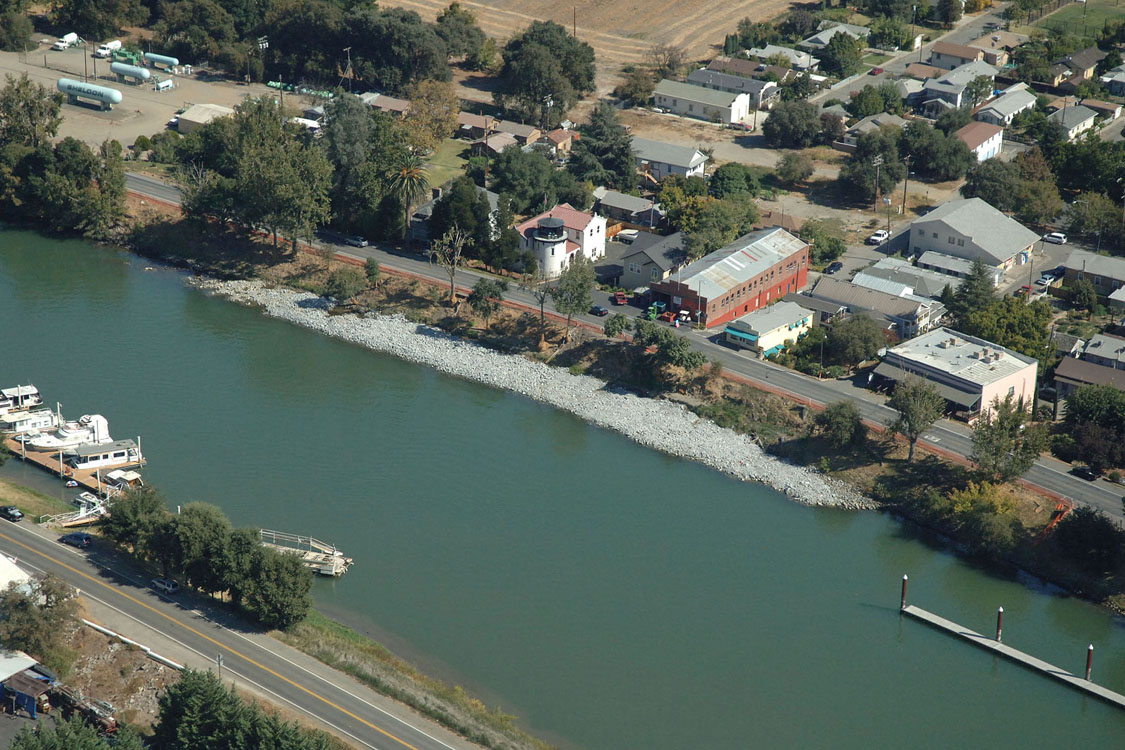
Photo: Aerial view showing levee repair work at Mile 26.9 on the Sacramento River, northeast of Rio Vista. Shot 12/27/07 by Department of Water Resources.
Photo: Aerial view showing levee repair work at Mile 26.9 on the Sacramento River, northeast of Rio Vista. Shot 12/27/07 by Department of Water Resources.
Delta group says levees are better investment than peripheral canal
by Dan Bacher
In conjunction with the Delta Levees Standards Conference being held today in Sacramento, Restore the Delta proposed that Delta levees be upgraded as part of any Bay-Delta water solution - and emphasized that they are a much better investment than building a peripheral canal or tunnel.
The conference, sponsored by the Delta Protection Commission and Water Education Foundation, takes place at Woodlake Hotel at 500 Leisure Lane, Sacramento.
“Fat, robust levees protect the Delta," said Barbara Barrigan-Parrilla, Executive Director of Restore the Delta. "An emergency preparedness plan against the greatest threat – flood – is also needed. But floods can be managed."
“We are well-positioned to deal with sea level rise – we can raise levees one to two inches per year," she noted.
Barrigan-Parrilla said levee improvements will be needed, regardless whether or not the state decides to build a peripheral canal or tunnel.
“The $1-2 billion investment is necessary to protect $20 billion in infrastructure in the Delta and 4 million urban residents," she stated. "Fattening the levees would still have to be completed, even if a canal were built. A canal won’t protect state highways, natural gas pipelines, PG&E transmission lines, railroads, East Bay MUD pipes and other key infrastructure threatened by a flood."
She also countered the argument, constantly brought up by canal proponents, that the conveyance needs to be built to counter the "catastrophic" threat of earthquakes.
“Earthquake threat to the Delta – with the Hayward Fault 45 miles away - is minimal, according to levee expert Dr. Bob Pyke, but the State Water Project and Central Valley Project cross right over some of the most dangerous faults in California from Coalinga south to LA. Large engineered projects are more vulnerable to earthquake then Delta levees," stated Barrigan-Parrilla.
Barrigan-Parrilla said funding exists for levee improvements in Prop 1E, and needs to be spent accordingly.
She also said the Department of Water Resources is proposing a lesser standard for levee protection than the higher safety standard developed by the Army Corps of Engineers (PL 84-99). "The Army Corps of Engineers’ levee standard is the same higher standard found in the Economic Sustainability Plan authored by the Delta Protection Commission earlier this year," noted Barrigan-Parrilla.
“It is problematic that the Department of Water Resources is actually proposing a weaker standard for Delta protection while promoting new conveyance," she concluded. "Today’s conference is an opportunity to highlight the differences between the two standards and to discuss the role that levees play in water exports, habitat for the ecosystem, and public safety for the people in the Delta and the urban periphery of the Delta."
Supporters of the conference include ATKINS, the Central Delta Water Agency, Contra Costa Water District, Kjeldsen, Sinnock & Neudeck, Inc., MBK Engineers, South Delta Water Agency, The Dutra Group, The Nature Conservancy, American Rivers, Natural Resources Defense Council and the Planning and Conservation League.
According to an announcement by the conference organizers, the conference features "a lively discussion about Delta levee standards - the differences between the Hazard Mitigation Plan (HMP) Standard and the PL 84-99 Standard and what that means for Delta conveyance, habitat and public safety."
Perspectives on the standards related to these areas will be presented by California Department of Water Resources officials, in-Delta residents and water agencies, and the Army Corps of Engineers. A seven-member response panel will then have its say.
While the inclusion of Delta residents on the panels is a promising move by the conference sponsors, the absence of any representatives from California Indian Tribes or recreational and commercial fishing groups on the conference panels is in my opinion a glaring omission, since these communities are among those most directly impacted by plans to build a peripheral canal.
A coalition of Delta residents, Indian Tribes, fishermen, family farmers, grassroots environmentalists, Southern California ratepayers and elected officials is opposed to the construction of the peripheral canal because of its enormous cost and the grave threat it poses to the Delta ecosystem. Delta advocates believe the canal, by exporting more Delta water to corporate agribusiness and southern California, will hasten the extinction of Central Valley steelhead, Sacramento River chinook salmon, Delta smelt, longfin smelt, Sacramento splittail, green sturgeon and other fish species.
For the conference agenda, go to: http://www.watereducation.org/userfiles/Final_Agenda.pdf
For information about Restore the Delta, go to http://www.restorethedelta.org.
by Dan Bacher
In conjunction with the Delta Levees Standards Conference being held today in Sacramento, Restore the Delta proposed that Delta levees be upgraded as part of any Bay-Delta water solution - and emphasized that they are a much better investment than building a peripheral canal or tunnel.
The conference, sponsored by the Delta Protection Commission and Water Education Foundation, takes place at Woodlake Hotel at 500 Leisure Lane, Sacramento.
“Fat, robust levees protect the Delta," said Barbara Barrigan-Parrilla, Executive Director of Restore the Delta. "An emergency preparedness plan against the greatest threat – flood – is also needed. But floods can be managed."
“We are well-positioned to deal with sea level rise – we can raise levees one to two inches per year," she noted.
Barrigan-Parrilla said levee improvements will be needed, regardless whether or not the state decides to build a peripheral canal or tunnel.
“The $1-2 billion investment is necessary to protect $20 billion in infrastructure in the Delta and 4 million urban residents," she stated. "Fattening the levees would still have to be completed, even if a canal were built. A canal won’t protect state highways, natural gas pipelines, PG&E transmission lines, railroads, East Bay MUD pipes and other key infrastructure threatened by a flood."
She also countered the argument, constantly brought up by canal proponents, that the conveyance needs to be built to counter the "catastrophic" threat of earthquakes.
“Earthquake threat to the Delta – with the Hayward Fault 45 miles away - is minimal, according to levee expert Dr. Bob Pyke, but the State Water Project and Central Valley Project cross right over some of the most dangerous faults in California from Coalinga south to LA. Large engineered projects are more vulnerable to earthquake then Delta levees," stated Barrigan-Parrilla.
Barrigan-Parrilla said funding exists for levee improvements in Prop 1E, and needs to be spent accordingly.
She also said the Department of Water Resources is proposing a lesser standard for levee protection than the higher safety standard developed by the Army Corps of Engineers (PL 84-99). "The Army Corps of Engineers’ levee standard is the same higher standard found in the Economic Sustainability Plan authored by the Delta Protection Commission earlier this year," noted Barrigan-Parrilla.
“It is problematic that the Department of Water Resources is actually proposing a weaker standard for Delta protection while promoting new conveyance," she concluded. "Today’s conference is an opportunity to highlight the differences between the two standards and to discuss the role that levees play in water exports, habitat for the ecosystem, and public safety for the people in the Delta and the urban periphery of the Delta."
Supporters of the conference include ATKINS, the Central Delta Water Agency, Contra Costa Water District, Kjeldsen, Sinnock & Neudeck, Inc., MBK Engineers, South Delta Water Agency, The Dutra Group, The Nature Conservancy, American Rivers, Natural Resources Defense Council and the Planning and Conservation League.
According to an announcement by the conference organizers, the conference features "a lively discussion about Delta levee standards - the differences between the Hazard Mitigation Plan (HMP) Standard and the PL 84-99 Standard and what that means for Delta conveyance, habitat and public safety."
Perspectives on the standards related to these areas will be presented by California Department of Water Resources officials, in-Delta residents and water agencies, and the Army Corps of Engineers. A seven-member response panel will then have its say.
While the inclusion of Delta residents on the panels is a promising move by the conference sponsors, the absence of any representatives from California Indian Tribes or recreational and commercial fishing groups on the conference panels is in my opinion a glaring omission, since these communities are among those most directly impacted by plans to build a peripheral canal.
A coalition of Delta residents, Indian Tribes, fishermen, family farmers, grassroots environmentalists, Southern California ratepayers and elected officials is opposed to the construction of the peripheral canal because of its enormous cost and the grave threat it poses to the Delta ecosystem. Delta advocates believe the canal, by exporting more Delta water to corporate agribusiness and southern California, will hasten the extinction of Central Valley steelhead, Sacramento River chinook salmon, Delta smelt, longfin smelt, Sacramento splittail, green sturgeon and other fish species.
For the conference agenda, go to: http://www.watereducation.org/userfiles/Final_Agenda.pdf
For information about Restore the Delta, go to http://www.restorethedelta.org.
Add Your Comments
Comments
(Hide Comments)
In the the California Assembly District 11 [AD-11, AD 11], a Delta/Bay District, only one single candidate has made it very clear that they'd fight the State's Canal Project. Patricia Hernandez challenged the other candidates to get their local city council's to pass resolutions denouncing the Peripheral Canal.
Oakley Councilman, and AD11 candidate, Jim Frazier has skirted the issue, claiming support for the Delta by standing with fishermen and women against the proposed Striped Bass Legislation and infers his position about the Canal by including an anti HR 1837 [allows for full pumping of water exports at the Delta pumps, strip away water rights from Delta area landowners, and dismember the San Joaquin River Restoration Act] petition link on his website.
He cleverly gives the appearance of standing against the Canal without doing so or actually committing to fight against it at all.
In fact one of his endorsements, The Building and Construction Trades, appears firm in their stance to support the Canal... for the jobs. How will Mr. Frazier account for the discrepancy when in Sacramento?
He needs to clearly state his position on the Peripheral Canal and not play "Delta Steward" double-speak and association games.
He can commit to his support for Restore the Delta, Hunters, Fishermen and women and Delta Farmers by authoring a resolution clearly defining his position on the Peripheral Canal, get "his" city council to approve the resolution, and to promote other city's to do the same.
Short of that, I'd suggest tossing your votes Hernandez's way.
Oakley Councilman, and AD11 candidate, Jim Frazier has skirted the issue, claiming support for the Delta by standing with fishermen and women against the proposed Striped Bass Legislation and infers his position about the Canal by including an anti HR 1837 [allows for full pumping of water exports at the Delta pumps, strip away water rights from Delta area landowners, and dismember the San Joaquin River Restoration Act] petition link on his website.
He cleverly gives the appearance of standing against the Canal without doing so or actually committing to fight against it at all.
In fact one of his endorsements, The Building and Construction Trades, appears firm in their stance to support the Canal... for the jobs. How will Mr. Frazier account for the discrepancy when in Sacramento?
He needs to clearly state his position on the Peripheral Canal and not play "Delta Steward" double-speak and association games.
He can commit to his support for Restore the Delta, Hunters, Fishermen and women and Delta Farmers by authoring a resolution clearly defining his position on the Peripheral Canal, get "his" city council to approve the resolution, and to promote other city's to do the same.
Short of that, I'd suggest tossing your votes Hernandez's way.
We are 100% volunteer and depend on your participation to sustain our efforts!
Donate

$125.00 donated
in the past month
Get Involved
If you'd like to help with maintaining or developing the website, contact us.
Publish
Publish your stories and upcoming events on Indybay.
Topics
More
Search Indybay's Archives
Advanced Search
►
▼
IMC Network