







 Publish to Newswire
 Add an Event
Coastal ecosystems suffer 100 fold decrease in capacity to store carbon mitigating climate
"We have effectively gone back in time and monitored carbon capture and storage by coastal ecosystems, finding a 100-fold weakening in the ability of coastal ecosystems to sequester carbon since the time of European settlement. This severely hampered the ability of nature to reset the planet's thermostat." said Dr. Peter Macreadie, University of Technology, Sydney Chancellor's Postdoctoral Research Fellow.
The scientific analysis suggests a rapid reduction in seagrass and increase in microalgae occurrred during industrialisation of Botany Bay. The findings are critical because plants such as seagrass have a relatively large carbon sink capacity, which plays a critical role in mitigating climate change.
Radiocarbon dating was used to examine a chronology for the sedimentation cores. Changes in plant and algae composition over time were then determined according to the change in the isotopic ratio of the organic matter in the sediment.
The study has been published in the journal Global Change Biology on 23 November 2011 as Paleoreconstruction of estuarine sediments reveal human-induced weakening of coastal carbon sinks. It was authored by Peter I. Macreadie, Katie Allen, Brendan P. Kelaher, Peter J. Ralph, and Charles G. Skilbeck.
The study paper abstract in Global Change Biology concludes with this statement:
Analysis of stable isotopic ratios of 12C/13C showed that the relative contribution of seagrass and C3 terrestrial plants (mangroves, saltmarsh) to detritus declined around the time of rapid industrial expansion (~1950s), coinciding with an increase in the contribution of microalgal sources. We conclude that the relative contribution of microalgae to detritus has increased within Botany Bay, and that this shift is the sign of increased industrialization and concomitant eutrophication. Given the lower carbon burial efficiencies of microalgae (~0.1%) relative to seagrasses and C3 terrestrial plants (up to 10%), such changes represent a substantial weakening of the carbon sink potential of Botany Bay - this occurrence is likely to be common to human-impacted estuaries, and has consequences for the role these systems play in helping to mitigate climate change.
The scientists argue that Greenhouse gas abatement schemes such as the Australian carbon farming initiative should be extended to provide funding for reversing the degredation of river estuary and coastal environments to improve their carbon sink effectiveness.
"Unfortunately, this outcome is common to urbanized estuaries throughout the world, therefore the study adds further support for the inclusion of Blue Carbon habitats (seagrasses, saltmarshes, and mangroves) in greenhouse gas abatement schemes," concluded Dr. Peter Macreadie.
Our coastal ecosystems play an important role as carbon sinks, fish nurseries, and for protection against storm surges and coastal erosion. Seagrass, saltmarsh and mangrove environments need preserving to maintain ecosystem resilience with increasing temperatures and sea level rise caused by global warming.
As sea levels rise it will be important to allow coastal marshes and ecosystems to advance inland to maintain biodiversity and their capacity to sequester carbon. But often human infrastructure - roads and buildings - may prevent their natural migration. They may need our help to survive according to a PRBO Conservation Science study of California coastal ecosystems which detailed that Marin's critical marshes could face extinction as sea level rises. The study found that 93 percent of San Francisco Bay's tidal marsh could be lost in the next century with 5.4 feet of sea-level rise, combined with low sediment levels. The researchers recommended protecting areas from development or that moving roads or buildings may be necessary.
Sources:
- Eureka Alert media Release, 29 November 2011 - Industrialization weakens important carbon sink
- Global Change Biology, 23 November 2011 - Paleoreconstruction of estuarine sediments reveal human-induced weakening of coastal carbon sinks (Abstract) DOI: 10.1111/j.1365-2486.2011.02582.x
- Sea Level Rise Foundation repost from Marin Independent Journal, November 25, 2011 - Marin's critical marshes could face extinction as sea level rises
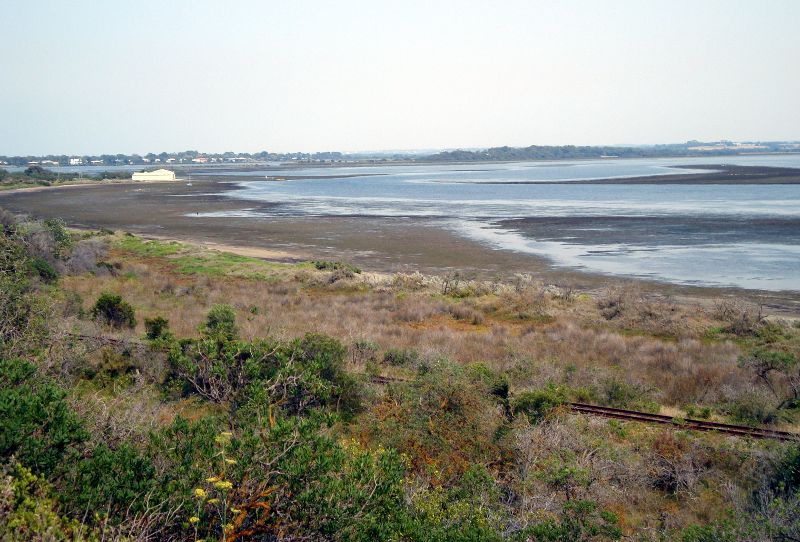
- Image -Tidal marshes and sandflats on Port Philip Bay near Melbourne (own collection)
Donate

$110.00 donated
in the past month
Get Involved
If you'd like to help with maintaining or developing the website, contact us.
Publish
Publish your stories and upcoming events on Indybay.