







 Publish to Newswire
 Add an Event
From the Open-Publishing Calendar
From the Open-Publishing Newswire
Indybay Feature
Commission close to making decision regarding acknowledging tribal rights
“Any attempt to institutionally diminish our right to gather coastal resources is essentially an act of ethnic cleansing,” Yurok Tribal Chairman Thomas O’Rourke said. “We depend on these traditions to carry on our culture for the rest of time.”
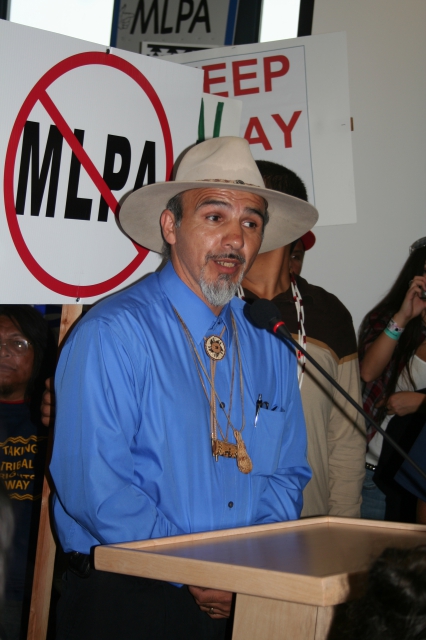
Photo of Yurok Tribal Chair, Thomas O'Rourke, at a direct action protest against the privately-funded Marine Life Protection Act (MLPA) Initiative in Fort Bragg on July 21, 2010. Photo by Dan Bacher.
Photo of Yurok Tribal Chair, Thomas O'Rourke, at a direct action protest against the privately-funded Marine Life Protection Act (MLPA) Initiative in Fort Bragg on July 21, 2010. Photo by Dan Bacher.
For Immediate Release: June 27, 2011
Contact Matt Mais, Yurok Tribe
(707) 482-1350 ext. 306
Cell: (707) 954-0976
Fish and Game to discuss details of acknowledging tribal rights
The commission is close to making an historic decision
On the rugged coastline of Northern California, a quiet revolution is unfolding that will undoubtedly alter the course of the Golden State’s brief history.
A broad and unified coalition, ranging from fishing industry representatives to environmental groups like the Ocean Conservancy from county governments to Native American governments, is advocating that the California Fish and Game Commission decriminalize the traditional tribal harvest of coastal resources.
“This is clearly an abundance of support and shows how things have change in the 21st century in terms of how California wants to treat its indigenous populations,” said Yurok Tribal Chairman Thomas O’Rourke Sr. “However, it remains to be seen if the California Fish and Game Commission is on the same page.”
The vehicle that brought the issue forward was the Marine Life Protection Act Initiative (MLPA) process in the North Coast Study Region. Implementation of the MLPA has occurred throughout the state in a privately funded joint effort overseen by a region-specific committee known as the Blue Ribbon Task Force (BTRF).
The BRTF assembled a 31-member working group, known as North Coast Regional Stakeholder Group, which developed a singular proposal that honors traditional tribal gathering rights.
As part of the last stages of locking down where marine protected areas will be set, the California Fish and Game Commission, which makes the final decision, is meeting Wednesday, June 29 in Stockton to make recommendations on whether or not to recognize existing, religious, ceremonial, subsistence and cultural harvesting.
While California Resources Secretary John Laird in February instructed the Fish and Game Commission to ensure “ongoing tribal activities will be accommodated and that other activities in the North Coast region marine protected areas will be at the scientific level of protection intended by the unified stakeholder proposal,” the Department of Fish and Game staff and the staff of the MLPA Initiative have submitted proposals that significantly diverge from the Unified Proposal and cut out tribal rights.
The plans lump tribal people with recreational fishers, which will have devastating impacts on tribal culture. Asking tribal members to follow a foreign set of regulations that have no connection to culture is not different than the federal policy of the early 1900s “Kill the Indian, Save the man. Yurok tribal cultural practices dictate that all resources must be managed for all future generations.
“Any attempt to institutionally diminish our right to gather coastal resources is essentially an act of ethnic cleansing,” O’Rourke Sr. said. “We depend on these traditions to carry on our culture for the rest of time.”
Throughout the process there have been proposals to aggressively deny existing Native Rights. While some of the proposals support Native rights, it is not clear which way the Fish and Game Commission will go.
O'Rourke concluded: "Regardless of the outcome of this process we will still continue to gather marine resources in a traditional way. Tribal rights are nonnegotiable.”
The Yurok Tribe, the largest tribe in California, has 5,500 members. The Tribe’s ancestral territory runs eighty-three miles along the California coastline from the Little River to Damnation Creek. To the east the Tribe’s ancestral lands reach above the Klamath River’s confluence with the Trinity River. For more information about the Yurok Tribe, please visit http://www.yuroktribe.org.
Contact Matt Mais, Yurok Tribe
(707) 482-1350 ext. 306
Cell: (707) 954-0976
Fish and Game to discuss details of acknowledging tribal rights
The commission is close to making an historic decision
On the rugged coastline of Northern California, a quiet revolution is unfolding that will undoubtedly alter the course of the Golden State’s brief history.
A broad and unified coalition, ranging from fishing industry representatives to environmental groups like the Ocean Conservancy from county governments to Native American governments, is advocating that the California Fish and Game Commission decriminalize the traditional tribal harvest of coastal resources.
“This is clearly an abundance of support and shows how things have change in the 21st century in terms of how California wants to treat its indigenous populations,” said Yurok Tribal Chairman Thomas O’Rourke Sr. “However, it remains to be seen if the California Fish and Game Commission is on the same page.”
The vehicle that brought the issue forward was the Marine Life Protection Act Initiative (MLPA) process in the North Coast Study Region. Implementation of the MLPA has occurred throughout the state in a privately funded joint effort overseen by a region-specific committee known as the Blue Ribbon Task Force (BTRF).
The BRTF assembled a 31-member working group, known as North Coast Regional Stakeholder Group, which developed a singular proposal that honors traditional tribal gathering rights.
As part of the last stages of locking down where marine protected areas will be set, the California Fish and Game Commission, which makes the final decision, is meeting Wednesday, June 29 in Stockton to make recommendations on whether or not to recognize existing, religious, ceremonial, subsistence and cultural harvesting.
While California Resources Secretary John Laird in February instructed the Fish and Game Commission to ensure “ongoing tribal activities will be accommodated and that other activities in the North Coast region marine protected areas will be at the scientific level of protection intended by the unified stakeholder proposal,” the Department of Fish and Game staff and the staff of the MLPA Initiative have submitted proposals that significantly diverge from the Unified Proposal and cut out tribal rights.
The plans lump tribal people with recreational fishers, which will have devastating impacts on tribal culture. Asking tribal members to follow a foreign set of regulations that have no connection to culture is not different than the federal policy of the early 1900s “Kill the Indian, Save the man. Yurok tribal cultural practices dictate that all resources must be managed for all future generations.
“Any attempt to institutionally diminish our right to gather coastal resources is essentially an act of ethnic cleansing,” O’Rourke Sr. said. “We depend on these traditions to carry on our culture for the rest of time.”
Throughout the process there have been proposals to aggressively deny existing Native Rights. While some of the proposals support Native rights, it is not clear which way the Fish and Game Commission will go.
O'Rourke concluded: "Regardless of the outcome of this process we will still continue to gather marine resources in a traditional way. Tribal rights are nonnegotiable.”
The Yurok Tribe, the largest tribe in California, has 5,500 members. The Tribe’s ancestral territory runs eighty-three miles along the California coastline from the Little River to Damnation Creek. To the east the Tribe’s ancestral lands reach above the Klamath River’s confluence with the Trinity River. For more information about the Yurok Tribe, please visit http://www.yuroktribe.org.
Add Your Comments
We are 100% volunteer and depend on your participation to sustain our efforts!
Donate

$110.00 donated
in the past month
Get Involved
If you'd like to help with maintaining or developing the website, contact us.
Publish
Publish your stories and upcoming events on Indybay.
Topics
More
Search Indybay's Archives
Advanced Search
►
▼
IMC Network