







 Publish to Newswire
 Add an Event
From the Open-Publishing Calendar
From the Open-Publishing Newswire
Indybay Feature
The New Map of Modesto: Budget Cuts, Homelessness, and Muratore’s War on the Poor
New homeless codes amount to class apartheid.
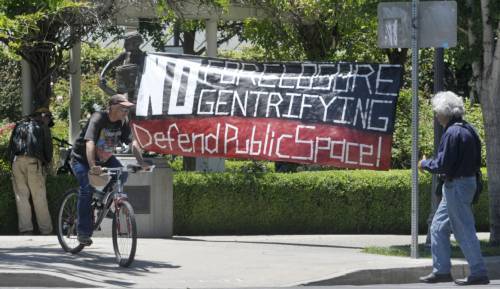
When you type “Downtown Modesto” into a search engine, something interesting happens. The little green box that was located at 15th and I Street is no longer there. That little green box used to represent a public park. Now, it simply doesn't exist. Where there used to be green, now there is only grey. The park in question was Paperboy Park, and while it used to be open to everyone, all the time, it is now only legally open to the public from 11 AM – 1 PM. If you want to use the park beyond these times, you have to pay for it. Paperboy Park was shut down upon the request of various businesses and the Safety and Community Committee, (a sub-committee of the Modesto City Council), which includes Vice Mayor and current Mayoral hopeful Brad Hawn and city councilman Joe Muratore. Muratore is a member of the La Loma Neighborhood Association, a group which has pushed for several anti-homeless initiatives such as the criminalization of dumpster-diving and the placing of surveillance cameras in public parks.
Recently, Muratore has formed a ‘Blue Ribbon Commission on Homelessness,’ made up of business leaders and local officials. It's purpose is to remove homeless people from the downtown area and get them out of public parks. Towards this end, Muratore and friends have called upon several time honored tricks: criminalization of previously legal practices, surveillance, and the use of the police. What else will be re-drawn on Modesto’s map? How can we ensure that we are the ones redrawing the lines?
The ‘Blue Ribbon Commission on Homelessness’ presents itself as a collection of community leaders who would simply like to advise the local government on how to find solutions to homelessness. The reality is much different. As we wrote when the BRCH group formed:
Some of the other people selected for the commission include many people who are involved in organizations that already 'manage' and 'control' the homeless population, including representatives with the First Methodist Church, Renaissance Christian Center, and the Modesto Gospel Mission. Other selections include the Chief Deputy District Attorney and business people such as Frank Ploof, a consultant, and J. David Wright, a business owner of Farmers Insurance. Rounding out the group is Vanessa Czopek, who is a librarian at the County Library.
The group proposes that services for the homeless should be condensed into one location. This is designed to have two effects. The first would be to remove the homeless from public parks and the second would be to criminalize the practice of sharing food in public areas. In order to stop homeless people from using the parks and to herd them into areas where services would be sanctioned by the city, the BRCH would like to have private security (such as those that patrol the La Loma area) patrol the parks and install surveillance cameras. According to the Modesto Bee:
David Wright, an insurance business owner who is chairman of the committee, said members have talked with other cities such as Santa Maria, which is using park safety officers to control the homeless. The unarmed peace officers patrol the parks, enforce the rules and respond to problems. The committee likes the program, and has also talked about using cameras to monitor parks in Modesto.
Thus, in the same way the hated HR-4437 law of 2006 which would have further criminalized working-class migrants and those that would help them, Muratore’s proposed laws will further criminalize both the homeless and people who share resources with them like food and blankets. The movement of the homeless would also be significantly more controlled and policed, both in parks and on the street. In a recent interview with a local homeless person who used to frequent Paperboy Park, Modesto Anarcho was told that the Mission was advising people to travel down James Street to Yosemite Blvd, as a way of avoiding La Loma Ave. In the same interview, the person described that they were recently attacked by police while looking for cans in an alley-way close to Graceada Park. When asked for an ID, the homeless individual was struck in the head. The police officer then released him when he thought that someone in the neighborhood was recording him. It would appear that this ‘class apartheid’ is already in effect. Come into a rich neighborhood – get beat.
Lastly as many people have been saying for years, many of those in the La Loma and College Neighborhood Associations are pushing for the ‘privatization’ of more public parks such as Graceada. If the proposed new “homeless rules” were put into place by the City, homeless would be policed in parks not only by MPD but also by private security, be surveilled through surveillance cameras, limited from traveling down certain streets where rich people live, and also kept out of (what used to be) public parks. Couple this with the laws already on the books aimed at harassing the homeless, such as anti-camping ordinances, the ban on dumpster-diving, and anti-panhandling codes – and the city has a barrage of very useful tools at their disposal for ‘fighting homelessness.’
At the same time as business and political interests in the city push for increased policing powers for those in public spaces, the restriction of freedom of movement, and the criminalization of mutual aid, the working-class of Modesto has been hit by wave after wave of budget cuts. While we have reported on various budget cuts and fee hikes (often referred to as ‘austerity measures’), such as the raising of co-pays at medical clinics or the shutting down of schools, the most recent round of budget cuts close many programs aimed at children in some of the most impoverished areas of Modesto. These measures include the closure of summer pools and the shutting down of lunch programs. Westside, Southside, and the Airport communities, these programs were aimed at poor and working class youth; people often the most at risk of becoming homeless. Furthermore, with these programs ending and the increased militarization of public space in Modesto, youth will have less of a reason to be out in public parks. In fact, the NRCH even stated that putting a damper on graffiti and other associated youth ‘crimes’ are also the target of the proposed surveillance and policing measures. As the summer drags on and youth in Modesto’s poorest areas are left with few resources, little chances of finding a job, and an increased police presence, they too will become the targets of the city’s war on the poor.
The future of Downtown Modesto is one in which public space is much more policed, the ability of human movement much more restricted, and the class divisions of the city much more enforced. If we desire to see something different then we must get organized, both homeless and renters alike, and stop ourselves from literally being wiped off the map.
Recently, Muratore has formed a ‘Blue Ribbon Commission on Homelessness,’ made up of business leaders and local officials. It's purpose is to remove homeless people from the downtown area and get them out of public parks. Towards this end, Muratore and friends have called upon several time honored tricks: criminalization of previously legal practices, surveillance, and the use of the police. What else will be re-drawn on Modesto’s map? How can we ensure that we are the ones redrawing the lines?
The ‘Blue Ribbon Commission on Homelessness’ presents itself as a collection of community leaders who would simply like to advise the local government on how to find solutions to homelessness. The reality is much different. As we wrote when the BRCH group formed:
Some of the other people selected for the commission include many people who are involved in organizations that already 'manage' and 'control' the homeless population, including representatives with the First Methodist Church, Renaissance Christian Center, and the Modesto Gospel Mission. Other selections include the Chief Deputy District Attorney and business people such as Frank Ploof, a consultant, and J. David Wright, a business owner of Farmers Insurance. Rounding out the group is Vanessa Czopek, who is a librarian at the County Library.
The group proposes that services for the homeless should be condensed into one location. This is designed to have two effects. The first would be to remove the homeless from public parks and the second would be to criminalize the practice of sharing food in public areas. In order to stop homeless people from using the parks and to herd them into areas where services would be sanctioned by the city, the BRCH would like to have private security (such as those that patrol the La Loma area) patrol the parks and install surveillance cameras. According to the Modesto Bee:
David Wright, an insurance business owner who is chairman of the committee, said members have talked with other cities such as Santa Maria, which is using park safety officers to control the homeless. The unarmed peace officers patrol the parks, enforce the rules and respond to problems. The committee likes the program, and has also talked about using cameras to monitor parks in Modesto.
Thus, in the same way the hated HR-4437 law of 2006 which would have further criminalized working-class migrants and those that would help them, Muratore’s proposed laws will further criminalize both the homeless and people who share resources with them like food and blankets. The movement of the homeless would also be significantly more controlled and policed, both in parks and on the street. In a recent interview with a local homeless person who used to frequent Paperboy Park, Modesto Anarcho was told that the Mission was advising people to travel down James Street to Yosemite Blvd, as a way of avoiding La Loma Ave. In the same interview, the person described that they were recently attacked by police while looking for cans in an alley-way close to Graceada Park. When asked for an ID, the homeless individual was struck in the head. The police officer then released him when he thought that someone in the neighborhood was recording him. It would appear that this ‘class apartheid’ is already in effect. Come into a rich neighborhood – get beat.
Lastly as many people have been saying for years, many of those in the La Loma and College Neighborhood Associations are pushing for the ‘privatization’ of more public parks such as Graceada. If the proposed new “homeless rules” were put into place by the City, homeless would be policed in parks not only by MPD but also by private security, be surveilled through surveillance cameras, limited from traveling down certain streets where rich people live, and also kept out of (what used to be) public parks. Couple this with the laws already on the books aimed at harassing the homeless, such as anti-camping ordinances, the ban on dumpster-diving, and anti-panhandling codes – and the city has a barrage of very useful tools at their disposal for ‘fighting homelessness.’
At the same time as business and political interests in the city push for increased policing powers for those in public spaces, the restriction of freedom of movement, and the criminalization of mutual aid, the working-class of Modesto has been hit by wave after wave of budget cuts. While we have reported on various budget cuts and fee hikes (often referred to as ‘austerity measures’), such as the raising of co-pays at medical clinics or the shutting down of schools, the most recent round of budget cuts close many programs aimed at children in some of the most impoverished areas of Modesto. These measures include the closure of summer pools and the shutting down of lunch programs. Westside, Southside, and the Airport communities, these programs were aimed at poor and working class youth; people often the most at risk of becoming homeless. Furthermore, with these programs ending and the increased militarization of public space in Modesto, youth will have less of a reason to be out in public parks. In fact, the NRCH even stated that putting a damper on graffiti and other associated youth ‘crimes’ are also the target of the proposed surveillance and policing measures. As the summer drags on and youth in Modesto’s poorest areas are left with few resources, little chances of finding a job, and an increased police presence, they too will become the targets of the city’s war on the poor.
The future of Downtown Modesto is one in which public space is much more policed, the ability of human movement much more restricted, and the class divisions of the city much more enforced. If we desire to see something different then we must get organized, both homeless and renters alike, and stop ourselves from literally being wiped off the map.
For more information:
http://www.modestoanarcho.org
Add Your Comments
We are 100% volunteer and depend on your participation to sustain our efforts!
Donate

$110.00 donated
in the past month
Get Involved
If you'd like to help with maintaining or developing the website, contact us.
Publish
Publish your stories and upcoming events on Indybay.
Topics
More
Search Indybay's Archives
Advanced Search
►
▼
IMC Network