







 Publish to Newswire
 Add an Event
From the Open-Publishing Calendar
From the Open-Publishing Newswire
Indybay Feature
As Reformist Liberals, We Sacrificed Our Youthful Liberators
These black-clad warriors were out there, prepared to lead the charge, much like youth today across Northern Africa and the Middle-East. They were learning, evolving, in that dark place where most activists cannot go, between mental restraint and spontaneity, a cutting edge where there are no comfort zones or fear. Seattle was our Tahrir Square but unfortunately too many of us had our lives entangled with the status quo. We let our youth down and they retreated into that sink-hole of “rugged American individualism” and its putrid pool of self-absorption.
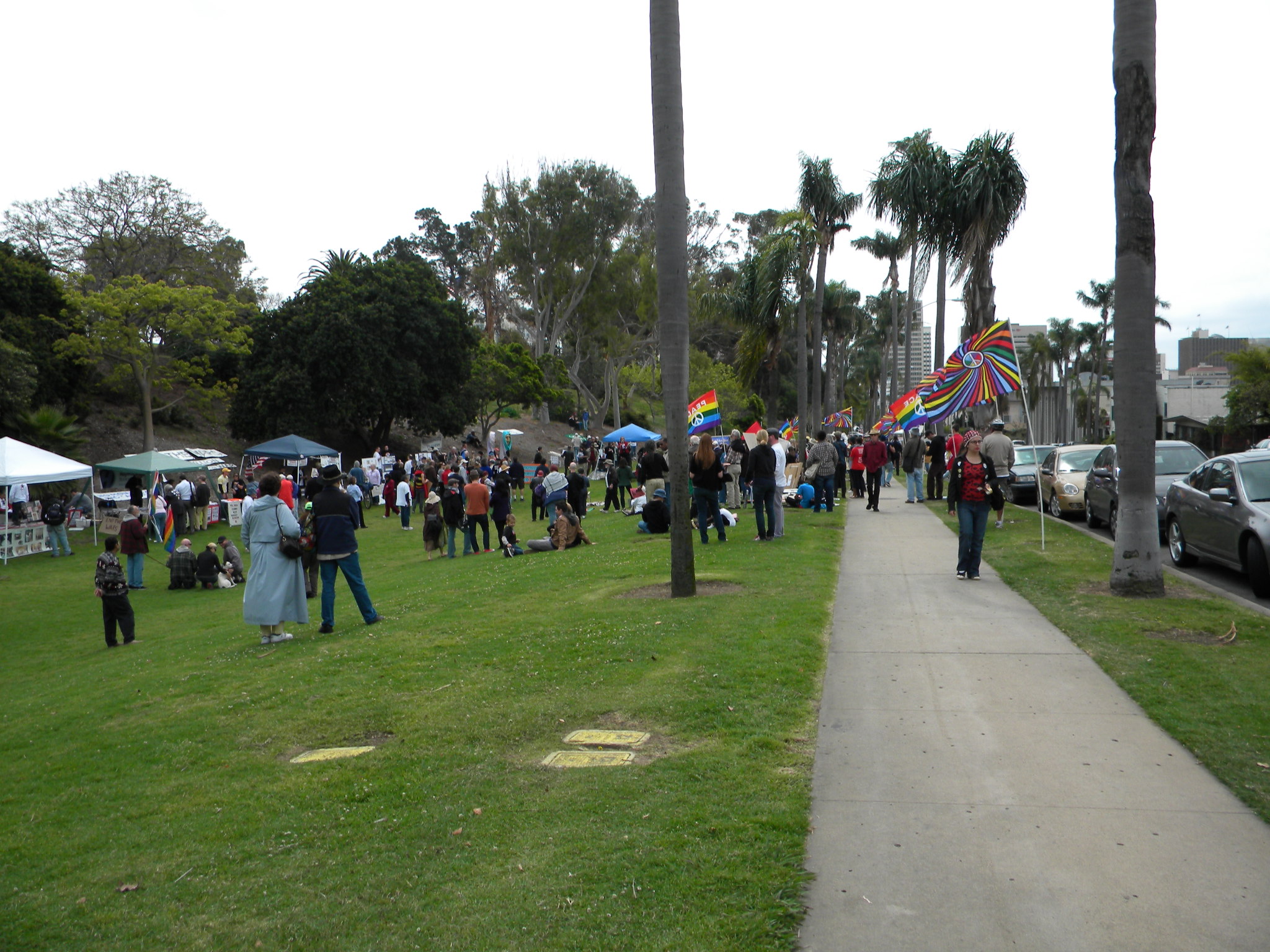
“Why do you people hide in the park?” one person asked me. “Do you think that you are going to change a damn thing?” another asked. “Obama promised to end the wars if we elected him and he lied, just like Bush” she continued. These were members of our Renters Union, working-class folks, some toiling at two jobs to pay the bills and raise their children and my announcement that there would be a demonstration at Balboa Park decrying the eighth anniversary of the Iraq War was like a message from beyond the Galaxy.
Some had sons and daughters in the military, a couple in Iraq and Afghanistan; while most had been so powerless all their lives that the notion that a demonstration could stop the wars or bring down the war economy which was decimating their job security, their schools, the quality of life in the their neighborhoods and, most terrifying, the prospect that the only economic option for their kids was the desert killing fields, seemed to them like a complete waste of precious time and dearth energy.
I went to the March, 2011 demonstration with a heavy heart. My own son, Robert Neptun, raised by his mother and step-father in relative poverty, was on his second tour of duty in Iraq. Sandwiched between him and a deceased father who served in World War II and a late brother, I helped turn AWOL from the Vietnam War; my Quaker faith based on historic pacifism gave me a sense of moral justification – almost too righteous – as I felt obligated to attend.
Absolution in the Park
“Who are these people I love so much; yet, in my own personal projections, have such great disappointment in,” I ask myself, walking up 6th Avenue toward the assemblage.
They arrive at the park in a troubled yearning for peace; they leave with a consecrated personal peace. They sense they are both the hope and the tragedy of our time, caught between a rock and a hard place, fighting the madness of a war economy while helping build the asylum.
A lagoon of white heads and gray tinted beards, more than half are seniors, human artifacts; year after year, decade after decade, they have not given up their moral imperative – a need to oppose the abomination of war. There is a great sadness, a lingering muteness, behind the hugs and smiles of recognition among friends that after all these years they must still imagine peace. Like the bewildered look of a mustang pulled from the range, standing in the corral, waiting to be slaughtered for dog food, their eyes reflect the confusion, the inability to understand the insanity of violence.
My lover is a Catholic, I was baptized into the faith; do I feel hostility toward confession? Of course not, any sympathetic listener, whether institutional or just a friend, helps the burden of our lonely, existential path. So for a group to conduct a collective confession, a kind of shared absolution from the horrible, obscene things done in our name in Iraq and Afghanistan, seems a valuable encounter. However, what is our penance? These yearly gatherings seemed to have evolved into a sort of “peace festival” with music, dancing, picnic baskets and even costumes. The depth of personal conversations, the warm embraces, the outpouring of shared love built over the years reflects a family reunion. It has become a familiar, cozy event. And, for some, it is too comforting. Year after year, far too many activists go to these gatherings for blood cleansing and come away seemingly mistaking their sense of moral cleanliness for having actually done something.
Meanwhile, Project Yano and the Committee Opposed to Militarism and the Draft in the San Diego region struggles to stay afloat in their endeavor to counsel high school students about war and economic options. They need people to hand out flyers in front of schools, to person GI hotlines for those wanting out and they need finances to support their non-military exhibits at school job fairs and recruiting events. These are real actions, affecting real youth, saving real lives – which, I doubt, has ever been done by a peace festival in the park.
There were hardly any youth at the peace festival. Explosive anger, hostility, the courage to challenge; the stuff of youngsters has long since passed in this group. Noisy young people stoke the sadness, reminding us of our generational failures to fundamentally change the system of wealth and power which depends on weapons and violence for control, whether in Baghdad or Barrio Logan.
One by one, over the years, they seemed to have knitted the villain bonds; compromises, excuses, attending the sacraments of the market economy – bank accounts, building pensions, paying the mortgage, tuition for the kids, stock options, on and on.
Yet, they remember! Sometimes they are haunted by the ghost of a simpler era when they were free to confront and disobey. Like sex and a good high, they reminisce with fondness their civil disobedience, the liberating power of just saying no to wage slavery, material obsession and artificial projections of self-worth based on wealth and position in the hierarchies – both grand and petty. They remember their defiance, the detentions and arrests, the shared solidarity, being above covet and fear, walking on air.
As Reformist Liberals, We Sacrificed Our Youthful Liberators
“Why do we do this?” I asked Tanya Winter, the elderly matron of activism in San Diego, who as a child had watched Nazi troops as they entered Prague, Czechoslovakia. “Why do we come here and stand around in the park and listen to the same speeches, wave the same signs, beat our chests about war, when we know full-well no-one is listening and it will not change a damn thing?” I shouted into her ear as the booming PA system was at full-blast in an apparent effort to compensate for the few who were attending the demonstration.
“We must do what is right and not worry about the results, the Buddhists remind us,” she said serenely. She had aged, both physically and rebelliously, since I first met her in 2000 when she had just returned from the WTO protests in Seattle and was helping organize Activist San Diego. With the aid of the Ruckus Society, she and Martin Eder, organized a week-end retreat at the Che Café on the grounds of UCSD for activists, particularly young radicals, to develop confrontational tactics for the upcoming 2000 Democratic National Convention in Los Angeles.
She spoke in fiery terms then, kilned by her experiences with the forceful insurgency which began in Seattle. Over 40,000 people, mostly youth, organized in phalanxes like magnificent ancient Greeks, wearing stunning black clothes and intense body language, evoking memories of Huey P. Newton and Fred Hampton, with colorful bandanas emulating the Zapatistas; they were prepared (and did, briefly) shut down the world’s corporate bosses as they met to discuss how to further plunder the Earth’s people of their resources. In those exhilarating first few days and months of the new millennium, we genuinely believed that we could bring down the edifice of war and poverty. A grand coalition of old leftys, environmentalists and workers, would merge with youthful radicals, who were staring into the jaws of the corporate beast and its wage slavery and oppression of the spirit.
We would pick up the threads of a dying counter-cultural mind-set and fold it into a new movement led by youth, who valued personal autonomy in non-hierarchical systems, from government to the work place, which would also end the blood-thirsty militarism of the 20th Century. We saw the “peace dividend” going directly toward ending poverty and sickness, or so we thought. Our nation and its peace dividend was high-jacked by the military-industrial complex and, together with right-wing Republicans, with the aid of a couple of Democratic Presidents, has built today’s American Empire and its corporate ownership.
In the early days of the twenty-first century, these black-clad warriors were out there, challenging the corporate state, fighting globalization, prepared to lead the charge, much like youth today across Northern Africa and into the Middle-East. They were learning, evolving, in that dark place where most activists cannot go, between mental restraint and spontaneity, a cutting edge where there are no comfort zones or fear – just pure engagement, an honest skirmish not only with the corporate state but with our innermost consciousness. Seattle was our Tahrir Square but unfortunately too many of us had our lives and investments entangled with the status quo. We let our youth down and they retreated into that sink-hole of “rugged American individualism” and its putrid pool of self-absorption.
As I walked among the 200 or so protesters in March 2011, they were mostly hidden from the street in a hollow of the park and obscured by a row of cars along the curb on 6th Avenue parked by punctual activists. These, the first actors of the play to arrive, many of whom have long since turned inward toward the persona of dissident, wearing the Greek mask, rather than outward toward the personality and pledge of rebel. For eight years we have trodden down to Balboa Park, from thousands we have dwindled to a few hundred, while another generation of youth, mostly poor kids, is scarred and warped by war. Meanwhile, our social consciousness, the moral fabric of our society is torn and sullied by the blood of tens of thousands of innocent men, women and children In Iraq, Afghanistan and, increasingly, in Pakistan.
How pathetic I have become, I thought, as I hug old friends and smooze with the power liberals who strut among their little fiefdoms of supporters. Why can’t I just go up on stage, take the microphone and demand that they move their cars so the world can see our little tribal ritual. Better yet, let’s move the whole program out onto the street, set up the tents with boxes of anti-war literature and each group’s activist angle in the intersection, create the circumstances where each speaker who takes the mike will get arrested and drive our cars into a barricade on the freeway below us and go door-to-door, banging on doors, inviting people to join us.
Of course, I didn’t. I kept my mouth shut. I didn’t want to alienate friends or seem too radical or visionary. I realize it is not allowed within the parameters set by the post-9-11 patriotic controls within our “mind-forged manacles.” I have bills to pay, a family to support; I am as trapped in my excuses for non-confrontation as everyone else. Then there is the practical angle – and justification. There is simply no interactive culture among activists to materially support resistance to the corporate state and its war economy. There is no community defense fund, no legal assistance mechanism, no organized support group to tend to love ones and pets, no overseeing of personal needs of detainees by any association. The corporate state has virtually won – we are alone, isolated and powerless.
One part of me says that we are getting what we deserve. Like Tanya’s aging radicalism and my timorous, imaginary verbal challenges to friends and fellow activists. What began in Seattle was derailed, in part, by the Los Angeles demonstrations during the 2000 Democratic Convention and was finished off by the convenience, almost too timely, of 9-11 and its post-traumatic xenophobia and blood lust.
During the week of the 2000 Democratic Convention, as is very typical of today’s jamborees, the power liberals led by Arianna Huffington and former Senator Gary Hart, held a “shadow convention” six blocks away from the corporate named Staples Convention Center. They were the establishment left of the Democratic Party and met to chide Al Gore, who had “become so beholden to special interests that he cannot demand reform.” Hart even said, “We sold our political birthright to the money-changers in the temple,” and asked “where today are the nation’s prophets,” and, then, he promptly returned to Denver to become a millionaire.
There was a third convention held that week (which I attended). Participating were the traditionally marginalized groups, which are abused and taken for granted by the Democratic hierarchy, minority communities, immigrant rights groups and farm workers, social justice and peace activists, direct-action environmentalists, native Americans and alternative political parties like the Green Party and California Peace and Freedom Party.
Yet neither of these so-called “alternative conventions” invited radical youth to address or participate in their deliberations. The youth held their own spontaneous encounters and encuentros at their Los Angeles Convergence Center and in the streets. They were effectively shut out of the discussions; allowing the media to portray them as dangerous subversives and riotous insurrectionists. There was no liberal outcry or solidarity when the youth’s convergence center on West 7th Street was surrounded by 120 police officers mid-way through the week of demonstrations. I had just left the building, after talking with California Assemblyman Tom Haden, and watched as 20 squad cars blocked off the neighborhood and officers trained their weapons toward the youth center’s windows. The police were prohibited by court order from entering the Convergence Center unless it was an emergency, so the show of force was an effort at intimidation and another effort to frighten the reformers away from the youths. I was so disheartened, taking it almost personal, that this police state tactic was happening just three blocks from where I was born.
Adding to a further polarization between generations, the power liberals and the hordes of reformist ideologues were so frighten that these mutinous youth would challenge the police or block of streets in an effort to create another Seattle that during the six days of marches, they surrounded the youthful groups and yelled at them every time they seemed poised to act. Six different activist groups had a permit for a march, so everyday we would assemble and stroll LA’s downtown cavernous streets for several hours; it became routine, almost ritualistic.
Nothing reflected the generational fear divide more than the proposed idea for a concert in the “free speech zone” outside Staples Center, planned for the night President Clinton was to speak to the convention. Not only was there objection to a concert for young people, but after police viciously attacked concert going youth, there was no massive protest on the part of liberal reformers.
Many liberal groups actually collaborated with the city to have the zone in a distant area and in an area way too small to have a concert. It took a federal judge to rule that the distance and size of the allotted space wasn’t conducive to the requirements of free speech. Even then, many of the power liberals and most city officials objected to the suggested performers.
Rage Against the Machine, was a popular rock-band whose lyrics called young people to act against the developing corporate state with songs like “We Have to Take the Power Back” and an entire album devoted to “The Battle of Los Angeles.” Like Phil Ochs and Bob Dylan (before he sold out) in the sixties cultural wars, Rage Against the Machine merged art with protest, urging young people to liberate their minds, and their bodies will follow.
As Bill Clinton was mouthing his spurious words to the Democratic Convention goers, the Los Angeles Police Department attacked several thousand young people, many of them were working-class youth who were from nearby neighborhoods who had no interest in politics but came for a free concert. Early in the evening, slightly after 8 p.m., shutting off the power to the platform while the band Ozomatli was playing, a beaming voice from an overhead helicopter announced that the concert was ended and everyone had 15 minutes to disperse. Standing outside the free speech zone, I realized immediately this was a setup - that there was no way 10,000 young people walled into a packed 14 foot fenced area with only one exit could leave in 15 minutes. And, sure enough, with several thousand still stranded within the cordoned off area, the police attacked. Firing rubber bullets, they began beating people with batons. The crush of the crowd knocked me down twice and I could hear the screams of victims as another group of police thugs moved in firing “stingers” which are rubber bullets aimed at ankles and legs and blasting away with shotguns loaded with small bean bags. Other officers were spraying pepper spray in every direction, as people fell under the feet of panicked concert goers.
Close to two hundred people were injured, some with serious head wounds, while not a single police officer got so much as a scratch. There was no doubt in anyone’s mind that the brutality of the police assault was two-fold. On the one hand, to show radical youth that the system was prepared to use extreme force to silence confrontational dissent and, on the other, to show the youth that the liberals and reformers, would stand by and do nothing about police violence and its attack on free speech and the rights of association. That night, for the first time, I felt shame; for myself, for my activist friends, for the movement.
We are All Equal Opportunity Victims
Since that night in Los Angeles, like Michael Valentine, a stranger in a strange land, I have drifted, like a lost soul, trying to fit in. Both loving and disparaging, in and out of the liberal, left-wing movement. I prefer to work with the homeless and the poor and working-class folks, from my roots, where there is not a lot of rhetorical baggage; just the basics of surviving in the corporate state of low wages and high prices.
I still tinge with guilt, with sadness, for what might have been. All of those black-clad youth ready to challenge the corporate state; disillusioned by the power liberals, sliding away from the honesty of confrontation to video games, partying, personal art rather than socially challenging art, becoming human gadgets, appended to machines, addicted to pure technological quintessence.
“But what of my friends” I ask myself. They too are trapped: ensnared by their responsibilities and obligations to family and their personal quality of life, paying the mortgage or rent, buying quality food, struggling to maintain health care, trying to secure the funds and time to devote to social justice; self-imprisoned by the fear of being an outcast, a pariah or, most prominently, the terror of making a fool out of oneself.
At the March 2011 Balboa Park demonstration, I stopped to chat with an activist I have known for many years. I could see his speech in his hand and when he asked, “when are you going to speak,” I laughed and said “I’m not going to speak, I wasn’t asked.” He looked at me sadly as if to say, “how unfortunate, after all these years, you have not moved up in the movement hierarchy.“ He abruptly turned away, like one would shy away from a homeless person. I was momentarily hurt, but realized this is who he is – a fine person, a being of faith and hope, a caring individual; yet, in terms of an activist for fundamental change he is only a caricature, a delusional persona in the guise of uprising agent, who deep down yearns for the idea of fundamental change but fears it as much as he would a snake slithering along the sidewalk.
So many of us at the protest are people of conscience; abused and degraded as citizens for so many years. We are now equal opportunity victims; first manipulated and lied to by a white President, and now stage-managed and lied to by a black President. A President who will continue to sacrifice young American men and women, thousands of innocent civilians, keep torturing Private Bradley Manning, continue selling our to Wall Street and bankers, all in the interest of his political career.
We can only hope that a new generation will watch what is happening in North Africa, driven by young Arabs, and not see it as political theater, glorified by the media, but, rather, as the energizing motif for their own liberation from the American corporate state and its obscene, tragic wars. This time, if it happens, we oldies will need to consider getting our fat asses and timid reformist dogma out of the way and supporting a youthful vanguard with our money and solidarity, no matter what they wear – black, brown or pink. Let’s hope we get a second chance to support our youth in their revolution – for peace, autonomy and justice. Now, there’s a legacy we can take to the grave with honor and pride.
**********************************************************
Rocky Neptun is director of the San Diego Renters Union. He calls himself an “aging peacenik” and was imprisoned for his human rights work, ferrying young Portuguese soldiers and sailors opposed to the colonial wars in Africa out of the country, in 1971 by the fascist dictator Antonio de Oliveira Salazar.
Some had sons and daughters in the military, a couple in Iraq and Afghanistan; while most had been so powerless all their lives that the notion that a demonstration could stop the wars or bring down the war economy which was decimating their job security, their schools, the quality of life in the their neighborhoods and, most terrifying, the prospect that the only economic option for their kids was the desert killing fields, seemed to them like a complete waste of precious time and dearth energy.
I went to the March, 2011 demonstration with a heavy heart. My own son, Robert Neptun, raised by his mother and step-father in relative poverty, was on his second tour of duty in Iraq. Sandwiched between him and a deceased father who served in World War II and a late brother, I helped turn AWOL from the Vietnam War; my Quaker faith based on historic pacifism gave me a sense of moral justification – almost too righteous – as I felt obligated to attend.
Absolution in the Park
“Who are these people I love so much; yet, in my own personal projections, have such great disappointment in,” I ask myself, walking up 6th Avenue toward the assemblage.
They arrive at the park in a troubled yearning for peace; they leave with a consecrated personal peace. They sense they are both the hope and the tragedy of our time, caught between a rock and a hard place, fighting the madness of a war economy while helping build the asylum.
A lagoon of white heads and gray tinted beards, more than half are seniors, human artifacts; year after year, decade after decade, they have not given up their moral imperative – a need to oppose the abomination of war. There is a great sadness, a lingering muteness, behind the hugs and smiles of recognition among friends that after all these years they must still imagine peace. Like the bewildered look of a mustang pulled from the range, standing in the corral, waiting to be slaughtered for dog food, their eyes reflect the confusion, the inability to understand the insanity of violence.
My lover is a Catholic, I was baptized into the faith; do I feel hostility toward confession? Of course not, any sympathetic listener, whether institutional or just a friend, helps the burden of our lonely, existential path. So for a group to conduct a collective confession, a kind of shared absolution from the horrible, obscene things done in our name in Iraq and Afghanistan, seems a valuable encounter. However, what is our penance? These yearly gatherings seemed to have evolved into a sort of “peace festival” with music, dancing, picnic baskets and even costumes. The depth of personal conversations, the warm embraces, the outpouring of shared love built over the years reflects a family reunion. It has become a familiar, cozy event. And, for some, it is too comforting. Year after year, far too many activists go to these gatherings for blood cleansing and come away seemingly mistaking their sense of moral cleanliness for having actually done something.
Meanwhile, Project Yano and the Committee Opposed to Militarism and the Draft in the San Diego region struggles to stay afloat in their endeavor to counsel high school students about war and economic options. They need people to hand out flyers in front of schools, to person GI hotlines for those wanting out and they need finances to support their non-military exhibits at school job fairs and recruiting events. These are real actions, affecting real youth, saving real lives – which, I doubt, has ever been done by a peace festival in the park.
There were hardly any youth at the peace festival. Explosive anger, hostility, the courage to challenge; the stuff of youngsters has long since passed in this group. Noisy young people stoke the sadness, reminding us of our generational failures to fundamentally change the system of wealth and power which depends on weapons and violence for control, whether in Baghdad or Barrio Logan.
One by one, over the years, they seemed to have knitted the villain bonds; compromises, excuses, attending the sacraments of the market economy – bank accounts, building pensions, paying the mortgage, tuition for the kids, stock options, on and on.
Yet, they remember! Sometimes they are haunted by the ghost of a simpler era when they were free to confront and disobey. Like sex and a good high, they reminisce with fondness their civil disobedience, the liberating power of just saying no to wage slavery, material obsession and artificial projections of self-worth based on wealth and position in the hierarchies – both grand and petty. They remember their defiance, the detentions and arrests, the shared solidarity, being above covet and fear, walking on air.
As Reformist Liberals, We Sacrificed Our Youthful Liberators
“Why do we do this?” I asked Tanya Winter, the elderly matron of activism in San Diego, who as a child had watched Nazi troops as they entered Prague, Czechoslovakia. “Why do we come here and stand around in the park and listen to the same speeches, wave the same signs, beat our chests about war, when we know full-well no-one is listening and it will not change a damn thing?” I shouted into her ear as the booming PA system was at full-blast in an apparent effort to compensate for the few who were attending the demonstration.
“We must do what is right and not worry about the results, the Buddhists remind us,” she said serenely. She had aged, both physically and rebelliously, since I first met her in 2000 when she had just returned from the WTO protests in Seattle and was helping organize Activist San Diego. With the aid of the Ruckus Society, she and Martin Eder, organized a week-end retreat at the Che Café on the grounds of UCSD for activists, particularly young radicals, to develop confrontational tactics for the upcoming 2000 Democratic National Convention in Los Angeles.
She spoke in fiery terms then, kilned by her experiences with the forceful insurgency which began in Seattle. Over 40,000 people, mostly youth, organized in phalanxes like magnificent ancient Greeks, wearing stunning black clothes and intense body language, evoking memories of Huey P. Newton and Fred Hampton, with colorful bandanas emulating the Zapatistas; they were prepared (and did, briefly) shut down the world’s corporate bosses as they met to discuss how to further plunder the Earth’s people of their resources. In those exhilarating first few days and months of the new millennium, we genuinely believed that we could bring down the edifice of war and poverty. A grand coalition of old leftys, environmentalists and workers, would merge with youthful radicals, who were staring into the jaws of the corporate beast and its wage slavery and oppression of the spirit.
We would pick up the threads of a dying counter-cultural mind-set and fold it into a new movement led by youth, who valued personal autonomy in non-hierarchical systems, from government to the work place, which would also end the blood-thirsty militarism of the 20th Century. We saw the “peace dividend” going directly toward ending poverty and sickness, or so we thought. Our nation and its peace dividend was high-jacked by the military-industrial complex and, together with right-wing Republicans, with the aid of a couple of Democratic Presidents, has built today’s American Empire and its corporate ownership.
In the early days of the twenty-first century, these black-clad warriors were out there, challenging the corporate state, fighting globalization, prepared to lead the charge, much like youth today across Northern Africa and into the Middle-East. They were learning, evolving, in that dark place where most activists cannot go, between mental restraint and spontaneity, a cutting edge where there are no comfort zones or fear – just pure engagement, an honest skirmish not only with the corporate state but with our innermost consciousness. Seattle was our Tahrir Square but unfortunately too many of us had our lives and investments entangled with the status quo. We let our youth down and they retreated into that sink-hole of “rugged American individualism” and its putrid pool of self-absorption.
As I walked among the 200 or so protesters in March 2011, they were mostly hidden from the street in a hollow of the park and obscured by a row of cars along the curb on 6th Avenue parked by punctual activists. These, the first actors of the play to arrive, many of whom have long since turned inward toward the persona of dissident, wearing the Greek mask, rather than outward toward the personality and pledge of rebel. For eight years we have trodden down to Balboa Park, from thousands we have dwindled to a few hundred, while another generation of youth, mostly poor kids, is scarred and warped by war. Meanwhile, our social consciousness, the moral fabric of our society is torn and sullied by the blood of tens of thousands of innocent men, women and children In Iraq, Afghanistan and, increasingly, in Pakistan.
How pathetic I have become, I thought, as I hug old friends and smooze with the power liberals who strut among their little fiefdoms of supporters. Why can’t I just go up on stage, take the microphone and demand that they move their cars so the world can see our little tribal ritual. Better yet, let’s move the whole program out onto the street, set up the tents with boxes of anti-war literature and each group’s activist angle in the intersection, create the circumstances where each speaker who takes the mike will get arrested and drive our cars into a barricade on the freeway below us and go door-to-door, banging on doors, inviting people to join us.
Of course, I didn’t. I kept my mouth shut. I didn’t want to alienate friends or seem too radical or visionary. I realize it is not allowed within the parameters set by the post-9-11 patriotic controls within our “mind-forged manacles.” I have bills to pay, a family to support; I am as trapped in my excuses for non-confrontation as everyone else. Then there is the practical angle – and justification. There is simply no interactive culture among activists to materially support resistance to the corporate state and its war economy. There is no community defense fund, no legal assistance mechanism, no organized support group to tend to love ones and pets, no overseeing of personal needs of detainees by any association. The corporate state has virtually won – we are alone, isolated and powerless.
One part of me says that we are getting what we deserve. Like Tanya’s aging radicalism and my timorous, imaginary verbal challenges to friends and fellow activists. What began in Seattle was derailed, in part, by the Los Angeles demonstrations during the 2000 Democratic Convention and was finished off by the convenience, almost too timely, of 9-11 and its post-traumatic xenophobia and blood lust.
During the week of the 2000 Democratic Convention, as is very typical of today’s jamborees, the power liberals led by Arianna Huffington and former Senator Gary Hart, held a “shadow convention” six blocks away from the corporate named Staples Convention Center. They were the establishment left of the Democratic Party and met to chide Al Gore, who had “become so beholden to special interests that he cannot demand reform.” Hart even said, “We sold our political birthright to the money-changers in the temple,” and asked “where today are the nation’s prophets,” and, then, he promptly returned to Denver to become a millionaire.
There was a third convention held that week (which I attended). Participating were the traditionally marginalized groups, which are abused and taken for granted by the Democratic hierarchy, minority communities, immigrant rights groups and farm workers, social justice and peace activists, direct-action environmentalists, native Americans and alternative political parties like the Green Party and California Peace and Freedom Party.
Yet neither of these so-called “alternative conventions” invited radical youth to address or participate in their deliberations. The youth held their own spontaneous encounters and encuentros at their Los Angeles Convergence Center and in the streets. They were effectively shut out of the discussions; allowing the media to portray them as dangerous subversives and riotous insurrectionists. There was no liberal outcry or solidarity when the youth’s convergence center on West 7th Street was surrounded by 120 police officers mid-way through the week of demonstrations. I had just left the building, after talking with California Assemblyman Tom Haden, and watched as 20 squad cars blocked off the neighborhood and officers trained their weapons toward the youth center’s windows. The police were prohibited by court order from entering the Convergence Center unless it was an emergency, so the show of force was an effort at intimidation and another effort to frighten the reformers away from the youths. I was so disheartened, taking it almost personal, that this police state tactic was happening just three blocks from where I was born.
Adding to a further polarization between generations, the power liberals and the hordes of reformist ideologues were so frighten that these mutinous youth would challenge the police or block of streets in an effort to create another Seattle that during the six days of marches, they surrounded the youthful groups and yelled at them every time they seemed poised to act. Six different activist groups had a permit for a march, so everyday we would assemble and stroll LA’s downtown cavernous streets for several hours; it became routine, almost ritualistic.
Nothing reflected the generational fear divide more than the proposed idea for a concert in the “free speech zone” outside Staples Center, planned for the night President Clinton was to speak to the convention. Not only was there objection to a concert for young people, but after police viciously attacked concert going youth, there was no massive protest on the part of liberal reformers.
Many liberal groups actually collaborated with the city to have the zone in a distant area and in an area way too small to have a concert. It took a federal judge to rule that the distance and size of the allotted space wasn’t conducive to the requirements of free speech. Even then, many of the power liberals and most city officials objected to the suggested performers.
Rage Against the Machine, was a popular rock-band whose lyrics called young people to act against the developing corporate state with songs like “We Have to Take the Power Back” and an entire album devoted to “The Battle of Los Angeles.” Like Phil Ochs and Bob Dylan (before he sold out) in the sixties cultural wars, Rage Against the Machine merged art with protest, urging young people to liberate their minds, and their bodies will follow.
As Bill Clinton was mouthing his spurious words to the Democratic Convention goers, the Los Angeles Police Department attacked several thousand young people, many of them were working-class youth who were from nearby neighborhoods who had no interest in politics but came for a free concert. Early in the evening, slightly after 8 p.m., shutting off the power to the platform while the band Ozomatli was playing, a beaming voice from an overhead helicopter announced that the concert was ended and everyone had 15 minutes to disperse. Standing outside the free speech zone, I realized immediately this was a setup - that there was no way 10,000 young people walled into a packed 14 foot fenced area with only one exit could leave in 15 minutes. And, sure enough, with several thousand still stranded within the cordoned off area, the police attacked. Firing rubber bullets, they began beating people with batons. The crush of the crowd knocked me down twice and I could hear the screams of victims as another group of police thugs moved in firing “stingers” which are rubber bullets aimed at ankles and legs and blasting away with shotguns loaded with small bean bags. Other officers were spraying pepper spray in every direction, as people fell under the feet of panicked concert goers.
Close to two hundred people were injured, some with serious head wounds, while not a single police officer got so much as a scratch. There was no doubt in anyone’s mind that the brutality of the police assault was two-fold. On the one hand, to show radical youth that the system was prepared to use extreme force to silence confrontational dissent and, on the other, to show the youth that the liberals and reformers, would stand by and do nothing about police violence and its attack on free speech and the rights of association. That night, for the first time, I felt shame; for myself, for my activist friends, for the movement.
We are All Equal Opportunity Victims
Since that night in Los Angeles, like Michael Valentine, a stranger in a strange land, I have drifted, like a lost soul, trying to fit in. Both loving and disparaging, in and out of the liberal, left-wing movement. I prefer to work with the homeless and the poor and working-class folks, from my roots, where there is not a lot of rhetorical baggage; just the basics of surviving in the corporate state of low wages and high prices.
I still tinge with guilt, with sadness, for what might have been. All of those black-clad youth ready to challenge the corporate state; disillusioned by the power liberals, sliding away from the honesty of confrontation to video games, partying, personal art rather than socially challenging art, becoming human gadgets, appended to machines, addicted to pure technological quintessence.
“But what of my friends” I ask myself. They too are trapped: ensnared by their responsibilities and obligations to family and their personal quality of life, paying the mortgage or rent, buying quality food, struggling to maintain health care, trying to secure the funds and time to devote to social justice; self-imprisoned by the fear of being an outcast, a pariah or, most prominently, the terror of making a fool out of oneself.
At the March 2011 Balboa Park demonstration, I stopped to chat with an activist I have known for many years. I could see his speech in his hand and when he asked, “when are you going to speak,” I laughed and said “I’m not going to speak, I wasn’t asked.” He looked at me sadly as if to say, “how unfortunate, after all these years, you have not moved up in the movement hierarchy.“ He abruptly turned away, like one would shy away from a homeless person. I was momentarily hurt, but realized this is who he is – a fine person, a being of faith and hope, a caring individual; yet, in terms of an activist for fundamental change he is only a caricature, a delusional persona in the guise of uprising agent, who deep down yearns for the idea of fundamental change but fears it as much as he would a snake slithering along the sidewalk.
So many of us at the protest are people of conscience; abused and degraded as citizens for so many years. We are now equal opportunity victims; first manipulated and lied to by a white President, and now stage-managed and lied to by a black President. A President who will continue to sacrifice young American men and women, thousands of innocent civilians, keep torturing Private Bradley Manning, continue selling our to Wall Street and bankers, all in the interest of his political career.
We can only hope that a new generation will watch what is happening in North Africa, driven by young Arabs, and not see it as political theater, glorified by the media, but, rather, as the energizing motif for their own liberation from the American corporate state and its obscene, tragic wars. This time, if it happens, we oldies will need to consider getting our fat asses and timid reformist dogma out of the way and supporting a youthful vanguard with our money and solidarity, no matter what they wear – black, brown or pink. Let’s hope we get a second chance to support our youth in their revolution – for peace, autonomy and justice. Now, there’s a legacy we can take to the grave with honor and pride.
**********************************************************
Rocky Neptun is director of the San Diego Renters Union. He calls himself an “aging peacenik” and was imprisoned for his human rights work, ferrying young Portuguese soldiers and sailors opposed to the colonial wars in Africa out of the country, in 1971 by the fascist dictator Antonio de Oliveira Salazar.
For more information:
http://www.SanDiegoRentersUnion.org
Add Your Comments
We are 100% volunteer and depend on your participation to sustain our efforts!
Donate

$110.00 donated
in the past month
Get Involved
If you'd like to help with maintaining or developing the website, contact us.
Publish
Publish your stories and upcoming events on Indybay.
Topics
More
Search Indybay's Archives
Advanced Search
►
▼
IMC Network