







 Publish to Newswire
 Add an Event
From the Open-Publishing Calendar
From the Open-Publishing Newswire
Indybay Feature
What we can learn from the MLPA Initiative
The initiative, overseen by oil industry, real estate, marina development and other corporate representatives, took water pollution, oil drilling and spills, wave energy development, corporate aquaculture, military testing, habitat destruction and all other human impacts on the ocean other than fishing and gathering off the table in its perverse concept of marine "protection."
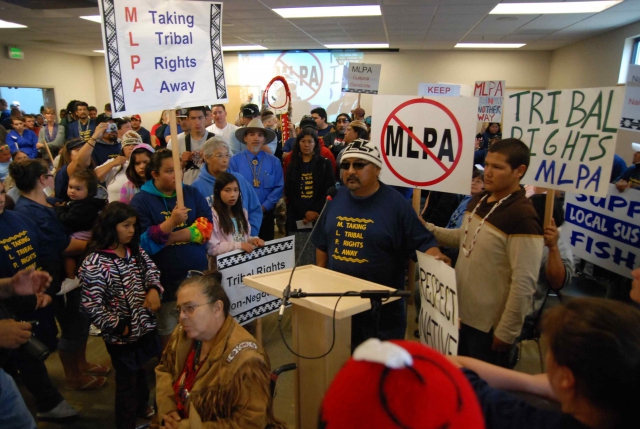
Photo: David Gensaw, Yurok Tribal Council Member, speaks during a protest at the MLPA Blue Ribbon Task Force meeting in Fort Bragg on July 21, 2010. Photo by Klamath Media Collective.
Photo: David Gensaw, Yurok Tribal Council Member, speaks during a protest at the MLPA Blue Ribbon Task Force meeting in Fort Bragg on July 21, 2010. Photo by Klamath Media Collective.
What we can learn from the MLPA Initiative
by Dan Bacher
In 28 years of covering fish, water and environmental politics in the West, Governor Arnold Schwarzenegger's Marine Life Protection Act (MLPA) Initiative is the most corrupt public process I've ever reported on.
The Marine Life Protection Act (MLPA), a landmark law signed by Governor Gray Davis in 1999 to create a network of marine protected areas in state waters along the California coast, was designed to provide comprehensive protection to the marine ecosystem. However, the law was eviscerated under Schwarzenegger's privately-funded MLPA Initiative.
The initiative, overseen by oil industry, real estate, marina development and other corporate representatives, took water pollution, oil drilling and spills, wave energy development, corporate aquaculture, military testing, habitat destruction and all other human impacts on the ocean other than fishing and gathering off the table in its perverse concept of marine "protection."
There are six major lessons to be learned from the MLPA fiasco so that the inherent flaws of the initiative are never repeated in any process anywhere.
1. Never fund a public conservation process with private, unaccountable money, especially in a case where you are in effect removing stakeholders from public access. The roots of the MLPA's problems largely derive from the privatization of conservation through the Resources Legacy Fund Foundation, a private corporation.
2. Always consult with Indian Tribes on closures of areas and other regulations that may impact their ceremonial and gathering rights and sacred sites, as protected by state, federal and international laws, including the American Indian Religious Freedom Act and the UN Declaration on the Rights of Indigenous Peoples. This was NOT done in the Central Coast process, in a bad case of institutional racism. It was very poorly and minimally done in the North Central Coast and South Coast. It was not until the process came to the North Coast that language respecting the fishing and gathering rights of Tribes was included in a proposal for marine protected areas.
3. When designing MPAs, you must include other human uses other than fishing and gathering. Otherwise the "marine protected areas" become "marine privatization" areas that aren't protected from water pollution, oil spills and drilling, wave energy projects, military testing and other human impacts on the ocean.
4. Never appoint corrupt corporate hacks like oil industry lobbyists, real estate executives and developers to panels designed to "protect" the ocean. Having Catherine Reheis-Boyd, the president of the Western States Petroleum Association, chair the South Coast MLPA Blue Ribbon Task Force was about as crazy a conflict of interest that you could ever come up with!
5. Make sure that you have a funding mechanism for enforcement in place BEFORE you even think about instituting a process like the MLPA Initiative. The wardens call MPAs "Marine Poaching Areas" because of the California, with the lowest per capita ratio of wardens to the population of any state in the nation, doesn't have enough wardens to patrol new marine reserves, let alone the existing marine protected areas.
6. We need to eliminate "Blue Ribbon Panels" and create "Blue Collar Panels" where grassroots people, rather than political hacks and corrupt big business interests, make decisions about public policy in an atmosphere of real democracy. To start off the MLPA process with a chair like Phil Isenberg, a well connected political lobbyist, is the absolute wrong way to do things. He then went on to chair the Delta Vision plan to build a peripheral canal, showing the direct link between the peripheral canal greenwashing and MLPA greenwashing.
In spite of the claims by MLPA officials and proponents that the process is "open, transparent and inclusive," it is anything but. Californians must pressure their Legislators and the Brown administration to suspend or cancel the corrupt MLPA Initiative - and to learn from its inherent flaws to avoid making the same mistakes in any future public conservation processes.
by Dan Bacher
In 28 years of covering fish, water and environmental politics in the West, Governor Arnold Schwarzenegger's Marine Life Protection Act (MLPA) Initiative is the most corrupt public process I've ever reported on.
The Marine Life Protection Act (MLPA), a landmark law signed by Governor Gray Davis in 1999 to create a network of marine protected areas in state waters along the California coast, was designed to provide comprehensive protection to the marine ecosystem. However, the law was eviscerated under Schwarzenegger's privately-funded MLPA Initiative.
The initiative, overseen by oil industry, real estate, marina development and other corporate representatives, took water pollution, oil drilling and spills, wave energy development, corporate aquaculture, military testing, habitat destruction and all other human impacts on the ocean other than fishing and gathering off the table in its perverse concept of marine "protection."
There are six major lessons to be learned from the MLPA fiasco so that the inherent flaws of the initiative are never repeated in any process anywhere.
1. Never fund a public conservation process with private, unaccountable money, especially in a case where you are in effect removing stakeholders from public access. The roots of the MLPA's problems largely derive from the privatization of conservation through the Resources Legacy Fund Foundation, a private corporation.
2. Always consult with Indian Tribes on closures of areas and other regulations that may impact their ceremonial and gathering rights and sacred sites, as protected by state, federal and international laws, including the American Indian Religious Freedom Act and the UN Declaration on the Rights of Indigenous Peoples. This was NOT done in the Central Coast process, in a bad case of institutional racism. It was very poorly and minimally done in the North Central Coast and South Coast. It was not until the process came to the North Coast that language respecting the fishing and gathering rights of Tribes was included in a proposal for marine protected areas.
3. When designing MPAs, you must include other human uses other than fishing and gathering. Otherwise the "marine protected areas" become "marine privatization" areas that aren't protected from water pollution, oil spills and drilling, wave energy projects, military testing and other human impacts on the ocean.
4. Never appoint corrupt corporate hacks like oil industry lobbyists, real estate executives and developers to panels designed to "protect" the ocean. Having Catherine Reheis-Boyd, the president of the Western States Petroleum Association, chair the South Coast MLPA Blue Ribbon Task Force was about as crazy a conflict of interest that you could ever come up with!
5. Make sure that you have a funding mechanism for enforcement in place BEFORE you even think about instituting a process like the MLPA Initiative. The wardens call MPAs "Marine Poaching Areas" because of the California, with the lowest per capita ratio of wardens to the population of any state in the nation, doesn't have enough wardens to patrol new marine reserves, let alone the existing marine protected areas.
6. We need to eliminate "Blue Ribbon Panels" and create "Blue Collar Panels" where grassroots people, rather than political hacks and corrupt big business interests, make decisions about public policy in an atmosphere of real democracy. To start off the MLPA process with a chair like Phil Isenberg, a well connected political lobbyist, is the absolute wrong way to do things. He then went on to chair the Delta Vision plan to build a peripheral canal, showing the direct link between the peripheral canal greenwashing and MLPA greenwashing.
In spite of the claims by MLPA officials and proponents that the process is "open, transparent and inclusive," it is anything but. Californians must pressure their Legislators and the Brown administration to suspend or cancel the corrupt MLPA Initiative - and to learn from its inherent flaws to avoid making the same mistakes in any future public conservation processes.
Add Your Comments
Latest Comments
Listed below are the latest comments about this post.
These comments are submitted anonymously by website visitors.
TITLE
AUTHOR
DATE
More Guidelines
Sun, Jan 30, 2011 10:13AM
We are 100% volunteer and depend on your participation to sustain our efforts!
Donate

$110.00 donated
in the past month
Get Involved
If you'd like to help with maintaining or developing the website, contact us.
Publish
Publish your stories and upcoming events on Indybay.
Topics
More
Search Indybay's Archives
Advanced Search
►
▼
IMC Network