







 Publish to Newswire
 Add an Event
From the Open-Publishing Calendar
From the Open-Publishing Newswire
Indybay Feature
Wolf Cries -- Howling About Drought -- All Wet
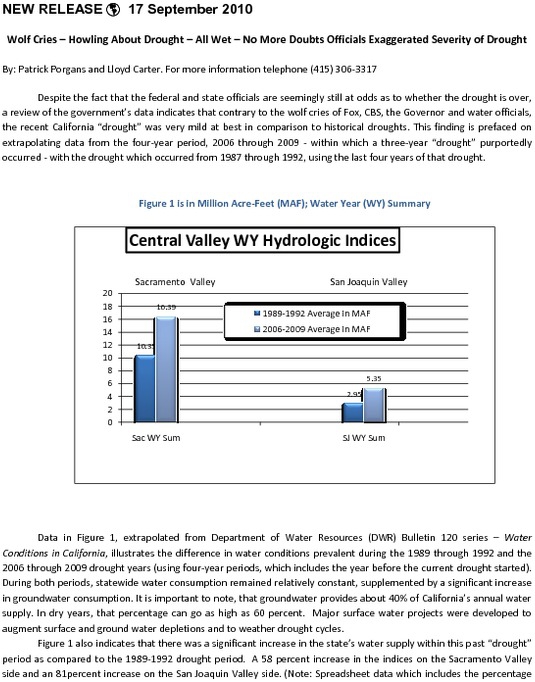
Patrick Porgans and Lloyd Carter reveal that while the federal and state officials are seemingly still at odds as to whether the "drought" is over, a review of the government’s data indicates that contrary to the wolf cries of Fox, CBS, the Governor and water officials, the recent California “drought” was very mild at best in comparison to historical droughts.
Add Your Comments
Comments
(Hide Comments)
The problem is the same every year in CA, known for regularly dry summer climates. For agribusiness corporations in CA's San Joaquin Valley, their choices in crops and growing methods result in them demanding greater amounts of water every year. This demand for water comes from the rivers that need the water to support fishes like salmon, sturgeon and smelt. The soils in the San Joaquin Valley suffer from intense heat and dry conditions EVERY summer, and cannot sustain the agribusinesses choices of water dependent crops without intensive irrigation, requiring taking more water from northern rivers than is sustainable for the fishes that inhabit these rivers and deltas.
So the claims of a drought isn't that unusual, only that there are usually drought conditions throughout the state, some years worse than others. If any growers wanted to change their choices of crops, they would be doing themselves and the fish a great many favors for years down the road. It would be simple as converting to drought tolerant crops, thus less water needed for irrigation every year into the future, and more water stored in groundwater (for real drought emergency) and more water left in rivers.
Here's the regular visit from the tepary beans, indigenous to the dry climate of the Sonoran desert and a prime candidate for San Joaquin growers who would like to make the most ethical choice of reducing their water demands into the future by converting to drought tolerant tepary beans today! Get this, tepary beans actually are harmed by overwatering!!
Background on tepary beans;
"Location
Tepary beans (Phaseolus acutifolius) are grown in desert and semi-desert conditions in Arizona, Mexico and southward to Costa Rica. The beans were first domesticated in Mexico and have been found in archaeological sites dating to 5000 years before present.
Light: Grow in full sun.
Moisture: Drought tolerant, tepary beans can grow in climates with as little as 16 in (40 cm) of rain per year. However, they do need a good rain to germinate and get started. Teparies may not do well if they get too much rain.
Hardiness: USDA Zones 7-10. Tepary beans are grown as annuals and require about 75-85 days to mature. They do best in hot, dry climates.
Propagation: Seeds can be sown late in the season since they require only 75-85 days to maturity. Some (but not all) varieties are short-day length bloomers and will not flower if planted in early spring.
Usage:
Tepary beans are typically harvested in the dry stage - or just before, since when fully dry, the pods split open by themselves and scatter beans all over the place. The whole plant is pulled up and threshed to separate out the beans. But like other kinds of beans, teparies can be harvested in the shellie stage, and that's the way I prefer them.
Tepary beans are not as productive as other beans; they are small and the plants produce a relatively small crop. However, teparies contain 23-27% protein, the highest of any bean except soy. They have higher levels of oils and the minerals calcium, iron, magnesium, zinc, phosphorus, and potassium than other beans. Tepary beans are lower in polyunsaturated fat and lower in the starchy compounds that make other beans hard to digest (i.e. less tooting). Teparies have a sweet, nutty flavor, quite different from other beans. Teparies cook faster than other beans and have a creamier texture when cooked. They are most often used in soups."
check out teparies here;
http://www.floridata.com/ref/p/phas_acu.cfm
So the claims of a drought isn't that unusual, only that there are usually drought conditions throughout the state, some years worse than others. If any growers wanted to change their choices of crops, they would be doing themselves and the fish a great many favors for years down the road. It would be simple as converting to drought tolerant crops, thus less water needed for irrigation every year into the future, and more water stored in groundwater (for real drought emergency) and more water left in rivers.
Here's the regular visit from the tepary beans, indigenous to the dry climate of the Sonoran desert and a prime candidate for San Joaquin growers who would like to make the most ethical choice of reducing their water demands into the future by converting to drought tolerant tepary beans today! Get this, tepary beans actually are harmed by overwatering!!
Background on tepary beans;
"Location
Tepary beans (Phaseolus acutifolius) are grown in desert and semi-desert conditions in Arizona, Mexico and southward to Costa Rica. The beans were first domesticated in Mexico and have been found in archaeological sites dating to 5000 years before present.
Light: Grow in full sun.
Moisture: Drought tolerant, tepary beans can grow in climates with as little as 16 in (40 cm) of rain per year. However, they do need a good rain to germinate and get started. Teparies may not do well if they get too much rain.
Hardiness: USDA Zones 7-10. Tepary beans are grown as annuals and require about 75-85 days to mature. They do best in hot, dry climates.
Propagation: Seeds can be sown late in the season since they require only 75-85 days to maturity. Some (but not all) varieties are short-day length bloomers and will not flower if planted in early spring.
Usage:
Tepary beans are typically harvested in the dry stage - or just before, since when fully dry, the pods split open by themselves and scatter beans all over the place. The whole plant is pulled up and threshed to separate out the beans. But like other kinds of beans, teparies can be harvested in the shellie stage, and that's the way I prefer them.
Tepary beans are not as productive as other beans; they are small and the plants produce a relatively small crop. However, teparies contain 23-27% protein, the highest of any bean except soy. They have higher levels of oils and the minerals calcium, iron, magnesium, zinc, phosphorus, and potassium than other beans. Tepary beans are lower in polyunsaturated fat and lower in the starchy compounds that make other beans hard to digest (i.e. less tooting). Teparies have a sweet, nutty flavor, quite different from other beans. Teparies cook faster than other beans and have a creamier texture when cooked. They are most often used in soups."
check out teparies here;
http://www.floridata.com/ref/p/phas_acu.cfm
We are 100% volunteer and depend on your participation to sustain our efforts!
Donate

$110.00 donated
in the past month
Get Involved
If you'd like to help with maintaining or developing the website, contact us.
Publish
Publish your stories and upcoming events on Indybay.
Topics
More
Search Indybay's Archives
Advanced Search
►
▼
IMC Network