







 Publish to Newswire
 Add an Event
From the Open-Publishing Calendar
From the Open-Publishing Newswire
Indybay Feature
Landmark Federal Case Upholds Instant Runoff Voting
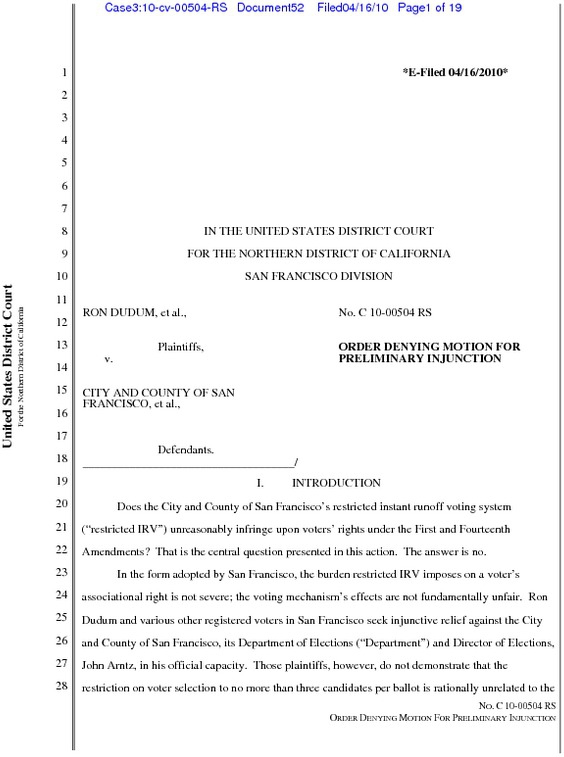
Instant Runoff Voting is reviewed for the first time by a federal court and declared to be constitutional. Even San Francisco's use of what the judge calls "limited IRV" is constitutional. Attached is the judge's opinion (19 pages).
(Originally Published by the New America Foundation at http://politicalreform.newamerica.net/blogposts/2010/landmark_federal_case_upholds_instant_runoff_voting-30691)
In a landmark opinion issued late on Friday, Federal District Court Judge Richard Seeborg upheld the constitutionality of San Francisco’s Ranked Choice Voting method, the first time a federal court has weighed in on the subject of Instant Runoff Voting (IRV).
This is a great contribution to the field of election reform and another in a series of decisions which clearly upholds the legality and constitutionality of Instant Runoff Voting. Yet another court has said “no” to the tired arguments that IRV somehow runs contrary to the “one person, one vote” principle or that some votes count more than others with IRV. The judge methodically disposed of these objections in a nineteen page decision.
This, of course, was not the first time a court has addressed IRV. The supreme courts of Massachusetts and Minnesota have previously ruled in favor of this election method. Both opinions were strong ones and the recent Minnesota decision, issued in June, was unanimous. Judge Seeborg quoted approvingly from those decisions which he called “thoroughly reasoned analyses.”
Seeborg’s decision reads like a civics lesson. The Judge reaches back to the 19th century for a United States Supreme Court decision which said “the science of government is the most abstruse of all sciences. It is a science of experimentation. Accordingly, the Constitution does not compel a fixed method of choosing state or local officers or representatives.”
Having established that local governments can figure out how to pick their own representatives, and that “no right is more precious in a free country than that of having a voice in the election,” the decision goes on to recognize the limitations of “first-past-the-post” (winner-take-all) elections and notes how instant runoff voting can be an improvement.
Critically, this decision acknowledges the sophistication of the Ranked Choice Voting method and how it better serves the populace, in particular those who may find themselves in the minority. The judge points to the Massachusetts decision which said that the purpose of voters stating their preferences for candidates instead of voting for just one candidate “is not a derogation from the principle of equality but an attempt to reflect it with more exquisite accuracy.”
In a landmark opinion issued late on Friday, Federal District Court Judge Richard Seeborg upheld the constitutionality of San Francisco’s Ranked Choice Voting method, the first time a federal court has weighed in on the subject of Instant Runoff Voting (IRV).
This is a great contribution to the field of election reform and another in a series of decisions which clearly upholds the legality and constitutionality of Instant Runoff Voting. Yet another court has said “no” to the tired arguments that IRV somehow runs contrary to the “one person, one vote” principle or that some votes count more than others with IRV. The judge methodically disposed of these objections in a nineteen page decision.
This, of course, was not the first time a court has addressed IRV. The supreme courts of Massachusetts and Minnesota have previously ruled in favor of this election method. Both opinions were strong ones and the recent Minnesota decision, issued in June, was unanimous. Judge Seeborg quoted approvingly from those decisions which he called “thoroughly reasoned analyses.”
Seeborg’s decision reads like a civics lesson. The Judge reaches back to the 19th century for a United States Supreme Court decision which said “the science of government is the most abstruse of all sciences. It is a science of experimentation. Accordingly, the Constitution does not compel a fixed method of choosing state or local officers or representatives.”
Having established that local governments can figure out how to pick their own representatives, and that “no right is more precious in a free country than that of having a voice in the election,” the decision goes on to recognize the limitations of “first-past-the-post” (winner-take-all) elections and notes how instant runoff voting can be an improvement.
Critically, this decision acknowledges the sophistication of the Ranked Choice Voting method and how it better serves the populace, in particular those who may find themselves in the minority. The judge points to the Massachusetts decision which said that the purpose of voters stating their preferences for candidates instead of voting for just one candidate “is not a derogation from the principle of equality but an attempt to reflect it with more exquisite accuracy.”
For more information:
http://www.cfer.org
Add Your Comments
We are 100% volunteer and depend on your participation to sustain our efforts!
Donate

$110.00 donated
in the past month
Get Involved
If you'd like to help with maintaining or developing the website, contact us.
Publish
Publish your stories and upcoming events on Indybay.
Topics
More
Search Indybay's Archives
Advanced Search
►
▼
IMC Network