







 Publish to Newswire
 Add an Event
From the Open-Publishing Calendar
From the Open-Publishing Newswire
Indybay Feature
Tesla to Reopen Closed Auto Site in Fremont; but will it be a Union Plant?
After filing for bankruptcy protection in June 2009, General Motors pulled out of a partnership with Toyota. They had employed thousands of workers and built cars at the Fremont NUMMI plant for almost 25 years, but shut down the site this spring. Today things look a bit brighter for the workers who lost their jobs. Tesla announced that instead of going to Downey, California, where they were considering opening a plant on a former toxic site, they will partner with Toyota to build electric cars at the former NUMMI plant in Fremont.
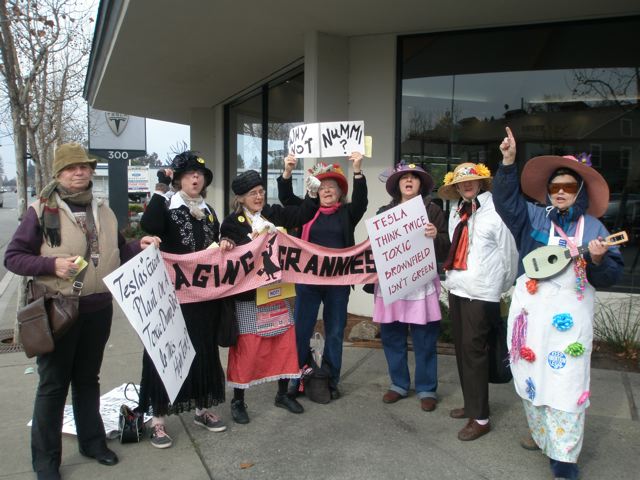
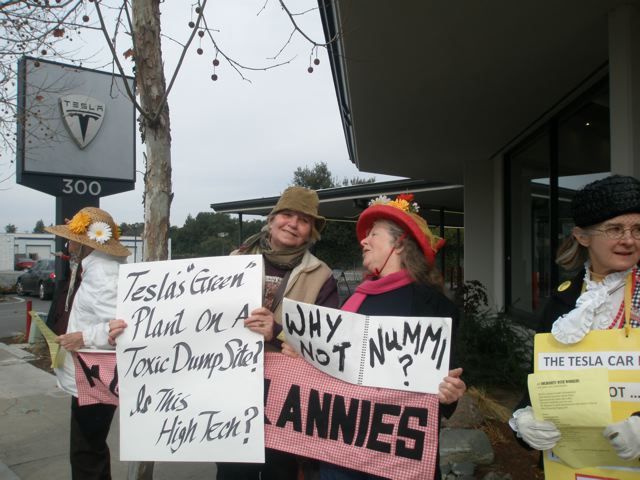
In early January of this year, activist group the Raging Grannies protested outside Tesla's tony showroom in Menlo Park, California. Their beef? They wanted Tesla to do the right thing, and go with a business plan that made sense for workers.
The Grannies, all women old enough to be grandmothers, chanted "Why Not Nummi?" and sang about the need to employ the formerly unionized workers who were let go when General Motors declared bankruptcy.
In a statement today, Raging Granny Barbara Baxter-Berman said that she is pleased that Tesla has chosen the site in San Francisco's East Bay over the southern California site. "The right thing to do is to engage the workers who were let go. The site in Downey had a questionable record as far as worker safety goes. Many workers at Downey Studios, and even at the Kaiser Hospital built in Downey, have become ill in disproportionate numbers compared to the number who would have gotten sick on a non-toxic site."
Granny Gail Sredanovic added that it remains to be seen if Tesla will treat workers fairly, allowing them to unionize, at the Fremont site. "But if choosing the NUMMI site over Downey is any indication, there is perhaps hope that Tesla will consider giving workers a fair deal" she said.
The Grannies went on to say that they are calling on Tesla to make sure the workers are paid the same wages and benefits as the former workers. They hope Tesla will hire the skilled workers who have lost their jobs due to the closure. They stated that they will continue to support the injured Downey workers and community members who are fighting for their healthcare and justice from the toxic dump site owned by Stuart Lichter.
In a video of the Raging Granny protest made on January 9 this year, the Grannies stated their concern that business decisions are often based solely on profit motive and greed. One Granny warned that if Tesla doesn't make good decisions, "We will be back again and again and again."
For video of the Grannies' protest and more about the Downey situation see previous indybay coverage here:
http://www.indybay.org/newsitems/2010/01/12/18635025.php
The Grannies, all women old enough to be grandmothers, chanted "Why Not Nummi?" and sang about the need to employ the formerly unionized workers who were let go when General Motors declared bankruptcy.
In a statement today, Raging Granny Barbara Baxter-Berman said that she is pleased that Tesla has chosen the site in San Francisco's East Bay over the southern California site. "The right thing to do is to engage the workers who were let go. The site in Downey had a questionable record as far as worker safety goes. Many workers at Downey Studios, and even at the Kaiser Hospital built in Downey, have become ill in disproportionate numbers compared to the number who would have gotten sick on a non-toxic site."
Granny Gail Sredanovic added that it remains to be seen if Tesla will treat workers fairly, allowing them to unionize, at the Fremont site. "But if choosing the NUMMI site over Downey is any indication, there is perhaps hope that Tesla will consider giving workers a fair deal" she said.
The Grannies went on to say that they are calling on Tesla to make sure the workers are paid the same wages and benefits as the former workers. They hope Tesla will hire the skilled workers who have lost their jobs due to the closure. They stated that they will continue to support the injured Downey workers and community members who are fighting for their healthcare and justice from the toxic dump site owned by Stuart Lichter.
In a video of the Raging Granny protest made on January 9 this year, the Grannies stated their concern that business decisions are often based solely on profit motive and greed. One Granny warned that if Tesla doesn't make good decisions, "We will be back again and again and again."
For video of the Grannies' protest and more about the Downey situation see previous indybay coverage here:
http://www.indybay.org/newsitems/2010/01/12/18635025.php
Add Your Comments
Comments
(Hide Comments)
And WHO said Grannie's "don't or can't get the job done"?
ATTA GIRLS!!!!!
My bonnet off to you!
ATTA GIRLS!!!!!
My bonnet off to you!
How an L.A. Suburb Downey Became One of the Most Toxic Towns
http://www.alternet.org/environment/145508/downey_flu:_how_an_l.a._suburb_became_one_of_the_most_toxic_towns
How an L.A. Suburb Became One of the Most Toxic Towns
By Sena Christian, AlterNet
Posted on February 10, 2010, Printed on May 20, 2010
In July 2007, Gail Shephard quit her job as an orthopedic technician. Her weakened muscles had made it too difficult for her to wash her hair or even pull up her pants in the morning. Now, Shephard, 55, takes two pain medications and Mirapex, a pill to treat Parkinson's disease, each day.
"I don't do anything," Shephard said. "I sit in the same chair. I dread getting up in the morning, it's so painful. I can't walk and I hold onto the walls to go the bathroom and back. And that is my entire day."
But Shephard doesn't have Parkinson's disease and doctors don't quite know how to diagnose her. She knows, however, that her ailments began shortly after February 2006, when she transferred to the new Kaiser Permanente facility built on the site of a former NASA plant, which comprised 160 acres of land in the Los Angeles suburb of Downey, Calif.
Shephard would come to find that she wasn't alone in her unexplained health problems. Several other former employees of the Kaiser Downey Medical Center andDowney Studios -- a film-production center also located at the site -- claim that they too became ill as a result of exposure to toxic contaminants left over from seven decades of military and aerospace research and manufacturing at the old NASA Downey Industrial Plant. The ailments have become so common that workers there coined a nickname: "Downey flu."
As for Shephard, the move to Downey aggravated her tendon and joint pain. Soon after, her feet and ankles ached: "My foot was so sensitive I couldn't put a blanket on it or let water touch it. I knew something was wrong, but I didn't know what."
That was only the beginning. Shephard had difficulty breathing, and experienced back spasms, dizzy spells and migraine headaches. Before long, she was urinating blood. Now, she has central nervous system damage and most of her body has turned numb.
Those who suffer from "Downey flu" claim that the city of Downey and Industrial Realty Group, which operate what's now called Downey Landing, failed to properly remediate the property or notify workers of mold, fungi and other toxic residue. The U.S. Department of Labor has identified 260 chemicals found at the NASA site, including arsenic, lead, uranium, plutonium, trichloroethylene and chromium.
For environmental health advocates, Downey illustrates the potential harm in redeveloping old industrial sites, and the loophole that allows for development to occur before hazardous substances are completely removed. Under the Comprehensive Environmental Response, Compensation and Liability Act, better known as Superfund or CERCLA, former U.S. military and industrial sites can be purchased by developers who promise to clean up the land. But some sickened workers question the wisdom of allowing the privatization of remediation efforts, which removes the responsibility from the government and places it into the hands of developers eager to start capitalizing on their investment.
In the Superfund program's nearly 30-year history, the U.S. Environmental Protection Agency has identified tens of thousands of hazardous waste sites. Upon some of these now sit office buildings, shopping malls, houses and schools, often without the knowledge of the people who live and work there. One such place -- Downey Landing -- boasts the film studio, Kaiser facility, Columbia Memorial Space Science Learning Center, a shopping center and a public park.
"They never told us [Downey] was a Boeing-NASA site," said Shephard, from her home in Norwalk. "Or that it was a brownfield."
Downey Flu's Impact
For 18 years, Shephard worked at Kaiser Permanente, starting out as a surgical clinical assistant before training to become an orthopedic technician. She originally worked at the Kaiser in Bellflower, Calif., before a new facility was constructed in nearby Downey.
For 70 years, this particular property served as a base for American aircraft and aerospace industries. Military-industrial use began in 1929 and personnel built bombers there during World War II. Later, North American Aviation conducted nuclear power and rocket propulsion research. NASA took over the property in 1960, using the facility to assemble rockets and missiles, and most famously, to build space shuttles for the Apollo space program. In 1972, Apollo 16 embarked on NASA's fifth lunar landing. Four notable travelers boarded the flight: fungal species selected to determine what effect, if any, space exposure had on cell changes. Afterward, the fungi returned to Downey for post-flight analysis.
In 1996, Boeing Company acquired the plant and shut down the facility in 1999. The city of Downey and Stuart Lichter's Industrial Realty Group -- known for developing brownfields -- bought the property. A film production studio was built and a few years later, Kaiser constructed its medical complex.
Shephard's ailments began shortly after transferring to the facility. She eventually lost her muscle strength and her doctor deemed her 100-percent disabled, stating that her "severe limitations in mobility and cognitive function" resulted from "workplace exposure to mold and toxic chemicals."
Steve Basile, 53, worked as a prop maker at Downey Studios in September 2004 for the DreamWorks' film The Island. It was unusually rainy that fall, Basile recalled, and the roof leaked and the stage was damp. Workers used a bathroom in the far back of the building, which Basile described as reminiscent of a 1920s abandoned subway station with ponds of standing water and mold on the walls. He developed a sore throat and sniffles. Before long, he was coughing and hacking, and his muscles grew sore. But he couldn't take any time off.
"We would stay because there's no work and you have to pay your mortgage," he said.
Sometimes, Basile and his partner climbed up to the ceiling to hang hoists for elevators, where they'd find beams covered with a black powder-like substance that made them cough. Clouds of particles always filled the air. Basile remembers workers removing asbestos and other people in hazmat suits removing dirt. His skin itched and his eyes burned. Basile never wore gloves and developed spots on his hands. He said his skin used to peel like a lizard's. One day in December of 2004, Basile's back snapped. That was his last day working at Downey.
Several months later, the International Alliance of Theatrical Stage Employees Local 44 warned union members that Downey was a toxic site. Lichter sued IATSE for harming his business and the union settled for $775,000. IATSE reversed its warnings and told workers the property was safe.
Daniel Ferguson worked as an actor at Downey Studios in June 2009 for the filming of Iron Man 2. He developed headaches, low energy, a dry cough and a sore throat that hasn't gone away. A month after his scene wrapped, he noticed rashes on his arms, which spread to his chest and back. Ferguson, 35, now suffers elbow, knee and lower back pain, and his illness has affected his ability to book acting jobs.
"For the past three years, I've been on sets for 15 hours a day and that's never affected me," Ferguson said. "Now, I can't pass the eight-hour mark. I never was like that before I walked on that set. I could have stayed on set for 24 hours if I had to."
Linda Sorensen, 55, worked for Rockwell International (which had merged with North American Aviation, and later Boeing) at Downey for 20 years. "I started getting back pain back in 1997 or 1998 and found out I have cancer of the spinal chord," she said. "I also used to get strange dizzy spells when I worked there and never could figure out why."
If indeed the site has sickened some Downey workers, these people are perhaps most upset because they believe their health shouldn't have been compromised in the first place, arguing that government officials could have prevented the development of the site.
A Los Angeles Time article last year reported that environmental surveys documented extensive contamination at Downey, including high concentrations of trichloroethylene found in the soil and groundwater. Exposure to this industrial solvent can cause nerve and organ damage, respiratory problems and impaired immunity. According to the article, these surveys found high levels of hexavalent chromium, which is used to plate metal and rust-proof aircraft engine parts, in the soil. Exposure to this chemical can cause damage to the nose, throat and lungs, and skin rashes.
Despite these risks, the city of Downey and IRG decided to redevelop the site in tandem with remediation efforts, which they were allowed to do thanks to an early-transfer amendment to CERCLA that fast-tracks redevelopment and allows the federal government to transfer property to a non-federal entity before completion of environmental clean-ups. Expediting title transfer paves the way for financing and loans for remediation and redevelopment, and generates new jobs and tax revenue. Gov. Gray Davis approved the transfer.
On September 7, 2000, the Department of Toxic Substances Control's office of military facilities faxed a letter to EPA Region 9 Administrator Philip Armstrong about the draft environmental assessment for the Downey NASA plant. It notes how a local water purveyor had detected low-level concentrations of organic solvents, including tetrachloroethene, which can affect the central nervous system, kidney, liver and reproductive system. Symptoms manifest themselves as dizziness, headaches and poor balance. The letter states: "It is also our understanding that no risk assessments for human and ecological health have yet been performed for this property."
The letter continues: "Additionally, it is DTSC's understanding that NASA has proposed that future land use restrictions be placed in the deed to prohibit use ... [that] may expose persons or the environment to residual contaminants." The department recommended that a land-use covenant be entered into that would bind future owners. The letter was sent during negotiations for early transfer (PDF) of the NASA site to the city of Downey.
But early transfer authority allows the deferral of a Superfund deed covenant that requires "all remedial action necessary to protect human health and the environment" be completed prior to property transfer.
As for Armstrong, in May 2008, he retired from the EPA to join the Peace Corps and retreat to the West African nation of Mauritania.
Workers Fight Back
Downey workers have rallied together to fight for what they call much-deserved justice. In November 2009, a Los Angeles judge dismissed a libel lawsuit filed by IRG's Lichter against two ex-Downey workers and two operators of the KaiserpapersWeb site, which documents health concerns of former employees. Lichter did not return requests for comment. But he told the L.A. Times reporter last year that his company did an "amazing amount to transform this property, and everything we've done has been totally responsible."
Recently, Lawrence Rose, a former Cal/OSHA senior public health officer for 28 years, reviewed illness complaints of some Downey employees. He said these employees have an unusually high incidence of work-associated illnesses.
"In view of the long history of previous industrial activity, a thorough workplace investigation should be carried out in relation to the employee-illness complaints," Rose said. "The sampling for all toxic chemicals previously used there ... should be carried out in a systematic formal epidemiology study. This has not been done."
Back in Downey, after Gail Shephard retired in 2007, her daughter Kristi visited her ailing mother weekly. On March 22, 2009, Kristi, then only 36, called her mother complaining of a terrible earache. She died a few minutes later of a stroke. Shephard said one autopsy found high levels of two toxins in Kristi's brain stem. Shephard worries she may somehow be to blame; that she brought home toxic mold and fungi from her workplace.
As for Steve Basile, after undergoing physical therapy for his back injury, he returned to work as a prop maker until October 2009. He had lost almost 50 pounds -- unintentionally -- and could no longer work. Nowadays, he undergoes chemotherapy for cancerous blood proteins, and he suffers nose bleeds, shortness of breath, headaches and occasionally develops bumps in his throat.
"It sucks," Basile said. "I got no energy. Probably two days out of the week, I get out [of the house]. I'm sick pretty much all the time. I try to do things so I don't end up on the couch. If I go to the couch, I'll stay there for three days."
More information at
http://www.workersmemorialday.org
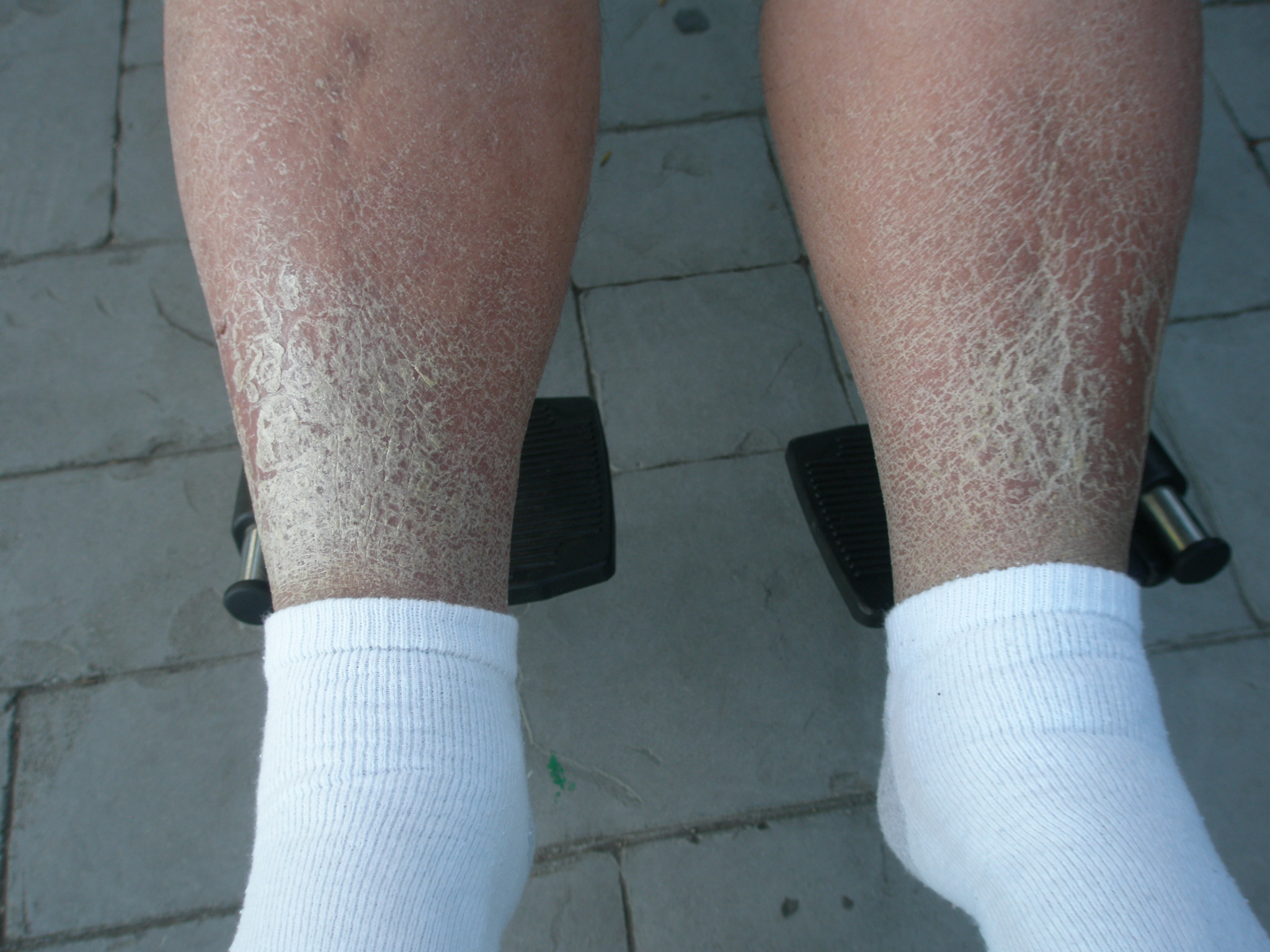
Photo is of the leg of injured Kaiser SEIU UHW Kaiser Downey worker Gail Shephard
http://www.alternet.org/environment/145508/downey_flu:_how_an_l.a._suburb_became_one_of_the_most_toxic_towns
How an L.A. Suburb Became One of the Most Toxic Towns
By Sena Christian, AlterNet
Posted on February 10, 2010, Printed on May 20, 2010
In July 2007, Gail Shephard quit her job as an orthopedic technician. Her weakened muscles had made it too difficult for her to wash her hair or even pull up her pants in the morning. Now, Shephard, 55, takes two pain medications and Mirapex, a pill to treat Parkinson's disease, each day.
"I don't do anything," Shephard said. "I sit in the same chair. I dread getting up in the morning, it's so painful. I can't walk and I hold onto the walls to go the bathroom and back. And that is my entire day."
But Shephard doesn't have Parkinson's disease and doctors don't quite know how to diagnose her. She knows, however, that her ailments began shortly after February 2006, when she transferred to the new Kaiser Permanente facility built on the site of a former NASA plant, which comprised 160 acres of land in the Los Angeles suburb of Downey, Calif.
Shephard would come to find that she wasn't alone in her unexplained health problems. Several other former employees of the Kaiser Downey Medical Center andDowney Studios -- a film-production center also located at the site -- claim that they too became ill as a result of exposure to toxic contaminants left over from seven decades of military and aerospace research and manufacturing at the old NASA Downey Industrial Plant. The ailments have become so common that workers there coined a nickname: "Downey flu."
As for Shephard, the move to Downey aggravated her tendon and joint pain. Soon after, her feet and ankles ached: "My foot was so sensitive I couldn't put a blanket on it or let water touch it. I knew something was wrong, but I didn't know what."
That was only the beginning. Shephard had difficulty breathing, and experienced back spasms, dizzy spells and migraine headaches. Before long, she was urinating blood. Now, she has central nervous system damage and most of her body has turned numb.
Those who suffer from "Downey flu" claim that the city of Downey and Industrial Realty Group, which operate what's now called Downey Landing, failed to properly remediate the property or notify workers of mold, fungi and other toxic residue. The U.S. Department of Labor has identified 260 chemicals found at the NASA site, including arsenic, lead, uranium, plutonium, trichloroethylene and chromium.
For environmental health advocates, Downey illustrates the potential harm in redeveloping old industrial sites, and the loophole that allows for development to occur before hazardous substances are completely removed. Under the Comprehensive Environmental Response, Compensation and Liability Act, better known as Superfund or CERCLA, former U.S. military and industrial sites can be purchased by developers who promise to clean up the land. But some sickened workers question the wisdom of allowing the privatization of remediation efforts, which removes the responsibility from the government and places it into the hands of developers eager to start capitalizing on their investment.
In the Superfund program's nearly 30-year history, the U.S. Environmental Protection Agency has identified tens of thousands of hazardous waste sites. Upon some of these now sit office buildings, shopping malls, houses and schools, often without the knowledge of the people who live and work there. One such place -- Downey Landing -- boasts the film studio, Kaiser facility, Columbia Memorial Space Science Learning Center, a shopping center and a public park.
"They never told us [Downey] was a Boeing-NASA site," said Shephard, from her home in Norwalk. "Or that it was a brownfield."
Downey Flu's Impact
For 18 years, Shephard worked at Kaiser Permanente, starting out as a surgical clinical assistant before training to become an orthopedic technician. She originally worked at the Kaiser in Bellflower, Calif., before a new facility was constructed in nearby Downey.
For 70 years, this particular property served as a base for American aircraft and aerospace industries. Military-industrial use began in 1929 and personnel built bombers there during World War II. Later, North American Aviation conducted nuclear power and rocket propulsion research. NASA took over the property in 1960, using the facility to assemble rockets and missiles, and most famously, to build space shuttles for the Apollo space program. In 1972, Apollo 16 embarked on NASA's fifth lunar landing. Four notable travelers boarded the flight: fungal species selected to determine what effect, if any, space exposure had on cell changes. Afterward, the fungi returned to Downey for post-flight analysis.
In 1996, Boeing Company acquired the plant and shut down the facility in 1999. The city of Downey and Stuart Lichter's Industrial Realty Group -- known for developing brownfields -- bought the property. A film production studio was built and a few years later, Kaiser constructed its medical complex.
Shephard's ailments began shortly after transferring to the facility. She eventually lost her muscle strength and her doctor deemed her 100-percent disabled, stating that her "severe limitations in mobility and cognitive function" resulted from "workplace exposure to mold and toxic chemicals."
Steve Basile, 53, worked as a prop maker at Downey Studios in September 2004 for the DreamWorks' film The Island. It was unusually rainy that fall, Basile recalled, and the roof leaked and the stage was damp. Workers used a bathroom in the far back of the building, which Basile described as reminiscent of a 1920s abandoned subway station with ponds of standing water and mold on the walls. He developed a sore throat and sniffles. Before long, he was coughing and hacking, and his muscles grew sore. But he couldn't take any time off.
"We would stay because there's no work and you have to pay your mortgage," he said.
Sometimes, Basile and his partner climbed up to the ceiling to hang hoists for elevators, where they'd find beams covered with a black powder-like substance that made them cough. Clouds of particles always filled the air. Basile remembers workers removing asbestos and other people in hazmat suits removing dirt. His skin itched and his eyes burned. Basile never wore gloves and developed spots on his hands. He said his skin used to peel like a lizard's. One day in December of 2004, Basile's back snapped. That was his last day working at Downey.
Several months later, the International Alliance of Theatrical Stage Employees Local 44 warned union members that Downey was a toxic site. Lichter sued IATSE for harming his business and the union settled for $775,000. IATSE reversed its warnings and told workers the property was safe.
Daniel Ferguson worked as an actor at Downey Studios in June 2009 for the filming of Iron Man 2. He developed headaches, low energy, a dry cough and a sore throat that hasn't gone away. A month after his scene wrapped, he noticed rashes on his arms, which spread to his chest and back. Ferguson, 35, now suffers elbow, knee and lower back pain, and his illness has affected his ability to book acting jobs.
"For the past three years, I've been on sets for 15 hours a day and that's never affected me," Ferguson said. "Now, I can't pass the eight-hour mark. I never was like that before I walked on that set. I could have stayed on set for 24 hours if I had to."
Linda Sorensen, 55, worked for Rockwell International (which had merged with North American Aviation, and later Boeing) at Downey for 20 years. "I started getting back pain back in 1997 or 1998 and found out I have cancer of the spinal chord," she said. "I also used to get strange dizzy spells when I worked there and never could figure out why."
If indeed the site has sickened some Downey workers, these people are perhaps most upset because they believe their health shouldn't have been compromised in the first place, arguing that government officials could have prevented the development of the site.
A Los Angeles Time article last year reported that environmental surveys documented extensive contamination at Downey, including high concentrations of trichloroethylene found in the soil and groundwater. Exposure to this industrial solvent can cause nerve and organ damage, respiratory problems and impaired immunity. According to the article, these surveys found high levels of hexavalent chromium, which is used to plate metal and rust-proof aircraft engine parts, in the soil. Exposure to this chemical can cause damage to the nose, throat and lungs, and skin rashes.
Despite these risks, the city of Downey and IRG decided to redevelop the site in tandem with remediation efforts, which they were allowed to do thanks to an early-transfer amendment to CERCLA that fast-tracks redevelopment and allows the federal government to transfer property to a non-federal entity before completion of environmental clean-ups. Expediting title transfer paves the way for financing and loans for remediation and redevelopment, and generates new jobs and tax revenue. Gov. Gray Davis approved the transfer.
On September 7, 2000, the Department of Toxic Substances Control's office of military facilities faxed a letter to EPA Region 9 Administrator Philip Armstrong about the draft environmental assessment for the Downey NASA plant. It notes how a local water purveyor had detected low-level concentrations of organic solvents, including tetrachloroethene, which can affect the central nervous system, kidney, liver and reproductive system. Symptoms manifest themselves as dizziness, headaches and poor balance. The letter states: "It is also our understanding that no risk assessments for human and ecological health have yet been performed for this property."
The letter continues: "Additionally, it is DTSC's understanding that NASA has proposed that future land use restrictions be placed in the deed to prohibit use ... [that] may expose persons or the environment to residual contaminants." The department recommended that a land-use covenant be entered into that would bind future owners. The letter was sent during negotiations for early transfer (PDF) of the NASA site to the city of Downey.
But early transfer authority allows the deferral of a Superfund deed covenant that requires "all remedial action necessary to protect human health and the environment" be completed prior to property transfer.
As for Armstrong, in May 2008, he retired from the EPA to join the Peace Corps and retreat to the West African nation of Mauritania.
Workers Fight Back
Downey workers have rallied together to fight for what they call much-deserved justice. In November 2009, a Los Angeles judge dismissed a libel lawsuit filed by IRG's Lichter against two ex-Downey workers and two operators of the KaiserpapersWeb site, which documents health concerns of former employees. Lichter did not return requests for comment. But he told the L.A. Times reporter last year that his company did an "amazing amount to transform this property, and everything we've done has been totally responsible."
Recently, Lawrence Rose, a former Cal/OSHA senior public health officer for 28 years, reviewed illness complaints of some Downey employees. He said these employees have an unusually high incidence of work-associated illnesses.
"In view of the long history of previous industrial activity, a thorough workplace investigation should be carried out in relation to the employee-illness complaints," Rose said. "The sampling for all toxic chemicals previously used there ... should be carried out in a systematic formal epidemiology study. This has not been done."
Back in Downey, after Gail Shephard retired in 2007, her daughter Kristi visited her ailing mother weekly. On March 22, 2009, Kristi, then only 36, called her mother complaining of a terrible earache. She died a few minutes later of a stroke. Shephard said one autopsy found high levels of two toxins in Kristi's brain stem. Shephard worries she may somehow be to blame; that she brought home toxic mold and fungi from her workplace.
As for Steve Basile, after undergoing physical therapy for his back injury, he returned to work as a prop maker until October 2009. He had lost almost 50 pounds -- unintentionally -- and could no longer work. Nowadays, he undergoes chemotherapy for cancerous blood proteins, and he suffers nose bleeds, shortness of breath, headaches and occasionally develops bumps in his throat.
"It sucks," Basile said. "I got no energy. Probably two days out of the week, I get out [of the house]. I'm sick pretty much all the time. I try to do things so I don't end up on the couch. If I go to the couch, I'll stay there for three days."
More information at
http://www.workersmemorialday.org
Photo is of the leg of injured Kaiser SEIU UHW Kaiser Downey worker Gail Shephard
For more information:
http://www.alternet.org/environment/145508...
Do you seriously think that the California Coalition For Workers Memorial Day (aka Steve "the headline grabber" Zeltzer) had anything to do with the fact that Tesla Motors chose to occupy a section of the closed NUMMI plant in Fremont. Toyota made Tesla an offer that they couldn't refuse to the tune of about 50 million bucks to stay in the area. Had Toyota not done this, they would have built on the Downey site because the land was so cheap.
Do you seriously think that a bunch of wobblies making a bunch of racket seriously makes a difference?
Time to champion another cause Stevie!
Do you seriously think that a bunch of wobblies making a bunch of racket seriously makes a difference?
Time to champion another cause Stevie!
It is interesting that the so called "Ilene Dover" does not think the issues of the injured workers at Downey has anything to do with Elon Musk and his decision not to build at Downey. In fact these injured workers went to the Tesla office and according to Tesla's VP of Communication Ricardo Reyes they were very aware of the SLAPP suit that toxic site developer Stuart Lichter lost against the injured workers and workers advocates.
This "Ilene Dover" would have people believe that the injured workers at Downey and the millions of disabled and injured workers in this country have no power but this in fact is the line of the insurance companies, the bosses and people like Dover. The workers at Downey will continue to fight for justice regardless of the corporate mouthpieces who want to silence these workers and censor the criminal corporate connections.
Here is a statement of injured worker Gail Shephard who spoke on April 29, 2010 at the Independence Park in Downey.
Statement of injured SEIU UHW Kaiser Downey Senior Orthopedic technician On April 29, 2010
Hello, Good afternoon and Thank you all for being here on this Workers Memorial Day. My name is Gail Shephard, and I have an environmental occupational injury, and it may very well kill me! My employer, - Kaiser --located here accross the street, built their new medical facility on 30 acres
its also on the most TOXIC Part-- of a 166 acre-- prioritized Superfund Site- it it is known as the former NASA Boeing Industrial Plant. BUT it was also known as DoE- Atomics International, North American Aviation, Vultee Training Field - Rockwell International-- also Air Force Plant #16 and a Dept. of Defense facility.
For thos who are not familliar with the term Superfund -it means lands that are
our nation's-- worst toxic waste sites, and this land across the street had a 70 year history of contamination. TOXIC SOIL
TOXIC GROUNDWATER TOXIC AIR
With deals made ---and at the stroke of a pen-- the land was downgraded to a Brownfield, which means-- Brownfields are only lightly contaminated.
and the only chemicals mentioned were TCE, PCE and Arsenic. which are all Cancer causing chemicals. But the Dept of Labor states there are 260 known chemicals to have been used at the site. Oh wait. they changed the number to 259, and removed one of the chemicals from the list. my guess is they didn't want the public to see as its known as Bio warfare Chemical.
Once the construction of the Hospital started they found tons of contamination, and NASA then claimed they "UNDER ESTIMATED THE CONTAMINATION level.
My co -workers and I had been moved onto the property in a new out patient building with the New Hospital construction beginning at the back of our building. Soon some of had rashes and breakouts of tiny bumps, dizzy spells, migraine headaches, short term memory loss, and --unexplainable ----small round bruises---- among many other symptoms.
quite a while after I became disabled, I was made aware it was a Superfund Site and to my knowledge, Kaiser nor the Union SEIU-UHW---has never disclosed this information to the employees. years prior to Kaiser moving onto the property there were the Downey Studios Movie Workers that had become sick with also some deaths, all atributed to the properties contamination.
The groundwater contamination Plumes have for many years affected water wells in the City of Bellflower. If a study was to be done on the # of death's among employees at Kaiser Bellflower, the 3's would be stagering in comparison to the National Avg on workplaces or any other hospitals for that matter!
Cal-OSHA has been called due to unsafe working conditions both at Downey Studios and Kaiser.
The Dept. of Health and Safety have had secret meetings out of the puplics eye, where they have given fines for deadly gas emissions on the property.
In the Final Kaiser Preliminary Endagerment Assesment Report it states at 4.0 Appearent PROBLEM . As a result of thos investigation discussed above, it was appearent that various chlorinated VOC's are present in the soil -soil gas and groundwater media-at the Kaiser Property. due to the volitile nature of these VOC's there is potential exposure of human receptors to VOC's eminating from subsurface soil and groundwater to both ambient air and indoor air via foundation cracks
The California Biomonitoring council has specifiically named Kaiser Downey Hospital Epmloyees are being exposed to Toxins at a level that is greater than public exposures.
In todays news. an announcement was made, that the EPA staffers were forced during the bush administration to ignore science! NIOSH was called to look into the illnesses and they said they could not get involved.
It was announced today that MS is thought to be an Environmental Illness Diabetes is also thought to be an environmental illness
Thyroid.... environmental.....
A carson neighborhood was just discovered to have dangerous gasses seeping thru the soil. Kaiser KNEW they were building on TOXINS!
Every single person to notify any authorities have been either argued with or ignored completely.
The Communities are sick and they think their aches pains and illnesses are normal !
While other contamination issues across the US are investigated it's very clear there is a COVER UP taking place here.
This "Ilene Dover" would have people believe that the injured workers at Downey and the millions of disabled and injured workers in this country have no power but this in fact is the line of the insurance companies, the bosses and people like Dover. The workers at Downey will continue to fight for justice regardless of the corporate mouthpieces who want to silence these workers and censor the criminal corporate connections.
Here is a statement of injured worker Gail Shephard who spoke on April 29, 2010 at the Independence Park in Downey.
Statement of injured SEIU UHW Kaiser Downey Senior Orthopedic technician On April 29, 2010
Hello, Good afternoon and Thank you all for being here on this Workers Memorial Day. My name is Gail Shephard, and I have an environmental occupational injury, and it may very well kill me! My employer, - Kaiser --located here accross the street, built their new medical facility on 30 acres
its also on the most TOXIC Part-- of a 166 acre-- prioritized Superfund Site- it it is known as the former NASA Boeing Industrial Plant. BUT it was also known as DoE- Atomics International, North American Aviation, Vultee Training Field - Rockwell International-- also Air Force Plant #16 and a Dept. of Defense facility.
For thos who are not familliar with the term Superfund -it means lands that are
our nation's-- worst toxic waste sites, and this land across the street had a 70 year history of contamination. TOXIC SOIL
TOXIC GROUNDWATER TOXIC AIR
With deals made ---and at the stroke of a pen-- the land was downgraded to a Brownfield, which means-- Brownfields are only lightly contaminated.
and the only chemicals mentioned were TCE, PCE and Arsenic. which are all Cancer causing chemicals. But the Dept of Labor states there are 260 known chemicals to have been used at the site. Oh wait. they changed the number to 259, and removed one of the chemicals from the list. my guess is they didn't want the public to see as its known as Bio warfare Chemical.
Once the construction of the Hospital started they found tons of contamination, and NASA then claimed they "UNDER ESTIMATED THE CONTAMINATION level.
My co -workers and I had been moved onto the property in a new out patient building with the New Hospital construction beginning at the back of our building. Soon some of had rashes and breakouts of tiny bumps, dizzy spells, migraine headaches, short term memory loss, and --unexplainable ----small round bruises---- among many other symptoms.
quite a while after I became disabled, I was made aware it was a Superfund Site and to my knowledge, Kaiser nor the Union SEIU-UHW---has never disclosed this information to the employees. years prior to Kaiser moving onto the property there were the Downey Studios Movie Workers that had become sick with also some deaths, all atributed to the properties contamination.
The groundwater contamination Plumes have for many years affected water wells in the City of Bellflower. If a study was to be done on the # of death's among employees at Kaiser Bellflower, the 3's would be stagering in comparison to the National Avg on workplaces or any other hospitals for that matter!
Cal-OSHA has been called due to unsafe working conditions both at Downey Studios and Kaiser.
The Dept. of Health and Safety have had secret meetings out of the puplics eye, where they have given fines for deadly gas emissions on the property.
In the Final Kaiser Preliminary Endagerment Assesment Report it states at 4.0 Appearent PROBLEM . As a result of thos investigation discussed above, it was appearent that various chlorinated VOC's are present in the soil -soil gas and groundwater media-at the Kaiser Property. due to the volitile nature of these VOC's there is potential exposure of human receptors to VOC's eminating from subsurface soil and groundwater to both ambient air and indoor air via foundation cracks
The California Biomonitoring council has specifiically named Kaiser Downey Hospital Epmloyees are being exposed to Toxins at a level that is greater than public exposures.
In todays news. an announcement was made, that the EPA staffers were forced during the bush administration to ignore science! NIOSH was called to look into the illnesses and they said they could not get involved.
It was announced today that MS is thought to be an Environmental Illness Diabetes is also thought to be an environmental illness
Thyroid.... environmental.....
A carson neighborhood was just discovered to have dangerous gasses seeping thru the soil. Kaiser KNEW they were building on TOXINS!
Every single person to notify any authorities have been either argued with or ignored completely.
The Communities are sick and they think their aches pains and illnesses are normal !
While other contamination issues across the US are investigated it's very clear there is a COVER UP taking place here.
Elon Musk arrogantly says he has no need for unions in article here.
http://www.businessinsider.com/teslas-elon-musk-no-need-for-unions-just-fire-the-assholes-2009-6
Note to Elon: Best to remember: "Without the workers brain and muscle not a single wheel can turn". Unions: the people who gave us the 5 day work week!
http://www.businessinsider.com/teslas-elon-musk-no-need-for-unions-just-fire-the-assholes-2009-6
Note to Elon: Best to remember: "Without the workers brain and muscle not a single wheel can turn". Unions: the people who gave us the 5 day work week!
Ilene,
To say that Tesla would've built on that toxic site if Toyota hadn't stepped in is pure speculation on your part. If Tesla had built on that site, one can always point to the testimony and videos that Steve has recorded and say what an arrogant jerk Elon was and the lawsuits would bring down this little startup of a company. Tesla is just a startup and bad publicity like this would threaten to destroy the company. Info about the toxic site probably reached Elon Musk much earlier than most realize and they probably started to negotiate a deal with Toyota much earlier than reported in the media. News about Downey being a toxic site would've pressured Elon to find another spot instead of building a plant with the risk of future lawsuits.
I would not be surprised that Toyota and Tesla started negotiating this deal months if not years in advance of NUMMI closing. The closing of NUMMI is a planned event. Everything you are hearing is planned. Note the timing of the announcement is in conjunction with Tesla's planned IPO. They are going public and they will hype up the stock for all its worth.
People from NUMMI are under the mistaken impression that Tesla will hire them. First, they are only expected to hire 1,000, but not right away. 4500 lost their jobs.
And what does Elon have to say about unions at the latest press conference?
http://www.techoat.com/questions-answered-live-blogging-the-tesla-toyota-press-conference/
Elon says:
"As far as the union is concerned, we’re neutral on that. We won’t fight any union activity, but [we're] not explicitly cultivating it."
He's being deliberately ambiguous and taking into context the last post of what he said a couple years ago, my guess is that he'll start by hiring the most anti-union workers first to keep out the union. Keep in mind, he only expects to hire 1000 at most and there is nothing mentioned about a "waiting list" to hire former workers.
To say that Tesla would've built on that toxic site if Toyota hadn't stepped in is pure speculation on your part. If Tesla had built on that site, one can always point to the testimony and videos that Steve has recorded and say what an arrogant jerk Elon was and the lawsuits would bring down this little startup of a company. Tesla is just a startup and bad publicity like this would threaten to destroy the company. Info about the toxic site probably reached Elon Musk much earlier than most realize and they probably started to negotiate a deal with Toyota much earlier than reported in the media. News about Downey being a toxic site would've pressured Elon to find another spot instead of building a plant with the risk of future lawsuits.
I would not be surprised that Toyota and Tesla started negotiating this deal months if not years in advance of NUMMI closing. The closing of NUMMI is a planned event. Everything you are hearing is planned. Note the timing of the announcement is in conjunction with Tesla's planned IPO. They are going public and they will hype up the stock for all its worth.
People from NUMMI are under the mistaken impression that Tesla will hire them. First, they are only expected to hire 1,000, but not right away. 4500 lost their jobs.
And what does Elon have to say about unions at the latest press conference?
http://www.techoat.com/questions-answered-live-blogging-the-tesla-toyota-press-conference/
Elon says:
"As far as the union is concerned, we’re neutral on that. We won’t fight any union activity, but [we're] not explicitly cultivating it."
He's being deliberately ambiguous and taking into context the last post of what he said a couple years ago, my guess is that he'll start by hiring the most anti-union workers first to keep out the union. Keep in mind, he only expects to hire 1000 at most and there is nothing mentioned about a "waiting list" to hire former workers.
For more information:
http://mothermuckraker.blogspot.com/
R. Wilson wrote:
"After filing for bankruptcy protection in June 2009, General Motors pulled out of a partnership with Toyota. They had employed thousands of workers and built cars at the Fremont NUMMI plant for almost 25 years, but shut down the site this spring."
--------------
Excuse me, but NUMMI is first and foremost a Toyota plant. It's Toyota that is spreading the lie that NUMMI was closed due to GM pulling out. If GM pulls out, its no big deal as most of the revenues are from sales of Toyotas that are made at NUMMI.
The vehicles made at NUMMI were Corollas and Tacomas. Even the "GM" car, the Pontiac Vibe, is nothing more than a rebadged Toyota Matrix.
Neither GM nor Toyota had much to lose by having GM pull out. Do people really think that just because GM owned 1/2 of NUMMI, they got 1/2 the profits from the sales of Toyotas? Of course not. Nor would GM necessarily get all the profits from the sale of a Vibe. After all, the Vibe is still a Toyota product. At most, GM would've received 1/2 the profits from the sale of the Vibe and with the production of the Vibe accounting for 15% of production at its peak, GM's share of profits would've been 7-8% at most.
And even after GM pulled, production actually INCREASED with overtime AND Saturdays. GM caused NUMMI to shut down? That's BS.
NUMMI was a Toyota plant. It was Toyota who made all the profits at that plant and it was Toyota's decision to shut it down. Toyota did it to get rid of their only union plant so they wouldn't have to peg the wages at their other plants to NUMMI's. With NUMMI out of the way, they can be free to lower wages at their other non-union plants in N. America. It's the same old story of why auto plants close..... union busting..... keep profits high by paying people less ...... corporate greed. It's nothing new.
When GM closed plants back in the 80s (as reported in Michael Moore's Roger and Me '88) GM did it when they posted record profits, much like Toyota has done over the past few years. GM learned a little about lean manufacturing from Toyota and Toyota learned how to union bust from GM.
With this unholy matrimony between Tesla & Toyota, you can expect more of the same union busting strategies they used at NUMMI to be employed at Tesla; only this time, its to keep the union out.
"After filing for bankruptcy protection in June 2009, General Motors pulled out of a partnership with Toyota. They had employed thousands of workers and built cars at the Fremont NUMMI plant for almost 25 years, but shut down the site this spring."
--------------
Excuse me, but NUMMI is first and foremost a Toyota plant. It's Toyota that is spreading the lie that NUMMI was closed due to GM pulling out. If GM pulls out, its no big deal as most of the revenues are from sales of Toyotas that are made at NUMMI.
The vehicles made at NUMMI were Corollas and Tacomas. Even the "GM" car, the Pontiac Vibe, is nothing more than a rebadged Toyota Matrix.
Neither GM nor Toyota had much to lose by having GM pull out. Do people really think that just because GM owned 1/2 of NUMMI, they got 1/2 the profits from the sales of Toyotas? Of course not. Nor would GM necessarily get all the profits from the sale of a Vibe. After all, the Vibe is still a Toyota product. At most, GM would've received 1/2 the profits from the sale of the Vibe and with the production of the Vibe accounting for 15% of production at its peak, GM's share of profits would've been 7-8% at most.
And even after GM pulled, production actually INCREASED with overtime AND Saturdays. GM caused NUMMI to shut down? That's BS.
NUMMI was a Toyota plant. It was Toyota who made all the profits at that plant and it was Toyota's decision to shut it down. Toyota did it to get rid of their only union plant so they wouldn't have to peg the wages at their other plants to NUMMI's. With NUMMI out of the way, they can be free to lower wages at their other non-union plants in N. America. It's the same old story of why auto plants close..... union busting..... keep profits high by paying people less ...... corporate greed. It's nothing new.
When GM closed plants back in the 80s (as reported in Michael Moore's Roger and Me '88) GM did it when they posted record profits, much like Toyota has done over the past few years. GM learned a little about lean manufacturing from Toyota and Toyota learned how to union bust from GM.
With this unholy matrimony between Tesla & Toyota, you can expect more of the same union busting strategies they used at NUMMI to be employed at Tesla; only this time, its to keep the union out.
For more information:
http://mothermuckraker.blogspot.com/
We are 100% volunteer and depend on your participation to sustain our efforts!
Donate

$165.00 donated
in the past month
Get Involved
If you'd like to help with maintaining or developing the website, contact us.
Publish
Publish your stories and upcoming events on Indybay.
Topics
More
Search Indybay's Archives
Advanced Search
►
▼
IMC Network