







 Publish to Newswire
 Add an Event
Climate tipping point: Global Atmospheric Methane on the rise
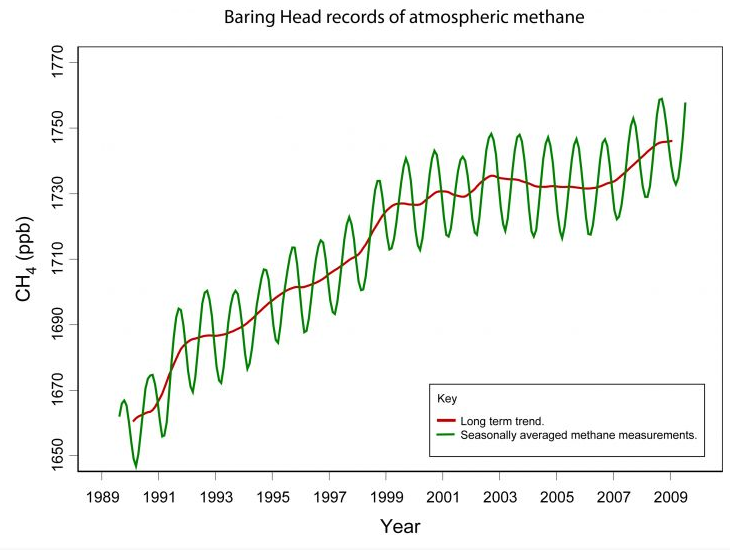
Image by NIWA: "The atmospheric methane measured at Baring Head near Wellington since August 1989. The graph shows the methane mixing ratio in parts per billion (molecules of methane for every billion molecules of dried air). Methane concentrations grew strongly in the 1990s then tailed off. There was even a hint of declining concentrations (negative growth) for 2003-06. Growth resumed in 2007 and appears to be persisting."
Methane (CH4) is a greenhouse gas whose affect on climate is 21 times stronger than Carbon Dioxide (CO2) and is the second most important contributor to global warming behind carbon dioxide. It is produced naturally mainly by biological breakdown of organic substances in oxygen-deficient conditions, such as the digestive system of ruminant animals and the decay of plant material in swamps or landfills. It is also prevalent in fossil fuels such as coal, oil, and natural gas (which is mainly methane).
Measurements released in December 2009 from its globally significant Baring Head station showed that southern hemisphere atmospheric methane increased by 0.7% over the two-year period 2007-08. The increase amounted to about 35 times more than all the methane produced by New Zealand livestock each year.
"The evidence we have shows that methane in the atmosphere is now more than double what it ever was during the 800,000 years before 1700AD" said NIWA Principal Scientist, Dr Keith Lassey. This analysis is based on examination of ancient air trapped in polar ice that has been extracted and dated.
The rise in methane follows a three-year period of no growth, and accounts for more than half of the growth observed over the ten years 1999-2008 (1.2%). The data is consistent with global trends with the US National Oceanic and Atmospheric Administration (NOAA) reporting that global methane concentrations rose in both 2007 and 2008 after a ten-year lull.
The increase has been attributed to unusually high temperatures in the Arctic and heavy rains in the tropical forests especially in the Amazon and Indonesia, after a decade of near-zero growth. Burning of forests contributed about 20 percent of the total methane released into the atmosphere in 2007.
The increased tropical rainfall was at least partly a result of a La Nina weather pattern of 2007 and 2008. Other factors are at work include global growth in commercial livestock farming, mining of fossil fuels, leaks from urban gas networks, and continued burn-offs of tropical rainforest.
As yet global warming has not triggered release of massive trapped carbon in permafrost or methane hydrates on the seafloor to methane according to the NOAA study that said their observations "are not consistent with sustained changes there yet."
"The most likely drivers of the CH4 anomalies observed during 2007 and 2008 are anomalously high temperatures in the Arctic and greater than average precipitation in the tropics. Near-zero CH4 growth in the Arctic during 2008 suggests we have not yet activated strong climate feedbacks from permafrost and CH4 hydrates." says the study published in the Geophysical Research Letters.
But research continuing in the north of Russia led by Professor Igor Semiletov from the University of Alaska at Fairbanks indicates methane seepage is increasing "Methane release from the East Siberian Shelf is underway and it looks stronger than it was supposed [to be]," said Igor Semiletov in a BBC news report "It is important now to understand how fast it is being released and how much is being released," he said.
Release of these methane reserves is a major climate tipping point, that could have a runaway affect on global temperatures and climate. Global warming may cause Siberia's subsea permafrost to thaw. Estimates of carbon trapped in shelf permafrost range up to 1,600 billion tonnes which is roughly twice as much carbon as in the atmosphere now.
Sources:
- National Institute of Water and Atmospheric Research (Niwa) Media Release, Dec 222, 2009 - NIWA says greenhouse gas methane is on the rise again
- NOAA, Sep 25, 2009 - Unusual Arctic Warmth, Tropical Wetness Likely Cause for Methane Increase
- Geophysical Research Letters, Sep 17, 2009 - Dlugokencky, E. J., et al. (2009), Observational constraints on recent increases in the atmospheric CH4 burden, Geophys. Res. Lett., 36, L18803, doi:10.1029/2009GL039780.
- BBC, Jan 6, 2010 - Methane release 'looks stronger'. See also a December 2008 media release by the International Arctic Research Center: Scientists find increased methane levels in Arctic Ocean and WWF report, Nov 2009 - Arctic Climate Feedbacks: Global Implications
Takver is a citizen journalist from Melbourne who has been writing on Climate Change issues and protests including Rising Sea Level, Ocean acidification, Environmental and social Impacts since 2004.
Thirty percent of the Earth's surface is land. Twenty percent of the land is permafrost. There is over a trillion tons of carbon frozen and buried in the land permafrost. More than half the land covered by the topmost layer of permafrost will probably thaw by 2050.
Permafrost ice contains a lot of methane (CH4) from past decomposition. CH4 is 70 times stronger than CO2 over 20 years. Decomposition will speed up when the permafrost thaws. A very large release of CH4 when the ice melts, followed by large chronic emission of CO2 and CH4.
A frozen peat bog in western Siberia the size of France and Germany put together contains about 500 billion tons of carbon. Western Siberia has warmed faster than almost anywhere else on the Earth, with an increase in average temperature of about 3C in the last 40 years.
Even more Siberian permafrost is under the ocean, an area six times the size of Germany containing about 540 billion tons of carbon. That submarine permafrost is perilously close to thawing. Three to 12 kilometers from the coast the sea sediment is just below freezing. The permafrost has grown porous, there is a loss of rigor in the frozen sea floor, and the surrounding seawater is highly oversaturated with solute methane.
"...Researchers were investigating "alarming" reports in the last few days of the release of methane from long frozen Arctic waters, possibly from the warming of the sea…" --"Arctic sea ice drops to 2nd lowest level on record," AP, 27 Aug '08
Since the future amount of CH4 (or CO2) entering the air from melting permafrost isn't known, it is not included at all in current climate models. The UN warned this year natural CH4 emissions are a major climate wild card.
"If the Siberian (submarine) permafrost-seal thaws completely and all the stored gas escapes, the methane content of the planet's atmosphere would increase twelve fold. The result would be catastrophic global warming." --"A Storehouse of Greenhouse Gases Is Opening in Siberia," Spiegel, 17 April '08
Donate

$65.00 donated
in the past month
Get Involved
If you'd like to help with maintaining or developing the website, contact us.
Publish
Publish your stories and upcoming events on Indybay.