







 Publish to Newswire
 Add an Event
From the Open-Publishing Calendar
From the Open-Publishing Newswire
Indybay Feature
“Voices of Honor” Tour Targets “Don’t Ask, Don’t Tell”
O.K., so maybe you're a hard-core peacenik who wouldn't dream of joining the military or of supporting anyone who would. You should still care about the continued exclusion of open Queer people from the U.S. military under the so-called “don’t ask, don’t tell” policy. Not only is the policy unjust and discriminatory on its face, it's also disproportionately enforced against women and people of color — so in practice it's racist and sexist as well as homophobic. “Voices of Honor” was a national tour which wrapped up in San Diego September 30 that featured five military veterans talking about the personal strains of living under “don’t ask, don’t tell.”
“Voices of Honor” Tour Closes in San Diego
Five Queer Veterans Plead for Repeal of “Don’t Ask, Don’t Tell”
by MARK GABRISH CONLAN
Copyright © 2009 by Mark Gabrish Conlan for Zenger’s Newsmagazine • All rights reserved
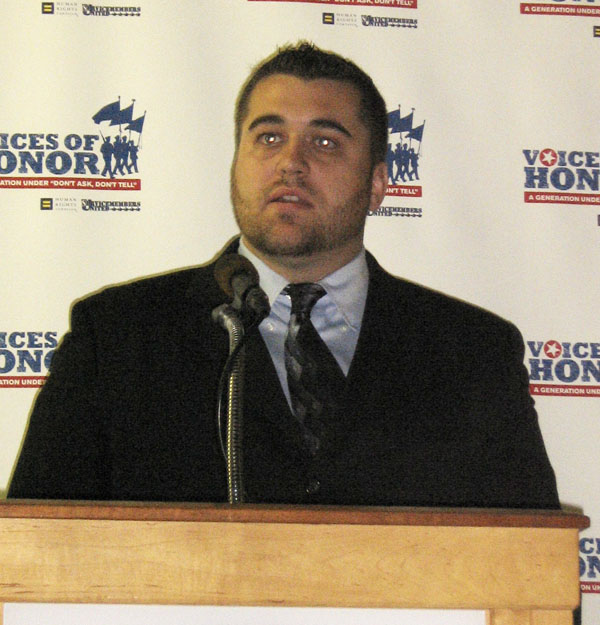
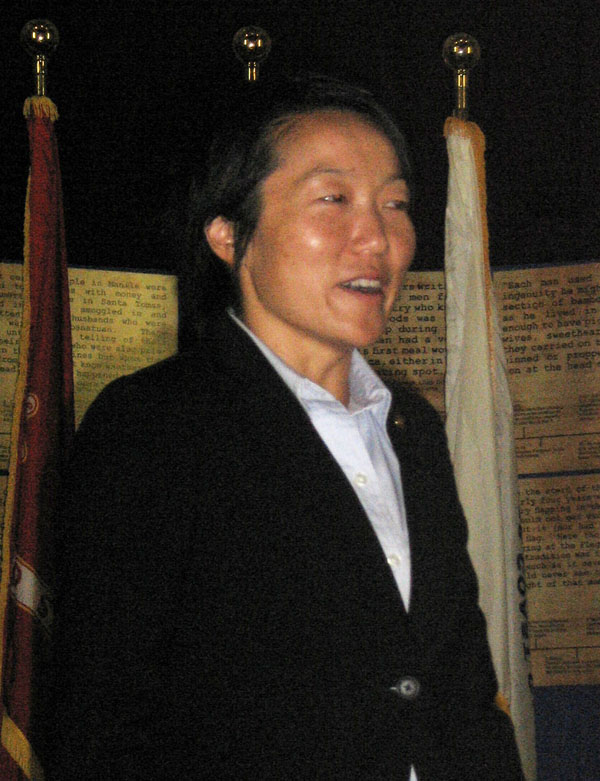
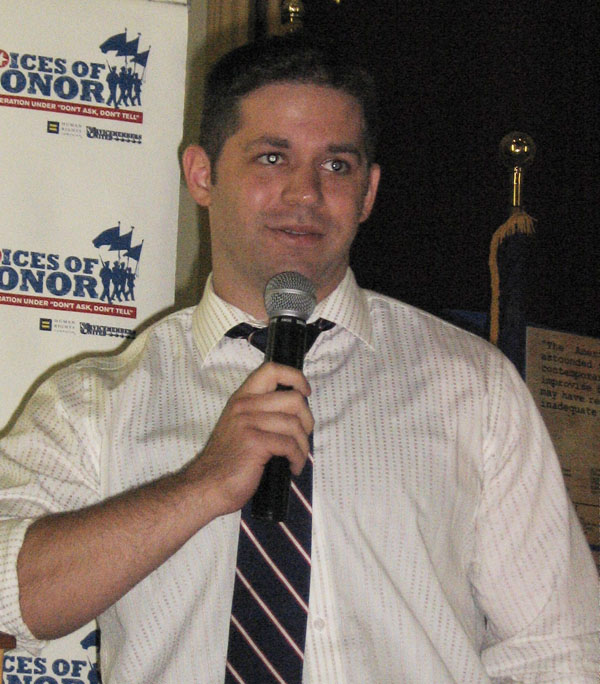
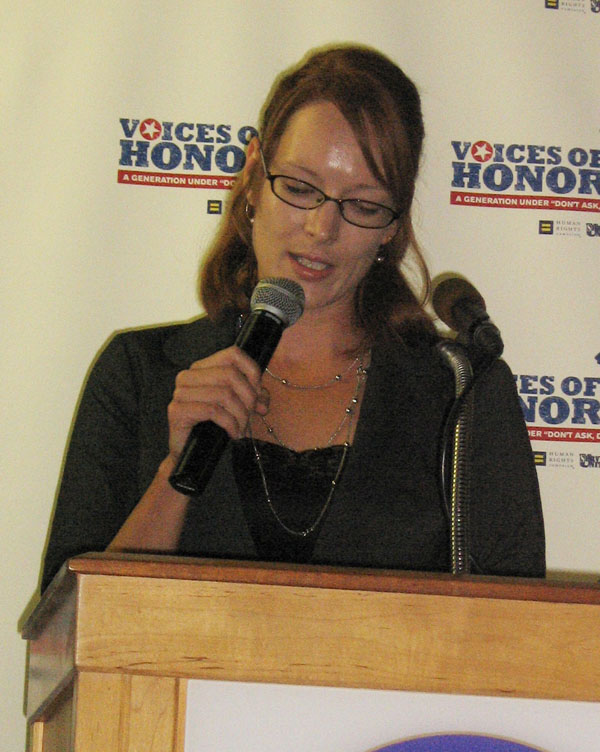
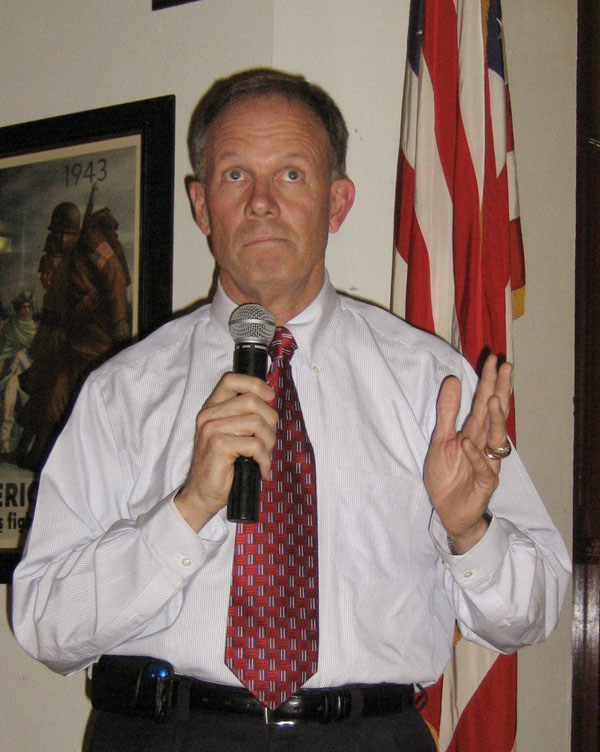
PHOTOS, top to bottom: Alex Nicholson, Julianne Sohn, Jarrod Chlapowski, Tess Benko, Stewart Bornhoft
“Different audiences have different understandings of ‘don’t ask, don’t tell,’” said Alex Nicholson, founder and director of Servicemembers United, at the final stop of the “Voices of Honor” tour his group and the Human Rights Campaign (HRC) staged this year to highlight the abuses under the U.S. military’s exclusion of open Queers and plead for repeal of the “don’t ask, don’t tell” policy. The setting was an unusual one for a Queer event — the former chapel of the old Navy hospital in Balboa Park, now a war museum mostly honoring veterans from World War II — and the San Diego stop, on September 30, featured Nicholson and two other voices from the national tour, Jarrod Chlapowski and Julianne Sohn. Two local Queer veterans with histories of activism against “don’t ask, don’t tell,” retired Col. Stewart Bornhoft and Tess Benko, also spoke.
“Voices of Honor” was the second nationwide tour of “out” Queer veterans speaking — often to military colleges and other unlikely audiences — against “don’t ask, don’t tell.” The first, “Call to Duty,” was organized by Nicholson and featured in the PBS-TV documentary Ask Not. He and Chlapowski were prominently portrayed in Ask Not, and Bornhoft spoke at a San Diego Public Library preview screening of the film. “Voices of Honor” made many of the same points against “don’t ask, don’t tell” that “Call to Duty” did — that it’s not only discriminatory, it’s unequally enforced and it forces people, on pain of losing not only their jobs but their opportunities to serve their country, to lie about a basic part of who they are.
Nicholson began the presentation by reviewing the shifting rationales the U.S. military has evoked in its drive to ban Queers from serving. Before the “don’t ask, don’t tell” policy was enacted in 1993, there was an outright ban on military service by Gays, Lesbians and Bisexuals, instituted shortly after the end of World War II and based on the idea “that Gays and Lesbians were security risks” because their lifestyles made them easy prey for blackmailers. “When that proved false,” Nicholson said, “the rationale became that Gays and Lesbians were mentally ill. When the leading psychological associations voted in the 1970’s that homosexuality was not a mental illness, the military abandoned that idea and in the late 1970’s and early 1980’s they started the idea that Gays and Lesbians in the military are a threat to unit cohesion, morale and combat readiness.”
That was the rationale for exclusion that got frozen into U.S. law when Congress enacted the “don’t ask, don’t tell” policy in 1993. Before that, the ban had been a policy of the Defense Department which the president could have overturned by executive order, much the way President Harry Truman ordered the military to end racial segregation in 1948. The film Ask Not dramatically contrasts Truman’s boldness and courage in ordering an end to institutionalized racism in the U.S. military with Bill Clinton’s weakness and cowardice in refusing to do the same by ending the ban on Queers in 1993, when he still had the power to do so, and instead accepting Congressional enactment of “don’t ask, don’t tell” as a so-called “compromise.”
According to Nicholson, the toll “don’t ask, don’t tell” has taken on the U.S. military is far greater than the estimated 13,000 servicemembers actually discharged under the policy “either because they admitted being Gay or Lesbian, were ‘outed’ or were caught having ‘homosexual acts.’ We also estimate that about 3,000 people leave the service every year” because they no longer wish to hold down a job that forces them to lie about who they are as a condition of continued employment. Nicholson also said that probably even more language and intelligence specialists are being forced out than official figures would indicate, because “’linguist’ is a specialized field and a liot of people who know languages aren’t qualified as ‘linguists’ — including me.”
Nicholson said he was a “human intelligence coordinator” in the Army until 2002, when he was discharged after being “outed” by someone in his unit. “I tried to contain the information,” he said, “but once it got to command, they decided to rout me out quickly.” Not everybody is pushed out as fast as he was, he added; enforcement of “don’t ask, don’t tell” is left largely up to commanders in the field, and as a result implementation varies widely. “There are many people serving openly today,” he said — thanks to superior officers being willing to leave them alone — “and you don’t find the underlying rationale, the alleged threat to unit cohesion, morale and combat readiness, has come to pass.”
“I served active duty in the U.S. Marine Corps from 1999 to 2003,” said Julianne Sohn. She said she was inspired to join the Marines by her older brother, who graduated from the Marines’ officer candidates’ school the day Julianne signed up. “The difference was that I knew going in that I was not like the other girls,” Sohn said. “My mother said, ‘Watch out for those women.” Sohn said she “educated myself on ‘don’t ask, don’t tell’ back in 1999” and thought she could live with it and serve out her hitch while staying closeted. But she noticed when she filled out her application that, despite the “don’t ask” promise of the policy, the form still had the “do you have homosexual tendencies?” question left over from the old days of the outright ban on Queers in the military.
“I joined the U.S. Marine Corps, went to Quantico for basic training and for the first year I didn’t have any trouble,” said Sohn — “except I broke up with my girlfriend because I couldn’t admit she existed. “In the second year it was scary because Marines talk to each other about everything, I came out to a few friends one at a time, and to lieutenants, and they were like, ‘It’s O.K.’ In my third year I was assigned to Parris Island, South Carolina, for deployment to Okinawa. Parris Island is where the big witchhunts were in the 1980’s, when Naval Intelligence Service (NIS) agents would hang out in Gay bars and follow people home.”
Sohn recalled that she was sent to Parris Island in 2001, just a few months before 9/11, and “I was called into the office of Mel, the legal assistant. He said, ‘I want to ask you something I don’t have a right to ask you.’ I said, ‘Stop right there.’ He actually protected me, but because of the strain of living under ‘don’t ask, don’t tell’ I decided to leave the Marines and go to graduate school.” Under normal circumstances, that might have been the end of her military career — but in 2004, while living in New York City, she was called up under the Individual Ready Reserve and ordered to deploy to Iraq. “My liberal friends said, ‘Why don’t you pull the Gay card? You don’t agree with the war anyway.’ I said that wouldn’t be consistent with the oath I took.”
When she went to Iraq, Sohn encountered the dangers of combat first-hand. “The worst commute in Iraq is from Camp Ramadi to the military command center,” she recalled, “because you have to drive really fast to avoid IED’s.” “IED’s” is military-speak for “improvised explosive devices,” crude, easy-to-manufacture bombs, generally planted along roadsides and detonated by remote control, one of the most effective weapons of the Iraqi resistance against the U.S. occupation force. Sohn said she encountered “a piece of trash in the road” one day that turned out to be an IED. “The thing exploded behind us, and at that moment, when you’re in a combat zone, you don’t think about whether someone is Gay or straight,” she said.
Both Nicholson and Sohn cited statistics from Servicemembers United that said that “don’t ask, don’t tell” is disproportionately enforced against women and people of color. According to these figures, 50 percent of the servicemembers discharged under “don’t ask, don’t tell” in 2008 were people of color, even though they make up only 29 percent of the total force. Women made up 46 percent of discharges under “don’t ask, don’t tell” in 2007 and 33 percent in 2008 — even though only 15 percent of all U.S. servicemembers are female. Sohn said at least part of the reason women are so strongly targeted is because sexist ideas about women are deeply ingrained in the military. “The joke from my brother was that all women Marines are either bitches, dykes or ’ho’s,” she said.
California State Assemblymember Lori Saldaña, who attended the September 30 event, raised another reason why the “don’t ask, don’t tell” axe falls disproportionately on women: sexual harassment. Many servicewomen are routinely “hit on” by men in the ranks, often by men with higher ranks or command responsibility over them — and one way for these men to threaten women and get them to have sex is to blackmail them with threats of reporting them as Lesbians and getting them discharged under “don’t ask, don’t tell.”
“Lesbian-baiting definitely occurs,” Sohn said in response to Saldaña’s comment. “Women and minorities are disproportionately impacted, especially in the Army and the Air Force. A lot of the 1980’s witchhunts were aimed not only at people who were Gay but people perceived to be Gay. You have commanders who treat everyone equally, and others who single people out.”
“I’ve not always been supportive of repeal” of “don’t ask, don’t tell,” Chlapowski admitted at the start of his presentation. “I served from 2000 to 2005 in the U.S. Army. My grandfather was one of the first Army linguists. He died before I was born, but I heard the stories and that made me want to enlist. At the same time, I was struggling with my sexuality, and I thought that being in the military would make me ‘masculine,’ and therefore not Gay. I finished basic training and I was still Gay, and I had to deal with it under the restrictions of ‘don’t ask, don’t tell.’”
Chlapowski recalled approaching his best friend in the service, Rob Hicks, and when Rob realized where the conversation was going, “he had me go to a secluded area on the post and said, ‘That’s O.K. I’m Gay, too.’ From that point, he and I were confidants, and eventually I met other Gay people in my unit and we developed a pocket, a support system. But it wasn’t enough. I saw this level of camaraderie and brotherhood in the unit — and I had to lie and say I was dating girls. It was frustrating, so I started telling people as it came up.”
At this point, Chlapowski admitted, he still didn’t think “don’t ask, don’t tell” was such a big deal. He felt that if he could stay on a professional level and keep in the closet, he’d be protected. “Then I started seeing cracks in the façade,” he said. “I met a woman named Jan who warned me not to talk to a certain Army psychologist because he reported.” Contrary to what many servicemembers believe, psychotherapists and chaplains in the military are not bound by confidentiality the way their civilian equivalents are. The military’s attitude is we’re paying them, therefore we have a right to know if anyone they’re seeing professionally has confessed to breaking the rules — including “don’t ask, don’t tell.”
In addition to his warnings about the therapist, Chlapowski recalled one friend who was “outed” by his mother, who thought he’d be better off out of the military and revealed his homosexuality to his command to get him out whether he wanted it or not. Another friend of Chlapowski’s, Derek Thomas, “embraced the stereotypes” of Gay behavior but stayed in for a while “until one thing led to another, and he had to go through a nine-month discharge process which was more detrimental to unit cohesion than letting him stay in would have been. My friend Rob Hicks was discharged six months later. I realized that one person could be vindictive and get me kicked out.”
In addition to this irony — that “don’t ask, don’t tell,” which is supposedly in place to promote “unit cohesion,” can actually destroy it by undermining the mutual trust servicemembers, or anyone else, need to be able to work together — Chlapowski pointed out other flaws in the policy. “It’s vaguely written,” he said. “It’s not clear what qualifies as ‘physical evidence’ of ‘homosexual acts.’ Also, the people responsible for enforcing the policy are captains — ‘03’s,” in the Army — who are barely in the military. They are not given proper training and are forced to go by their own gut.” Chlapowski said his commander kept him on despite the rumors, but another member of his unit was forced out because of a letter someone had written him in Portuguese. “We hear these things,” he said, “but we need to conceptualize it as entire units being affected.”
Tess Benko, a straight woman and Marine veteran whose husband is still in the Marines, said she “saw first-hand the effects of the policy” when she was stationed in Okinawa. “One man told me he was Gay,” she said, “and later the inspectors saw his screen saver was a picture of a man, and in his quarters there were style magazines and other ‘questionable’ items. He felt like he was being hunted, and I believed he was. I believed he was being treated as a second-class citizen.”
According to Benko, “the idea that homosexuality affects unit cohesion is wrong.” She said her experience is that both straight and Queer servicemembers are equally able to put aside their sexuality and do their jobs properly — and when they aren’t, the policies now in place to protect servicemembers against heterosexual harassment and exploitation could be applied to Queers as well. “The United States Supreme Court, Congress and the executive branch have refused to do anything about ‘don’t ask, don’t tell,’ so it’s up to us to do something from the bottom up,” she said.
“It’s not just about Gays themselves, it’s about the people around them,” said Bornhoft. “The ideals of West Point are embedded in me. ‘Don’t ask, don’t tell’ isn’t about sex; it’s about honesty. It’s a policy that forces us to lie. The West Point Cadets’ Honor Code demands that we tell the truth, the whole truth and nothing but the truth. The Cadet Prayer says, ‘Never be content with a half-truth when the whole can be won.’ ‘Don’t ask, don’t tell’ mandates that we lie. This policy mandates that we discriminate.”
Bornhoft talked about his long struggle with his own sexuality. Like many Queers of earlier generations, he said, “I didn’t understand the feelings I had, and I thought I was the only person who had them. I joined the military, got married and had two children, and all that time those feelings were still there.” He cited the case of lieutenant Dan Choi, who came back from Iraq “and talked about how uncomfortable he felt telling half-truths.” Choi went on Rachel Maddow’s TV talk show and came out to the world on cable news — and got processed out, despite the pleas of activist groups to President Obama to invoke “stop-loss” (a policy that allows the military to suspend discharges in the middle of a war) and keep him in.
The degree of helplessness felt by mere politicians going up against the military establishment was highlighted by Bornhoft when he mentioned that U.S. Senate majority leader Harry Reid (D-NV) had written letters to Obama and Defense Secretary Robert Gates urging that the “don’t ask, don’t tell” law be changed. What Reid hadn’t done was introduce a Senate version of the Military Readiness Enhancement Act, H.R. 1283, which has 126 co-sponsors in the House of Representatives but, even if it gets through the House, can’t be approved unless a Senate version is also passed.
Bornhoft portrayed the case against “don’t ask, don’t tell” as a no-brainer. He said that 24 nations allow Queers to serve openly in their militaries — including the two biggest U.S. allies in the “war on terror,” Britain and Israel — and they haven’t had problems with unit cohesion, combat readiness and morale. “The British were forced by their courts to open, and now they recruit at Pride events,” he said. “Every demographic in U.S. polls is against ‘don’t ask, don’t tell.’ How come it hasn’t been repealed yet? It takes Congress to change the law. Write your Senators and Congressmembers, and get in touch with your friends in other states to get them to write.”
Web resources for repealing “Don’t ask, don’t tell”
Servicemembers United: http://www.servicemembersunited.org
Servicemembers’ Legal Defense Network (legal aid for servicemembers facing issues with “don’t ask, don’t tell”): http://www.sldn.org
Human Rights Campaign: http://www.hrc.org/issues/military.asp
AVER (American Veterans for Equal Rights): http://aver.us
Knights Out (West Point veterans urging repeal): http://www.knightsout.org, http://www.knightsout.com (they reserved both domains)
Five Queer Veterans Plead for Repeal of “Don’t Ask, Don’t Tell”
by MARK GABRISH CONLAN
Copyright © 2009 by Mark Gabrish Conlan for Zenger’s Newsmagazine • All rights reserved
PHOTOS, top to bottom: Alex Nicholson, Julianne Sohn, Jarrod Chlapowski, Tess Benko, Stewart Bornhoft
“Different audiences have different understandings of ‘don’t ask, don’t tell,’” said Alex Nicholson, founder and director of Servicemembers United, at the final stop of the “Voices of Honor” tour his group and the Human Rights Campaign (HRC) staged this year to highlight the abuses under the U.S. military’s exclusion of open Queers and plead for repeal of the “don’t ask, don’t tell” policy. The setting was an unusual one for a Queer event — the former chapel of the old Navy hospital in Balboa Park, now a war museum mostly honoring veterans from World War II — and the San Diego stop, on September 30, featured Nicholson and two other voices from the national tour, Jarrod Chlapowski and Julianne Sohn. Two local Queer veterans with histories of activism against “don’t ask, don’t tell,” retired Col. Stewart Bornhoft and Tess Benko, also spoke.
“Voices of Honor” was the second nationwide tour of “out” Queer veterans speaking — often to military colleges and other unlikely audiences — against “don’t ask, don’t tell.” The first, “Call to Duty,” was organized by Nicholson and featured in the PBS-TV documentary Ask Not. He and Chlapowski were prominently portrayed in Ask Not, and Bornhoft spoke at a San Diego Public Library preview screening of the film. “Voices of Honor” made many of the same points against “don’t ask, don’t tell” that “Call to Duty” did — that it’s not only discriminatory, it’s unequally enforced and it forces people, on pain of losing not only their jobs but their opportunities to serve their country, to lie about a basic part of who they are.
Nicholson began the presentation by reviewing the shifting rationales the U.S. military has evoked in its drive to ban Queers from serving. Before the “don’t ask, don’t tell” policy was enacted in 1993, there was an outright ban on military service by Gays, Lesbians and Bisexuals, instituted shortly after the end of World War II and based on the idea “that Gays and Lesbians were security risks” because their lifestyles made them easy prey for blackmailers. “When that proved false,” Nicholson said, “the rationale became that Gays and Lesbians were mentally ill. When the leading psychological associations voted in the 1970’s that homosexuality was not a mental illness, the military abandoned that idea and in the late 1970’s and early 1980’s they started the idea that Gays and Lesbians in the military are a threat to unit cohesion, morale and combat readiness.”
That was the rationale for exclusion that got frozen into U.S. law when Congress enacted the “don’t ask, don’t tell” policy in 1993. Before that, the ban had been a policy of the Defense Department which the president could have overturned by executive order, much the way President Harry Truman ordered the military to end racial segregation in 1948. The film Ask Not dramatically contrasts Truman’s boldness and courage in ordering an end to institutionalized racism in the U.S. military with Bill Clinton’s weakness and cowardice in refusing to do the same by ending the ban on Queers in 1993, when he still had the power to do so, and instead accepting Congressional enactment of “don’t ask, don’t tell” as a so-called “compromise.”
According to Nicholson, the toll “don’t ask, don’t tell” has taken on the U.S. military is far greater than the estimated 13,000 servicemembers actually discharged under the policy “either because they admitted being Gay or Lesbian, were ‘outed’ or were caught having ‘homosexual acts.’ We also estimate that about 3,000 people leave the service every year” because they no longer wish to hold down a job that forces them to lie about who they are as a condition of continued employment. Nicholson also said that probably even more language and intelligence specialists are being forced out than official figures would indicate, because “’linguist’ is a specialized field and a liot of people who know languages aren’t qualified as ‘linguists’ — including me.”
Nicholson said he was a “human intelligence coordinator” in the Army until 2002, when he was discharged after being “outed” by someone in his unit. “I tried to contain the information,” he said, “but once it got to command, they decided to rout me out quickly.” Not everybody is pushed out as fast as he was, he added; enforcement of “don’t ask, don’t tell” is left largely up to commanders in the field, and as a result implementation varies widely. “There are many people serving openly today,” he said — thanks to superior officers being willing to leave them alone — “and you don’t find the underlying rationale, the alleged threat to unit cohesion, morale and combat readiness, has come to pass.”
“I served active duty in the U.S. Marine Corps from 1999 to 2003,” said Julianne Sohn. She said she was inspired to join the Marines by her older brother, who graduated from the Marines’ officer candidates’ school the day Julianne signed up. “The difference was that I knew going in that I was not like the other girls,” Sohn said. “My mother said, ‘Watch out for those women.” Sohn said she “educated myself on ‘don’t ask, don’t tell’ back in 1999” and thought she could live with it and serve out her hitch while staying closeted. But she noticed when she filled out her application that, despite the “don’t ask” promise of the policy, the form still had the “do you have homosexual tendencies?” question left over from the old days of the outright ban on Queers in the military.
“I joined the U.S. Marine Corps, went to Quantico for basic training and for the first year I didn’t have any trouble,” said Sohn — “except I broke up with my girlfriend because I couldn’t admit she existed. “In the second year it was scary because Marines talk to each other about everything, I came out to a few friends one at a time, and to lieutenants, and they were like, ‘It’s O.K.’ In my third year I was assigned to Parris Island, South Carolina, for deployment to Okinawa. Parris Island is where the big witchhunts were in the 1980’s, when Naval Intelligence Service (NIS) agents would hang out in Gay bars and follow people home.”
Sohn recalled that she was sent to Parris Island in 2001, just a few months before 9/11, and “I was called into the office of Mel, the legal assistant. He said, ‘I want to ask you something I don’t have a right to ask you.’ I said, ‘Stop right there.’ He actually protected me, but because of the strain of living under ‘don’t ask, don’t tell’ I decided to leave the Marines and go to graduate school.” Under normal circumstances, that might have been the end of her military career — but in 2004, while living in New York City, she was called up under the Individual Ready Reserve and ordered to deploy to Iraq. “My liberal friends said, ‘Why don’t you pull the Gay card? You don’t agree with the war anyway.’ I said that wouldn’t be consistent with the oath I took.”
When she went to Iraq, Sohn encountered the dangers of combat first-hand. “The worst commute in Iraq is from Camp Ramadi to the military command center,” she recalled, “because you have to drive really fast to avoid IED’s.” “IED’s” is military-speak for “improvised explosive devices,” crude, easy-to-manufacture bombs, generally planted along roadsides and detonated by remote control, one of the most effective weapons of the Iraqi resistance against the U.S. occupation force. Sohn said she encountered “a piece of trash in the road” one day that turned out to be an IED. “The thing exploded behind us, and at that moment, when you’re in a combat zone, you don’t think about whether someone is Gay or straight,” she said.
Both Nicholson and Sohn cited statistics from Servicemembers United that said that “don’t ask, don’t tell” is disproportionately enforced against women and people of color. According to these figures, 50 percent of the servicemembers discharged under “don’t ask, don’t tell” in 2008 were people of color, even though they make up only 29 percent of the total force. Women made up 46 percent of discharges under “don’t ask, don’t tell” in 2007 and 33 percent in 2008 — even though only 15 percent of all U.S. servicemembers are female. Sohn said at least part of the reason women are so strongly targeted is because sexist ideas about women are deeply ingrained in the military. “The joke from my brother was that all women Marines are either bitches, dykes or ’ho’s,” she said.
California State Assemblymember Lori Saldaña, who attended the September 30 event, raised another reason why the “don’t ask, don’t tell” axe falls disproportionately on women: sexual harassment. Many servicewomen are routinely “hit on” by men in the ranks, often by men with higher ranks or command responsibility over them — and one way for these men to threaten women and get them to have sex is to blackmail them with threats of reporting them as Lesbians and getting them discharged under “don’t ask, don’t tell.”
“Lesbian-baiting definitely occurs,” Sohn said in response to Saldaña’s comment. “Women and minorities are disproportionately impacted, especially in the Army and the Air Force. A lot of the 1980’s witchhunts were aimed not only at people who were Gay but people perceived to be Gay. You have commanders who treat everyone equally, and others who single people out.”
“I’ve not always been supportive of repeal” of “don’t ask, don’t tell,” Chlapowski admitted at the start of his presentation. “I served from 2000 to 2005 in the U.S. Army. My grandfather was one of the first Army linguists. He died before I was born, but I heard the stories and that made me want to enlist. At the same time, I was struggling with my sexuality, and I thought that being in the military would make me ‘masculine,’ and therefore not Gay. I finished basic training and I was still Gay, and I had to deal with it under the restrictions of ‘don’t ask, don’t tell.’”
Chlapowski recalled approaching his best friend in the service, Rob Hicks, and when Rob realized where the conversation was going, “he had me go to a secluded area on the post and said, ‘That’s O.K. I’m Gay, too.’ From that point, he and I were confidants, and eventually I met other Gay people in my unit and we developed a pocket, a support system. But it wasn’t enough. I saw this level of camaraderie and brotherhood in the unit — and I had to lie and say I was dating girls. It was frustrating, so I started telling people as it came up.”
At this point, Chlapowski admitted, he still didn’t think “don’t ask, don’t tell” was such a big deal. He felt that if he could stay on a professional level and keep in the closet, he’d be protected. “Then I started seeing cracks in the façade,” he said. “I met a woman named Jan who warned me not to talk to a certain Army psychologist because he reported.” Contrary to what many servicemembers believe, psychotherapists and chaplains in the military are not bound by confidentiality the way their civilian equivalents are. The military’s attitude is we’re paying them, therefore we have a right to know if anyone they’re seeing professionally has confessed to breaking the rules — including “don’t ask, don’t tell.”
In addition to his warnings about the therapist, Chlapowski recalled one friend who was “outed” by his mother, who thought he’d be better off out of the military and revealed his homosexuality to his command to get him out whether he wanted it or not. Another friend of Chlapowski’s, Derek Thomas, “embraced the stereotypes” of Gay behavior but stayed in for a while “until one thing led to another, and he had to go through a nine-month discharge process which was more detrimental to unit cohesion than letting him stay in would have been. My friend Rob Hicks was discharged six months later. I realized that one person could be vindictive and get me kicked out.”
In addition to this irony — that “don’t ask, don’t tell,” which is supposedly in place to promote “unit cohesion,” can actually destroy it by undermining the mutual trust servicemembers, or anyone else, need to be able to work together — Chlapowski pointed out other flaws in the policy. “It’s vaguely written,” he said. “It’s not clear what qualifies as ‘physical evidence’ of ‘homosexual acts.’ Also, the people responsible for enforcing the policy are captains — ‘03’s,” in the Army — who are barely in the military. They are not given proper training and are forced to go by their own gut.” Chlapowski said his commander kept him on despite the rumors, but another member of his unit was forced out because of a letter someone had written him in Portuguese. “We hear these things,” he said, “but we need to conceptualize it as entire units being affected.”
Tess Benko, a straight woman and Marine veteran whose husband is still in the Marines, said she “saw first-hand the effects of the policy” when she was stationed in Okinawa. “One man told me he was Gay,” she said, “and later the inspectors saw his screen saver was a picture of a man, and in his quarters there were style magazines and other ‘questionable’ items. He felt like he was being hunted, and I believed he was. I believed he was being treated as a second-class citizen.”
According to Benko, “the idea that homosexuality affects unit cohesion is wrong.” She said her experience is that both straight and Queer servicemembers are equally able to put aside their sexuality and do their jobs properly — and when they aren’t, the policies now in place to protect servicemembers against heterosexual harassment and exploitation could be applied to Queers as well. “The United States Supreme Court, Congress and the executive branch have refused to do anything about ‘don’t ask, don’t tell,’ so it’s up to us to do something from the bottom up,” she said.
“It’s not just about Gays themselves, it’s about the people around them,” said Bornhoft. “The ideals of West Point are embedded in me. ‘Don’t ask, don’t tell’ isn’t about sex; it’s about honesty. It’s a policy that forces us to lie. The West Point Cadets’ Honor Code demands that we tell the truth, the whole truth and nothing but the truth. The Cadet Prayer says, ‘Never be content with a half-truth when the whole can be won.’ ‘Don’t ask, don’t tell’ mandates that we lie. This policy mandates that we discriminate.”
Bornhoft talked about his long struggle with his own sexuality. Like many Queers of earlier generations, he said, “I didn’t understand the feelings I had, and I thought I was the only person who had them. I joined the military, got married and had two children, and all that time those feelings were still there.” He cited the case of lieutenant Dan Choi, who came back from Iraq “and talked about how uncomfortable he felt telling half-truths.” Choi went on Rachel Maddow’s TV talk show and came out to the world on cable news — and got processed out, despite the pleas of activist groups to President Obama to invoke “stop-loss” (a policy that allows the military to suspend discharges in the middle of a war) and keep him in.
The degree of helplessness felt by mere politicians going up against the military establishment was highlighted by Bornhoft when he mentioned that U.S. Senate majority leader Harry Reid (D-NV) had written letters to Obama and Defense Secretary Robert Gates urging that the “don’t ask, don’t tell” law be changed. What Reid hadn’t done was introduce a Senate version of the Military Readiness Enhancement Act, H.R. 1283, which has 126 co-sponsors in the House of Representatives but, even if it gets through the House, can’t be approved unless a Senate version is also passed.
Bornhoft portrayed the case against “don’t ask, don’t tell” as a no-brainer. He said that 24 nations allow Queers to serve openly in their militaries — including the two biggest U.S. allies in the “war on terror,” Britain and Israel — and they haven’t had problems with unit cohesion, combat readiness and morale. “The British were forced by their courts to open, and now they recruit at Pride events,” he said. “Every demographic in U.S. polls is against ‘don’t ask, don’t tell.’ How come it hasn’t been repealed yet? It takes Congress to change the law. Write your Senators and Congressmembers, and get in touch with your friends in other states to get them to write.”
Web resources for repealing “Don’t ask, don’t tell”
Servicemembers United: http://www.servicemembersunited.org
Servicemembers’ Legal Defense Network (legal aid for servicemembers facing issues with “don’t ask, don’t tell”): http://www.sldn.org
Human Rights Campaign: http://www.hrc.org/issues/military.asp
AVER (American Veterans for Equal Rights): http://aver.us
Knights Out (West Point veterans urging repeal): http://www.knightsout.org, http://www.knightsout.com (they reserved both domains)
For more information:
http://zengersmag.blogspot.com
Add Your Comments
Comments
(Hide Comments)
Yes, i am one of those hardcore peaceniks who won't buy into the hype of this pro-military campaign disguised as "anti-discrimination". The ruling elites will do whatever is needed to expand the numbers of the military, people sent off to lose their souls, minds, limbs and lives for the profit of a few petroleum executives. My advice to the gay community is to be happy that if you are gay, bi or lesbian you now have a reasonable excuse not to join the service and sacrifice your life and limbs for petroleum corporations. Just TELL the recruiter that you prefer the same sex even if they do not ASK!! Then you won't need to enlist!!
The fewer people in the U.S. military the better. ALL people in the U.S. military are being exploited by being sent off to needless wars for resource (petroleum) extraction, transport and/or control. If the internal climate in the military gets so hostile that all the women of color, gays, bisexuals and lesbians are encouraged drop out, great! The fewer enlisted soldiers, the better!!
If that doesn't help, maybe this will;
"From the newsletter of March Forward!
We join the military for many different reasons. Some of us want to have access to a college education. Some of us want job training and a steady paycheck. Some of us join to get U.S. citizenship. Some of us need to get out of debt or need to get off a destructive path. Some of us join out of pride, patriotism and a genuine desire to be a part of some greater, collective good. Many of us made the decision early-while still in high school, enticed by recruiters' promises of cash bonuses, adventure and opportunity-while some of us joined after years as a worker, drawn by the military's full health care and housing benefits.
Whatever the reason, we all found ourselves wearing the uniform of the U.S. military. What did we actually join? What is the role of the U.S. military in the world? What does it mean to be a soldier following the dictates of U.S. foreign policy? When we sign ourselves away to the military, what are we being used to do?
In recent years, many of us ended up in Iraq or Afghanistan. We are told that as a soldier in the U.S. military we are defending the interests of the United States. This does have an ounce of truth-but only an ounce. We are defending the interests of a particular class in the United States. It is only a wealthy minority whose interests are being defended in Iraq, Afghanistan and the more than 130 countries where U.S. troops are stationed.
In whose interests do we serve?
I was sent to Iraq believing we would be helping the Iraqi people. Once the illusions of pride and patriotism crumbled, I realized I was never sent to help anyone. I kicked down their doors and dragged them from their homes. I robbed them of their humanity in interrogation cells. I watched the life ripped out of them. I saw children torn to shreds. I witnessed my friends disabled by physical and/or psychological trauma. All this suffering and destruction for "Iraqi Freedom," which really means the freedom of a new U.S.-installed government to hand over control of its natural resources to U.S. corporations.
It wasn't much different for those soldiers sent to Korea, Vietnam, the Dominican Republic, El Salvador, Panama or other countries that have been targets of U.S. intervention over the past half-century and more.
We are taught the United States stands for freedom and democracy, and that military force is used to defend or further those ideals. This is echoed constantly throughout our lives, in school and in the media. It is woven into the fabric of our national identity, making it possible for people to accept the deaths of U.S. soldiers in foreign lands, as long as they are assured they died in the interests of democracy.
History of U.S. conflicts
However, reviewing the history of conflicts in which the U.S. military has been involved tells a completely different story. The U.S. government does not have a history of supporting democratic movements, but rather a history of overthrowing them. Among those countries whose popularly elected governments have been crushed by the U.S. military and replaced by authoritarian and non-elected dictators are the Congo, Grenada, the Philippines, Nicaragua, Chile, Indonesia, Iran, Haiti-and the list goes on. Quite simply, this government - whether it's a Democrat or a Republican in the White House-has no problem installing and backing oppressive dictatorships.
Understanding U.S. foreign policy becomes much easier if we stop looking at it in terms of "defending democracy," and start looking at it in terms of economic interests. It is not the form of a foreign government that determines whether it ends up in the crosshairs of the U.S. government, but whether or not that government will give U.S. businesses access to its markets, labor force and natural resources. This explains why the United States supports governments with some of the worst human rights records, like Colombia, or Saudi Arabia, which has never had an election in its history! U.S. corporations reap billions of dollars in profits from these countries.
U.S. foreign policy really boils down to ensuring the extraction of wealth from the developing world by U.S. corporations. In the words of two-time Medal of Honor winner Major General Smedley Butler: "I spent 33 years in the Marines. Most of my time being a high-class muscle man for Big Business, for Wall Street and the bankers. In short, I was a racketeer for capitalism."
Claims that the Pentagon only works to defend the United States and spread democracy fall apart when you look at the current use of the military. It is now obvious that Saddam Hussein posed no threat to the United States, nor did the U.S. government care about the well-being of the Iraqi people. A quarter of Iraq's population of 26 million people has been killed, wounded or displaced since the illegal U.S. invasion on March 19, 2003. Iraq sits atop a massive supply of petroleum, all of which was nationalized and closed to U.S. corporations' control under Saddam Hussein.
The role of banks and big business
The banks and Wall Street exert dominating influence over U.S. foreign policy. Our "democracy" is reserved for those who have millions of dollars to run for office, and who are funded by (and ultimately beholden to) corporate interests. Our "free press" is owned by only five mega-corporations who directly profit from the military-industrial complex and distort reality to shape public opinion accordingly.
The ruling class of Wall Street CEOs, bankers and their loyal politicians has the power to annihilate an entire country for profit-but they never fight in these wars themselves. So they have to find a way to convince the average worker that these wars are worth fighting. They must find a way to convince working-class people that we should kill and die to make the rich ruling class even richer.
Our enemy is not on the other side of the world; that enemy is in the corporate boardrooms and the Pentagon Brass. Defeating that enemy means refusing to take part in their imperialist plans and organizing together to demand real justice."
find article @;
http://www.bethink.org/diary/1177/march-forward-support-our-soldiers
Try to ask the activists from "gay shame" what they think of all this pro-enlistment hype. My guess is they would say that it is another attempt by mainstream gay and lesbian organizations to fall lockstep into line with their corporatist masters. Don't take my word for it, ask them for yourself!!
"GAY SHAME is a Virus in the System. We are committed to a queer extravaganza that brings direct action to astounding levels of theatricality. We will not be satisfied with a commercialized gay identity that denies the intrinsic links between queer struggle and challenging power. We seek nothing less than a new queer activism that foregrounds race, class, gender and sexuality, to counter the self-serving “values” of gay consumerism and the increasingly hypocritical left. We are dedicated to fighting the rabid assimilationist monster with a devastating mobilization of queer brilliance."
visit gay shame @;
http://www.gayshamesf.org/
The fewer people in the U.S. military the better. ALL people in the U.S. military are being exploited by being sent off to needless wars for resource (petroleum) extraction, transport and/or control. If the internal climate in the military gets so hostile that all the women of color, gays, bisexuals and lesbians are encouraged drop out, great! The fewer enlisted soldiers, the better!!
If that doesn't help, maybe this will;
"From the newsletter of March Forward!
We join the military for many different reasons. Some of us want to have access to a college education. Some of us want job training and a steady paycheck. Some of us join to get U.S. citizenship. Some of us need to get out of debt or need to get off a destructive path. Some of us join out of pride, patriotism and a genuine desire to be a part of some greater, collective good. Many of us made the decision early-while still in high school, enticed by recruiters' promises of cash bonuses, adventure and opportunity-while some of us joined after years as a worker, drawn by the military's full health care and housing benefits.
Whatever the reason, we all found ourselves wearing the uniform of the U.S. military. What did we actually join? What is the role of the U.S. military in the world? What does it mean to be a soldier following the dictates of U.S. foreign policy? When we sign ourselves away to the military, what are we being used to do?
In recent years, many of us ended up in Iraq or Afghanistan. We are told that as a soldier in the U.S. military we are defending the interests of the United States. This does have an ounce of truth-but only an ounce. We are defending the interests of a particular class in the United States. It is only a wealthy minority whose interests are being defended in Iraq, Afghanistan and the more than 130 countries where U.S. troops are stationed.
In whose interests do we serve?
I was sent to Iraq believing we would be helping the Iraqi people. Once the illusions of pride and patriotism crumbled, I realized I was never sent to help anyone. I kicked down their doors and dragged them from their homes. I robbed them of their humanity in interrogation cells. I watched the life ripped out of them. I saw children torn to shreds. I witnessed my friends disabled by physical and/or psychological trauma. All this suffering and destruction for "Iraqi Freedom," which really means the freedom of a new U.S.-installed government to hand over control of its natural resources to U.S. corporations.
It wasn't much different for those soldiers sent to Korea, Vietnam, the Dominican Republic, El Salvador, Panama or other countries that have been targets of U.S. intervention over the past half-century and more.
We are taught the United States stands for freedom and democracy, and that military force is used to defend or further those ideals. This is echoed constantly throughout our lives, in school and in the media. It is woven into the fabric of our national identity, making it possible for people to accept the deaths of U.S. soldiers in foreign lands, as long as they are assured they died in the interests of democracy.
History of U.S. conflicts
However, reviewing the history of conflicts in which the U.S. military has been involved tells a completely different story. The U.S. government does not have a history of supporting democratic movements, but rather a history of overthrowing them. Among those countries whose popularly elected governments have been crushed by the U.S. military and replaced by authoritarian and non-elected dictators are the Congo, Grenada, the Philippines, Nicaragua, Chile, Indonesia, Iran, Haiti-and the list goes on. Quite simply, this government - whether it's a Democrat or a Republican in the White House-has no problem installing and backing oppressive dictatorships.
Understanding U.S. foreign policy becomes much easier if we stop looking at it in terms of "defending democracy," and start looking at it in terms of economic interests. It is not the form of a foreign government that determines whether it ends up in the crosshairs of the U.S. government, but whether or not that government will give U.S. businesses access to its markets, labor force and natural resources. This explains why the United States supports governments with some of the worst human rights records, like Colombia, or Saudi Arabia, which has never had an election in its history! U.S. corporations reap billions of dollars in profits from these countries.
U.S. foreign policy really boils down to ensuring the extraction of wealth from the developing world by U.S. corporations. In the words of two-time Medal of Honor winner Major General Smedley Butler: "I spent 33 years in the Marines. Most of my time being a high-class muscle man for Big Business, for Wall Street and the bankers. In short, I was a racketeer for capitalism."
Claims that the Pentagon only works to defend the United States and spread democracy fall apart when you look at the current use of the military. It is now obvious that Saddam Hussein posed no threat to the United States, nor did the U.S. government care about the well-being of the Iraqi people. A quarter of Iraq's population of 26 million people has been killed, wounded or displaced since the illegal U.S. invasion on March 19, 2003. Iraq sits atop a massive supply of petroleum, all of which was nationalized and closed to U.S. corporations' control under Saddam Hussein.
The role of banks and big business
The banks and Wall Street exert dominating influence over U.S. foreign policy. Our "democracy" is reserved for those who have millions of dollars to run for office, and who are funded by (and ultimately beholden to) corporate interests. Our "free press" is owned by only five mega-corporations who directly profit from the military-industrial complex and distort reality to shape public opinion accordingly.
The ruling class of Wall Street CEOs, bankers and their loyal politicians has the power to annihilate an entire country for profit-but they never fight in these wars themselves. So they have to find a way to convince the average worker that these wars are worth fighting. They must find a way to convince working-class people that we should kill and die to make the rich ruling class even richer.
Our enemy is not on the other side of the world; that enemy is in the corporate boardrooms and the Pentagon Brass. Defeating that enemy means refusing to take part in their imperialist plans and organizing together to demand real justice."
find article @;
http://www.bethink.org/diary/1177/march-forward-support-our-soldiers
Try to ask the activists from "gay shame" what they think of all this pro-enlistment hype. My guess is they would say that it is another attempt by mainstream gay and lesbian organizations to fall lockstep into line with their corporatist masters. Don't take my word for it, ask them for yourself!!
"GAY SHAME is a Virus in the System. We are committed to a queer extravaganza that brings direct action to astounding levels of theatricality. We will not be satisfied with a commercialized gay identity that denies the intrinsic links between queer struggle and challenging power. We seek nothing less than a new queer activism that foregrounds race, class, gender and sexuality, to counter the self-serving “values” of gay consumerism and the increasingly hypocritical left. We are dedicated to fighting the rabid assimilationist monster with a devastating mobilization of queer brilliance."
visit gay shame @;
http://www.gayshamesf.org/
You mention in the piece that "Contrary to what many servicemembers believe, psychotherapists and chaplains in the military are not bound by confidentiality the way their civilian equivalents are.” For over three years now, we have been researching, filming, and interviewing chaplains and troops for an independent documentary about military chaplains ("Chaplains Under Fire" due out in the next month or so), and nowhere did we see any evidence of chaplains breaking the confidentiality of their counseling with troops. While it is true that psychotherapists can have their records subpoenaed and therefore the degree of confidentiality they can offer is limited, the confidentiality that chaplains provide can only by breached if a life is at stake. If service members have evidence of individual chaplains breaking that confidentiality, we would hope they would report the chaplain in question for this is a serious breach of conduct.
Lee Lawrence and Terry Nickelson
Lee Lawrence and Terry Nickelson
For more information:
http://www.chaplainsunderfire.com
We are 100% volunteer and depend on your participation to sustain our efforts!
Donate

$110.00 donated
in the past month
Get Involved
If you'd like to help with maintaining or developing the website, contact us.
Publish
Publish your stories and upcoming events on Indybay.
Topics
More
Search Indybay's Archives
Advanced Search
►
▼
IMC Network