







 Publish to Newswire
 Add an Event
From the Open-Publishing Calendar
From the Open-Publishing Newswire
Indybay Feature
Leidesdorff Bicentennial, a part of California Cultural Heritage
California Cultural and Historical Endowment prepares to announce the process for the final round of funding to "Tell the California Story." The legacy of Honorable William Alexander Leidesdorff, Jr is essential to sharing authentic California's Cultural Heritage.
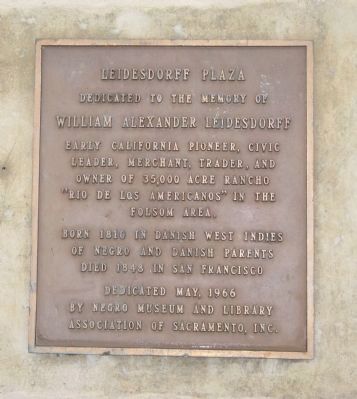
Why California's Black Cultural Heritage is Worth Preserving
The Honorable William Alexander Leidesdorff, Jr. served our nation as U.S. Vice Consul, first black diplomat in U.S. history. His official government reports of U.S. acquisition of California, facilitated by the Bear Flag Revolt, documents our path toward statehood.
Beginning at Colton Hall, California Constitution Convention, and continuing with pre-Civil War California Legislature sessions, our California State Government created unique obstacles to equal opportunity specific to Black citizens beginning in 1850.
In 1848, William Alexander Leidesdorff, Jr. was President of the first public school board in the state. He supervised construction and opened the first public school in the State of California.
Yet, today's challenged 21st century black school children in this state have no clue of his contributions and the broader connection of California's Black Cultural Heritage to today's world.
Overcoming obstacles and challenges toward amazing success is the California story. California's Black Cultural Heritage is an open secret. Honorable William Alexander Leidesdorff, Jr. is the tip of a vast legacy that continues to be missing component from our California Cultural and Historical Endowment.
(Excerpted in part from AB716)
Every civilization defines itself in part by its past, and an understanding of its past helps determine its basic values and future aspirations. Understanding of the past is strengthened and deepened by contact with the buildings, physical places, and artifacts of earlier times.
Through learning this past, our young and future generations come to better understand the society in which they live and to better understand themselves.
As California ’s built environment becomes remarkably similar throughout the state, it is left to the natural environment and the structures of the past to give a unique sense of place to our communities.
Preserving these structures is becoming increasingly important as a way of preserving community identity.
The buildings, other structures, and artifacts that embody California ’s past are in escalating danger of being redeveloped, remodeled, renovated, paved, excavated, bulldozed, modernized, and lost forever.
For history to be part of our lives, and to preserve community identities, we must include history in our daily lives. This can be accomplished through creative, adaptive reuse of historic structures in our older commercial districts and inner cities.
California has one of the most diverse populations on earth, and its cultural and historic preservation efforts should reflect that fact.
The California Cultural and Historical Endowment’s mission is to document the cultural traditions and historic roles of California ’s Latino, African-American, Asian and Pacific Islanders, Native Americans, and Jewish populations.
The Endowment is also seeking out and telling the stories of the many other groups of peoples with uniquely identifiable cultures and histories.
It is increasingly important to preserve the physical and cultural history and folklife of these many groups, who have made important contributions to California ’s history, development, and identity.
The Honorable William Alexander Leidesdorff, Jr. served our nation as U.S. Vice Consul, first black diplomat in U.S. history. His official government reports of U.S. acquisition of California, facilitated by the Bear Flag Revolt, documents our path toward statehood.
Beginning at Colton Hall, California Constitution Convention, and continuing with pre-Civil War California Legislature sessions, our California State Government created unique obstacles to equal opportunity specific to Black citizens beginning in 1850.
In 1848, William Alexander Leidesdorff, Jr. was President of the first public school board in the state. He supervised construction and opened the first public school in the State of California.
Yet, today's challenged 21st century black school children in this state have no clue of his contributions and the broader connection of California's Black Cultural Heritage to today's world.
Overcoming obstacles and challenges toward amazing success is the California story. California's Black Cultural Heritage is an open secret. Honorable William Alexander Leidesdorff, Jr. is the tip of a vast legacy that continues to be missing component from our California Cultural and Historical Endowment.
(Excerpted in part from AB716)
Every civilization defines itself in part by its past, and an understanding of its past helps determine its basic values and future aspirations. Understanding of the past is strengthened and deepened by contact with the buildings, physical places, and artifacts of earlier times.
Through learning this past, our young and future generations come to better understand the society in which they live and to better understand themselves.
As California ’s built environment becomes remarkably similar throughout the state, it is left to the natural environment and the structures of the past to give a unique sense of place to our communities.
Preserving these structures is becoming increasingly important as a way of preserving community identity.
The buildings, other structures, and artifacts that embody California ’s past are in escalating danger of being redeveloped, remodeled, renovated, paved, excavated, bulldozed, modernized, and lost forever.
For history to be part of our lives, and to preserve community identities, we must include history in our daily lives. This can be accomplished through creative, adaptive reuse of historic structures in our older commercial districts and inner cities.
California has one of the most diverse populations on earth, and its cultural and historic preservation efforts should reflect that fact.
The California Cultural and Historical Endowment’s mission is to document the cultural traditions and historic roles of California ’s Latino, African-American, Asian and Pacific Islanders, Native Americans, and Jewish populations.
The Endowment is also seeking out and telling the stories of the many other groups of peoples with uniquely identifiable cultures and histories.
It is increasingly important to preserve the physical and cultural history and folklife of these many groups, who have made important contributions to California ’s history, development, and identity.
Add Your Comments
We are 100% volunteer and depend on your participation to sustain our efforts!
Donate

$110.00 donated
in the past month
Get Involved
If you'd like to help with maintaining or developing the website, contact us.
Publish
Publish your stories and upcoming events on Indybay.
Topics
More
Search Indybay's Archives
Advanced Search
►
▼
IMC Network