







 Publish to Newswire
 Add an Event
From the Open-Publishing Calendar
From the Open-Publishing Newswire
Indybay Feature
Friendship Caravan Successfully Chips Away at U.S. Embargo on Cuba
The twentieth Pastors for Peace Caravan to Cuba successfully returned to the United States on August 3, 2009 with markedly reduced resistance from U.S. Customs authorities in both outbound and inbound border crossings, signalling that the failed U.S. embargo on Cuba is slowing crumbling. Caravanistas and supporters hailed the significance of the Caravan in San Jose.
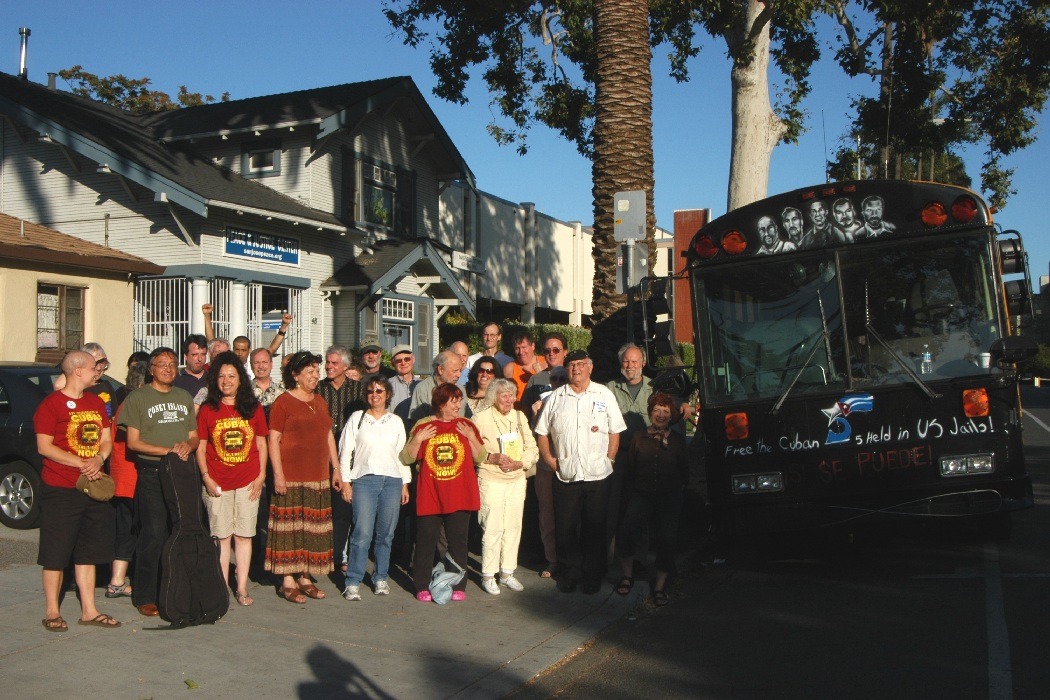
The twentieth Pastors for Peace Friendship Caravan to Cuba with 130 caravanistas successfully completed its mission of delivering 115 tonnes of humanitarian aid and construction materials when it crossed back over the Hidalgo Bridge over the Rio Grande into the United States on August 3, 2009.
Contingents of the Caravan travelling on 14 different routes had been welcomed at some 140 U.S. and Canadian cities, collecting humanitarian supplies and construction materials, on their way to converging on McAllen, Texas before crossing into México. When the Friendship Caravan initially crossed the U.S.-México border on July 21, 2009, it was subjected to inspection, but met the least resistance ever from U.S. Customs authorities – a sign that the U.S. embargo on travel and trade with Cuba is finally crumbling.
By travelling to Cuba carrying material aid without a U.S. government license, Pastors for Peace has been challenging the U.S. blockade for 18 years.
When one Caravan school bus arrived in San José on July 12, 2009, it was greeted by a large crowd of enthusiastic supporters.
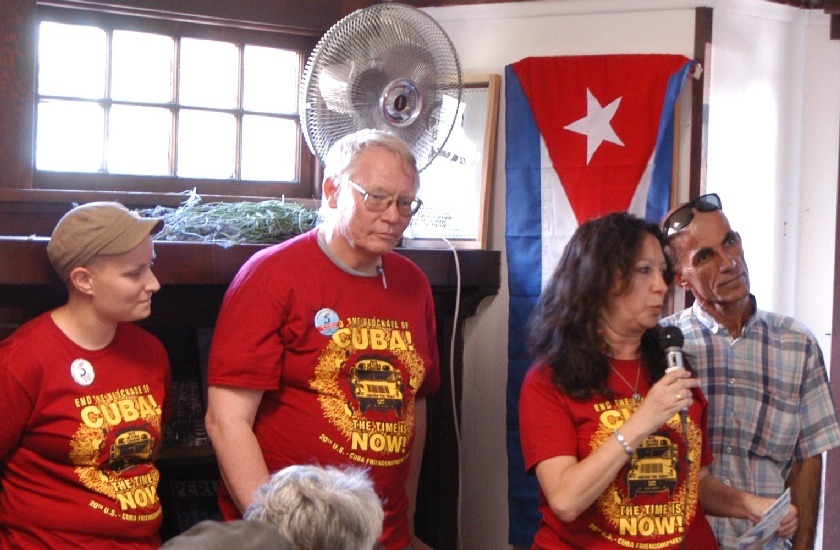
Speaking to an overflow audience at the San José Peace and Justice Center, caravanista Alicia Jrapko explained why she is travelling on the Caravan, “We feel very proud to be there to show the Cuban people our solidarity and show them that there are many people in the United States that are against the policy of the U.S. We are opposed to this unjust and immoral law that has been in place for a long time and has failed.”
Explaining why she is participating in the Pastors for Peace Caravan, Nita Palmer said, “Cuba is a very very inspiring example for all of us, for what can be possible in the world. And that’s why I continue to go to Cuba and I continue to oppose the blockade and go on these caravans. I’m from Canada so I can go freely to Cuba, but I choose to go with this caravan, showing solidarity with Cuba and with U.S. people fighting against the blockade.”
Mike Beilstein told about how he got started with the Pastors for Peace Caravan in 1996 by collecting and refurbishing old computers for the Infomed project for health clinics in Cuba. “The entire load of computers was held up at the border and confiscated,” he recalled. “Five people went on a hunger strike for 90 days to get those computers released. They were finally released and given to the Methodist Church, which then turned them over to Pastors for Peace. So we got those computers back.”
Brad Jones pointed out how Sey’a Sangari, who joined the Caravan in San José, was one of five people who went on hunger strike for over 90 days to win the release from U.S. Customs of 30 computers carried by the Pastors for Peace Caravan. “So he is a real hero to the Cuban people and all of us with Pastors for Peace.”
The project of gathering and repairing old computers in the U.S. for health clinics in Cuba in defiance of the U.S. blockade was championed by the late David Wald of the San José Peace and Justice Center and epidemiologist Juan Reardon. Over the course of the decade-long project, the USA-Cuba InfoMed project successfully shipped thousands of computer systems to Infomed (Centro Nacional de Información de Ciencias Médicas) in Cuba for distribution to local health clinics.
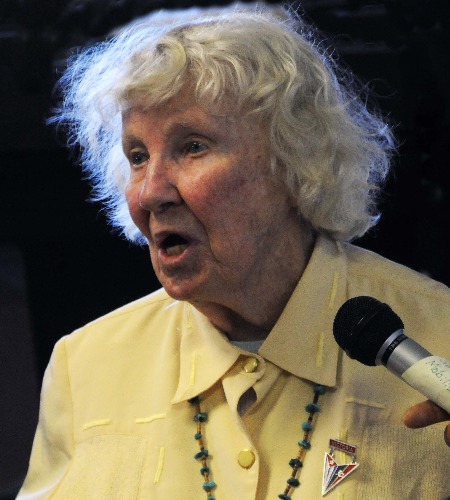
Martha Acevedo, 90, who has been a life-long activist for social justice, told several personal stories about Cuba’s role in the world. “When I was in Cuba with my husband, we had trouble with the floor in the bathroom, and his friend from up above [in the apartment building] came and helped me fix the floor. His name is ‘Peachy.’ He was one who had gone as a volunteer to Africa. He is just a little guy, but brave. … When he finished his work, because I had worked for peace and because I was a friend of Cuba, he gave me this medal that he had won when he was in Africa. And this is it. I said to my other friend, ‘I can’t take his medal. This is so important for him.’ He said, ‘Well, keep it till you are ready to go. Wear it and then when you are ready to go, give it back.’ But he wouldn’t take it back. So now I have it.”
Then Chilean musician Rafael Manriquez, one of the leading exponents of Latin American music in the San Francisco Bay Area during the last twenty years, performed for the packed audience.
The Pastors for Peace Friendship Caravan to Cuba and over a hundred supporting events like this throughout North America are chipping away at the failed and unjustified U.S. blockade on Cuba, a policy that continues to violate the American people’s human right to travel.
- - - - - - - - - - - -
Lead photo: A Pastors for Peace Friendship Caravan school bus was welcomed and sent off by an enthusiastic crowd at the San José Peace and Justice Center on July 12, 2009.
For more information on the Pastors for Peace Friendship Caravan, see http://www.ifconews.org
For more information on the U.S. embargo on Cuba, see http://dissidentvoice.org/2009/08/the-crumbling-u-s-embargo-on-cuba
Contingents of the Caravan travelling on 14 different routes had been welcomed at some 140 U.S. and Canadian cities, collecting humanitarian supplies and construction materials, on their way to converging on McAllen, Texas before crossing into México. When the Friendship Caravan initially crossed the U.S.-México border on July 21, 2009, it was subjected to inspection, but met the least resistance ever from U.S. Customs authorities – a sign that the U.S. embargo on travel and trade with Cuba is finally crumbling.
By travelling to Cuba carrying material aid without a U.S. government license, Pastors for Peace has been challenging the U.S. blockade for 18 years.
When one Caravan school bus arrived in San José on July 12, 2009, it was greeted by a large crowd of enthusiastic supporters.
Speaking to an overflow audience at the San José Peace and Justice Center, caravanista Alicia Jrapko explained why she is travelling on the Caravan, “We feel very proud to be there to show the Cuban people our solidarity and show them that there are many people in the United States that are against the policy of the U.S. We are opposed to this unjust and immoral law that has been in place for a long time and has failed.”
Explaining why she is participating in the Pastors for Peace Caravan, Nita Palmer said, “Cuba is a very very inspiring example for all of us, for what can be possible in the world. And that’s why I continue to go to Cuba and I continue to oppose the blockade and go on these caravans. I’m from Canada so I can go freely to Cuba, but I choose to go with this caravan, showing solidarity with Cuba and with U.S. people fighting against the blockade.”
Mike Beilstein told about how he got started with the Pastors for Peace Caravan in 1996 by collecting and refurbishing old computers for the Infomed project for health clinics in Cuba. “The entire load of computers was held up at the border and confiscated,” he recalled. “Five people went on a hunger strike for 90 days to get those computers released. They were finally released and given to the Methodist Church, which then turned them over to Pastors for Peace. So we got those computers back.”
Brad Jones pointed out how Sey’a Sangari, who joined the Caravan in San José, was one of five people who went on hunger strike for over 90 days to win the release from U.S. Customs of 30 computers carried by the Pastors for Peace Caravan. “So he is a real hero to the Cuban people and all of us with Pastors for Peace.”
The project of gathering and repairing old computers in the U.S. for health clinics in Cuba in defiance of the U.S. blockade was championed by the late David Wald of the San José Peace and Justice Center and epidemiologist Juan Reardon. Over the course of the decade-long project, the USA-Cuba InfoMed project successfully shipped thousands of computer systems to Infomed (Centro Nacional de Información de Ciencias Médicas) in Cuba for distribution to local health clinics.
Martha Acevedo, 90, who has been a life-long activist for social justice, told several personal stories about Cuba’s role in the world. “When I was in Cuba with my husband, we had trouble with the floor in the bathroom, and his friend from up above [in the apartment building] came and helped me fix the floor. His name is ‘Peachy.’ He was one who had gone as a volunteer to Africa. He is just a little guy, but brave. … When he finished his work, because I had worked for peace and because I was a friend of Cuba, he gave me this medal that he had won when he was in Africa. And this is it. I said to my other friend, ‘I can’t take his medal. This is so important for him.’ He said, ‘Well, keep it till you are ready to go. Wear it and then when you are ready to go, give it back.’ But he wouldn’t take it back. So now I have it.”
Then Chilean musician Rafael Manriquez, one of the leading exponents of Latin American music in the San Francisco Bay Area during the last twenty years, performed for the packed audience.
The Pastors for Peace Friendship Caravan to Cuba and over a hundred supporting events like this throughout North America are chipping away at the failed and unjustified U.S. blockade on Cuba, a policy that continues to violate the American people’s human right to travel.
- - - - - - - - - - - -
Lead photo: A Pastors for Peace Friendship Caravan school bus was welcomed and sent off by an enthusiastic crowd at the San José Peace and Justice Center on July 12, 2009.
For more information on the Pastors for Peace Friendship Caravan, see http://www.ifconews.org
For more information on the U.S. embargo on Cuba, see http://dissidentvoice.org/2009/08/the-crumbling-u-s-embargo-on-cuba
For more information:
http://www.sanjosepeace.org

Add Your Comments
We are 100% volunteer and depend on your participation to sustain our efforts!
Donate

$110.00 donated
in the past month
Get Involved
If you'd like to help with maintaining or developing the website, contact us.
Publish
Publish your stories and upcoming events on Indybay.
Topics
More
Search Indybay's Archives
Advanced Search
►
▼
IMC Network