







 Publish to Newswire
 Add an Event
From the Open-Publishing Calendar
From the Open-Publishing Newswire
Indybay Feature
Bill's Trail. SAVE IT NOW
California State Park officials are trying to snow-job the public by requiring only a "Notice of Exemption" for the opening up of a sensitive trail in Samuel Taylor State Park to aggressive downhill mountain biking. The trail winds through narrow lush fren lined redwood forest and ends in a feeder creek at Devil's Gulch that is home to endangered Coho salmon. Stop IMBA and their corporate agenda from destroying this serene zen trail..
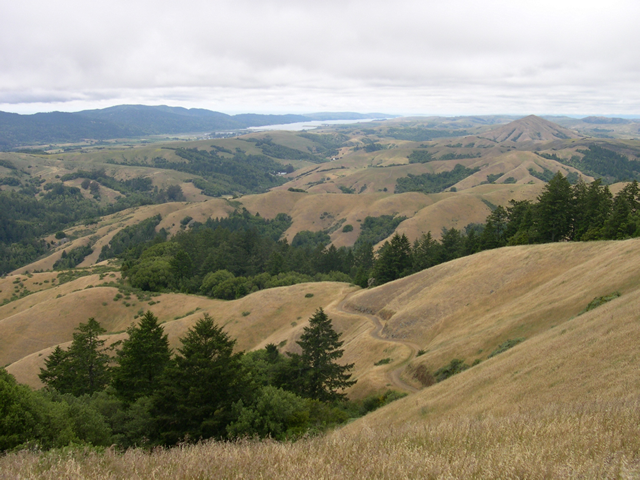
Bill’s Trail, in a steep, remote section of Samuel Taylor State Park is under assault by IMBA, the International Mountain Bike Association, and other local mountain bike proponents. This well funded and determined lobby has managed to convince State Park staff, that opening the fragile, narrow, fern lined trail to aggressive downhill mountain biking is within the definitions of state park shared use trails. IMBA maps of the trail depict only a few hairpin turns when in fact there are up to 40 such switchbacks. The trail is accessible by an arduous climb to about the 850’ elevation of Barnaby Mountain and would provide a mostly moderately steep downhill ride (7-8% grade) for bike users.
Mountain bikers have proved on numerous occasions to be poor stewards of the trail systems in Marin and Sonoma counties. Bikers in Marin, have been arrested for building illegal trails in sensitive wildlife habitats on numerous occasions, threatened local residents who report or encounter them on illegal trails, destroy private property, cut down redwood and other trees and continue to build downhill ramps and jump courses in off limits county open spaces. Their tire tracks leave deep erosive ruts in healthy trails especially during the rain season. Recently, an injured mountain biker had to be air lifted out of nearby Annadel State Park. The remoteness of Bill’s Trail poses significant problems for state park resources in both maintenance and monitoring in an economic climate that is in serious decline. Endangered Coho salmon spawn in a creek at the base of the trail. The impacts of substantial bike traffic near this creek have not been studied. When over a hundred miles of legal trails remain open to them in Sonoma and Marin, one wonders what the feverish urgency is in opening up more trails. The answer is that the mountain bike industry is a billion dollar commercial enterprise that must sell products. IMBA takes its marching orders from corporate giants. This is not care for the wilderness but yet another exploitative grab of traditional wilderness and open space for basic thrill seeking.
Voice your opposition to the plan by June 26, 2009. Demand a full CEQA review from state authorities. Call or email staff head, Roy McNamee rmcna [at] parks.ca.gov
707- 769-5665 ex 226
Mountain bikers have proved on numerous occasions to be poor stewards of the trail systems in Marin and Sonoma counties. Bikers in Marin, have been arrested for building illegal trails in sensitive wildlife habitats on numerous occasions, threatened local residents who report or encounter them on illegal trails, destroy private property, cut down redwood and other trees and continue to build downhill ramps and jump courses in off limits county open spaces. Their tire tracks leave deep erosive ruts in healthy trails especially during the rain season. Recently, an injured mountain biker had to be air lifted out of nearby Annadel State Park. The remoteness of Bill’s Trail poses significant problems for state park resources in both maintenance and monitoring in an economic climate that is in serious decline. Endangered Coho salmon spawn in a creek at the base of the trail. The impacts of substantial bike traffic near this creek have not been studied. When over a hundred miles of legal trails remain open to them in Sonoma and Marin, one wonders what the feverish urgency is in opening up more trails. The answer is that the mountain bike industry is a billion dollar commercial enterprise that must sell products. IMBA takes its marching orders from corporate giants. This is not care for the wilderness but yet another exploitative grab of traditional wilderness and open space for basic thrill seeking.
Voice your opposition to the plan by June 26, 2009. Demand a full CEQA review from state authorities. Call or email staff head, Roy McNamee rmcna [at] parks.ca.gov
707- 769-5665 ex 226
For more information:
http://trailkillerz.blogspot.com
Add Your Comments
Comments
(Hide Comments)
Trails all around the world are happily shared by bicyclists, bikers and horsemen. Bill's trail will be a great step forward for more equitable access in Marin.
i thought there might be some substance at the website linked above. but there's just all this nasty anti-bike shit. ugh.
i bike everywhere, but i don't like bikes on hiking trails. i don't know anything about bill's trail so this is a general comment about the demand for more bike trails and other recreation amenities.
maintaining hiking trails in steep terrain is challenging to land stewards around the bay. trail widening and branching is a consistent problem on our erosion prone, sedimentary based soils. space for people and wildlife in and for wildlands is what i give a shit about, not any recreation subculture.
"shared use" sounds great but does not address the damage that recreation inflicts either through intensity of use or the particular activity. "shared" use only addresses sharing land between people, not wildlife, habitat, or environmental processes.
the land shares everything with us but we always want something more from the fragments. our demands develop and further fragment our 'open space', creating homogenized, anthropocentric landscapes. (not just with bike trails, of course. also shit like 'disc golf'.) still manifesting destiny.
i bike everywhere, but i don't like bikes on hiking trails. i don't know anything about bill's trail so this is a general comment about the demand for more bike trails and other recreation amenities.
maintaining hiking trails in steep terrain is challenging to land stewards around the bay. trail widening and branching is a consistent problem on our erosion prone, sedimentary based soils. space for people and wildlife in and for wildlands is what i give a shit about, not any recreation subculture.
"shared use" sounds great but does not address the damage that recreation inflicts either through intensity of use or the particular activity. "shared" use only addresses sharing land between people, not wildlife, habitat, or environmental processes.
the land shares everything with us but we always want something more from the fragments. our demands develop and further fragment our 'open space', creating homogenized, anthropocentric landscapes. (not just with bike trails, of course. also shit like 'disc golf'.) still manifesting destiny.
HikerBiker, If you read the threads of Trailkillerz, you'd see that many of the articles address the very land use issues you're making excellent points about. Wildlife is the most frequently neglected "user" in the equation. Night riding is growing in popularity in Marin, when "poaching" (the illegal use of no-bike trails) happens. This disturbs nocturnal feeding routines of many species. Mt. Bike riders seem to be a particularly self-centered user group, though many are law abiding trail users. I'm not anti-bike. I road ride quite a bit. I am against the whiny entitlement complaints for narrow hiking trails, mislabeled by mountain bike culture as "single track". There is no such thing as a "single track", unless of course you're thinking of a "racing track", and that ain't something you see in the wilderness. Bill's Trail would be destroyed if opened to mountain biking. Take a look at the video again.
This poster's author has presented numerous straw man arguments that are intended to distract from the real issue.
Mountain rescue statistics, previous incidents of illegal trail building, and his opinions on the IMBA "lobby" are irrelevant.
I assume he would also want this rescue service for himself if he were to be injured on Bill's Trail. (Google 'hiker airlift') If it were relevant to consider specific incidents of environmental and trail damage in other parks, then we would also have to consider such incidents from all user groups (such as hikers cutting switchbacks, hikers roaming totally off trail, horses dropping manure on trails, etc) and we would also have to include examples of good stewardship such as trail and habitat restoration. Yes, mountain biking companies want bikers to have more trail access just as backpacker equipment companies want hikers to have more access. Guess what, the American Hiking Society has corporate sponsors too! http://americanhiking.org/corpSponsors.aspx
The issue here is fair access for all user groups on public land and trails.
If you are going to restrict one mode on some trails, than that restriction should be applied to other modes on other trails. The author doesn't want to share the narrow width Bill's Trail but he also doesn't want an equal trail access on other narrow width trails. In other words, he wants his chosen mode to have preferential access on trails without sharing. Samuel Taylor St. Park is not private land and all access modes needs to be included equally.
Don't be fooled by the side issues. Bill's Trail is not within "traditional wilderness" and carries no special Wilderness designation. If the author wants to open up discussion on the effects of siltation in the creek on Bill's Trail, he'd also better be prepared to consider rerouting the trail or closing it entirely. Poorly built trails cause the siltation of creeks, not the user groups.
Mountain rescue statistics, previous incidents of illegal trail building, and his opinions on the IMBA "lobby" are irrelevant.
I assume he would also want this rescue service for himself if he were to be injured on Bill's Trail. (Google 'hiker airlift') If it were relevant to consider specific incidents of environmental and trail damage in other parks, then we would also have to consider such incidents from all user groups (such as hikers cutting switchbacks, hikers roaming totally off trail, horses dropping manure on trails, etc) and we would also have to include examples of good stewardship such as trail and habitat restoration. Yes, mountain biking companies want bikers to have more trail access just as backpacker equipment companies want hikers to have more access. Guess what, the American Hiking Society has corporate sponsors too! http://americanhiking.org/corpSponsors.aspx
The issue here is fair access for all user groups on public land and trails.
If you are going to restrict one mode on some trails, than that restriction should be applied to other modes on other trails. The author doesn't want to share the narrow width Bill's Trail but he also doesn't want an equal trail access on other narrow width trails. In other words, he wants his chosen mode to have preferential access on trails without sharing. Samuel Taylor St. Park is not private land and all access modes needs to be included equally.
Don't be fooled by the side issues. Bill's Trail is not within "traditional wilderness" and carries no special Wilderness designation. If the author wants to open up discussion on the effects of siltation in the creek on Bill's Trail, he'd also better be prepared to consider rerouting the trail or closing it entirely. Poorly built trails cause the siltation of creeks, not the user groups.
We are 100% volunteer and depend on your participation to sustain our efforts!
Donate

$140.00 donated
in the past month
Get Involved
If you'd like to help with maintaining or developing the website, contact us.
Publish
Publish your stories and upcoming events on Indybay.
Topics
More
Search Indybay's Archives
Advanced Search
►
▼
IMC Network