







 Publish to Newswire
 Add an Event
From the Open-Publishing Calendar
From the Open-Publishing Newswire
Indybay Feature
Beat the Fascists wherever you meet them!
Communiqué from the 7th of May about the big nazi rallies in Germany from the 1st of May 2008 to the 1st of May 2009
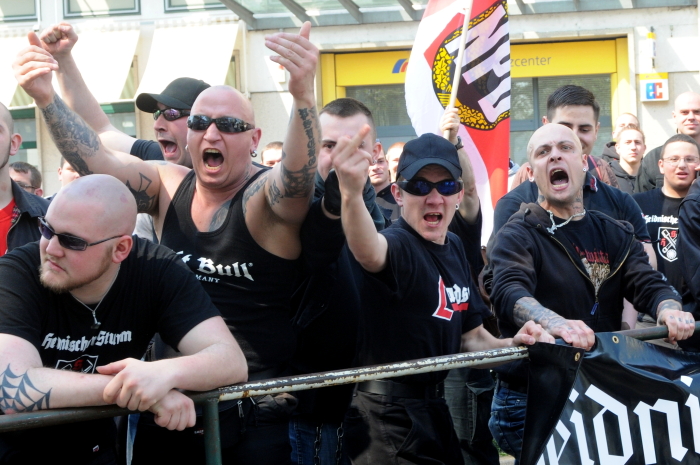
On May Day 2009 around 1,000 Nazis marched through Ulm (Baden-Württemberg) and Neu-Ulm (Bavaria) where they were confronted by 5,000 counter demonstrators. On this day there were further fascist demonstrations, with a total of 3,000 participating Nazis. Despite the militant resistance in Ulm, the only Nazi march that could be prevented was in Mainz. The march in Ulm was organised by the youth organisation of the National Democratic Party of Germany (NPD), the young national democrats (JN). A broad spectrum of fascists participated at the march.
While in Ulm autonomous Antifa were subjected to excessive police violence, they were yet again betrayed by the “German Confederation of Trade Unions” (DGB) but received solidarity only from Kurdish as well as communist demonstrators. The DGB has yet again placed itself in the tradition of May Day 1933. Even then the Nazi’s attempted to transfigure the international workers day into the “day of national work”. On the 2nd of May 1933 they devoured the trade union movement while on the day before part of the trade Union movement went on the streets together with the Nazi Party. Every year the Nazis try to claim May Day for themselves so that its roots will be forgotten: The anarchist assembly in 1886 at the Haymarket in Chicago to promote a general strike for an 8 hour working day.
May Day 2008 became a signal for a new form of right-wing radicalism in Germany. For the first time the “Autonomous Nationalists” (AN) received attention from the media. It was then that 1,100 Nazis from a militant youth subculture marched through the Barmbeck district of the city Hamburg. Over 9,000 leftists gave resistance, the Nazis concentrated their attacks against members of the press as well as political opponents. The police were surprised and dumbfounded by the new quality of right wing militancy. Within the scene the attention resulted in a greater momentum in the attractiveness of the AN. The AN present themselves as a superficial right-wing rip-off of Autonomous Antifa’s and are attempting to develop a violent and modern image in order to attract young people. Although they are turning away from traditional repugnant Nazi images such as the narrow minded hair parting (aka Hitler) or the thuggish Nazi-skin, in order to appeal to a new generation, they have however failed to achieve the support of a broad spectrum necessary for a mass movement.
On the 12th of April 2008, 800 AN’s had already marched through the town of Stolberg (North Rhine-Westphalia). The reason for this is that on the 4th of April a youth had been killed in a street fight after attending an NPD meeting. The largest rally so far by the Autonomous Nationalists occurred on the 6th of September 2008 when 1,200 Nazis, despite counter-protests from 1,800 left-wing demonstrators, were able to march undisturbed through the streets of Dortmund (North Rhine-Westphalia). The march was to commemorate the German invasion of Poland on the 1st of September 1939. The Nazis have been commemorating the start of the second world war for the past four years, cynically running under the motto of “national anti-war day”. On the 1st of May 2009 the AN marched once again through their stronghold Dortmund, this time 300 of them attacked a Trade union demonstration.
On the 13th of September 2008 1,100 Nazis took part in the 4th “Festival of the nations” (Fest der Völker/Fdv) in Altenburg (Thuringia), they were met by 2,000 left-wing counter-demonstrators. At the annual Rechtsrock (Rock against communism) festival, organised by the NPD, the bands which play mainly belong to the music network “Blood and Honour”. Hardcore Nazis from all over Europe travel to this festival which serves as an opportunity to improve right-wing networks. Many of the Nazis are independent of political parties organised into the so-called “Freien Kameradschaften” (independent camaraderie organisations). The aim of such large meetings, such as the “Festival of Nations”, is to construct so-called “nationally liberated zones” within larger cities, which in contrast to some rural areas will only exist for a limited time.
The largest Nazi demonstration in Germany, since the end of the second world war, took place on the 14th of February in Dresden (Saxony). On the anniversary of the allied bombing 6,500 Nazis, from all over Europe, marched through the city. Although for the first time this year, several thousand left-wing counter-demonstrators also attended, the revisionist event has managed to inscribe itself in the agenda of European Nazis. Just as the marches in Wunsiedel (Bavaria) to the grave of Rudolf Hess or the annual party of the NPD newspaper “Deutschen Stimme” (“German voice”) mostly in towns in East-Germany before, Dresden has become the main annual meeting of European Nazis.
The three main characteristics of the larger Nazi meetings is networking and organising, promoting self confidence in the internal ranks and demonstrating a potency to the outside world. The reason why the Nazis are meeting is unimportant, as long as they serve as an identification function for the whole Nazi spectrum. This is especially the case for historical revisionist themes, where mainly Nazi political strongholds are selected. It is not enough to just stop the larger Nazi meetings, the Nazis have shown that they are able to react flexibly to legal restrictions. Besides fighting against the Nazi ideology present within the society and reporting about Nazi activities it is completely necessary to smash the Nazi structures: every single Nazi has to be attacked by any means necessary.
Never again fascism!
Autonome Antifa Freiburg
Communiqué from 07.05.2009
Antifascist Ticker of May 1st 2009 from Hanover, Mainz, Siegen und Ulm
In German: http://linksunten.indymedia.org/de/ticker/1mai09
In English: http://linksunten.indymedia.org/en/ticker/1mai09
While in Ulm autonomous Antifa were subjected to excessive police violence, they were yet again betrayed by the “German Confederation of Trade Unions” (DGB) but received solidarity only from Kurdish as well as communist demonstrators. The DGB has yet again placed itself in the tradition of May Day 1933. Even then the Nazi’s attempted to transfigure the international workers day into the “day of national work”. On the 2nd of May 1933 they devoured the trade union movement while on the day before part of the trade Union movement went on the streets together with the Nazi Party. Every year the Nazis try to claim May Day for themselves so that its roots will be forgotten: The anarchist assembly in 1886 at the Haymarket in Chicago to promote a general strike for an 8 hour working day.
May Day 2008 became a signal for a new form of right-wing radicalism in Germany. For the first time the “Autonomous Nationalists” (AN) received attention from the media. It was then that 1,100 Nazis from a militant youth subculture marched through the Barmbeck district of the city Hamburg. Over 9,000 leftists gave resistance, the Nazis concentrated their attacks against members of the press as well as political opponents. The police were surprised and dumbfounded by the new quality of right wing militancy. Within the scene the attention resulted in a greater momentum in the attractiveness of the AN. The AN present themselves as a superficial right-wing rip-off of Autonomous Antifa’s and are attempting to develop a violent and modern image in order to attract young people. Although they are turning away from traditional repugnant Nazi images such as the narrow minded hair parting (aka Hitler) or the thuggish Nazi-skin, in order to appeal to a new generation, they have however failed to achieve the support of a broad spectrum necessary for a mass movement.
On the 12th of April 2008, 800 AN’s had already marched through the town of Stolberg (North Rhine-Westphalia). The reason for this is that on the 4th of April a youth had been killed in a street fight after attending an NPD meeting. The largest rally so far by the Autonomous Nationalists occurred on the 6th of September 2008 when 1,200 Nazis, despite counter-protests from 1,800 left-wing demonstrators, were able to march undisturbed through the streets of Dortmund (North Rhine-Westphalia). The march was to commemorate the German invasion of Poland on the 1st of September 1939. The Nazis have been commemorating the start of the second world war for the past four years, cynically running under the motto of “national anti-war day”. On the 1st of May 2009 the AN marched once again through their stronghold Dortmund, this time 300 of them attacked a Trade union demonstration.
On the 13th of September 2008 1,100 Nazis took part in the 4th “Festival of the nations” (Fest der Völker/Fdv) in Altenburg (Thuringia), they were met by 2,000 left-wing counter-demonstrators. At the annual Rechtsrock (Rock against communism) festival, organised by the NPD, the bands which play mainly belong to the music network “Blood and Honour”. Hardcore Nazis from all over Europe travel to this festival which serves as an opportunity to improve right-wing networks. Many of the Nazis are independent of political parties organised into the so-called “Freien Kameradschaften” (independent camaraderie organisations). The aim of such large meetings, such as the “Festival of Nations”, is to construct so-called “nationally liberated zones” within larger cities, which in contrast to some rural areas will only exist for a limited time.
The largest Nazi demonstration in Germany, since the end of the second world war, took place on the 14th of February in Dresden (Saxony). On the anniversary of the allied bombing 6,500 Nazis, from all over Europe, marched through the city. Although for the first time this year, several thousand left-wing counter-demonstrators also attended, the revisionist event has managed to inscribe itself in the agenda of European Nazis. Just as the marches in Wunsiedel (Bavaria) to the grave of Rudolf Hess or the annual party of the NPD newspaper “Deutschen Stimme” (“German voice”) mostly in towns in East-Germany before, Dresden has become the main annual meeting of European Nazis.
The three main characteristics of the larger Nazi meetings is networking and organising, promoting self confidence in the internal ranks and demonstrating a potency to the outside world. The reason why the Nazis are meeting is unimportant, as long as they serve as an identification function for the whole Nazi spectrum. This is especially the case for historical revisionist themes, where mainly Nazi political strongholds are selected. It is not enough to just stop the larger Nazi meetings, the Nazis have shown that they are able to react flexibly to legal restrictions. Besides fighting against the Nazi ideology present within the society and reporting about Nazi activities it is completely necessary to smash the Nazi structures: every single Nazi has to be attacked by any means necessary.
Never again fascism!
Autonome Antifa Freiburg
Communiqué from 07.05.2009
Antifascist Ticker of May 1st 2009 from Hanover, Mainz, Siegen und Ulm
In German: http://linksunten.indymedia.org/de/ticker/1mai09
In English: http://linksunten.indymedia.org/en/ticker/1mai09
For more information:
http://www.autonome-antifa.org/
Add Your Comments
Comments
(Hide Comments)
From: http://www.wsws.org/articles/2009/may2009/nazi-m09.shtml
Approximately 300 neo-Nazis attacked a demonstration organised by the DGB, the German trade union federation, on May 1 as it set off from the square in front of the old synagogue towards Westphalia Park.
Approximately 40 right-wingers had turned up at the main railway station at 9 o’clock, where they then waited for others to arrive who were travelling by bus. They told police officers present that they wanted to go to Siegen, about 100 kilometres southeast of Dortmund, where a right-wing demonstration had been authorised.
However, the police officers seemed more worried about approximately 30 anti-fascist activists who wanted to demonstrate against the Nazis.
The main police presence was in Siegen, while only a small force had remained in Dortmund, although prior to May 1 several right-wing web sites had called for “creative” and “decentralised actions” and for their supporters to “visit other demos” (clearly a reference to the DGB demonstration).
However, instead of travelling to Siegen by train, the mob of neo-Nazis, now grown to approximately 300, set off at 11 o’clock towards the DGB demonstration. Their numbers had been swelled by the arrival of two buses from Wartburg and one from Minden. The Dortmund DGB district chair, Eberhard Weber, who had been warned by the police, immediately gave the signal for the union demonstration to set off toward Westphalia Park, where the DGB’s family fete takes place each May Day.
The neo-Nazis, however, used the urban transit system and were able to reach the DGB demonstration before it arrived at the park. Armed with sticks, firecrackers, stones and lumps of clay containing glass fragments the Nazi thugs attacked a contingent of Kurds and Turks at the rear of the demonstration, injuring several people, including some police officers. One demonstrator was said to have received serious injuries after being hit by a bullet-like projectile.
The DGB demonstrators attempted to defend themselves. The relatively few police officers present, who were poorly equipped, tried to separate the two groups. Some of those on the DGB demonstration were treated with extreme brutality by the police, as is shown in photos published in the press and in one video, which clearly shows a prostrate Turkish demonstrator being kicked in the head by a policeman in full riot gear.
Eyewitnesses also report that those attacking the DGB demonstration included “SS-Siggi” (Siegfried Borchardt), an individual who has been convicted several times before and has been active in the Dortmund neo-Nazi scene since the 1970s.
The Dortmund police called for reinforcements from other cities in the Ruhr, but these arrived sometime later. According to police reports, officers used their batons against the aggressors and were finally able to push them back. Approximately 150 Nazis were detained near the pedestrian precinct, and another 40 were held near the Reinoldi Church. In addition, a section of the DGB demonstration was also held in a police “kettling,” operation, surrounded by a line of police.
In contrast to the treatment previously meted out to anti-fascists in Dortmund, the police treated the detained neo-Nazis with reserve. Under police escort, they were allowed access to toilets, and minors and pregnant women were released. Those remaining were then gradually taken away to give their details to police. A total of some 280 right-wingers were arrested and face charges of breach of the peace.
A counter-demonstration later the same day was banned, with police threatening to declare an “emergency situation,” leading the protesters to hold a meeting instead. However, anti-Nazi demonstrators arriving to participate were prevented from joining the meeting.
The head of the Dortmund Social Democratic Party (SPD), Franz Josef Drabig, witnessed the attack on the DGB demonstration and said: “I was angered by the brutality of the right-wing extremists. One cannot criticise the few police officers who were present. They were surprised by the attack. But I ask myself, how such a mob of Nazis could remain unnoticed under the eyes of the police and secret service.” The Dortmund DGB district chair Weber also deplored the lack of a police presence: “The situation was unique. The region has a massive problem with violent neo-Nazis. A question that has to be asked is how the state’s forces of protection are set up in Dortmund.”
A question that should indeed be asked. Considering the fact that there are many undercover agents active inside the far-right, it is strange that there was apparently no prior knowledge of what was going to transpire. It is simply not credible that the Nazis were able to lead the police and secret service on such a wild goose chase, particularly since they have been trying to make Dortmund and the Ruhr area a centre of their activities for some years.
Recently, the secret service in North Rhine-Westphalia had warned that some nationalist groups in the Dortmund region were prone to extreme militancy, also modelling themselves (at least in appearance) on so-called “left” Autonome (anarchists). The question arises whether it was simply accepted that there was going to be an escalation of right-wing violence.
The Dortmund events are not an isolated case. In several German cities this year, neo-Nazis have stepped up their attempts to exploit May 1 for their own propaganda purposes. In the cities of Ulm, Rotenburg, Mainz and Berlin, there have been violent clashes between police and opponents of the far-right.
In view of the growth of the activities of the “Autonome Nationalisten,” it is difficult to establish the extent to which the Nazis, or the undercover agents in their ranks, had a hand in the so-called “left-wing riots” in Berlin and Hamburg.
Following May Day this year, the establishment parties and the media have been calling loudly for state intervention to be stepped up and for parties and demonstrations to be banned. The Dortmund police chief, Hans Schulze, said that in light of the right-wing attack on the DGB demo, a “re-evaluation of Nazi demos” would have to be conducted and they may well be banned. Until now, the Supreme Court has always given priority to the freedom of assembly, and in only a few cases have Nazi marches been banned.
In this regard, it is important to look at the reasons given for the banning of the central Nazi demonstration in Hanover. The Lower Saxony Administrative Court regarded it as sufficient grounds to prohibit the planned demonstration to cite the expected high numbers of participants of so-called Autonome Nationalisten, and that this would lead to violence on the demonstration. Moreover, the court ruled that even if the right-wing demonstration ran peacefully, it was to be expected that there would be a violent counter-demonstration, which could entail the police having to declare an “emergency situation.”
Such reasons could easily be used in future by the authorities to ban nearly any meeting or demonstration, and to completely abrogate the fundamental rights of freedom of expression and assembly.
In Dortmund, it did not even take a judge to ban the counter-demonstration against the Nazis. It was sufficient that the police declared they faced a “policing emergency,” a decision that was not justified by the level of reinforcements that then materialised.
The reactions to the violent events on May 1 by the political and trade union elite and the media, regardless whether these events stemmed from misguided young “left” Autonome or Nazis, and the calls for the state to be strengthened, must be taken very seriously. The motives for such a campaign are obvious when one reads the press reports about “right- and left-wing violence” on May 1 this year and repeated warnings of some politicians and trade unionists about the danger of “social unrest” because of the intensifying economic situation.
A cry of indignation went through the media when the SPD’s presidential candidate, Gesine Schwann, and DGB leader Michael Sommer dared to warn about the anger and danger of unrest in the general population in view of the financial and economic crisis and the attempts to resolve this on the backs of ordinary working people. This shows that ruling circles are very conscious of the explosiveness of the situation. They clearly see the necessity to sharpen the means of repression in order to defend their system and suppress the justified resistance of working people. The actions of the neo-Nazis supply them with a welcome pretext.
Approximately 300 neo-Nazis attacked a demonstration organised by the DGB, the German trade union federation, on May 1 as it set off from the square in front of the old synagogue towards Westphalia Park.
Approximately 40 right-wingers had turned up at the main railway station at 9 o’clock, where they then waited for others to arrive who were travelling by bus. They told police officers present that they wanted to go to Siegen, about 100 kilometres southeast of Dortmund, where a right-wing demonstration had been authorised.
However, the police officers seemed more worried about approximately 30 anti-fascist activists who wanted to demonstrate against the Nazis.
The main police presence was in Siegen, while only a small force had remained in Dortmund, although prior to May 1 several right-wing web sites had called for “creative” and “decentralised actions” and for their supporters to “visit other demos” (clearly a reference to the DGB demonstration).
However, instead of travelling to Siegen by train, the mob of neo-Nazis, now grown to approximately 300, set off at 11 o’clock towards the DGB demonstration. Their numbers had been swelled by the arrival of two buses from Wartburg and one from Minden. The Dortmund DGB district chair, Eberhard Weber, who had been warned by the police, immediately gave the signal for the union demonstration to set off toward Westphalia Park, where the DGB’s family fete takes place each May Day.
The neo-Nazis, however, used the urban transit system and were able to reach the DGB demonstration before it arrived at the park. Armed with sticks, firecrackers, stones and lumps of clay containing glass fragments the Nazi thugs attacked a contingent of Kurds and Turks at the rear of the demonstration, injuring several people, including some police officers. One demonstrator was said to have received serious injuries after being hit by a bullet-like projectile.
The DGB demonstrators attempted to defend themselves. The relatively few police officers present, who were poorly equipped, tried to separate the two groups. Some of those on the DGB demonstration were treated with extreme brutality by the police, as is shown in photos published in the press and in one video, which clearly shows a prostrate Turkish demonstrator being kicked in the head by a policeman in full riot gear.
Eyewitnesses also report that those attacking the DGB demonstration included “SS-Siggi” (Siegfried Borchardt), an individual who has been convicted several times before and has been active in the Dortmund neo-Nazi scene since the 1970s.
The Dortmund police called for reinforcements from other cities in the Ruhr, but these arrived sometime later. According to police reports, officers used their batons against the aggressors and were finally able to push them back. Approximately 150 Nazis were detained near the pedestrian precinct, and another 40 were held near the Reinoldi Church. In addition, a section of the DGB demonstration was also held in a police “kettling,” operation, surrounded by a line of police.
In contrast to the treatment previously meted out to anti-fascists in Dortmund, the police treated the detained neo-Nazis with reserve. Under police escort, they were allowed access to toilets, and minors and pregnant women were released. Those remaining were then gradually taken away to give their details to police. A total of some 280 right-wingers were arrested and face charges of breach of the peace.
A counter-demonstration later the same day was banned, with police threatening to declare an “emergency situation,” leading the protesters to hold a meeting instead. However, anti-Nazi demonstrators arriving to participate were prevented from joining the meeting.
The head of the Dortmund Social Democratic Party (SPD), Franz Josef Drabig, witnessed the attack on the DGB demonstration and said: “I was angered by the brutality of the right-wing extremists. One cannot criticise the few police officers who were present. They were surprised by the attack. But I ask myself, how such a mob of Nazis could remain unnoticed under the eyes of the police and secret service.” The Dortmund DGB district chair Weber also deplored the lack of a police presence: “The situation was unique. The region has a massive problem with violent neo-Nazis. A question that has to be asked is how the state’s forces of protection are set up in Dortmund.”
A question that should indeed be asked. Considering the fact that there are many undercover agents active inside the far-right, it is strange that there was apparently no prior knowledge of what was going to transpire. It is simply not credible that the Nazis were able to lead the police and secret service on such a wild goose chase, particularly since they have been trying to make Dortmund and the Ruhr area a centre of their activities for some years.
Recently, the secret service in North Rhine-Westphalia had warned that some nationalist groups in the Dortmund region were prone to extreme militancy, also modelling themselves (at least in appearance) on so-called “left” Autonome (anarchists). The question arises whether it was simply accepted that there was going to be an escalation of right-wing violence.
The Dortmund events are not an isolated case. In several German cities this year, neo-Nazis have stepped up their attempts to exploit May 1 for their own propaganda purposes. In the cities of Ulm, Rotenburg, Mainz and Berlin, there have been violent clashes between police and opponents of the far-right.
In view of the growth of the activities of the “Autonome Nationalisten,” it is difficult to establish the extent to which the Nazis, or the undercover agents in their ranks, had a hand in the so-called “left-wing riots” in Berlin and Hamburg.
Following May Day this year, the establishment parties and the media have been calling loudly for state intervention to be stepped up and for parties and demonstrations to be banned. The Dortmund police chief, Hans Schulze, said that in light of the right-wing attack on the DGB demo, a “re-evaluation of Nazi demos” would have to be conducted and they may well be banned. Until now, the Supreme Court has always given priority to the freedom of assembly, and in only a few cases have Nazi marches been banned.
In this regard, it is important to look at the reasons given for the banning of the central Nazi demonstration in Hanover. The Lower Saxony Administrative Court regarded it as sufficient grounds to prohibit the planned demonstration to cite the expected high numbers of participants of so-called Autonome Nationalisten, and that this would lead to violence on the demonstration. Moreover, the court ruled that even if the right-wing demonstration ran peacefully, it was to be expected that there would be a violent counter-demonstration, which could entail the police having to declare an “emergency situation.”
Such reasons could easily be used in future by the authorities to ban nearly any meeting or demonstration, and to completely abrogate the fundamental rights of freedom of expression and assembly.
In Dortmund, it did not even take a judge to ban the counter-demonstration against the Nazis. It was sufficient that the police declared they faced a “policing emergency,” a decision that was not justified by the level of reinforcements that then materialised.
The reactions to the violent events on May 1 by the political and trade union elite and the media, regardless whether these events stemmed from misguided young “left” Autonome or Nazis, and the calls for the state to be strengthened, must be taken very seriously. The motives for such a campaign are obvious when one reads the press reports about “right- and left-wing violence” on May 1 this year and repeated warnings of some politicians and trade unionists about the danger of “social unrest” because of the intensifying economic situation.
A cry of indignation went through the media when the SPD’s presidential candidate, Gesine Schwann, and DGB leader Michael Sommer dared to warn about the anger and danger of unrest in the general population in view of the financial and economic crisis and the attempts to resolve this on the backs of ordinary working people. This shows that ruling circles are very conscious of the explosiveness of the situation. They clearly see the necessity to sharpen the means of repression in order to defend their system and suppress the justified resistance of working people. The actions of the neo-Nazis supply them with a welcome pretext.
For more information:
http://www.wsws.org/articles/2009/may2009/...
We are 100% volunteer and depend on your participation to sustain our efforts!
Donate

$210.00 donated
in the past month
Get Involved
If you'd like to help with maintaining or developing the website, contact us.
Publish
Publish your stories and upcoming events on Indybay.
Topics
More
Search Indybay's Archives
Advanced Search
►
▼
IMC Network