







 Publish to Newswire
 Add an Event
From the Open-Publishing Calendar
From the Open-Publishing Newswire
Indybay Feature
EFCA on the ropes
Adam Turl reports on the bosses' backlash against the Employee Free Choice Act--and analyzes the shortcomings of organized labor's strategy.
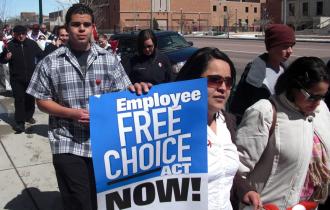
http://socialistworker.org/2009/04/03/efca-on-the-ropes
Analysis: Adam Turl
EFCA on the ropes
Adam Turl reports on the bosses' backlash against the Employee Free Choice Act--and analyzes the shortcomings of organized labor's strategy.
April 3, 2009
A SENSE of imminent triumph in the house of labor has been replaced by uncertainty and unease about the prospects for the Employee Free Choice Act (EFCA).
As Politico.com reported on March 26: "Key Democrats fled from the Employee Free Choice Act on Wednesday, saying they couldn't support the bill unless significant modifications were made, including some ardently opposed by labor unions."
The same day, Republican Sen. Arlen Spector, who was a co-sponsor of EFCA when it was first introduced in 2003, did an about-face and vowed to oppose the legislation. That means Senate Republicans will have the 40 members they need to use procedural moves to block votes on EFCA.
"The bill, as written," the Politico article concluded, "appears to have a slim chance of moving forward, and labor union supporters now fear it may be on hold until after next year's midterm elections."
EFCA was the major political priority of the U.S. labor movement in the 2008 elections. The proposal would make it easier for workers to join unions by giving them the option of bypassing a drawn-out National Labor Relations Board (NLRB) supervised election--a process frequently abused by corporations to intimidate workers--in favor of a simple majority of workers signing union cards to achieve legal union recognition. EFCA would also increase fines on companies that violate workers' rights and make it harder for employers to avoid signing initial contracts with newly unionized workers.
Needless to say, Corporate America didn't take kindly to EFCA, and spent hundreds of millions, mobilizing all its forces to defeat the legislation.
The anti-EFCA war had its intended impact. In addition to Specter's flip-flop, Democratic Sen. Ben Nelson has called for compromise that would gut the legislation. Even one of EFCA's authors, Sen. Tom Harkin, has now said he would open up the bill to changes.
EFCA isn't dead yet--but it is in danger. There's still time to shift things, but that time is growing short.
Unfortunately, the blame for what's happening to the legislation doesn't lie solely with EFCA's corporate enemies, but also with the strategy of its supporters.
The AFL-CIO and Change to Win labor federations have been oriented on the Senate vote-count. Labor focused in on lobbying 10 key senators who wavered on the legislation, running pro-EFCA advertisements in their states.
There are a number of problems with this math-based approach.
First of all, in terms of lobbying and running advertisements, organized labor will always be outgunned by Corporate America. Lobbying is about access to the corridors of power. Running television, radio and newspaper ads takes money. Big business simply has more access and more money.
Secondly, organized labor approached individual senators as allies who just needed to hear good arguments in favor of the legislation and be shored up so they would do "the right thing"--instead of approaching the Senate as a collection of politicians worried about their own power.
And by focusing all their energy on lobbying "swing" votes in the Senate, the unions gave the most conservative Democrats the most attention in the political debate about EFCA. Thus, the entire media waited with bated breath for the opinions of two Arkansas senators who, though they are Democrats, are ultimately in the pocket of home-state union-buster Wal-Mart.
This was a lost opportunity. If the unions had launched a mass, grassroots and active campaign for EFCA, the media would be hearing arguments from workers about why labor law reform is needed.
- - - - - - - - - - - - - - - -
EFCA'S SETBACKS are in part the result of labor's misreading of the dynamics of the Democratic Party--again. While the Democrats have long counted the unions as part of their base and the party's liberal politicians are adept at making pro-worker speeches, the Democrats are, in fact, a pro-business party. The party's approach to EFCA reflects this contradiction.
On the one hand, the political shift that brought President Barack Obama into the White House and increased the Democratic majorities in both houses of Congress has made it more possible to pass EFCA. But the dirty secret is that that this same Democratic Party is entirely capable of sabotaging its own legislation if Corporate America wants it to.
While Congressional Republicans--backed up by the corporate anti-EFCA blitzkrieg--were confidently denouncing the bill and planning for its defeat, Democratic leaders treated EFCA like a legislative stepchild, professing support, but not getting "too close." No senior Senate or House leader--House Speaker Nancy Pelosi and Majority Leader Harry Reid included--even showed up for the Capitol Hill press conference announcing the reintroduction of EFCA on March 10.
The White House also kept EFCA at arms' length and avoided putting any pressure on members of congress to support the legislation. And when Vice President Joe Biden spoke to union leaders about EFCA, cameras weren't allowed to cover the proceedings. Thus, when the bill was reintroduced on March 10, several former sponsors of the 2007 version of the legislation had already gone AWOL.
Why? Well, it's one thing for the Democrats to vote for pro-union legislation when there's no chance of it actually becoming law. It's quite another to do so when it is possible.
In 2007, with George W. Bush in the White House and a bare Democratic majority in the Senate, there was simply no chance of EFCA becoming law. Democrats could vote for the legislation to be on record as fighting for workers, yet be assured that their actions would not actually infringe on the interests of big business.
Now that EFCA is possible, however, some party leaders have apparently concluded that the "best" outcome would be to allow a narrow defeat for EFCA in the Senate, or a compromise that guts the legislation, or indefinite postponement. This would allow the Democrats to defend corporate interests while appearing to be loyal to their pro-union working-class base.
In fact, Congress has been caught in a tug of war between its increasingly discredited corporate patrons and an increasingly angry working-class base. Members have been weighing which course of action--EFCA's success or failure--poses the greatest risk.
Genuine grassroots pressure could tip the scales back in labor's favor. Democratic-controlled Congresses have passed pro-union and pro-working-class legislation in the past--in the 1930s and the 1960s in particular--when there was sufficient pressure to force their hand.
But lobbying alone can't produce that sort of pressure. Democrats who have turned on EFCA should not merely be challenged with words or targeted in the next election. Those politicians should be targeted with protests--now.
- - - - - - - - - - - - - - - -
ANOTHER THREAT to EFCA comes from supposedly "progressive" companies that are proposing an alternative process to expedite union elections.
Some on the left see this is an advance. In a recent article, titled "Corporate United Front Against EFCA Cracking," posted on the Web site of the magazine Political Affairs (published by the Communist Party USA), Joel Wendland cites two signs of a supposed corporate retreat--the so-called "compromise" proposal on labor law reform put forward by Costco, Starbucks and Whole Foods, and an admission in the Wall Street Journal that EFCA would not, contrary to the claims of its opponents, prevent the use of secret ballots in union elections if workers decide they want one.
Wendland argues that the Journal's acknowledgement of the truth about EFCA opened up the potential for Republicans (!) to support EFCA. He adds:
It is likely that many Republicans, without reading the bill, simply accepted the word of anti-worker television entertainers like Lou Dobbs and Glenn Beck, and a massive $200 million ad campaign by big business groups like the National Association of Manufacturers.
In fact, one day after Wendland's article was posted, Specter publicly announced his opposition to the bill. So much for "Republicans for EFCA."
What about the Costco, Starbucks and Whole Foods proposal? AFL-CIO Organizing Director Stewart Acuff described it this way:
[S]ections of Corporate America have smelled the coffee and are looking for compromise legislation...Though their compromise is totally inadequate, it does signal that the ranks of Corporate America have been broken, and that passage of the Employee Free Choice Act is increasingly inevitable."
Of course, the fact that Costco, Starbucks and Whole Foods felt compelled to break with the Chamber of Commerce's strategy of total war is a sign of the times. Big business has been discredited by the crisis and by government bailouts for corporations. The overall terrain should be politically favorable to unions.
But labor needs to take stock of the balance of forces. There are more than 500 business organizations aligned with the Chamber's hard-line "no-compromise" approach to EFCA. Steven Law, general counsel for the Chamber, made Corporate America's position clear on March 10 while speaking to businessmen and Republican members of congress: "The only thing that stands between [EFCA] and your workplace is the filibuster. There is no compromise."
It should be further emphasized that only three companies have "broken ranks"--and there is a reason why it was these three. Starbucks and Whole Foods in particular--despite (or because of) a long and sordid history of union-busting--have tried to present themselves as "socially responsible," and are worried about their corporate images. Moreover, as most EFCA supporters have argued, including Wendland and Acuff, the "Third Way" proposal (as it has been dubbed) would gut EFCA.
The distressing reality is that things are going the wrong direction on EFCA. The proposal is losing support in the Senate, and Corporate America is increasingly confident that it will be defeated. There is no point in pretending otherwise.
- - - - - - - - - - - - - - - -
THE ONLY way to revive chances of passing EFCA is through organization, activism and protest.
Some of this is already taking place. As Acuff wrote of labor's pro-EFCA activism:
What grassroots movement can in the span of one week run 57 letters to the editor in newspapers across America, send 14,000 handwritten letters to 10 U.S. Senators and simultaneously plan 35 grassroots advocacy events with workers in 10 states?
America's labor movement, the AFL-CIO can. Now that the Employee Free Choice Act has been introduced in the U.S. House and Senate, organized labor's multi-state grassroots campaign is running at full throttle.
But is this really all organized labor can do?
Labor's muscle--its membership--has not been flexed in the battle for EFCA, even though union members and many other workers are itching for a fight, and on exactly this issue. Union members could be mobilized to pressure senators who have dropped their support for EFCA, as well as to protest companies and CEOs involved in the anti-EFCA campaign.
In such an activist pro-EFCA campaign, organized labor could win the support of tens of millions of nonunion workers to back the legislation. For example, a Gallup poll released March 17 showed that a solid majority of 52 percent favored laws making it easier to join a union. Previous polls have shown even greater support.
More worrisome, however, was that the Gallup poll showed only 12 percent of Americans were following the debate around EFCA closely. Another recent poll found that only half of respondents were even clear as to what EFCA was.
Organized labor, by focusing on the Senate vote count at the expense of much else, has simply not done a good enough job educating the people about EFCA and the reasons why working people should pull out all the stops to support it.
While there have been some important rallies and protests called by local union federations, union locals and chapters of Jobs with Justice, more can and should be done.
Certainly, the moment is right to target big business. Today's corporate giants have clay feet. After Citibank joined fellow ward of the state Bank of America in organizing anti-EFCA conference calls, unions sent a letter to the Treasury Department in protest. But this is a political crack that labor could drive every unionized truck in the country through--if it looked beyond the Beltway.
Some chapters of Jobs with Justice and student groups have organized protests at these banks. Unions and pro-worker groups everywhere should follow this example.
Industrial action could also have an impact. For example, what if Teamsters at UPS refused to deliver packages to Bank of America for just a single day? They would be heroes--and it could connect the struggle for EFCA to the fight against corporate greed in the public imagination.
As the great abolitionist Frederick Douglas famously said, "Without struggle, there is no progress." At the end of the day, our fight isn't about one piece of pro-labor legislation--however important it may be--but building a militant rank-and-file workers' rebellion that can change the world.
EFCA is one battle in that war--and we could still win that battle. But only if we fight.
- - - - - - - - - - - - - - - - -
Material on this Web site is licensed by SocialistWorker.org, under a Creative Commons (by-nc-nd 3.0) [1] license, except for articles that are republished with permission. Readers are welcome to share and use material belonging to this site for non-commercial purposes, as long as they are attributed to the author and SocialistWorker.org.
[1] http://creativecommons.org/licenses/by-nc-nd/3.0
Analysis: Adam Turl
EFCA on the ropes
Adam Turl reports on the bosses' backlash against the Employee Free Choice Act--and analyzes the shortcomings of organized labor's strategy.
April 3, 2009
A SENSE of imminent triumph in the house of labor has been replaced by uncertainty and unease about the prospects for the Employee Free Choice Act (EFCA).
As Politico.com reported on March 26: "Key Democrats fled from the Employee Free Choice Act on Wednesday, saying they couldn't support the bill unless significant modifications were made, including some ardently opposed by labor unions."
The same day, Republican Sen. Arlen Spector, who was a co-sponsor of EFCA when it was first introduced in 2003, did an about-face and vowed to oppose the legislation. That means Senate Republicans will have the 40 members they need to use procedural moves to block votes on EFCA.
"The bill, as written," the Politico article concluded, "appears to have a slim chance of moving forward, and labor union supporters now fear it may be on hold until after next year's midterm elections."
EFCA was the major political priority of the U.S. labor movement in the 2008 elections. The proposal would make it easier for workers to join unions by giving them the option of bypassing a drawn-out National Labor Relations Board (NLRB) supervised election--a process frequently abused by corporations to intimidate workers--in favor of a simple majority of workers signing union cards to achieve legal union recognition. EFCA would also increase fines on companies that violate workers' rights and make it harder for employers to avoid signing initial contracts with newly unionized workers.
Needless to say, Corporate America didn't take kindly to EFCA, and spent hundreds of millions, mobilizing all its forces to defeat the legislation.
The anti-EFCA war had its intended impact. In addition to Specter's flip-flop, Democratic Sen. Ben Nelson has called for compromise that would gut the legislation. Even one of EFCA's authors, Sen. Tom Harkin, has now said he would open up the bill to changes.
EFCA isn't dead yet--but it is in danger. There's still time to shift things, but that time is growing short.
Unfortunately, the blame for what's happening to the legislation doesn't lie solely with EFCA's corporate enemies, but also with the strategy of its supporters.
The AFL-CIO and Change to Win labor federations have been oriented on the Senate vote-count. Labor focused in on lobbying 10 key senators who wavered on the legislation, running pro-EFCA advertisements in their states.
There are a number of problems with this math-based approach.
First of all, in terms of lobbying and running advertisements, organized labor will always be outgunned by Corporate America. Lobbying is about access to the corridors of power. Running television, radio and newspaper ads takes money. Big business simply has more access and more money.
Secondly, organized labor approached individual senators as allies who just needed to hear good arguments in favor of the legislation and be shored up so they would do "the right thing"--instead of approaching the Senate as a collection of politicians worried about their own power.
And by focusing all their energy on lobbying "swing" votes in the Senate, the unions gave the most conservative Democrats the most attention in the political debate about EFCA. Thus, the entire media waited with bated breath for the opinions of two Arkansas senators who, though they are Democrats, are ultimately in the pocket of home-state union-buster Wal-Mart.
This was a lost opportunity. If the unions had launched a mass, grassroots and active campaign for EFCA, the media would be hearing arguments from workers about why labor law reform is needed.
- - - - - - - - - - - - - - - -
EFCA'S SETBACKS are in part the result of labor's misreading of the dynamics of the Democratic Party--again. While the Democrats have long counted the unions as part of their base and the party's liberal politicians are adept at making pro-worker speeches, the Democrats are, in fact, a pro-business party. The party's approach to EFCA reflects this contradiction.
On the one hand, the political shift that brought President Barack Obama into the White House and increased the Democratic majorities in both houses of Congress has made it more possible to pass EFCA. But the dirty secret is that that this same Democratic Party is entirely capable of sabotaging its own legislation if Corporate America wants it to.
While Congressional Republicans--backed up by the corporate anti-EFCA blitzkrieg--were confidently denouncing the bill and planning for its defeat, Democratic leaders treated EFCA like a legislative stepchild, professing support, but not getting "too close." No senior Senate or House leader--House Speaker Nancy Pelosi and Majority Leader Harry Reid included--even showed up for the Capitol Hill press conference announcing the reintroduction of EFCA on March 10.
The White House also kept EFCA at arms' length and avoided putting any pressure on members of congress to support the legislation. And when Vice President Joe Biden spoke to union leaders about EFCA, cameras weren't allowed to cover the proceedings. Thus, when the bill was reintroduced on March 10, several former sponsors of the 2007 version of the legislation had already gone AWOL.
Why? Well, it's one thing for the Democrats to vote for pro-union legislation when there's no chance of it actually becoming law. It's quite another to do so when it is possible.
In 2007, with George W. Bush in the White House and a bare Democratic majority in the Senate, there was simply no chance of EFCA becoming law. Democrats could vote for the legislation to be on record as fighting for workers, yet be assured that their actions would not actually infringe on the interests of big business.
Now that EFCA is possible, however, some party leaders have apparently concluded that the "best" outcome would be to allow a narrow defeat for EFCA in the Senate, or a compromise that guts the legislation, or indefinite postponement. This would allow the Democrats to defend corporate interests while appearing to be loyal to their pro-union working-class base.
In fact, Congress has been caught in a tug of war between its increasingly discredited corporate patrons and an increasingly angry working-class base. Members have been weighing which course of action--EFCA's success or failure--poses the greatest risk.
Genuine grassroots pressure could tip the scales back in labor's favor. Democratic-controlled Congresses have passed pro-union and pro-working-class legislation in the past--in the 1930s and the 1960s in particular--when there was sufficient pressure to force their hand.
But lobbying alone can't produce that sort of pressure. Democrats who have turned on EFCA should not merely be challenged with words or targeted in the next election. Those politicians should be targeted with protests--now.
- - - - - - - - - - - - - - - -
ANOTHER THREAT to EFCA comes from supposedly "progressive" companies that are proposing an alternative process to expedite union elections.
Some on the left see this is an advance. In a recent article, titled "Corporate United Front Against EFCA Cracking," posted on the Web site of the magazine Political Affairs (published by the Communist Party USA), Joel Wendland cites two signs of a supposed corporate retreat--the so-called "compromise" proposal on labor law reform put forward by Costco, Starbucks and Whole Foods, and an admission in the Wall Street Journal that EFCA would not, contrary to the claims of its opponents, prevent the use of secret ballots in union elections if workers decide they want one.
Wendland argues that the Journal's acknowledgement of the truth about EFCA opened up the potential for Republicans (!) to support EFCA. He adds:
It is likely that many Republicans, without reading the bill, simply accepted the word of anti-worker television entertainers like Lou Dobbs and Glenn Beck, and a massive $200 million ad campaign by big business groups like the National Association of Manufacturers.
In fact, one day after Wendland's article was posted, Specter publicly announced his opposition to the bill. So much for "Republicans for EFCA."
What about the Costco, Starbucks and Whole Foods proposal? AFL-CIO Organizing Director Stewart Acuff described it this way:
[S]ections of Corporate America have smelled the coffee and are looking for compromise legislation...Though their compromise is totally inadequate, it does signal that the ranks of Corporate America have been broken, and that passage of the Employee Free Choice Act is increasingly inevitable."
Of course, the fact that Costco, Starbucks and Whole Foods felt compelled to break with the Chamber of Commerce's strategy of total war is a sign of the times. Big business has been discredited by the crisis and by government bailouts for corporations. The overall terrain should be politically favorable to unions.
But labor needs to take stock of the balance of forces. There are more than 500 business organizations aligned with the Chamber's hard-line "no-compromise" approach to EFCA. Steven Law, general counsel for the Chamber, made Corporate America's position clear on March 10 while speaking to businessmen and Republican members of congress: "The only thing that stands between [EFCA] and your workplace is the filibuster. There is no compromise."
It should be further emphasized that only three companies have "broken ranks"--and there is a reason why it was these three. Starbucks and Whole Foods in particular--despite (or because of) a long and sordid history of union-busting--have tried to present themselves as "socially responsible," and are worried about their corporate images. Moreover, as most EFCA supporters have argued, including Wendland and Acuff, the "Third Way" proposal (as it has been dubbed) would gut EFCA.
The distressing reality is that things are going the wrong direction on EFCA. The proposal is losing support in the Senate, and Corporate America is increasingly confident that it will be defeated. There is no point in pretending otherwise.
- - - - - - - - - - - - - - - -
THE ONLY way to revive chances of passing EFCA is through organization, activism and protest.
Some of this is already taking place. As Acuff wrote of labor's pro-EFCA activism:
What grassroots movement can in the span of one week run 57 letters to the editor in newspapers across America, send 14,000 handwritten letters to 10 U.S. Senators and simultaneously plan 35 grassroots advocacy events with workers in 10 states?
America's labor movement, the AFL-CIO can. Now that the Employee Free Choice Act has been introduced in the U.S. House and Senate, organized labor's multi-state grassroots campaign is running at full throttle.
But is this really all organized labor can do?
Labor's muscle--its membership--has not been flexed in the battle for EFCA, even though union members and many other workers are itching for a fight, and on exactly this issue. Union members could be mobilized to pressure senators who have dropped their support for EFCA, as well as to protest companies and CEOs involved in the anti-EFCA campaign.
In such an activist pro-EFCA campaign, organized labor could win the support of tens of millions of nonunion workers to back the legislation. For example, a Gallup poll released March 17 showed that a solid majority of 52 percent favored laws making it easier to join a union. Previous polls have shown even greater support.
More worrisome, however, was that the Gallup poll showed only 12 percent of Americans were following the debate around EFCA closely. Another recent poll found that only half of respondents were even clear as to what EFCA was.
Organized labor, by focusing on the Senate vote count at the expense of much else, has simply not done a good enough job educating the people about EFCA and the reasons why working people should pull out all the stops to support it.
While there have been some important rallies and protests called by local union federations, union locals and chapters of Jobs with Justice, more can and should be done.
Certainly, the moment is right to target big business. Today's corporate giants have clay feet. After Citibank joined fellow ward of the state Bank of America in organizing anti-EFCA conference calls, unions sent a letter to the Treasury Department in protest. But this is a political crack that labor could drive every unionized truck in the country through--if it looked beyond the Beltway.
Some chapters of Jobs with Justice and student groups have organized protests at these banks. Unions and pro-worker groups everywhere should follow this example.
Industrial action could also have an impact. For example, what if Teamsters at UPS refused to deliver packages to Bank of America for just a single day? They would be heroes--and it could connect the struggle for EFCA to the fight against corporate greed in the public imagination.
As the great abolitionist Frederick Douglas famously said, "Without struggle, there is no progress." At the end of the day, our fight isn't about one piece of pro-labor legislation--however important it may be--but building a militant rank-and-file workers' rebellion that can change the world.
EFCA is one battle in that war--and we could still win that battle. But only if we fight.
- - - - - - - - - - - - - - - - -
Material on this Web site is licensed by SocialistWorker.org, under a Creative Commons (by-nc-nd 3.0) [1] license, except for articles that are republished with permission. Readers are welcome to share and use material belonging to this site for non-commercial purposes, as long as they are attributed to the author and SocialistWorker.org.
[1] http://creativecommons.org/licenses/by-nc-nd/3.0
For more information:
http://socialistworker.org/2009/04/03/efca...
Add Your Comments
Comments
(Hide Comments)

Thinking Outside The Box to Get The Employee Free Choice Act EFCA Passed!
Over the last few weeks while many corporate front groups like the Coalition For Democratic Workplace, Save our Secret Ballot and the U.S. Chamber of Commerce Smile and grin on the fact that Senator Arlen Specter (R - PA).and Sen. Dianne Feinstein (D-Calif.) have retreated from supporting the Employee Free Choice Act (EFCA) in its present form, both labor leaders at the forefront of this fight and George Miller (D - CA)., Senator Edward M. Kennedy, and Sen. Thomas Harkin [D-IA] must start thinking outside of the box to get the Employee Free Choice Act EFCA passed.
One way to do this is to introduce separate bills in both the House and the Senate based on some of the provisions of the Employee Free Choice Act (EFCA)since both Senator Arlen Specter and Sen. Dianne Feinstein (D-Calif.) have indicated they would seek alternative legislation that was less divisive.
By separating the Employee Free Choice Act into mini bills vs. its entirety the big business corporate front groups would have less to attack and their biggest gun the elimination of the "Secret Ballot" would be fought on another street corner while mini bills would be introduced.

Peter N. Kirsanow a former member of the National Labor Relations Board from January, 2006 to January, 2008 under the Bush administration stated in his recent blog;
Senator Specter signaled a receptiveness to possible amendments to the National Labor Relations Act ("Act") that purport to remedy what he perceives as defects in the current system. In fact, he's detailed several of the changes he'd like to see.
These include, among other things, "quickie elections" that would be conducted between 10-21 days of the filing of a union election petition, a form of "equal access" that would give unions access to employees on employer premises, enhanced penalties for unfair labor practices, and expedited bargaining schedules imposed by the NLRB. He also appears open to "last best offer" arbitration of contract terms.
Furthermore, Senator Specter didn't rule out reconsidering EFCA if reforms to the Act aren't implemented or if the economy improves.
The timing of Senator Specter's remarks is interesting. When EFCA was reintroduced in both Houses two weeks ago, Senator Harkin repeatedly invoked "equal access," as if to signal a possible compromise based on that concept
The elimination of secret-ballot elections was the big drag on EFCA's prospects for passage. Now that card check may be off the table, EFCA opponents have lost their most effective talking point.
Consequently, wavering senators may now be more inclined to vote for the remaining provisions of EFCA, plus quickie-election/equal-access provisions that make union organization almost as easy as card check.
Senator Specter's announcement merely concludes Round Two according to Peter N. Kirsanow.

So Now Lets take Peter N. Kirsanows advice and think outside of the box. What could these mini Employee Free Choice Act (EFCA) bills look like?
Here are just a few I come up with:
1. Majority Sign up based on a dual card membership card.
Under this proposal the employee would choose either to have his union membership card be used for a petition to be filed on his behalf by a labor organization to conduct a secret ballot election by the National Labor Relations Board or he or she may desire to waive their right to a secret ballot election by indicating that they wish to have their union membership card be used for the purposes of having a card check under the Employee Free Choice Act (EFCA). Press Here for more on this.

In either case it is NOT the Union, Management, nor the National Labor Relations Board who decides what their union membership card is going to be used for, it is the Employee who decides. This would now give new meaning to the spirit of the Employee Free Choice while taking these corporate front groups biggest arguments away from them that it would eliminate “ secret ballot” elections. Based on this alternative there is no question about it. The employee has a free choice to decide which method to use.
2. An alternative to the 50 plus 1 is to make it 60 percent for certification.
Since corporate front groups continue to compare a National Labor Relations Board election to a Federal election then if 60 votes is needed for cloture then 60 percent should be needed for the Board to certify the individual or labor organization as the representative of the bargaining unit as long as the Board finds that a majority of the employees in a unit appropriate for bargaining has signed valid authorizations designating the individual or labor organization specified in the petition as their bargaining representative and that no other individual or labor organization is currently certified or recognized as the exclusive representative of any of the employees in the unit.
3. FACILITATING INITIAL COLLECTIVE BARGAINING AGREEMENTS as stated under Text of H.R. 1409: Employee Free Choice Act of 2009
4. STRENGTHENING ENFORCEMENT as stated under Text of H.R. 1409: Employee Free Choice Act of 2009.
5. To amend the National Labor Relations Act to require employers to provide labor organizations with equal access to employees prior to an election regarding representation as stated under Text H.R. 1355.
6.To amend the National Labor Relations Act to require employers to provide labor organizations with equal access to employees prior to an election regarding representation prior to any organizing drive to see if such employee wish a desire to be represented by a labor organization or individual.
7. Authorizing the NLRB to impose treble back pay without reduction for mitigation when an employee is unlawfully fired.
8. Conduct quicker elections rather than 42-day period.
9. Prohibit the use of anti-union consultants as persuaders once an election is filed or notice to an employer by a union is sent.
10. Prohibit mandatory union-busting meetings by an employer. All meetings would now be voluntary for both sides.
11. Modify the NLRA to give the court broader discretion to impose a Gissel order on a finding that the environment has deteriorated to the extent that a fair election is not possible.
12. On a finding that a party is not negotiating in good faith, an order may be issued establishing a schedule for negotiation and imposing costs and attorney fees.
13. Broaden the provisions for injunctive relief with reasonable attorneys’ fees on a finding that either party is not acting in good faith.
14. last best offer" arbitration of contract terms.
15 Authorizing the award of reasonable attorneys’ fees on a finding of harassment, causing unnecessary delay or bad faith.
16. Putting a time limit for objections to be heard and resolved.

In conclusion by thinking outside of the box by using a shotgun approach to the Employee Free Choice Act rather than all your Easter eggs in one basket approach corporate front groups would now be in a tailspin trying to stop a dam ready to burst, while labor and pro-EFCA Senators continue to work on gaining the needed 60 votes for cloture from both democrats and republicans such as Senator Specter who may support some of these mini Employee Free Choice Act Bills.
Peter N. Kirsanow said it best in his blog “Now that card check may be off the table, EFCA opponents have lost their most effective talking point “
Under my approach card check (as corporate front groups call it) would not be off the table but it would be separated under a new alternative bill giving less credence to the mini bills which are essential to the body and spirit of the Employee Free Choice Act.
Tags: Employee Free Choice Act, EFCA, Free Choice Act, Free Choice, EFCA Compromise, Employee Free Choice Compromise, Free Choice Bill, Peter Kirsanow, Labor Union,Corporate Front Groups, The Coalition For Democratic Workplace, Save our Secret Ballot, Chamber of Commerce
For more information:
http://efcanow.blogspot.com/
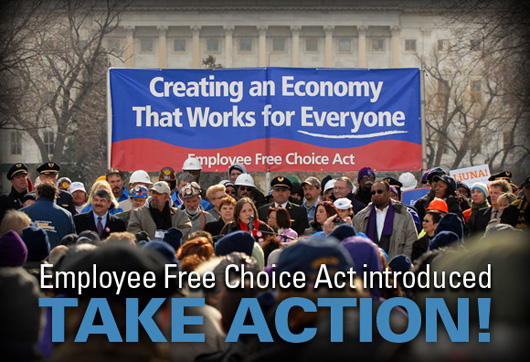
EFCA: Time To Turn Up The Heat - Employee Free Choice Battle’s Just Beginning
by Employee Free Choice News EFCA Saturday, Apr. 04, 2009 at 3:02 PM
Employee Free Choice EFCA: “We cannot stop. We have to continue this fight. It might be long, it might be hard, but we will win the battle. You need to get a hold of your congressperson; you need to tell them we need this act. We cannot continue to have union-busting going on like this. Enough is enough.”
http://cleveland.indymedia.org/news/2009/04/36329.php
http://www.azcentral.com/members/Blog/EFCANOW
by Employee Free Choice News EFCA Saturday, Apr. 04, 2009 at 3:02 PM
Employee Free Choice EFCA: “We cannot stop. We have to continue this fight. It might be long, it might be hard, but we will win the battle. You need to get a hold of your congressperson; you need to tell them we need this act. We cannot continue to have union-busting going on like this. Enough is enough.”
http://cleveland.indymedia.org/news/2009/04/36329.php
http://www.azcentral.com/members/Blog/EFCANOW
For more information:
http://cleveland.indymedia.org/news/2009/0...

Photo by Jason Kosena/The Colorado Statesman Stewart Acuff, special assistant to AFL-CIO President John Sweeney and spearhead of the EFCA, told The Colorado Statesman this week that organized labor is ready to work on behalf of lawmakers who “do the right thing” and support the act.
Stewart Acuff, special assistant to AFL-CIO President John Sweeney touts Employee Free Choice Act : EFCA campaign
By Jason Kosena THE COLORADO STATESMAN
The heat is on when it comes to the Employee Free Choice Act.
One week after U.S. Chamber of Commerce President Tom Donohue came to Denver to talk to business leaders about the importance of opposing the EFCA, a major labor leader made stops up and down the Front Range to promote the proposed legislation.
Reps. Mike Merrifeld, D-Colorado Springs, Judy Solano, D-Thornton and Rep. Gwyn Green, D-Golden, listen to a presentation by the AFL-CIO.
Acuff said that — unlike Donohue, who publicly promised last week that the business community would go after middle-of-the-road senators such as Colorado’s Michael Bennet if they choose to vote for the EFCA — he isn’t planning to play hardball.
“I will leave it to the business community to bully political leaders in the way they bully their employees,” Acuff said. “We’re not making any threats, as they are. But we are appealing to senators’ common sense and their sense of fairness…. We will fight as hard as we can to protect everyone who makes the right decision about this legislation.”
The EFCA would ease union organization rules and, in theory, clear a path for organized labor to eliminate a secret ballot in elections on whether to unionize. Republicans and business leaders say union bosses will use the open voting process to intimidate voters they know oppose union formation.
Democrats and organized labor disagree, pointing to a provision in the act that would allow for a secret ballot if 30 percent of workers ask for one. Furthermore, they say, it will level the playing field because corporate bosses currently are able to intimidate workers who are known to favor unionization.
AFL-CIO special assistant to the president Stewart Acuff speaks to Colorado lawmakers about the Employee Free Choice Act on Tuesday during a legislative breakfast.
The Colorado Statesman Acuff was in Colorado Springs, Denver and Boulder touting the importance of the labor law revision. His Front Range tour included a legislative breakfast with a handful of Democratic state lawmakers at the Colorado Education Association Tuesday morning. During the breakfast, Acuff made an impassioned speech, stressing the importance of the EFCA to working Americans and urging those in attendance to contact Bennet and demand that he support the bill.
The EFCA is not an easy call for Bennet.
He has been targeted by both labor and business groups since arriving in Congress because both feel they can appeal to his moderate political views. Bennet — a former executive for Phil Anschutz and superintendent of Denver Public Schools who has never run for public office — has appeal to the business community but was appointed to his seat by Democratic Gov. Bill Ritter. Furthermore, Bennet, along with Colorado Sen. Mark Udall, recently joined a working group of moderate Senate Democrats that, according to some insiders, will play a role in brokering a compromise on the EFCA.
Bennet has yet to make a public statement about his position on the EFCA except to say he is studying the legislation and weighing the arguments. That hasn’t stopped labor and business interests from intensifying their lobbying campaign, however.
AFL-CIO Colorado chapter leader Mike Cerbo listens intently.
The Colorado Statesman As Acuff was in Denver asking lawmakers and labor supporters to contact Bennet in order to lobby for passage of the EFCA, a delegation from the Colorado Association of Commerce and Industry was on its way to Washington to persuade Senators Bennet and Udall to oppose the legislation.
Acuff told his Denver audience that he believes the legislation will come before Congress in seven to eight weeks and that he is hopeful Senate Democrats will be able to round up 60 votes.
“This is a close game we’re playing here,” Acuff told lawmakers Tuesday morning. “Saying (Minnesota senator-elect) Al Franken is seated, we need every Democrat to support this, and one Republican. We are working on the Republican side of things, but you can help us with the Democrats like Mark Udall and Michael Bennet who have not stated their positions.”
Most political observers agree that most voters will not view the EFCA as a campaign issue by November 2010, but that the issue will help define the nation’s newly elected officeholders. If he were to oppose the bill, Bennet might find it hard to attract union campaign donations, or he could see organized labor get behind another Democrat — possibly one Ritter passed up to appoint Bennet — in order to wage an expensive primary.
On the other hand, if he votes for the legislation, Bennet risks losing his image as a business-friendly Democrat, and he could see anti-labor forces pour millions of dollars into a 2010 GOP campaign against him.
Although state lawmakers do not have a direct vote on the EFCA issue, Rep. John Kefalas, D-Fort Collins, said he wanted to attend the breakfast with Acuff to get better information and to support labor.
“I think this legislation is very important to working families and the middle class in America,” Kefalas said after the event. “I came today because I wanted more information but also because I feel it’s important that we all reach out and see what we can do to ensure this bill is passed. Talking to people and contacting our (national) lawmakers is all part of that.”

www.TheTruthAboutEFCA.Org
http://efcanow.blogspot.com/
For more information on Employer Intimidation and Union-Busting FEAR Tactics Press Below
http://efcanow.blogspot.com/2009/02/just-say-no-to-employee-free-choice-act.html
http://www.azcentral.com/members/Blog/EFCANOW
http://efcaunionbustingclub.blogspot.com/
http://www.employeefreechoiceactnow.org
http://www.FreeChoiceActNow.Org
http://www.LaborUnionResources.Org
Tags: Stewart Acuff, Employee Free Choice Act, Employee Free Choice, EFCA, Free Choice Act, Free Choice, Labor Union, Employee Free Choice Grassroots, The Truth about EFCA, Employee Free Choice Support, AFL-CIO, Workers Rights, Labor Reform, Union Blogs, Working Families, John Sweeney
For more information:
http://efcanow.blogspot.com/

By: Steve Maritas International Organizing Director for The International Union, Security, Police and Fire Professionals of America (SPFPA) www.SPFPA.Org
Breaking News: Now another Senate Democrat, Colorado Senator Michael Bennet, has told a gathering of constituents in his state that the EFCA can’t pass in its current form, according to the Fort Collins Coloradoan: Source Coloradoan.com
“We’re going to have to see whether or not there’s a consensus that can be reached that makes it something that can be passed because right now there isn’t something that can be passed,” Bennet told the group at New Belgium.
Sen. Specter, Feinstein, Lincoln and now Colorado Senator Michael Bennet Now Opens The Door for The Employee Free Choice EFCA Labor Reform Compromise Bills
While many Corporate Front Groups such as the Coalition for a Democratic Workplace, Save our Secret Ballot and U.S. Chamber of Commerce are celebrating the news that Sen. Blanche Lincoln and now Colorado Senator Michael Bennet won't support the EFCA bill in its current form, joining two past supporters of a similar bill -- Sens. Dianne Feinstein, D-Calif., and Arlen Specter, R-Pa. -- who both said they would not vote for the legislation in its current form, their victory is once again short lived!
In its current form The Employee Free Choice Act (EFCA) is legislation in the United States which aims to "amend the National Labor Relations Act to establish an efficient system to enable employees to form, join, or assist labor organizations, to provide for mandatory injunctions for unfair labor practices during organizing efforts, and for other purposes by FACILITATING INITIAL COLLECTIVE BARGAINING AGREEMENTS and STRENGTHENING ENFORCEMENT.
When corporate front groups talk about the Employee Free Choice Act (EFCA)they target only the bill itself. However the EFCA is just not about majority signup, binding arbitration, and strengthening enforcment.
In principle The Employee Free Choice Act (EFCA) stands for much more. Its about fixing a broken system, leveling the playing field for workers who wish to gain a voice on the job, RESPECT, Job Security, Better Benefits, Higher Wages and Better Working conditions and much more. It represents the workers struggles and the middle class trying to acheive a better life for them and their families.
In any shape or form The Employee Free Choice Act (EFCA) stands for Labor Reform!
Under its current form EFCA looks at only three areas of change. Under a EFCA Labor Reform Compromise Bill we will now see many areas which have yet been put onto the table for discussion such as:
Dual Membership Cards allowing the employee to decide how his or her union membership card is to be used. Either by a Secret Ballot Election or under the EFCA majority signup process. Press Here for More Information
Allowing "Neutrality Agreements" whereby an employer agrees to stand neutral "Not For or Against" a union's attempt to organize its workforce. In return a "Secret Ballot" Election must be held for certification under this process.
An alternative to the 50 plus 1 is to make it 60 percent for certification.
To amend the National Labor Relations Act to require employers to provide labor organizations with equal access to employees prior to an election regarding representation prior to any organizing drive to see if such employee wish a desire to be represented by a labor organization or individual.
Authorizing the NLRB to impose treble back pay without reduction for mitigation when an employee is unlawfully fired.
Conduct quicker elections rather than 42-day period.
Prohibit the use of anti-union consultants as persuaders once an election is filed or notice to an employer by a union is sent.
Prohibit mandatory union-busting meetings by an employer. All meetings would now be voluntary for both sides.
Modify the NLRA to give the court broader discretion to impose a Gissel order on a finding that the environment has deteriorated to the extent that a fair election is not possible.
On a finding that a party is not negotiating in good faith, an order may be issued establishing a schedule for negotiation and imposing costs and attorney fees.
Broaden the provisions for injunctive relief with reasonable attorneys’ fees on a finding that either party is not acting in good faith.
Last best offer" arbitration of contract terms.
Authorizing the award of reasonable attorneys’ fees on a finding of harassment, causing unnecessary delay or bad faith.
Putting a time limit for objections to be heard and resolved.
Demanding a Secret Ballot Election before an employer can pull recognition(Presently an Employer can do this without a "Secret Ballot" Election.
Eliminating Right to Work laws or having those employees who wish to be part of the union and covered by a collective bargaining agreement in a Right to Work be the ones who are entitled to the benefits of the collective bargaining negotiated by the union.
In conclusion the Employee Free Choice Act EFCA is far from dead!
Senator Specter said it best when he signaled a receptiveness to possible amendments to the National Labor Relations Act ("Act") that purport to remedy what he perceives as defects in the current system. In fact, he's detailed several of the changes he'd like to see.
Based on Sen.Specter, Feinstein, and Lincolns' actions they have now Opened the Door for The Employee Free Choice EFCA Labor Reform Compromise Bills, which are much stronger then in its current form giving new life to the Employee Free Choice Act EFCA Labor Reform Movement - NO Surrender NO Retreat!
Realated Articles: Thinking Outside The Box to Get The Employee Free Choice Act EFCA Passed Press Here
LABOR: "WE'RE ESCALATING" ON EMPLOYEE FREE CHOICE. Press Here
Wavering Dem Senator Will Cast Key Vote For EFCA
Now centrist Senator Mark Warner is confirming that he’s backing cloture. Despite being aggressively targeted by EFCA foes, here’s what he wrote in a letter to constituents: Source The Plum Line
“I believe there is a need for reform in this area, and that EFCA should be debated and voted upon by the Senate. I intend to evaluate any prevailing proposal to ensure that it allows workers and employers to be adequately informed and that it ultimately provides a fair and level playing field for both management and labor.”
Tags: Corporate Front Groups, Coalition for a Democratic Workplace, Sen Specter, Sen Feinstein, Sen Lincoln, Employee Free Choice, EFCA, Free Choice Act, Free Choice, Employee Free Choice Compromise, EFCA Compromise, Labor Union, Unions, Steve Maritas, SPFPA
For more information:
http://efcanow.blogspot.com/
We are 100% volunteer and depend on your participation to sustain our efforts!
Donate

$115.00 donated
in the past month
Get Involved
If you'd like to help with maintaining or developing the website, contact us.
Publish
Publish your stories and upcoming events on Indybay.
Topics
More
Search Indybay's Archives
Advanced Search
►
▼
IMC Network