







 Publish to Newswire
 Add an Event
From the Open-Publishing Calendar
From the Open-Publishing Newswire
Indybay Feature
Yurok Tribe Presents River of Renewal at Tribal Office Feb. 6, 6 p.m.
The Yurok Tribe is screening the award-winning documentary, River of Renewal, on Friday, February 6 at 6 p.m. at the Yurok Tribal Offices in Klamath, California.
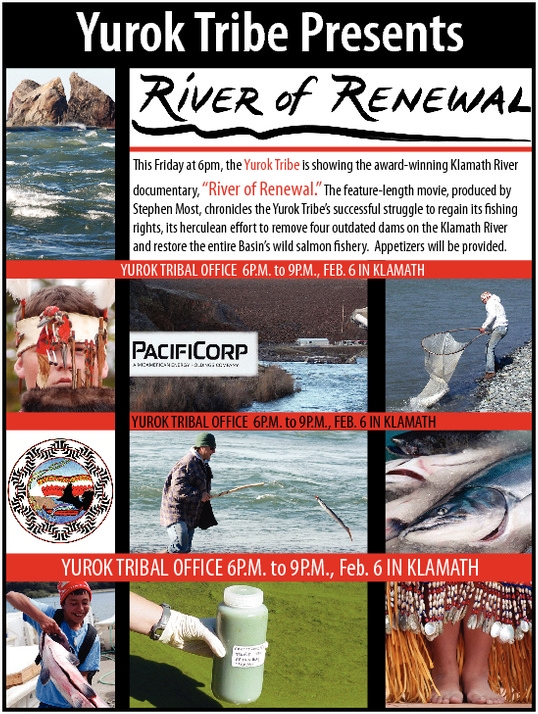
The Yurok Tribe is screening the award-winning documentary, River of Renewal, on Friday, February 6 at 6 p.m. at the Yurok Tribal Office in Klamath. The film, adapted from Most’s book River of Renewal, Myth and History in the Klamath Basin, earned best documentary honors at the American Indian Film Festival last year.
Most will attend the showing and will be available for questions following the movie. Troy Fletcher, the Yurok Tribe’s Policy Analyst and lead negotiator in the Klamath Basin Restoration Agreement talks, will talk about the Yurok Tribe’s perspective concerning the Agreement in Principle to remove the dams and on the Klamath Basin Restoration Agreement negotiations.
The thrust of the film unveils how former nemeses in the basin formed a storm-proof alliance to solve one of the most complex water issues in the Western United States through mutual agreements — still in the process of being fine-tuned — rather than through litigation.
“I want people to know that it is very important how this turns out,” Most said.
River of Renewal shows one of the great rivers of America in crisis while telling the story of a "sidewalk Indian" who discovers his roots among the Klamath River tribes. Jack Kohler comes to the mouth of the Klamath River to make a film about the 1978 Salmon War, the subject of a play in which he had acted as a Yurok fishermen.
Then an event occurs at the headwaters that brings the conflict over salmon into the 21st century. Farmers protest the federal cut-off of irrigation water due to a judge's ruling under the Endangered Species Act to protect three fish species, including coho salmon.Bypassing the ESA, the Bush Administration orders the unlimited release of water to farmers in 2002.
Later that year, 80,000 spawning salmon die in the Klamath estuary. That disaster leads to the collapse of the salmon fishery off the California and Oregon coasts several years later. The polarization of Klamath Basin communities gives way to conflict resolution and consensus building in view of the potential decommissioning of Klamath Basin hydroelectric dams that cut salmon off from hundreds of miles of spawning habitat. Recognizing that their livelihoods all depend on the health of the river, stakeholders who had been antagonists agree to share the water and to demand the removal of the dams.
Working on the movie “I saw a very powerful story emerging in which the Tribes, farmers and ranchers, and commercial fishermen came together to work for the benefit of their communities, but also for the watershed as a whole,” Most said.
Currently, the majority of Klamath Basin stakeholders, which include the states of Oregon and California and the federal government as well as Upper Basin farmers and ranchers, the Yurok and Karuk tribes, and the Klamath Tribes of Oregon, are finalizing an agreement in principle that will remove the Klamath dams by 2020. Simultaneously, the same alliance is cinching up a restoration agreement, which is indivisible from the dam removal deal, aimed at fixing the water problems on the Klamath Basin for good.
“If the deals clear the necessary hurdles, we will see the largest dam removal in the history of the United States,” said Most. “If they do not, we will see a dying river and that will have a devastating effect on the Basin’s wildlife and on the economy of the region.”
Stephen Most co-wrote Berkeley in the Sixties (1990) which received an Academy Award nomination, worked as Consulting Writer and Researcher on Promises (2001) which won Emmys for best documentary and outstanding background analysis and wrote Wonders of Nature for the Great Wonders of the World (1993) series, which won an Emmy for best special non-fiction program.
For more information, go to the Yurok Tribe's website, http://www.yuroktribe.org.
Most will attend the showing and will be available for questions following the movie. Troy Fletcher, the Yurok Tribe’s Policy Analyst and lead negotiator in the Klamath Basin Restoration Agreement talks, will talk about the Yurok Tribe’s perspective concerning the Agreement in Principle to remove the dams and on the Klamath Basin Restoration Agreement negotiations.
The thrust of the film unveils how former nemeses in the basin formed a storm-proof alliance to solve one of the most complex water issues in the Western United States through mutual agreements — still in the process of being fine-tuned — rather than through litigation.
“I want people to know that it is very important how this turns out,” Most said.
River of Renewal shows one of the great rivers of America in crisis while telling the story of a "sidewalk Indian" who discovers his roots among the Klamath River tribes. Jack Kohler comes to the mouth of the Klamath River to make a film about the 1978 Salmon War, the subject of a play in which he had acted as a Yurok fishermen.
Then an event occurs at the headwaters that brings the conflict over salmon into the 21st century. Farmers protest the federal cut-off of irrigation water due to a judge's ruling under the Endangered Species Act to protect three fish species, including coho salmon.Bypassing the ESA, the Bush Administration orders the unlimited release of water to farmers in 2002.
Later that year, 80,000 spawning salmon die in the Klamath estuary. That disaster leads to the collapse of the salmon fishery off the California and Oregon coasts several years later. The polarization of Klamath Basin communities gives way to conflict resolution and consensus building in view of the potential decommissioning of Klamath Basin hydroelectric dams that cut salmon off from hundreds of miles of spawning habitat. Recognizing that their livelihoods all depend on the health of the river, stakeholders who had been antagonists agree to share the water and to demand the removal of the dams.
Working on the movie “I saw a very powerful story emerging in which the Tribes, farmers and ranchers, and commercial fishermen came together to work for the benefit of their communities, but also for the watershed as a whole,” Most said.
Currently, the majority of Klamath Basin stakeholders, which include the states of Oregon and California and the federal government as well as Upper Basin farmers and ranchers, the Yurok and Karuk tribes, and the Klamath Tribes of Oregon, are finalizing an agreement in principle that will remove the Klamath dams by 2020. Simultaneously, the same alliance is cinching up a restoration agreement, which is indivisible from the dam removal deal, aimed at fixing the water problems on the Klamath Basin for good.
“If the deals clear the necessary hurdles, we will see the largest dam removal in the history of the United States,” said Most. “If they do not, we will see a dying river and that will have a devastating effect on the Basin’s wildlife and on the economy of the region.”
Stephen Most co-wrote Berkeley in the Sixties (1990) which received an Academy Award nomination, worked as Consulting Writer and Researcher on Promises (2001) which won Emmys for best documentary and outstanding background analysis and wrote Wonders of Nature for the Great Wonders of the World (1993) series, which won an Emmy for best special non-fiction program.
For more information, go to the Yurok Tribe's website, http://www.yuroktribe.org.
Add Your Comments
We are 100% volunteer and depend on your participation to sustain our efforts!
Donate

$110.00 donated
in the past month
Get Involved
If you'd like to help with maintaining or developing the website, contact us.
Publish
Publish your stories and upcoming events on Indybay.
Topics
More
Search Indybay's Archives
Advanced Search
►
▼
IMC Network