







 Publish to Newswire
 Add an Event
From the Open-Publishing Calendar
From the Open-Publishing Newswire
Indybay Feature
Refining the California Ag Vision during Kwanzaa Season 2008
California Ag Vision 2030 can utilize the notion of Sankofa before the "Water Wars" begin. "Sankofa" teaches us that we must go back to our roots in order to move forward. That is, we should reach back and gather the best of what our past has to teach us, so that we can achieve our full potential as we move forward. Whatever we have lost, forgotten, forgone or been stripped of, can be reclaimed, revived, preserved and perpetuated.
The Food, Conservation and Energy Act of 2008, for the first time, canonized in U.S. Agriculture Law inclusion of tangible progress for socially disadvantaged producers and our USDA/Community Based Organization partnership will bring home the arugula to California for a harvest celebration of the Kwanzaa season.
2008 Agriculture Census and 2010 Population Census will quantify salient California data necessary to qualify projected trends for a credible forecast toward refining an inclusive California Ag Vision for 2030.
Asian and Pacific Islanders, Black, Latino, Native American, Immigrant, Refugee and Farm workers have specific new USDA programs to bridge past discrimination, lack of access and tracking effective participation in tax-payer resources support for our U.S. agriculture industry.
California Congressional Agriculture Leadership balanced competing objectives of historic industrial agriculture while embracing innovative sustainable agriculture, especially the inclusion of new programs for “socially disadvantaged farmers and ranchers.”
A special thanks to our complete California Congressional Delegation lead by Speaker Pelosi and our 4 California regal members of the Congressional Black Caucus, Congresswomen Maxine Waters, Babara Lee, Diane Watson and Laura Richardson whom continue to support the endangered species, Black Agriculture producers in California.
House Agriculture Subcommittee Chairman on Department Operations, Oversight, Nutrition, and Forestry Chairman, Joe Baca, (D-CA)
House Agriculture Subcommittee Chairman on Horticulture and Organic Agriculture, Dennis A. Cardoza, (D-CA)
House Ag Committee Member, Jim Costa (D-CA)
Senate Agriculture Appropriations, Senator Diane Feinstein (D-CA)
House Agriculture Appropriations, Congressman Sam Farr (D-CA)
Deserve special thanks from all whom celebrated the plentiful California harvest and plan for a California Ag Vision 2030.
Congresswomen Barbara Lee (D-CA) will lead the powerful Congressional Black Caucus and Assemblyman Sandre Swanson (D-CA) will lead the powerful California Legislative Black Caucus; increasing the potential of the Bay Area Regional Food System to becoming the nation’s leading Urban Agriculture Center as envision and enacted in 1845 by the first Black Diplomat in U.S. History the Honorable William Alexander Leidesdorff, Jr., "Afro-Cuban Danish-Jewish Founding Father of California"
Today, President Elect Barack Obama selected Adolfo Carrión, Jr.; White House Director of Urban Policy who may include recommendations toward city revitalization effort which include greater partnerships that utilize community based urban agriculture job creation. Positive nationwide examples of the regenerative effect on communities where vacant lots are transformed from trash-ridden, dangerous, unproductive gathering places of ill repute into bountiful, beautiful and productive community resources.
Urban agriculture is defined in simple terms as owning, growing, processing and distributing food and other products through intensive plant cultivation within the urban service boundary around our population centers for a sustainable future.
Globally, the intensive methods of production maximize the efficiency of small-scale operations and create a plethora a ‘green jobs.’ A renaissance of agriculture based small businesses development in partnership with industrial large scale production is the future.
In many cases, the fruit and vegetable varieties sold in supermarkets are chosen for their ability to withstand industrial harvesting equipment and extended travel, not for their taste or nutritional value or visual quality.
Labor intensive ethnic specialty crops have a high yield and do not have the quantifiable environmental costs of large-scale, industrial agriculture include air pollution, surface and groundwater contamination, soil erosion, and loss of bio-diversity.
California is blessed with several regional local food systems that can connect regional producers, processors, distributors to all consumers. California Agriculture saw a 15 percent gain in the sales value of its products in 2007, to a record 36.6 billion total industry with well over 100 billion in related economic activity, battling our high-tech industry for California’s #1 economic market, yet epidemic levels of diet related disease persists.
Now is the time for a California Agriculture vision inclusive of rural industrial agriculture with large-scale production and urban agriculture with small-scale production to move toward sharing appropriate processing and marketing and distribution systems.
Now is the time for a California Agriculture vision inclusive of ethnic diversity at every level and facets of our dynamic worldwide leading agriculture industry.
Now is the time for a California Agriculture vision inclusive of serving the needs of all California, especially farm workers who are essential for a bountiful safe harvest.
If the California Department of Food and Agriculture Board can choose to include and recognize “left out” significant historical contributions from Native American, Hawaiian and Black agriculture producers toward the establishment of our early California Agriculture, then the California Department of Food and Agriculture Board can choose to include and recognize those who are “left out” in the current draft of the California Agriculture Vision 2030.
Governor Arnold Schwarzenegger will appreciate the assistance in sharing this Republican backed agriculture agenda for a long term future vision of California during these difficult times for the broader economy.
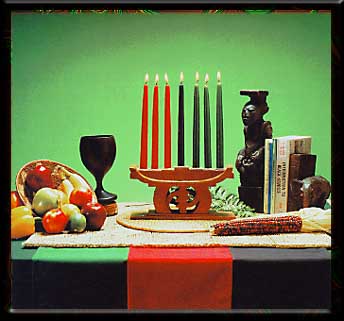
Kwanzaa is a “California Grown” global celebration of giving our “first fruits of the harvest to our creator.” Many extended family agricultural tradition that aligns well with the biblical notion of Proverbs 3:9 and most ancient agriculture traditions recognize nature's fate in a plentiful harvest, Black Agriculture is no different.
In the first Kwanzaa documentary, The Black Candle, scholar Scott Brown says, "As long as Africa is pushed to the margins of humanity as far as giving credit for what it has given to humanity in terms of intellectual, scientific, philosophical, cultural presence in our lives, there will be a need for Kwanzaa.”
December 18, 2008 is Kwanzaa Family Night at the Bayview Branch of the San Francisco library, 5075 Third St. The event, from 6 to 8 p.m., will feature music, dance, poetry and a showing of "The Black Candle." You don’t want to miss this opportunity.
Global markets will continue to place a premium on our “California Grown” bounty however continued significant agriculture investment must embrace new Congressional and Legislative leadership, especially during this current round of multifaceted water wars fundamental to any long term Rural and/or Urban California Agriculture Vision.
2008 Agriculture Census and 2010 Population Census will quantify salient California data necessary to qualify projected trends for a credible forecast toward refining an inclusive California Ag Vision for 2030.
Asian and Pacific Islanders, Black, Latino, Native American, Immigrant, Refugee and Farm workers have specific new USDA programs to bridge past discrimination, lack of access and tracking effective participation in tax-payer resources support for our U.S. agriculture industry.
California Congressional Agriculture Leadership balanced competing objectives of historic industrial agriculture while embracing innovative sustainable agriculture, especially the inclusion of new programs for “socially disadvantaged farmers and ranchers.”
A special thanks to our complete California Congressional Delegation lead by Speaker Pelosi and our 4 California regal members of the Congressional Black Caucus, Congresswomen Maxine Waters, Babara Lee, Diane Watson and Laura Richardson whom continue to support the endangered species, Black Agriculture producers in California.
House Agriculture Subcommittee Chairman on Department Operations, Oversight, Nutrition, and Forestry Chairman, Joe Baca, (D-CA)
House Agriculture Subcommittee Chairman on Horticulture and Organic Agriculture, Dennis A. Cardoza, (D-CA)
House Ag Committee Member, Jim Costa (D-CA)
Senate Agriculture Appropriations, Senator Diane Feinstein (D-CA)
House Agriculture Appropriations, Congressman Sam Farr (D-CA)
Deserve special thanks from all whom celebrated the plentiful California harvest and plan for a California Ag Vision 2030.
Congresswomen Barbara Lee (D-CA) will lead the powerful Congressional Black Caucus and Assemblyman Sandre Swanson (D-CA) will lead the powerful California Legislative Black Caucus; increasing the potential of the Bay Area Regional Food System to becoming the nation’s leading Urban Agriculture Center as envision and enacted in 1845 by the first Black Diplomat in U.S. History the Honorable William Alexander Leidesdorff, Jr., "Afro-Cuban Danish-Jewish Founding Father of California"
Today, President Elect Barack Obama selected Adolfo Carrión, Jr.; White House Director of Urban Policy who may include recommendations toward city revitalization effort which include greater partnerships that utilize community based urban agriculture job creation. Positive nationwide examples of the regenerative effect on communities where vacant lots are transformed from trash-ridden, dangerous, unproductive gathering places of ill repute into bountiful, beautiful and productive community resources.
Urban agriculture is defined in simple terms as owning, growing, processing and distributing food and other products through intensive plant cultivation within the urban service boundary around our population centers for a sustainable future.
Globally, the intensive methods of production maximize the efficiency of small-scale operations and create a plethora a ‘green jobs.’ A renaissance of agriculture based small businesses development in partnership with industrial large scale production is the future.
In many cases, the fruit and vegetable varieties sold in supermarkets are chosen for their ability to withstand industrial harvesting equipment and extended travel, not for their taste or nutritional value or visual quality.
Labor intensive ethnic specialty crops have a high yield and do not have the quantifiable environmental costs of large-scale, industrial agriculture include air pollution, surface and groundwater contamination, soil erosion, and loss of bio-diversity.
California is blessed with several regional local food systems that can connect regional producers, processors, distributors to all consumers. California Agriculture saw a 15 percent gain in the sales value of its products in 2007, to a record 36.6 billion total industry with well over 100 billion in related economic activity, battling our high-tech industry for California’s #1 economic market, yet epidemic levels of diet related disease persists.
Now is the time for a California Agriculture vision inclusive of rural industrial agriculture with large-scale production and urban agriculture with small-scale production to move toward sharing appropriate processing and marketing and distribution systems.
Now is the time for a California Agriculture vision inclusive of ethnic diversity at every level and facets of our dynamic worldwide leading agriculture industry.
Now is the time for a California Agriculture vision inclusive of serving the needs of all California, especially farm workers who are essential for a bountiful safe harvest.
If the California Department of Food and Agriculture Board can choose to include and recognize “left out” significant historical contributions from Native American, Hawaiian and Black agriculture producers toward the establishment of our early California Agriculture, then the California Department of Food and Agriculture Board can choose to include and recognize those who are “left out” in the current draft of the California Agriculture Vision 2030.
Governor Arnold Schwarzenegger will appreciate the assistance in sharing this Republican backed agriculture agenda for a long term future vision of California during these difficult times for the broader economy.
Kwanzaa is a “California Grown” global celebration of giving our “first fruits of the harvest to our creator.” Many extended family agricultural tradition that aligns well with the biblical notion of Proverbs 3:9 and most ancient agriculture traditions recognize nature's fate in a plentiful harvest, Black Agriculture is no different.
In the first Kwanzaa documentary, The Black Candle, scholar Scott Brown says, "As long as Africa is pushed to the margins of humanity as far as giving credit for what it has given to humanity in terms of intellectual, scientific, philosophical, cultural presence in our lives, there will be a need for Kwanzaa.”
December 18, 2008 is Kwanzaa Family Night at the Bayview Branch of the San Francisco library, 5075 Third St. The event, from 6 to 8 p.m., will feature music, dance, poetry and a showing of "The Black Candle." You don’t want to miss this opportunity.
Global markets will continue to place a premium on our “California Grown” bounty however continued significant agriculture investment must embrace new Congressional and Legislative leadership, especially during this current round of multifaceted water wars fundamental to any long term Rural and/or Urban California Agriculture Vision.
For more information:
http://www.theblackcandle.com
Add Your Comments
We are 100% volunteer and depend on your participation to sustain our efforts!
Donate

$110.00 donated
in the past month
Get Involved
If you'd like to help with maintaining or developing the website, contact us.
Publish
Publish your stories and upcoming events on Indybay.
Topics
More
Search Indybay's Archives
Advanced Search
►
▼
IMC Network