







 Publish to Newswire
 Add an Event
From the Open-Publishing Calendar
From the Open-Publishing Newswire
Indybay Feature
Interview to Leonel Rivero Rodriguez, lawyer of the migrantes workers of FLOC
Of passage by FLOC in September, we asked Rivero Rodriguez to him on the bond that establishes Monterrey, Mé xico, in the flow of the migrantes workers of Ohio; we requested to him that Rafael Cruz in the context of Mé speaks to us of the case of Santiago; xico and of the Inter-American Commission of the Right Smoke; and finally, that paints a picture to us of the human rights in México.
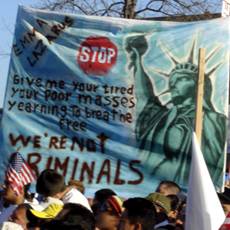
Between Monterrey, Mé xico, and Toledo, Ohio
Toledo. From 1967, when FLOC (Farm was based Work Organizing Committee/Comité Organizer of Workers of the Field), until 1994, the fight of the workers of the field in Ohio was mainly one who carried out migrantes mexicoamericanos of Texas. Despué s of the Free Trade Agreement of Amé rich from Norte (TLCAN), a measurement that destroyed Mexican agriculture, in 1994, the manual labor arrived at Ohio from Mé xico. Nothing of which, with marches, strikes, arrests, have obtained the migrantes workers to travé s of its union, FLOC, has been fécil. But nothing had been as bad as what, in 2007, it passed to Santiago Rafael to him Cruz, representative of FLOC in Monterrey, Mé xico: it was assassinated. As a result of the crime, FLOC contracts to the services of Leonel Rivero Rodriguez, recognized lawyer of the human rights in Mé xico, to determine qué it happened and to demand justice.
Between 1983 and 1996, Rivero Rodriguez represented several unions in industries like General Motors, Volkswagen and Renault. Tambié n represented many university employees, including the one of the Independent National University of Mé xico; to the workers of the newspaper the Day and to those of the Nuclear Industrialist. From 2001 to 2003, he was lawyer of the Federal District of Mé xico, Cuauhtemoc Delegation, in questions related to the corruption at high levels of the government.
From 1997 to 2008, its work has been centered in the defense of the human rights. Among other cases, it represents the movement Towns in Earth Defense of Atenco, whose members are processings to defend their earth before the desarrollista attempt to construct a new international airport for the City of Mé xico. It process provides legal defense to the students by its participation in last strike in the Independent University with Mé xico. Next to a team of lawyers like Maria of the Noriega Pillar Garci'a, Worthy Ochoa, Plécido and José Lamberto, defends to a group of individuals accused by the Federal Government by its presumed participation in guerrilla detachments. It provides legal consultant's office to several organizations with human rights, like the Popular Coordinator of Madres Educadoras (COPOME), Citizens in Support to the Human rights (CADHAC), In front Popular Francisco Villa, National Center of Comunicación Social (CENCOS). It is part of an international team of seven lawyers that guards because the human rights in the cases against Euskal Herria are protected.
Of passage by FLOC in September, we asked Rivero Rodriguez to him on the bond that establishes Monterrey, Mé xico, in the flow of the migrantes workers of Ohio; we requested to him that Rafael Cruz in the context of Mé speaks to us of the case of Santiago; xico and of the Inter-American Commission of the Right Smoke; and finally, that paints a picture to us of the human rights in Mé xico.
--¿Qué it means Monterrey for the Mexican migrantes workers who go to the United States contracted under the visa program H2A?
Monterrey means the final step towards the United States, because it is where the migrantes workers carry out trémites migratory in the North American consulate, as the visa expedition to be able to happen to the United States. Monterrey has become a point estraté gico in Mé xico because the migrantes are not only concentrated there, but tambié n is the place in which all a series of legal and illegal movements is carried out. Tambié n is a passage for the people who if at some time she is rejected, can choose to happen thus of illegal, irregular way, digemos it, to the United States.
--¿Strain are the typical cases of corruption that FLOC is trying to come up?
The temporary migratory worker must pay an approximated cost of 350 dollars, that include trémite of visa and the transfer, That money, when arriving at the United States, is reimbursed by the patrons. Nevertheless, something that apparently is very simple, is already not transferred it to the Mexican question. And he is not so simple because first that we cannot leave of side, it is the serious economic crisis that there is in Mé xico and the high index of unemployment. That implies that there is a sobresupply of manual labor, which saturates the market and ademés causes that if people want to go to work to the United States, often pays from 1.000 to 1, 500 dollars like a compensation or a bribe to the person who contracts it to be able to go to the United States.
The work of FLOC is, from which it knows those abuses, to report them to the NCGA, so that they stop.
--¿How the Mexican authorities in the corruption take part?
In agreement with the Federal Law of the Work, a law that derives from article 123 constitutionalist, who regulates the relations obreropatronal and that at their moment were one of the proposals month outposts of century XX, by the protectionism level that occurred to the worker him, because that law establishes that, for the workers who must themselves move abroad, the employer has the obligation to make them extensive at least the benefits that the own Federal Law of the Work or the constitution consecrates in their favor.
--¿How?
By means of procedure of supervision that it has to carry out the Mexican labor authority, supervision of contract of work that implies, for example, that a pattern that transfers workers to the foreigner would have to leave to a guarantee or a pecuniaria guarantee who guaranteed, in case of some breach, was compensated the worker of that bottom. That does not become. From that moment the authority is failing to fulfill with a constitutional mandate.
Now, when the authority has had knowledge of the acts of corruption by means of complaints or denunciations that have raised affected workers, it has not done anything; it has protected, solapendo it, to that network of corruption. Inclusively, it receives money of those same networks of protection. The own experience of FLOC that of their personnel was persecuted much and accused by the authorities as much of the government again Leon like of other states of the republic in where it has partners and has been affiliated. That is a way in which the government participates in not doing, in an omission, in not watching that the rights of their workers are respected; and in doing, that is to receive money and to protect those networks of corruption.
--¿Monterrey has become a blurred image of Tijuana, bridge to arrive at the United States?
No, I believe that no, she has not arrived at that level; although estraté is a zone; gica, mainly because it is a territory of passage for the workers who go to the fields of Florida, of Carolina of the North, Ohio. Nevertheless, Tijuana continues being one of the borders with greater mobility than they exist, important by the high degree of Latin that that way circulate, not only Mexican but tambié n Central American and people of Suramé rich, that happens for California, for Arizona, for New Mé xico…
--¿Monterrey is month specialized in the Mexican agricultural work?
Exactly, Monterrey centralizes month in that agricultural work. Now, in qué estraté has become; gico Monterrey? Then, in congregating the migrantes workers, the class of workers unprotected month, vulnerable month that during centuries operation has undergone. It is a class that always has been private in Mé xico not only of the elementary rights month, but that ademés has been pressed. This makes vulnerable doubly. First, before the Mexican authorities, because they do not respect its rights; and despué s, month still vulnerable, in the United States, because they arrive with a total ignorance and a history of oppression. That marks them like workers.
--¿You can give to a synthesis on the case of Santiago Rafael us Cruz? Qué it happened and where it is the case at the moment?
Santiago Rafael Cruz arrived at the city of Monterrey in the middle of the month of February of 2007; it went contracted by union FLOC to reinforce its activities in defense of the migrantes workers and, lamentably, to the month and means, the nine of April of 2007, it was assassinated inside the offices of the union. Its murder occurred in a context in which a spiral of violence in Monterrey existed; only in the one hundred first days of the year they had taken place month of forty executions, and at some time the government tried to establish the death of Santiago like an execution month of the organized crime, of the common delinquency that he was happening.
From a principle, with union FLOC, like the coadyuvancia that I represent, we felt that this had a different origin; we did not agree with the hypothesis of the authorities that month was a crime. Nor which the result of a union dispute was a crime of passion nor, but that it had its antecedents in previous acts of harassments that the personnel of FLOC at different moments had undergone.
The case has been extremely difficult and has had the particularitity of which we have faced some obstéculos that normally do not offer as much resistance on the part of the local and federal authorities so that they carry out an investigation. We have been accompanying that investigation, contributing evidences to the office of the public prosecutor, that were at some time not considered, always tried to impel the case, that it is not filed.
At the moment there is a stopped, accused and sentenced person. But they are left 3 people fugitive (in their murder 4 participated). Several of the evidences that we have approached the office of the public prosecutor are for trying to corroborate the identity of the other aggressors, to impel that they are stopped.
An important step for FLOC is to establish the moving body of the murder, because in as much it is not clarified, we can think that the risk is no disappear, mainly if thinks that the moving body was the work of defense of the migrantes workers.
Although the case of Santiago is in impasse, because it has not been possible to stop to demés cocontributor, we continued impulsendo it local level so that it follows ahead; ademés, we have requested to him to the Inter-American Commission of Human rights that opens a hearing in its next period of decisions, in October, to take the case and of discussing it in that organism; and along with the Mexican state to treat of which the case recovers impulse to obtain the halting and the elucidation of he himself.
--¿There are month cases like the one of Santiago in Monterrey?
That I know, at this moment does not exist any case like the one of Santiago. The case of Santiago has to do with an aggression an organism that protects rights of the migrantes and that somehow the causes of the murder can have intimate relation with the defense of the workers.
--¿Qué it is the Inter-American Commission of the Rights and how you think to insert the case of Santiago in that organism?
It is an almost contentious organism that has its origin in the American Convention of Human rights, the pact of San José (1969), an international instrument that has been subscribed by all the countries of Amé rich, by which the countries are commited to respect the rights consecrated in that American convention. The Commission is an organism before a which as much individual as states can put under controversies on violation the human rights. By that mechanism it is persecuted to force the states to that they respect those human rights. Tambié n, as in the case of Santiago, one looks for that the Commission forces the state to investigate and to punish the people in charge of the crime.
--¿The Mexican state can disregard to the Commission?
In case that the Mexican state did not get to accept a decision of the Commission, it can be subject of an international determination, which in Mé xico we called a extrañamiento; a requirement so that it fulfills. Inclusively, the case of can take before the O.A.S.
If the Inter-American Commission determines it, we can happen to the contentious mechanism, that is the Inter-American Court of Human rights. To take the case before the Court, is to take in opinion to the Mexican state and to put under it the jurisdiction of the Court, and that the Court is pronounced and solved if the Mexican state has fulfilled or it has not perform one's duty to respect the human rights; and mainly, the right to the guarantee of judicial protection that has the family of the victim, to that their rights of due processes are respected
--¿Feasible Cuén seems to you that it is going to be the proposal that does to him to the Commission?
We took to the Commission, three weeks ago, a request so that he opens to a hearing in his next period sessions, that are the third week of October, so that the parts, I mean, the Mexican government, exposes their arguments. We considered that the government has not taken an effective investigation and that for that reason has been managed to clarify neither the murder nor has been able to stop all the people in charge.
What we try with that hearing is that the Commission knows clearly knowledge of cuél is the present situation of the case and that with base in that is exhorted to the Mexican state to that redoubling the investigation efforts so that the murder of Santiago is clarified.
Let us think that he is feasible that the Commission takes care of our request; they were made him arrive all the antecedents from the case; ademés, we have maintained meetings bimonthlily with the Mexican authorities.
--¿By qué to go to the Commission?
The origin of the intervention of the Commission is related to a request that is done to him so that it grants provisional measures; a faculty that has the Commission that force the states to guard by the security and the rights of the people who are subject of those provisional measures. In this case there are three members of FLOC that are subject of those provisional measures and that therefore the Mexican state is forced to guarantee its security by means of different measures, like telé cellular phonos, corporal's rounds, escorts, so that the FLOC people do not undergo any aggression. Pero tambié n has to do with the investigation of the case.
--¿Be esperanzados of which the Commission is going them to take care of?
We considered that there are great possibilities that the Commission yes us dé the hearing.
--Finally, us you could paint a general picture as far as the present situation of the civil rights in the Mé xico of the 20008?
Good, a near picture of civil, political, ecological and social the rights in Mé xico goes of the hand of the crisis of the state; there are serious violations to some right, as in the tactical mission of the civil rights, political participation, freedom of expression, judicial guarantees, of had process; the trénsito rights, mainly from which ejé rcito has taken a preponderant paper in the public security. This has brought of the hand many abuses on the part of the military administrations. It has restricted seriously right of trénsito, of freedom of movement; there has been much violation to the legality rights, of annoyance acts that do not have a foundation and that the authority has carried out them of arbitrary way.
As far as the social rights, there is a tremendous crisis that has taken to the government to make cuts in the social cost, mainly in the question of educative matter, health. There has been a substantial diminution of the budgetary resources, that have discredited not only the quality of the service but that have excluded good part of the population of those services of health.
In general, we can say that the picture is not nothing flattering and that we are entering a crisis of respect to the civil rights, political, economic and cultural.
LQSomos. Francisco Cabanillas. October of 2008.
Other notes of the author
Santiago Rafael Cruz ¡ Present!
Toledo. From 1967, when FLOC (Farm was based Work Organizing Committee/Comité Organizer of Workers of the Field), until 1994, the fight of the workers of the field in Ohio was mainly one who carried out migrantes mexicoamericanos of Texas. Despué s of the Free Trade Agreement of Amé rich from Norte (TLCAN), a measurement that destroyed Mexican agriculture, in 1994, the manual labor arrived at Ohio from Mé xico. Nothing of which, with marches, strikes, arrests, have obtained the migrantes workers to travé s of its union, FLOC, has been fécil. But nothing had been as bad as what, in 2007, it passed to Santiago Rafael to him Cruz, representative of FLOC in Monterrey, Mé xico: it was assassinated. As a result of the crime, FLOC contracts to the services of Leonel Rivero Rodriguez, recognized lawyer of the human rights in Mé xico, to determine qué it happened and to demand justice.
Between 1983 and 1996, Rivero Rodriguez represented several unions in industries like General Motors, Volkswagen and Renault. Tambié n represented many university employees, including the one of the Independent National University of Mé xico; to the workers of the newspaper the Day and to those of the Nuclear Industrialist. From 2001 to 2003, he was lawyer of the Federal District of Mé xico, Cuauhtemoc Delegation, in questions related to the corruption at high levels of the government.
From 1997 to 2008, its work has been centered in the defense of the human rights. Among other cases, it represents the movement Towns in Earth Defense of Atenco, whose members are processings to defend their earth before the desarrollista attempt to construct a new international airport for the City of Mé xico. It process provides legal defense to the students by its participation in last strike in the Independent University with Mé xico. Next to a team of lawyers like Maria of the Noriega Pillar Garci'a, Worthy Ochoa, Plécido and José Lamberto, defends to a group of individuals accused by the Federal Government by its presumed participation in guerrilla detachments. It provides legal consultant's office to several organizations with human rights, like the Popular Coordinator of Madres Educadoras (COPOME), Citizens in Support to the Human rights (CADHAC), In front Popular Francisco Villa, National Center of Comunicación Social (CENCOS). It is part of an international team of seven lawyers that guards because the human rights in the cases against Euskal Herria are protected.
Of passage by FLOC in September, we asked Rivero Rodriguez to him on the bond that establishes Monterrey, Mé xico, in the flow of the migrantes workers of Ohio; we requested to him that Rafael Cruz in the context of Mé speaks to us of the case of Santiago; xico and of the Inter-American Commission of the Right Smoke; and finally, that paints a picture to us of the human rights in Mé xico.
--¿Qué it means Monterrey for the Mexican migrantes workers who go to the United States contracted under the visa program H2A?
Monterrey means the final step towards the United States, because it is where the migrantes workers carry out trémites migratory in the North American consulate, as the visa expedition to be able to happen to the United States. Monterrey has become a point estraté gico in Mé xico because the migrantes are not only concentrated there, but tambié n is the place in which all a series of legal and illegal movements is carried out. Tambié n is a passage for the people who if at some time she is rejected, can choose to happen thus of illegal, irregular way, digemos it, to the United States.
--¿Strain are the typical cases of corruption that FLOC is trying to come up?
The temporary migratory worker must pay an approximated cost of 350 dollars, that include trémite of visa and the transfer, That money, when arriving at the United States, is reimbursed by the patrons. Nevertheless, something that apparently is very simple, is already not transferred it to the Mexican question. And he is not so simple because first that we cannot leave of side, it is the serious economic crisis that there is in Mé xico and the high index of unemployment. That implies that there is a sobresupply of manual labor, which saturates the market and ademés causes that if people want to go to work to the United States, often pays from 1.000 to 1, 500 dollars like a compensation or a bribe to the person who contracts it to be able to go to the United States.
The work of FLOC is, from which it knows those abuses, to report them to the NCGA, so that they stop.
--¿How the Mexican authorities in the corruption take part?
In agreement with the Federal Law of the Work, a law that derives from article 123 constitutionalist, who regulates the relations obreropatronal and that at their moment were one of the proposals month outposts of century XX, by the protectionism level that occurred to the worker him, because that law establishes that, for the workers who must themselves move abroad, the employer has the obligation to make them extensive at least the benefits that the own Federal Law of the Work or the constitution consecrates in their favor.
--¿How?
By means of procedure of supervision that it has to carry out the Mexican labor authority, supervision of contract of work that implies, for example, that a pattern that transfers workers to the foreigner would have to leave to a guarantee or a pecuniaria guarantee who guaranteed, in case of some breach, was compensated the worker of that bottom. That does not become. From that moment the authority is failing to fulfill with a constitutional mandate.
Now, when the authority has had knowledge of the acts of corruption by means of complaints or denunciations that have raised affected workers, it has not done anything; it has protected, solapendo it, to that network of corruption. Inclusively, it receives money of those same networks of protection. The own experience of FLOC that of their personnel was persecuted much and accused by the authorities as much of the government again Leon like of other states of the republic in where it has partners and has been affiliated. That is a way in which the government participates in not doing, in an omission, in not watching that the rights of their workers are respected; and in doing, that is to receive money and to protect those networks of corruption.
--¿Monterrey has become a blurred image of Tijuana, bridge to arrive at the United States?
No, I believe that no, she has not arrived at that level; although estraté is a zone; gica, mainly because it is a territory of passage for the workers who go to the fields of Florida, of Carolina of the North, Ohio. Nevertheless, Tijuana continues being one of the borders with greater mobility than they exist, important by the high degree of Latin that that way circulate, not only Mexican but tambié n Central American and people of Suramé rich, that happens for California, for Arizona, for New Mé xico…
--¿Monterrey is month specialized in the Mexican agricultural work?
Exactly, Monterrey centralizes month in that agricultural work. Now, in qué estraté has become; gico Monterrey? Then, in congregating the migrantes workers, the class of workers unprotected month, vulnerable month that during centuries operation has undergone. It is a class that always has been private in Mé xico not only of the elementary rights month, but that ademés has been pressed. This makes vulnerable doubly. First, before the Mexican authorities, because they do not respect its rights; and despué s, month still vulnerable, in the United States, because they arrive with a total ignorance and a history of oppression. That marks them like workers.
--¿You can give to a synthesis on the case of Santiago Rafael us Cruz? Qué it happened and where it is the case at the moment?
Santiago Rafael Cruz arrived at the city of Monterrey in the middle of the month of February of 2007; it went contracted by union FLOC to reinforce its activities in defense of the migrantes workers and, lamentably, to the month and means, the nine of April of 2007, it was assassinated inside the offices of the union. Its murder occurred in a context in which a spiral of violence in Monterrey existed; only in the one hundred first days of the year they had taken place month of forty executions, and at some time the government tried to establish the death of Santiago like an execution month of the organized crime, of the common delinquency that he was happening.
From a principle, with union FLOC, like the coadyuvancia that I represent, we felt that this had a different origin; we did not agree with the hypothesis of the authorities that month was a crime. Nor which the result of a union dispute was a crime of passion nor, but that it had its antecedents in previous acts of harassments that the personnel of FLOC at different moments had undergone.
The case has been extremely difficult and has had the particularitity of which we have faced some obstéculos that normally do not offer as much resistance on the part of the local and federal authorities so that they carry out an investigation. We have been accompanying that investigation, contributing evidences to the office of the public prosecutor, that were at some time not considered, always tried to impel the case, that it is not filed.
At the moment there is a stopped, accused and sentenced person. But they are left 3 people fugitive (in their murder 4 participated). Several of the evidences that we have approached the office of the public prosecutor are for trying to corroborate the identity of the other aggressors, to impel that they are stopped.
An important step for FLOC is to establish the moving body of the murder, because in as much it is not clarified, we can think that the risk is no disappear, mainly if thinks that the moving body was the work of defense of the migrantes workers.
Although the case of Santiago is in impasse, because it has not been possible to stop to demés cocontributor, we continued impulsendo it local level so that it follows ahead; ademés, we have requested to him to the Inter-American Commission of Human rights that opens a hearing in its next period of decisions, in October, to take the case and of discussing it in that organism; and along with the Mexican state to treat of which the case recovers impulse to obtain the halting and the elucidation of he himself.
--¿There are month cases like the one of Santiago in Monterrey?
That I know, at this moment does not exist any case like the one of Santiago. The case of Santiago has to do with an aggression an organism that protects rights of the migrantes and that somehow the causes of the murder can have intimate relation with the defense of the workers.
--¿Qué it is the Inter-American Commission of the Rights and how you think to insert the case of Santiago in that organism?
It is an almost contentious organism that has its origin in the American Convention of Human rights, the pact of San José (1969), an international instrument that has been subscribed by all the countries of Amé rich, by which the countries are commited to respect the rights consecrated in that American convention. The Commission is an organism before a which as much individual as states can put under controversies on violation the human rights. By that mechanism it is persecuted to force the states to that they respect those human rights. Tambié n, as in the case of Santiago, one looks for that the Commission forces the state to investigate and to punish the people in charge of the crime.
--¿The Mexican state can disregard to the Commission?
In case that the Mexican state did not get to accept a decision of the Commission, it can be subject of an international determination, which in Mé xico we called a extrañamiento; a requirement so that it fulfills. Inclusively, the case of can take before the O.A.S.
If the Inter-American Commission determines it, we can happen to the contentious mechanism, that is the Inter-American Court of Human rights. To take the case before the Court, is to take in opinion to the Mexican state and to put under it the jurisdiction of the Court, and that the Court is pronounced and solved if the Mexican state has fulfilled or it has not perform one's duty to respect the human rights; and mainly, the right to the guarantee of judicial protection that has the family of the victim, to that their rights of due processes are respected
--¿Feasible Cuén seems to you that it is going to be the proposal that does to him to the Commission?
We took to the Commission, three weeks ago, a request so that he opens to a hearing in his next period sessions, that are the third week of October, so that the parts, I mean, the Mexican government, exposes their arguments. We considered that the government has not taken an effective investigation and that for that reason has been managed to clarify neither the murder nor has been able to stop all the people in charge.
What we try with that hearing is that the Commission knows clearly knowledge of cuél is the present situation of the case and that with base in that is exhorted to the Mexican state to that redoubling the investigation efforts so that the murder of Santiago is clarified.
Let us think that he is feasible that the Commission takes care of our request; they were made him arrive all the antecedents from the case; ademés, we have maintained meetings bimonthlily with the Mexican authorities.
--¿By qué to go to the Commission?
The origin of the intervention of the Commission is related to a request that is done to him so that it grants provisional measures; a faculty that has the Commission that force the states to guard by the security and the rights of the people who are subject of those provisional measures. In this case there are three members of FLOC that are subject of those provisional measures and that therefore the Mexican state is forced to guarantee its security by means of different measures, like telé cellular phonos, corporal's rounds, escorts, so that the FLOC people do not undergo any aggression. Pero tambié n has to do with the investigation of the case.
--¿Be esperanzados of which the Commission is going them to take care of?
We considered that there are great possibilities that the Commission yes us dé the hearing.
--Finally, us you could paint a general picture as far as the present situation of the civil rights in the Mé xico of the 20008?
Good, a near picture of civil, political, ecological and social the rights in Mé xico goes of the hand of the crisis of the state; there are serious violations to some right, as in the tactical mission of the civil rights, political participation, freedom of expression, judicial guarantees, of had process; the trénsito rights, mainly from which ejé rcito has taken a preponderant paper in the public security. This has brought of the hand many abuses on the part of the military administrations. It has restricted seriously right of trénsito, of freedom of movement; there has been much violation to the legality rights, of annoyance acts that do not have a foundation and that the authority has carried out them of arbitrary way.
As far as the social rights, there is a tremendous crisis that has taken to the government to make cuts in the social cost, mainly in the question of educative matter, health. There has been a substantial diminution of the budgetary resources, that have discredited not only the quality of the service but that have excluded good part of the population of those services of health.
In general, we can say that the picture is not nothing flattering and that we are entering a crisis of respect to the civil rights, political, economic and cultural.
LQSomos. Francisco Cabanillas. October of 2008.
Other notes of the author
Santiago Rafael Cruz ¡ Present!
For more information:
http://www.loquesomos.org
Add Your Comments
We are 100% volunteer and depend on your participation to sustain our efforts!
Donate

$110.00 donated
in the past month
Get Involved
If you'd like to help with maintaining or developing the website, contact us.
Publish
Publish your stories and upcoming events on Indybay.
Topics
More
Search Indybay's Archives
Advanced Search
►
▼
IMC Network