







 Publish to Newswire
 Add an Event
From the Open-Publishing Calendar
From the Open-Publishing Newswire
Indybay Feature
Fish Groups, DFG Rescue Trout from Caples Lake
The California Sportfishing Protection Alliance (CSPA) and Trout Unlimited (TU) are teaming up the DFG and the El Dorado Irrigation District this week to rescue brook trout, brown trout, rainbow trout and mackinaw from Caples Lake, now being drained for dam repairs.
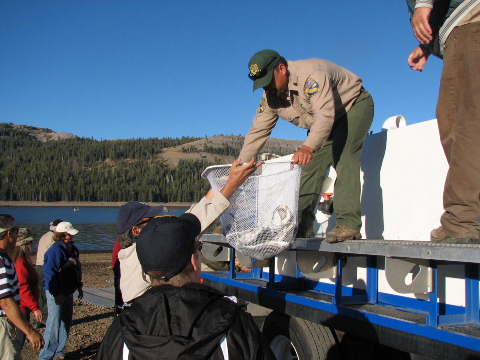
1,100 fish rescued in first 24 hours of Caples Lake operation with hope that even larger numbers will be saved in the next two days
by Jerry Neuburger, CSPA Webmaster
August 26, 2008 -- Caples Lake CA – A large crowd of reporters were gathered on the east shoreline of Caples Lake at noon Tuesday, listening to a briefing by Stafford Lehr, Department of Fish and Game Incident Commander. Lehr briefed the press on the methods DFG hoped to use to capture a significant portion of the lake’s trophy fishery, which includes brook trout, rainbows, brown trout and Mackinaw.
The draw down of the lake was necessary because the sluice gates to the dam had deteriorated to the extent that they needed replacement. The lake’s owners, the El Dorado Irrigation District (IED) discovered the problems in an underwater inspection in mid June. The repairs were originally scheduled for 2009 but were moved up to October of 2008 when replacement parts were found to be available.
The repairs of the dam require the lake to be drawn down from it’s normal 22,400 acre feet to two pools with a total of less than 2,000 acre feet. IED will construct a coffer dam will be constructed to allow the release of a small amount of water into Caples Creek, a beautiful little stream that trickles into the Silver Fork of the American.
Once committed to the drawdown of the lake, the question of whether the lake’s fishery could survive the severe winter conditions expected. EID and DFG debated whether a rescue was feasible and while questionable, DFG decided that an attempt should be made to save some of the lake’s larger fish including the large Mackinaw that make the lake so special to anglers.
Hearing of the rescue attempt, Trout Unlimited and the California Sportfishing Protection Alliance volunteered to do what they could to assemble a cadre of willing volunteers to assist in the process. Over 85 people signed up in the first 72 hours after the announcement was made on the CSPA website.
Armed with list of volunteers, Chris Shutes of CSPA and Barbara Bania of TU met with Joe Ferreira of DFG and a work schedule was planned and the volunteers notified of their shifts with rescue operations to start on August 26.
EID personnel arranged for a series of campsites at Silver Lake during the rescue attempt and set up a common kitchen where volunteers could cook meals, have a cup of coffee and otherwise take a break from the shift work.
On August 25, DFG staff started assembling the equipment necessary to make the rescue attempt on the east shoreline of the lake. One of the major concerns, that of the lake bottom being too soft to allow for vehicle traffic was found to be of no concern, the lakes rock bottom now exposed for hundreds of feet from the now 8,500 acre feet pool left in the lake was firm enough for boat launching and the heavy tank trucks needed to transport any fish captured. The next day at noon the press conference was held and the work started.
Early results were very disappointing. Three electrofishing boats and other boats manned with DFG staff and volunteers worked the lake and checked the hoop and gill nets regularly but in six hours fishing less than a hundred fish were collected. New DFG and volunteer crews showed up and started the night shift with the hopes of greater success throughout the night.
The three electrofishing crews operated throughout the night, from 6PM to 6AM with much greater success than the day efforts. The gill nets also produced and the fish started to come in. Crews of volunteers and DFG people worked hard throughout the night and the holding pens began to hold respectable numbers of fish, some as large as five pounds. The whoops from the electrofishing boats could be heard throughout the night as large fish came to the surface and were netted were coming to the surface to be netted.
The gill nets also produced and were checked every half hour. One large Mackinaw was found in the nets as well as a number of rainbows, browns and chubbs. Unfortunately the Mackinaw had drowned in the short time that it was held in the net. Most of the other fish survived and were sorted by species as were the fish captured by the electrofishing boats. The rainbows, browns and Mackinaw were placed in two of the pens and the brooks separated out to the third pen. At the end of the night, over 1,000 fish were captured .
A new crew of volunteers and staff were on site Tuesday morning, excited to hear the news that that there were fish to be moved and that some of the problems of the first day sorted out. Lehr of DFG also advised that he was seeking additional electroshocking boats, had found three more boats that he hoped to have on site tonight and a possibility of two more.
Since the electrofishing boats already on site proved to be much less successful during the day, and the boats are already suffering some wear and tear, a decision is being considered to hold the boats until the evening shifts. If five more electrofishing boats arrive, for a total of eight, the number if fish captured during the next two nights should increase dramatically.
Although the lake is drawn down to the extent that a large area of shoreline is exposed, fishing is still permitted in the lake. However the boat ramp is high and dry. There are no plans to stop or restrict fishing throughout the drawdown although silt build up along the exposed shore line may make access difficult when the lake is drawn down to its minimum pool.
by Jerry Neuburger, CSPA Webmaster
August 26, 2008 -- Caples Lake CA – A large crowd of reporters were gathered on the east shoreline of Caples Lake at noon Tuesday, listening to a briefing by Stafford Lehr, Department of Fish and Game Incident Commander. Lehr briefed the press on the methods DFG hoped to use to capture a significant portion of the lake’s trophy fishery, which includes brook trout, rainbows, brown trout and Mackinaw.
The draw down of the lake was necessary because the sluice gates to the dam had deteriorated to the extent that they needed replacement. The lake’s owners, the El Dorado Irrigation District (IED) discovered the problems in an underwater inspection in mid June. The repairs were originally scheduled for 2009 but were moved up to October of 2008 when replacement parts were found to be available.
The repairs of the dam require the lake to be drawn down from it’s normal 22,400 acre feet to two pools with a total of less than 2,000 acre feet. IED will construct a coffer dam will be constructed to allow the release of a small amount of water into Caples Creek, a beautiful little stream that trickles into the Silver Fork of the American.
Once committed to the drawdown of the lake, the question of whether the lake’s fishery could survive the severe winter conditions expected. EID and DFG debated whether a rescue was feasible and while questionable, DFG decided that an attempt should be made to save some of the lake’s larger fish including the large Mackinaw that make the lake so special to anglers.
Hearing of the rescue attempt, Trout Unlimited and the California Sportfishing Protection Alliance volunteered to do what they could to assemble a cadre of willing volunteers to assist in the process. Over 85 people signed up in the first 72 hours after the announcement was made on the CSPA website.
Armed with list of volunteers, Chris Shutes of CSPA and Barbara Bania of TU met with Joe Ferreira of DFG and a work schedule was planned and the volunteers notified of their shifts with rescue operations to start on August 26.
EID personnel arranged for a series of campsites at Silver Lake during the rescue attempt and set up a common kitchen where volunteers could cook meals, have a cup of coffee and otherwise take a break from the shift work.
On August 25, DFG staff started assembling the equipment necessary to make the rescue attempt on the east shoreline of the lake. One of the major concerns, that of the lake bottom being too soft to allow for vehicle traffic was found to be of no concern, the lakes rock bottom now exposed for hundreds of feet from the now 8,500 acre feet pool left in the lake was firm enough for boat launching and the heavy tank trucks needed to transport any fish captured. The next day at noon the press conference was held and the work started.
Early results were very disappointing. Three electrofishing boats and other boats manned with DFG staff and volunteers worked the lake and checked the hoop and gill nets regularly but in six hours fishing less than a hundred fish were collected. New DFG and volunteer crews showed up and started the night shift with the hopes of greater success throughout the night.
The three electrofishing crews operated throughout the night, from 6PM to 6AM with much greater success than the day efforts. The gill nets also produced and the fish started to come in. Crews of volunteers and DFG people worked hard throughout the night and the holding pens began to hold respectable numbers of fish, some as large as five pounds. The whoops from the electrofishing boats could be heard throughout the night as large fish came to the surface and were netted were coming to the surface to be netted.
The gill nets also produced and were checked every half hour. One large Mackinaw was found in the nets as well as a number of rainbows, browns and chubbs. Unfortunately the Mackinaw had drowned in the short time that it was held in the net. Most of the other fish survived and were sorted by species as were the fish captured by the electrofishing boats. The rainbows, browns and Mackinaw were placed in two of the pens and the brooks separated out to the third pen. At the end of the night, over 1,000 fish were captured .
A new crew of volunteers and staff were on site Tuesday morning, excited to hear the news that that there were fish to be moved and that some of the problems of the first day sorted out. Lehr of DFG also advised that he was seeking additional electroshocking boats, had found three more boats that he hoped to have on site tonight and a possibility of two more.
Since the electrofishing boats already on site proved to be much less successful during the day, and the boats are already suffering some wear and tear, a decision is being considered to hold the boats until the evening shifts. If five more electrofishing boats arrive, for a total of eight, the number if fish captured during the next two nights should increase dramatically.
Although the lake is drawn down to the extent that a large area of shoreline is exposed, fishing is still permitted in the lake. However the boat ramp is high and dry. There are no plans to stop or restrict fishing throughout the drawdown although silt build up along the exposed shore line may make access difficult when the lake is drawn down to its minimum pool.
Add Your Comments
We are 100% volunteer and depend on your participation to sustain our efforts!
Donate

$110.00 donated
in the past month
Get Involved
If you'd like to help with maintaining or developing the website, contact us.
Publish
Publish your stories and upcoming events on Indybay.
Topics
More
Search Indybay's Archives
Advanced Search
►
▼
IMC Network