







 Publish to Newswire
 Add an Event
From the Open-Publishing Calendar
From the Open-Publishing Newswire
Indybay Feature
Climate Change Impacts Socially Disadvantaged Communities More than Bull Sh*t
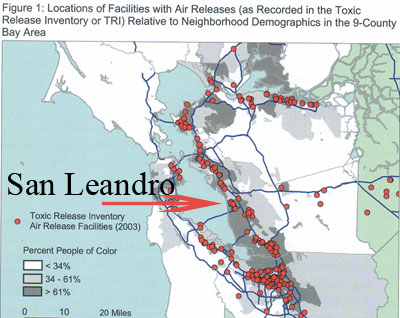
Throughout California, historic "Black Communities" face environmental challenges. Pastor Jones, Oak Park United Methodist Church, Oak Park Historic District need our support to challenge the status quo. California participation in the U.S. Commission to Engage African-Americans on Climate Change could use quantifiable support from Senator Pat Wiggins to demonstrate her change of heart toward the care and concern about a segment of California citizens.
Reprint
U.S. blacks face harsher climate change impact
By Deborah Zabarenko, Environment Correspondent
WASHINGTON (Reuters) - American blacks are likely to suffer disproportionately from climate change and they are willing to pay to combat it, a commission aimed at raising awareness about global warming said on Tuesday.
"There is a fierce urgency regarding climate change effects on the African-American community," said Ralph Everett, the co-chair of the Commission to Engage African-Americans on Climate Change said. "People need to understand what is at stake -- our very health and well-being."
Blacks are more than twice as likely as whites to live in cities where the so-called heat island effect is expected to make temperature increases more severe, the newly formed group said at a briefing.
More blacks also will be "fuel poor" as energy demand rises due to higher air-conditioning loads, population growth and urbanization, commission said.
In a survey of 750 U.S. black adults released by the commission, 81 percent said the U.S. government should take strong action to deal with global warming, and seven in 10 said it was very important for the 2008 presidential candidates to do something about it.
A solid majority, 64 percent, of those surveyed by telephone between June 20 and July 3 said they would be willing to pay an additional $10 a month to fight global warming. Twenty-eight percent were willing to pay an added $25 a month and only 14 percent were willing to pay an extra $50.
As expected, poorer respondents were willing to pay less, said David Bositis, who supervised the survey for the non-profit Joint Center for Political and Economic Studies, which launched the commission's effort.
When asked an open-ended question about what they considered to be the most important problem facing the United States, 5 percent of respondents answered global warming.
This has never been mentioned before as the top problem by any black respondents in surveys in 2000, 2004 and 2007. In this survey, 42 percent listed the economy as the most important problem, followed by 17 percent answering energy.
The 5 percent who considered global warming paramount compared with 8 percent who said the Iraq war and 3 percent who answered education. Bositis said most U.S. surveys and polls have such a small number of black participants that it is difficult to separate out black attitudes.
The commission aims to draw African-Americans into the climate change debate and to involve the black community in economic opportunities of the green economy.
U.S. blacks face harsher climate change impact
By Deborah Zabarenko, Environment Correspondent
WASHINGTON (Reuters) - American blacks are likely to suffer disproportionately from climate change and they are willing to pay to combat it, a commission aimed at raising awareness about global warming said on Tuesday.
"There is a fierce urgency regarding climate change effects on the African-American community," said Ralph Everett, the co-chair of the Commission to Engage African-Americans on Climate Change said. "People need to understand what is at stake -- our very health and well-being."
Blacks are more than twice as likely as whites to live in cities where the so-called heat island effect is expected to make temperature increases more severe, the newly formed group said at a briefing.
More blacks also will be "fuel poor" as energy demand rises due to higher air-conditioning loads, population growth and urbanization, commission said.
In a survey of 750 U.S. black adults released by the commission, 81 percent said the U.S. government should take strong action to deal with global warming, and seven in 10 said it was very important for the 2008 presidential candidates to do something about it.
A solid majority, 64 percent, of those surveyed by telephone between June 20 and July 3 said they would be willing to pay an additional $10 a month to fight global warming. Twenty-eight percent were willing to pay an added $25 a month and only 14 percent were willing to pay an extra $50.
As expected, poorer respondents were willing to pay less, said David Bositis, who supervised the survey for the non-profit Joint Center for Political and Economic Studies, which launched the commission's effort.
When asked an open-ended question about what they considered to be the most important problem facing the United States, 5 percent of respondents answered global warming.
This has never been mentioned before as the top problem by any black respondents in surveys in 2000, 2004 and 2007. In this survey, 42 percent listed the economy as the most important problem, followed by 17 percent answering energy.
The 5 percent who considered global warming paramount compared with 8 percent who said the Iraq war and 3 percent who answered education. Bositis said most U.S. surveys and polls have such a small number of black participants that it is difficult to separate out black attitudes.
The commission aims to draw African-Americans into the climate change debate and to involve the black community in economic opportunities of the green economy.
For more information:
http://www.nbejn.org/who.html#
Add Your Comments
We are 100% volunteer and depend on your participation to sustain our efforts!
Donate

$110.00 donated
in the past month
Get Involved
If you'd like to help with maintaining or developing the website, contact us.
Publish
Publish your stories and upcoming events on Indybay.
Topics
More
Search Indybay's Archives
Advanced Search
►
▼
IMC Network