







 Publish to Newswire
 Add an Event
From the Open-Publishing Calendar
From the Open-Publishing Newswire
Indybay Feature
State and Feds Must Review Relationship between Delta Crash and Salmon Collapse!
This is an edited version of my letter responding to Matt Weiser's article regarding the decline of Central Valley chinook salmon in this morning's Sacramento Bee. Although the article pointed out the economic problems that are expected to result from proposed salmon fishing closures/restrictions that will be voted upon during the Pacific Fishery Management Council meetings in Sacramento this week, the National Marine Fisheries Service biologists quoted in the article dismissed the huge role that massive increases in Delta water exports during recent years have undoubtedly played in the unprecedented collapse of Sacramento River chinook salmon.
In the letter, I note the request I made at the DFG "informational exchange" meeting in Santa Rosa on Wednesday. I asked the DFG and NOAA Fisheries to convene an emergency conference/meeting of state, federal and independent scientists and fishing groups to explore (1) the relationship between the Pelagic Organism Decline and the salmon collapse and (2) the relationship with Bay-Delta Estuary conditions and the collapse of the food chain and ocean conditions. I believe that you can't separate what happens in the ocean from what happens in the estuary.
Here's the link to the Bee's article, "Salmon fishing ban mulled in California as run suffers record plunge," http://www.sacbee.com/101/story/772762.html
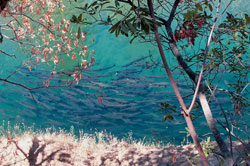
(Photo of salmon migrating upstream is courtesy of the California Department of Water Resources).
In the letter, I note the request I made at the DFG "informational exchange" meeting in Santa Rosa on Wednesday. I asked the DFG and NOAA Fisheries to convene an emergency conference/meeting of state, federal and independent scientists and fishing groups to explore (1) the relationship between the Pelagic Organism Decline and the salmon collapse and (2) the relationship with Bay-Delta Estuary conditions and the collapse of the food chain and ocean conditions. I believe that you can't separate what happens in the ocean from what happens in the estuary.
Here's the link to the Bee's article, "Salmon fishing ban mulled in California as run suffers record plunge," http://www.sacbee.com/101/story/772762.html
(Photo of salmon migrating upstream is courtesy of the California Department of Water Resources).
Matt
This email was spurred by your front page article on the salmon collapse this morning in the Bee. I have four points to make.
First, I greatly appreciate your extensive coverage of the Prospect Island fish kill, as well as the article you did on the sportfishing panel at the Sacramento ISE Show.
Second, I like the fact that you covered the impact of the looming salmon closure/restrictions on local fisheries in your article this morning in your interview with J.D. Richey.
Third, I wanted to make sure that you are receiving my emails and are aware of the press conference by fishing, tribal and environmental groups at the PFMC this coming Friday at 10 a.m. in the Del Paso Room at the Double Tree Hotel.
Fourth, in your article NOAA Fisheries is quoted dismissing anything other than "ocean conditions" for the collapse. Tell me if I'm wrong, but I think the causes behind the salmon collapse are much more complex.
At the DFG meeting in Santa Rosa last Wednesday, I made a request to the DFG and NOAA Fisheries to convene an emergency conference/meeting of state, federal and independent scientists and fishing groups to explore (1) the relationship between the Pelagic Organism Decline and the salmon collapse and (2) the relationship between Bay-Delta Estuary conditions and the collapse of the food chain and ocean conditions. I believe that you can't separate what happens in the ocean from what happens in the estuary.
The Bay-Delta estuary is the most significant estuary on the West Coast. It well known as a nursery, spawning ground and migration corridor for salmon, steelhead, striped bass, sturgeon, delta smelt, longfin smelt, threadfin shad and other species. It is also essential habitat for herring, smelt, sardines and other species that sustain salmon and other fish up and down the coast.
What happens to the food chain in the bay-delta estuary has an impact from Central California all of the way to the Oregon coast. Disruptions in the food chain of the estuary caused by massive increases in Delta water exports in recent years will certainly have a big impact not only on salmon migrating through the estuary, but ocean conditions up and down the coast.
By failing to explore the relationships between (1) the POD and the salmon collapse and (2) water and forage conditions in the estuary and water and forage conditions on the ocean, NOAA Fisheries and the DFG have made a big mistake to date. It is very convenient for the federal and state governments to point to "ocean conditions" as the cause without reviewing other conditions that impact not only Central Valley salmon, but other salmon runs in California and Oregon, since it absolves them of any responsibility for the salmon collapse!
Thanks
Dan Bacher
This email was spurred by your front page article on the salmon collapse this morning in the Bee. I have four points to make.
First, I greatly appreciate your extensive coverage of the Prospect Island fish kill, as well as the article you did on the sportfishing panel at the Sacramento ISE Show.
Second, I like the fact that you covered the impact of the looming salmon closure/restrictions on local fisheries in your article this morning in your interview with J.D. Richey.
Third, I wanted to make sure that you are receiving my emails and are aware of the press conference by fishing, tribal and environmental groups at the PFMC this coming Friday at 10 a.m. in the Del Paso Room at the Double Tree Hotel.
Fourth, in your article NOAA Fisheries is quoted dismissing anything other than "ocean conditions" for the collapse. Tell me if I'm wrong, but I think the causes behind the salmon collapse are much more complex.
At the DFG meeting in Santa Rosa last Wednesday, I made a request to the DFG and NOAA Fisheries to convene an emergency conference/meeting of state, federal and independent scientists and fishing groups to explore (1) the relationship between the Pelagic Organism Decline and the salmon collapse and (2) the relationship between Bay-Delta Estuary conditions and the collapse of the food chain and ocean conditions. I believe that you can't separate what happens in the ocean from what happens in the estuary.
The Bay-Delta estuary is the most significant estuary on the West Coast. It well known as a nursery, spawning ground and migration corridor for salmon, steelhead, striped bass, sturgeon, delta smelt, longfin smelt, threadfin shad and other species. It is also essential habitat for herring, smelt, sardines and other species that sustain salmon and other fish up and down the coast.
What happens to the food chain in the bay-delta estuary has an impact from Central California all of the way to the Oregon coast. Disruptions in the food chain of the estuary caused by massive increases in Delta water exports in recent years will certainly have a big impact not only on salmon migrating through the estuary, but ocean conditions up and down the coast.
By failing to explore the relationships between (1) the POD and the salmon collapse and (2) water and forage conditions in the estuary and water and forage conditions on the ocean, NOAA Fisheries and the DFG have made a big mistake to date. It is very convenient for the federal and state governments to point to "ocean conditions" as the cause without reviewing other conditions that impact not only Central Valley salmon, but other salmon runs in California and Oregon, since it absolves them of any responsibility for the salmon collapse!
Thanks
Dan Bacher
Add Your Comments
Latest Comments
Listed below are the latest comments about this post.
These comments are submitted anonymously by website visitors.
TITLE
AUTHOR
DATE
Delta Crash
Tue, Mar 11, 2008 11:58AM
We are 100% volunteer and depend on your participation to sustain our efforts!
Donate

$110.00 donated
in the past month
Get Involved
If you'd like to help with maintaining or developing the website, contact us.
Publish
Publish your stories and upcoming events on Indybay.
Topics
More
Search Indybay's Archives
Advanced Search
►
▼
IMC Network