







 Publish to Newswire
 Add an Event
From the Open-Publishing Calendar
From the Open-Publishing Newswire
Indybay Feature
Nader, the Greens and 2008
Todd Chretien, the Green party candidate who ran for the Senate against Dianne Feinstein in 2006, looks at where the Green Party has been and where it is today.
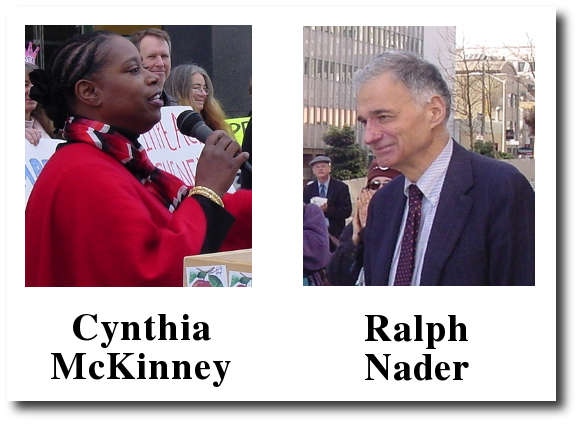
Nader, the Greens and 2008
SocialistWorker.org
January 25, 2008
TODD CHRETIEN, the Green Party candidate for senator from California in 2006, looks at the difficult prospects for a left-wing presidential challenge in 2008.
LESS THAN eight years ago, Ralph Nader's 2000 presidential campaign was electrifying U.S. politics.
Nader won almost 3 million votes, the best showing in at least 50 years for a left-wing presidential candidate running against the Republican-Democrat duopoly. Running on the Green Party ticket, Nader had support from significant sections of progressives and social activists--an important break from the long history of the U.S. left falling behind the “lesser evil” of the Democratic Party at election time.
Today, the picture is very different. Nader will probably run for president again, but neither he nor any other independent candidate to the left of the Democrats can expect to win more than a token number of votes. His support among people on the left has crumbled. And the Green Party that nominated Nader in 2000 is in a state of crisis, weakened significantly in terms of both voter registration and active membership.
So what happened?
- - - - - - - - - - - - - - - -
A reaction against eight years of Clinton
THE YEARS before 2000 saw some important struggles begin to develop on a number of fronts.
In August 1997, 185,000 Teamsters struck for two weeks and beat UPS, one of the most powerful corporations in the country. A few weeks after, transit workers and garbage workers struck and won in the Bay Area, and a strike by GM workers in a single brake plant shut down the auto giant's entire North American operation.
Meanwhile, the global justice movement was taking shape. In November 1999, 40,000 activists marched in Seattle and took direct action to shut down the World Trade Organization (WTO) talks.
Why was all this happening? Despite the hopes placed in him, Bill Clinton didn't bring fundamental change after a decade of Reagan-Bush trickle-down economics and conservative politics.
Instead, corporations continued to dominate a “one-sided class struggle.” Clinton himself displayed a Republican-like zeal for privatization, which shredded what remained of the social safety net. The prison population doubled, and 1 million Iraqis were starved to death by sanctions.
Anger with the failure of the Democrats to do much of substance for the majority of people was expressed in these still modest but growing mobilizations, culminating in Los Angeles in August 2000, when 40,000 activists protested outside the Democratic National Convention.
These struggles didn't translate automatically into a break with the Democrats--in fact, most people who took part in them continued to look to the Democrats as the “lesser evil.” Although the fact that Democratic Party delegates and officials looked on from the balcony of the Staples Center while the LAPD launched canisters of tear gas at the crowd certainly did help make the point that the party was still an evil.
In the months before the election, more than 100,000 people attended a dozen indoor “super-rallies” supporting Nader. Nader's stump speech called for the abolition of the WTO, tearing up NAFTA, slicing the military budget, investing dramatically in education, a national health care system, ending the death penalty and three-strikes laws, and defending abortion rights.
Nader slammed the Democrats as a corporate party, wholly owned by the richest of the rich. He ended every speech by invoking the struggles of the anti-slavery abolitionists, the suffragettes, the industrial unionists and the civil rights movement.
Socialists and radicals were welcomed into the campaign. On stage at the super-rallies, Michael Moore, Phil Donahue, Patti Smith, Medea Benjamin, Susan Sarandon and other well-known figures supported him. The California Nurses Association and the United Electrical Workers endorsed his candidacy and campaigned for him.
When it was all over, Nader won 2,883,105 votes, the best showing for a left-wing candidate since Eugene Debs ran for president from prison in 1920 for the Socialist Party and won 6 percent of the vote.
- - - - - - - - - - - - - - - -
The Florida fiasco and September 11
AFTER THE Republican theft of the 2000 election that installed Bush--the loser of the popular vote--in the White House, and then the September 11 attacks and the start of the “war on terror,” many of Nader's former supporters turned on him.
Liberal writer Eric Alterman explicitly blamed Nader for Bush's crimes: “Thank you, Ralph, for the Iraq war. Thank you, Ralph, for the tax cuts. Thank you, Ralph, for the destruction of the environment. Thank you, Ralph, for the destruction of the Constitution.”
Most 2000 Nader supporters weren't nearly as snotty as Alterman, but the fact was that the momentum built up by the global justice movement and other struggles didn't survive the nationalist fury whipped up by politicians of both parties after September 11.
Only one Democrat in Congress, Barbara Lee, voted against the rush to war against Afghanistan. The invasion and occupation of Afghanistan in October 2001 was met by only very small protests.
When the Bush administration began its drive to war on Iraq, there was a massive outpouring in February 2003 to try to stop the invasion. But there was little organizational continuity with the global justice movement and the 2000 Nader campaign. Nader didn't involve himself in antiwar organizing, and the Green Party played almost no role.
After the invasion and Bush's “Mission Accomplished” speech, it looked as if progressive politics would be beaten back for a long time.
There were some exceptions in terms of relatively successful political campaigns. Green Party member and socialist Peter Camejo ran in the California recall governor's race and got into the TV debates. The Green Party's Matt Gonzalez came within a whisker of winning the 2003 race for mayor of San Francisco. Both these campaigns generated enthusiastic responses reminiscent of the Nader's 2000 run, and it looked as if the Green Party might recover, at least in California.
- - - - - - - - - - - - - - - -
2004: Anybody But Bush
THE 2004 election exposed the Green Party's internal political damage. Although registration figures continued to increase after September 11 (for instance, in California, the Greens grew from about 100,000 in 1999 to 165,000 in early 2004), much of the leadership of the party was in full retreat from openly fighting against the two-party “duopoly,” as Nader called it.
Please read the rest:
SocialistWorker.org
January 25, 2008
TODD CHRETIEN, the Green Party candidate for senator from California in 2006, looks at the difficult prospects for a left-wing presidential challenge in 2008.
LESS THAN eight years ago, Ralph Nader's 2000 presidential campaign was electrifying U.S. politics.
Nader won almost 3 million votes, the best showing in at least 50 years for a left-wing presidential candidate running against the Republican-Democrat duopoly. Running on the Green Party ticket, Nader had support from significant sections of progressives and social activists--an important break from the long history of the U.S. left falling behind the “lesser evil” of the Democratic Party at election time.
Today, the picture is very different. Nader will probably run for president again, but neither he nor any other independent candidate to the left of the Democrats can expect to win more than a token number of votes. His support among people on the left has crumbled. And the Green Party that nominated Nader in 2000 is in a state of crisis, weakened significantly in terms of both voter registration and active membership.
So what happened?
- - - - - - - - - - - - - - - -
A reaction against eight years of Clinton
THE YEARS before 2000 saw some important struggles begin to develop on a number of fronts.
In August 1997, 185,000 Teamsters struck for two weeks and beat UPS, one of the most powerful corporations in the country. A few weeks after, transit workers and garbage workers struck and won in the Bay Area, and a strike by GM workers in a single brake plant shut down the auto giant's entire North American operation.
Meanwhile, the global justice movement was taking shape. In November 1999, 40,000 activists marched in Seattle and took direct action to shut down the World Trade Organization (WTO) talks.
Why was all this happening? Despite the hopes placed in him, Bill Clinton didn't bring fundamental change after a decade of Reagan-Bush trickle-down economics and conservative politics.
Instead, corporations continued to dominate a “one-sided class struggle.” Clinton himself displayed a Republican-like zeal for privatization, which shredded what remained of the social safety net. The prison population doubled, and 1 million Iraqis were starved to death by sanctions.
Anger with the failure of the Democrats to do much of substance for the majority of people was expressed in these still modest but growing mobilizations, culminating in Los Angeles in August 2000, when 40,000 activists protested outside the Democratic National Convention.
These struggles didn't translate automatically into a break with the Democrats--in fact, most people who took part in them continued to look to the Democrats as the “lesser evil.” Although the fact that Democratic Party delegates and officials looked on from the balcony of the Staples Center while the LAPD launched canisters of tear gas at the crowd certainly did help make the point that the party was still an evil.
In the months before the election, more than 100,000 people attended a dozen indoor “super-rallies” supporting Nader. Nader's stump speech called for the abolition of the WTO, tearing up NAFTA, slicing the military budget, investing dramatically in education, a national health care system, ending the death penalty and three-strikes laws, and defending abortion rights.
Nader slammed the Democrats as a corporate party, wholly owned by the richest of the rich. He ended every speech by invoking the struggles of the anti-slavery abolitionists, the suffragettes, the industrial unionists and the civil rights movement.
Socialists and radicals were welcomed into the campaign. On stage at the super-rallies, Michael Moore, Phil Donahue, Patti Smith, Medea Benjamin, Susan Sarandon and other well-known figures supported him. The California Nurses Association and the United Electrical Workers endorsed his candidacy and campaigned for him.
When it was all over, Nader won 2,883,105 votes, the best showing for a left-wing candidate since Eugene Debs ran for president from prison in 1920 for the Socialist Party and won 6 percent of the vote.
- - - - - - - - - - - - - - - -
The Florida fiasco and September 11
AFTER THE Republican theft of the 2000 election that installed Bush--the loser of the popular vote--in the White House, and then the September 11 attacks and the start of the “war on terror,” many of Nader's former supporters turned on him.
Liberal writer Eric Alterman explicitly blamed Nader for Bush's crimes: “Thank you, Ralph, for the Iraq war. Thank you, Ralph, for the tax cuts. Thank you, Ralph, for the destruction of the environment. Thank you, Ralph, for the destruction of the Constitution.”
Most 2000 Nader supporters weren't nearly as snotty as Alterman, but the fact was that the momentum built up by the global justice movement and other struggles didn't survive the nationalist fury whipped up by politicians of both parties after September 11.
Only one Democrat in Congress, Barbara Lee, voted against the rush to war against Afghanistan. The invasion and occupation of Afghanistan in October 2001 was met by only very small protests.
When the Bush administration began its drive to war on Iraq, there was a massive outpouring in February 2003 to try to stop the invasion. But there was little organizational continuity with the global justice movement and the 2000 Nader campaign. Nader didn't involve himself in antiwar organizing, and the Green Party played almost no role.
After the invasion and Bush's “Mission Accomplished” speech, it looked as if progressive politics would be beaten back for a long time.
There were some exceptions in terms of relatively successful political campaigns. Green Party member and socialist Peter Camejo ran in the California recall governor's race and got into the TV debates. The Green Party's Matt Gonzalez came within a whisker of winning the 2003 race for mayor of San Francisco. Both these campaigns generated enthusiastic responses reminiscent of the Nader's 2000 run, and it looked as if the Green Party might recover, at least in California.
- - - - - - - - - - - - - - - -
2004: Anybody But Bush
THE 2004 election exposed the Green Party's internal political damage. Although registration figures continued to increase after September 11 (for instance, in California, the Greens grew from about 100,000 in 1999 to 165,000 in early 2004), much of the leadership of the party was in full retreat from openly fighting against the two-party “duopoly,” as Nader called it.
Please read the rest:
For more information:
http://www.socialistworker.org/2008-1/659/...
Add Your Comments
Comments
(Hide Comments)
Todd says:
"But there is also a misunderstanding at the heart of the Green Party program about how social change comes about."
I wouldn't be surprised. Most of us are pretty imperfect and the national is the worst. But I'm not sure that these articles that trash the Greens really do anything constructive, in the end. Mainly they serve to help keep infighting alive and promote the idea that if we're not radical enough we will fail.
I assume the point is to try to pressure people into a direction, but doing things like pointing to the two votes in all of McKinney's decade long career in Congress that are wrong to most Greens, while ignoring the tons of extremely courageous things she's done, is just distorting things for an agenda. It's cherry-picking the facts. I had to learn how to see that type of writing being a 9/11 activist because that area is constantly attacked from all directions. And that's not what I'm interested in for this party. Those interested in real truths, in fighting for the truth, understand that what McKinney has done to open up truths with what little power she had in Congress -- not just 9/11, but on many other issues -- has been enormous.
Ralph is also a person of great integrity and value to the party, a person of courage who has spent a lifetime working for social change.
But from this article it sounds like Todd thinks that Nader is the way to social change, and Elaine Brown would have been the way, and Jared Ball is the way, but that McKinney is not.
I disagree.
I would have preferred to see a concrete discussion here about real ways to achieve social change, concrete problems with concrete solutions. But what I see is bias and cherry picking to promote the candidates that are making the most references to Malcolm X. And I'm getting really tired of that.
How is Malcolm X going to grow the Green Party? Can we see where that will take us? Ralph and Cynthia both tap into anger in their own ways. Why is black nationalism and Malcolm X the only acceptable type of anger? And why from within a fragile party -- packed with infightiing -- like the Greens?
In a way, this type of push seems obvious.
But I just think that there are other ways.
And the fact that the Greens finding other ways in 80 nations around the world is meaningful. It suggests that in the end, there is no formula for social change, but many many possibilities, some we don't even know about yet. Malcolm X was one important and courageous way, and there are other ways too.
I commend ALL of the candidates running with the Greens, including Jared, Kat, Kent, Jesse, Ralph and Cynthia. I'm sorry that Elaine chose to attack the party when she decided to leave. I wish her luck.
To understand the larger picture on both Ralph & Cynthia, see their websites:
http://www.nader.org/
http://www.allthingscynthiamckinney.com/
"But there is also a misunderstanding at the heart of the Green Party program about how social change comes about."
I wouldn't be surprised. Most of us are pretty imperfect and the national is the worst. But I'm not sure that these articles that trash the Greens really do anything constructive, in the end. Mainly they serve to help keep infighting alive and promote the idea that if we're not radical enough we will fail.
I assume the point is to try to pressure people into a direction, but doing things like pointing to the two votes in all of McKinney's decade long career in Congress that are wrong to most Greens, while ignoring the tons of extremely courageous things she's done, is just distorting things for an agenda. It's cherry-picking the facts. I had to learn how to see that type of writing being a 9/11 activist because that area is constantly attacked from all directions. And that's not what I'm interested in for this party. Those interested in real truths, in fighting for the truth, understand that what McKinney has done to open up truths with what little power she had in Congress -- not just 9/11, but on many other issues -- has been enormous.
Ralph is also a person of great integrity and value to the party, a person of courage who has spent a lifetime working for social change.
But from this article it sounds like Todd thinks that Nader is the way to social change, and Elaine Brown would have been the way, and Jared Ball is the way, but that McKinney is not.
I disagree.
I would have preferred to see a concrete discussion here about real ways to achieve social change, concrete problems with concrete solutions. But what I see is bias and cherry picking to promote the candidates that are making the most references to Malcolm X. And I'm getting really tired of that.
How is Malcolm X going to grow the Green Party? Can we see where that will take us? Ralph and Cynthia both tap into anger in their own ways. Why is black nationalism and Malcolm X the only acceptable type of anger? And why from within a fragile party -- packed with infightiing -- like the Greens?
In a way, this type of push seems obvious.
But I just think that there are other ways.
And the fact that the Greens finding other ways in 80 nations around the world is meaningful. It suggests that in the end, there is no formula for social change, but many many possibilities, some we don't even know about yet. Malcolm X was one important and courageous way, and there are other ways too.
I commend ALL of the candidates running with the Greens, including Jared, Kat, Kent, Jesse, Ralph and Cynthia. I'm sorry that Elaine chose to attack the party when she decided to leave. I wish her luck.
To understand the larger picture on both Ralph & Cynthia, see their websites:
http://www.nader.org/
http://www.allthingscynthiamckinney.com/
I think your comments are helpful but I do not think Chretien's essay was biased in any direction. His comments about Nader made me squirm. I happen to like McKinney like yourself, but believe she (and other Greens) will better succeed by campaigning without illusions as to where the Green Party really is.
So you think if he could only say negatives about a candidate with a decade in congress but can't say a single real positive, that there is no bias???
I think Todd is great activist and extremely dedicated, a great writer, compassionate, etc. But we all have our positions and our feelings -- he is writing with his feelings and not being fair to McKinney. I don't post this isn't to fault Todd (he's human, as we all are) but to correct the record and express my disagreement. I appreciate the work he does and has done for years. It's just hard to see this type of description when McKinney has taken so many risks as it is, and has taken so many, so far.
From the local GP voter guide:
Cynthia McKinney
http://www.acgreens.org/images/stories/GPAC-VG-0208.pdf
For over a decade Cynthia McKinney has represented
Georgia’s fourth congressional district as a Democrat in
the U.S. House of Representatives (1993 - 2003 and 2005
- 2007), but in an historic move in September of 2007,
she quit the Democratic Party and registered Green. On
October 22, 2007 she filed paperwork creating an exploratory
committee for a Green Party presidential campaign.
For many, this was a long-awaited Green Party milestone.
Green Party activists have been trying to get
McKinney to run as the presidential candidate since 2002,
and many Greens are very excited and invigorated to have
finally achieved this goal. On a recent visit to the Bay
Area, Cynthia McKinney pointed out that Greens have
always supported her and that support has meant something
to her.
McKinney is, to many, the perfect Green Party candidate
for president. She has served in congress but is
also a rare example of someone with the courage to leave
the comfort of a large corporate party. Despite her status
as a public figure, this is a person whom we see speaking
on the stages of anti-war events, speaking in the living
rooms of activists, organizing investigations into coverups
and using her position in office to expose the lies when
no one else would. McKinney’s work has been synonymous
with Green Party values throughout her political
career and for that work, much of which has involved fighting
for human rights, she was eventually driven out of her
congressional office.
Campaign organizer and Georgia Green Party delegate,
Hugh Esco, said of McKinney in his statement about
her candidacy, “Having worked in her Congressional office
on Capitol Hill, I can say that her constituency
stretches across 435 Congressional districts and that the
phones never stopped ringing with people across this nation
seeking a sympathetic ear on the Hill in spite of their
own elected Congressmember’s failure to represent their
interests.”
Described on the website http://www.oilempire.us as, “The most
courageous Member of Congress, the only Representative
willing to talk about 9/11 foreknowledge and complicity,”
McKinney is has shown remarkable courage at
key junctures of US events, and then has followed up with
investigations. For example, after Hurricane Katrina,
McKinney marched with local New Orleans residents
across the Crescent City Connection Bridge on November
7, 2005 in protest of what had happened on that bridge
(evacuees had been turned away by the Gretna Police when
they attempted to cross the Crescent City Connection
Bridge between New Orleans and Gretna, Louisiana). She
introduced legislation based on the incident and in August
of 2006, a grand jury began an investigation. Speaking
in a hearing following the disastrous FEMA response
to Katrina, McKinney asked Homeland Security Secretary
Michael Chertoff, “Mr. Secretary, if the nursing home
owners are arrested for negligent homicide, why shouldn’t
you also be arrested for negligent homicide?”
McKinney has also served as the highest-ranking
Democrat on the Human Rights Subcommittee of the
House International Relations Committee until the year
2000, where she worked on legislation to stop weapons
transfers to governments with human rights violations.
She has submitted to Congress a bill called the “MLK
Records Act” to release all currently sealed files concerning
the 1968 assassination of Martin Luther King, Jr. (currently
not due to be declassified until 2028). Over time
the bill garnered 67 co-sponsors, numerous endorsements
from former Members of the House Select Committee on
Assassinations and was introduced in the Senate by Senator
Kerry and co-signed by Sen. Clinton. And McKinney
was one of just 31 in the House of Representatives who,
in the 2004 election, objected to the official allotment of
the electoral votes from Ohio for Bush.
The good work that Cynthia McKinney has done is
far too large for the write-up here.
I think Todd is great activist and extremely dedicated, a great writer, compassionate, etc. But we all have our positions and our feelings -- he is writing with his feelings and not being fair to McKinney. I don't post this isn't to fault Todd (he's human, as we all are) but to correct the record and express my disagreement. I appreciate the work he does and has done for years. It's just hard to see this type of description when McKinney has taken so many risks as it is, and has taken so many, so far.
From the local GP voter guide:
Cynthia McKinney
http://www.acgreens.org/images/stories/GPAC-VG-0208.pdf
For over a decade Cynthia McKinney has represented
Georgia’s fourth congressional district as a Democrat in
the U.S. House of Representatives (1993 - 2003 and 2005
- 2007), but in an historic move in September of 2007,
she quit the Democratic Party and registered Green. On
October 22, 2007 she filed paperwork creating an exploratory
committee for a Green Party presidential campaign.
For many, this was a long-awaited Green Party milestone.
Green Party activists have been trying to get
McKinney to run as the presidential candidate since 2002,
and many Greens are very excited and invigorated to have
finally achieved this goal. On a recent visit to the Bay
Area, Cynthia McKinney pointed out that Greens have
always supported her and that support has meant something
to her.
McKinney is, to many, the perfect Green Party candidate
for president. She has served in congress but is
also a rare example of someone with the courage to leave
the comfort of a large corporate party. Despite her status
as a public figure, this is a person whom we see speaking
on the stages of anti-war events, speaking in the living
rooms of activists, organizing investigations into coverups
and using her position in office to expose the lies when
no one else would. McKinney’s work has been synonymous
with Green Party values throughout her political
career and for that work, much of which has involved fighting
for human rights, she was eventually driven out of her
congressional office.
Campaign organizer and Georgia Green Party delegate,
Hugh Esco, said of McKinney in his statement about
her candidacy, “Having worked in her Congressional office
on Capitol Hill, I can say that her constituency
stretches across 435 Congressional districts and that the
phones never stopped ringing with people across this nation
seeking a sympathetic ear on the Hill in spite of their
own elected Congressmember’s failure to represent their
interests.”
Described on the website http://www.oilempire.us as, “The most
courageous Member of Congress, the only Representative
willing to talk about 9/11 foreknowledge and complicity,”
McKinney is has shown remarkable courage at
key junctures of US events, and then has followed up with
investigations. For example, after Hurricane Katrina,
McKinney marched with local New Orleans residents
across the Crescent City Connection Bridge on November
7, 2005 in protest of what had happened on that bridge
(evacuees had been turned away by the Gretna Police when
they attempted to cross the Crescent City Connection
Bridge between New Orleans and Gretna, Louisiana). She
introduced legislation based on the incident and in August
of 2006, a grand jury began an investigation. Speaking
in a hearing following the disastrous FEMA response
to Katrina, McKinney asked Homeland Security Secretary
Michael Chertoff, “Mr. Secretary, if the nursing home
owners are arrested for negligent homicide, why shouldn’t
you also be arrested for negligent homicide?”
McKinney has also served as the highest-ranking
Democrat on the Human Rights Subcommittee of the
House International Relations Committee until the year
2000, where she worked on legislation to stop weapons
transfers to governments with human rights violations.
She has submitted to Congress a bill called the “MLK
Records Act” to release all currently sealed files concerning
the 1968 assassination of Martin Luther King, Jr. (currently
not due to be declassified until 2028). Over time
the bill garnered 67 co-sponsors, numerous endorsements
from former Members of the House Select Committee on
Assassinations and was introduced in the Senate by Senator
Kerry and co-signed by Sen. Clinton. And McKinney
was one of just 31 in the House of Representatives who,
in the 2004 election, objected to the official allotment of
the electoral votes from Ohio for Bush.
The good work that Cynthia McKinney has done is
far too large for the write-up here.
I read several complements about McKinney in Chretien's essay about the Green Party... and some barbed criticisms of Nader.
Todd's purpose in writing the essay was to try to understand why the Green Party along with the antiwar and social justice movements have been losing their influence.
As someone I admire mentioned recently, "I don't understand what is going on, but the antiwar left has faded away." Well, I think Chretien's broad and clear historical analysis gets very close to helping us find some answers.
He is right, I think, when he says there will be no short cuts-- for Nader... or Mckinney.
Reader, it doesn't ever hurt to list all McKinney's accomplishments-- more people need to know about them (the Mainstream Media certainly doesn't help much, does it?).
I want you to know something: I want Nader to have the true honor he deserves.
And-- I want Cynthia McKinney to be president--but only because she deserves to be.
We have only begun to learn who the real Cynthia McKinney is.
You know and I know that there are many who would like to see her contributions and potential buried-- Chretien is certainly NOT one.
Who is a real friend-- the one that grins and says "it's all good" or the one who looks out for you and watches your back by sometimes telling you what you might not like to hear?
I think Cynthia and Nader need to help each other.
And we need to do something too-- especially if we want to see the Green Party grow and do good in the world.
We need to insist on democracy, transparency, and productive action in any movement we join. We need to become independent of the corporate parties and we need to make real demands for change.
We don't need illusions that "it's all good."
Otherwise we are simply carrying "cardboard signs on a police-directed route to a nice area behind the toilets for 'free speech'."
Todd's purpose in writing the essay was to try to understand why the Green Party along with the antiwar and social justice movements have been losing their influence.
As someone I admire mentioned recently, "I don't understand what is going on, but the antiwar left has faded away." Well, I think Chretien's broad and clear historical analysis gets very close to helping us find some answers.
He is right, I think, when he says there will be no short cuts-- for Nader... or Mckinney.
Reader, it doesn't ever hurt to list all McKinney's accomplishments-- more people need to know about them (the Mainstream Media certainly doesn't help much, does it?).
I want you to know something: I want Nader to have the true honor he deserves.
And-- I want Cynthia McKinney to be president--but only because she deserves to be.
We have only begun to learn who the real Cynthia McKinney is.
You know and I know that there are many who would like to see her contributions and potential buried-- Chretien is certainly NOT one.
Who is a real friend-- the one that grins and says "it's all good" or the one who looks out for you and watches your back by sometimes telling you what you might not like to hear?
I think Cynthia and Nader need to help each other.
And we need to do something too-- especially if we want to see the Green Party grow and do good in the world.
We need to insist on democracy, transparency, and productive action in any movement we join. We need to become independent of the corporate parties and we need to make real demands for change.
We don't need illusions that "it's all good."
Otherwise we are simply carrying "cardboard signs on a police-directed route to a nice area behind the toilets for 'free speech'."
Look, Chretien is a trotskyite, and like all leftists, he thinks that only the sectarian left can win.
The Green Party is not a leftist party. It is neither capitalist nor socialist.
The truth is that noncorporate forces are in no position to contest the presidential election because we haven't organized the capacity to make a positive impact.
Once upon a time, leftists organized. Now they feel entitled, based on their religion that dictates based on the supposed iron laws of history, that revolution will eventually happen.
Until then, they spend their time dividing other groups and competing with other leftists on how left they are.
How many college scholarships were awarded based on College Not Combat?'
Useless leftist slime.
The Green Party is not a leftist party. It is neither capitalist nor socialist.
The truth is that noncorporate forces are in no position to contest the presidential election because we haven't organized the capacity to make a positive impact.
Once upon a time, leftists organized. Now they feel entitled, based on their religion that dictates based on the supposed iron laws of history, that revolution will eventually happen.
Until then, they spend their time dividing other groups and competing with other leftists on how left they are.
How many college scholarships were awarded based on College Not Combat?'
Useless leftist slime.
What silly and unjustified name calling (Todd has always worked to build coalition partnerships)-- but maybe you have the seed of a good idea.
Why doesn't the peace movement organize a way to send real kids to school as an dirext alternative to ROTC?
Maybe some of us, myself, just hadn't thunk it.
Why doesn't the peace movement organize a way to send real kids to school as an dirext alternative to ROTC?
Maybe some of us, myself, just hadn't thunk it.
We are 100% volunteer and depend on your participation to sustain our efforts!
Donate

$85.00 donated
in the past month
Get Involved
If you'd like to help with maintaining or developing the website, contact us.
Publish
Publish your stories and upcoming events on Indybay.
Topics
More
Search Indybay's Archives
Advanced Search
►
▼
IMC Network